
The NBA Just Opened Pandora's Box After 22 Years — The Real Reason Behind the $10 Billion Tickets to Seattle and Las Vegas
Summary
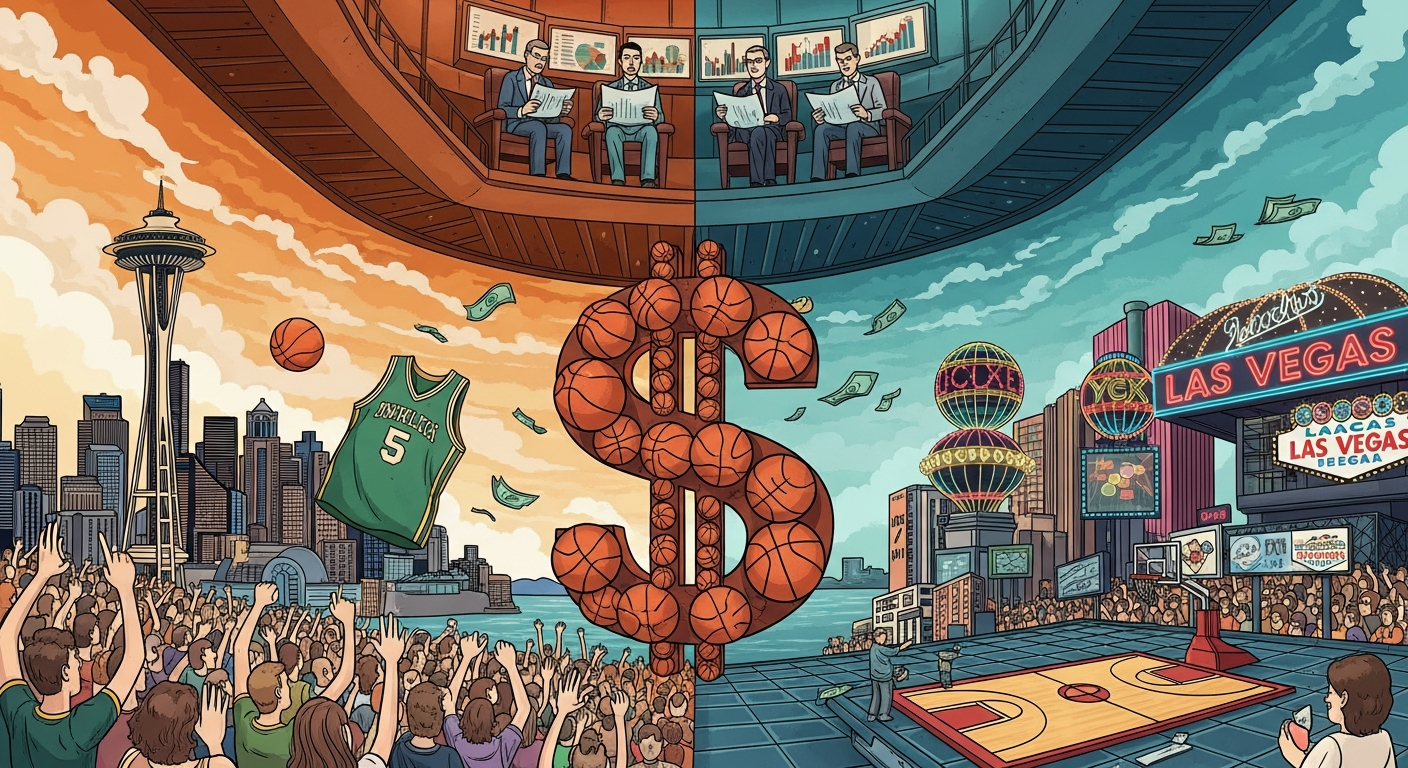
The NBA hadn't created a new team since the Charlotte Bobcats in 2004. Now it has approved expansion to Seattle and Las Vegas. The record-breaking expansion fees of up to $10 billion per team and the $20 billion windfall for existing owners tell the real story: professional sports has reached the tipping point of becoming a pure financial asset class.
Key Points
First NBA Expansion in 22 Years — A Record $7-10 Billion Per Team
The NBA Board of Governors unanimously approved exploring expansion bids for Seattle and Las Vegas on March 25, 2026. The first expansion since the Charlotte Bobcats ($300M) in 2004, with estimated fees of $7-10 billion per team — a 23-33x increase in 22 years. This signals that sports franchises have evolved beyond mere businesses into an independent asset class. Investment bank PJT Partners serving as strategic adviser confirms this is a finance decision, not just a basketball one. Target debut is the 2028-29 season, with final decision expected by end of 2026.
Seattle SuperSonics — The Door Opens After 18 Years in Exile
Since the SuperSonics relocated to Oklahoma City in 2008, Seattle has held the NBA's biggest unfinished story. Climate Pledge Arena is already built and ready, and One Roof Sports and Entertainment (parent company of the NHL's Kraken) has formally expressed interest. For fans who remember Gary Payton, Shawn Kemp, and Ray Allen, this expansion means more than a franchise — it's the restoration of a city's identity. The Pacific Northwest tech hub (Amazon, Microsoft, Boeing) guarantees corporate sponsorship and premium seating demand.
Las Vegas — The Final Transformation from Sin City to Sports Empire
Adding the NBA after the NFL Raiders, NHL Golden Knights, and WNBA Aces would make Las Vegas a city hosting all four major North American pro sports leagues. The unique structural advantage of 40 million annual tourists provides attendance demand no other city can replicate. Multiple billionaire groups including Magic Johnson's MAGI, Golden Knights owner Bill Foley, and the Adelson family are bidding, with plans to invest $300M upgrading T-Mobile Arena. The post-2018 sports betting legalization shift from risk to synergy works in Vegas's favor.
$20 Billion Windfall — Why Existing 30 Franchise Owners Are the Real Winners
Expansion fees are distributed equally among existing 30 franchise owners. If two teams sell at $10B each, that's $20 billion total — roughly $650M+ per owner. According to Sportico, this is the largest one-time revenue event in league history, secured through nothing more than a board vote. Simultaneously, expansion triggers revaluation of the entire league's enterprise value, pushing up existing team values in a double effect. This is why all 30 teams voted unanimously in favor.
Revenue Dilution and Talent Pool — Structural Risks of a 32-Team League
Splitting the NBA's roughly $11 billion annual revenue among 32 teams means approximately 6.7% less per team. For small-market teams like Milwaukee and Memphis, this reduction could be the line between profit and loss. Despite a deeper global talent pool, the number of elite players is finite, meaning expansion teams face 3-5 years of uncompetitive basketball. The 2004 Charlotte Bobcats went 7-59 in their first season. Conference realignment and division restructuring are also inevitable.
Positive & Negative Analysis
Positive Aspects
- Seattle SuperSonics Return Restores City Identity
For a city without an NBA team for 18 years, the SuperSonics' return transcends sports as a cultural event. Climate Pledge Arena is ready, and the Pacific Northwest tech hub guarantees corporate sponsorship. The legacy of Gary Payton, Shawn Kemp, and Ray Allen adds emotional depth to a new franchise that fills a void in Seattle's sports culture.
- Las Vegas Sports Ecosystem Completion
The NBA would make Las Vegas a city hosting all four major North American pro sports leagues. The irreplicable structural advantage of 40 million annual tourists, combined with the entertainment capital brand, creates a new sports business model. The market is already proven by the Golden Knights and Raiders.
- Massive One-Time Revenue for Existing Franchises
The $20 billion expansion fee distributes to roughly $650M+ per existing owner with zero additional investment or risk. This strengthens financial health and can be reinvested in player acquisitions and facilities. It simultaneously triggers league-wide enterprise value revaluation.
- More Opportunities for Players
A 32-team league creates 30+ additional roster spots, opening doors for G-League and international players who have NBA-level talent but lack opportunities. This contributes to the league's globalization and player diversity.
- Playoff Structure Innovation Potential
Expansion naturally triggers redesign of the current playoff format. An expanded postseason or enhanced play-in tournament could increase regular season significance and drive overall league viewership and revenue.
Concerns
- Approximately 6.7% Revenue Dilution Per Team
Splitting roughly $11 billion among 32 teams instead of 30 means measurably less per franchise. New teams generate local revenue but need time to build national broadcast value. Small-market teams like Milwaukee, Memphis, and New Orleans face direct financial pressure.
- Astronomical Expansion Fees Expose Sports Asset Bubble Risk
The $7-10B price reflects multiples far exceeding actual annual revenue. If streaming wars shrink broadcast revenue or a recession cuts corporate sponsorships, new owners who entered at this price could face severe difficulty recouping their investment.
- Expansion Teams Face Initial Competitiveness Gap
Existing teams protect core players in expansion drafts, leaving new teams to build from discarded players. The 2004 Charlotte Bobcats' 7-59 inaugural season shows the patience required. The first 3-5 years test whether a $10B fan base can endure a losing team.
- Las Vegas 82-Game Attendance Uncertainty
Vegas's sports success relies heavily on tourist inflow. With 41 home games spread across an 82-game season, the tourist-dependent model's reliability during off-peak periods and low-profile matchups remains unproven.
- Conference Imbalance and Organizational Disruption
Both Seattle and Las Vegas are Western cities, creating a 17-15 West-East imbalance. Teams like Minnesota or Memphis would need to switch conferences, disrupting established rivalries, scheduling, and travel costs.
Outlook
In the short term, the NBA will make its final expansion decision by the end of 2026. Commissioner Adam Silver says it'll be based on data and financial analysis, but with investment bank PJT Partners already on advisory duty, the conclusion is essentially predetermined. Has an investment bank in the history of humanity ever advised, "Don't do it"? I believe both teams will be approved. Both markets have arena infrastructure ready, bidding groups have ample financial firepower, and existing owners have zero reason to turn down a $20 billion check.
If both teams debut in the 2028-29 season, the first one to two years will be a period of "fresh energy." Seattle will reclaim the SuperSonics name and create one of the league's most passionate home courts. Las Vegas will present a new experience of entertainment-sports convergence. But the harsh reality of the expansion draft awaits. Existing teams will protect their core players, and the new teams will have to build rosters from players other teams "discarded." The first three to five years will inevitably be a test of patience.
Looking at the mid-term beyond 2030, genuinely interesting changes begin. A 32-team league will necessitate restructuring the current conference and division system. If both Seattle and Las Vegas join the Western Conference, it creates a 17-15 imbalance with the East, making some team transfers inevitable. Minnesota or Memphis could move East, triggering cascading changes to rivalries and scheduling.
International expansion also deserves discussion. According to Sportico's analysis, the NBA is considering expanding to Europe (London, Paris) or Mexico City after Seattle and Las Vegas. If this materializes, the NBA evolves from a mere "American league" into a truly "global league." But given practical barriers like time zones, travel fatigue, and cultural differences, this is a story for 2035 at the earliest.
The most important legacy of this expansion in the long term is establishing a "price benchmark for sports franchises." If two teams sell for $10 billion each, it redefines the valuation of every professional sports team worldwide — EPL clubs, European football teams, even IPL cricket franchises. All sports assets will be influenced by this number. Here's my bold prediction: by 2035, the average NBA franchise value will exceed $10 billion. When that happens, we'll look back at this moment — the March 2026 Board of Governors vote — as the inflection point where American professional sports completed its transformation into a financial asset.
In the best-case scenario, both cities successfully build fan bases, the 32-team structure grows the overall pie, and the NBA solidifies its position as the world's premier sports brand. In the base case, Seattle thrives on SuperSonics nostalgia and Pacific Northwest loyalty, while Las Vegas struggles with the inherent volatility of a tourist city's fandom, and revenue dilution strains small-market teams. In the worst-case scenario, the $10 billion expansion fee becomes the peak of the sports asset bubble, and economic recession or broadcast market shifts leave new owners unable to recoup their investment. But even in this worst case, the existing 30 owners will have already pocketed their $20 billion — so for them, it's never the "worst." That's the most cunning structural truth of this entire expansion.
Sources / References
- NBA Board of Governors approves exploration of expansion to Seattle, Las Vegas — NBA.com
- NBA owners vote to explore Vegas, Seattle expansion bids — ESPN
- NBA Expansion in U.S., Europe Could Net Over $20 Billion for Owners — Sportico
- NBA owners vote to explore Seattle, Las Vegas expansion bids — Al Jazeera
- NBA to explore bids for expansion teams exclusively in Las Vegas, Seattle — Las Vegas Review-Journal
- NBA to explore expansion opportunities in Seattle and Las Vegas — Yahoo Sports
- NBA expansion hasn't happened for 20 years, so what does the future hold — CBS Sports