
$3.3 Billion Bet on March Madness — When Point-Shaving, Player Harassment, and Regulatory Failure All Explode at Once
Summary
A record $3.3 billion in bets collides with a federal point-shaving indictment, widespread player harassment, and regulatory gaps, putting the integrity of American college sports on its most precarious edge.
Key Points
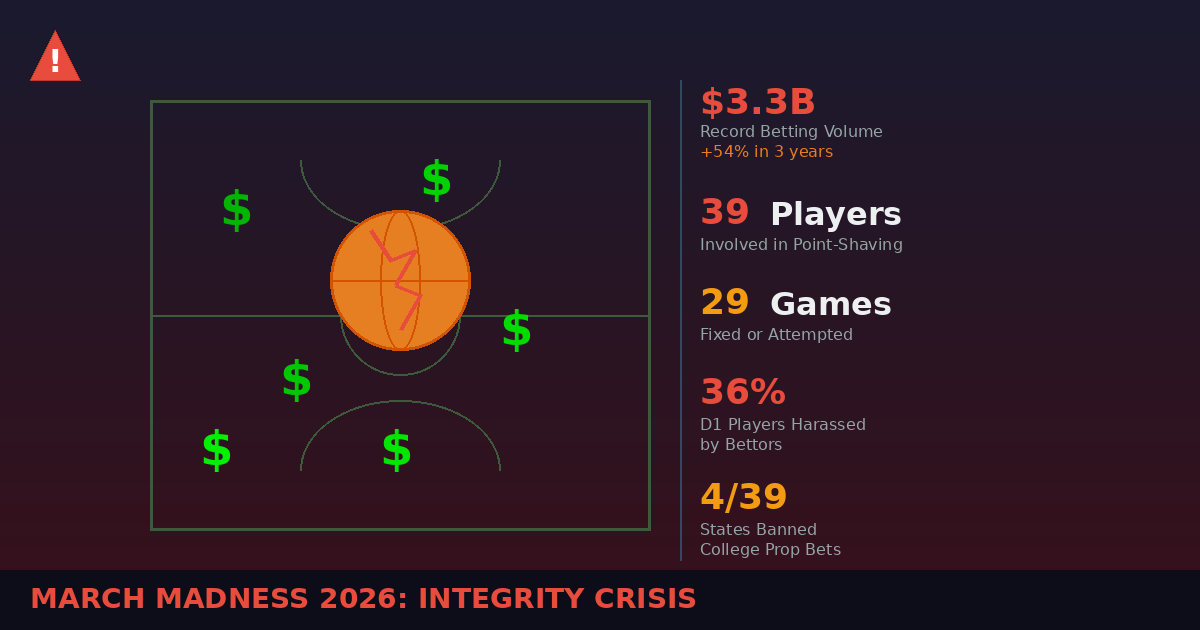
Record $3.3 billion betting volume: The AGA estimates legal wagering on 2026 March Madness at $3.3 billion, a 54% surge from three years ago. This follows 39 states legalizing sports betting after the 2018 PASPA ruling, making the NCAA tournament the second-largest betting event in America after the Super Bowl. The growth is driven by digital betting apps, diversified prop bet markets, and the emergence of prediction markets like Kalshi. The core problem is that this growth has far outpaced the development of integrity infrastructure — money has grown like a rocket while the systems to monitor its corrosive effects on competition are still in their infancy.
Largest point-shaving scandal in history — 39 players, 29 games: The Philadelphia federal indictment filed in January 2026 is the biggest match-fixing scandal in American college sports history. Thirty-nine players across 17 college basketball teams were bribed by six fixers, with 29 games fixed or attempted. Schools like DePaul, Georgetown, Fordham, and Tulane are implicated, and the network traces back to the Chinese Basketball Association. Players received $10,000-$30,000 per game — amounts that dwarf the meager NIL earnings of mid-major athletes. This case proves point-shaving is not a relic of the past but a present-day, cross-border global network.
Student-athlete harassment and mental health crisis: NCAA surveys show 36% of Division I men's basketball players have experienced betting-related harassment, while 67% of college students participate in sports betting. Players routinely receive messages like 'you missed that free throw and it cost me money.' A 2024 Lancet study found 16.3% of adolescent sports bettors developed gambling addiction. This is not a mere side effect — it is a structural problem systematically destroying the mental health of students aged 18-23.
Structural regulatory failure — prop bets and prediction markets: Despite NCAA pleas to all states to ban college athlete prop bets, only four states complied while Washington state actually expanded them. Forty-three percent of digital sports betting ads lack responsible gambling messaging. Prediction markets like Kalshi operate in gray zones beyond traditional gambling regulation. The SAFE Bet Act is pending in Congress but faces uncertain prospects due to industry lobbying and state dependence on gambling tax revenue. America's federalist structure makes unified protection nearly impossible.
The sports betting industry's self-destruction paradox: The sports gambling industry parasitizes the integrity of sports — people bet because they believe outcomes are fair. Yet the very money flowing through this industry creates incentives to destroy that fairness. As the $3.3 billion market grows, so does the economic incentive for match-fixing. Already 43% of American adults say legal sports betting is a bad thing for society, up sharply from 34% in 2022. The numbers prove the industry is eroding its own foundation.
Positive & Negative Analysis
Positive Aspects
- Federal indictment as turning point
The Philadelphia point-shaving prosecution has elevated the dark side of college sports gambling to a national conversation. With 26 indictments and guilty pleas underway, public opinion is shifting and fueling momentum for prop bet bans and the federal SAFE Bet Act. Multiple states are already debating related legislation.
- NCAA taking active measures
Starting in 2026, all tournament teams must submit player availability reports. The NCAA has deployed ProhiBet technology to monitor 200+ officials, delivered gambling risk education to 300,000+ student-athletes, and the Don't Be A Loser campaign reduced abusive messages targeting athletes in 2025.
- Public opinion tilting toward regulation
58% of American adults want federal regulation of online sports betting and 63% support banning gambling ads during live broadcasts. Some major sportsbooks are voluntarily scaling back college prop bets. Big Ten student-athletes personally testifying before Congress for prop bet bans symbolizes a powerful shift in sentiment.
- Technology-based integrity protection
AI-powered betting anomaly detection, automated officiating systems like ABS, and blockchain-based transparent betting records are advancing rapidly. IC360's ProhiBet deployment for NCAA official monitoring demonstrates that technology can serve as an effective integrity protection tool.
Concerns
- Formidable gambling industry lobbying
Billions in annual revenue and significant state tax contributions give the industry enormous lobbying power that repeatedly blocks regulatory legislation. Washington state expanding prop bets and Missouri's Gaming Commission rejecting NCAA requests are textbook examples.
- Prediction markets and offshore platforms in regulatory blind spots
Prediction markets like Kalshi operate in gray zones beyond traditional gambling regulation, and cryptocurrency-based offshore betting platforms are beyond the reach of American regulators. New betting platforms combining technology and capital will always stay one step ahead of regulation.
- NIL inequality creating fertile ground for point-shaving
NIL income is concentrated among a tiny elite of star athletes while most mid-major players earn negligible amounts. The federal indictment explicitly stated that targets were players for whom bribe payments would meaningfully supplement or exceed legitimate NIL opportunities. Until this structural inequality is resolved, the vulnerability persists.
- Globalization of match-fixing
The scandal originating in the Chinese Basketball Association demonstrates that point-shaving operates as a cross-border global network. Domestic regulation alone cannot contain international fixing organizations, and international coordination is far more complex and time-consuming.
- Fundamental absence of student-athlete protection
NCAA education campaigns and monitoring amount to emergency first aid. The fundamental problem is a structure that exposes 18-23-year-old students to a multi-billion dollar gambling market. Until college sports identity question is resolved, student-athlete protection remains aspirational rhetoric.
Outlook
Looking at the short-term outlook over the next one to six months, the biggest change will be the intensification of federal regulatory discussion. Once this March Madness concludes, the record $3.3 billion in bets combined with inevitable integrity incidents will draw congressional attention. The SAFE Bet Act is currently pending in Congress, proposing minimum federal standards covering marketing, affordability, and AI use in online sports betting. My prediction is that by the second half of 2026, at least five additional states will pass legislation banning or restricting college athlete prop bets. Comprehensive federal regulation remains premature, but this scandal will significantly accelerate legislative momentum.
The follow-up investigation from the Philadelphia indictment deserves close attention. With 26 people indicted and one guilty plea already secured, additional plea deals and cooperating testimony will likely expose a wider network. The NCAA's own investigation into approximately 40 student-athletes at 20 schools for potential game manipulation is ongoing. As these investigations yield results in summer and fall 2026, further indictments could follow, reigniting public debate and policy discussions each time.
In the medium term, over six months to two years, structural reorganization of the sports gambling industry will begin. The most likely scenario is the establishment of "differential regulation" — professional sports maintain current betting levels, while college sports see a complete prop bet ban with only game line bets surviving. NCAA President Charlie Baker has clearly signaled this direction, and Big Ten student-athletes have personally testified before Congress for prop bet bans.
The bull case envisions the SAFE Bet Act passing at the federal level, all states banning college athlete prop bets, and the NCAA building an internal integrity monitoring system capable of real-time detection of betting anomalies. In this scenario, the industry sees a 10-15% short-term decline in college market revenue but achieves long-term growth through restored integrity trust. Japanese professional baseball provides a relevant precedent, having introduced strict regulations after its own gambling scandal and subsequently recovered attendance and viewership.
The base case — and what I believe is most probable — sees incremental state-level regulation without federal action. By 2027, approximately 15-20 states ban college prop bets, while the rest continue allowing them. Prediction markets and offshore illegal platforms grow in regulatory blind spots. Point-shaving scandals surface every one to two years, perpetuating the tug-of-war between regulation and industry. The fundamental challenge is America's federalist structure, where getting 50 states to adopt unified regulation is extraordinarily difficult, compounded by the industry's substantial lobbying power.
The bear case is the most troubling. Regulatory discussion stalls under industry lobbying pressure, prop bet markets actually expand, and student-athlete protection stagnates at the level of NCAA education campaigns. Within two to three years, another major point-shaving scandal erupts, severely damaging trust in college sports altogether. In the worst case, March Madness viewership and attendance begin declining as the question "are they even really trying out there?" spreads among fans, dealing a blow to the entire industry.
Looking at the long-term horizon of two to five years, technology could be either savior or destroyer. On the positive side, AI-powered betting anomaly detection, blockchain-based transparent betting records, and automated officiating systems like ABS could reduce human error and corruptibility. Technology can serve as a tool for integrity protection.
On the negative side, the same technologies could enable more sophisticated fixing. Deepfakes spreading false injury information, AI analyzing optimal point-shaving targets, and cryptocurrency enabling untraceable bribes are all technically feasible scenarios. Technology is neutral — who uses it and for what purpose determines the outcome.
Ultimately, the most critical variable is how American society defines college sports. If college sports are "an extension of education," exposing student-athletes to a gambling market is a clear contradiction. If college sports are "a minor league for the pros," integrating the gambling market is a natural evolution. The conclusion of that identity debate will determine the direction of gambling regulation.
One thing I'm certain of: in this tournament where $3.3 billion rides on 68 teams, the biggest gamble isn't being taken by the fans placing bets — it's being taken by the 20-year-old students stepping onto the court with their futures on the line. And the window to protect them is closing fast.
Sources / References
- March Madness 2026: Record Betting Meets Scandal and a Growing Policy Fight — Gambling Insider
- Many college players among dozens charged in point-shaving plot — ESPN
- Dozens of NCAA basketball games were fixed by bettors, prosecutors allege — Washington Post
- NCAA President Baker issues statement regarding sports betting indictments — NCAA
- As fans bet on March Madness, debate grows over gambling safeguards — WAMC
- Prediction Markets Push March Madness Despite NCAA Opposition — Front Office Sports
- 26 charged in college basketball point-shaving scheme — CBS News