
When the Battery Dies, the Throttle Is Useless — The Day F1 Became a Smartphone
Summary
F1 2026's super clipping produced a 50G crash and a broadcast cover-up controversy at Suzuka. As drivers call these the worst cars ever made, the FIA schedules an emergency review for April 9.
Key Points
The Structural Root of Super Clipping — How the 50:50 Power Split Broke Racing
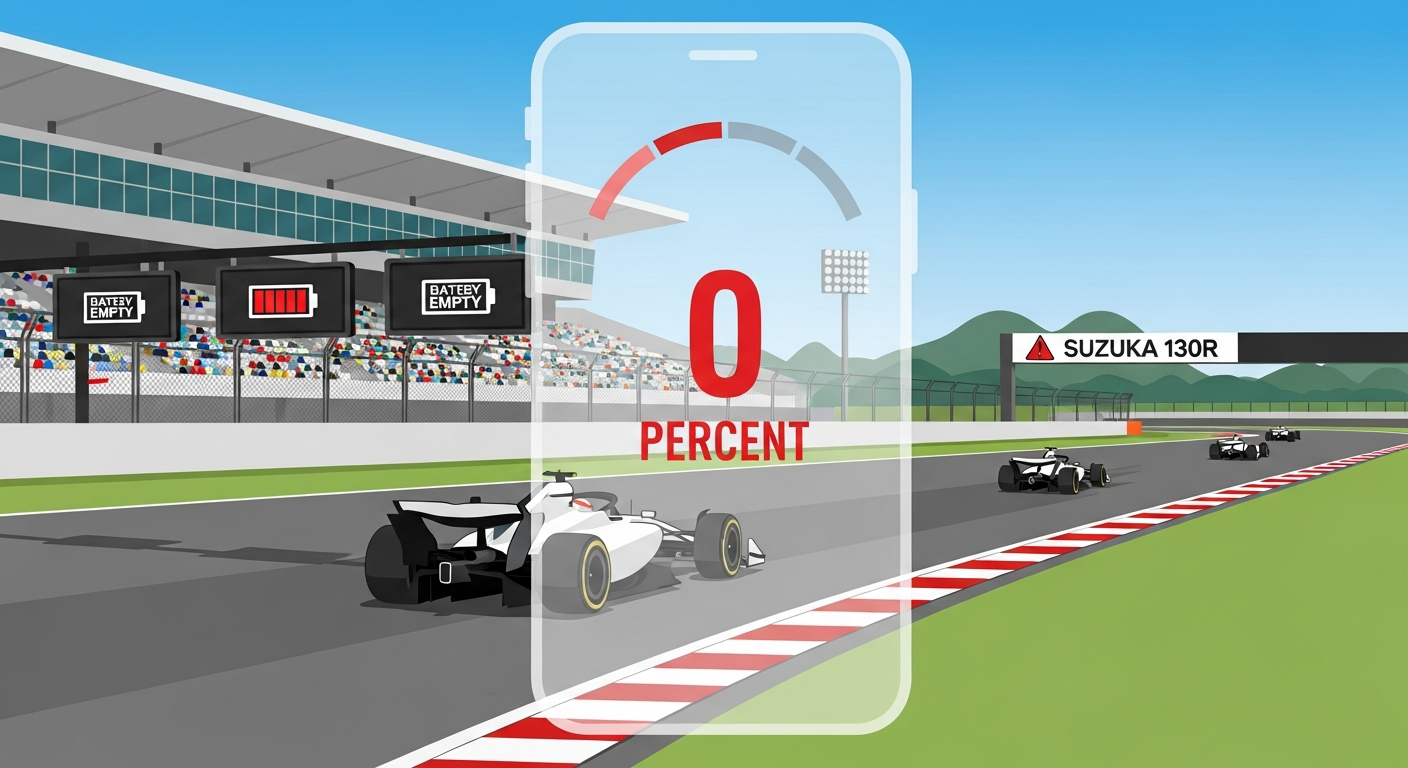
The 2026 regulations nearly tripled MGU-K output from 120kW to 350kW while completely eliminating the MGU-H thermal energy recovery system. On paper, total power output remains comparable to previous seasons. In practice, the battery simply cannot sustain the enormous electrical demand, causing 470bhp to vanish the instant the battery depletes — even when the driver is at full throttle. At Suzuka's 130R, speed drops of roughly 50km/h were documented, and Oscar Piastri testified that certain sections saw an effective power loss of 450 horsepower. The FIA's pre-season reduction of the battery recharge limit from 9MJ to 8MJ proved completely insufficient to address the scale of the problem. The core issue is not electrification as a concept, but the miscalculation that a 50:50 ratio is viable given the current state of battery technology — a design-level error that no amount of driver adaptation can compensate for.
The FOM Footage Editing Scandal — A Crisis of Sports Broadcasting Transparency
Antonelli's pole position onboard video, posted on F1's official social media, abruptly cut to an external camera angle at the 130R section — the exact stretch where super clipping is most severe. Fans immediately accused the broadcast of deliberate editing to hide the problem. Community notes on X flagged the incomplete footage, and the incident echoed an earlier controversy at the Australian GP where critical comments were quietly filtered into hidden replies on F1's official channels. F1's explanation — a camera technical issue — strained credibility because of the suspicious timing and the emerging pattern. The footage showed cars losing up to 56km/h at 130R, a deeply embarrassing visual for a sport marketing itself as the pinnacle of motorsport. This was not a minor glitch but a trust-defining moment. If FOM experienced a genuine malfunction, they should have immediately published alternative-angle footage rather than letting a one-line statement fester into a full-blown credibility crisis.
Bearman's 50G Crash — The First Safety Incident Caused by Battery Deployment Gaps
On lap 22, Ollie Bearman approached Franco Colapinto's Alpine at the Spoon Curve entry and found himself facing a 50km/h speed differential — Colapinto's car was decelerating sharply because its battery deployment had been exhausted. Traveling at 308km/h, Bearman attempted evasive action but lost control on the grass and slammed into the barriers at 50G, escaping with only a right knee contusion through sheer luck. GPDA director Carlos Sainz revealed that drivers had explicitly warned the FIA about this exact scenario before it happened, but their concerns were dismissed. His warning about what such closing speeds would mean at street circuits like Baku or Singapore sent chills through the paddock. McLaren team principal Andrea Stella called the crash 'not a surprise,' and Haas boss Ayao Komatsu declared it could no longer be ignored. This incident proved that battery state-induced speed gaps between cars in the same category have shattered the foundational assumptions of F1's safety engineering.
A Universal Driver Revolt — The Unprecedented Consensus That These Are the Worst Cars Ever
Verstappen called it 'Formula E on steroids' and 'anti-racing' and compared it to Mario Kart. Norris said the sport had gone 'from the best cars ever to the worst.' Hamilton declared it 'completely against what F1 is about.' Alonso labeled it a 'battery world championship.' Leclerc and Sainz piled on with equal conviction. Six world champions or champion-caliber drivers voicing the same criticism at the same time is simply without precedent in F1's seven-decade history. What proves this transcends mere competitiveness complaints is the fact that Verstappen was raising identical objections before the season even started, well before anyone knew which team would be on top. Norris's agonizing silence before answering 'not really, no' when asked if the new cars bring him any joy has become a defining image of the 2026 season. ESPN has flagged that Verstappen's repeated hints at retirement should worry F1 commercially. This revolt is not about any single team's performance — it is the sport's most accomplished drivers collectively questioning whether what they are doing still qualifies as racing.
The Sustainability Paradox — Manufacturers Recruited, but the Racing Is Dying
The 2026 regulations achieved something historic on the manufacturer front: Audi entered through the Sauber acquisition, Honda returned with an Aston Martin works deal, Ford re-engaged for the first time since 2004 to support Red Bull Powertrains, and Cadillac debuted as the eleventh team. The regulations also mandated 100% sustainable fuels. This was F1's grand strategy to stay relevant in an electrifying automotive landscape and attract the world's biggest carmakers. But the strategy has come at a devastating cost. Mercedes dominates the constructors' championship (135 points) on the back of battery management software superiority, while Ferrari repeatedly fades in the second half of races as its energy management falls short — proving the competitive axis has shifted from driver skill and aerodynamics to a single variable. The FIA has convened an emergency review for April 9, with both short-term energy deployment adjustments and a long-term overhaul of the power ratio on the table. The uncomfortable question remains: what good is sustainability if the product it sustains is no longer worth watching?
Positive & Negative Analysis
Positive Aspects
- Historic scale of new manufacturer recruitment
Audi entered F1 through the Sauber acquisition, Honda returned with an Aston Martin works partnership, Ford came back for the first time since 2004 to support Red Bull Powertrains, and Cadillac debuted as the eleventh team — the first new team since 2016. This level of manufacturer commitment is the largest F1 has seen since the golden era of the 1950s and 60s. The hundreds of millions each manufacturer invested is proof that the 2026 regulations offered an attractive technology platform for the global automotive industry. Audi in particular chose F1 as the centerpiece of the Volkswagen Group's motorsport strategy — an investment that simply would not have materialized without regulations enabling electrification competition. The sheer breadth of new entrants also strengthens the grid commercially, bringing fresh sponsor ecosystems and engineering talent pools that benefit the sport as a whole.
- A real-world validation platform for sustainable fuel technology
Starting in 2026, 100% sustainable fuels — derived from carbon capture, municipal waste, and non-food biomass — became mandatory across the grid. These fuels were successfully tested in F2 and F3 during 2025 and met rigorous sustainability standards through independent certification. Validating them under F1's extreme operating conditions, where engines run above 15,000 RPM and temperatures regularly exceed safety thresholds, can meaningfully accelerate the commercialization timeline for the broader transportation sector. The ripple effects could extend well beyond motorsport into commercial vehicles, aviation, and industrial energy storage. In a world of tightening environmental regulations, F1 now has a credible claim to being a genuine technology incubator. This positions the sport to attract sustainability-focused sponsors and governmental support that would have been unthinkable a decade ago.
- New strategic depth created by energy management
Battery deployment timing has introduced an entirely new strategic layer to race management, adding a dimension of tactical complexity that did not previously exist. When to deploy energy, when to harvest it, and how to sequence those decisions across overtaking and defensive maneuvers have become choices that meaningfully shape race outcomes. ESPN's analysis noted that a new demographic of fans finds this strategic layer genuinely compelling, drawn to the chess-match quality it adds to each stint. Despite fierce purist backlash, race unpredictability has undeniably increased as energy strategy can override raw pace advantages on any given lap. At the Japanese GP, Antonelli dropped to sixth before surging back to win through superior energy management — exactly the kind of dramatic comeback narrative that this added complexity can produce.
- Power unit innovation driven by electrification competition
The dramatic increase in MGU-K output from 120kW to 350kW has set off a genuine technology race in electric motors, inverters, and battery systems. This competition carries implications far beyond the track, with potential spillover into electric vehicles, grid-scale energy storage, aerospace, and defense applications. The fact that Mercedes currently leads the field through energy management software superiority — rather than raw engine power or aerodynamic tricks — is proof that this technology competition is functioning as intended. Each manufacturer is pouring resources into battery chemistry and thermal management solutions that have direct real-world applications. Over time, the extreme demands F1 places on battery technology could serve as a catalyst for breakthroughs that benefit the broader energy transition across multiple industries.
Concerns
- Racing's most basic cause-and-effect has been destroyed — full throttle now means deceleration
Super clipping means that even at full throttle, 470bhp can vanish in an instant when the battery depletes and the car actively decelerates. This is unprecedented in 70 years of Formula 1. Piastri testified to enduring three separate lift-and-coasts and two super clips in a single lap. Speed drops of around 50km/h at 130R have been documented. When Norris says he has to check the steering wheel display every three seconds or risk going off track, what he is really describing is a sport that has transformed from racing into an energy management simulator. The critical difference from the 2014 V6 turbo transition is that the fundamental relationship between throttle input and forward acceleration has been severed — a line that no previous regulation change had ever crossed.
- Structural safety risks created by battery state differentials between cars
Bearman's 50G crash at Spoon Curve proved that battery deployment differences between cars in the same category can produce closing speeds of 50km/h on the same piece of track. One car running at full electrical power while the car directly ahead has dropped to half power at 308km/h is a scenario that existing safety engineering never contemplated and was never designed to handle. As Sainz warned, such closing speeds at narrow street circuits like Baku, Singapore, or Las Vegas could produce fatal consequences. The drivers had explicitly flagged this risk to the FIA before the season and were ignored. Under the current regulation framework, incidents like this are not freak accidents — they are structurally inevitable.
- Erosion of sports broadcasting transparency and fan trust
The Antonelli pole lap editing controversy and the Australian GP hidden-comments incident have together fueled a growing suspicion that F1 is actively trying to conceal the most damaging visual evidence of its product's flaws. F1 cited a camera technical issue for the missing 130R footage and automated filtering for the hidden comments, but both incidents targeted negative content directly related to super clipping — a pattern that is hard to dismiss as coincidence. Sports fans fundamentally have the right to see what they are paying for, warts and all. Trust damage like this compounds as the season progresses and, once a fanbase decides the sport is no longer being honest with them, that trust is extraordinarily difficult to rebuild.
- F1's most iconic corners have lost the very quality that made them legendary
Suzuka's 130R has been one of the most hallowed high-speed corners in F1 history — a place where drivers tested the absolute limits of their courage and machine control. Under the 2026 regulations, it has been reduced to a function of remaining battery charge. At what drivers now call 'zero kilowatt zones' — the Degner Corners and Spoon Curve — the MGU-K cuts out entirely, leaving the car with roughly 50% of its total power. As Bearman put it, corners that used to demand everything from a driver simply do not anymore. This is not unique to Suzuka. It is a structural problem that will repeat at every demanding high-speed corner on the calendar: Spa's Eau Rouge, Silverstone's Copse, and every other corner that once defined the sport's identity.
- The competitive axis has shifted from driver skill to software optimization
Mercedes dominating the championship — Antonelli at 72 points, Russell at 63, constructors' leading with 135 — is overwhelmingly attributed to energy management software superiority rather than aerodynamic advantage or driver brilliance. Ferrari consistently leads early in races but collapses in the second half as its battery management falls behind, a pattern that has repeated at every round so far. Verstappen described the experience as 'playing Mario Kart — boosting past, then slowing when the battery runs out,' while Alonso pointedly called it a 'battery world championship.' F1's identity has always rested on being a comprehensive contest of engine power, aerodynamics, tire management, and raw driver talent. When all of that becomes subordinated to a single software variable, what remains is something fundamentally different from the sport that built seven decades of history.
Outlook
The outlook for the F1 2026 super clipping controversy breaks down across three distinct time horizons, each carrying its own set of variables, stakeholders, and probable outcomes.
In the short term, the single most critical variable is the outcome of the FIA emergency review meeting scheduled for April 9. This meeting will bring together the FIA, F1 management under Liberty Media, and all ten teams. The central agenda item is energy deployment limit adjustment. The most probable short-term measure is a further reduction of the battery recharge cap from the current 8MJ down to somewhere in the 6-7MJ range. This would reduce the severity of super clipping without fundamentally solving it. George Russell's pre-season demand for more aggressive reductions suggests this approach had already been circulating among teams well before the Suzuka weekend forced the issue.
At minimum, the April 9 meeting should produce an energy limit adjustment. With Bearman's 50G crash now on the record as a concrete safety incident, the FIA simply has no political room to walk away empty-handed. However, modifying the 50:50 power ratio itself is unlikely in the near term. The reason is straightforward: Audi, Honda, Ford, and the other new manufacturers committed hundreds of millions of dollars based on this ratio. Changing it fundamentally alters the premise of their investments, and that makes it a far more complicated negotiation than a simple number tweak.
The short-term bull case looks like this. The FIA cuts the energy limit aggressively to 6MJ or below and simultaneously mandates a visual warning system — LED lights on the rear of the car, for instance — that alerts following drivers when a car ahead is experiencing super clipping. If this happens, noticeable improvement could arrive as early as the Miami GP in May. Speed losses at sections like 130R would drop from around 50km/h to perhaps 20-25km/h, and the kind of extreme closing speed differential that caused the Bearman crash would be significantly reduced. The racing would still be different from 2025, but the most dangerous edge cases would be blunted.
The short-term base case is a more modest reduction to 7MJ, paired with an announcement that the FIA will collect data over the next two or three races before committing to further changes. Super clipping would persist but at a lower frequency. Drivers would continue to voice frustration, but the FIA would frame the situation as manageable and point to the incremental improvement as evidence of responsiveness. This scenario buys time but does not resolve the underlying tension.
The short-term bear case is a meeting that produces an agreement in principle but no concrete numerical changes. This could happen if competing interests among manufacturers create gridlock — Mercedes, for example, currently benefits from the status quo and may resist changes that erode its advantage. In this scenario, the Miami and Emilia Romagna GPs carry elevated risk of additional safety incidents, and the possibility of an official boycott threat from drivers through the GPDA cannot be ruled out. The reputational damage to the FIA in this scenario would be severe.
Moving to the medium term — the second half of 2026 through 2027 — the most consequential variable is whether the 50:50 power ratio itself gets revised. Based on three converging factors, a ratio adjustment to at least 55:45 and more likely 60:40 (ICE to electric) should materialize by the 2027 season.
The first factor is viewership and fan sentiment data. F1 is a commercial sport operated by Liberty Media, and Liberty responds to numbers. Once mid-season viewership trends and social media sentiment data are compiled, any confirmed decline will trigger intense internal pressure for regulatory change.
The second factor is Max Verstappen's contract situation. The four-time world champion currently sits ninth with a mere 12 points and has openly discussed the possibility of retirement. Verstappen's departure from F1 would represent an enormous blow to the sport's commercial value.
The third factor is the natural evolution of battery technology. As each power unit manufacturer develops its battery technology through 2027 and 2028, super clipping severity should naturally diminish to some degree.
The medium-term bull case envisions the FIA adjusting the ratio from 50:50 to 60:40 during the second half of 2026 and reducing MGU-K output from 350kW to 280kW. In this scenario, super clipping effectively disappears while the meaningful technological dimension of electrification is preserved.
The medium-term base case involves a more cautious adjustment to 55:45 starting from the 2027 season. Super clipping does not fully vanish but its frequency and severity decrease substantially.
The medium-term bear case is one where manufacturer resistance blocks any meaningful ratio adjustment. The FIA is left with only stopgap measures.
Looking at the long term, from 2028 through 2030, F1 is heading down one of three possible paths.
The first path, which carries roughly a 50% probability, is corrected electrification. The sport starts at 50:50 but incrementally adjusts to 65:35 or even 70:30, with the electric motor retreating to a supplementary boost role while the internal combustion engine reclaims its position as the primary power source.
The second path, at around 30% probability, is current regulations vindicated by a battery technology breakthrough. If next-generation battery technologies reach F1-grade readiness faster than expected, the 50:50 split could become workable.
The third path, at roughly 20% probability, is outright regulation failure leading to a complete redesign.
The most realistic scenario, in my assessment, is the first path — corrected electrification. F1 is entangled in too many commercial relationships to completely scrap the current regulations, but it equally cannot afford to ignore the damage to racing quality.
To summarize with specific probability estimates: there is an 85% chance the energy limit is reduced from 8MJ to somewhere between 6.5 and 7MJ following the April 9 meeting. There is a 35% chance the 50:50 ratio is modified within the 2026 season itself. That probability rises to 70% by the end of the 2027 season. There is a 40% chance Verstappen retires or leaves Red Bull before his 2028 contract expires. And there is a 55% chance that 2026 season viewership declines by more than 10% compared to 2025.
Sources / References
- 'Anti-racing' — Max Verstappen's scathing F1 2026 car review — The Race
- The worst part of what F1 2026 has done to Suzuka — The Race
- FIA to assess F1 2026 regulations after Oliver Bearman crash at Suzuka highlights closing speeds issue — Sky Sports
- Max Verstappen's F1 2026 rules complaints — every car criticism judged — ESPN
- FIA sets April date to review 2026 F1 rules amid safety and performance concerns — Scuderia Fans
- Norris: It sucks F1's traded best car for worst in 2026 — The Race
- F1 in new 2026 regulations storm as backlash escalates over 'missing Antonelli video' — GPFans
- Antonelli takes championship lead after surging to victory in Japan — Formula1.com
- Lando Norris: F1 has gone from the best cars ever to probably the worst — Motorsport.com
- The alarming factors that triggered Bearman's 50G crash at F1 Japanese GP — Autosport
- Carlos Sainz: FIA ignored driver warnings before Oliver Bearman crash — ESPN
- 2026 F1 championship standings after the Japanese Grand Prix — RacingNews365
- F1 2026 clipping: Charles Leclerc Suzuka telemetry shows energy loss issue — PlanetF1
- F1 fans censored after criticising controversial new regulations on social media — GPFans
- Max Verstappen 'seriously considering' F1 retirement — GPFans
- Why F1 Driver Max Verstappen Is Considering Retirement at End of 2026 — Sports Illustrated
- Fernando Alonso makes 'battery world championship' dig over F1 2026 racing — PlanetF1
- F1 responds as fans accuse them of hiding 'super-clipping' on Antonelli's pole lap — RaceFans
- Haas' Ollie Bearman reacts to 50G crash during 2026 Japanese Grand Prix — Formula1.com
- Most frightening crash of 2026 a wake-up call F1 cannot ignore — Crash.net
- '600-metre lift-and-coast is not what racing is about' — Hamilton — RaceFans