
The Night Venezuela Beat America at Its Own Game — And Baseball Stopped Being American
Summary
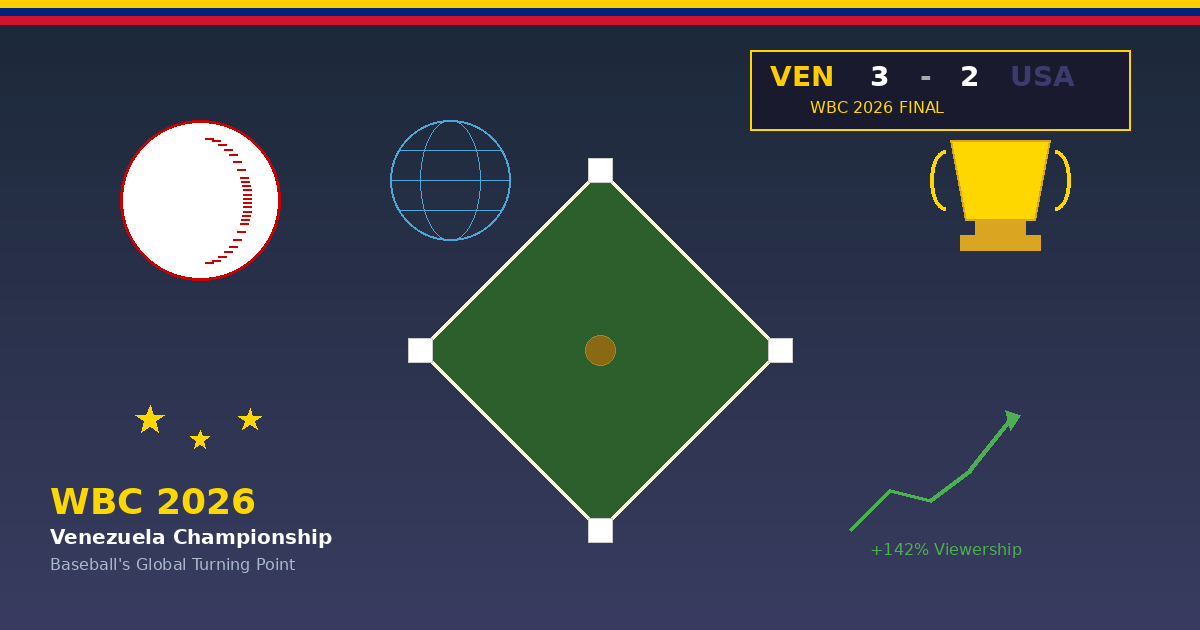
Venezuela stunned the United States 3-2 in the 2026 World Baseball Classic final to claim its first-ever title. With viewership surging 142%, a record $37 million prize pool, and Trump posting "STATEHOOD!!!" — this was not just a baseball game but a tectonic shift in global sports power.
Key Points
Venezuela's Historic First WBC Championship and Its Symbolism
Venezuela defeated the United States 3-2 in the WBC final on March 17 in Miami, becoming the fourth nation to win the tournament. Eduardo Rodriguez delivered 4.1 scoreless innings against America's dream-team lineup, striking out Aaron Judge twice, while Eugenio Suarez's go-ahead RBI double in the ninth sealed the upset. This victory transcended sports. For a nation experiencing political upheaval following the US military capture of Maduro in January, this win represented a restoration of national pride. Suarez's post-game statement — 'Our country needs this happiness with all the things we've gone through' — was no platitude. The solidarity of 63 Venezuelan-born MLB players imprinted the depth and resilience of Latin American baseball on the global stage.
142% Viewership Surge Proves WBC's Commercial Transformation
The WBC final drew 10.784 million viewers on FOX, a 128% increase over the 2023 USA-Japan final's 4.46 million on FS1. Tournament-wide, average viewership surged 156%, establishing the most-watched WBC in its 20-year history across English-language networks. The implications are unambiguous: the WBC is no longer a marginal event sandwiched between spring training and Opening Day. It has become premium sports content rivaling NBA playoff games. MLB's broadcast deal with Netflix Japan is estimated at over $100 million. The prize pool jumped from $15 million to $37 million. For advertisers and broadcasters, these numbers fundamentally reprice the WBC's investment value and signal baseball's growing global reach as a media property.
Trump's '51st State' Posts Expose the Dangerous Intersection of Sports and Politics
After Venezuela's semifinal win over Italy, President Trump posted 'STATEHOOD, #51, ANYONE?' Following the championship victory, he posted 'STATEHOOD!!!' This was not casual trolling. Coming months after the US military operation that captured Maduro, these posts weaponized a sports event as a geopolitical messaging platform. While the politicization of sport is nothing new, a sitting president projecting real-time political commentary onto international tournament results represents a virtually unprecedented escalation. When Venezuelan players waved their flag on the mound, whether that symbolized sportsmanship under the MLB logo or geopolitical tension — that boundary completely collapsed.
Record $37 Million Prize Pool Reshapes Baseball Economics
The 2026 WBC prize pool of $37 million represents a 146% increase from 2023's $15 million. Champion Venezuela received $6.75 million total, with the players' share at $3.375 million — approximately $112,500 per player. While still modest compared to MLB salaries, this amount is significant for Latin American players who spend winters in Caribbean leagues or minor leaguers seeking supplemental income. The trend matters more than the absolute number. If the prize pool continues doubling each tournament, it could exceed $70 million by 2029 — a level that could fundamentally change player participation incentives and force MLB clubs to formally negotiate WBC involvement as a contract term.
Baseball's Global Multipolarization and the WBC's Future Trajectory
With Venezuela joining Japan, the Dominican Republic, and the United States as WBC champions, four different nations have now won across six tournaments. This mirrors soccer's World Cup evolution from a European-South American duopoly to a genuinely global competition. The 2026 tournament's attendance of 1.62 million (up 24%) and the 156% viewership surge suggest baseball's global appeal has crossed a critical threshold. Combined with MLB expanding regular-season games in London, Tokyo, and Mexico City, the WBC is becoming baseball's Olympics. As prize money and tournament prestige grow, nations like South Korea, Taiwan, Australia, and Israel will invest more seriously in preparation, creating a virtuous cycle that broadens the sport's global footprint.
Positive & Negative Analysis
Positive Aspects
- A Definitive Turning Point for Baseball's Globalization
Venezuela's championship diversifies WBC winners to four nations — Japan, Dominican Republic, USA, and Venezuela. This proves baseball is breaking free from its US-Japan duopoly toward becoming a genuinely global sport. With 1.62 million in attendance (24% increase) and viewership surging 156%, the data confirms expanding global fandom. If this momentum holds, baseball could establish itself as the world's third major global sport alongside soccer and basketball.
- Latin American Baseball's Economic Value Reappraised
With 63 Venezuelan and 100 Dominican players on MLB rosters, Latin America dominates baseball's talent pipeline. The WBC championship spotlights this pipeline's economic significance. As US-Venezuela relations improve following Maduro's capture and Vice President Rodriguez's cooperative stance, the investment climate for baseball academies could transform. The $37 million prize pool era creates a compelling business case for Latin American baseball infrastructure investment.
- A New Revenue Stream for the Media Industry
The 10.784 million viewers for the WBC final was the highest-rated WBC broadcast in FOX history, exceeding some NBA playoff games. MLB's estimated $100 million+ deal with Netflix Japan, ESPN's 84% spring training ratings increase — these data points reveal that baseball content has been systematically undervalued in the media marketplace. If global OTT platforms commit seriously to baseball broadcast rights, both MLB and the WBC could construct entirely new revenue structures.
- Sport Reclaiming Its Essential Purpose: Hope for a Nation in Crisis
For Venezuelans enduring political upheaval and economic crisis, the WBC championship carried meaning far beyond sports. Suarez's words — 'Our country needs this happiness' — captured sport's power to heal and unite. Following the January military operation that captured Maduro, the national baseball team's triumph gave Venezuelans a positive narrative on the world stage.
- Competitive Balance Enhances Tournament Appeal
The USA fielded arguably the strongest lineup in WBC history yet lost — proving this tournament rewards team chemistry and tournament strategy over raw talent aggregation. Eduardo Rodriguez striking out Aaron Judge twice encapsulated baseball's beautiful paradox where individual brilliance bows to collective execution. This competitive balance makes the WBC dramatically more compelling than a tournament where the favorite always wins.
Concerns
- Dangerous Escalation of Sport as Political Instrument
Trump's '51st state' posts demonstrated how international sporting events can be weaponized as geopolitical messaging platforms. A sitting president projecting real-time political commentary onto sports results erodes the space where athletes and fans can engage with competition on its own terms. The principle of separating politics from sport — painstakingly developed since the 1980 Moscow Olympics boycott — suffered a significant setback.
- The Fundamental Conflict Between MLB Clubs and the WBC
As the WBC grows, so do MLB owners' anxieties. A star player injured during spring-training-adjacent WBC play directly threatens contracts worth hundreds of millions. Multiple players suffered injuries during the 2023 tournament. From a club's perspective, the WBC represents pure risk with negligible return — perpetuating the chronic problem of top-tier player absences.
- Viewership Surge Dependency on One-Time Factors
A significant portion of 2026's viewership can be attributed to three one-time catalysts: US home-country hosting in Miami, FOX main-channel placement versus 2023's FS1, and the Trump-Venezuela political drama. If the 2029 tournament is hosted outside the US or the American team exits early, US ratings could collapse. Whether the numbers reflect genuine global baseball growth or temporary American attention remains an open question.
- Structural Prize Limitations and Player Compensation Imbalance
A record $37 million sounds impressive until you calculate that the winning player receives roughly $112,500 — just 15% of the MLB minimum salary. Would Bryce Harper, earning $33 million annually, risk injury for $112,500? Even doubling the prize pool would not resolve this structural imbalance. Until WBC compensation genuinely compensates for injury risk, the tournament will struggle to consistently attract the sport's biggest names.
- Venezuela's Uncertain Baseball Infrastructure Future
Post-Maduro US-Venezuela relations show improvement under Vice President Rodriguez, but political stability remains fragile. Assuming WBC success automatically translates to infrastructure investment may be excessively optimistic given Venezuela's economic reality of hyperinflation and deteriorating infrastructure. Without addressing structural economic problems, Venezuela's championship could remain an isolated achievement rather than a catalyst for sustained development.
Outlook
The geography of baseball is undergoing a fundamental transformation. It is happening faster and more dramatically than anyone anticipated. Venezuela's WBC championship is the most symbolic moment of that shift, but what truly matters is everything that comes after.
In the short term, within the next six months, we will witness the first wave of the WBC effect. The 2026 MLB season opens March 28, with 63 Venezuelan-born players on major league rosters. That number trails only the Dominican Republic's 100, but the marketing value of Venezuelan players will be measurably different after this championship. Eduardo Rodriguez went from a pitcher coming off a mediocre 5.02 ERA season to the man who shut down America's dream-team lineup for 4.1 scoreless innings in the WBC final. That narrative translates directly into dollars — sponsorships, merchandising, broadcast rights, all of it changes.
More significantly, the WBC's commercial trajectory has entered an entirely new dimension. The prize pool jumped from $15 million in 2023 to $37 million, more than doubling. MLB's broadcast deal with Netflix Japan is estimated at over $100 million. The 142% viewership surge proved to advertisers that the WBC is no longer a curiosity wedged between spring training and Opening Day — it is a premium event capable of pulling postseason-caliber ratings. The 10.784 million viewers who watched the final on FOX exceeded some NBA playoff games. That is the kind of data that fundamentally reprices an asset.
In the medium term, between six months and two years out, real structural change begins. Baseball academy investment across Latin America will accelerate. Currently, MLB teams operate over 30 academies in the Dominican Republic, but investment in Venezuela has been suppressed due to political instability. With the post-Maduro arrest government under Vice President Delcy Rodriguez signaling cooperation with the United States, the investment climate for Venezuelan baseball infrastructure could improve significantly. If this materializes, the pipeline of Venezuelan MLB players could approach Dominican levels within five to ten years.
Restructuring of the WBC itself is inevitable. The 2029 tournament will likely feature expanded participation, further prize increases, and schedule redesign. The pitching restriction controversy has already begun, and as competition intensity rises, negotiations between MLB clubs and players over WBC participation will grow more complex. But with viewership numbers like these, contraction is off the table. Expansion is the more probable direction.
Looking at the long term, two to five years out, baseball's global power balance will genuinely multipolarize. Japan (2006, 2009, 2023 champion), Dominican Republic (2013), United States (2017), and now Venezuela (2026) — four different champions across six tournaments. This mirrors soccer's World Cup trajectory.
Consider the bull case scenario. WBC viewership grows an additional 50% by 2029, the prize pool breaks $50 million, and new baseball leagues emerge in Asia and Europe. MLB expands its regular-season international game schedule to London, Tokyo, and Mexico City. Global OTT platforms like Netflix make significant investments in baseball broadcast rights. In this scenario, baseball establishes itself as the genuine third global sport behind soccer and basketball.
The base case sees WBC growth continuing but at a more moderate pace. Viewership increases 20-30%, the prize pool reaches roughly $40 million. Some top-tier MLB stars still skip the tournament due to injury concerns, maintaining the recurring pattern of incomplete rosters. Nevertheless, the tournament's prestige and commercial value continue their steady ascent.
The bear case is the WBC bubble thesis. The 2026 viewership explosion turns out to have been driven by one-time factors — home-country advantage, FOX main channel placement, and the Trump-Venezuela political drama — and American ratings crater when the 2029 tournament is hosted in Japan or Korea.
I expect a trajectory closer to the base case with significant bull-case elements mixed in. The decisive variable is how MLB and the players' union choose to position the WBC. If WBC performance becomes formally reflected in player evaluation and compensation — for example, WBC MVP recipients receiving All-Star-caliber bonuses, or WBC statistics being recognized as official references in contract negotiations — the fundamental incentive structure changes, and the competitive level of the tournament jumps to an entirely different tier.
Sources / References
- 2026 WBC championship: Takeaways as Venezuela stuns Team USA — ESPN
- 2026 World Baseball Classic Final Marks Most-Watched WBC Broadcast Ever — Barrett Media
- Venezuela Team Gets Biggest Share of $37M WBC Prize Pool — Front Office Sports
- Trump posts STATEHOOD for Venezuela after WBC championship — Fox News
- USA vs Venezuela in WBC final — decades of tension simmer — CNN
- World Baseball Classic television audience doubles for 2026 — The Washington Post
- Eduardo Rodriguez Leads Venezuela to Historic WBC Win — Sports Illustrated