
$124 Million for One Player? The Moment NFL's Salary Cap Crossed $300 Million, the Entire Money Logic of Pro Sports Changed Forever
Summary
The 2026 NFL salary cap shattered the $300 million barrier for the first time in history, and the free agency market literally exploded. Teams spent a collective $5.83 billion in the first week alone, and a quarterback with just six career starts landed a $67.5 million deal. Is this a bubble, or the new normal of the sports industry?
Key Points
First-Ever $300M Barrier Shattered
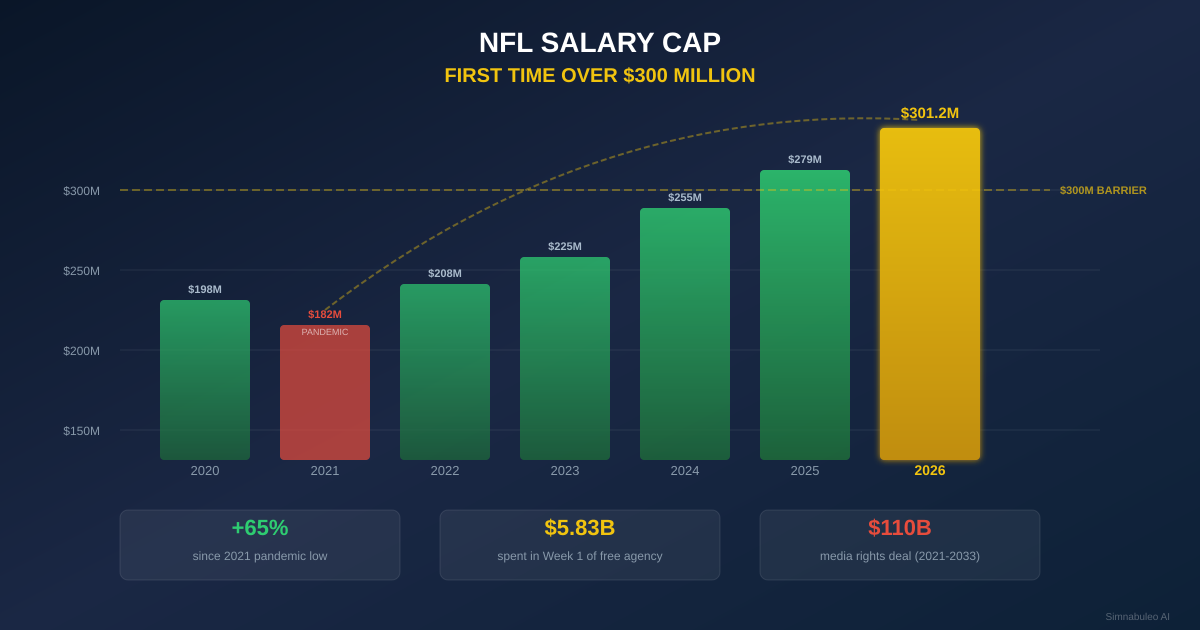
The 2026 NFL salary cap was set at $301.2 million, surpassing the $300 million mark for the first time in history. This represents a 65%+ increase from the 2021 pandemic low of $182.5 million in just five years. The driving force behind this meteoric rise is the $110 billion, 11-year media rights deal signed in 2021 with five broadcasters — Amazon, CBS, ESPN, FOX, and NBC. While it took 16 years for the cap to break $200 million, the jump from $200 million to $300 million took only four years, illustrating the exponential acceleration of NFL revenue growth.
Week One Spending Explosion: $5.83 Billion
In the first week of free agency alone, NFL teams committed a staggering $5.83 billion in player compensation, with $2.59 billion in guaranteed money. The Tennessee Titans led all spenders at $293.2 million, building around 2025 No. 1 overall pick Cam Ward, while the Las Vegas Raiders spent $281.57 million preparing for their own franchise quarterback selection. Both teams' single-offseason spending exceeded the entire 2020 salary cap, underscoring the sheer scale of the new financial landscape.
Eight Positions Reset Simultaneously
Eight players set all-time salary records at their respective positions simultaneously — center (Tyler Linderbaum at $27M/year, resetting the market by 50%), cornerback (Trent McDuffie at $124M over 4 years), offensive tackle, running back, safety, and more. This kind of mass simultaneous reset is unprecedented in NFL history and will trigger league-wide domino effects as agents of other elite players demand renegotiations to match the new benchmarks. The 2027 free agency market is virtually guaranteed to be significantly more expensive.
Quarterback Market Structural Overheating
Malik Willis received a three-year, $67.5 million contract ($45M guaranteed) from the Miami Dolphins despite having only six career starts. The franchise tag for quarterbacks is set at $43.9 million, signaling where the league values the position. With Kyler Murray and Kirk Cousins both released, more quarterback options flooded the market than expected, yet the scarcity of proven elite quarterbacks drove desperate overpayment for unproven talent. Long-term deals exceeding $50 million per year for truly elite QBs are now a matter of when, not if.
The Supply-Demand Paradox Fueling Inflation
Despite the salary cap hitting an all-time high, the pool of elite free agents is actually shrinking. Most core players are locked up with extensions before reaching the open market, as teams preemptively sign players knowing the cap will keep rising. The result is a market with only two types of players: talented players with injury/age concerns that teams declined to extend, and decent players released for cap/roster management reasons. Thirty-two teams with $300M+ in cap space chasing this limited talent pool creates classic inflation dynamics — high demand, limited supply.
Positive & Negative Analysis
Positive Aspects
- Cap growth is structurally guaranteed through 2033 via the $110 billion media deal, making today's expensive contracts look reasonable in 2-3 years
- NFL media value is strengthening in the streaming era, with Amazon's Thursday Night Football driving measurable Prime Video subscriber growth
- Record spending creates unprecedented wealth transfer to players, raising the floor for athlete compensation across all sports
- International expansion and sports betting integration provide additional revenue growth vectors beyond the current media deal
Concerns
- Individual contract irrationality is rampant — $67.5 million for a QB with six starts and $27 million/year for a center represent clear market overheating
- Rebuilding teams spending nearly $300 million in free agency contradicts historical evidence that Super Bowl winners build through the draft
- Simultaneous 8-position market resets will trigger league-wide salary renegotiation chain reactions, compressing cap flexibility for all teams
- Growing salary concentration in top-20% elite players weakens mid-tier bargaining power, creating an increasingly polarized player economy
Outlook
In the short term, over the next one to six months, the trajectory is relatively predictable. The April NFL Draft will see big-spending teams like the Titans and Raiders leverage the cost efficiency of rookie contracts to complete their rosters. Rookie deals are overwhelmingly cheap relative to the cap, so teams that spent heavily in free agency effectively get a "dividend" from the draft. Additionally, remaining unsigned free agents will see their prices drop sharply. The overcorrection from early-market premium pricing means "bargain" contracts will emerge in June and July. Teams with already-strong rosters — I expect the Detroit Lions and Philadelphia Eagles to use this strategy — will be poised to add depth at discounted rates.
In the medium term, the outlook for six months to two years hinges on the continuation of cap growth. The 2027 cap is projected to reach $320-330 million, which creates a time-value mechanism where contracts that felt "expensive" this year become "reasonable" just twelve months later. As long as this mechanism continues — and the media deal guarantees it through 2033 — NFL salary inflation is structural growth, not a bubble. But this growth comes with imbalance. An ever-larger share of the cap will concentrate on the top 20% of elite players, while mid-tier players' bargaining power may actually weaken. The gap between "the eight players who reset markets" and "roster-bottom players earning near the minimum" is already at historic highs this year. Additionally, the 2026 season results for big-spending FA teams (Titans, Raiders) will serve as a litmus test for future FA strategy. If these teams make the playoffs, the "FA all-in strategy" becomes a new trend; if they fail, draft-centric strategies will resurge.
Looking long term at a three-to-five-year horizon, I can envision three scenarios. In the bull case, the NFL expands through international markets (regular season games in London, Germany, Mexico, Brazil), sports betting integration, and proprietary media platforms. The 2034 media deal exceeds $150 billion, and the cap breaks $400 million by 2030. NFL player salaries solidify their position as the highest average compensation in global professional sports, and international fan base expansion underpins the league's long-term growth. In the base case, the media deal performs as expected, and the cap grows steadily at $15-25 million per year. The 2030 cap reaches $370-380 million, salary inflation continues but the pace of position market resets gradually slows. Teams learn from the inefficiency of excessive free agency spending, and "Build through the Draft" strategies regain prominence as the dominant approach. In the bear case, a U.S. economic recession or accelerating cord-cutting contracts the advertising market, eroding the practical value of media deals. The 2033 deal renewal merely maintains current levels, or in the worst case, declines. Long-term contracts built around the expectation of a high cap become burdens across the league, potentially creating a crisis similar to the 2021 pandemic-era cap reduction. Heightened sports betting regulation or player safety concerns (expanded concussion litigation) could also damage the league's social perception.
I believe the most likely trajectory is close to the base case. The NFL's media value will hold as long as demand for live sports content persists, and streaming platforms' competition for sports rights is more likely to push prices higher. But the individual irrationality on display in this free agency market — $67.5 million for a quarterback with six starts, $27 million a year for a center — will produce contracts that end up on the "worst deals in NFL history" lists within two to three years. A market growing structurally is a very different thing from individual teams spending wisely within that market. Ultimately, the NFL salary cap crossing $300 million means that our attention and time as viewers have generated that much value. The $110 billion media deal is what advertisers pay to access NFL viewers, and that money flows into players' pockets. The question is whether endlessly rising player salaries are making the game more entertaining, or if only the numbers are getting bigger. I lean toward the latter, and that is the real challenge the NFL needs to solve.
Sources / References
- NFL salary cap hits milestone at $301.2 million for 2026 — ESPN
- Stunning Sum NFL Teams Spent During First Week of 2026 Free Agency — Sportsnaut
- NFL free agency 2026 winners and losers — CBS Sports
- NFL Teams Updated Salary Cap Space for 2026 Free Agency — Bleacher Report
- 5 biggest overpays of 2026 NFL free agency — ClutchPoints
- NFL salary cap for 2026 hits new high at $301.2 million — Chicago Tribune
- 2026 NFL free agency tracker — NFL.com