
When You Turn On the AC, Your Neighbor Gets Hotter — And That's Not a Metaphor
Summary
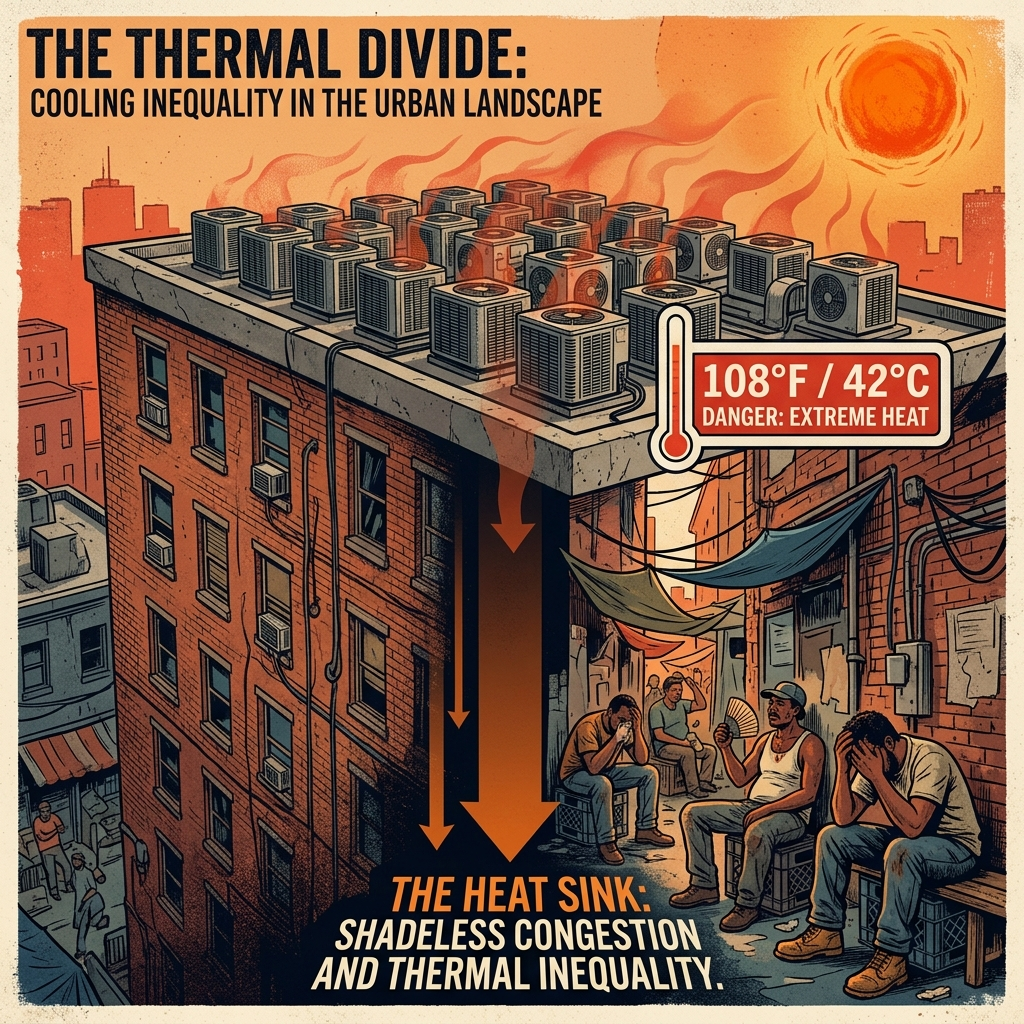
The record-breaking heatwaves that struck Europe and India in 2026 have forced a new concept — the "Right to Cool" — into the center of global climate and human rights discourse. Air conditioner outdoor units discharge waste heat that measurably raises urban temperatures by up to 2°C, producing what researchers term the "cooling paradox": low-income residents who cannot afford air conditioning are pushed into environments made physically hotter by their wealthier neighbors' appliances. Approximately 3.5 billion people live in high-temperature regions worldwide, yet only 15% own air conditioners, and the WHO has confirmed that more than 200,000 people died from heat across Europe alone in the past four years — with nearly all of those deaths classified as preventable. This structural inequality operates as a self-reinforcing feedback loop in which private cooling consumption deepens the collective heat crisis, effectively transforming personal comfort into a mechanism that exploits the shared public climate as a cost-free dumping ground. Unless cooling infrastructure is reconceived as a public utility comparable to water and electricity, climate justice will remain aspirational rhetoric without any structural foundation to support it.
Key Points
The Physics of the Cooling Paradox: How Your AC Heats Your Neighbor's Street
An air conditioner does not eliminate heat — it relocates heat, extracting it from the interior of a building and discharging it through an outdoor unit into the surrounding air. When thousands of these units operate simultaneously in a dense urban neighborhood, the cumulative effect is a measurable increase in ambient temperature in the streets outside. Arizona State University research documented that waste heat from AC outdoor units raises nighttime urban temperatures by more than 1°C in certain districts, and a Berlin-based academic study found that the artificial heat output from air conditioner systems raises heat island intensity by 1.0°C in residential zones and 1.4°C in mixed-use areas. The paradox is most devastating in its distributional consequence: the neighborhoods most densely packed with air conditioners — typically wealthier areas — generate the highest volumes of waste heat, which then radiates into adjacent lower-income blocks that cannot afford cooling. Mumbai offers the starkest documented example: Observer Research Foundation data shows that two neighborhoods merely 2 kilometers apart record a 5.6°C temperature gap, with corrugated-roof informal settlements on the hotter side. Urban heating analysis in Indian cities shows that 60% of the warming effect stems from the built environment itself — concrete, asphalt, and metal — making the cooling paradox a structural feature baked into the city's physical design, not a solvable outlier.
3.5 Billion People, 15% Ownership: The True Scale of Cooling Inequality
The IEA estimates that roughly 3.5 billion people currently live in high-temperature regions worldwide, yet only 15% of those people own air conditioners. That single statistic is the most direct measure of how thoroughly cooling has been distributed as an economic privilege rather than a basic need. Nature Communications research from 2024 modeled the trajectory through 2050 and found that while global AC penetration will rise from 27% to 41%, the lowest income quintile will only reach 21% to 39% — meaning the gap between top and bottom earners does not close and may widen. SEforAll's 2025 Global Cooling Watch report found that more than 1 billion people currently live in conditions of high-risk cooling deprivation, with that figure projected to reach 1.05 billion by 2030. In the United States, Harvard and Lancet Planetary Health research demonstrates that the highest-poverty ZIP codes show a significantly stronger correlation between heat events and mortality — approximately 11 additional deaths per 10,000 residents annually — compared to wealthier areas. Critically, areas with abundant green cover show the reverse: a protective effect of 13.51 fewer deaths per 10,000 during heatwaves. Cooling access has become one of the most consequential new axes of inequality, one that is not merely about comfort but about survival, and existing policy frameworks have so far failed to treat it with the urgency the mortality data demands.
The Positive Feedback Loop: How AC Use Accelerates the Warming That Drives AC Demand
The global cooling system is trapped in a self-amplifying cycle: rising temperatures drive more air conditioning demand, which increases electricity consumption, which boosts carbon emissions, which drives further temperature rises, which generate even more demand for cooling. The IEA projects global AC stock growing from 2 billion units today to more than 5.5 billion by 2050, with cooling electricity demand tripling from 2,000 TWh to 6,000 TWh — a staggering 200% increase. A 2026 study in Nature Communications quantified the feedback for the developing world specifically: expanding cooling access in lower-income countries will generate an additional 0.015°C to 0.05°C of global warming by 2050, even after accounting for efficiency improvements. Under business-as-usual projections, cooling sector emissions are on track to triple by 2050, representing an increasingly large share of the total carbon budget. The cruelest dimension of this loop is its distributional logic: when developing nations gain air conditioning access, the resulting warming concentrates its worst effects on populations that still cannot afford cooling — meaning the loop transfers costs from the newly cooled to the still-uncooled. This is not merely a technical energy efficiency problem; it is a fundamental structural contradiction that pits the individual right to thermal relief against the collective need to avoid catastrophic warming.
When 1948 Law Cannot Protect 2026 Workers: The Gaping Legal Void
India's Factories Act, enacted in 1948, does not extend to outdoor workers — a legal exclusion that was arguably manageable in a pre-climate-crisis world but is catastrophically inadequate for 2026 realities. With 90% of India's workforce in the informal sector, the practical effect is that the vast majority of Indian workers have no statutory entitlement to heat protection of any kind. An estimated 140 million informal workers — in construction, on farms, running street stalls, working on factory floors under corrugated metal roofing — are exposed to temperatures exceeding 45°C with no legal recourse. The 2024 Supreme Court ruling in M.K. Ranjitsinh v. Union of India was a landmark: the court recognized that the constitutional right to life under Article 21 encompasses the right to be free from the effects of climate change. However, the court itself acknowledged that extending this right to obligations on informal-sector private employers requires separate enabling legislation, which does not exist. Europe faces its own variant of this gap: Euronews data shows 130 million European workers face annual heat stress, generating 277,000 injuries and 230 deaths, yet no unified EU-level standard for workplace heat protection has been established. The legal frameworks that govern worker safety were designed for industrial-era conditions and have not been updated to reflect the thermal realities of a 1.5°C-and-rising world.
How Air Conditioning Reproduces Class Inequality Across Generations
Air conditioning functions not just as a comfort device but as a compounding mechanism that widens existing economic gaps over time. Households with cooling maintain cognitive performance, avoid heat-related illness, protect physical assets, and retain earning capacity during heatwaves. Households without it lose labor hours, accumulate medical debt, and experience declining productivity — losses that compound into structural disadvantage over years and decades. Lancet Countdown 2025 puts the magnitude in stark terms: extreme heat erased 247 billion labor hours from India's economy in 2024 alone, translating to roughly $194 billion in lost output and 419 hours per worker — a 124% increase above the 1990s baseline. Critically, 66% of those losses occurred in agriculture and 20% in construction — the sectors with the lowest AC access and the highest proportion of informal workers. IEEFA projects that extreme heat could shave 2.5% to 4.5% from India's GDP by 2030, with the damage concentrated among the economically precarious classes least equipped to absorb it. The mechanism is self-reinforcing in a classic poverty trap structure: the inability to afford air conditioning reduces earning capacity, which prevents the purchase of air conditioning, which perpetuates the original disadvantage. This is why I believe cooling inequality is not simply an outcome of economic inequality — it is actively reproducing and deepening economic inequality with each summer that passes without structural intervention.
Positive & Negative Analysis
Positive Aspects
- The 2026 Crisis Is Rapidly Accelerating Global Climate Justice Discourse
The scale and visibility of the 2026 heatwave is doing something important that years of scientific reports could not: making the human cost of cooling inequality undeniable in real time. The WHO's declaration that more than 200,000 Europeans died from heat in four years — and that most of those deaths were preventable — has provided the climate justice movement with a powerful moral anchor. Framing like PreventionWeb's declaration that air conditioning access is the new inequality index and EU Commissioner Ribera's warning that cooling must not become a luxury good represent a shift in mainstream political language that would have been unlikely just five years ago. This emerging consensus is creating the preconditions for structural policy change: when elected officials in France, Belgium, and Spain face constituent demands to explain thousands of preventable deaths, the abstract arguments for cooling as a public good become politically actionable. The broader implication is that a crisis visible enough to dominate summer news cycles across multiple continents can accelerate the policy timeline for transformative change in ways that incremental advocacy cannot.
- Paris's District Cooling Network Proves the Public Infrastructure Model Already Works
The Fraicheur de Paris district cooling system is not a pilot project or a proposal — it is 120 kilometers of underground cold-water pipes serving 900 buildings across Paris, achieving 50% reductions in both electricity use and carbon emissions compared to conventional standalone cooling systems. This is the most important empirical fact in the entire cooling infrastructure debate, because it demolishes the argument that public cooling at scale is either technically infeasible or economically unworkable. EDF's announcement of an additional 80 million euro investment in France's district cooling network indicates that private capital has recognized the business case, not just the social case. The Paris model eliminates the waste-heat externality problem at its source: district cooling doesn't discharge heat neighborhood by neighborhood; it manages the thermal load centrally and more efficiently. Combined with public cooling centers like Seoul's public shelter network or India's Ahmedabad coolrooms, the evidence base for a public cooling infrastructure approach is substantial. The question is no longer whether such systems can work — it's whether the political will exists to scale them up before another summer takes thousands of preventable lives.
- Passive Cooling Technology Offers Low-Cost Urban Temperature Reduction at Scale
UCL research demonstrates that deploying cool roofs across London could reduce the city's average urban temperature by 1.2°C, with some areas seeing reductions of up to 2°C — and those are not expensive or experimental interventions. In developing countries, cool roof implementation costs between $1 and $5 per square meter, compared to the far higher per-unit cost of installing and running conventional air conditioners for every household. Passive cooling techniques including reflective roofing, green roofs, and optimized night ventilation design can reduce peak indoor temperatures by 1.2°C to 3.3°C and cut roof surface temperatures by 12°C to 31°C without consuming any electricity. UNEP's analysis concludes that passive and low-energy cooling solutions could account for two-thirds of the total achievable emissions reductions in the cooling sector through 2050. These technologies are particularly valuable in the Global South, where the combination of the highest cooling need, the lowest ability to pay, and the weakest electrical grid infrastructure creates an environment where leapfrogging conventional AC with passive solutions could be both economically rational and climatically essential.
- EU EPBD Creates the First Real Institutional Framework for Building Thermal Performance and Tenant Protection
The EU Building Energy Performance Directive (EPBD 2024/1275), which entered into force in 2024 with a May 2026 national implementation deadline, represents the most significant institutional step yet toward treating building thermal performance as a rights issue rather than a market preference. The directive mandates renovation of 16% of the worst-performing non-residential buildings by 2030, rising to 26% by 2033, and targets the complete phase-out of fossil fuel-based heating and cooling by 2040. Its inclusion of explicit anti-renoviction clauses — preventing energy improvements from being used as pretext for tenant displacement — signals an understanding that cooling equity and housing security are inseparable. If fully implemented, the EPBD would structurally improve the thermal performance of millions of European buildings, reducing dependence on individual air conditioners and creating baseline cooling protection for renters who currently have none. Other regions adopting EPBD-style frameworks would establish a global standard linking building codes to thermal safety, potentially breaking the cycle in which the poorest renters systematically occupy the hottest and least energy-efficient buildings.
- UNEP's $2.2 Trillion Economic Case Makes Sustainable Cooling Fiscally Irresistible
The UNEP Global Cooling Watch report projects that a transition to sustainable cooling technologies and infrastructure could save $2.2 trillion in combined energy costs ($1.7 trillion) and avoided capital expenditure ($500 billion) through 2050, while simultaneously cutting sector emissions by 64%. These are not speculative figures — they are grounded in modeled scenarios with documented technology costs and energy price assumptions. The developing-world cooling market, currently valued at roughly $300 billion annually, is projected to reach at least $600 billion by 2050, representing a massive private investment opportunity that is already attracting capital toward high-efficiency, low-GWP refrigerant technologies. The argument that sustainable cooling is a luxury the global economy cannot afford is directly contradicted by UNEP's finding that the alternative — business-as-usual cooling expansion — will cost far more in energy expenditure, capital outlays, and avoided productivity losses. When the economic case for transformation aligns with the moral and scientific cases, the political calculus for action shifts significantly, and the resistance of incumbent cooling equipment manufacturers becomes the primary remaining obstacle.
Concerns
- Public Cooling Infrastructure Requires Enormous Upfront Capital and Decades-Long Timelines
District cooling systems like Paris's Fraicheur de Paris are extraordinarily effective, but building 120 kilometers of underground pipes to serve 900 buildings requires the kind of capital, engineering capacity, and long-term planning horizon that most cities — and virtually all cities in the Global South — do not currently possess. In sub-Saharan Africa, SEforAll data shows that countries including Malawi, Mozambique, Nigeria, Sudan, and Uganda have near-zero cooling infrastructure development, and in many cases lack reliable electricity and clean water access, making the idea of district cooling a distant second-order priority. The climate finance commitments that wealthy nations have made to support developing country adaptation remain chronically under-delivered, and the gap between what is promised and what arrives in the form of investable capital is wide enough to swallow the entire cooling infrastructure deficit. The structural mismatch between the timeline for building public cooling infrastructure — measured in decades — and the timeline of cooling deaths — measured in summers — is perhaps the most difficult challenge: the intervention that would solve the problem long-term cannot be deployed fast enough to prevent the deaths occurring right now.
- Developing Nations' Energy Transitions Cannot Keep Pace With Surging Cooling Demand
India's rapid expansion of air conditioning access is happening against the backdrop of an electricity grid that still draws more than 70% of its power from coal, meaning that every additional air conditioner installed today is primarily powered by fossil fuels and contributes directly to the warming that makes cooling more necessary. The IEA's business-as-usual cooling scenario projects sector emissions tripling by 2050 under current energy mix trajectories in the world's fastest-growing cooling markets. Carnegie Institution analysis shows that peak cooling demand during Indian heatwaves already threatens grid stability in major cities, with rolling blackouts undermining the very cooling access expansion that the situation demands. The technical pathway — replacing coal power with renewable energy while simultaneously meeting rapidly rising cooling demand — is feasible in theory but requires simultaneous policy action across electricity generation, grid infrastructure, building codes, and appliance standards that no major developing country has yet deployed at the required scale. This is not a single-sector problem, and single-sector solutions will not fix it.
- Solving Cooling Inequality Itself Generates Additional Warming: The Cruelest Tradeoff
Nature Communications quantified a finding that deserves to sit at the center of every cooling policy conversation: expanding air conditioning access in developing countries will generate between 0.015°C and 0.05°C of additional global warming by 2050, even with efficiency improvements factored in. World Weather Attribution has already warned that at 1.4°C of global warming, some societies are reaching the outer edges of their adaptive capacity. Even fractions of a degree of additional warming in that range translate to nonlinear increases in the frequency and severity of extreme heat events. This creates a genuine ethical dilemma with no clean resolution: the most morally urgent response to cooling inequality — giving everyone access to air conditioning — accelerates the warming that will make cooling inequality worse for the people who remain uncooled. High-efficiency, low-GWP refrigerant technologies can reduce the magnitude of this tradeoff, but they cannot eliminate it entirely. The honest answer is that we are choosing between imperfect options, and any policy that pretends otherwise is not engaging seriously with the physics of the problem.
- Short Electoral Cycles and Weak Political Will Systematically Block Long-Term Infrastructure Transitions
Transforming cooling from a private consumer product to public infrastructure is a 10-to-20-year project, but in most democracies, the political horizon extends only to the next election cycle of four or five years. Politicians who invest in district cooling networks today will not be in office when those networks deliver results, and the constituencies most harmed by cooling inequality — informal workers, low-income renters, rural populations — are frequently the least politically organized. The EU EPBD is the most ambitious building performance framework yet enacted, but implementation deadline violations are already occurring among member states, and the mandatory renovation targets face sustained real estate industry lobbying at every stage of implementation. India's Heat Action Plan framework exists at the national level, but enforcement capacity for informal employers is essentially nonexistent, reflecting a political economy in which the interests of capital-employing industries consistently outweigh the thermal welfare of the workers who power them. Without mechanisms that insulate long-term infrastructure commitments from short electoral cycles — such as statutory cooling standards, independent infrastructure funds, or constitutionally grounded rights — the structural transition will perpetually be deferred to the next government's term.
- Climate Feedback Loop Time Lags Systematically Dull the Political Sense of Urgency
One of climate change's most dangerous characteristics as a policy challenge is the multi-decade time lag between the emission of carbon and its full warming effect. The additional warming that will result from today's expansion of conventional air conditioning will not be fully manifest until the 2050s and beyond — a timeline that falls outside the planning horizon of virtually every political institution and most private investment frameworks. Nature Communications' projection that 3.2 to 4.1 billion people could be exposed to extreme heat without adequate cooling by 2050 reads as an alarming number in an academic paper but registers as an abstraction in the political arena, where the urgent always crowds out the important. The intergenerational dimension of this time lag creates an ethical structure in which current generations capture the cooling benefits of conventional AC while future generations bear the warming costs — a form of temporal cost-shifting that operates invisibly and without political accountability. Until cooling policy explicitly incorporates intergenerational equity frameworks and binding long-term commitments that survive electoral cycles, the time lag between cause and consequence will continue to function as one of the most powerful obstacles to timely structural action.
Outlook
Let me start with what I expect in the next one to six months — the near-term picture for the remainder of 2026. Based on World Weather Attribution's finding that Western European June temperatures are rising at three times the global average pace, I think it's highly probable that combined excess deaths in France, Belgium, the Netherlands, and Spain will reach 5,000 to 6,000 before European summer ends. France alone had already logged 2,025 excess deaths by late June, and July and August historically deliver the most extreme temperatures. When that mortality data surfaces in European media, the cooling inequality debate will shift from the margins of climate discussion into the center of political agendas. I estimate better than a 50% chance that the European Parliament will see a formal resolution on emergency protection for heat-vulnerable populations by autumn 2026, and the political pressure on EPBD implementation laggards will intensify sharply once summer fatality counts are published.
India's near-term trajectory looks even more urgent. The data point that stopped me cold: in May 2026, India claimed 97 of the world's 100 hottest cities. The pre-monsoon heatwave was the worst on record. I believe the Indian government will be politically compelled to reinforce its National Cooling Action Plan in some form during the second half of 2026 — if only at the level of official declarations. Lancet's figure of 247 billion lost labor hours and $194 billion in economic damage is too large for any government to ignore. That said, I'm being honest with myself: as long as India's legal infrastructure remains anchored to a 1948 Factories Act, substantive enforcement is more likely to follow high-profile announcements than precede them. The model to watch is Ahmedabad's Heat Action Plan, which reduced heat deaths from 2,600 in 2015 to under 200 in 2017 — how quickly that approach reaches other major Indian cities is the most important variable in the short-term outlook.
Looking at the medium-term window — six months to two years — the air conditioning market is entering explosive growth that will stress every climate commitment on the table. The IEA projects global AC stock surging to more than 5.5 billion units by 2050, with much of that growth concentrated in India, Southeast Asia, and Africa between 2027 and 2030. From a cooling equity angle, that looks like progress. From a climate angle, Nature Communications warns it could add 590 to 1,365 million tons of CO2 equivalent through 2050. I expect 2027 to 2028 to be the period when the cooling carbon dilemma becomes impossible to ignore politically. AC manufacturers will be racing to capture growth markets; climate scientists will warn of blown carbon budgets; governments will be caught between the two. The IEA estimates that aggressive efficiency policies could cut cooling energy demand by 45%, but whether those policies get enforced rather than just announced is the entire question.
In the same medium-term window, the concept of a legal Right to Cool will begin entering real statutory frameworks. India's Supreme Court set the precedent with the 2024 Ranjitsinh ruling, and Indian legal scholars and activists are already building constitutional cases under Article 21. I would forecast that by 2028, at least three countries will have introduced legislation explicitly framing cooling access or heat protection as a statutory right. In the EU, the EPBD framework is likely to generate binding minimum thermal performance standards for rental units, effectively requiring landlords to guarantee baseline heat protection for tenants. The EPBD already includes anti-renoviction clauses to prevent energy upgrades from being used as displacement tools — that logic, extended, could create affirmative thermal safety obligations on building owners. Real estate industry pushback will be fierce, but I expect the political momentum from 2026's death toll to serve as a significant forcing function.
For the longer-term picture — two to five years out — I think the most significant structural shift will be the move from mechanical cooling toward passive and low-energy cooling as a primary design philosophy. UCL's research demonstrates that cool roofs alone could reduce London's average urban temperature by 1.2°C and up to 2°C in targeted areas, at a cost of $1 to $5 per square meter in developing countries. UNEP estimates that passive and low-energy solutions could account for two-thirds of achievable emissions reductions in the cooling sector by 2050. Paris's Fraicheur de Paris network is already delivering 50% energy and carbon savings versus conventional systems. None of these require technological breakthroughs — they are proven, deployable, and cost-effective today. I would forecast that by 2030, at least 10 major European cities will have established or significantly expanded district cooling networks, with EDF's 80 million euro French investment announcement representing the leading edge of broader capital reallocation.
The market structure itself will look fundamentally different by the end of this decade. UNEP projects that a sustainable cooling transition could save $2.2 trillion in combined energy costs and capital expenditure through 2050, while extending access to an additional 3 billion people. The developing-world cooling market is expected to roughly double from $300 billion today to at least $600 billion by 2050. Whether that growth flows into high-efficiency, low-GWP refrigerant models or conventional units will determine whether the climate trajectory resembles UNEP's optimistic scenario or Nature Communications' pessimistic one. My forward estimate: roughly 30% of new global AC sales shifting to high-efficiency, low-GWP models by 2030, and cool roof mandates spreading to at least 20 equatorial-belt countries — enough to bend the emissions curve, though not yet enough to hit the 64% reduction UNEP says is achievable.
Let me lay out three concrete scenarios. In an optimistic scenario, EU EPBD implementation proceeds on schedule, Paris-style district cooling spreads to major cities globally, and India's Heat Action Plan scales nationally — together achieving the IEA's 45% cooling energy demand reduction and dramatically cutting excess deaths. In a baseline scenario matching Nature Communications 2024 projections, global AC penetration rises from 27% to 41%, but the bottom income quintile only reaches 21% to 39%, cooling electricity demand climbs from 1,220 TWh to 1,940 TWh, and the high-risk population without cooling grows from 1 billion to 1.05 billion. In a pessimistic scenario, the cooling feedback loop crosses a tipping point, World Weather Attribution's warning that social adaptation capacity is already being exceeded at 1.4°C plays out in real time, India loses 2.5% to 4.5% of GDP to heat damage by 2030, and 4.1 billion people face extreme heat without cooling by 2050. Right now, I would place us between the baseline and pessimistic tracks, and I think the 2027 policy window — when legislative responses to 2026's deaths either crystallize or don't — is the genuine hinge point.
The strongest counterargument to my position deserves honest acknowledgment: without individual air conditioning, people die right now. That's true. In India, slowing AC deployment would almost certainly increase immediate heat mortality. My argument is not that we should ban air conditioners — it's that we need to stop treating cooling as purely private consumption and start treating it as public infrastructure. The question isn't whether people get cooling. It's whether cities are built to cool everyone, or whether we keep constructing systems that cool the wealthy while overheating everyone else. Those are fundamentally different engineering choices, and they lead to fundamentally different human outcomes.
The historical parallel I keep returning to is the cholera epidemics of the 19th century. Before germ theory was understood, the idea of government-provided clean water for everyone was considered economically absurd. The epidemic forced a reckoning: unregulated individual water sources were spreading disease, and only coordinated public infrastructure could break the cycle. Water became a public good, then a human right. Electricity followed the same arc. I believe 2026's heatwave has the potential to be a comparable inflection point for cooling. Whether that potential is realized depends on whether this summer's deaths are treated as a system failure demanding structural reform — or merely as a weather event to be managed with more personal AC units sold to those who can afford them.
Sources / References
- WHO Europe statement: 200,000 heat deaths in 4 years across Europe — WHO
- IEA: The Future of Cooling — IEA
- Nature Communications: Cooling inequality projections through 2050 — Nature Communications
- Lancet Countdown 2025: India heat-related labor productivity losses — The Lancet
- World Weather Attribution: 2026 European heatwave attribution analysis — WWA
- UNEP: Sustainable cooling could slash 2050 sector emissions by 64% — UNEP
- Nature Communications: Rising AC use accelerates warming feedback loop — Nature Communications
- Harvard/Lancet Planetary Health: Heat mortality by poverty rate in U.S. ZIP codes — Harvard T.H. Chan School of Public Health
- ASU: AC waste heat raises nighttime urban temperatures — Arizona State University
- UCL: Cool roofs are most effective tool against urban heat islands — UCL