
Deporting and Importing at the Same Time — Why America Built Its Own Kafala System Into Law
Summary
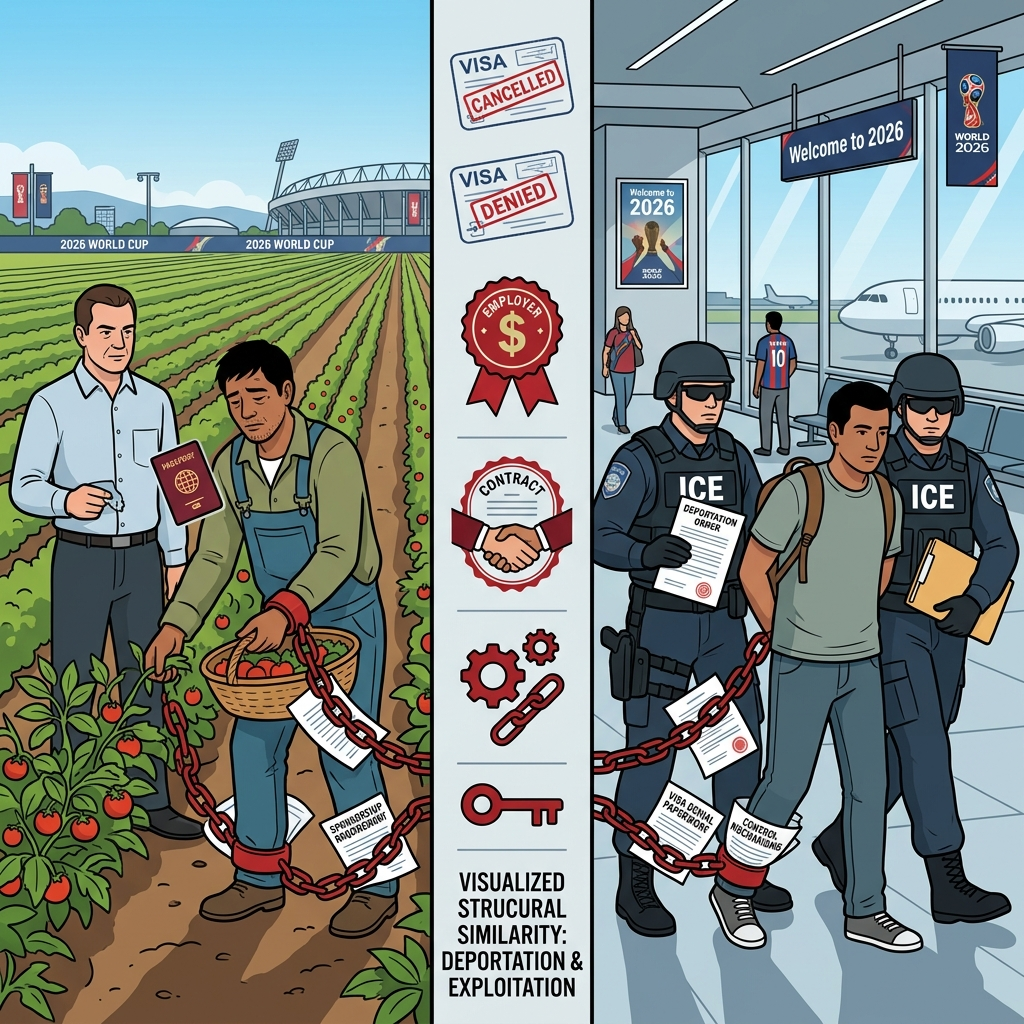
The United States' H-2A and H-2B guest worker programs share the same core exploitation mechanism as Qatar's kafala system, a structural parallel that the 2026 FIFA World Cup has thrust into sharp international focus. Both systems bind workers to a specific employer-sponsor, stripping them of any meaningful ability to change jobs, assert rights, or escape abuse without risking deportation — an identical architecture of coercion regardless of geography or political rhetoric. The Trump administration's simultaneous mass deportation of undocumented immigrants and aggressive expansion of H-2A visa access, including proposals to eliminate wage floors and remove issuance caps entirely, is not a policy contradiction but a deliberate strategy to replace rights-bearing migrants with structurally rightless guest workers. While Qatar's 2022 World Cup generated global outrage over an estimated 6,500 migrant worker deaths, the 2026 American tournament finds approximately 167,000 immigrants in host cities living under active ICE arrest threats, demonstrating that the form of harm has changed but the structural pattern of migrant workers suffering in the shadow of mega sporting events has not. This analysis argues that systematic migrant labor exploitation is a structural feature of advanced-economy capitalism — not a problem unique to developing nations or autocratic states — and that dismantling it demands binding international labor standards and genuine enforcement infrastructure, not merely periodic moral outrage.
Key Points
Kafala and Guest Workers: Two Names, One Exploitation Machine
Qatar's kafala system and America's H-2A and H-2B guest worker programs look completely different on the surface — one is a Gulf state institution with roots in pre-modern labor law, the other a federal visa program administered by the U.S. Department of Labor with detailed regulatory requirements. But the core operating principle of both systems is strikingly, almost disturbingly identical. In each case, a worker's legal right to remain in the country is tied to a specific private employer-sponsor. Leave that employer without their cooperation, and you lose your status. Complain about violations, and you risk being reported, losing your visa, and facing deportation.
Foreign Policy's June 2026 investigation documented this structural parallel in rigorous detail. In Qatar's kafala, employers routinely confiscated worker passports — a practice that is technically illegal but widely practiced and rarely prosecuted. In U.S. H-2A contexts, the Department of Labor has repeatedly found employers holding workers' identification documents as a means of control. The specific legal mechanisms differ, but the power dynamic they create is identical: a worker who depends on a specific employer for their legal right to remain in the country cannot effectively resist that employer's demands, no matter how unreasonable or illegal those demands become. The fear of deportation functions as a near-universal deterrent to complaint-filing in both systems, and the data on actual reporting rates confirms this suppression effect is real and significant.
What makes this structural similarity so important is what it reveals about the nature of the exploitation itself. It is not a product of individual bad actors, cultural attitudes specific to the Gulf, or any failure of governance unique to Qatar. It is a predictable, reproducible output of any system that makes a worker's immigration status contingent on a private employer's goodwill. Wherever that structure exists — whether in Qatar, the United States, South Korea, Singapore, or Hong Kong — the same patterns of wage theft, unsafe conditions, and coerced compliance appear in the data. Business and Human Rights Resource Centre's documentation of 747 global migrant worker abuse cases in 2025 is not a record of individual employer crimes scattered randomly. It is a map of where employer-sponsorship systems operate and what they consistently produce. The structure generates the outcome. Change the structure, change the outcome. This is the core insight that distinguishes meaningful reform from cosmetic adjustment.
Deporting Some While Importing Others: Policy Design, Not Policy Confusion
On its face, the Trump administration's simultaneous mass deportation of undocumented immigrants and aggressive expansion of H-2A guest worker access looks incoherent. How can a government that says it wants fewer immigrants also be actively lowering visa barriers to bring more workers in? The answer becomes clear once you examine what distinguishes the migrants being expelled from the migrants being imported. The undocumented immigrants facing deportation include long-term residents, parents of American citizens, and workers who have been embedded in American communities for years — people who have developed social capital, legal awareness, and the capacity to assert rights. The H-2A workers being imported are legally bound to their employers, geographically isolated in rural agricultural settings, often not fluent in English, and subject to deportation if they complain about the very conditions their employment terms prohibit.
This distinction is not an accident of policy design. It is the design. American capital — particularly in agriculture, construction, and hospitality — has always required access to labor that is cheap, reliable, and controllable. The historic Bracero Program, which ran from 1942 to 1964, served the same function for twenty-two years before the Civil Rights movement generated sufficient political pressure to terminate it. The contemporary H-2A and H-2B programs are Bracero's legal successors, updated with more regulatory language but preserving the structural power asymmetry that makes the programs attractive to employers in the first place. The agricultural lobby's political influence in Congress ensures this structural core is protected from reform even as the regulatory framework around it evolves.
The result of pursuing both policies simultaneously is a labor market structure that maximizes employer control across the entire low-wage immigrant labor population. The threat of deportation keeps undocumented workers compliant. The visa dependency keeps guest workers compliant. Both populations compete in overlapping labor markets, suppressing wages and working conditions for everyone at the bottom of the wage distribution, including American workers who find their own bargaining position undercut by this artificially depressed competition. The economic consequences extend beyond the directly exploited workers: industries with access to captive cheap labor have structurally weakened incentives to automate or innovate, which ultimately compromises their long-term productivity and competitiveness relative to economies where higher labor costs have driven sustained technological investment.
The World Cup as Migrant Labor's Four-Year Reckoning
The FIFA World Cup has proven to be something its administrators almost certainly did not intend: a recurring, global audit of the host nation's migrant labor practices. In 2022, Qatar's kafala system became international news in a way that decades of academic documentation and human rights reporting had never managed to achieve. The Guardian's estimate of over 6,500 migrant worker deaths linked to World Cup construction shocked global audiences and created political pressure that produced genuine — if incomplete — legal reform. The mechanism was simple: a massive global event concentrated unprecedented media attention on a host country that depended on migrant labor, and that attention made previously invisible workers suddenly visible to an audience that had never thought about them before.
The same mechanism is operating in 2026, but the host is different — and arguably the implications are more consequential. The United States is not a small Gulf monarchy without a free press. It is the world's largest economy, the home of global media institutions, and the self-proclaimed champion of human rights on the international stage. The contradictions are therefore considerably more glaring. ACLU's documentation of 167,000 immigrants in World Cup host cities under ICE arrest threat is happening in New York, Los Angeles, Dallas, and Kansas City — cities with large independent press corps, active civil society organizations, and international populations watching closely. The hypocrisy is structural and visible, and the World Cup's global platform means it cannot be quietly contained to domestic news cycles.
Human Rights Watch has taken the unusual step of formally demanding that FIFA's corporate sponsors — Coca-Cola, Adidas, Visa — push for an ICE enforcement pause during the tournament. The fact that HRW has to ask private corporations to intervene with federal immigration enforcement on human rights grounds reveals how far short FIFA's own human rights commitments fall from translating into practical action. The four-year World Cup cycle creates recurring moments of accountability, but the historical pattern is that these moments generate intense pressure and then dissipate without producing structural change. The critical question for 2026 is whether the advocacy infrastructure that has matured since Qatar 2022 is now sophisticated enough to convert this moment into something that outlasts the tournament by months or years, rather than weeks.
Employer Sponsorship: The Universal Engine of Migrant Worker Exploitation
The deepest insight embedded in the kafala-H-2A comparison is not about these two specific systems. It is about the universal mechanism that generates exploitation wherever it operates: the legal linkage of a worker's immigration status to a specific private employer. This structure appears not just in Qatar and the United States, but in Singapore's Foreign Domestic Worker scheme, Hong Kong's helper visa system, South Korea's Employment Permit System, and Japan's Technical Intern Training Program. These are countries with vastly different political systems, legal traditions, and cultural contexts — yet they produce remarkably similar exploitation outcomes because they share the same structural feature. The universality of the outcome is the most powerful evidence that it is the structure, not any cultural or political particularity, that is doing the work.
Walk Free Foundation's Global Slavery Index estimates approximately 27.8 million people in forced labor globally, with migrant workers disproportionately represented in that figure. This disproportionality is not coincidental or randomly distributed. The condition of being a migrant — of having arrived in a country whose language you may not fully speak, whose legal system is unfamiliar, and whose institutional infrastructure is oriented toward the native population — creates inherent vulnerability. When you add employer-sponsored immigration status to that baseline vulnerability, you create a situation where workers structurally cannot exercise the rights they technically possess. The legal rights exist on paper; the power to enforce them does not exist in practice. This is the specific combination that makes employer-sponsorship systems dangerous regardless of the country's overall rule-of-law quality.
The implication for reform advocates is significant and often overlooked: country-specific campaigns for individual program reform, while necessary, are structurally insufficient on their own. The United States can add protections to H-2A. South Korea can adjust its Employment Permit System. Singapore can strengthen Foreign Domestic Worker regulations. But as long as the fundamental employer-sponsorship structure remains intact in each case, each system will continue generating exploitation at rates determined by enforcement capacity and employer behavior. The structural fix is visa portability — decoupling immigration status from individual employer control and attaching it instead to industry sectors or geographic regions, so workers can move toward better conditions rather than being permanently anchored to exploitative ones. New Zealand's 2023 portability reforms provide a working proof of concept. The challenge is translating a single successful national experiment into a global policy standard before the structural incentives for exploitation rebuild themselves around whatever local variation replaces the current form.
What Qatar's Kafala Reforms Actually Teach Us
Qatar's post-2022 kafala reforms were announced with considerable international fanfare: minimum wages introduced, job-switching without employer permission legalized, exit visa requirements abolished. Taken at face value, these are substantive changes to the architecture of a system that had been operating in its unreformed state for decades. And they were achieved, fundamentally, because international pressure during the 2022 World Cup created political costs for inaction that outweighed the economic benefits of the status quo for Qatar's leadership. The mechanism of external accountability worked, at least to the point of producing legislative change that would have been unthinkable without the tournament's global spotlight.
Georgetown GJIA's 2025 academic analysis tells the harder, less-reported part of the story. Implementation rates for Qatar's kafala reforms sit at roughly 30-40% — meaning that for the majority of workers, the reformed laws exist on paper but not in the workplaces where they are supposed to apply. Domestic workers and workers employed by small businesses are particularly likely to remain in the unreformed system regardless of what the statute now says. The failure of implementation follows a predictable pattern: without sufficient labor inspectors, without accessible complaint mechanisms that protect workers from deportation in retaliation for reporting, and without genuine employer accountability including meaningful penalties, reformed laws become a rebranding exercise rather than a rights enforcement mechanism.
The lesson for the United States is direct and sobering. The U.S. already has written legal protections for H-2A workers covering wages, housing standards, and safety regulations. The gap is not in the laws. The gap is in the enforcement infrastructure. The DOL's Wage and Hour Division does not have enough investigators relative to the H-2A workforce to create any meaningful deterrent effect on employer violations. Workers who know their rights still face deportation risk if they exercise them. The legal rights are real. The structural ability to act on them is not. Qatar's experience demonstrates that sustained international pressure can move a government to pass reformed legislation — but it cannot pressure a government into actually enforcing those laws without a monitoring infrastructure that functions independently of employer cooperation. Building that infrastructure requires sustained political will, dedicated enforcement budgets, and whistleblower protections that separate a worker's immigration status from their decision to report violations. Neither Qatar nor the United States has demonstrated the will to build this infrastructure, and that failure is the most predictive indicator of what happens next.
Positive & Negative Analysis
Positive Aspects
- Mainstream Media Is Finally Making the Structural Comparison
The most meaningful positive development in this space is that the comparison between America's guest worker programs and Qatar's kafala system has moved from academic literature and labor advocacy reports into mainstream journalism with large, politically diverse audiences. Foreign Policy, The Conversation, and ACLU are now framing H-2A not as a well-regulated immigration pathway but as a structural parallel to the system that generated international outrage in 2022. This frame shift is not a marginal development. For decades, the exploitation of guest workers in the United States was documented in research that reached narrow specialist audiences, while the public perception of H-2A remained anchored to its official framing as a legal, regulated program distinct from the abusive practices of Gulf autocracies. The current media cycle is cracking that perception open in ways that previous reporting never managed to sustain.
The mechanism driving this shift is the World Cup mirror effect. The 2022 Qatar coverage established the critical vocabulary and the analytical frame; the 2026 American context gave journalists a story that required them to apply it to a domestic situation. That recursive movement — using the critical frame developed for judging an "other country" and turning it on your own — is historically one of the most powerful drivers of domestic reform consciousness. It happened with child labor at the turn of the twentieth century, with segregation in the 1960s, with prison conditions in the 1970s and 1980s. Seeing your own country through the lens you developed for judging others creates a particular kind of cognitive dissonance that is difficult to dismiss or neutralize with "but our situation is different" arguments. The foundation this media attention builds for future advocacy will persist after the World Cup coverage ends, and that residual shift in public framing is a genuine and lasting positive outcome of this moment.
- Qatar's Post-2022 Reforms Created an International Precedent
Despite the enormous gap between Qatar's legal reforms and their actual implementation, Qatar's post-2022 kafala modifications created something of lasting value for migrant labor advocates globally: a demonstrated proof of concept that sustained international pressure from a major sporting event can actually move a sovereign nation's labor policy in a measurable direction. Minimum wages were introduced. The legal right to switch employers without permission became codified, if inconsistently enforced. Exit visas were abolished. These changes happened in a country with no independent press, no organized labor movement, and every economic incentive to maintain the status quo. That they happened at all — and happened within the compressed timeline of World Cup preparation and aftermath — is evidence that the combination of international media attention, corporate sponsor pressure, and organized civil society advocacy can overcome significant institutional resistance even in highly constrained political environments.
The ILO and international human rights organizations have been explicit about using Qatar as a reference model for pushing similar commitments from other nations, including democracies that should theoretically be more responsive to rights-based arguments. The "but meaningful reform is impossible in this political environment" argument that reform opponents traditionally deploy has become harder to make credibly when Qatar — which faced far stronger institutional barriers than the United States, South Korea, or Singapore — managed to produce legal changes. The fact that those changes have been poorly implemented does not erase the precedent that they were made at all. For advocates working to pressure destination countries to reform employer-sponsorship systems, the Qatar experience provides both a model and a rebuttal: external accountability through major international events can produce real, if imperfect, legislative change. The challenge is building on that precedent by demanding enforcement mechanisms alongside the legislative language, rather than accepting paper reform as a satisfactory outcome.
- Data-Based Monitoring of Migrant Abuse Is Becoming More Sophisticated
The Business and Human Rights Resource Centre's systematic documentation of 747 migrant worker abuse cases globally in 2025 represents a qualitative leap in how migrant labor exploitation is tracked, reported, and used for advocacy purposes. For most of the history of this issue, advocacy relied heavily on individual testimonies and journalistic investigations — powerful for generating public empathy but difficult to aggregate across countries, compare over time, or use as the basis for policy arguments that legislators and regulatory agencies find credible and actionable. The emergence of systematic, quantified, cross-border documentation changes the entire advocacy toolkit in fundamental ways that compound over time as the data infrastructure matures.
Walk Free Foundation's annual Global Slavery Index updates serve a similar function at a different geographic scale, providing country-level data that enables the comparative analysis necessary for international policy coordination. The ACLU's documentation of the 167,000-person ICE arrest exposure figure in World Cup host cities represents this same approach applied to a specific moment and context: a specific, defensible number that advocacy organizations can attach to concrete policy demands and that journalists can use as the hook for substantial reporting rather than relying on general claims about immigrant vulnerability. Digital reporting tools that allow migrant workers themselves to document and submit abuse cases in real time are making the monitoring system more distributed, more granular, and harder for any single institutional actor to suppress or dismiss. The direction of travel in migrant labor monitoring is toward the kind of real-time, quantified accountability that could eventually change the power dynamics of enforcement in ways that traditional labor inspection, with its chronic staffing and resource constraints, simply cannot achieve on its own.
- Multi-Track Legal Strategies Are Building Long-Term Reform Infrastructure
The legal landscape for H-2A worker rights is more active and more promising than at any previous point in the program's history, with simultaneous progress across state legislatures, federal courts, international supply chain regulations, and civil society litigation. In states including California, New York, and Washington, legislation has been introduced or passed to extend additional labor protections to guest workers beyond federal minimums. These state-level efforts matter not only for the workers they immediately protect, but as demonstration projects showing that meaningful H-2A protections are operationally feasible and economically survivable for agricultural employers. Federal courts have also been moving gradually toward more worker-favorable interpretations of H-2A contract terms in wage-theft litigation, creating a growing body of case law that future litigants can reference and build upon.
At the international level, the EU's Corporate Sustainability Due Diligence Directive creates a powerful external pressure vector that operates through supply chain economics rather than direct regulatory authority over U.S. employers. European companies importing American agricultural products will, under CSDDD requirements, need to conduct and document due diligence on labor conditions throughout their supply chains — including the conditions faced by H-2A workers who harvest those products. This creates an economic incentive for American agricultural exporters to improve labor practices that does not depend on domestic political will, which is currently pointed in the opposite direction. When legal reform efforts operate simultaneously at state, federal, judicial, and international supply chain levels, the cumulative pressure is considerably greater than any single track could generate alone. Even if each individual effort advances slowly and faces setbacks, their combination creates a reform environment that is meaningfully different from what existed five or ten years ago, and the legal precedents being set now will constrain future policy in ways that the current political moment cannot easily reverse.
Concerns
- The Current Administration Is Actively Worsening the Structural Problem
The most serious near-term concern is not that the American guest worker system is standing still — it is that the current administration is actively moving to make it structurally worse in ways that will outlast any particular political moment. The proposed reduction of the H-2A wage floor would directly reduce the already-limited bargaining power of guest workers, and its effects would not be contained to the visa-holder population. When the artificially suppressed wage floor for guest workers falls further, it exerts downward pressure on wages for American workers competing in the same labor markets — primarily agriculture, landscaping, and seasonal construction. The entire low-wage end of those labor markets is affected, not just the visa holders who are the program's most visible beneficiaries from the employer's perspective. This is the race-to-the-bottom dynamic operating within the domestic labor market, accelerated by explicit policy choice rather than external competitive pressure.
The simultaneous proposal to effectively eliminate the H-2A issuance cap compounds these effects across the entire system. A larger guest worker population means higher worker replaceability for employers, which means stronger structural disincentives for any individual worker to report violations or advocate for better conditions. The economic logic of retaliation becomes more compelling to employers when labor supply is abundant and easily replenished: the cost of losing one complaining worker is reduced to near zero when replacements are readily available and legally bound to the employer relationship. Department of Labor budget cuts under the broader regulatory rollback agenda further erode the enforcement infrastructure that theoretically holds employers accountable. These three policy moves — lower wage floor, uncapped issuances, reduced enforcement capacity — form a coherent package that, taken together, constitutes a structural expansion of the exploitative features of the current system rather than a refinement of its regulatory framework.
- ICE Enforcement Is Turning the World Cup Into a Season of Fear
The collision of ICE enforcement escalation and the 2026 FIFA World Cup is producing documented, measurable harm in American host cities that goes beyond abstract policy concern to concrete economic and human impact. ACLU analysis documents approximately 167,000 immigrants in World Cup host cities living under credible arrest threat. Migrant workers in the food service, cleaning, and hospitality sectors that are essential to the tournament's operation are reporting fear of traveling to work — and in some cases are not showing up at all, creating operational gaps in the labor supply that the tournament's organizers are quietly managing. The economic impact has begun to appear in business data: some analyses of immigrant-owned business revenue in host cities show drops of 15-20% as community members reduce their public visibility and avoid commercial activity that might increase their exposure to enforcement.
The structural irony of this situation cuts deep and deserves to be named clearly. The FIFA World Cup markets itself as a global celebration of inclusion, connection, and shared humanity across borders. It depends critically on migrant and immigrant labor to function operationally — from the workers who renovated the stadiums to the workers who staff the concession stands, clean the facilities, and operate the transportation networks that the tournament depends on. Yet during the tournament, the migrant workers who are essential to its operation face elevated enforcement risk precisely because of the heightened federal presence the event has attracted to their cities. Human Rights Watch's demand that FIFA sponsors push for an ICE truce acknowledges this contradiction directly, but the mechanism it relies on — corporate public relations pressure against federal immigration enforcement — is an extremely difficult needle to thread practically. The most likely outcome is that the tournament proceeds, the migrant communities bear the cost in silence, and the official World Cup narrative of human rights progress goes largely unchallenged in the event's own communications infrastructure.
- The Global Race to the Bottom in Migrant Labor Protection Continues
The most structurally intractable problem in migrant labor rights is not any individual country's policy choices, but the competitive dynamics between countries that systematically punish unilateral improvement and reward those who maintain lower standards. When a destination country raises its labor standards for migrant workers, it risks becoming comparatively less attractive to sending countries' labor flows than lower-standard competitors offering the same economic opportunity at lower rights protections. When a sending country advocates too aggressively for its citizens' rights in destination countries, it risks losing access to those labor markets entirely, eliminating remittance flows that its domestic economy depends on. This "first-mover disadvantage" creates a powerful structural incentive for all parties — destination countries, sending countries, and the individual employers and workers caught between them — to accept current conditions rather than risk the economic consequences of pushing for improvement.
Walk Free Foundation's finding that approximately 27.8 million people globally remain in forced labor conditions — a figure that has remained stubbornly stable over years of dedicated advocacy, legal reform efforts, and growing international attention — is the clearest available evidence that this race-to-the-bottom dynamic is winning the competition against rights-based reform impulses. The structural incentive to maintain exploitable labor conditions is stronger, in aggregate and in most institutional environments, than the political will to eliminate them. The UN Migrant Workers Convention, which would theoretically create a binding international floor under migrant worker rights, has been ratified by almost no major destination country. The United States, the European Union member states, the Gulf Cooperation Council members, and the major East Asian destination countries have all declined to ratify. Without their participation, the convention is a statement of moral aspiration rather than a binding commitment, and the race to the bottom continues with no structural brake in sight.
- The Enforcement Gap Makes All Legal Rights Theoretical
The most fundamental and persistent obstacle to migrant worker rights in the United States is not the absence of legal protections — it is the structural inability to enforce the protections that already exist, combined with the deliberate design features that deter workers from invoking those protections even when they know about them. The Department of Labor's Wage and Hour Division, which is responsible for monitoring H-2A employer compliance with wage, housing, and safety requirements, is dramatically understaffed relative to the workforce it oversees. The ratio of investigators to covered workers means that the expected cost of violating H-2A requirements — the probability of being investigated multiplied by the expected penalty — is far below the economic benefit that employers gain from violations in practice. Rational-actor employers who face near-zero enforcement risk will systematically undercomply, and the data on wage theft and housing violations in H-2A contexts confirms that significant undercompliance is exactly what occurs.
The enforcement gap is compounded at every level by the same visa-dependency dynamic that enables the structural exploitation in the first place. Workers who want to report violations face the realistic prospect that the investigation will trigger visa cancellation and deportation before any legal remedy is obtained or even fully investigated. Even workers who proceed through the legal system to formal litigation face a structural time problem: most H-2A visas are seasonal in duration, meaning the worker's right to remain in the country expires — and the worker must depart — before court proceedings conclude. Workers who win their cases in principle may be legally required to leave the United States before collecting a judgment. Addressing the enforcement gap requires not just more investigators and higher employer penalties, but structural protections that separate a worker's immigration status from their decision to report violations. The parallel with Qatar is direct and instructive: Qatar passed legal reforms and the violations continued because the enforcement infrastructure was not built to match the legal framework. America has the same structural failure embedded in its existing system, and the current political direction is toward making it worse, not better.
Outlook
The short-term picture — the next one to six months — revolves almost entirely around the arc of the 2026 FIFA World Cup, running from the June 11 opener through the July 19 final. During this window, international media attention on American migrant labor conditions will be more sustained than anything else could generate. My view is that coverage will actually exceed the Qatar 2022 cycle in scope and penetration, for two compounding reasons. First, the United States is the gravitational center of English-language global media — the number of journalists in New York, Los Angeles, and Miami alone exceeds the entire international press corps that covered Doha in 2022. Second, the "sports and human rights" narrative frame was built and field-tested during Qatar, giving reporters a ready-made lens they will deploy without hesitation. The ACLU's Know Your Rights campaign is already operational. Human Rights Watch has formally requested an ICE truce from FIFA sponsors. If ICE conducts a high-profile mass arrest in a World Cup host city during the tournament — especially near stadium infrastructure or in a community the event depends on — the international political fallout could equal or exceed the impact of the Guardian's 2022 death-toll reporting in terms of sustained policy pressure.
The critical short-term question is whether this moment generates any durable legislative or administrative outcome, or whether it follows the pattern I anticipate: intense scrutiny, meaningful public pressure, and rapid dissipation once the television audience moves on. Based on the Qatar post-2022 trajectory, I estimate the effective half-life of World Cup-generated attention at roughly 90-120 days. By October, the American news cycle will be absorbed by domestic political battles entirely disconnected from migrant labor reform. That gives human rights organizations, labor advocates, and sympathetic legislators a genuinely narrow window to convert public attention into structural change. Congressional hearings are almost certain to happen. Whether any resulting legislation reaches a floor vote before the window closes is a harder question, and my honest answer is: probably not at the federal level. The state level is considerably more promising in the near term, and three to four states with significant agricultural workforces could plausibly advance H-2A portability provisions before the momentum dissipates.
Looking at the medium term — roughly six months to two years out — I see three plausible paths for how the American guest worker situation evolves, and I want to be specific about my probability estimates for each scenario.
The bull case, at roughly 15% probability, is one where World Cup-generated political momentum catalyzes a genuine structural reform: legal job portability for H-2A workers. Portability means a worker can switch employers without losing visa status — the single reform that would most directly dismantle the employer-dependency that makes exploitation structurally inevitable. The reason I put this at only 15% is the extraordinary political power of agricultural lobbying in the current Congress, combined with an administration whose instinct runs in the opposite direction entirely. However, if a major ICE incident during the World Cup creates a genuine diplomatic embarrassment — say, an arrest of a tournament-adjacent migrant worker that goes viral internationally and becomes a genuine incident — that probability could rise toward 25% as the reputational cost to American soft power creates unusual political pressure to act. A bill with bipartisan agricultural support that packages portability with employer indemnification could thread the needle in that environment.
The base case, which I assign roughly 55% probability, is marginal adjustment within an essentially unchanged core structure. A handful of states pass guest worker protection ordinances, particularly in agriculture-heavy states where farm labor advocacy has existing political muscle. Federal legislation gets introduced, clears a committee, and dies before a floor vote. The Department of Labor sees a temporary uptick in enforcement actions driven by media attention, then returns to its chronic baseline. The H-2A program continues its structural expansion: annual issuances could reach 25-30% above current levels by 2028, driven by agricultural and hospitality sector demand that shows no sign of contracting. The gap between written legal rights and practical enforcement continues to widen in absolute terms even as the public debate becomes more sophisticated. This is the most historically consistent outcome — American migrant labor policy has not seen fundamental structural reform since the Immigration Reform and Control Act of 1986, and the conditions for breaking that pattern, while closer than they have been in years, are not quite fully assembled.
The bear case, at roughly 30% probability, is active regression. The H-2A wage floor gets formally reduced. The issuance cap is eliminated entirely. DOL enforcement staff and budget are cut further under the broader regulatory rollback agenda, reducing the already-inadequate monitoring infrastructure. In this scenario, average real wages for H-2A workers fall 10-15% within two years, documented violations of wage, housing, and safety standards increase by 30% or more, and the structural gap between the American guest worker system and Qatar's kafala narrows to near-zero — not because Qatar regressed but because the American system converged toward it. The probability is non-trivial given the current administration's regulatory philosophy and its structural relationship to agricultural sector lobbying. In this scenario, international criticism that previously trained its sights on Gulf states would increasingly focus on American practices, and the EU's CSDDD compliance machinery would become the primary external pressure vector forcing American exporters to confront their own labor practices.
Zooming out to the long term — two to five years — this issue will transcend national policy debates and become a central question in global migrant labor governance restructuring. Two structural mega-forces are going to amplify this regardless of what any individual government chooses to do. Climate-driven displacement is accelerating: the global migrant worker population, currently around 170 million, is projected to exceed 200 million by 2030 as climate impacts force population movements across South and Southeast Asia, sub-Saharan Africa, and Central America. Simultaneously, aging demographics in wealthy nations are creating structural labor shortages in exactly the industries — agriculture, care work, construction, hospitality — where migrant labor is already concentrated. These two trends intersecting will intensify both the supply and the demand for migrant labor, meaning the structural pressure on worker rights will grow unless governance frameworks keep pace with scale. Migrant labor is not a temporary economic phenomenon that automation will soon eliminate. It is becoming a permanent and expanding feature of the global economy, and its governance deserves to be treated accordingly.
I believe the ILO or UN will advance new binding or quasi-binding international guidelines on migrant worker rights within five years, with the sequential World Cup labor scandals of Qatar 2022 and America 2026 providing the political momentum necessary for that kind of multilateral standard-setting. The fundamental obstacle is ratification: the UN Migrant Workers Convention has been ratified by almost none of the major destination countries. The United States, the Gulf states, and most of Western Europe have not signed it. Without those signatories, any new standard faces the same structural enforcement vacuum that has plagued every previous international labor initiative. The more realistic near-term pathway runs through corporate compliance rather than governmental ratification. The EU's CSDDD phasing in from 2026 will require European multinationals to audit migrant labor practices in their supply chains, creating cascading pressure on American agricultural exporters, food processors, and hospitality companies to demonstrate legitimate labor conditions or risk losing access to European markets. This supply-chain accountability mechanism operates independently of domestic political will and could move faster than any legislative process.
The historical parallel I keep returning to is the American Bracero Program, which ran from 1942 to 1964. For twenty-two years, Mexican agricultural workers were admitted under employer-tied contracts with predictable and well-documented results: wage theft, dangerous conditions, and systematic abuse that the program technically prohibited but practically enabled at scale. When the Civil Rights movement created enough political pressure to terminate Bracero, the structural exploitation did not end with the program — it migrated into undocumented labor channels, which is precisely the pattern that generated the contemporary undocumented workforce crisis. The lesson Bracero's termination teaches is that eliminating the formal program alone was insufficient. What was needed, and never built, was a framework that acknowledged the legitimate demand for migrant labor while making exploitation structurally impossible by design. The right mechanism, in my view, is visa portability: detach the worker's legal immigration status from the individual employer and attach it instead to the industry or geographic region, so workers can move toward better conditions rather than being permanently anchored to exploitative ones. New Zealand implemented a version of this in 2023 with promising early results. That model deserves serious consideration as the basis for a global standard. The alternative — terminating programs without replacing the structural employer-worker power balance — simply reproduces exploitation in different legal forms, as the Bracero-to-undocumented transition demonstrated definitively.
The second-order effects of genuine reform, if it materializes, are worth tracing to counter the standard objection that labor rights protection is purely a cost to the economy. If H-2A wages rise to fair market levels, short-term consumer prices for agricultural products would likely increase by 5-8%. That seems like a cost, and in the narrow short-term frame it is. But the second-order effect is accelerated agricultural automation investment: California's strawberry-harvesting robots and Florida's orange-picking drones are already in commercial deployment stages, and a sustained increase in labor costs would push the industry past the adoption threshold faster than any technology subsidy program could. The third-order effect operates through development finance: the World Bank estimates annual global remittances at roughly $656 billion, a figure that exceeds foreign direct investment for most developing nations. Higher migrant worker wages translate directly to larger remittances, generating a positive feedback loop for origin-country economic development that multilateral institutions should be including in their labor reform cost-benefit frameworks but rarely do.
Let me be honest about where I could be wrong. The biggest wildcard is the 2028 U.S. presidential election — a new administration with a fundamentally different orientation on immigration and labor could accelerate reform dramatically, while a continuation or intensification of the current approach would entrench regression further. A second major variable is the pace of AI and automation in low-wage industries: if autonomous systems displace a significant share of jobs that currently require guest workers faster than projected, the entire political economy of H-2A reform shifts, potentially making the debate moot before meaningful legislation arrives. What I am genuinely confident about is this: the structural problem does not solve itself, and the pattern of periodic outrage followed by systemic inaction is not an accident — it is what happens when the economic beneficiaries of exploitation are more politically organized than the workers being harmed. The 280,000 workers in South Korea's Employment Permit System, the 350,000 in Japan's Technical Intern Training Program, the 250,000 foreign domestic workers in Singapore — all are watching what America does with this moment. The window of global attention opened by the 2026 World Cup is narrow. What happens inside that window — in legislation, in litigation, in corporate compliance commitments, in journalistic accountability — will reverberate well beyond the tournament's final whistle and signal to the rest of the world whether the richest democracy on earth is capable of holding itself to the standards it demands of others.
Sources / References
- Foreign Policy — How U.S. Guest Worker Programs Resemble Qatar's Kafala System — Foreign Policy (June 18, 2026)
- Human Rights Watch — Gulf States: Repression of Migrant Workers During Conflict — Human Rights Watch (June 11, 2026)
- Human Rights Watch — World Cup: FIFA Sponsors Should Back an ICE Truce — Human Rights Watch (June 11, 2026)
- Business & Human Rights Resource Centre — Migrant Workers 2026 Analysis — Business & Human Rights Resource Centre
- The Conversation — How U.S. Border Crackdowns Are Tarnishing the World Cup — The Conversation
- ACLU — The 2026 FIFA Men's World Cup: Know Your Rights, Know Your Risks — American Civil Liberties Union
- Walk Free Foundation — Life Under the Kafala System — Walk Free Foundation
- Georgetown GJIA — Reforming the Kafala System: Persistent Violations and the Role of Private Recruitment Agencies — Georgetown Journal of International Affairs (March 2025)