
China's Ethnic Unity Law: Written as "Unity," Read as "Erasure"
Summary
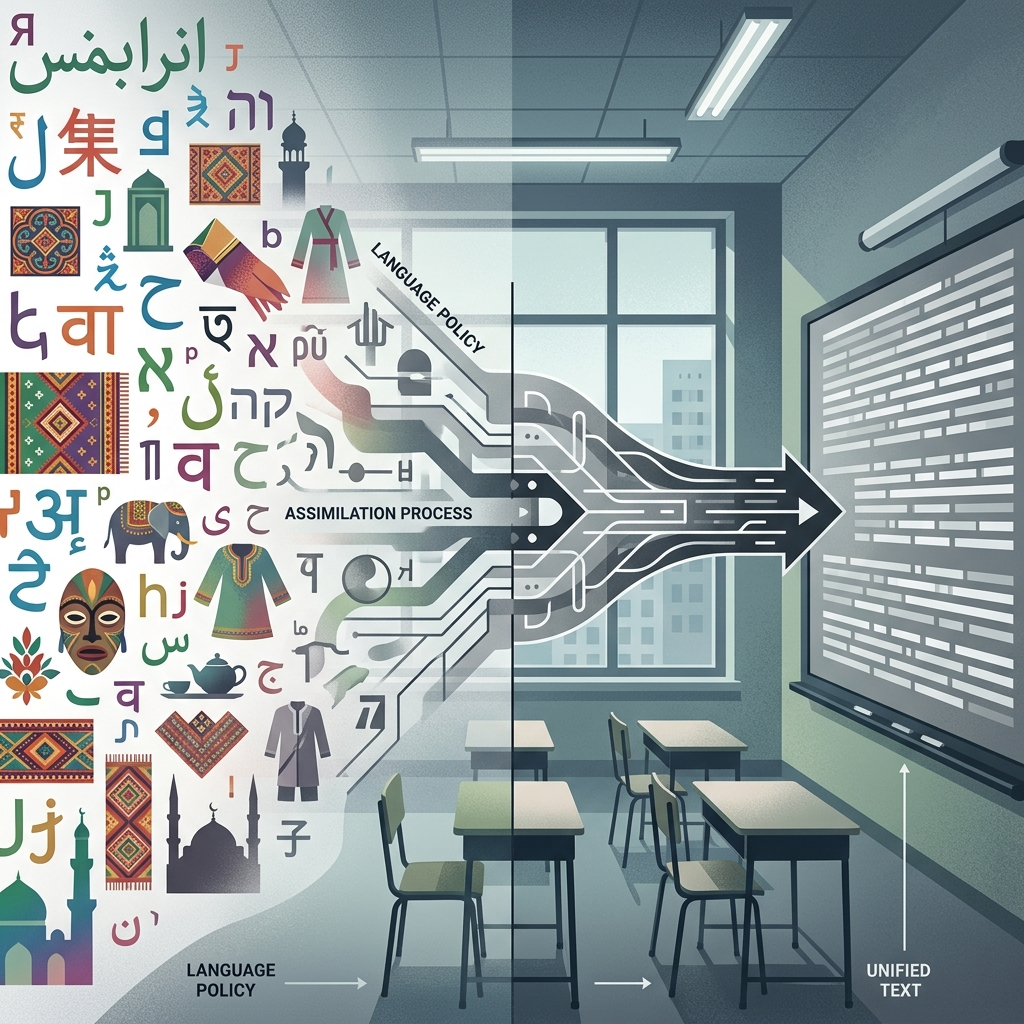
China's Law on the Promotion of Ethnic Unity and Progress entered into force on July 1, 2026, providing legally binding authority to a systematic state-directed assimilation policy targeting all 56 officially recognized ethnic groups within the People's Republic. The 62-article legislation mandates Mandarin-only instruction from kindergarten through high school, requires citizens to internalize a "Chinese national community" consciousness across education, religion, media, and the internet, and establishes extraterritorial criminal jurisdiction under Article 63 that enables prosecution of individuals and organizations outside China who are deemed to "undermine ethnic unity" — a provision that directly threatens an estimated 500,000-strong Uyghur diaspora spread across 38 countries. Passed by the National People's Congress with a vote of 2,756 in favor and only 3 opposed, the law drew a formal repeal demand from UN High Commissioner for Human Rights Volker Türk and a joint warning from eight former UN Special Rapporteurs citing potential violations of at least 12 international treaties China has ratified, including the ICESCR, the CRC, and the ICCPR. UN OHCHR data reveals that approximately 800,000 Tibetan children between ages 6 and 18 — representing 78 percent of that age cohort — are currently separated from their families in state boarding schools, a rate nearly four times the national average that defies any "voluntary" explanation. The law represents a decisive break from the 1984 Law on Regional Ethnic Autonomy, which had explicitly protected minority languages, and its extraterritorial reach sets a precedent with consequences extending far beyond China's borders into the foundations of international human rights law itself.
Key Points
Mandatory Mandarin and the Structural Elimination of Minority Languages
Article 15 of the Ethnic Unity Law mandates Mandarin-language instruction for all children from kindergarten through high school, effectively blocking minority languages from functioning as primary educational media — a structural barrier encoded in statute, not an administrative preference. The contrast with China's 1984 Law on Regional Ethnic Autonomy is precise: that earlier statute explicitly protected the right to receive instruction in minority languages, while the 2026 law reverses those guarantees without acknowledging the reversal. Professor James Leibold at La Trobe University has stated that the law will intensify pressure across schools, media, public culture, and religious life, narrowing whatever space had remained for meaningful linguistic self-determination at every institutional level. The 2020 Inner Mongolia episode demonstrates what happens when this type of mandate is enforced against community resistance: approximately 300,000 students boycotted school in protest over the announced replacement of Mongolian-language instruction with Mandarin, triggering the largest demonstrations in the region in more than three decades. I believe Article 15, combined with the 78 percent boarding school enrollment rate for Tibetan children already documented by the UN OHCHR, represents the most structurally effective instrument in this law's toolkit — because it operates on the youngest, most linguistically formative age cohort, making the cultural rupture structurally irreversible within a single generation. No law that claims to promote ethnic unity can simultaneously prohibit the transmission of identity from parent to child through the medium of language and expect to be taken at its word on the unity claim.
Article 63 and the Direct Challenge to International Law's Territorial Principle
Article 63 of the law states that overseas organizations and individuals who "undermine ethnic unity or instigate ethnic separatism" shall be held legally accountable — a provision extending Chinese criminal jurisdiction to foreign nationals residing in foreign countries on the basis of terms no legal text has defined with any precision. Under established international law, extraterritorial jurisdiction is permissible primarily in cases involving active personality (a state's own nationals committing crimes abroad) or passive personality (crimes whose victims are that state's nationals); what Article 63 attempts is categorically different and collides directly with the territorial sovereignty principle that structures the modern international legal order. Eight former UN Special Rapporteurs addressed this in a joint warning letter, identifying potential violations of at least 12 international treaties China has ratified, including the International Covenant on Economic, Social, and Cultural Rights, the Convention on the Rights of the Child, and the International Covenant on Civil and Political Rights. Taiwan's Premier Cho Jung-tai has characterized Article 63 as the third pillar of an emerging extraterritorial legal architecture — following the Anti-Secession Law and the Counter-Espionage Law — completing a trifecta of statutes claiming authority over events and individuals far outside Chinese territorial boundaries. I assess Article 63 as the most consequential provision in this law not because of the prosecutions it will generate, but because of the expression and behavior it will suppress without generating any prosecutable cases at all — the chilling radius of an undefined prohibition is always larger than the radius of an explicit one.
Tibet's 78 Percent Boarding School Rate: The Data Behind the Statute
UN OHCHR's 2023 press release confirmed that approximately 800,000 Tibetan children between ages 6 and 18 — representing 78 percent of that age cohort — are currently separated from their families and enrolled in state boarding schools, while more than 100,000 children aged 4 to 6 are housed in state residential preschools. China's national boarding school rate sits at approximately 20 percent; the Tibetan rate of 78 percent is structurally incompatible with the Chinese government's claim that enrollment decisions rest entirely with students and their parents. China's Vice Minister of Education Duan Yijun has insisted that boarding choices are fully voluntary, but International Campaign for Tibet representative Puchung Tsering has described the system as "a diabolical scheme targeting the youngest children to separate them from their culture," and the arithmetic supports that characterization rather than the official one. The Ethnic Unity Law now provides formal legal scaffolding for this boarding school infrastructure — a system in which children are separated from family environments where minority languages are spoken, educated in Mandarin-only institutional settings, and socialized into a "Chinese national community" identity at the precise developmental ages at which identity and language capacity form. Tibetan representative Tsering Chukyi testified before the United Nations that the law "legislates the elimination of Tibetan identity, Tibetan culture, and the Tibetan language." I find the arithmetic more persuasive than any official description: when four out of five children in a given population are removed from family-language environments at state direction, the operating mechanism is not an education system — it is a cultural replacement program.
"Chinese National Community Consciousness" as Ideological Infrastructure
The concept at the operational core of this law — "zhonghua minzu gongtongti yishi," or the sense of community for the Chinese nation — was elevated to core state policy by Xi Jinping at the 2014 Central Ethnic Work Conference and has since served as the organizing framework for all ethnic policy. Chapter Two of the new law mandates simultaneous identification with five distinct referents: the "great motherland," the "Chinese nation," "Chinese culture," the Chinese Communist Party, and socialism — leaving no ideological alternative for any citizen to occupy. NPC Observer has analyzed this as a wholesale transplantation of political slogans from Xi Jinping's personal ethnic work doctrine into binding national statute, deliberately blurring the boundary between party ideological requirement and state legal obligation. Article 22 requires local governments to create "inter-embedded community environments" where different ethnicities live, study, and work together — which in practice serves as legal authorization for state-encouraged Han Chinese resettlement into minority-majority regions, altering the demographic composition of those communities through legal mandate rather than organic migration. I believe this ideological framework — stretching from mandatory parental instruction under Article 20 through media requirements, religious institutions, and regional demographics — represents an intervention at a deeper level than any prior Chinese ethnic policy, because its target is not merely behavior but the interior self-conception of 125 million people who are now legally required to experience their identity in a prescribed way.
China's Legal Expansionism: From Hong Kong NSL to Ethnic Unity Law
This law does not stand alone — it is the third node in a growing network of extraterritorial Chinese legal instruments, and understanding the pattern is essential for assessing the trajectory accurately. Taiwan's Premier Cho Jung-tai identified the sequence with precision: the Anti-Secession Law established the framework for justifying unilateral action against Taiwan; the Counter-Espionage Law extended surveillance jurisdiction to new categories of actors; and the Ethnic Unity Law now completes a trifecta of statutes that collectively claim legal authority over events and individuals far outside Chinese territorial boundaries. Hong Kong's National Security Law provides the most instructive precedent for understanding how these instruments evolve in application: initially framed as a domestic security matter in 2020, it was progressively expanded in scope to target overseas activists and organizations, reinforced by a stronger security ordinance in 2024, and is still evolving. HRW's Maya Wang characterized the Ethnic Unity Law as "a blatant attempt to control the thoughts of people both inside and outside China" — a description that captures its content and its place within a broader project of extending Chinese legal authority into the cognitive and cultural space of individuals who have never entered Chinese territory. State Council spokesman Zhou Jianshuo has asserted that Article 63 is "lawful, necessary, and practicable," which I read not as a defense of its conformity with international norms but as a declaration that China intends to enforce it regardless of how the international community assesses its legality.
Positive & Negative Analysis
Positive Aspects
- Economic Development and Documented Poverty Alleviation in Minority Regions
The Chinese Ministry of Justice reports that all 420 poverty-stricken counties across the five ethnic autonomous regions achieved poverty alleviation between 2013 and 2021, and aggregate GDP across those regions grew at an average annual rate of 5.6 percent from 2020 to 2024, exceeding the national average during the same period. These figures have not been independently verified by external auditors with full data access, but infrastructure investment in minority regions — transportation networks, telecommunications, urban development — has visibly reduced the physical isolation that historically characterized remote minority communities. Vice Minister of Justice Hu Weili has argued that the law's approach is grounded in China's specific national conditions and represents a legitimate exercise of sovereign authority that conforms to the practices of other multi-ethnic states. Intellectual honesty requires acknowledging these economic gains as potentially real, even while recognizing that economic development cannot serve as justification for eliminating cultural rights — these are not competing values to be traded against each other. Canada and Switzerland provide clear empirical counter-examples: both are genuinely multi-ethnic states that have achieved sustained economic development while maintaining meaningful cultural and linguistic autonomy for minority communities, demonstrating that prosperity and pluralism are not a zero-sum trade. The existence of genuine economic development in minority regions is part of the full picture, and an analysis that dismisses these gains entirely misrepresents the complexity of what this law is doing and why it has domestic legitimacy in some quarters.
- International Human Rights Monitoring Galvanized and Coordinated by the Law
In a deeply paradoxical way, this law's passage has achieved something that years of fragmented reporting on Xinjiang and Tibet could not: it has unified the international human rights architecture around a single, legally bounded, and precisely defined target. The European Parliament's April 2026 condemnation resolution, the UN High Commissioner's formal repeal demand, and the eight-former-Rapporteur joint warning represent a level of institutional coordination around Chinese ethnic policy that is historically unusual and represents a genuine shift in how international bodies are engaging with the issue. Prior to this law, criticism of China's treatment of Uyghurs and Tibetans tended to be siloed — Xinjiang specialists, Tibet advocates, and international law scholars operated in largely parallel tracks with limited cross-pollination. The Ethnic Unity Law provides a single analytical and legal framework under which all of these concerns converge in a way that is easier to communicate to legislative bodies, trade negotiators, and the general public. Amnesty International and Human Rights Watch have both produced detailed clause-by-clause analyses of the law's 62 articles, creating a documented record that can be used in international legal proceedings, trade negotiation contexts, and UN human rights review cycles for years to come. The law has inadvertently placed China's minority policies at the center of global human rights discussion in a way that individual incidents and administrative actions never managed to do.
- Accelerating Diaspora Cultural Preservation in the Digital Era
The direct threat this law poses to minority cultures within China's borders is simultaneously accelerating preservation efforts outside those borders in ways that may prove more consequential than the Chinese government anticipates. The global Uyghur diaspora — more than 500,000 people across 38 countries — and the Tibetan exile community centered in Dharamsala and other locations worldwide are both engaged in systematic cultural archiving: documenting languages, oral traditions, musical forms, religious texts, and historical records in digital formats that exist entirely outside the reach of Chinese enforcement. The digital archiving tools available in 2026 — cloud storage, decentralized platforms, open-source oral history databases, AI-assisted language transcription — are qualitatively different from what was available during any previous forced assimilation campaign in history, including Australia's Stolen Generations period. While China can suppress cultural expression within its territory through legal mandate and enforcement, it cannot suppress cultural preservation in the global digital commons, and the more aggressively it pursues erasure within its borders, the more urgently diaspora communities are motivated to document what is being erased before it is gone. Historical patterns are consistent on this dynamic: the suppression of Occitan and Basque in France produced a regional identity revival movement that persisted across centuries, and the Welsh language went from near-extinction in the early 20th century to a partially revitalized status through sustained community and government effort. The Ethnic Unity Law may prove, over the long run, one of the most effective inadvertent tools for strengthening diaspora cultural identity ever deployed — not through design, but through provocation.
- Clarifying Global Legal Questions on Extraterritorial Ideological Jurisdiction
Whatever else this law does, it has forced into global academic and policy discourse a set of legal questions that urgently needed rigorous attention and had been inadequately theorized. How far can extraterritorial criminal jurisdiction legitimately extend under international law? When does a state's assertion of jurisdiction over foreign nationals in foreign countries constitute a violation of the territorial sovereignty principle? What is the threshold at which a domestic law conflicts with ratified international human rights instruments in ways that trigger enforceable international accountability? The Ethnic Unity Law has simultaneously presented international law scholars, human rights advocates, and governments with a concrete, detailed, and consequential test case for all of these questions at once. Taiwan's Judicial Reform Foundation lawyers have produced analysis of Article 63 that is already circulating in international legal circles as a framework for understanding the problem of extraterritorial ideological enforcement more broadly — useful not only for responding to China but for anticipating similar attempts by other authoritarian states. The eight former UN Special Rapporteurs' joint statement, citing 12 specific treaty conflicts with precise treaty references, represents a level of legal specificity that can inform both targeted responses to this law and preemptive treaty frameworks designed to constrain analogous legislation in the future. Sometimes a deeply problematic law generates better arguments and more durable norms than any amount of theoretical discussion could produce in the abstract.
- Creating a Detailed Accountability Benchmark for Future Enforcement Tracking
The law's very specificity — 62 precisely worded articles, covering everything from mandatory parental instruction to inter-embedded community demographic engineering to extraterritorial criminal prosecution — creates a detailed accountability checklist that human rights monitors, investigative journalists, academic researchers, and international institutions can use to track actual enforcement outcomes in granular and verifiable terms. Vague authoritarian intent is harder to document and challenge than codified legal requirements with specific text, and the Ethnic Unity Law has converted what was previously a pattern of opaque administrative practices into a legally enumerated set of obligations and prohibitions that can be measured against observable real-world outcomes over time. UN OHCHR can systematically track Tibet boarding school enrollment rates against the legal framework established by Article 15; academic researchers can document the pace of Mandarin-language expansion in minority educational settings across different regions; and international legal bodies can assess enforcement of Article 63 against the extraterritorial jurisdiction standards they articulate in responding to this law. The law's specificity is genuinely double-edged: it provides Chinese authorities with a clearer enforcement roadmap, but it equally provides the international monitoring community with a clearer accountability roadmap. Long-term enforcement legitimacy depends on observable compliance with stated provisions, and this law has stated its provisions with enough precision that observable compliance — or observable violation — becomes documentable.
Concerns
- Irreversible Loss of Minority Languages and Cultural Heritage at Generational Scale
The most profound and least reversible consequence of this law is the structural destruction of minority linguistic heritage across the generation currently in elementary and secondary education. Article 15's mandated Mandarin instruction from kindergarten onward, combined with the 78 percent boarding school enrollment rate for Tibetan children documented by the UN OHCHR, creates conditions under which Tibetan-speaking, Uyghur-speaking, and Mongolian-speaking young people will have no institutional environment in which to acquire or regularly use their heritage languages as primary communication media during the formative years when language competence is established. Amnesty International's Sarah Brooks has described this as pushing minority communities into "a single homogeneous national identity dominated by Han Chinese culture" — and the mechanism is not persuasion but the structural exclusion of any institutional alternative. The parallel with Australia's Stolen Generations is analytically exact: that system, which operated through forcible removal of Aboriginal and Torres Strait Islander children from their families and cultural environments, produced documented multi-generational consequences including collective trauma, community identity fracture, elevated rates of mental health disorders, and social rupture that Australia is still reckoning with in the 21st century, decades after active removals ceased. Languages carry embedded knowledge systems — ecological knowledge, historical memory, social organization principles, and spiritual frameworks that cannot be translated into dominant languages without catastrophic loss of content. I consider this the most serious consequence of the Ethnic Unity Law because the generational window for language acquisition is narrow and time-bounded, and once a cohort grows up without a heritage language, cultural recovery requires sustained institutional investment that no state pursuing forced assimilation has ever voluntarily provided.
- Transnational Repression and the Systematic Chilling of Free Expression Globally
Article 63 constitutes a direct legal assault on the expressive freedom of 500,000 Uyghurs and hundreds of thousands of Tibetan diaspora members, as well as every researcher, journalist, attorney, and advocacy organization anywhere in the world that engages with minority rights in China. HRW China researcher Yaqiu Wang has explicitly defined the mechanism as transnational repression, distinguishing it from conventional extraterritorial law through its targeting of political and ideological expression rather than ordinary criminal conduct with recognizable civilian victims. The deliberate vagueness of "undermining ethnic unity" is a calculated design feature rather than a drafting failure: an undefined prohibition creates a larger deterrence perimeter than a specific one, because potential violators cannot identify where the line falls and therefore retreat from a far wider range of expression than any explicit prohibition would reach. Taiwan's Premier has already instructed citizens to exercise caution when traveling abroad in light of this provision, and Taiwan's judiciary is closely tracking the connection between Article 63 and China's announced willingness to prosecute independence advocates through in-absentia criminal proceedings. Academics studying Uyghur and Tibetan cultures are already reporting behavioral modifications — reduced willingness to travel to China, avoidance of specific research topics, and self-censorship in academic publications intended for international audiences. I believe Article 63 will prove more effective as a global chilling mechanism than as a prosecution tool, and the measurable chilling effect is already operating well before any formal enforcement case has been filed.
- Erosion of the Post-WWII International Human Rights Architecture
This law poses a structural threat to the international human rights framework constructed in the decades following World War II, precisely because it challenges that framework's foundational operating assumption: that treaty commitments ratified by states constrain their subsequent domestic legislation. Eight former UN Special Rapporteurs have documented that the law violates at least 12 instruments China has ratified — but because China holds a permanent Security Council veto, no binding multilateral enforcement response is structurally available through existing mechanisms. The European Parliament condemnation and the U.S. Senate letter carry real diplomatic weight without producing enforceable accountability. The deeper structural problem is the precedent this creates in the system of international governance. When a permanent Security Council member can systematically violate ratified treaty commitments through domestic legislation without facing any enforceable accountability, the credibility of international human rights treaty systems as real constraints on state behavior is fundamentally weakened across the entire system, not only in China's case. Other authoritarian governments observe this, and the lesson they draw is not that China is exceptional — it is that permanent Security Council membership is the variable that determines whether treaty obligations are operationally binding. The erosion of the international human rights framework is not a side effect of this law; it is one of its logical and foreseeable systemic outcomes. I believe this structural damage to international norms may prove more consequential over the coming decades than the direct impact on any specific community within China's borders.
- Intergenerational Trauma and the Long-Term Social Cost of Forced Family Separation
UN OHCHR data on residential preschools — more than 100,000 children aged 4 to 6 separated from their families and placed in state institutions focused on Mandarin socialization — indicates that forced cultural separation begins in China's minority regions at the earliest possible ages at which institutional environments can shape language development and identity formation. Australia's reckoning with its Stolen Generations, which operated through a similar logic of compulsory separation with official assimilation intent, provides the most rigorously documented long-term outcome available: collective trauma transmitted across multiple generations, disproportionate rates of mental health disorders, significantly elevated substance dependency, disrupted family formation patterns, and profound community cohesion damage that researchers continued to quantify half a century after the active removal period ended. International Campaign for Tibet representative Puchung Tsering has described the Tibetan boarding school system as targeting "the youngest children to separate them from their culture," and the combination of early institutional separation with mandatory Mandarin immersion creates conditions in which children return to their families as cultural and linguistic strangers, producing the identity fracture that characterizes intergenerational trauma in every documented historical case. The economic costs of this damage, when they eventually manifest in public health statistics, social service demands, and reduced social capital across affected communities, will not be borne only by minority communities — they will fall on the Chinese state as a whole over timescales longer than any current leadership's planning horizon. I believe these long-term social costs are being systematically excluded from the Chinese government's calculation, and that exclusion is characteristic of policies that eventually produce outcomes their architects did not anticipate and cannot reverse once underway.
- Global Suppression of Academic Freedom and Cultural Documentation
The law's impact on intellectual freedom extends far beyond China's borders and will progressively degrade the global community's capacity to understand what is happening to minority cultures within China. Article 63's vague prohibition on "undermining ethnic unity" is already producing self-censorship among scholars studying Uyghur, Tibetan, and Mongolian cultures, journalists covering minority rights issues in China, human rights attorneys representing diaspora clients in international forums, and translators and publishers handling minority-language materials. Taiwan's Judicial Reform Foundation attorney Chang Ching-chu has analyzed how the vagueness operates mechanically: it creates maximum enforcement discretion for Chinese authorities while imposing maximum uncertainty on potential targets, a combination that generates behavioral modification without requiring any enforcement action to be filed. The cases of Ilham Tohti — sentenced to life imprisonment for advocating dialogue between ethnic communities — and Rahile Dawut — who disappeared after 2018 for documenting her own people's cultural heritage — established that cultural documentation and scholarly research are legally categorizable as potential separatism, and that precedent is now formalized in statute. Researchers outside China cannot determine whether their work falls within Article 63's prohibition, and that uncertainty alone is sufficient to produce accommodation — the academic literature on chilling effects documents this consistently. I believe the long-term consequence of this systematic suppression is an information environment in which cultural erasure proceeds in a vacuum of documentation, making it progressively harder for the international community to understand what is being lost while there is still time to respond — and that informational vacuum may be precisely what the law is designed to create.
Outlook
Only two weeks have elapsed since this law's effective date, but the short-term trajectory over the next six months is already taking shape. My assessment is that Chinese authorities will pursue a quiet enforcement strategy in the early implementation period — the same approach deployed with Hong Kong's National Security Law, where the law's existence generated substantial self-censorship effects while a small number of symbolic enforcement cases were carefully selected to establish deterrence. In Xinjiang and Tibet, Mandarin-language mandates and boarding school policies were already being enforced in practice before July 1; what the new law adds is formal statutory force behind existing administrative pressure. Tibet's boarding school enrollment rate — currently at 78 percent of the 6-to-18 age cohort — is likely to increase further, and we should expect intensifying pressure on other minority regions, particularly Inner Mongolia, to conform to the new legal framework. The most revealing early signal will be the implementation regulations that each autonomous region's government issues in the opening quarter of enforcement — and specifically whether those regulations provide operational guidance on Article 63's extraterritorial provisions.
International reaction has already fired its first volley, and I assess that volley will not translate into real policy constraint on China's behavior. The European Parliament adopted its condemnation resolution in April 2026. Senators Lindsey Graham and Sheldon Whitehouse sent a formal letter demanding amendments in June 2026. UN High Commissioner Türk called publicly for full repeal. But here is the structural problem these reactions cannot overcome: they stop at the level of political signaling. As The Diplomat has accurately framed it, the toolkit for applying genuine pressure on China through international mechanisms is significantly depleted. China holds a permanent Security Council veto, making binding UN resolutions structurally impossible. Deep economic interdependence blunts the edge of sanctions instruments across both the US and European contexts.
Over the next six months, additional punitive measure discussions will continue, but translation from discussion to implementation faces obstacles that are not easily overcome. China will almost certainly frame foreign criticism as "interference in internal affairs," a framing it has consistently deployed to mobilize domestic nationalist sentiment and convert external pressure into domestic political consolidation. The result, in practical terms, is that the most vocal international opposition is likely to strengthen China's domestic nationalist narrative rather than alter the law's enforcement trajectory.
The medium-term window — roughly six months to two years — pivots on a single question: when does Article 63 produce its first real-world application against a specific individual or organization outside mainland China? I believe the moment China actually invokes this provision against an identifiable overseas target will be the inflection point that determines how seriously the global community treats the law's extraterritorial reach. Formal extradition is technically difficult in the absence of mutual legal assistance treaties with the EU, the United States, or Australia. But China's operational objective is not extradition — it is the fear of the possibility. Taiwan's premier has already warned citizens to exercise caution when traveling abroad. Taiwan's judiciary is tracking the connection between this law and China's publicly announced willingness to pursue independence advocates through in-absentia criminal proceedings. In the medium-term period, the most visible behavioral change will be the self-censorship of investors, academics, journalists, and travelers who navigate between mainland China and third countries — an effect that will be measurable in aggregate without requiring any formal prosecution to have been initiated.
Within the same medium-term horizon, diaspora communities will experience two contradictory currents simultaneously, and I think the interplay between them is underappreciated. On the chilling side, Article 63's threat will suppress the most publicly visible advocacy activity, most acutely among communities physically proximate to China. The 297,000 Uyghurs in Kazakhstan are structurally the most exposed population: Kazakhstan depends heavily on Chinese economic relationships and faces structural pressure to constrain Uyghur political activity within its territory. On the mobilization side, this law is already functioning as a catalyst for diaspora solidarity in ways its architects almost certainly did not intend. History demonstrates this dynamic repeatedly — aggressive assimilation campaigns have consistently strengthened the identities they sought to dissolve, and Inner Mongolia 2020 is the most recent illustration. I expect Uyghur and Tibetan diaspora communities to significantly accelerate digital archiving projects: systematic documentation of languages, oral traditions, historical records, and cultural practices in formats that exist entirely beyond the reach of Chinese enforcement. The tools available for this work today — cloud storage, decentralized platforms, open-source oral history databases — are qualitatively different from anything available during previous forced assimilation campaigns.
Looking two to five years ahead, the law's deepest consequence will manifest not in political confrontations but in the severing of intergenerational cultural continuity — and that is the dimension I believe will prove most permanent. The OHCHR's confirmed figures — 800,000 Tibetan children enrolled in state boarding schools representing 78 percent of the 6-to-18 cohort, plus over 100,000 children aged 4 to 6 in state residential preschools — mean that within a single generation, the population of young Tibetans who acquired Tibetan as a primary language in a family environment will shrink dramatically. This is not a prediction; it is arithmetic. The parallel with Australia's Stolen Generations is analytically precise: a state systematically separating Indigenous children from their families and cultural environments, with documented multi-generational consequences including collective trauma, identity fracture, elevated rates of mental health disorders, and social rupture that Australia is still reckoning with in the 21st century. In Xinjiang, where the ODNI estimates over one million Muslims have been subjected to arbitrary detention since 2017 and HRW's 2026 World Report notes hundreds of thousands remain detained, the Ethnic Unity Law now supplies formal legal legitimacy to an infrastructure of detention and ideological re-education that was already operating at scale.
History offers one more corrective to any confidence that this project will succeed on its own terms. The Soviet Union remains the most powerful counter-case — a case CCP theorists have studied carefully. Soviet nationalities policy oscillated between the 1920s Korenizatsiya program, which paradoxically strengthened ethnic institutions by giving them official form, and subsequent Russification. The outcome: the ethnic-territorial architecture of Soviet republics, originally designed to make ethnicity administratively legible and therefore manageable, became the scaffolding through which independence claims were pressed the moment central authority weakened. China's autonomous region system carries structural features that echo that Soviet architecture. The CCP's control infrastructure is far more sophisticated than late-Soviet institutions — digital surveillance, facial recognition at massive scale, economic dependency, and total media control give Beijing tools the Kremlin never possessed. But the fundamental dynamic is unchanged: suppressed identities do not disappear. They reorganize, preserve themselves in underground forms, accumulate across generations, and under conditions that cannot be perfectly controlled, they re-emerge with force that surprises authorities who assumed their suppression had been successful.
Here are the three scenarios I see playing out over this period, with my honest probability assessments. In the optimistic scenario — perhaps 15 to 20 percent probability — the law paradoxically accelerates diaspora consolidation and international coordination to the point where economic pressure becomes substantive rather than rhetorical. Supply chain diversification driven by the Uyghur Forced Labor Prevention Act and expanding EU forced labor regulations imposes real costs that create space for tactical adjustment. The 500,000-strong global Uyghur diaspora network, newly galvanized by Article 63's explicit threat, generates sustained advocacy that keeps the issue on the active agenda of democratic legislatures and trade negotiators. Combined with any political transition in Beijing that opens space for policy recalibration, this scenario ends with enforcement remaining softer than the statute's text implies.
In the base scenario — which I assess at approximately 55 to 60 percent — the law exists but enforcement is selective and uneven. Article 63 is invoked against a small number of carefully chosen targets rather than systematically, producing substantial self-censorship effects without generating the mass international reaction that high-profile prosecutions of Western-based activists would trigger. The 5.6 percent GDP growth figures in minority regions continue to function as internal legitimation, and visible resistance remains suppressed through the combination of legal threat and surveillance infrastructure. In the pessimistic scenario — perhaps 20 to 25 percent probability — the law follows the Hong Kong NSL trajectory precisely: Article 63 is invoked against specific overseas targets, diaspora activism is substantially suppressed, and Tibet's boarding school enrollment reaches 90 percent or higher within a decade. International response remains constrained by China's veto and economic leverage throughout, completing a generational language rupture that becomes structurally irreversible.
I want to close with two honest observations. First, the conditions under which my analysis could be wrong: if China's economy sustains its growth trajectory and substantially improves real incomes in minority regions, economic satisfaction may mute internal resistance more durably than historical precedent suggests. A post-Xi political leadership transition that produces genuine ethnic policy recalibration would also significantly alter the trajectory. And if international supply chain restructuring proves more economically costly than current projections indicate, tactical enforcement adjustment is plausible. These are real possibilities. Second, my suggestion for anyone tracking this closely: disregard official government press releases entirely and watch three specific data series instead. Tibet boarding school enrollment rates over time. Minority language speaker demographics across age cohorts. Diaspora activism levels in Kazakhstan and Western Europe. Those numbers will tell you whether this is unity or erasure, with a precision that no policy statement can match.
Sources / References
- What's China's New Ethnic Unity Law, and What Does It Mean for Minorities? — Al Jazeera
- China: New Ethnic Unity Law Set to Entrench Assimilation of Minority Groups — Amnesty International
- China: Draft Ethnic Unity Law Tightens Ideological Control — Human Rights Watch
- China: UN Experts Alarmed at Separation of 1 Million Tibetan Children from Families — UN OHCHR
- Uyghur Diaspora Report: Global Distribution Across 38 Countries — UHRP
- China NPC 2026: The Ethnic Unity Law and the Policy Turn Toward Assimilation — NPC Observer
- China's Ethnic Unity Law Extends Legal Reach to Taiwan and the Diaspora — Asia Times
- China's New Ethnic Unity Law Legalizing Cultural Erasure, Tibetan and Uyghur Minorities Warn at UN — Hong Kong Free Press
- Assessment on Uyghur Detention and Reeducation Facilities in Xinjiang — ODNI