
It's Not Your Fault You're Lonely — Here's Who Actually Built That
Summary
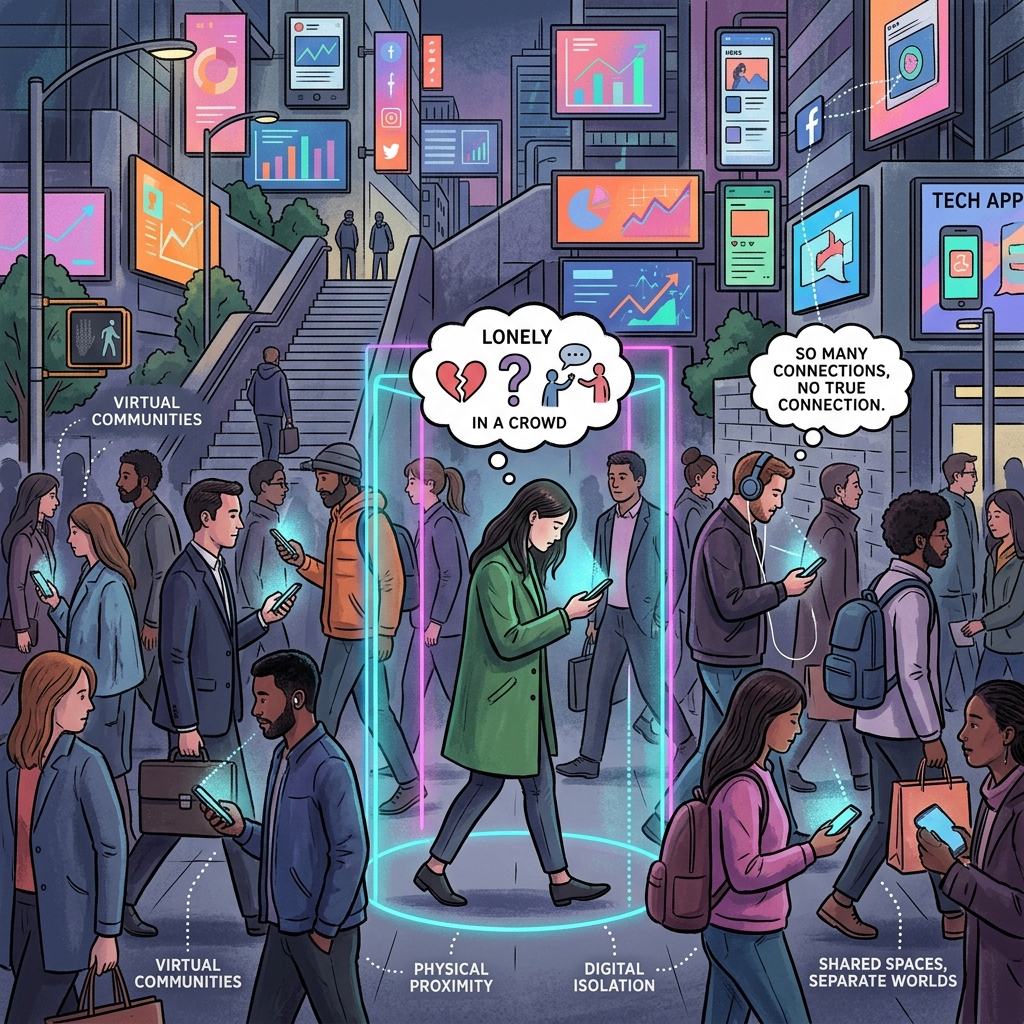
A global loneliness epidemic is silently claiming 871,000 lives every year, making it one of the quietest public health catastrophes in recorded history. Social isolation carries a mortality risk equivalent to smoking fifteen cigarettes per day — a finding formalized by the U.S. Surgeon General in 2023 and confirmed by the WHO in its landmark June 2025 report from the Commission on Social Connection. The generation that grew up most digitally connected in history is paradoxically the loneliest ever recorded, a contradiction that demolishes the popular assumption that social media is the primary driver of the crisis. Of the 194 WHO member states, only eight nations have developed any formal national loneliness policy, and even those eight — including the UK and Japan — have produced minimal structural change despite years of public effort and ministerial appointments. Loneliness is not a personal failing; it is the predictable outcome of an economic and urban system engineered over the past half-century to systematically dissolve the communities, workplaces, and public spaces that once made social life possible without effort.
Key Points
Loneliness Kills More Reliably Than You've Been Told — The Epidemiological Record
The U.S. Surgeon General's 2023 official advisory established that the mortality impact of social disconnection is equivalent to smoking fifteen cigarettes per day — a figure derived from medical data, not chosen for rhetorical effect. The WHO's June 2025 Commission on Social Connection report linked loneliness to approximately 871,000 deaths annually, translating to roughly 100 lives lost every hour around the clock. A meta-analysis of ninety cohort studies published in Nature Human Behaviour found that social isolation raises all-cause mortality risk by 35 percent, that loneliness independently adds 14 percent to that risk, and that living alone contributes a further 21 percent — these are additive risks operating through distinct biological pathways. Norway's Tromsø Study, tracking participants across thirty years from 1994 to 2023, independently confirmed adjusted hazard ratios of 1.46 to 1.51 among people reporting chronic loneliness, providing essential cross-validation for the shorter-term cohort studies. The downstream organ-level consequences compound the mortality picture: stroke risk rises 32 percent, heart disease risk climbs 29 percent, and dementia risk surges 50 percent among chronically lonely individuals compared to socially connected ones. Half of American adults currently report feeling lonely, and U.S. employers absorb an estimated $154 billion per year in loneliness-related absenteeism and productivity losses. The characterization of loneliness as an emotional inconvenience rather than a physiological threat is directly contradicted by every tier-one epidemiological dataset available.
Social Media Did Not Cause This — and the Data Proves It
The 2025 Annals of the New York Academy of Sciences study is arguably the most important piece of research in the loneliness policy conversation that almost no policymaker is actually citing when they reach for the regulatory toolkit. It found that social media use is only weakly associated with loneliness, explains only a small fraction of variance in loneliness scores across populations, and — most critically — there is no causal evidence that social media use produces loneliness in people who were not already experiencing it for other reasons. Australia introduced a nationwide social media ban for minors with significant political momentum, and Australian authorities have since acknowledged that evidence for its effectiveness is essentially nonexistent in the available data. The lonely person spending six hours a night on social media is using it because they have nowhere else to be and no one expecting them anywhere — the app is a destination of last resort, not the engine of the underlying emptiness. Stronger predictors of loneliness consistently identified in the research — economic precarity, social exclusion, physical isolation from third places — explain far more variance than platform usage patterns have ever accounted for. Treating social media as the primary villain of the loneliness epidemic allows governments, urban planners, and economists to escape scrutiny for the structural choices that actually drove decades of community dissolution. The policy implication is direct: restricting social media without addressing economic and spatial conditions will produce no measurable reduction in population-level loneliness.
The Economy Is Engineering Loneliness Through Deliberate Design Choices
A 2025 British Journal of Sociology study found that gig workers in high-dependency arrangements experience loneliness at roughly twice the rate of traditionally employed workers — a gap that has nothing to do with personality type or social aptitude. The mechanism is entirely structural: no fixed employer means no workplace community; no stable schedule means no consistent colleague relationships that compound over time; no shared physical space means no ambient social contact that once made the workday a de facto community experience by default, regardless of whether anyone consciously intended it. PubMed research on socioeconomic determinants confirms that social disconnection concentrates disproportionately among low-income populations, ethnic minorities, and communities that are economically or geographically isolated from centers of economic activity and social infrastructure. Carleton University's published academic analysis describes neoliberalism as systematically normalizing a culture of loneliness, enabling lonely behaviors at scale, and institutionalizing systemic alienation across fifty years of policy choices framed as market efficiency. The cumulative economic cost of this structural loneliness is staggering: $406 billion annually in U.S. absenteeism costs alone, plus $2.5 billion in UK employer costs and an amount equivalent to 1.17 percent of Spain's entire GDP. Half a century of labor flexibility mandates, housing market deregulation, and platform economy expansion has dismantled the community infrastructure that once made incidental daily social contact an automatic feature of ordinary life. This did not happen by accident; it happened through deliberate policy decisions with traceable economic beneficiaries.
Only 8 of 194 Countries Have a National Loneliness Policy — The Policy Vacuum Is Structural
A 2025 ScienceDirect scoping review covering all 194 WHO member nations found that only eight countries — Denmark, Finland, Germany, Japan, the Netherlands, Sweden, the United Kingdom, and the United States — have any national policy explicitly addressing loneliness and social isolation as a population-level concern. That is 4.1 percent of the world's countries formally responding to a crisis that claims 871,000 lives per year and costs global economies hundreds of billions annually. The UK's 2018 appointment of the world's first Minister for Loneliness and subsequent national strategy for connection generated significant international attention and genuine optimism, but the UK parliament's own research briefing acknowledges that much more needs to be done to achieve meaningful change and that there is little known about the actual effectiveness of the public awareness campaigns that formed the strategy's centerpiece. Japan appointed a Minister of Loneliness and Social Isolation in 2021, committed six billion yen in emergency funding, and passed enabling legislation in 2024 — yet reported 76,020 solitary deaths in that same year, a figure that speaks for itself. The root cause of implementation failure in both countries is chronic underfunding of local government: the policy architecture gets built at the national level, but the execution budget never reaches the community level where the actual work must occur. The pattern of loneliness policy narrowing to health ministry jurisdiction rather than spreading across labor, housing, urban planning, and finance departments means the structural causes of the epidemic remain politically untouched regardless of how many ministers are appointed.
Medicalizing Loneliness Is an Alibi for Structural Responsibility, Not a Path to Solutions
The 2026 NCBI systematic review confirmed that cognitive behavioral therapy produces moderate-to-large effect sizes for reducing loneliness at the individual level — a finding that is genuinely important and should not be dismissed in the appropriate clinical context. But deploying therapy as the primary societal response to loneliness created by gig employment, unaffordable housing, and neighborhoods stripped of public gathering spaces is a category error with real consequences: it treats the symptom while actively worsening the structural causes, and it provides political cover for the governments and economic actors who created those causes. The National Academies of Sciences described the disappearance of third places — neighborhood bars, independent bookstores, community diners, public libraries — as a public health crisis rather than a market adjustment, and post-pandemic library visit data showing a 44 percent decline compounded by federal funding cuts demonstrates that the structural driver is accelerating, not reversing. Social prescribing, the UK-pioneered approach of linking lonely individuals to community activities through healthcare referrals, has expanded internationally but researchers consistently acknowledge that its evidence base is weak and outcomes are difficult to quantify at the population scale needed to matter. The real solutions — redesigning cities to incorporate accessible third places, shortening work hours so people have time to form relationships outside of managed contexts, and investing publicly in community infrastructure as seriously as in transportation infrastructure — require governments to accept structural responsibility rather than outsourcing it to clinical psychology departments. The medical framing of loneliness is more politically convenient than restructuring labor markets and rebuilding urban commons, which is precisely why it keeps winning the policy debate.
Positive & Negative Analysis
Positive Aspects
- The WHO Reframing Has Fundamentally Changed the Terms of the Debate
The WHO Commission on Social Connection's three-year body of work — establishing loneliness as a public health crisis rather than a personal character deficiency — represents a genuine historical inflection point in how societies are authorized to discuss this problem at the political level. This is analogous to the moment when smoking was reframed from a personal lifestyle choice to a secondhand-harm public health issue: the reframing didn't immediately solve anything, but it changed which policy responses became politically legitimate and which actors bore responsibility for outcomes. WHO Director-General Tedros's public statement acknowledging that in this era of supposedly unlimited digital connection, growing numbers of people are isolated and deeply lonely signals that the international community can no longer treat this as a private matter best handled through self-help. Nordic countries — Denmark, Finland, and Sweden — have begun adopting cross-ministerial approaches that integrate loneliness into labor, housing, and urban planning policy rather than confining it within health ministry budgets. The shift from people need to be more sociable to why are structural conditions making it impossible for so many people to form connections is a necessary prerequisite for any real change, and that shift is now measurably underway in at least some policy environments.
- Seoul's Maeum Pyeonijeom Proved That Unmet Demand for Connection Is Overwhelming
Seoul's five-year No Loneliness or Isolation city initiative — funded at roughly $240 million equivalent — achieved 1,192 percent of its target participation rate in the Maeum Pyeonijeom community drop-in program, spaces where lonely residents can arrive without appointments, without fees, and without social prerequisites and simply talk to someone. That figure does not describe a modestly overperforming program; it describes an almost complete collapse of the gap between supply and the scale of unmet demand, and it constitutes the most powerful empirical argument available against the claim that people are too disengaged or too lazy to want community connection. South Korea's baseline context makes the result unsurprising but no less instructive: 21.1 percent of the national population reports loneliness, 62.1 percent of single-person households in Seoul experience chronic loneliness, and 66 percent of Koreans aged forty to sixty-four report feeling lonely regularly. The lesson is directly portable to other contexts: when government creates genuinely accessible connection infrastructure — free to use, no appointment required, no social performance expected — people show up in numbers that obliterate the original projections. The supply of community infrastructure is the binding constraint, not the demand for it.
- The Economic Return on Investment for Loneliness Interventions Is Quantitatively Established
A PMC systematic review calculated the social return on investment for loneliness interventions at $2.28 to $13.72 for every dollar invested — a range that provides genuine economic justification for treating loneliness as an infrastructure investment rather than a compassion expenditure, which is a significant political and rhetorical shift that matters enormously for budget negotiations. The full cost picture strengthens the case further: $154 billion annually in U.S. employer absenteeism and productivity costs, $6.7 billion in additional Medicare expenditure attributable to loneliness-related health conditions, £2.5 billion in UK employer losses, and $14 billion in Spain — 1.17 percent of the country's entire GDP — are numbers that belong in infrastructure cost-benefit analyses, not in social services budgets. The preventive investment argument becomes even more compelling when the dementia linkage is added to the calculation: social isolation combined with loneliness raises dementia risk by 1.71 times, and isolated individuals face a 117 percent elevated Alzheimer's risk specifically, meaning that the healthcare cost of dementia at population scale massively dwarfs any credible public investment in community infrastructure. When this arithmetic becomes standard in government budget frameworks — as it should, and as the evidence demands — the financial case for public space, third places, and community programming becomes obvious rather than merely compassionate.
- Urban Design Innovation Provides a Scalable, Evidence-Based Template
Spain's plaza model — urban spaces deliberately configured to generate spontaneous human interaction through their physical design rather than through programming or staffing — demonstrates that city design can systematically build community connection into the built environment rather than hoping it emerges organically from economic and market forces that are structurally opposed to it. The National Academies of Sciences' conclusion that third-place erosion constitutes a public health crisis implies, by simple inversion, that third-place creation is a public health investment that belongs in the same budget conversations as hospital infrastructure and public transit. Cities currently experimenting with pedestrian-priority districts, mixed-use neighborhoods with accessible ground-floor community spaces, and public squares that make lingering comfortable rather than commercially marginal are generating outcome data we can already observe and compare. Multigenerational programming — combining young adults and elderly residents in shared housing projects or regular activity programs — is gaining research support as an approach that simultaneously addresses age-based isolation at both ends of the demographic spectrum. The architectural and planning imagination for building connection into cities rather than designing it out of them already exists in tested form; the remaining constraint is the political will to prioritize social infrastructure over real estate revenue maximization when those two objectives conflict.
- The Mortality Data Will Force a Political Tipping Point Eventually
The accumulation of loneliness-mortality evidence is following a trajectory that has produced structural policy responses to other embedded crises before, and the structural parallel to tobacco policy is not superficial. When lung cancer data became undeniable, tobacco policy shifted from individual choice framing to structural regulation across dozens of countries, and global tobacco-related death tolls declined measurably as a result — a policy success story that took decades but eventually happened. The loneliness-dementia causal linkage is approaching an equivalent evidentiary saturation point now, and its policy implications are equally structural in nature: you cannot treat your way out of a dementia crisis that is being generated by social isolation at population scale. Every year that 871,000 people die and that figure is publicly reported with WHO authority, the political cost of continued structural inaction increases in measurable ways. OECD and WHO standardization of loneliness measurement tools is creating an international benchmarking infrastructure that will enable country-to-country comparison and accelerate policy competition. The political tipping point — when ignoring the structural problem becomes more costly than addressing it — may still be five to ten years distant, but every year of data accumulation and demographic aging moves it measurably closer.
Concerns
- Loneliness as a Function of Poverty Is Systematically Ignored in Policy Design
WHO data shows the loneliness rate in low-income countries is 24 percent — more than double the 11 percent rate in high-income countries — and African regions specifically report 24 percent loneliness rates, more than double the European figure of approximately 11 percent. Brazil appears near the top of global loneliness indices repeatedly, reflecting the simultaneous destruction of community bonds through rapid urbanization, economic austerity measures, social prejudice, and political polarization that few countries have experienced at that combined intensity. Female adolescents aged thirteen to seventeen report the highest loneliness rate of any demographic group globally at 24.3 percent, a figure that sits at the intersection of gender, developmental stage, and the particular social pressures that concentration produces. Virtually every national loneliness policy currently in existence was designed by and for high-income countries, meaning the populations experiencing the highest absolute loneliness rates — heavily concentrated in low- and middle-income nations — receive essentially zero policy attention from the international community. The framing of the loneliness epidemic as a problem of wealthy, over-connected societies failing to appreciate their good fortune while ignoring its most concentrated manifestation in economically marginalized communities is not just analytically incomplete; it is an ethical failure that deserves to be named explicitly.
- Solitary Deaths Are Rising as a Leading Indicator of What Aging Societies Face
Japan recorded 76,020 solitary deaths — kodokushi — in 2024, with 76.4 percent of victims aged sixty-five or older, despite years of dedicated ministerial appointments, emergency funding commitments, and legislative action specifically targeting social isolation among the elderly. South Korea recorded 3,924 solitary deaths in 2024, a 7.2 percent year-over-year increase and approximately 20 percent higher than five years prior, with the trend showing no sign of deceleration. A survey of 3,000 single-person households in Seoul found that 62.1 percent experience chronic loneliness, and South Korea estimates 540,000 hikikomori — individuals who have largely withdrawn from ordinary social participation altogether. Among South Koreans aged forty to sixty-four, 66 percent report loneliness and 15.8 percent are assessed as meeting criteria for social isolation. These two societies, which are demographically among the most aged in the world, are functioning as leading indicators for trends that Germany, Italy, Spain, Canada, and dozens of others will face within a decade or less as their demographic curves catch up. The countries failing to take the East Asian solitary death data seriously now are precisely the countries that will be least prepared when their own projections arrive.
- AI Companions Are Commodifying Loneliness Rather Than Addressing Its Structural Source
Replika has 30 million users, Character.ai has 20 million, and the global AI companion market is projected to reach $140.7 billion by 2030 — making loneliness itself one of the fastest-growing consumer market categories in the technology sector. Harvard Business School research confirmed that AI companions reduce self-reported loneliness in the short term, a finding the industry will deploy as its primary regulatory defense in every jurisdiction that attempts to regulate it. MIT Media Lab research found that heavy daily AI companion use is associated with greater long-term social isolation rather than reduced isolation — the more important finding for anyone thinking about systemic effects rather than individual-session outcomes. The American Psychological Association raised formal ethics concerns in early 2026 about emotionally manipulative design patterns deliberately engineered into these platforms, including aesthetic and relational choices calibrated to maximize dependency rather than healthy human development. The fundamental economic problem is structural and unavoidable: once loneliness becomes a $140 billion industry, the financial incentive rewards maintaining loneliness rather than eliminating it — a cured customer is a lost revenue stream, and that dynamic creates a permanent conflict of interest between industry profitability and the public health outcome society actually needs.
- Government Loneliness Policy Is Trapped in a Structural Self-Contradiction
The United Kingdom demonstrates the central contradiction most nakedly: a national government simultaneously appointing a Minister for Loneliness and imposing austerity measures on local councils — the very institutions responsible for funding the libraries, community centers, parks programs, and social services that constitute the third-place infrastructure any loneliness strategy requires to function. Japan has ministerial appointments, enabling legislation, emergency funding allocations, and a track record of international attention — and kodokushi deaths continue climbing year after year despite all of it. Of 194 WHO member nations, only eight have any national policy, and those eight are individually struggling to move beyond symbolic gestures. The pattern repeats across different national contexts because the actual structural causes of loneliness — labor market design, housing market conditions, urban planning priorities, and the political decision to allow public gathering space to be converted to commercial uses — sit in ministries that rarely coordinate with health ministries in any substantive way. As long as loneliness policy is treated as a single-ministry health concern rather than a cross-governmental infrastructure challenge spanning labor, housing, planning, finance, and urban design, the policy apparatus will document the crisis with increasing precision while leaving its causes entirely untouched.
- Third-Place Collapse Is Deepening Social Inequality Along Geographic and Economic Lines
Post-pandemic data shows library visits in the United States dropped 44 percent before federal funding for those same libraries was cut further, compounding the decline. The neighborhood bar, the independent bookstore, the community diner, the church hall: all disappearing rapidly under pressure from rising commercial rents, franchise chain expansion, and car-centric development patterns that make walking to any gathering space increasingly impractical for residents without reliable personal transportation. The National Academies of Sciences research is explicit that low-income neighborhoods and rural communities bear the heaviest burden of third-place loss — meaning the communities that most need accessible, free, low-barrier gathering infrastructure are losing it at the fastest rate. In wealthier urban neighborhoods, paid alternatives are filling the gap: specialty coffee shops, co-working spaces, private fitness and wellness clubs, membership-based social organizations. These alternatives cost money that low-income residents do not have and create social environments that select strongly for particular demographics, eliminating the incidental cross-class social mixing that historically characterized genuine third places and made them powerful engines of social cohesion. The result is an emerging geography of connection: some neighborhoods are designed for human encounter and others are designed for throughput, and the division tracks economic class lines with a consistency that should alarm anyone who believes social cohesion matters for democratic stability.
Outlook
The most politically consequential near-term development is the delivery of the WHO Commission on Social Connection's final policy recommendations to member governments as the Commission's three-year mandate concludes in 2026. While these recommendations carry no binding legal force, the political weight of a number tied to 871,000 annual deaths is not trivial, and the Commission's international profile has already elevated this issue in ways that would have been unimaginable ten years ago. I expect the recommendations to function as a modest catalyst for an expansion in the number of countries adopting formal loneliness frameworks — particularly English-speaking Commonwealth nations like Canada, Australia, and New Zealand, which have the political and administrative infrastructure to adapt from the UK model relatively quickly. Canada's own OECD data already shows that Canadians aged fifteen to twenty-four experience loneliness at nearly double the rate of those over sixty-five, providing ready political justification for action. That said, I want to be blunt about the distinction between adopting a policy document and actually changing the conditions that produce loneliness: Britain invented the loneliness minister and still achieved limited impact, largely because chronic underfunding of local government made the strategy unexecutable in practice. Document proliferation without budget reallocation is political theater.
Simultaneously, the AI companion regulatory conversation is moving toward seriousness in the near term. With Replika at 30 million users and Character.ai at 20 million, the scale is no longer niche enough to ignore, and the APA's 2026 formal ethics objections to emotionally manipulative design patterns — including what they characterized as racialized and gendered aesthetic choices deliberately built into these platforms — have opened regulatory space under the EU AI Act's forthcoming subregulations. In the United States, the calculation that loneliness-related care burdens Medicare by an estimated $6.7 billion annually is beginning to attract attention from fiscal conservatives who had no prior interest in the social connection debate. American employers, facing $154 billion per year in loneliness-related productivity losses, are starting to add social connection programming to employee wellness offerings as a cost-reduction measure rather than a compassion initiative. I think these developments are positive as far as they go, but I remain fundamentally skeptical that employer wellness budgets — historically the first line item eliminated in an economic downturn — represent a durable structural solution to what is at its core a structural problem that predates any individual employer.
The six-month-to-two-year window is where I believe the real policy paradigm fork will actually occur. The optimistic path looks like this: WHO recommendations catalyze a genuine shift in government thinking from individual-level psychological intervention toward social infrastructure investment — redesigned urban spaces, expanded public third places, and a policy connection between rising gig work rates and rising loneliness rates that forces labor and planning ministries to engage with territory previously reserved for health ministries. Seoul's Maeum Pyeonijeom program, with its 1,192 percent overachievement of participation targets, is the single most compelling demonstration that latent demand for accessible community connection is overwhelming wherever the supply side is adequately resourced. Spain's plaza model shows that intentional urban design can systematically generate spontaneous human interaction without requiring any program or staff. The social return on investment data — $2.28 to $13.72 per dollar invested in loneliness interventions — gives finance ministries a vocabulary to frame this as infrastructure investment rather than welfare expenditure. If solitary death statistics from Japan and South Korea begin to function as the warning signal they should for other aging societies, a genuine wave of preventive public investment becomes conceivable within this timeframe.
The more realistic mid-term scenario — which I assign a 50 percent probability — is considerably less optimistic. Most governments will continue to classify loneliness as a health ministry matter and fund individual-level responses: more therapy referrals, more social prescribing programs, more public awareness campaigns about the importance of calling a friend. The gig economy will continue to expand, meaning the structural factor responsible for a twofold loneliness premium among gig workers gets larger, not smaller, with every passing quarter. Global mental health spending was approximately $477 billion in 2024 and is on a trajectory to exceed $700 billion by 2028; under a business-as-usual scenario, much of that growth gets absorbed by loneliness-related mental health conditions without any reduction in the underlying loneliness rate that is generating the demand. The global loneliness rate — currently around 17 percent — stagnates or drifts upward toward 19 percent over this period. National loneliness policy adoption climbs from eight countries to perhaps fifteen or twenty, but structural change doesn't follow the policy documents. A published strategy is not a plaza. A minister's portfolio is not a neighbor.
Looking out to 2028 through 2031, three variables will ultimately determine which trajectory we actually land on. The first is the pace of demographic aging: by 2030, the global population of people over sixty will exceed 1.4 billion, and research confirms that social isolation combined with loneliness raises dementia risk by 1.71 times, while isolated individuals face a 117 percent elevated risk of Alzheimer's onset specifically — not a footnote, but a forecast of fiscal and medical catastrophe for every society that treats social connection as a soft issue. The second variable is what happens to urban space: will cities actively resist third-place erosion, or will commercial real estate pressure continue to convert every underperforming public gathering space into a higher-margin private use? The 44 percent post-pandemic decline in U.S. library visits, compounded by subsequent federal funding cuts, suggests the current directional arrow is pointed the wrong way. The third variable is what the AI companion industry actually does — not what regulators tell it to do, but what it decides based on its own incentive structure — because at $140 billion in projected market size by 2030, it will command more lobbying capacity than many governments have regulatory bandwidth to counter.
The bear scenario — which I assign a 30 percent probability and which genuinely troubles me — unfolds like this: neoliberal labor flexibility accelerates through continued gig economy expansion, public infrastructure continues to contract through austerity and political disinvestment, and the third-place ecosystem essentially disappears from everywhere except wealthy urban neighborhoods where expensive private alternatives fill the gap. AI companions absorb an increasing share of the emotional labor once distributed across human relationships, providing just enough short-term relief to consistently delay the political urgency that structural reform requires. Policymakers, reassured that the market is managing the problem through technology, defer indefinitely the public investments that could actually alter community infrastructure at the necessary scale. Solitary death trends visible in South Korea and Japan spread to Western European and North American cities that are demographically two decades behind. Global mental health expenditure crosses $14 trillion cumulatively by 2040. Democratic participation declines as chronically isolated individuals disengage from civic institutions and become more susceptible to authoritarian political narratives that offer engineered belonging as a political product — transforming the loneliness epidemic from a public health story into a democratic stability crisis.
The bull scenario — which I assign a 20 percent probability — requires a policy momentum shift that has historical precedent but remains politically rare in execution. The smoking policy analogy comes to mind repeatedly as the closest structural parallel: individual-choice framing dominated tobacco policy for decades, then the accumulation of secondhand smoke evidence forced a structural regulatory response that has since demonstrably saved millions of lives across multiple generations. If the linkage between loneliness and dementia — social isolation raising Alzheimer's risk by 117 percent, combined loneliness and isolation raising dementia risk by 1.71 times — becomes as politically inescapable as lung cancer data became for tobacco regulation, the medical cost argument alone could force governments to act on the structural conditions that generate loneliness rather than continuing to fund only individual-level responses. In this scenario, WHO recommendations drive genuine urban design reform in enough major cities to create a visible, measurable feedback loop: cities that invest in public space and accessible third places produce demonstrably lower loneliness rates, which produce lower healthcare costs, which justify further investment in a virtuous cycle. The SROI data becomes a standard entry in infrastructure cost-benefit analyses submitted to finance ministries. By 2031, global loneliness rates decline from approximately 17 percent toward 12 to 13 percent. Annual loneliness-related deaths fall from 871,000 toward 500,000 or below.
I want to close by acknowledging honestly where my analysis could be wrong. If technology companies redesign their platforms to optimize for connection quality rather than time-on-platform engagement metrics, social media and AI tools could contribute positively to reducing loneliness rather than serving as convenient but inadequate substitutes for it. If AI companions evolve toward relationship training tools that complement rather than substitute for human interaction — helping people with severe social anxiety build the skills and confidence to seek in-person connection — they could serve a genuinely beneficial function rather than the salt-water role I described earlier. The SROI data — $2.28 to $13.72 per dollar invested — will only become more compelling as evidence accumulates, and if that range becomes standard knowledge among finance ministers and budget directors, the political calculus for preventive infrastructure investment could shift faster than my base-case scenario suggests.
The loneliness-dementia data will only accumulate from here, and the political cost of inaction will only grow with every year of demographic aging and every solitary death that makes national headlines. My best estimate is that we are somewhere between five and ten years from the equivalent of the secondhand smoke moment for loneliness policy — the point at which ignoring the structural problem becomes more politically costly than addressing it, and the tools for action are already sitting in the published evidence base waiting to be used. Until that moment arrives, three practical suggestions: stop framing your own loneliness as a personal moral failure, because population-level data makes that diagnosis impossible to sustain; find and actively use a third place in your physical community with no transactional purpose attached; and treat the presence or absence of accessible public gathering space in your neighborhood as a legitimate political demand, not merely a personal preference.
Sources / References
- WHO Commission on Social Connection: Social Connection Linked to Improved Health and Reduced Risk of Early Death — WHO
- Our Epidemic of Loneliness and Isolation: The U.S. Surgeon General's Advisory on the Healing Effects of Social Connection and Community — U.S. Surgeon General / NCBI
- Social Isolation and Loneliness and Their Associations with All-Cause Mortality: A Systematic Review and Meta-Analysis of 90 Cohort Studies — Nature Human Behaviour
- Social Media Use and Loneliness: No Evidence That Social Media Use Causes Loneliness — Annals of the New York Academy of Sciences
- Gig Economy Work and Mental Distress: Loneliness as a Structural Mediator — British Journal of Sociology
- National Policies Addressing Loneliness and Social Isolation: A Scoping Review of 194 Countries — ScienceDirect
- Economic Costs of Loneliness and Social Isolation: A Systematic Review of the Evidence — PMC / NCBI
- Tackling Loneliness: The Government's Strategy and Progress to Date — UK House of Commons Library
- Loneliness, Social Isolation, and Risk of Dementia: A Systematic Review and Meta-Analysis — PMC / NCBI
- AI Companions and Emotional Connection: Trends in Digital Relationships — APA Monitor on Psychology