
India's Cockroach Movement Got a Minister's Head — But That Wasn't Even on Its Wish List
Summary
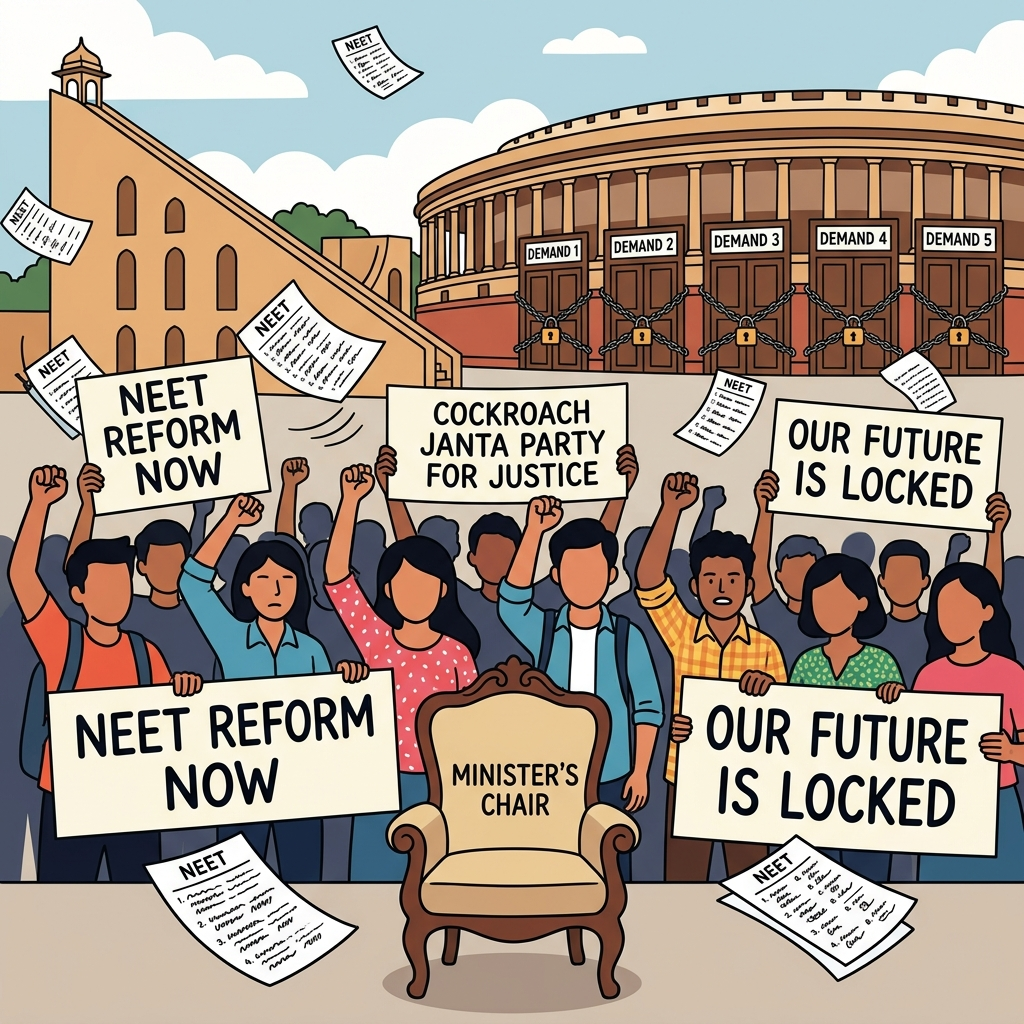
India's Cockroach Janata Party (CJP), born from Chief Justice Surya Kant's contemptuous "cockroach" remark in May 2026 and the NEET medical entrance exam leak scandal, sustained fifty consecutive days of protest at New Delhi's Jantar Mantar before forcing the resignation of Education Minister Dharmendra Pradhan on July 25 — the first time in twelve years of Modi governance that sustained public protest pressure drove a sitting cabinet minister from office. The movement proved that a Gen Z-led, meme-powered campaign operating entirely outside traditional party structures can produce tangible political results in Indian democracy, setting a precedent for future civic pressure campaigns. Yet the irony at the heart of the story is striking: Pradhan's resignation appeared on none of CJP's five manifesto demands, and his successor Pralhad Joshi received the Education Ministry as an additional charge layered on top of three existing portfolios — a signal that the government's commitment to educational reform is, at best, cosmetic. The structural fault lines underneath it all remain entirely untouched: 2.27 million applicants competing for 136,939 MBBS seats at roughly 16.6:1, compounded by over 90 documented exam leaks across two decades, a legal framework that exists on paper but is rarely enforced, and a youth unemployment paradox in which the more educated a young Indian is, the harder it becomes to find work. Whether CJP's unprecedented digital force of 22 million Instagram followers can eventually bridge the vast gap between online reach and ballot-box results — ahead of the 2027 state elections and 2029 general elections — will determine whether this moment is remembered as a democratic turning point or a cautionary tale about the limits of viral politics.
Key Points
NEET's Structural Flaw Built the Cockroach Movement's Foundation
Of the 2.27 million applicants who sat for NEET-UG 2026, only 136,939 MBBS seats were available nationwide — 63,296 in government institutions and 73,643 in private colleges, per NMC's official July 18 announcement — yielding a competition ratio of approximately 16.6:1 that makes a single leaked exam paper astronomically valuable in financial terms. This ultra-concentrated single-exam structure doesn't just attract fraud; it structurally incentivizes it, embedding the financial motive for leaks directly into the system's architecture in a way that cannot be addressed by changing a minister or doubling a fine. India has documented over 90 exam leaks and irregularities over the past two decades, with at least 15 involving centrally administered high-stakes examinations, and the Public Examinations (Prevention of Unfair Means) Act 2024 — already on the books — did nothing to prevent the 2026 NEET leak. When 120 out of 180 exam questions — two-thirds of the entire test — match materials circulated by coaching centers, and the exam is canceled nine days after administration, what you are looking at is not a routine security breach but a systemic failure of institutional integrity at the highest level. The Cockroach movement was not a response to a single bad actor; it was the predictable consequence of a system whose incentive structure practically guarantees periodic catastrophic failure, and no amount of surface-level political turnover addresses that underlying design problem.
The Chief Justice's Insult Got Reclaimed as the Movement's Identity
On May 15, 2026, Chief Justice of India Surya Kant, speaking during a contempt hearing, described certain unemployed young people as being "like cockroaches" and added that "parasites in society are attacking the system" — remarks that fell on an audience of NEET aspirants already raw with fury over a just-canceled exam and the theft of their futures. Two days later on May 17, the Chief Justice clarified that his target was specifically those who had entered legal and other professions using fake degrees rather than young people broadly — stating "It is totally baseless to suggest that I criticised the youth of our nation" while also noting "Such persons have sneaked into media, social media, and other noble professions and hence they are like parasites" — a clarification that repeated the word "parasites" and thereby handed CJP fresh ammunition rather than defusing the situation. CJP incorporated on May 16 under the name Cockroach Janata Party, founded by political communication strategist Abhijit Dipke, reclaiming the slur with the same logic as "Black Power" in the American civil rights movement and the LGBTQ community's reclamation of "Queer" — owning your attacker's weapon first makes it impossible to be attacked with it. By May 21, just five weeks after founding, CJP's Instagram account reached 11.8 million followers, surpassing BJP's official account at 8.7 million — a milestone achieved without party organization, legacy funding, or regional voter infrastructure — and the account eventually grew to 22 million, a number unprecedented in Indian political history for a non-legacy political organization. The reclaimed identity became the movement's most durable asset, one that no subsequent clarification or legal action could revoke, and the cultural power of that transformation will outlast any particular legislative or electoral outcome.
The Minister's Resignation Was a Concession Nobody Had Actually Demanded
Pradhan's voluntary resignation on July 25 — the first time in twelve years of Modi governance that sustained public protest drove a sitting cabinet minister from office — carried a fundamental irony: of CJP's five manifesto demands (banning post-retirement CJI Rajya Sabha appointments, prosecuting election commissioners under anti-terror law, reserving 50 percent of parliament and cabinet for women, revoking Adani and Reliance broadcast licenses, barring floor-crossers for twenty years), none specified Pradhan's departure. The government offered something it was never asked to give, and by doing so redirected public attention away from the structural reforms on CJP's actual agenda while leaving every single one of them completely untouched. Pradhan's resignation letter compounded the paradox: he simultaneously claimed to be stepping down "in the interest of students" and warned that protests must not be "used by anti-national forces" — a framing that denied the legitimacy of the very pressure that produced his departure — and his insistence that this was "not a matter of individual prestige" reads, in context, as a rhetorical admission that it was precisely that. What looked like democratic accountability in action was, on closer inspection, a political theater performance designed to generate the impression of accountability while preserving every actual lever of power undisturbed. This is not a concession but an alibi — and that distinction is essential to understanding what actually happened on July 25.
The Replacement Appointment Revealed the Government's Real Priorities
The day after Pradhan's resignation, July 26, Pralhad Joshi was named Education Minister — not as a dedicated appointee with the Education Ministry as his primary responsibility, but as an additional charge layered on top of his existing portfolios for Consumer Affairs, Food, and New and Renewable Energy, meaning a minister already overseeing three departments was handed a fourth as a bureaucratic afterthought. The signal this sends is unambiguous: the government regards the Education Ministry as a portfolio manageable on the side, not a national crisis requiring focused and dedicated leadership — which is a categorical and direct answer to the fifty days of protest that demanded serious educational reform. The anti-exam-fraud bill's simultaneous movement through parliament (Cabinet approval July 24, Lok Sabha introduction July 27, vote delayed by opposition pushback) suggests the government is managing public optics rather than addressing substance, since the bill's fine increases and fast-track courts target the symptoms of exam fraud while leaving the root cause — a 16.6:1 competition ratio that makes leaks structurally profitable — completely unaddressed. Congress MP Imran Masood's observation that "the CBI hasn't even filed a chargesheet yet" against those responsible for the 2026 leak identifies the enforcement gap that no new legislation can close on its own. The distance between legislative action and institutional will to enforce it is, in Indian governance terms, a well-documented and recurring pattern, and it is the actual variable to watch in the months ahead.
The Gap Between Online Reach and Electoral Power Is the Defining Challenge
CJP's 22 million Instagram followers represent an unprecedented digital mobilization achievement in Indian political history, accomplished in weeks without traditional party infrastructure, but the pathway from that number to actual electoral influence remains entirely uncharted and unproven by any available evidence. As an unregistered political party, CJP cannot directly field candidates in the 2027 state elections covering Uttar Pradesh, Punjab, Uttarakhand, Goa, and Manipur — elections that represent the first meaningful opportunity to measure whether protest energy translates into ballot-box outcomes. No published polling data measuring CJP's actual electoral support exists, CJP's X account with roughly 90,000 followers was blocked on June 21 in what reads as a demonstration of the government's willingness to use platform suppression as a political tool, and the empirical global record of social-media-born political movements successfully converting digital reach into sustained electoral results is, at best, thin. CJP faces a structural choice between pursuing formal electoral registration with its substantial demands and constraints, or building informal coalition arrangements with established opposition parties that risk diluting its independent identity and agenda. The movement demonstrated that Gen Z can mobilize digitally at unprecedented scale and translate that into physical street presence; what it has not yet demonstrated is whether that mobilization can survive first serious contact with Indian electoral mechanics.
Positive & Negative Analysis
Positive Aspects
- Mass Protest Forced the First Cabinet Resignation in Twelve Years of Modi Rule
Pradhan's July 25 resignation marks the first time in twelve years of Modi governance that sustained mass protest pressure drove a sitting cabinet minister from office, demonstrating that civil society pressure operating entirely outside traditional political party structures can still produce tangible and measurable political outcomes in Indian democracy. The protest ran for 50 consecutive days from June 6 to July 25, with the July 20 Sansad Chalo March bringing tens of thousands into the streets in physical confrontation with police, proving this was not merely an online phenomenon but a movement with substantial physical presence and the organizational capacity to translate digital reach into street-level mass action. Compared with the broader South Asian Gen Z protest wave — Sri Lanka 2022, Bangladesh 2024, Nepal 2025 — India's case stands out for producing visible political accountability at the cabinet level without the fatalities and institutional rupture that characterized those episodes: Nepal alone saw 76 deaths and parliamentary dissolution in the aftermath of protest success. The precedent established here is real and consequential: India's next generation of civic activists now has a demonstrated playbook showing that converting digital mobilization into physical mass action and then into political pressure that the government responds to is achievable, even if the concession was deliberately limited in scope. This doesn't mean the system delivered genuine reform — the concession was carefully calibrated — but it proves that the channel from organized protest to governmental accountability is not completely closed in contemporary India.
- Gen Z Demonstrated a New and Replicable Template for Political Participation
CJP's achievement of 11.8 million Instagram followers by May 21 — surpassing BJP's official account at 8.7 million within five weeks of founding, without party organization, regional voter base, or legacy funding — constitutes a real-world proof of concept that political influence can be built at scale through identity and community rather than institutional infrastructure. The "cockroach" rebranding, executed by political communication strategist Abhijit Dipke, demonstrates that the most powerful political brands can emerge from the reclamation of opponents' attacks — a strategy with deep historical precedent in Black Power and LGBTQ identity politics that CJP executed at the speed and scale made possible by social media platforms in ways that no prior generation of Indian activists had access to. The movement's founding itself on May 16 — before even the CJI's clarification arrived on May 17 — shows a political instinct for decisive action and narrative ownership that traditional party bureaucracies with their internal deliberation processes rarely display. The fact that CJP's growth to 22 million followers continued despite the blocking of its X account on June 21 suggests organizational resilience and platform diversification capacity that is not dependent on any single channel — exactly the kind of redundancy a political movement needs to survive systematic suppression attempts. This template — convert a symbolic offense into an identity, build an online community at scale, pivot to physical action, and sustain pressure — is genuinely new in Indian political history and will be studied, adapted, and imitated across the political spectrum.
- Protest Pressure Accelerated Anti-Leak Legislation That Would Have Moved Far More Slowly Otherwise
Whatever its ultimate enforcement fate, the anti-exam-fraud bill's accelerated path through the Cabinet and into the Lok Sabha — a process that almost certainly would have moved far more slowly, if at all, without 50 days of sustained public pressure — represents a measurable legislative consequence of the Cockroach movement's agenda-setting power. The bill's substantive content, including a twentyfold fine increase from ₹50 lakh to ₹10 crore, a ten-year maximum prison sentence, and fast-track courts with 60-day investigation and three-month trial deadlines, is a materially stronger legal framework than the one that existed when the 2026 NEET leak occurred, even if the existing framework's failure was fundamentally one of enforcement rather than text. The legitimate critique — that the existing 2024 law wasn't enforced so a stronger law won't automatically be either — is correct but incomplete: it doesn't negate the fact that a legislative response of this scale and speed would not have entered the parliamentary pipeline without CJP's sustained mobilization creating political urgency. Getting a bill into the legislative process, even one whose enforcement is uncertain, is a meaningfully different outcome from leaving the legal framework unchanged and allowing the government to claim the situation requires no further attention. Whether the bill eventually clears the Rajya Sabha and is actually enforced will determine whether this counts as a genuine legislative achievement or a performative gesture, but the movement's agenda-setting function is already demonstrated.
- India Achieved Visible Accountability With the Lowest Human Cost in South Asia's Gen Z Wave
Among South Asia's recent wave of Gen Z-led political protests, India's Cockroach movement achieved the highest ratio of visible political outcome to human cost of any comparable episode in the region's recent history. Sri Lanka's 2022 protest resulted in a presidential resignation after roughly four months of sustained action; Bangladesh's 2024 protest led to the prime minister's departure within three weeks; Nepal's 2025 protest ended with a prime minister's resignation in five days but left 76 people dead and parliament dissolved in the aftermath, triggering a period of democratic fragility. India's outcome: one cabinet minister's resignation after 50 days, with no fatalities and democratic institutions remaining structurally intact. That outcome is simultaneously more modest in scope and more sustainable in consequence — the absence of deaths and institutional rupture means Indian democracy's basic architecture absorbed the protest pressure without shattering, which matters enormously for the long-term health of civil society's ability to continue organizing. The institutional absorptive capacity that limited the Cockroach movement's immediate impact also, paradoxically, is what made the protest period survivable for all parties involved, and a protest movement that can produce accountability without triggering systemic democratic collapse is, from the perspective of long-term civic health, closer to the ideal type than the more dramatic but more destructive alternatives seen elsewhere in the region.
Concerns
- Unregistered Party Status Blocks Direct Electoral Participation at the Critical Moment
CJP's most fundamental structural constraint is that it is not registered with the Election Commission of India, which means it cannot place candidates on a ballot in any upcoming election — including the 2027 state elections in Uttar Pradesh (403 seats), Punjab, Uttarakhand, Goa, and Manipur that represent the first real opportunity to test whether protest energy converts into ballot-box outcomes. Twenty-two million Instagram followers cannot vote for a party that isn't on the ballot, and the pathway from digital following to effective political participation requires either formal party registration — a process with substantial bureaucratic, legal, and financial requirements that take significant time and institutional capacity to navigate — or coalition arrangements with established opposition parties that risk diluting CJP's independent agenda and identity into the compromises of existing partisan structures. No polling data exists to gauge CJP's actual support levels among likely voters in any constituency, making any prediction about its electoral potential speculative rather than evidence-based, and the empirical global record of social-media-first political movements successfully translating digital reach into sustained electoral success is considerably thinner than their digital prominence would suggest. The X account blocking on June 21 demonstrates the government's readiness to use platform suppression as a political tool, creating a real vulnerability for a movement whose reach is heavily concentrated in digital channels that can be administratively restricted with limited procedural recourse. Unless CJP resolves the registration-or-coalition dilemma within the next year, the 2027 elections will pass without a meaningful empirical test of whether the movement's digital mass can actually move ballots, and the question of its political viability will remain permanently open to dispute.
- The "Anti-National Forces" Framing Sets Up Future Crackdowns Under Security Narratives
The language in Pradhan's resignation letter — specifically, his warning that protests must not be "used by anti-national forces" — is not casual political rhetoric but a deliberate framing choice that establishes the government's advance justification for suppressing future civic protest under national security narratives. When a sitting minister uses official resignation language to categorize protesters as potentially serving "anti-national" interests, it creates a rhetorical template that subsequent officials can invoke to delegitimize any future CJP action, regardless of how peaceful or constitutionally protected that action may be. In India's current legal environment, the line between "anti-national" framing and the invocation of laws like the Unlawful Activities Prevention Act against movement organizers is narrower than most outside observers realize, and once that label sticks in the public narrative, the burden of legitimacy shifts from the government to the protesters. The June 21 blocking of CJP's X account — executed the day before the NEET retake, under the facially neutral justification of preventing "confusion" — was the first operational deployment of this playbook, using administrative authority to suppress the movement under a pretext while the actual purpose was political damage limitation. Nepal's 2025 case, where protest success was followed by severe institutional rupture including 76 deaths and parliamentary dissolution, gives the Modi government a reference point for both what to avoid and potentially for how to justify escalating suppression as "preventing chaos." CJP will need to build sophisticated counter-framing capacity, robust legal defense infrastructure, and redundant platform presence if it intends to continue operating at scale beyond the current phase.
- Four of Five Manifesto Demands Have Near-Zero Near-Term Feasibility
Four of CJP's five manifesto demands — banning CJI post-retirement Rajya Sabha appointments, reserving 50 percent of parliament and cabinet for women, revoking Adani and Reliance media broadcast licenses, and imposing 20-year electoral bans on floor-crossers — each directly threaten the core institutional interests of India's existing political establishment in ways that give every current political actor, not just BJP, strong structural incentives to block them regardless of stated ideological positions. Media license revocation is particularly fraught: it implicates press freedom norms recognized under international law, would face immediate constitutional challenge in Indian courts, and would draw criticism from global press freedom organizations in ways that any Indian government — BJP or opposition — would want to avoid. The women's reservation demand, while constitutionally grounded in principle, requires the cooperation of the very male-dominated legislative majorities that would directly lose seats as a consequence of its implementation. The CJI appointment and floor-crossing demands require constitutional or legislative amendments that the political class as a whole, across party lines, has structural reasons to resist for self-interested reasons that transcend any particular partisan calculation. These demands function powerfully as a vision statement — "here is the system we want" — but not as a near-term negotiating roadmap, because no actor in the existing system has the incentive to unilaterally grant them, and the danger is that when supporters realize how little of this agenda is achievable in the short run, the resulting disillusionment could accelerate the movement's organizational decline before it has built the infrastructure to pursue longer-term change.
- Strategic Concession Repeatedly Absorbs Movement Energy Without Structural Reform
The Modi government's 2021 farm law repeal established a clear pattern: strategic concessions that manage political damage while preserving the fundamental structures of power — and Pradhan's resignation follows exactly this template, executed in 50 days instead of 12 months, suggesting the government has refined rather than abandoned this approach. After the farm law repeal in November 2021, BJP won UP with 255 seats — down 57 from the 312 of 2017, but still a majority victory — demonstrating that well-timed strategic retreat can prevent electoral catastrophe while allowing seat erosion to occur slowly rather than catastrophically. With BJP at 240 seats in the 2024 general election, below the 272 solo-majority threshold, and governing through the NDA coalition at 292, the government's political bleeding tolerance is structurally lower — which may actually motivate faster tactical concessions rather than genuine structural reforms, buying coalition stability through targeted retreats that don't disturb the underlying power architecture. This pattern, repeated consistently, creates the most dangerous long-term scenario for CJP: achieving visible symbolic wins (another resignation, another bill, another announcement) while systematically failing to reach the structural changes that actually motivated the movement, producing a cycle of surface-level victories that exhaust organizational energy without creating the fundamental shifts that the underlying structural conditions — 16.6:1 NEET competition, educated-youth unemployment at 3-4x the average rate — demand. A movement that wins every battle while losing the war is, in the long run, more demoralizing than one that loses battles while keeping the larger stakes visible and motivating.
Outlook
As of the time of writing on July 28, 2026, the most immediately pressing variable is whether the strengthened anti-exam-fraud bill will clear both chambers of parliament during the current monsoon legislative session. The Cabinet approved it on July 24, and it was introduced in the Lok Sabha on July 27, but opposition pushback has already caused a vote delay. Even if the Lok Sabha passes it, the Rajya Sabha still needs to weigh in — meaning full legislative enactment requires at least two more parliamentary steps from where we are right now. My assessment is that the Modi government is highly motivated to push this bill through during the current session. Having already sacrificed Pradhan, the government needs a legislative "follow-through" to justify that concession; a minister's departure without bill passage would leave the government criticized from every direction simultaneously, and that is a political vulnerability the government cannot afford given its current coalition-dependent position.
But whether the bill passes or not, the critical question of whether it actually changes anything on the ground is an entirely separate matter. The Public Examinations (Prevention of Unfair Means) Act 2024 was already in force when the 2026 NEET leak occurred — and it changed nothing. Increasing the maximum fine twentyfold from ₹50 lakh to ₹10 crore, setting a ten-year prison ceiling, and mandating fast-track courts with 60-day investigation and three-month trial deadlines are meaningful on paper. But when the CBI hasn't filed a single chargesheet in connection with the 2026 leak as of late July, the problem isn't the text of the law — it's the will to enforce it. Agencies that don't investigate under a weaker law don't automatically investigate more aggressively under a stronger one. The enforcement culture is the variable that actually matters, and that's not something a statute can change on its own.
On CJP's immediate trajectory: activist Sudhir Sangwan characterized the current pause as preparation rather than dissolution — "resting and getting ready for the next phase." Following a 50-day protest camp that included a major physical confrontation at the Sansad Chalo March on July 20, a period of strategic regrouping is entirely rational. My expectation is that within one to three months, CJP will shift into new forms of activity — targeted online campaigns on specific policy failures, regional-level community organizing, or both — rather than attempting to immediately restart a large-scale encampment. The organizational capacity that brought tens of thousands into the streets in July does not dissolve overnight, and the question is what container that energy flows into next, not whether the energy still exists.
The NEET retake ran on June 21 with results released July 16. Any further controversy emerging from those results could reignite protests quickly. More fundamentally, the question for 2027 is whether the exam structure itself changes — specifically, whether NMC's 136,939 MBBS seats (63,296 government, 73,643 private) remain concentrated in a single national exam administered once per year. As long as the 16.6:1 competition ratio remains intact, the financial incentive structure that drives leaks remains structurally embedded in the system. Every year that passes without reform in the exam architecture is another year that the same conditions that produced the 2026 scandal persist, and a second major NEET leak would not simply re-ignite protest — it would validate CJP's entire critique with devastating precision.
The 2027 state elections — covering Uttar Pradesh (India's largest state, 403 assembly seats), Punjab, Uttarakhand, Goa, and Manipur — represent the medium-term crucible for measuring the Cockroach movement's actual political weight. UP in particular is the first major electoral test of whether the CJP era has moved any needle on the government's youth-policy record. The 2021 farm law repeal is the closest historical parallel: after Modi reversed course in November 2021, BJP still won the 2022 UP election — but with 255 seats, down 57 from the 312 they had held in 2017. Strategic concession limited the damage but didn't eliminate it. If the same pattern holds, the Cockroach movement's influence would be visible as a quiet seat reduction rather than a dramatic BJP defeat — a slow erosion that is easy to undercount but compounds over time.
CJP's medium-term strategic dilemma is structural and cannot be avoided indefinitely. An unregistered party cannot field candidates in any of these elections. That leaves two main paths: pursue formal electoral registration through the Election Commission of India, which carries substantial bureaucratic, legal, and financial requirements; or build informal coalition arrangements with established opposition parties like Congress or the Samajwadi Party, which risks diluting CJP's independent identity. Gaur's statement about "broadening the agenda" could point toward either path — independent political institutionalization, or transformation into a pressure group that amplifies existing opposition. Converting 22 million Instagram followers into votes for specific candidates requires organizational infrastructure and voter mobilization capacity that social media virality doesn't automatically provide, and this will be the hardest operational challenge CJP faces.
The Modi government's management strategy is worth analyzing independently of CJP's choices. Having demonstrated in 2021 that strategic retreat can prevent a larger defeat, and having now executed a faster version of the same play in 2026 — 50 days rather than 12 months — the government appears to have deliberately calibrated its concession speed upward. The reason involves BJP's current parliamentary arithmetic: 240 seats in 2024, short of the 272 solo-majority threshold, governing through the NDA coalition at 292. Coalition-dependent governance means the political bleeding tolerance is structurally lower than during BJP's majority years. Every additional political controversy increases coalition instability risk, which explains why this concession arrived faster than the farm law repeal — and may explain why future concessions, should they come, arrive faster still.
Looking at CJP's five manifesto demands with a realistic medium-term lens reveals the gap between their value as a vision statement and their feasibility as a policy agenda. The ban on CJI's post-retirement Rajya Sabha appointments, the revocation of Adani and Reliance media licenses, the 50 percent women's parliamentary and cabinet seats, and the 20-year disqualification for floor-crossers — all of these cut directly into the core institutional interests of the existing political establishment. No governing party voluntarily dismantles its own media allies, constrains the judiciary's political patronage pipeline, or imposes effective term limits on its own legislators. These demands are best understood as a declaration of what a fundamentally different political system would look like, not as a near-term negotiating position. That doesn't make them meaningless — but movement supporters need to understand that distinction clearly, because the gap between the manifesto's aspirations and near-term achievability is wide enough to generate serious disillusionment if not managed carefully.
The unresolved post-protest grievances matter considerably for the medium-term mobilization calculus. No official police apology has been issued for incidents during the protest period. Cases opened against activists during the campaign remain active and have not been withdrawn. These are not minor footnotes in the protest record — they are exactly the kind of unfinished institutional business that provides the most emotionally resonant fuel for the next round of mobilization. Movements are often energized not by their victories but by the specific injustices those victories failed to resolve. As the 2027 election calendar draws closer, these open files become increasingly valuable political currency, and I expect CJP to activate them deliberately and at a time of strategic choosing.
The "anti-national forces" framing in Pradhan's resignation letter represents, in my judgment, the single most dangerous long-term variable for CJP's continued existence as a functioning movement. This language was not casual rhetoric — it appeared in official resignation language and functions as an advance justification for reframing future civic protest as a national security threat. If that framing takes hold in the broader public discourse, future mobilizations face a fundamentally different legitimacy landscape than the one that made the 50-day protest possible. The June 21 X account blocking was the opening move in this playbook, executed under the facially neutral justification of preventing exam-day confusion. The next iterations could involve more sophisticated applications of administrative and platform pressure — content moderation interventions, more aggressive use of existing laws like UAPA against organizers, or coordinated pressure on the platforms that host CJP's main audience. CJP will need to build explicit counter-framing capacity and robust legal defense infrastructure if it intends to operate at scale beyond the current honeymoon period.
The 2029 Indian general election is the long-horizon test of whether the Cockroach movement matters at the national level. For CJP to meaningfully influence that outcome — whether by fielding its own candidates, backing opposition coalition candidates, or functionally shifting the agenda of the national debate — it needs roughly three years of systematic organizational development starting now. The movement's long-term survival depends critically on its ability to broaden from a single-issue platform anchored in NEET reform into a comprehensive youth economic agenda covering employment, opportunity inequality, and educational access more broadly. The ILO's 2024 finding that educated Indian youth face unemployment rates three to four times higher than the overall average provides the structural data foundation for exactly this platform expansion. That underlying condition — studying harder makes your employment prospects worse — is not going away on its own, and as long as it persists, the movement's fuel supply remains intact regardless of what happens with any particular bill or any particular election result.
The long-term trajectory of NEET's structural reform is also critical to watch. The 16.6:1 competition ratio will not correct itself without deliberate policy intervention that goes beyond fine schedules and fast-track courts. Options that need to enter the serious policy conversation include distributed exam administration across multiple annual sittings, expanded regional testing infrastructure to reduce concentration risk, and — most consequentially — a substantial increase in total MBBS seat supply that would require major capital investment in either public or private medical education. Each of these demands sustained political will across a multi-year timeframe, and India's education bureaucracy has historically resisted large-scale structural reorganization. The more realistic scenario is incremental adjustment — a second annual NEET window, marginal seat increases — rather than wholesale redesign. But any genuine reform reduces the mathematical incentive for leaks at the margin, and even marginal reductions in the 16.6:1 ratio have real consequences for the hundreds of thousands of students on the edge of that cutoff.
The South Asian Gen Z movement comparison points toward two distinct long-term scenarios for India. In Sri Lanka, Bangladesh, and Nepal, protest succeeded in changing who held power but produced little durable institutional reform in the aftermath — in Nepal's case, the post-protest period involved significant democratic regression. India's higher absorptive capacity has, so far, prevented the regime-threatening escalation that those countries saw, at the cost of slower structural change.
In the most optimistic scenario, CJP's cultural legacy — the reclamation of "cockroach" as an identity of pride and resistance — persists as a living reference point in Indian politics regardless of the party's organizational fate, serving as a standing precedent that youth mobilization can produce accountability. In the most pessimistic scenario, the movement peaks with Pradhan's resignation, fragments without achieving electoral registration, and the structural education and employment crises it highlighted deepen quietly while no one with political power is held responsible. The base case sits between these poles: CJP continues as a sustained pressure-group presence rather than a formal electoral force, the anti-leak bill passes with modest enforcement improvements, and the 2027 elections show marginal BJP seat erosion in youth-heavy constituencies without decisive realignment. What I believe will be most lasting — and most difficult to measure precisely because it operates through culture rather than legislation — is the change in the grammar of how power addresses youth in India. The next time any official reaches for condescension toward young people, they will do so knowing that the word "cockroach" now carries a history of resistance, not just humiliation. That shift in the cost of contempt is, in the long run, worth more than any single piece of legislation passed or any single election result achieved.
Sources / References
- India's education minister resigns after weeks of cockroach protests — Al Jazeera
- India Gen Z Cockroach Party Protests — NPR
- NMC MBBS Seat Matrix 2026 — NMC via Careers360
- 2026 NEET controversy — Wikipedia
- Anti-Paper Leak Bill provisions — Prokerala/ANI
- Opposition critique of anti-paper leak bill — Prokerala/ANI
- Cockroach Janata Party Instagram following beats BJP — Deccan Chronicle
- Pralhad Joshi appointed Education Minister gets additional charge — Newsonair/AIR
- Periodic Labour Force Survey Annual Report 2025 — PIB/PLFS
- India Employment Report 2024: Youth employment, education and skills — ILO
- CJI Surya Kant clarifies cockroach remark — The Quint
- Lok Sabha adjourned, anti-paper leak Bill discussion on Tuesday — Siasat Daily