
The Policy Wasn't Designed for Workers — But Workers Have Never Been Happier: The Philippines' Four-Day Workweek Paradox
Summary
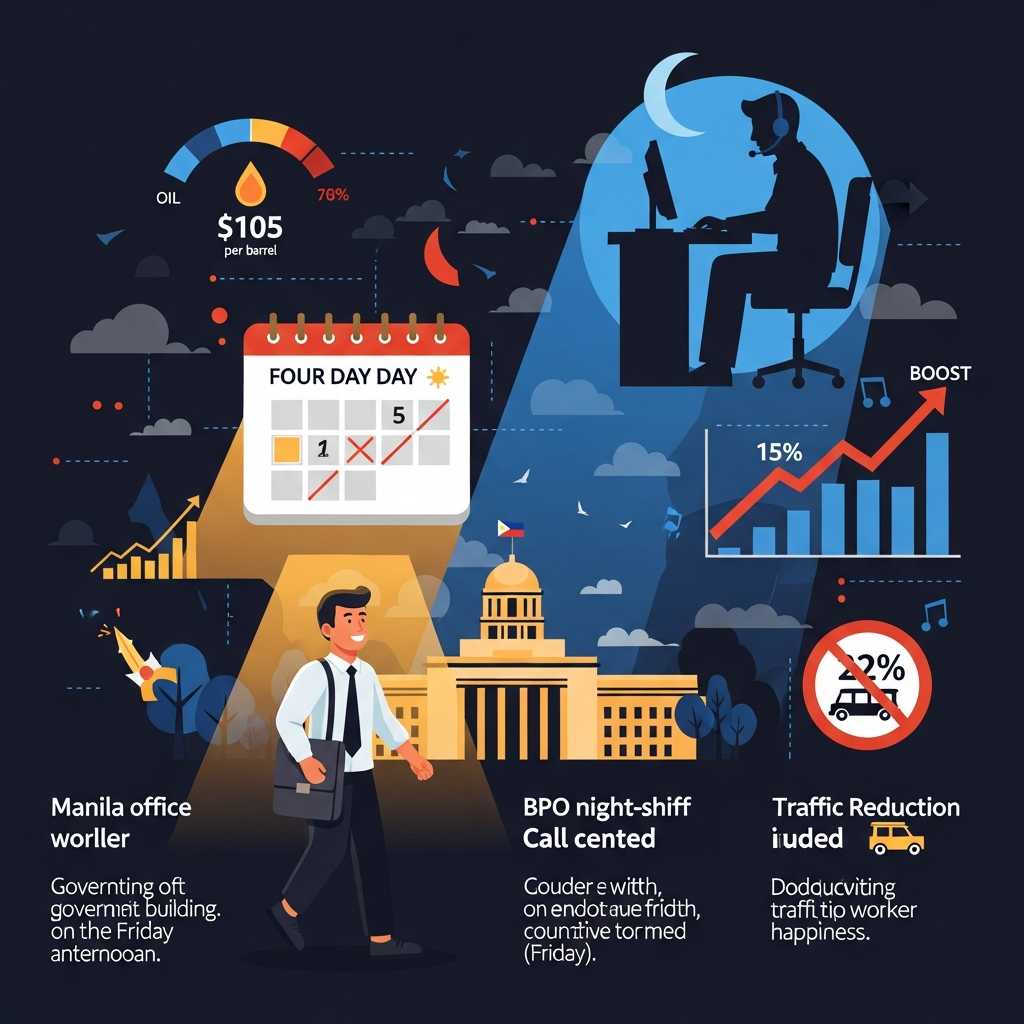
The Philippines implemented a compressed four-day workweek in March 2026 as an emergency energy-saving measure after international crude oil prices surpassed $105 per barrel, and the policy has since produced unexpected labor welfare improvements that have captured global attention. Initial pilot data from government agencies show a 15% productivity increase, a 22% reduction in Metro Manila traffic volume, and 89% worker satisfaction — figures that rival or exceed outcomes from purpose-designed four-day work trials in the United Kingdom and Iceland. Unlike Belgium, which codified the four-day week as a legally protected right, or the United Kingdom, where post-trial adoption became voluntary and employer-driven, the Philippine model emerged from external economic shock, making its policy rationale directly tethered to oil price volatility rather than structural labor reform. The policy's benefits remain systemically inaccessible to approximately 1.3 million BPO workers, hospital staff, and retail employees who operate on 24/7 schedules, raising substantive concerns about class-based labor inequality embedded within a single policy framework. As a living experiment at the intersection of energy politics, labor rights, and AI-driven automation of the BPO sector, the Philippines' experience is emerging as the most consequential test case for whether developing nations can sustain four-day work arrangements beyond the crisis conditions that created them.
Key Points
Energy Savings Was the Goal — Labor Innovation Was the Accidental Byproduct
The Philippine four-day workweek didn't emerge from a values-driven conversation about workers' quality of life. It emerged from a spreadsheet about crude oil import costs. When international oil prices surpassed $105 per barrel in early 2026, the Philippines — a country where fossil fuels generate more than 60% of electricity and where Metro Manila commuters can spend three to four hours a day stuck in traffic — faced a direct and immediate fiscal hit to household budgets. President Marcos Jr. signed Memorandum Circular No. 114 in March 2026, implementing what was officially labeled a "Compressed Work Week" for government agencies. That label is the most revealing detail in the entire story: the policy was categorized as an energy conservation program from the first word of its official title, not a labor welfare initiative. The mechanics reinforce this framing — total weekly working hours remained at 40, compressed into four 10-hour days, rather than adopting the 32-hour model that labor advocates in Europe and North America champion as the genuine version of a four-day week. Filipino households spend an estimated 15–20% of income on transportation, nearly double advanced-economy averages, making commute reduction a meaningful household-level intervention during a commodity shock. What no one fully anticipated was that eliminating one day of commuting would also produce a 15% productivity increase, a 22% traffic reduction across the metro area, and 89% worker satisfaction in the initial government agency pilots. I believe this represents a textbook case of unintended positive externality in policy design — the outcome was genuinely better than the intent, which is rare enough to deserve serious scholarly attention. The question the Philippines is now wrestling with is whether a policy that started as a financial emergency measure can be redesigned, rebranded, and ultimately sustained as a structural labor reform once the financial emergency that justified it resolves.
A 15% Productivity Gain and a 10–15% Revenue Loss Warning Are Happening at the Same Time — and Both Are Real
The data collision at the center of the Philippine four-day workweek debate is perhaps the most instructive element of the entire experiment. Pilot results from participating government agencies show a 15% increase in productivity and 89% worker satisfaction — numbers that compare favorably with four-day trials in Iceland, where reducing weekly hours to 36 maintained or improved output while measurably reducing stress, and with the UK's 2023 trial, where 92% of participating employers permanently adopted the schedule after finding revenue unchanged or improved. The mechanism driving these results appears consistent across contexts: longer concentrated work sessions reduce daily transition costs, compress meeting overhead, and increase individual task density, producing more output per person per unit of calendar time. Microsoft's 2019 Japan pilot documented essentially the same pattern. However, the Philippine Chamber of Commerce and Industry for Small and Medium Enterprises has issued warnings that a broader mandate could reduce annual revenues by 10–15%, a figure consistent with what the hospitality, retail manufacturing, and daily-service sectors have reported in countries where four-day mandates reached beyond white-collar office environments. The BPO sector, which requires round-the-clock staffing synchronized with multiple international time zones, has stated publicly that a compressed workweek is operationally incompatible with its business model at any scale. I think this is the most important insight the Philippine experiment is generating: the relationship between working-time compression and productivity is real and reproducible, but it is not universal. It is highly sensitive to industry structure, workflow type, client dependency, and capital investment in digital tools. The 15% productivity gain in government agencies and the 10–15% revenue loss warning from SMEs are not contradictory data points — they are accurate descriptions of two different sectors responding to the same policy change in structurally different ways. The danger lies in using one to dismiss the other.
1.3 Million BPO Workers Are Structurally Excluded — and That's Not a Minor Footnote
The Philippine BPO sector accounts for approximately 8–9% of national GDP and employs more than 1.3 million people — predominantly workers in their 20s and 30s who staff call centers, data processing centers, and customer support hubs running on U.S. Eastern Time, 24 hours a day, every day of the year. For this workforce, the four-day compressed workweek is not a policy that applies to them with modifications. It is simply a policy that does not apply to them at all. The same structural exclusion applies to hospital nurses and doctors on rotating coverage shifts, retail and food service workers maintaining daily operating hours, construction crews operating on project completion deadlines, and transportation workers who keep Manila's infrastructure functioning. These groups cannot reduce their presence by one day per week because their work is defined by continuous coverage, not output per week. I believe this isn't a manageable edge case — it's a fundamental design flaw in how the policy has been framed and implemented. When a single labor policy creates categorically different lived experiences for white-collar government employees and BPO workers who live in the same neighborhoods, attend the same churches, and send their children to the same schools, the policy is not neutral. It is actively redistributing quality of life along existing class lines rather than improving it across the board. The generational dimension sharpens this concern further: the workers excluded from the four-day week are disproportionately younger, less tenured, and working in the sector most vulnerable to AI-driven automation. They are simultaneously missing out on a quality-of-life improvement and facing a more precarious long-term employment outlook. Belgium and the UK confronted similar exclusion critiques in their four-day trials, but the scale of the BPO sector relative to the Philippine national economy makes the inequality here structurally more significant. A reform that improves the working lives of office-based government employees while leaving essential workers untouched is not a labor revolution. It is a rearrangement of privilege.
Belgium, UK, Philippines — Same Label, Completely Different DNA
Describing these three countries as all "doing the four-day workweek" is technically accurate and profoundly misleading in equal measure. Belgium legislated the four-day workweek as a formal legal right in 2022, meaning eligible workers can request compressed schedules and employers cannot lawfully refuse without documented business justification. The motivation was explicit and values-driven: work-life balance, burnout reduction, and recognizing that worker wellbeing is a structural economic asset, not a luxury. The UK's approach was empirical and market-driven: a 2023 pilot involving dozens of companies across multiple sectors generated data showing stable or improved revenue with reduced hours, after which 92% of participating employers voluntarily made the change permanent — because the economics worked, not because a law required it. The Philippines' version originated from neither values nor market data. It originated from an energy cost crisis, was implemented by executive memorandum with a name that contains the word "compressed" rather than any language about wellbeing or rights, and remains revocable by a single administrative decision. I believe the differences between these three models aren't just interesting contextual detail — they are the single most predictive variable for long-term policy survival. Belgium's model survives because it is legally embedded and would require legislative action to reverse. The UK's model survives because enough employers found it economically advantageous and have no financial incentive to go back. The Philippines' model survives only as long as oil prices justify it and the political will to maintain it holds — neither of which is structurally guaranteed. For the Philippine four-day week to achieve the durability of the Belgian or British models, it must acquire either a legal foundation (which requires Congressional action in a legislature that moves slowly) or a genuine economic constituency in the private sector (which requires convincing SMEs and BPO operators, neither of whom are currently enthusiastic). The starting point doesn't determine the destination, but it matters enormously for how much work is required to get there.
A Policy Anchored to Oil Prices Has an Existential Problem When Oil Prices Fall
The most structurally fragile element of the Philippine four-day workweek is not its operational complexity, its exclusion of the BPO sector, or the opposition from small business groups. It is the fact that the policy's formal justification is entirely contingent on an external market price over which no Philippine administration has meaningful control. Memorandum Circular No. 114's stated rationale is energy cost reduction. When international crude oil was at $105 per barrel, that rationale was self-evidently compelling. If crude stabilizes at $75 or falls to $65 — as it has during multiple recent supply normalization periods — the documented energy savings from one fewer commute day will no longer generate a policy benefit proportionate to the disruption the schedule imposes on businesses and service delivery. The political counterpressure from SME associations and the BPO sector will intensify immediately in that scenario, and the government's ability to resist will depend on how far the pro-labor constituency has solidified. There is already a draft bill before the Philippine House of Representatives that would incorporate compressed workweek provisions into labor law, but the Philippine legislative process routinely takes two to three years to move significant labor legislation from introduction to passage. If crude oil prices normalize before the bill passes, the political momentum that could have carried it through may dissipate. I believe the Philippine government has a narrow and time-limited window to pivot the policy's rationale from "energy emergency response" to "evidence-based labor reform," and that executing this pivot successfully is the most consequential thing the Marcos administration can do in the next 12 months. Failing to make that pivot doesn't necessarily mean the policy disappears — worker satisfaction at 89% creates real political resistance to rollback — but it does mean the policy continues to live on borrowed time, hostage to the next commodity cycle, indefinitely.
Positive & Negative Analysis
Positive Aspects
- The Philippines Is Generating the First Large-Scale Real-World Four-Day Labor Data From a Developing Nation
Prior to the Philippine experiment, almost all published research and pilot data on the four-day workweek came from high-income, post-industrial economies: Iceland's 2021 national study, the UK's 2023 multi-company trial, Belgium's legislated model, Microsoft Japan's productivity experiment. The consistent criticism of applying those findings globally was obvious: these are wealthy countries with strong digital infrastructure, high baseline labor productivity, mature social safety nets, and workforce compositions dominated by knowledge work. The four-day week might work wonderfully in Stockholm or Edinburgh, but does that tell us anything useful about Manila, Dhaka, or Nairobi? The Philippines is now answering that question with real data, in a real crisis, across a real economy. A 15% productivity improvement and 89% worker satisfaction in Philippine government agencies — which operate with significantly less digital infrastructure than their European counterparts — suggests that the underlying mechanism of productivity gain from schedule compression is more portable than prior research implied. For Indonesia, Vietnam, Thailand, Bangladesh, and dozens of other middle-income and lower-middle-income countries watching Manila carefully, this data represents a genuinely new policy input that didn't exist before 2026. I believe the value of this data persists regardless of what the Philippine government ultimately decides about the policy's future. Even if the four-day week is rolled back when oil prices stabilize, the documented outcomes from the pilot period will remain available in the research literature and will be cited in policy discussions across the Global South for years. The Philippines is not just running an experiment for its own benefit — it is inadvertently conducting a research program for the entire developing world.
- In a City as Congested as Manila, a 22% Traffic Reduction Is a Quality-of-Life Transformation, Not Just a Statistic
Metro Manila consistently ranks among the most traffic-congested urban areas on Earth. TomTom's traffic indices regularly place the metropolitan area in the top tier globally for commute time lost to congestion. Manila commuters on EDSA — the main arterial highway connecting major business districts — can spend three to four hours per day in vehicles going nowhere, which means a typical worker loses 15–20 hours of personal time per week simply moving between home and office. The DILG's reported 22% reduction in Metro Manila traffic volume following the compressed workweek implementation isn't a marginal improvement in this context — it is a significant structural change to the daily experience of millions of residents. For individual workers who eliminated one full round-trip commute from their weekly schedule, the time savings translate to roughly 150–200 hours annually — equivalent to nearly a full month of working hours returned as personal time, reclaimed for family, health, rest, and whatever else people value when they're not sitting in traffic. Beyond the individual quality-of-life dimension, the traffic reduction has direct environmental and public health implications: fewer vehicles on the road means lower tailpipe emissions, lower average particulate matter concentration, and reduced cardiovascular and respiratory burden on a population that already faces significant urban air quality challenges. The original energy-saving rationale is also vindicated here: lower traffic volume correlates with reduced fuel consumption across the entire metro area, not just for the workers who stay home on Fridays. I believe this traffic reduction data is the single most politically durable argument for maintaining the policy, because it produces visible, tangible, broadly experienced benefits that even opponents of the four-day workweek find difficult to argue against.
- The Policy Accidentally Achieved Two Objectives Simultaneously — and That Double Dividend Is Rare
In policy design, achieving two distinct objectives with a single intervention is uncommon enough to be considered a meaningful success criterion in its own right. Most policies trade off between competing goals: fiscal stimulus tends to increase inflation, environmental regulation tends to increase production costs, labor protections tend to reduce hiring flexibility. The Philippine compressed workweek has, at least in its government-agency pilot phase, produced both measurable energy cost savings — through reduced commuting and lower government facility operating costs on compressed days — and substantial labor welfare improvements, including a 15% productivity increase and 89% worker satisfaction. These are not the same objective dressed up differently. Energy cost reduction improves the fiscal position of both households and the government. Labor productivity improvement expands the economic output of the public sector. Worker satisfaction improves retention, reduces absenteeism, and has downstream effects on healthcare costs associated with stress and burnout. Each of these outcomes has independent economic value, and the fact that a single policy intervention appears to be generating all of them simultaneously creates an unusually strong cost-benefit case for continuation. From a political economy standpoint, this double dividend also builds a coalition of supporters with different primary interests — fiscal conservatives can support it for energy savings, labor advocates can support it for worker wellbeing, productivity researchers can support it for efficiency gains — making the policy more politically resilient than single-objective policies typically are. I believe this accidental multi-objective success is exactly the kind of outcome that policy scholars call an "unintended positive externality," and it deserves serious documentation and analysis precisely because it demonstrates how crisis-driven improvisation can occasionally outperform deliberate design.
- Worker Satisfaction at 89% Creates Genuine Political Inertia That Protects the Policy Even Without Legal Guarantees
One of the most analytically interesting features of the Philippine four-day workweek situation is the degree to which the policy has become self-reinforcing through political economics, independent of its original economic rationale. A worker satisfaction rate of 89% is not a neutral statistic in a democracy with competitive elections. It represents a politically activated constituency that has experienced a concrete improvement in their daily lives and has a strong personal incentive to resist any effort to reverse it. Workers who have restructured their childcare arrangements, social commitments, and personal schedules around a three-day weekend do not simply absorb a return to five-day working with equanimity — they become politically mobilized opponents of whoever orders the change. For the Marcos administration, which maintains approval ratings of 52–55% and faces a midterm election cycle in 2028, the political logic of reversing a popular labor benefit that affects the most electorally responsive segment of the workforce — urban government employees — is essentially prohibitive. This creates what economists call "downward rigidity" in labor benefits: the asymmetric political cost structure means benefits are far easier to grant than to withdraw, creating a structural bias toward permanence regardless of the original fiscal or energy rationale. I believe this political inertia will function as a de facto institutional protection for the policy during the period between now and whenever the Philippine Congress can move labor legislation forward. It's not a substitute for legal codification, but it provides a meaningful buffer against the most likely threat — an oil price decline that removes the stated economic justification — by making the political cost of rollback prohibitive even in the absence of legal constraints.
- The Philippines Is Expanding the Geographic and Economic Diversity of the Global Four-Day Workweek Conversation
The academic and policy conversation about compressed or reduced working time has been overwhelmingly concentrated in wealthy, post-industrial, English-speaking and Northern European economies. Iceland, the UK, Belgium, Spain, Japan — these are the reference points that dominate the literature, the conference discussions, and the media coverage. The implicit framing that emerges is that the four-day workweek is a policy option for countries that have already solved more fundamental labor problems: poverty wages, workplace safety, minimum hour standards, social insurance coverage. The Philippines disrupts that framing directly. It introduces a new type of actor — a lower-middle-income country with a large BPO sector, high fossil fuel import dependency, severe urban congestion, and a labor market characterized by significant informality — into a conversation that had previously had no room for it. The introduction of Philippine data into the global four-day workweek literature is not just additive; it is transformative, because it forces a rethinking of which assumptions about workplace structure, technological infrastructure, and economic baseline are actually necessary conditions for the policy to generate positive results, and which are incidental artifacts of the countries where it has been studied before. Euronews and other European media outlets have already begun covering the Philippine experiment as a significant comparative case, and global institutions like the ILO and the World Economic Forum are beginning to incorporate developing-world data into their working-time research agendas. I believe that as Philippine data matures and becomes more systematically documented, it will play an increasingly central role in how the four-day workweek is discussed in Southeast Asia, South Asia, Africa, and Latin America — regions that include the majority of the world's workers but have been almost entirely absent from the research literature on working-time reform until now.
Concerns
- Excluding 1.3 Million BPO Workers Is Not a Minor Policy Exception — It Is a Structural Design Flaw
The Philippine BPO industry employs more than 1.3 million people, generates 8–9% of national GDP, and operates on a 24/7 schedule synchronized with the United States Eastern Time Zone. For this sector, the four-day compressed workweek is not a policy that creates operational challenges requiring creative problem-solving. It is a policy that is physically incompatible with the sector's fundamental business model. The same categorical exclusion applies to hospital nurses and doctors on rotating coverage shifts, retail and food service workers maintaining daily operating hours, construction crews working against project completion deadlines, and transportation workers. The structural exclusion of these groups from the policy's benefits means that the four-day workweek, as implemented in the Philippines, is fundamentally a white-collar government employee benefit program wearing the branding of a broad labor reform. I think this is the policy's most serious long-term problem, and it operates on multiple levels simultaneously. At the economic level, the excluded workers are concentrated in sectors more exposed to market volatility and less protected by civil service tenure than the government employees who benefit. At the social level, the exclusion entrenches and makes visible a hierarchy of working conditions within the same society. At the political level, it creates a constituency of workers who have concrete evidence that labor reform isn't for them — a perception that tends to generalize into broader political disengagement or resentment toward reform-oriented governance. Belgium and the UK also faced exclusion critiques in their four-day trials, but the BPO sector represents a significantly larger share of the Philippine economy than any comparable excluded sector in those countries, making the inequality more economically consequential and politically volatile. Solving this exclusion is not an optional refinement of the policy. It is a prerequisite for the policy to be defensible as anything other than a class-specific benefit dressed up as universal labor reform.
- Small and Medium Enterprises Face an Adaptation Cost Asymmetry That Could Produce Real Economic Harm
The Philippine Chamber of Commerce and Industry for Small and Medium Enterprises has warned that extending the four-day workweek mandate to the private sector could reduce annual revenues for affected firms by 10–15%. That estimate is not alarmist — it reflects a structural reality about how SMEs operate relative to large corporations and government agencies. Small businesses running on thin margins, tight cash flow, and client relationships built on consistent daily availability cannot absorb service gaps without economic consequence. A legal firm with five attorneys cannot tell clients their files will be handled in four days what used to take five. A small-batch food manufacturer with weekly delivery commitments cannot defer Friday production without breaking contracts. A neighborhood hardware store cannot close on Fridays without losing customers to competitors who remain open. Large corporations have the digital infrastructure, remote work capability, cross-trained staffing pools, and client relationship buffers to make schedule compression work smoothly. A ten-person family business operates in a fundamentally different economic reality. Manila Bulletin reporting on local business responses captures this contrast clearly: the objections aren't ideological resistance to shorter working weeks — they're operational concerns about concrete revenue impacts in businesses where a single day's closure directly affects monthly cash flow. The additional dynamic driving SME concern is competitive pressure from large employers: if major corporations voluntarily adopt the four-day week, smaller businesses must match the benefit to compete for the same talent pool, regardless of whether their economics support it. I believe this adaptation cost asymmetry represents the most realistic near-term economic risk of the policy, and the government's current approach — treating SME concerns as stakeholder noise to be managed rather than a structural constraint to be designed around — risks producing genuine economic harm to the sector that employs the majority of Filipino workers.
- The Policy's Stated Rationale Disappears When Oil Prices Normalize — and No Alternative Foundation Has Been Built
Memorandum Circular No. 114's justification is unambiguous: the four-day compressed workweek exists to reduce energy consumption and alleviate the fiscal pressure of elevated oil prices on Filipino households and government operations. That justification is both the policy's greatest short-term strength and its most serious structural vulnerability. When crude oil was at $105 per barrel, the logic was self-evident and hard to argue against. When crude returns to $75 or lower — as it has during multiple prior supply normalization periods — the documented energy savings from one fewer commute day will no longer generate a compelling cost-benefit case proportionate to the disruption the schedule creates for service delivery, small business operations, and BPO sector workforce management. At that point, the BPO industry's lobbyists, the SME association's representatives, and fiscal conservatives in Congress will have a straightforward argument: the condition that justified the policy no longer exists, so the policy should end. The current government's ability to counter that argument depends on how successfully it has pivoted the policy's narrative to productivity gains and worker wellbeing — neither of which is currently documented as extensively as the original energy savings rationale. Belgium's model is protected from this vulnerability because it is embedded in legislation that requires active legislative effort to reverse. The UK model is protected because private employers have found genuine economic advantage in shorter weeks. The Philippine model currently has neither protection. I believe this exposure — a policy with a justification that can evaporate with an oil price movement — is the existential threat that should be driving urgency in the government's legislative agenda. The window to convert a crisis-born policy into a durable structural reform is finite, and every month that passes without legislative action is a month closer to the moment when the original crisis resolves and the policy has no institutional foundation to stand on.
- AI Automation of BPO Functions Combined With the Four-Day Policy Could Produce a Double Blow to the Philippines' Most Vulnerable Workers
The Philippine BPO sector is already experiencing meaningful displacement pressure from AI-driven automation. Customer service chatbots, automated data classification systems, AI-assisted transcription and translation tools, and large language model-based query resolution systems are progressively replacing the routine cognitive tasks that constitute the core workload of many BPO positions. Industry analysts have estimated that 15–20% of current BPO job functions could be automated by 2028 under existing technology adoption trajectories. The four-day workweek adds a potentially accelerating variable to this dynamic. From an employer's perspective, a workforce that is physically present for only four of seven days creates a business case for deploying AI tools to cover the remaining coverage gap rather than hiring additional human staff. The economic logic is straightforward: if the labor cost of human coverage for a fifth working day is comparable to or greater than the annualized cost of deploying an AI system capable of handling routine queries, the marginal incentive to automate shifts in favor of automation. My concern is that this creates a compounding risk for the segment of the BPO workforce that is already most economically vulnerable: workers doing routine, repeatable tasks that both four-day scheduling complications and AI systems make easier to rationalize eliminating. These workers are simultaneously excluded from the policy's direct benefits — because BPO cannot compress into four days — and face accelerated displacement pressure if the policy indirectly changes the automation economics for their employers. The unintended cascade is both plausible and alarming: a policy designed to save energy costs ends up accelerating structural unemployment in the sector most critical to the economic welfare of millions of young Filipino workers. I believe this AI-automation interaction effect is one of the most underanalyzed risks in the current policy discussion.
- The Cost of Reversing the Four-Day Workweek Will Dramatically Exceed the Cost of Implementing It — Creating a Policy Trap
One of the most reliable findings in behavioral economics and political science is that the psychological and political cost of removing a benefit is substantially larger than the cost of never having granted it in the first place. The Philippine four-day workweek is now demonstrating this principle in real time, at national scale. An 89% worker satisfaction rate means that roughly nine out of ten benefiting workers have structured their personal lives, family routines, childcare arrangements, and social commitments around the expectation of a three-day weekend. Reversing that expectation doesn't return them to a neutral baseline — it creates active grievance. Workers who experienced a better arrangement and had it taken away are more politically activated against the removal than workers who never had the benefit are activated in favor of obtaining it. For the Marcos administration, this asymmetry means that rolling back the four-day week is politically more costly than maintaining it, even in scenarios where the economic case for maintenance is weak. The government is, in policy theory terms, in a "ratchet trap" — the policy can move forward or stay where it is, but moving it backward requires paying a political cost that is disproportionate to the economic benefit of reversal. The danger in this dynamic is that it can keep a policy in place past the point where it is economically rational to maintain it, generating distortions that compound over time. If the four-day week remains in force while small business revenues decline and BPO sector workers grow increasingly resentful of their exclusion, the political inertia that is currently protecting the policy becomes the mechanism of a slow-motion social fracture. I believe the government needs to recognize that the political difficulty of reversal, while currently functioning as a buffer against premature rollback, also makes it more urgent — not less — to build a genuine economic and legal foundation for the policy. Using political inertia as a substitute for institutional design is a strategy that works only until it doesn't.
Outlook
In the near term — call it the next one to six months — we're watching the most critical window for the Philippine four-day workweek's institutional survival. International crude oil prices are currently oscillating between $100 and $110 per barrel, and if Middle East geopolitical instability continues or OPEC+ holds its output cuts through the year, prices could spike toward $120. That scenario would give the Marcos administration both the political cover and the economic justification to extend the compressed workweek from government agencies into voluntary private-sector participation. Reports already suggest that Metro Manila's economic managers are drafting guidelines to encourage private employers to opt in. On the flip side, if crude falls below $80 — which a geopolitical de-escalation, a global demand slowdown, or a coordinated supply release could trigger — the policy's stated rationale evaporates almost overnight. My read is that in that case, the government will attempt a narrative pivot: quietly discarding the "energy savings" justification and reframing the policy around "demonstrated productivity improvements and worker wellbeing." The political math supports this move. The accumulated data — 15% productivity gain, 89% satisfaction — is too compelling to walk away from, and doing so would hand opposition parties an easy line of attack ahead of the 2028 midterm elections. The administration knows it.
The political calculus in this short-term window deserves careful attention on its own terms. President Marcos Jr.'s approval ratings sit at roughly 52–55%, and the four-day compressed week has become a genuinely popular policy among urban government workers — exactly the demographic that tends to determine electoral outcomes in Philippine cities. Rolling back the policy before the 2028 midterms would be politically equivalent to self-inflicted damage. My prediction is that within the next six months, at least two or three major regional cities beyond Metro Manila will launch their own local government pilot programs. Cebu City and Davao are the most likely first movers — both have the administrative infrastructure for structured pilots, and both have mayors who would benefit from being seen as labor innovators. The BPO sector conflict will intensify during this period, but the government's most probable resolution is a formal exemption carve-out: classifying BPO and 24/7 essential industries as excluded categories, rather than forcing a confrontation that risks destabilizing a sector generating nearly $30 billion in annual export revenues. The core short-term variables are crude oil prices and the political calendar — both of which are external factors that no administration fully controls. That fundamental dependency on variables outside government control is what makes this policy's near-term trajectory genuinely unpredictable.
In the medium term — six months to two years out — the Philippines faces its defining institutional choice: does the four-day workweek get legislated into durable permanence, or does it gradually dissolve back into the category of crisis-era emergency measures? I consider this the most dangerous and most consequential stretch of the policy's entire lifecycle. The amount and quality of economic data accumulated during this window will likely determine whether the policy survives the conditions that created it. Under a bull-case scenario, oil prices hold above $90 per barrel, maintaining the original policy rationale while a growing body of pilot data from an expanding pool of government agencies and willing private employers builds the empirical foundation for legislation. There is already a draft bill before the Philippine House of Representatives that would codify compressed workweek provisions into labor law — if this advances through committee and reaches a floor vote, the Philippines could become the first Asian nation to formally guarantee a form of the four-day workweek as a statutory entitlement. The international visibility of that milestone would be substantial: the Philippines positioning itself as a labor policy innovator in the Global South is a story global media, labor rights organizations, and development institutions would run with enthusiastically.
Under the base-case scenario — which I estimate carries roughly a 45% probability — legislation doesn't advance quickly enough to outpace changing conditions, but the policy persists through executive order renewals and expanded voluntary private-sector adoption. This trajectory mirrors the UK model in a meaningful way: no law was passed mandating four-day work, but the social norm and employer calculus shifted durably because enough organizations found the economics compelling. In this scenario, BPO remains formally exempt, the inequality gap between knowledge workers and shift workers stays unresolved but politically manageable, and the Philippines drifts toward a de facto two-tier labor market where work schedule is determined largely by sector and collar color. The bear case — which I put at roughly 25% probability — involves crude oil prices declining sharply and sustained BPO industry lobbying successfully pressuring the administration to scale back or terminate the compressed workweek program. The Philippine Congress has historically taken two to three years to move labor legislation through its procedural gauntlet, which means the policy could expire before legislation ever arrives if external conditions shift at the wrong moment.
One medium-term variable I'm tracking with particular interest is the AI automation trajectory within BPO. The sector is already experiencing displacement from AI chatbots, automated response systems, and data-processing tools. If the four-day week were hypothetically applied to BPO operations — even as a discussion point — the economic logic for employers would shift immediately toward filling the "missing" working day with AI systems rather than additional human headcount. My estimate is that 15–20% of BPO positions could be restructured by AI by 2028, and a four-day compressed mandate could accelerate that timeline by two to three years, creating an unintended cascade: an energy-saving policy triggering a structural labor market transformation.
Looking five years out, the more consequential story isn't what ultimately happens to the Philippines' specific policy — it's what the Philippines proves possible for the rest of the developing world. I believe that by 2030, somewhere between 15 and 20 percent of the global workforce will operate under some form of compressed or four-day work arrangement. Advanced economies — the UK, Belgium, Iceland, Spain, parts of Scandinavia — are already leading that expansion. What the Philippines uniquely provides is proof-of-concept for middle-income and lower-middle-income countries that have long been told the four-day week is a luxury for rich nations with mature social safety nets. If the Philippine experiment succeeds and generates a durable institutional record, it becomes a genuine reference case for G77 finance ministers, ASEAN labor ministers, and ILO policy recommendations. Countries with high fossil fuel import dependency — across sub-Saharan Africa, South Asia, and Southeast Asia — could frame a four-day policy with the same double justification the Philippines stumbled into: energy conservation and labor welfare as a single package. By 2029, I'd estimate at least five developing countries will have launched a Philippines-inspired pilot, using energy efficiency as the entry-point framing for what is ultimately a broader labor reform conversation. The historical pattern here is worth invoking: the Great Depression didn't just cause economic suffering — it generated the policy conditions that normalized the five-day, 40-hour week across much of the industrialized world. Crisis as the catalyst for durable labor reform is more rule than exception.
At the broadest level, the Philippines is navigating terrain where three structural forces intersect — and none of them are going away. AI-driven automation is systematically reducing the labor-hours required to generate a given economic output. The energy transition is creating sustained pressure to reduce consumption, including the transportation emissions associated with daily mass commuting. And a generational shift in how workers value time — dramatically accelerated by the pandemic and its aftermath — has permanently altered the baseline of what people are willing to accept as a working arrangement. In this macro context, the four-day workweek gradually shifts from being a progressive policy option to something closer to a structural inevitability. Countries that design the transition deliberately, with inclusive frameworks that reach shift workers and SMEs as well as white-collar professionals, will fare substantially better than those that have the transition forced upon them by AI displacement and economic crisis without any preparation.
The Philippines is, paradoxically, doing both things simultaneously — being forced into the transition through energy crisis while also generating the empirical data needed to design the next iteration more deliberately. My probability summary across scenarios: bull case — full legislation, civil society expansion, regional replication in at least three Southeast Asian nations — 30%; base case — executive order persistence, voluntary employer adoption expanding, BPO formally exempted — 45%; bear case — policy rollback under oil-price normalization and sustained industry lobbying — 25%. One honest caveat I owe readers: Philippine electoral politics is notoriously difficult to model, and a 2028 election that shifts the governing coalition could reset every scenario from scratch. Whatever happens to the policy itself, the data it has already produced will survive any administration's decisions. And that empirical record — messy, imperfect, and undeniably real — is ultimately the most durable contribution the Philippines is making to the global conversation about the future of work.
Sources / References
- Philippine Presidential Communications Office official press release on President Marcos signing the compressed workweek executive order — Philippine Presidential Communications Office
- DILG guidelines for the four-day workweek and list of participating government agencies and local government units — Philippine Daily Inquirer
- Opinion column analyzing the four-day workweek's operational drawbacks including service gaps and permit processing delays — Philippine Star
- Coverage of small business opposition to mandatory four-day workweek expansion and revenue loss projections — Manila Bulletin
- Global outlook on the four-day workweek in 2026 including perspectives from major business leaders and corporate adoption trends — Fortune
- Comprehensive 2026 research summary on the four-day workweek covering latest productivity and worker wellbeing data — Success Magazine
- Comparative analysis of four-day workweek adoption across European nations including Belgium, UK, and Iceland models — Euronews