
It Takes 0.3 Seconds for Your Face to Be Marked as Criminal — The Prison Ticket Written by AI Facial Recognition
Summary
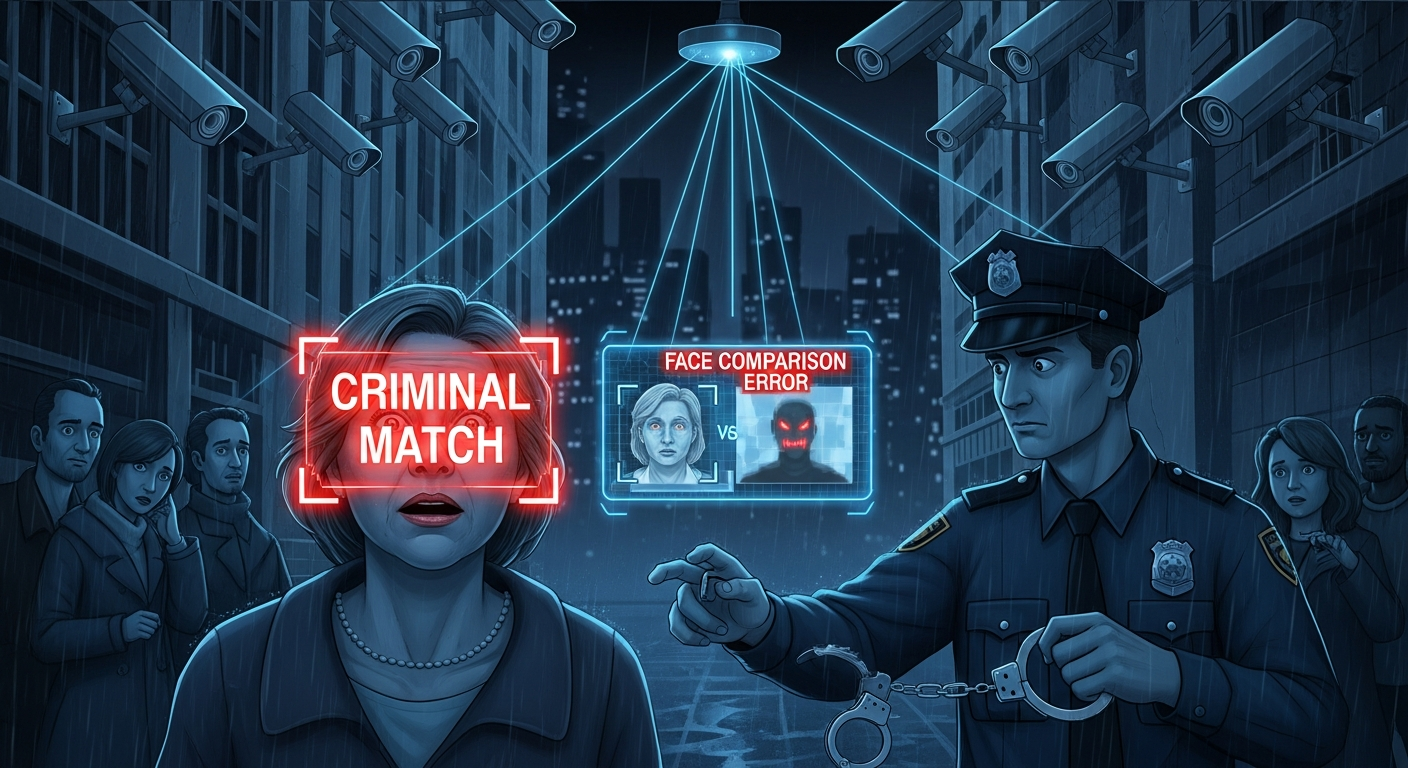
Wrongful arrests driven by AI facial recognition technology have now reached at least twelve confirmed cases cumulatively through 2025, with additional incidents emerging in 2026, systematically destroying the lives of innocent citizens. Powered by a database of over 50 to 70 billion facial images scraped without consent by Clearview AI, law enforcement agencies are treating probabilistic matching results as conclusive evidence, fueling a cycle of algorithmic bias that disproportionately harms people of color and amounts to structural racism embedded in technology. While the United States lacks any federal-level regulation of facial recognition, the European Union has begun enforcing portions of its AI Act as of February 2025, with full real-time facial recognition restrictions set for August 2026, exposing a widening regulatory chasm between the world's largest democracies.
Key Points
The Angela Lipps Case: A Grandmother's Life Destroyed by a False Match
Angela Lipps, a 50-year-old grandmother from Tennessee, became one of the most harrowing examples of what happens when AI facial recognition goes wrong. On July 14, 2025, U.S. Marshals arrived at her home with guns drawn while she was watching her four grandchildren, arresting her for a crime committed in North Dakota — a state she had never visited. Clearview AI's system had flagged her face as a match, and that probabilistic suggestion was treated as gospel by law enforcement. She spent approximately five months in jail before the charges were finally dismissed on Christmas Eve 2025, but by then the damage was catastrophic and irreversible. Lipps lost her home, her car, and even her dog during the months of incarceration. Her case has become a rallying cry for civil liberties advocates who argue that no algorithm should have the power to strip someone of their freedom based on a statistical guess, and Fargo police have notably refused to apologize for the ordeal.
Clearview AI's Surveillance Infrastructure: A Database Built on Stolen Faces
Clearview AI has amassed a staggering database of 50 to 70 billion or more facial images, all scraped from social media platforms, news sites, and publicly accessible corners of the internet without the knowledge or consent of the individuals depicted. This biometric dragnet forms the backbone of a surveillance infrastructure that multiple U.S. government agencies have eagerly adopted. U.S. Customs and Border Protection signed a $225,000 contract for access to the system, while ICE's Homeland Security Investigations unit inked a separate $9.2 million contract in September 2025, signaling a dramatic escalation in federal investment. The U.S. Army Special Forces also secured an extendable contract with a one-year base period and options for up to four years total, embedding facial recognition deep within military special operations. What makes this particularly alarming is the complete absence of meaningful consent mechanisms — billions of people have had their biometric data harvested and fed into a system that can be used to identify, track, and potentially incriminate them, all without ever being asked or even notified.
Algorithmic Bias and Structural Racism: When Code Perpetuates Discrimination
A landmark study by the National Institute of Standards and Technology found that facial recognition algorithms produce false positive rates for Black women that are 10 to 100 times higher than for white men, laying bare a devastating technological disparity that maps directly onto existing racial fault lines. This is not a minor calibration issue — it is a systematic flaw that transforms software into an instrument of racial profiling. The ACLU has documented at least twelve confirmed wrongful arrests attributable to facial recognition errors, and the overwhelming majority of victims have been Black Americans. The pattern is unmistakable and deeply troubling: the communities that have historically been subjected to the most aggressive policing are now being disproportionately targeted by the very technology that was supposed to make law enforcement more objective and fair. When a technology consistently fails along racial lines, deploying it in high-stakes contexts like criminal identification is not just negligent — it is an active perpetuation of structural racism through algorithmic means.
The U.S. Regulatory Vacuum vs. the EU AI Act: A Tale of Two Approaches
The United States remains the only major democracy without federal legislation governing the use of facial recognition technology by law enforcement, creating a regulatory vacuum that has allowed agencies to deploy the technology with virtually no oversight or accountability. While sixteen or more municipalities and twelve or more states have enacted various restrictions, this patchwork approach leaves enormous gaps and creates jurisdictional confusion. Virginia's facial recognition approval law, set to take effect on July 1, 2026, represents one of the more comprehensive state-level efforts, but it remains an exception rather than the rule. Meanwhile, the European Union has moved decisively with its AI Act, portions of which have already been in effect since February 2025, with full restrictions on real-time facial recognition in public spaces scheduled for August 2026. The EU framework carries teeth — violations can result in fines of up to 35 million euros or 7 percent of global annual revenue, whichever is higher. This growing regulatory divergence means that European citizens will soon enjoy robust protections against algorithmic surveillance while their American counterparts remain largely exposed to the whims of individual police departments and federal agencies.
The Policing Efficiency Trap: When Convenience Overrides Civil Rights
Over two-thirds of law enforcement agencies in the United States now use some form of facial recognition technology, and Clearview AI alone claims its system is deployed across more than 3,000 police departments nationwide. The appeal is obvious — facial recognition promises to accelerate investigations, identify suspects faster, and solve cases that might otherwise go cold. But this pursuit of efficiency has created a dangerous trap where the convenience of algorithmic identification systematically overrides the civil rights of the individuals it targets. Officers are not trained to understand the probabilistic nature of facial recognition matches, and departmental policies rarely require independent corroboration before making an arrest based on an algorithmic hit. The result is a system where a computer's best guess can land an innocent person in jail for months, with the burden of proving their innocence falling entirely on the wrongly accused. The efficiency gains are real but modest, while the human costs — destroyed lives, eroded trust in law enforcement, and the normalization of mass surveillance — are immeasurable and compounding.
Positive & Negative Analysis
Positive Aspects
- Accelerated Criminal Investigations
Facial recognition technology can dramatically compress the timeline of criminal investigations, enabling law enforcement to identify suspects in hours rather than weeks or months. In cases involving serial offenders, fugitives, or individuals captured on surveillance footage, the technology provides a powerful tool for narrowing the field of potential suspects. High-profile cases have been solved using facial recognition matches that would have been virtually impossible through traditional investigative methods alone. The speed advantage is particularly significant in time-sensitive situations where a suspect may pose an ongoing threat to public safety, and supporters argue that the technology has directly contributed to apprehending dangerous individuals who might otherwise have evaded capture.
- Missing Persons and Human Trafficking Recovery
One of the most compelling and least controversial applications of facial recognition technology lies in locating missing persons and identifying victims of human trafficking. The National Center for Missing and Exploited Children has leveraged facial recognition systems to match images of unidentified children with missing persons databases, reuniting families in cases that had gone cold for years. In human trafficking operations, the technology can scan images from online advertisements and match them against databases of known missing individuals, providing leads that investigators would never have found through conventional means. These humanitarian applications represent genuine success stories, though advocates note that the same technology could achieve these results without the mass surveillance infrastructure that raises so many civil liberties concerns.
- Rapid Response to Terrorism and Security Threats
In the context of counterterrorism and national security, facial recognition offers the ability to identify known threats in real time across airports, border crossings, and high-profile public events. Following major security incidents, the technology has proven valuable in rapidly identifying perpetrators and their associates from surveillance footage, enabling faster apprehension and potentially preventing follow-up attacks. Military and intelligence agencies argue that facial recognition is an indispensable tool in the modern security landscape, where threats can materialize with little warning and traditional identification methods are too slow to be effective. The U.S. Army Special Forces' adoption of Clearview AI underscores the perceived operational value of this capability in high-stakes security environments.
- Convenience in Identity Verification Systems
Beyond law enforcement, facial recognition has found widespread adoption in identity verification systems that millions of people use daily — from unlocking smartphones to passing through automated airport gates and accessing secure facilities. These consumer-facing applications generally operate with the user's explicit consent and offer a genuinely more convenient alternative to passwords, PINs, and physical ID cards. The technology has also been deployed in financial services for fraud prevention, comparing transaction selfies against account holder photos to block unauthorized access. While these applications raise their own privacy concerns, they represent a category of facial recognition use where the individual retains meaningful control over their biometric data and derives a direct personal benefit from the technology's capabilities.
Concerns
- Wrongful Arrests and the Destruction of Innocent Lives
The most devastating consequence of facial recognition in policing is the wrongful arrest of innocent people, a phenomenon that has now been documented in at least twelve confirmed cases with additional incidents continuing to surface. Each wrongful arrest represents not just a legal error but a life-altering catastrophe for the victim. Angela Lipps lost five months of her life, her home, her car, and her pet. Other victims have lost jobs, suffered psychological trauma, and faced social stigma that persists long after charges are dropped. The fundamental problem is that facial recognition produces probabilistic matches — statistical suggestions, not definitive identifications — yet the criminal justice system treats these outputs as though they carry the weight of certainty. Until this gap between algorithmic probability and legal certainty is addressed, every face scanned is a potential wrongful arrest waiting to happen.
- Racial Bias Embedded in the Technology Itself
The racial bias in facial recognition is not a bug that can be patched in the next software update — it is a structural feature rooted in the training data, algorithm design, and deployment patterns of the technology. NIST's finding that error rates for Black women are 10 to 100 times higher than for white men reflects training datasets that dramatically overrepresent lighter-skinned faces, algorithms that have been optimized primarily for features common in white populations, and testing protocols that fail to catch disparities before deployment. This means that the communities already subjected to disproportionate policing are now being disproportionately misidentified by the technology deployed to police them, creating a feedback loop of algorithmic discrimination. The problem is compounded by the fact that many police departments are unaware of or indifferent to these accuracy disparities, deploying the technology uniformly without adjusting for its known limitations.
- Mass Biometric Data Collection Without Consent
Clearview AI's business model is built on the wholesale harvesting of human biometric data without consent — a practice that would be considered a serious violation of bodily autonomy in virtually any other context. The company's database of 50 to 70 billion or more images was constructed by scraping publicly available photos from social media, news sites, and personal websites, turning every selfie, family photo, and casual snapshot ever posted online into a potential tool for identification and surveillance. Most people whose faces populate this database have no idea they are in it and have been given no opportunity to opt out. This represents a fundamental violation of the principle that individuals should have meaningful control over their own biometric data, and it sets a dangerous precedent for what corporations can do with publicly accessible information. Several countries and jurisdictions have already found Clearview AI's practices to violate existing privacy laws, yet the company continues to operate and expand.
- The Slide Toward a Surveillance State
The combination of ubiquitous cameras, powerful facial recognition algorithms, and massive biometric databases creates the technical infrastructure for a surveillance state that would have been unimaginable a generation ago. When law enforcement can identify any individual in any public space in real time, the very nature of public life changes — anonymity disappears, and with it the freedom to attend protests, visit sensitive locations, or simply move through the world without being tracked. The expansion of federal contracts — CBP's $225,000 deal, ICE HSI's $9.2 million investment, and the Army's multi-year agreement with Clearview AI — suggests that the surveillance apparatus is growing, not shrinking. China's experience with pervasive facial recognition surveillance offers a cautionary tale of where this trajectory can lead, and the absence of strong regulatory guardrails in the United States means there is little to prevent a similar drift toward comprehensive algorithmic monitoring of public spaces.
- Accountability Gaps and Institutional Deflection
When facial recognition leads to a wrongful arrest, accountability effectively evaporates into a blame-shifting loop between technology companies and law enforcement agencies. Clearview AI insists that its system only provides leads, not positive identifications, and that responsibility for arrest decisions rests with the officers who act on those leads. Police departments, in turn, point to the technology as an objective tool that guided their judgment. The result is that no one bears responsibility when an innocent person is jailed for months based on a faulty algorithmic match. Fargo police's refusal to apologize to Angela Lipps exemplifies this institutional deflection. There are no mandatory reporting requirements for facial recognition errors, no standardized protocols for verifying matches before making arrests, and no clear legal framework for victims to seek compensation. This accountability vacuum means that the true scale of wrongful identifications is almost certainly much larger than the documented cases suggest, as many victims may never realize that facial recognition was the basis for their arrest.
Outlook
The story of AI facial recognition in law enforcement is entering what might be its most consequential chapter yet, and the decisions made in the next few years will determine whether this technology becomes a carefully regulated tool or an unchecked engine of mass surveillance. The Angela Lipps case has landed like a grenade in the public consciousness at a moment when the legal, technological, and political landscapes are all shifting simultaneously, and the reverberations are going to reshape how we think about the relationship between algorithms and civil liberties for decades to come.
In the short term — over the next six months to a year — the most immediate developments will center on the regulatory front. Virginia's facial recognition approval law takes effect on July 1, 2026, establishing one of the most comprehensive state-level frameworks in the country. This law requires law enforcement agencies to obtain explicit legislative approval before deploying facial recognition technology, and it could serve as a template for other states grappling with the same questions. Meanwhile, the EU AI Act reaches full enforcement in August 2026, with its restrictions on real-time facial recognition in public spaces representing the most aggressive regulatory intervention any major jurisdiction has attempted. The contrast with the United States could hardly be starker — while Europeans gain meaningful protections against algorithmic surveillance, Americans will continue navigating a patchwork of sixteen or more municipal regulations, twelve or more state-level restrictions, and a complete absence of federal oversight.
The global facial recognition market, currently valued at $8.58 billion in 2025, is projected to reach $18.28 billion by 2030, representing a compound annual growth rate of 16.33 percent according to Mordor Intelligence. That kind of growth trajectory tells you everything you need to know about the commercial forces aligned behind this technology. Security and surveillance applications accounted for 49 percent of 2024 revenue, making law enforcement the single largest market driver. Asia represented 38.7 percent of global revenue in 2024, reflecting the rapid adoption of facial recognition across China, India, and Southeast Asia for everything from payment systems to urban surveillance. These numbers suggest that regardless of what happens in Western regulatory circles, the global proliferation of facial recognition technology is accelerating, not decelerating.
The Angela Lipps case and others like it are generating real momentum for legislative action, but I believe the path to meaningful federal regulation in the United States remains frustratingly uncertain. The political dynamics are complex — facial recognition enjoys support from law enforcement lobbies, defense contractors, and national security hawks who frame any restriction as a threat to public safety. On the other side, an unusual coalition of civil liberties organizations, racial justice advocates, and libertarian-leaning conservatives who oppose government surveillance has been pushing for restrictions, but they have yet to coalesce around a single legislative proposal with enough bipartisan appeal to survive the congressional gauntlet. The most likely near-term outcome is continued state-level action rather than a federal breakthrough, which means the regulatory landscape will remain fragmented and uneven.
Looking at the medium term — one to three years out — several dynamics are worth watching closely. First, the civil litigation pipeline is going to become a significant force in shaping how facial recognition is deployed. Wrongful arrest victims are increasingly filing lawsuits against both police departments and technology companies, and a landmark verdict or settlement could create de facto regulatory constraints even in the absence of legislation. The legal theory that deploying a technology known to produce racially biased results constitutes a violation of civil rights protections is gaining traction among constitutional scholars, and it is only a matter of time before this argument reaches a federal appellate court.
Second, the EU AI Act's enforcement is going to create significant compliance challenges for global technology companies that operate on both sides of the Atlantic. Companies like Clearview AI that have already been found to violate European privacy laws face potential fines of up to 35 million euros or 7 percent of global annual revenue under the new framework. The extraterritorial reach of EU regulation means that even companies headquartered in the United States may need to fundamentally restructure their data practices if they want to maintain any European business. This regulatory pressure could indirectly improve outcomes for American citizens as well, as companies find it more efficient to implement a single, more restrictive global standard rather than maintaining separate systems for different jurisdictions.
Third, the technology itself will continue to improve, but improvement in average accuracy does not automatically translate to the elimination of racial bias. The core problem — that training datasets underrepresent darker-skinned faces and that algorithms perform less reliably across demographic groups — requires deliberate, sustained investment in dataset diversity and algorithm redesign, not just incremental upgrades to existing systems. Some companies are making genuine progress on this front, but the competitive pressure to deploy fast and market aggressively means that bias mitigation often takes a backseat to performance metrics that emphasize overall accuracy rather than equity across demographic groups.
The expansion of government contracts adds another layer of complexity to the medium-term outlook. ICE's Homeland Security Investigations unit committed $9.2 million to Clearview AI in September 2025, representing a dramatic escalation from the relatively modest contracts that characterized earlier government adoption of the technology. The Army's extendable contract, with a one-year base period and options for up to four years, signals that military integration of facial recognition is becoming institutionalized rather than experimental. As these contracts grow in size and duration, they create bureaucratic and financial momentum that makes it increasingly difficult to roll back deployment even if the political will to do so emerges.
In the long term — three to five years and beyond — I see three plausible scenarios that could shape the trajectory of facial recognition in law enforcement.
The bull case envisions a future where regulatory action, technological improvement, and public accountability converge to create a genuinely balanced framework. In this scenario, the combination of EU AI Act enforcement, continued state-level legislation in the United States, and perhaps even a federal privacy law creates a regulatory environment that permits facial recognition for narrowly defined, high-value applications while prohibiting its use in mass surveillance and requiring rigorous accuracy standards that effectively eliminate racial bias. The market would still grow substantially — perhaps reaching or exceeding the projected $18.28 billion by 2030 — but the growth would be concentrated in consent-based applications like identity verification and access control rather than in law enforcement surveillance. Technology companies would invest heavily in bias mitigation as a competitive differentiator, and the wrongful arrest problem would decline dramatically as deployment standards improve and independent oversight mechanisms take hold. This scenario requires a level of political will and corporate responsibility that frankly seems optimistic given current trends, but the growing public outrage over cases like Angela Lipps's makes it more plausible than it would have been even a year ago.
The base case, which I consider the most probable trajectory, involves continued incremental progress without a transformative breakthrough. The regulatory landscape remains fragmented, with the EU leading on comprehensive rules while the United States muddles through with a patchwork of state and local restrictions. Federal legislation continues to stall in Congress, though individual agencies may adopt internal guidelines under political pressure. The technology improves gradually, reducing but not eliminating demographic accuracy disparities. Wrongful arrests continue to occur at a lower but still unacceptable rate — perhaps dropping from the current pace as departments implement better verification protocols, but never reaching zero because the underlying algorithmic limitations persist. The market grows as projected, driven primarily by Asian adoption and consumer applications, while law enforcement use becomes more controversial but not significantly more restricted. Public opinion shifts against unregulated facial recognition, but this shift translates into political action only at the local and state level, leaving the federal landscape essentially unchanged. Companies like Clearview AI face ongoing legal challenges in Europe and some U.S. states but continue to operate profitably by focusing on jurisdictions with minimal regulation.
The bear case is the one that keeps civil liberties advocates up at night, and it is not as far-fetched as optimists might hope. In this scenario, the absence of federal regulation in the United States combines with growing investment in surveillance infrastructure to normalize the routine use of facial recognition in public spaces. Government contracts expand beyond law enforcement into immigration enforcement, public benefits administration, and even education, creating a web of algorithmic surveillance that touches virtually every aspect of public life. The technology improves in overall accuracy but the racial bias problem persists or even worsens as deployment scales faster than mitigation efforts. Wrongful arrests become more common but attract less attention as the public grows desensitized to algorithmic errors. The EU's regulatory approach, while protective of European citizens, has limited impact on global trends as Asian markets — representing nearly 40 percent of global revenue — adopt facial recognition with minimal restrictions. In this scenario, the $18.28 billion market projection for 2030 proves conservative, and the line between democratic governance and algorithmic surveillance blurs beyond recognition.
Several wildcards could disrupt any of these scenarios. A Supreme Court ruling on whether facial recognition surveillance constitutes a Fourth Amendment search could radically alter the legal landscape overnight. A catastrophic data breach exposing Clearview AI's database of 50 to 70 billion images could trigger a public backlash severe enough to force legislative action. The emergence of effective anti-facial recognition technologies — from adversarial makeup to infrared-blocking accessories — could shift the power dynamic between surveillance systems and the individuals they target. And the rapidly evolving landscape of deepfake technology creates an entirely new category of risk, as the same facial analysis capabilities that power recognition systems could be weaponized to create convincing false evidence. A bipartisan congressional push for a national biometric privacy standard, while currently unlikely, cannot be ruled out if a sufficiently high-profile wrongful arrest case generates sustained media coverage and public outrage during an election cycle.
What strikes me most about this entire situation is the fundamental asymmetry of power it represents. The technology companies and government agencies deploying facial recognition operate with near-total opacity — we often do not know which departments are using it, how they are using it, what accuracy standards they apply, or what happens when the system gets it wrong. The individuals subjected to this surveillance have almost no visibility into or control over how their biometric data is being used. Angela Lipps had no idea that her face was in Clearview AI's database, no knowledge that Fargo police were running her image through an algorithm, and no recourse when that algorithm destroyed her life. Until this power asymmetry is addressed through transparency requirements, independent oversight, and meaningful accountability mechanisms, every improvement in the technology will simply make the surveillance more efficient without making it more just.
For those following this issue, there are a few things worth watching in the coming months. The aftermath of the Lipps case — whether it generates lawsuits, legislative proposals, or policy changes — will be an important indicator of whether individual horror stories can translate into systemic reform. The rollout of the EU AI Act's full provisions in August 2026 will provide the first large-scale test of whether comprehensive regulation can coexist with continued technological innovation. And the 2026 midterm elections in the United States could reshape the political calculus around surveillance and privacy, particularly if candidates in competitive districts find that voters care more about algorithmic accountability than they did four years ago.
The data is clear, the human cost is documented, and the technological limitations are well understood. What remains uncertain is whether the political systems that are supposed to protect individual rights from institutional overreach will act before the surveillance infrastructure becomes too deeply embedded to dismantle. The next two to three years will likely determine whether facial recognition technology serves democracy or subverts it, and right now, the outcome is genuinely up for grabs.
Sources / References
- Tennessee Grandmother Wrongfully Arrested by AI Facial Recognition, Jailed Five Months — CNN
- Wrongfully Arrested Because Face Recognition Can't Tell Black People Apart — ACLU
- DHS Customs and Border Protection Signs Biometric Facial Recognition Contract — FedScoop
- U.S. Army Renews Clearview AI Facial Recognition Contract for Special Operations — Biometric Update
- NIST Study Evaluates Effects of Race, Age, Sex on Face Recognition Software — NIST
- European Union AI Act: Regulatory Framework for Artificial Intelligence — European Commission
- How Police Use AI Facial Recognition to Identify Suspects — Washington Post
- Federal Agency Use of Facial Recognition Technology — U.S. Government Accountability Office
- Fargo Police Refuse to Apologize to Tennessee Grandmother Jailed on Bogus AI Evidence — Reason
- Clearview AI Facial Recognition Used by Over 3,000 Police Departments — NBC News