
Europe Has Started Outsourcing Refugees — The Evasion of Responsibility Called 'Return Hubs'
Summary
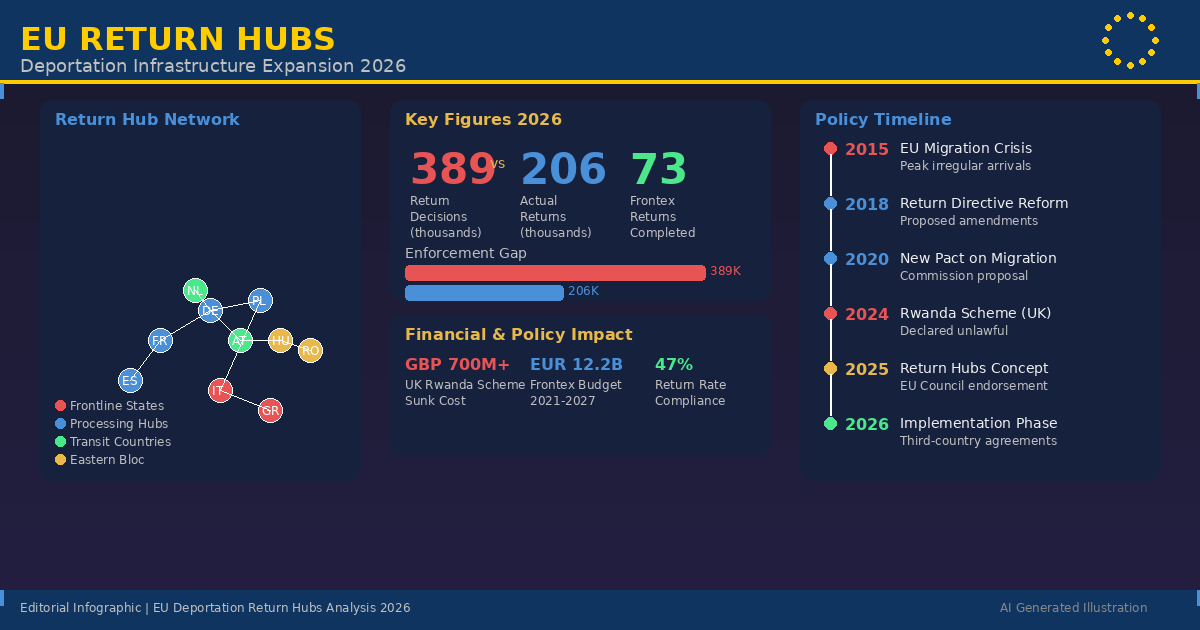
In March 2026, the European Parliament approved the 'offshore return hub' regulation by a vote of 389 to 206, establishing the legal basis for transferring rejected asylum seekers to third-country detention facilities outside EU territory. Using the Italy-Albania model as a prototype, five countries — Germany, Greece, the Netherlands, Austria, and Denmark — have begun pilot negotiations in African regions. However, the International Rescue Committee (IRC) and the Council of Europe Commissioner for Human Rights have designated this system as a 'legal black hole' and a 'human rights black hole,' warning that the failures of the UK Rwanda plan will be repeated.
Key Points
389 to 206: The Pandora's Box Opened by the European Parliament
In March 2026, the European Parliament passed the offshore return hub regulation by an overwhelming margin of 389 to 206. This regulation established the legal foundation for transferring rejected asylum seekers to third-country detention facilities outside EU territory, marking a fundamental turning point in European immigration policy. The vote was made possible by a de facto coalition between the European People's Party (EPP) and far-right parties, with reports emerging of cross-faction coordination through secret WhatsApp groups right up to the vote. Key provisions include allowing long-term detention of up to 24 months, family detention, and most controversially, the possibility of detaining unaccompanied minors. The Council of Europe Commissioner for Human Rights officially issued an opinion stating that this regulation could directly violate the protection obligations enshrined in the European Convention on Human Rights and the EU Charter of Fundamental Rights. France and Spain voted against the regulation, with Spain's Prime Minister Pedro Sanchez notably proposing a legalization program for 500,000 undocumented migrants as a counter-proposal.
The Italy-Albania Model: A Failed Prototype
The direct prototype for the EU offshore return hub is the offshore processing facility Italy established in Albania. Promoted as Prime Minister Giorgia Meloni's flagship immigration policy, the model began operations in late 2024, but the results were disastrous. All 73 people transferred were returned to the Italian mainland on legal grounds, and not a single asylum claim was processed offshore. The European Court of Justice (ECJ) significantly tightened safe third country criteria through its rulings in this process, effectively undermining the legal basis for offshore processing. The Kaldor Centre (UNSW's international refugee law research institute) analyzed Australia's Nauru and Manus Island offshore processing experience and warned that offshore detention inherently embeds structural human rights violations. According to ActionAid Italy's cost analysis, processing one migrant at the Albanian facility costs approximately EUR 153,000, more than seven times the EUR 21,000 domestic processing cost in Italy.
The EU Ignoring the Lessons of the UK Rwanda Plan
Just two years before the EU began pursuing offshore return hubs in earnest, the UK experienced the failure of a nearly identical model. The Rwanda transfer plan, initiated under Boris Johnson and continued under Rishi Sunak, spent over GBP 700 million (approximately KRW 1.2 trillion) yet managed to transfer only four people. The UK Supreme Court ruled the plan unlawful given Rwanda's human rights conditions, and it was officially scrapped shortly after Keir Starmer's Labour government took office. The European Parliamentary Research Service (EPRS) concluded in its legal analysis that offshore transfers are extremely difficult to reconcile with the EU fundamental rights framework and the non-refoulement principle. The UK experience demonstrated that offshore transfer as political symbolism ultimately results in a triple failure of enormous costs, legal defeats, and absence of real deterrent effect. Yet the EU deliberately ignores these lessons and walks the same path.
The Five-Country Coalition and Africa Pilot — Questions of Feasibility
Germany, the Netherlands, Austria, Denmark, and Greece have launched pilot projects for offshore return hubs in African regions. Candidate locations include Tunisia, Uganda, and the Kurdistan Region of Iraq — all areas where serious human rights concerns have been raised. UNHCR has expressed strong concern about these negotiations themselves, warning that processing asylum claims in third countries could undermine core principles of refugee protection. Realistically, the EU's effective return rate stands at only about 20%. According to Eurostat's 2024 annual statistics, 53.8% of migrants who received return decisions departed voluntarily while 46.2% were subject to forced removal. These figures suggest that even with operational return hubs, a dramatic improvement in actual return rates is unlikely. Given the legal and diplomatic complexity of pilot programs, the human rights environment of host countries, and the enormous operational costs, fundamental questions arise about whether the five-country coalition's plan is a feasible policy.
The Vicious Cycle of Far-Right Politics and Immigration Policy
The passage of the offshore return hub regulation reflects a dramatic rightward shift in European political terrain. What made this regulation possible in the European Parliament was a de facto coalition between the center-right EPP and far-right parties. This combination, unimaginable in the past, is the result of far-right framing on immigration colonizing mainstream politics. The EPP has adopted increasingly hardline immigration policies to absorb far-right votes, creating a vicious cycle of normalizing the far right through policy competition. France and Spain pushed back against this trend but were insufficient to change the EU's overall direction. Spain's Prime Minister Sanchez implementing a legalization program for 500,000 undocumented migrants demonstrates that inclusive immigration policies offer an alternative path to offshore deportation. However, the current political climate in Europe flows toward favoring visible, hardline measures over such alternatives.
Positive & Negative Analysis
Positive Aspects
- Attempting to Address Structural Gaps in the Return System
The EU's existing return system was in a state of serious dysfunction. The actual departure rate among migrants who received return decisions stood at only about 20%, serving as a core factor eroding the credibility of immigration policy overall. The offshore return hub is an attempt to fill this structural gap by establishing systematic return procedures in third countries for migrants whose asylum claims have been clearly rejected. Given the current structure of 53.8% voluntary departures and 46.2% forced removals per Eurostat 2024 statistics, if return procedures could be made more efficient through third-country bases, at least administrative bottlenecks could be reduced.
- Expectations for Deterrence Against Illegal Entry
Supporters of offshore hubs argue that the system will have a deterrent effect on irregular migration. The logic holds that if the message spreads that arriving in EU territory only to have asylum denied means transfer to a third-country facility, fewer migrants will attempt the dangerous Mediterranean crossing. If paying thousands of euros to trafficking organizations ultimately leads to offshore facilities, the incentive structure for economically motivated irregular migration could be weakened. The frequently cited example of boat arrivals plummeting after Australia introduced offshore processing is countered by arguments that this comparison overlooks the geographical difference between island nation Australia and Europe with its accessible land borders.
- Potential for a Responsibility-Sharing Mechanism Among Member States
If offshore hubs are operated within a multilateral framework, there are expectations that they could distribute the disproportionate burden of migrant reception concentrated on Mediterranean coastal states like Italy, Greece, and Spain. Under the current Dublin Regulation, the first country of entry bears responsibility for the asylum procedure, a structure that places an unbalanced burden on Southern European countries geographically. If the five-country coalition's pilot program operates successfully, it could be expanded into EU-level integrated return infrastructure to build a fairer responsibility-sharing system. However, this remains a theoretical possibility for now, with uncertainty about whether cost-sharing and political agreement among member states can be achieved in practice.
- Mainstream Politics' Response Logic to Far-Right Forces
From a political perspective, the offshore return hub functions as a mainstream political response to the spread of far-right populism. In a situation where the perception that nothing is being done about immigration accelerates the rise of far-right forces, the strategy is to present visible policy responses to prevent centrist voter defection. Behind the EPP's willingness to cooperate with the far right to pass this regulation lies the political reality of far-right advances in the 2024 European Parliament elections. It can be seen as an attempt to respond within an institutional framework to voter sentiment demanding hardline responses to immigration.
Concerns
- Structural Retreat in Human Rights Protection
The most fundamental problem with offshore return hubs is that by physically locating the human rights protection system outside EU territory, they create blind spots for monitoring and remedy. The International Rescue Committee (IRC) designated this a legal black hole, and the Council of Europe Commissioner for Human Rights warned this system would become a human rights black hole. Detention conditions, access to legal assistance, and possibilities for judicial remedy at third-country facilities will inevitably be significantly more limited than within EU territory. The Commissioner officially stated in an opinion that this regulation directly contravenes the non-refoulement principle and protection obligations enshrined in the EU Charter of Fundamental Rights. Provisions allowing detention of unaccompanied minors and family units also violate international standards on children's rights.
- Repetition of a Proven Failed Model
The history of offshore processing is a series of failures. In the Italy-Albania model, all 73 people transferred returned to the mainland. The UK Rwanda plan spent GBP 700 million to transfer just four people before being scrapped following a ruling of unlawfulness. Australia's Nauru and Manus Island offshore facilities operated for years, but according to the Kaldor Centre (UNSW) analysis, systematic human rights violations occurred including mental health crises, self-harm, and minor abuse, ultimately receiving assessments of policy failure as well. EPRS legal analysis also concluded that EU offshore processing is extremely difficult to reconcile with existing legal frameworks. The fundamental question arises whether it is rational policy for the EU to make a fourth attempt at a model that has failed three times across three continents.
- Enormous Costs Without Effectiveness
The operating costs of offshore hubs dramatically exceed domestic processing costs within the EU. According to ActionAid Italy's analysis, the per-person processing cost at the Albanian facility is approximately EUR 153,000, more than seven times the approximately EUR 21,000 domestic processing cost in Italy. In the UK Rwanda plan as well, the per-transfer cost was astronomical. With the EU's effective return rate at only about 20%, there is no evidence anywhere that offshore hubs can dramatically improve this ratio. Critics argue that it would be far more cost-effective to invest these enormous resources in diplomatic cooperation with countries of origin, voluntary return programs, or integration policies.
- Shifting Responsibility to Third Countries and Diplomatic Risks
The essence of offshore hubs is the EU shifting migrant management responsibilities that should be resolved within its own territory to third countries. Candidate locations including Tunisia, Uganda, and the Kurdistan Region of Iraq all face their own human rights issues and political instability. Outsourcing facility operations to these countries not only weakens the EU's moral authority but also carries the risk of host countries leveraging this as a diplomatic tool. The precedent of Turkey repeatedly playing the migrant card against the EU in the Turkey-EU migration agreement illustrates this well. UNHCR has warned that third-country return agreements could undermine core principles of refugee protection and expressed strong concern about the approach itself.
- Regression Against Climate Migration and the Global Refugee Crisis
According to the World Bank's Groundswell report, up to 216 million internal climate migrants could emerge by 2050. If this prediction materializes, migration pressure toward Europe will increase to levels incomparable to today. In this macro trend, the offshore deportation hub as a physical barrier is no different from trying to hold back the tide with a bucket. What is needed now is investment in the root causes of migration, expansion of legal migration pathways, and strengthening of global responsibility-sharing systems. International organizations and civil society point out that the enormous budget and political capital being invested in offshore hubs would be far more effective if directed toward these long-term, structural responses.
Outlook
The European Parliament's approval of the offshore return hub regulation is both a watershed moment in European immigration policy and the beginning of its most dangerous experiment. The overwhelming margin of 389 to 206 serves as a barometer of how drastically European political terrain has shifted rightward on immigration. As this regulation is implemented into actual policy, Europe will face unprecedented challenges on legal, ethical, economic, and diplomatic dimensions. Whether the pillars of human rights and rule of law — the core values of European integration — can bear the weight of this experiment will be determined by developments over the coming years.
The most immediate focus should be on legal battles. The Italy-Albania model has already prompted the European Court of Justice (ECJ) to tighten safe third country criteria, fundamentally shaking the legal foundation of offshore return hubs. As EPRS legal analysis points out, offshore transfers are extremely difficult to reconcile with the EU Charter of Fundamental Rights, the European Convention on Human Rights, and the non-refoulement principle. The Council of Europe Commissioner for Human Rights warned of a structural retreat in human rights protection in an official opinion on this regulation. Once the five-country pilot programs begin, lawsuits will almost certainly cascade through the European Court of Human Rights (ECHR) and ECJ, with these legal battles expected to continue for years. The provision on detaining unaccompanied minors in particular will clash directly with the UN Convention on the Rights of the Child (UNCRC), likely triggering debates at the international law level.
The failure of the Italy-Albania model has laid bare the structural limitations of offshore processing. The case of all 73 people returning to Italian mainland was not merely an early operational hiccup but a manifestation of the inherent legal and operational flaws of offshore processing. The failure of this project, on which Prime Minister Meloni staked her political fortune, sent significant shockwaves through Italian domestic politics, becoming a cautionary tale rather than a showcase for offshore processing. As the Kaldor Centre (UNSW) warned through its analysis of Australia's Nauru and Manus Island experience, offshore detention structurally creates blind spots for monitoring and remedy, with human rights conditions tending to deteriorate over time. In Australia, self-harm, mental health crises, and abuse of minors occurred systematically at offshore facilities, demonstrating that geographical isolation inevitably creates monitoring gaps. As ActionAid Italy's cost analysis shows, the per-person processing cost of approximately EUR 153,000 at the Albanian facility is more than seven times the approximately EUR 21,000 domestic cost. If this cost structure scales to the five-country pilot, the financial burden will grow exponentially, with taxpayer backlash inevitable.
The likelihood of repeating the UK Rwanda plan's fate is also very high. This plan, which spent GBP 700 million to transfer just four people before being scrapped following a Supreme Court ruling of unlawfulness, proved the extreme gap between the political symbolism of offshore transfers and their actual effect. The Rwanda plan was the flagship immigration policy of Conservative governments from Boris Johnson through Rishi Sunak, but it failed to clear legal hurdles, leaving only enormous costs before being scrapped shortly after Keir Starmer's Labour government took office. The EU's situation is even more complex than the UK's. It requires agreement among 27 member states and must simultaneously satisfy the multi-layered legal framework of EU law, individual member state constitutions, and the European Convention on Human Rights. With France and Spain already having voted against, achieving EU-wide consensus is a political ordeal of the highest order. The expectation that the EU as a 27-nation consensus body can succeed at a task where the UK failed as a single country is overly optimistic.
The question of return effectiveness challenges the very rationale for offshore hubs. The EU's effective return rate stands at only about 20%, and according to Eurostat 2024 annual statistics, 53.8% of migrants who received return decisions departed voluntarily while 46.2% were subject to forced removal. The implication is clear: with the forced removal ratio approaching half, no return mechanism can be effective without cooperation from countries of origin. There is no evidence that offshore hubs can dramatically change this ratio. The claim that the mere existence of offshore facilities will have a deterrent effect is not empirically supported outside Australia's case, and even that comparison is difficult given the geographical differences between island-nation Australia and Europe. Australia, surrounded by ocean, could physically block maritime entry, while Europe has diverse migration routes through both Mediterranean coasts and Eastern European land borders.
The relationship between far-right politics and immigration policy reveals the political essence of this issue. The EPP's alliance with far-right parties to pass this regulation shows how deeply far-right framing on immigration has colonized mainstream European politics. Reports of cross-faction coordination through secret WhatsApp groups right up to the vote suggest this alliance was a product of backroom dealing rather than open policy debate. While this alliance achieved the short-term result of passing the regulation, in the long term it will normalize far-right policy agendas and shift the political Overton window further right. If offshore hubs fail to produce the expected deterrent effect, far-right forces will demand even more extreme measures under the logic of not being tough enough, and this vicious cycle risks eroding the foundations of European democracy.
Spain's Prime Minister Sanchez implementing a legalization program for 500,000 undocumented migrants demonstrates that alternatives to the offshore deportation approach exist. Legalized migrants pay taxes, contribute to social security systems, and by joining the formal rather than underground economy, positively impact national finances. Expanding legal migration pathways, strengthening investment in root causes of migration (poverty, conflict, climate change), and promoting integration of migrants already residing in Europe is an approach that can improve the effectiveness of migration management while protecting human rights. However, the current political climate in Europe flows toward favoring visible, hardline measures over such structural approaches.
From a broader perspective, the World Bank's Groundswell report projecting up to 216 million internal climate migrants by 2050 suggests that current migration pressure is only the beginning. When large-scale population movements driven by water scarcity, food crises, and sea-level rise intensify from sub-Saharan Africa, South Asia, and Central America, migration pressure toward Europe could amplify by orders of magnitude. When climate-driven migration fully materializes, the offshore hub as a physical barrier will be structurally rendered powerless. The enormous budget and political capital currently being invested would have produced far more effective results if directed toward climate adaptation support, development cooperation, and building legal migration infrastructure.
Four key variables will determine this regulation's future trajectory. First, legal judgments by the ECJ and ECHR. As legal battles that began with the Italy-Albania model expand to the five-country pilot programs, the legal viability of offshore hubs will be put to the test. Second, actual operational outcomes of the pilot programs. Given the precedent of all 73 people returning from Albania, it is extremely uncertain whether the Africa pilot can achieve meaningful-scale returns. Third, public response to cost-effectiveness. Considering that public opinion sharply deteriorated once UK Rwanda plan costs were reported in the media, similar headwinds may emerge when the astronomical costs of EU offshore hubs become public. Fourth, the European political calendar through 2027. Depending on election schedules in major countries like France and Germany, immigration policy direction could shift again.
Ultimately, the offshore return hub is Europe's attempt to push responsibility out of sight through physical distance rather than confronting the complexity of the immigration issue head-on. As the experiences of Italy, the UK, and Australia consistently show, offshore processing structurally embeds the triple burden of high costs, legal defeats, and human rights violations. What the parliamentary vote of 389 to 206 reveals is not policy conviction but European politics' sense of powerlessness before the immigration issue and capitulation to far-right populist pressure. Pushing refugees and migrants outside EU territory does not solve the problem — it merely removes it from view, and the price is paid with Europe's decades-long legacy of human rights and rule of law. True solutions will begin not with offshore deportation, but with long-term investment in the root causes of migration, expansion of legal migration pathways, and building an immigration management system grounded in human rights and rule of law.
Sources / References
- European Parliament approves return hub regulation — European Parliament
- EU offshore return hubs: A legal black hole — International Rescue Committee (IRC)
- UNHCR concerns on EU external processing proposals — UNHCR
- Return operations annual report 2025 — Frontex
- Italy-Albania migrant deal: 73 transferred, all returned — The Guardian
- Rwanda asylum plan: £700m spent, four people relocated — BBC News
- ECJ ruling on safe third country criteria — Court of Justice of the European Union
- Groundswell: Climate change could force 216 million people to migrate by 2050 — World Bank
- Five EU countries launch Africa return hub pilot negotiations — Reuters
- Inside the EPP-far right alliance that passed the EU return regulation — Politico Europe
- Offshore processing: A failure analysis of Australia's extraterritorial asylum model — Kaldor Centre for International Refugee Law (UNSW)
- EU external processing of asylum claims: Legal analysis — European Parliamentary Research Service (EPRS)
- Commissioner's opinion on EU return hub regulation — Council of Europe Commissioner for Human Rights
- The cost of the Albania model: €153,000 per person vs €21,000 domestically — ActionAid Italy
- Enforcement of immigration legislation statistics — 2024 annual data — Eurostat