
114 Countries Took Phones Out of Classrooms — But the Thing That Actually Needs Banning Is Silicon Valley's Algorithm
Summary
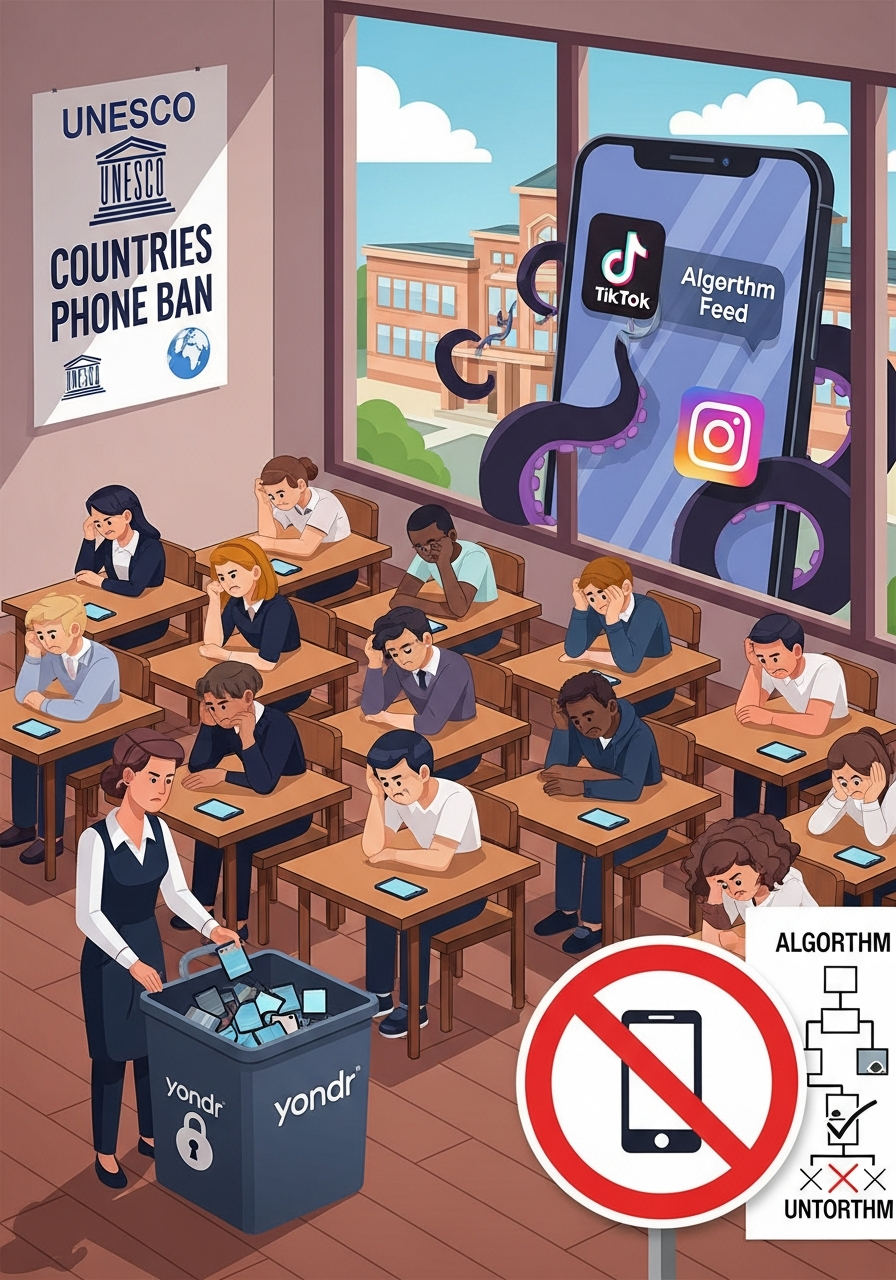
School smartphone bans have surged from 24 percent of countries in 2023 to 58 percent in 2026, with 114 education systems now enforcing classroom phone prohibitions. A Florida study found only a 0.6 percentile point academic improvement, while a Lancet study of 1,227 British students concluded there was no significant mental health benefit, and 56 percent of students still secretly check phones despite bans. The policy addresses classroom distraction but leaves untouched the root cause: addictive algorithmic business models from Meta and TikTok that a Los Angeles jury found guilty of harming minors in March 2026. What truly demands prohibition is not the device but the engagement-maximizing code exploiting developing brains during the 17 hours no classroom policy can reach.
Key Points
From 24% to 58% in Three Years — An Unprecedented Global Ban Wave
In June 2023, only 24 percent of the world's education systems had any form of school smartphone ban in place. By early 2025 that number had crossed 40 percent, and by March 2026 it had catapulted to 58 percent, meaning 114 education systems now actively prohibit phones in classrooms. Bolivia, Costa Rica, Croatia, Georgia, the Maldives, and Malta were among the latest additions, joining the growing global consensus in late 2025. The United States has been particularly aggressive — 39 states have introduced some form of restriction, with 15 of those implementing outright bans. Germany's federal states of Bavaria, Saarland, and Thuringia have enacted their own prohibitions, while Argentina's Buenos Aires province, Armenia, Thailand, and North Macedonia have all followed suit. At this pace, the 70 percent threshold could be crossed by 2027, making smartphone-free classrooms the de facto global standard rather than the exception.
Grades Went Up, But Mental Health Stayed Flat — The Mixed Evidence Dilemma
The most comprehensive data on academic impact comes from a Florida study that tracked outcomes across the state's public school system after its phone ban took effect. The results showed a 0.6 percentile point increase for all students and a 1.1 percentile point bump in schools where pre-ban phone usage had been highest. Male students saw a 1.4 percentile point gain, and Black students experienced a 1.2 point improvement. However, a study published in the Lancet Regional Health Europe in February 2025, examining 1,227 students across 30 British schools, found no statistically significant difference in mental health outcomes between schools with all-day bans and those without.
Kids Are Cracking Yondr Pouches on Day One — The Reality of Workarounds
The Academy at Shawnee in Louisville, Kentucky became a poster child for the bell-to-bell phone ban movement when it introduced Yondr pouches to physically lock away student devices for the entire school day. Library checkouts tripled, but students adapted with remarkable speed — bringing backup phones, borrowing dummy phones, cutting pouches open with scissors, or lying about possession. A Brookings survey found that 56 percent of students at ban-enforcing schools still check their phones multiple times per day, with 25 percent reporting frequent use during prohibited hours.
The Ban Treats the Symptom — The Real Disease Is the Algorithm's Business Model
An internal Meta employee described the company's relationship with young users in court documents by comparing it to drug dealing, writing that the company is 'basically pushers.' A Los Angeles jury delivered a landmark guilty verdict in March 2026, finding that Meta and Google had harmed minors through deliberately addictive product design. The European Commission threatened ByteDance with fines amounting to 6 percent of TikTok's global revenue. Research from CCDH found that TikTok's algorithm delivers body image content to teenagers every 39 seconds and eating disorder-related content every 8 minutes.
A Phone Ban Without Digital Citizenship Education Is Only Half a Solution
Washington state legislator Sharon Tomiko Santos called the phone restriction an 'overly broad response aimed at the wrong target.' A Brookings survey found that 76 percent of students agree some form of restriction is necessary, but a Pew survey revealed that only 4 in 10 students support an all-day ban. Ten countries, including Colombia, Estonia, Iceland, Peru, Indonesia, Serbia, Poland, and the Philippines, have opted for school-level autonomy rather than national blanket bans, placing greater emphasis on digital literacy education over prohibition.
Positive & Negative Analysis
Positive Aspects
- Measurable Gains in Classroom Focus and Academic Achievement
The Florida study documented a 0.6 to 1.1 percentile point improvement in academic performance following the phone ban, with the effects most pronounced among low-income students. In Ohio, 68 percent of principals reported that students could now sustain focus on a single task for more than 20 minutes. At Kentucky's Academy at Shawnee, library checkouts surged to three times their previous year's level.
- Revival of In-Person Social Interaction
Seventy-two percent of Ohio principals observed that cafeteria behavior shifted from silent scrolling to actual conversation, and 62 percent reported increased face-to-face socializing during breaks and lunch periods. Additionally, 61 percent of principals reported a decline in online conflicts spilling over into the physical classroom.
- Improved Attendance and Reduced Truancy
The Florida study found that attendance rates among middle and high school students improved after the ban, with truancy declining by a statistically significant margin. Researchers identified improved attendance as a key mediating variable in the academic gains.
- A Rare Policy With Near-Universal Support Among Adults
The Brookings survey found that 93 percent of adults support some form of phone restriction during class or throughout the school day, and even 76 percent of students agreed that some limitation is necessary. Among teachers, 78 percent supported the policy and 62 percent observed concrete improvements in student behavior.
- Bipartisan Momentum That Transcends Political Divides
In the United States, 39 states have adopted some form of restriction, cutting across traditionally red and blue political lines with remarkable evenness. Globally, the pattern is equally striking — from France and Germany to Bolivia and the Maldives.
Concerns
- No Proven Improvement in Student Mental Health
The February 2025 Lancet Regional Health Europe study of 1,227 students across 30 British schools found no statistically significant difference in mental health outcomes between all-day ban schools and those without restrictions. A Brookings survey corroborated this finding, with the majority of students reporting that restrictions had no effect on their emotional wellbeing.
- Student Workaround Strategies Are Eroding Policy Effectiveness
From the very first day of implementation in Kentucky, students developed an arsenal of evasion techniques — backup phones, pouch cutting, dummy devices, and outright lying. The Brookings survey found that 56 percent of students at ban-enforcing schools still check their phones multiple times daily, with 25 percent doing so frequently during prohibited hours.
- Legitimate Concerns About Emergency Communication and Safety
Students in Ohio expressed genuine anxiety about being unreachable during family emergencies. The inability to document bullying incidents on camera was raised as another concrete safety concern, removing an important evidence-gathering tool for victims.
- A Policy That Covers 7 Hours but Ignores the Other 17
School bans operate during approximately six to seven hours of a student's day, leaving the remaining 17 hours completely unaddressed. During those unprotected hours, TikTok's algorithm delivers body image content every 39 seconds and eating disorder-related material every 8 minutes.
- Stripping Students of Digital Autonomy and Citizenship Learning
Thirteen out of 18 Ohio students interviewed objected to the ban on the grounds that it infantilized them. The Pew survey showed that only 4 in 10 students support an all-day ban, indicating majority opposition among the population most directly affected.
Outlook
In the short term, over the next six months to a year, the global momentum behind school smartphone bans will only accelerate. The 58 percent adoption rate as of March 2026 is likely to surpass 65 percent by the end of the year. In the United States, most of the remaining 11 states that have not yet passed ban legislation have bills actively pending, and even cautious holdouts like Washington state have set concrete timelines — completing their study by 2027 and implementing an all-day policy by 2030. However, student workaround strategies are astonishingly fast and creative. The next wave of evasion will involve alternative devices — smartwatches with cellular connectivity, wireless earbuds with voice assistant access, and increasingly capable wearable technology that occupies a regulatory gray zone.
The medium-term outlook, covering roughly six months to two years from now, hinges on how far legal accountability for social media companies will actually go. The March 2026 guilty verdict delivered by a Los Angeles jury against Meta and Google represents a potential paradigm shift. If this verdict survives appeal, it will unlock a flood of class-action litigation across the United States. The EU Commission's threat to fine ByteDance up to 6 percent of TikTok's global revenue targets the specific mechanisms of addiction — infinite scroll, autoplay, personalized recommendation algorithms.
Looking further out to the long term, two to five years from now, the fundamental terms of this debate will be redefined entirely. The current school smartphone ban controversy will be absorbed by 2030 into a much larger framing: device bans versus algorithm regulation. As AI-powered personalized education tools proliferate in classrooms, the core question will no longer be whether smartphones belong in schools but rather which apps and algorithms should be permitted to interact with students during learning hours. Policy will need to operate at the service and algorithm layer rather than the hardware layer. As a Meta employee acknowledged in court, if social media companies are 'basically pushers,' then the war we need to fight is not about confiscating the syringes from the classroom but about dismantling the supply chain itself.
Sources / References
- Phone Bans in Schools Are Spreading Worldwide as Policy Debate Rages — UNESCO GEM Report
- 114 Countries Now Restrict Phones in Schools, UNESCO Report — Business Today
- Survey: Parents and Teens Support School Cellphone Bans — Brookings Institution
- Kentucky School Cell Phone Ban Consequences — NPR
- Washington Cellphone Ban Study — OPB
- Mobile Phone Bans and Student Mental Health — The Lancet
- Meta, Google Liable in Addiction Case Jury Verdict — Rappler
- EU Says TikTok Must Change Addictive Design — Al Jazeera
- The Effects of School Phone Bans on Student Achievement — NBER
- Deadly by Design: TikTok Algorithm Body Image Research — CCDH
- About 4 in 10 Teens Support Cellphone Bans in Classrooms — Pew Research Center
- 98% of Teens Have School Cellphone Bans, But Majority Don't Follow Them — The 74
- Zuckerberg Testimony at Social Media Addiction Trial — NPR
- Banning Cellphones: Quick Fix or False Hope? — Harvard GSE
- State Efforts to Ban Cellphones in Schools and Youth Mental Health — KFF
- Students Easily Subvert LAUSD Phone Ban — EdSource