
The Real Barrier to Space Colonization Isn't the Rocket — It's the Womb
Summary
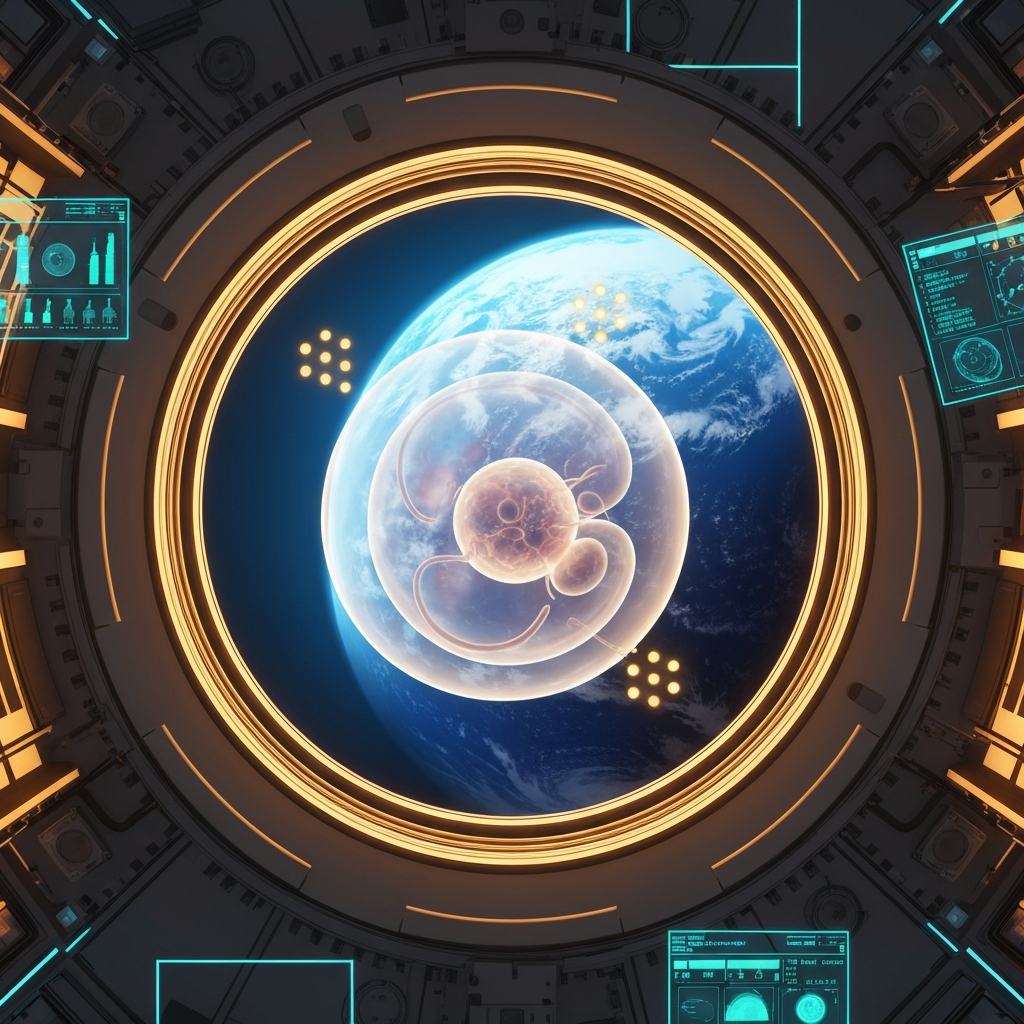
China's Tianzhou-10 cargo spacecraft has carried humanity's first artificial embryo models into orbit aboard the Tiangong Space Station, initiating a landmark experiment to observe early cellular development under microgravity conditions and generate the first direct data on whether human reproductive biology can function off-world. The experiment employs blastoids — stem cell-derived structures that closely replicate the blastocyst stage of development without possessing the capacity to implant or develop into a human being — providing a scientifically rigorous yet ethically defensible window into space reproductive biology. Five days after launch, state media reported normal developmental signals, offering the first tentative evidence that microgravity may not be the insurmountable barrier to early embryo-like development that many researchers feared. This experiment confronts one of the most fundamental yet systematically neglected questions in long-duration spaceflight: whether humans can reproduce off-world, and what biological risks that reproduction would carry in an environment shaped by microgravity, cosmic radiation, and the absence of Earth's protective magnetic field. I believe this research is not only ethically justified but represents an essential scientific investment for any civilization that takes its multi-planetary future seriously — because the true barrier to permanent space colonization has never been the rocket. It has always been the womb.
Key Points
Humanity's First Space Embryo Development Experiment Is Actually Happening
China's Tianzhou-10 cargo spacecraft, launched on May 11, 2026, docked with the Tiangong Space Station carrying 41 scientific experiment packages — but none drew more attention than the human artificial embryo development study. The experiment exposes blastoids — stem cell-derived structures that mimic the early embryonic blastocyst stage — to microgravity conditions, using a miniaturized automated culture system to monitor whether cellular division and differentiation proceed normally in orbit. Led by Professor Yu Leqian at the Chinese Academy of Sciences' Institute of Zoology, the project represents the first time a human embryo model has been used to investigate developmental biology in the space environment directly. Just five days after launch, Xinhua News Agency reported that normal developmental signals had been detected, suggesting that microgravity does not completely disrupt embryo-like development at its earliest stage — the first encouraging data point in an area that has, astonishingly, remained almost entirely unexplored until now. Previous experiments using mouse embryos had raised legitimate concerns that the space environment could scramble early cell division processes, but the direct application of a human embryo model changes the scientific and historical significance of the question entirely.
What makes this experiment so significant is not just what it tests but what it reveals about a remarkable gap in our preparedness for space colonization. For over 65 years, humanity has sent people into space, refined propulsion systems, developed life-support technology, and built habitats in orbit — yet nobody had rigorously tested whether our species can actually reproduce beyond Earth until now. Professor Yu stated the purpose plainly: "This is our first attempt to answer whether humans can survive and reproduce in space." That sentence carries extraordinary weight. The single most fundamental prerequisite for any genuine space civilization — not an outpost, not a relay station, but an actual civilization with generational continuity — is the ability to produce new members locally. This experiment is the first time that prerequisite has been subjected to direct scientific scrutiny, and the fact that it took until 2026 to get here is itself a revealing commentary on how science and policy have collectively avoided an uncomfortable question.
Why Blastoids Are the Ethically Smart Move
The entire premise of this experiment depends on a critical scientific and ethical distinction that most media coverage has obscured: these are not real human embryos. Blastoids are synthetic structures assembled from induced pluripotent stem cells by introducing specific chemical signals that coax the cells into forming a configuration nearly identical to a blastocyst — the structure that would normally implant in the uterine wall during early pregnancy. Crucially, blastoids lack the biological capacity for implantation and cannot develop into a human being under any circumstances. This is not a semantic or legal distinction but a fundamental biological one. As the 2025 PMC review of stem cell-based embryo models explains, unlike traditional embryos derived from fertilized gametes, these structures lack totipotency and therefore cannot develop into complete organisms. The distinction is what allowed this experiment to proceed at all, and it's what separates this research from any ethical category that would warrant serious international concern.
This biological boundary enabled the scientific team to navigate an ethical landscape that would otherwise have been impassable. Had researchers attempted to send actual human embryos to the space station, the international backlash would have been immediate and the scientific credibility of the program would have been destroyed. By using stem cell-derived models, the team achieved both scientific validity and ethical defensibility simultaneously. The ISSCR's 2021 revised guidelines, which moved from a blanket 14-day prohibition on extended embryo culture to a supervised case-by-case review framework, reflected the scientific community's recognition that blastoid technology occupies a fundamentally different ethical category from actual embryo manipulation — one that deserves careful oversight but not categorical prohibition. The Nuffield Council on Bioethics made a similar determination in its 2024 report, recommending a dedicated regulatory sandbox for stem cell-based embryo models precisely because existing law was never written to handle them.
However, there is an uncomfortable truth embedded in this ethical workaround that deserves honest acknowledgment. As blastoid technology improves, the biological similarity between synthetic models and actual blastocysts increases. Current best-in-class blastoids already share over 95% gene expression similarity with real blastocysts, and some research has demonstrated implantation-like responses in uterine tissue. At some point along this technological trajectory, the distinction that makes blastoids ethically permissible today becomes strained enough to require its own fresh ethical reckoning. That moment is not today — but it is approaching, and the scientific community needs governance frameworks ready before it arrives.
The Double Barrier: Microgravity and Cosmic Radiation
The scientific landscape leading into this experiment is considerably more complex than a simple "gravity is bad for embryos" narrative, and understanding the prior evidence matters enormously for interpreting what Tianzhou-10 can and cannot tell us. Two previous studies reached contradictory conclusions. In 2023, a JAXA and University of Yamanashi team published results in iScience from an ISS experiment involving 720 frozen two-cell mouse embryos split evenly between a microgravity group and an artificial 1G control group. The result defied most people's intuitions: both groups developed normally to the blastocyst stage. Lead researcher Teruhiko Wakayama concluded that "gravity had no significant effect on the early embryo development of mammals in space" — a finding that is as encouraging as it is surprising. If gravity is not a fundamental obstacle to early embryonic development, that's genuinely good news for the long-term viability of space reproduction.
But China's 2020 SJ-10 satellite experiment told a different story. Of 3,400 unfrozen two-cell mouse embryos exposed to 64 hours of microgravity, researchers observed a significant decrease in blastocyst formation rates and detected both DNA double-strand breaks and global hypomethylation — serious warning signs for developmental integrity. Published in the National Science Review, these findings directly conflict with the JAXA 2023 data. The discrepancy likely stems from differences in whether embryos were frozen before flight, the radiation exposure levels at different orbital altitudes, and the duration of experimentation. The critical point is that this conflict cannot be resolved by further mouse experiments — it requires direct data from a human embryo model in a controlled environment, which is exactly what the Tianzhou-10 experiment provides.
Space radiation, more than microgravity, may prove to be the harder barrier. Tiangong operates in low Earth orbit within the protective influence of Earth's magnetic field, where annual radiation exposure runs roughly 150–300 mSv. A Mars transit, by contrast, exposes travelers to an estimated 600–1,000 mSv per year from galactic cosmic rays and solar energetic particles, with the NCRP's maximum allowable radiation dose during pregnancy set at just 5 mSv. A 2025 paper in npj Microgravity found that radiation doses equivalent to a three-year Mars mission would induce structural malformations in human embryos including microcephaly, microphthalmia, and neural tube defects. The implications are sobering: even if the Tianzhou-10 blastoid data proves entirely positive, that result describes conditions aboard a shielded low-orbit station — it cannot be directly extrapolated to the deep-space environments where the real colonization challenges lie.
The 14-Day Rule Has No Passport — And That's a Problem
The 14-day rule, first proposed by the UK's Warnock Committee in 1979 and subsequently codified in various forms across more than two dozen countries, has been the foundational ethical framework governing embryo research for nearly half a century. The rule prohibits culturing human embryos beyond 14 days in vitro, a timeline chosen because the primitive streak — the first anatomical precursor to a central nervous system — forms around that developmental stage. It represents one of the most durable achievements of applied bioethics in the modern era. What the Warnock Committee could not have anticipated in 1979 was the possibility that relevant experiments would eventually take place 400 kilometers above Earth's surface.
China applies the 14-day rule as a national scientific guideline rather than hard statute, and its official position is that blastoids do not fall within the rule's scope. The 1967 Outer Space Treaty, the only genuinely multilateral framework governing orbital activity, addresses nuclear weapons, sovereignty claims, and general state responsibility — it contains precisely zero language about bioethical research standards. There is no binding international treaty, no enforceable UN resolution, and no multilateral agreement that directly governs embryo-related research conducted in space. The Tianzhou-10 experiment proceeds in complete compliance with all existing legal frameworks, which is either reassuring or alarming depending on one's perspective. My view is that this regulatory vacuum represents a predictable failure of norm-making to keep pace with technological capability — a failure that needs urgent correction before competitive pressures between spacefaring nations create incentives to exploit the vacuum rather than close it.
The deeper issue is that this gap was entirely foreseeable and largely ignored. Legal scholars and bioethicists have been flagging the absence of space bioethics governance for years, and a 2022 Frontiers paper reviewing Chinese embryo research regulations noted explicitly that "the space environment is not clearly addressed in current regulatory frameworks." The scientific and diplomatic groundwork for addressing this gap needed to be laid before the first experiment happened — and it wasn't. Now governance must catch up to practice rather than the more desirable reverse.
China's Strategic Position — And Why the West Should Pay Attention
It would be a mistake to analyze this experiment as a product of scientific curiosity alone, disconnected from strategic intent. China's national space roadmap calls for a crewed lunar landing by 2030, a permanent lunar base by 2035, and crewed Mars exploration in the 2040s — and within that roadmap, understanding whether humans can reproduce in space is not niche research but essential infrastructure. Professor Yu Leqian's own framing of the experiment confirms this: it is explicitly positioned as part of building the scientific foundation required for long-term human space habitation, not as basic research with abstract future applications.
The contrast with the United States and Europe is stark and deserves honest examination. In the U.S., the Dickey-Wicker Amendment has prohibited the use of federal funds to create or destroy human embryos since 1996, and anything adjacent to embryo research faces intense congressional opposition regardless of its scientific context. NASA cannot fund this category of research through normal channels. Europe faces a patchwork of national bioethics laws that makes unified transnational reproductive research programs nearly impossible to coordinate. What may look like Chinese scientific boldness is at least partly Western political paralysis — and that distinction matters enormously for long-term competitive positioning in space.
I want to be clear that this structural advantage on China's part does not imply ethical superiority. China's credibility in international bioethics has been damaged by the 2018 He Jiankui affair, in which a researcher edited the germline of human embryos and brought gene-edited twins to term without proper institutional oversight or international scientific consensus. China strengthened its regulatory framework after that scandal, but the structural concerns about independent ethics oversight and transparency have not been fully resolved. The correct response to China's lead in this research area is not to block the work but to build better governance frameworks and competitive programs — which requires Western democracies to have an honest conversation about the cost of their political constraints on science policy.
Positive & Negative Analysis
Positive Aspects
- It Addresses the Most Fundamental Bottleneck in Space Colonization
Even if humanity builds permanent settlements on Mars or the Moon, the inability to reproduce locally would condemn those outposts to perpetual dependence on Earth for population replenishment — which means they would be forward operating bases at best, never genuine civilizations with generational continuity. Every successful human colony in history, on every continent, only became truly self-sustaining when it developed the capacity for local reproduction and population growth. A Mars base that cannot produce a second generation is not a colony — it is an extremely expensive field station. This experiment represents the first serious attempt to determine whether the biology of that second generation is even possible, and the long-term value of that data is difficult to overstate. Elon Musk's publicly stated goal of a million-person Mars city cannot be achieved through continuous transport from Earth alone; at some point, people must be born there, which means the question this experiment is asking must eventually be answered. Given that a one-way Mars transit takes six to nine months under current propulsion technology, the medical management of pregnancy and early development during transit and on the Martian surface will require scientific foundations that do not currently exist. This research begins building those foundations, making it at least as strategically important as the propulsion systems and life-support technologies that receive exponentially more funding and public attention.
- The Experiment Design Is Ethically Sound
The choice to use blastoids rather than actual human embryos is not simply a regulatory maneuver — it reflects genuine scientific creativity deployed in the service of ethical constraint, and it deserves recognition as such. Using real human embryos in an orbital experiment would have generated immediate, severe, and justified international backlash; it would have jeopardized the program's credibility and almost certainly triggered a coordinated response from international scientific bodies that could have set the entire field back by decades. By using stem cell-derived models that biologically cannot develop into human beings, the research team preserved scientific value while minimizing legitimate concerns about human dignity in a way that is broadly defensible under current international bioethics standards. The ISSCR's 2021 guideline revision, which moved from absolute prohibition on extended embryo culture to supervised case-by-case review, reflects a mature scientific recognition that blastoid research occupies a distinct ethical category that warrants careful oversight without requiring blanket prohibition. If the team had restricted themselves to animal models only, the cross-species gap would have severely limited the applicability of results to human reproductive medicine. And if they had used real human embryos, the research would have been blocked. Blastoids occupy the scientifically productive middle ground, and recognizing that represents legitimate ethical problem-solving rather than corner-cutting.
- It Opens a New Dimension in Developmental Biology
Every developmental biology experiment conducted on Earth shares one fundamental limitation that has never been adequately acknowledged: Earth's gravitational field cannot be removed as a variable. For over a century, researchers have studied how embryos develop without ever being able to test what role gravity itself plays in the cellular and molecular processes that guide that development, because there was no practical way to eliminate it as a factor. The Tianzhou-10 experiment changes that by introducing microgravity as a genuine experimental variable for human developmental biology for the first time in history. Questions that have been theoretically interesting but empirically inaccessible — to what degree does gravity determine cell division orientation in early development? how much do mechanical forces contribute to cell polarity formation? which aspects of early patterning are truly intrinsic to the genome and which are environmental responses to gravitational context? — are now empirically investigable. The scientific return on this investment extends far beyond space exploration. NASA's Tissue Chip program demonstrated that studying organ development in microgravity environments yields insights applicable to terrestrial medicine in ways that ground-based experiments simply cannot replicate. The global infertility rate stands at 17.5% by WHO estimates, and the assisted reproductive technology market exceeded $4 billion annually as of 2024 with consistent 7-8% year-on-year growth. Understanding which developmental pathways are gravity-dependent and which are not will have direct downstream applications in infertility treatment, developmental disorder research, and the emerging field of artificial uterus technology — making this research valuable for Earth-based medicine regardless of what it reveals about space.
- It Could Catalyze International Scientific Cooperation in a Critical New Domain
Space reproductive science is not a challenge that belongs to any single nation — it is a challenge that belongs to any species that aspires to existence beyond a single planet, which makes international cooperation both scientifically sensible and diplomatically valuable. The data generated by the Tianzhou-10 experiment has implications for every crewed deep-space mission regardless of national origin: American astronauts on a Mars mission, European astronauts on a lunar base, and Chinese astronauts on a Tianwen mission will all face the same biological questions. Scientific problems held in common create frameworks for diplomatic engagement that transcend competitive geopolitics, at least potentially. If China publishes its results in international peer-reviewed journals — and given that the Chinese Academy of Sciences' Institute of Zoology published extensively in Cell and Nature in 2024, there is strong precedent for expecting open scientific sharing — this experiment could provide the foundation for a collaborative framework in space life science comparable to the U.S.-Russia cooperation that made the ISS possible. The UN Committee on the Peaceful Uses of Outer Space has begun incorporating space bioethics into its agenda, and this experiment will give that conversation necessary urgency. Sometimes the most productive diplomatic openings come not from political negotiation but from shared scientific necessity — and the necessity here is genuine enough to cut across the sharpest current geopolitical divisions.
- It Forces a Policy Conversation That Cannot Happen Without a Catalyst
Before this experiment, space reproductive ethics was a philosophical hypothetical — interesting in academic seminars, irrelevant to actual policy. The Tianzhou-10 experiment transforms it into a live policy question that regulators, legislators, and international bodies can no longer defer indefinitely. What are the ethical limits on embryo research conducted in orbital environments beyond national jurisdiction? What legal status would a person born in space carry under existing international law? Who owns intellectual property generated by space-based reproductive research? How do we ensure equitable access to reproductive technologies developed for wealthy spacefaring nations? These questions were previously hypothetical; they are now live. The UN COPUOS has reportedly begun incorporating space bioethics into its official agenda partly in response to this experiment. Regulatory frameworks always lag behind technological development, but the gap can be minimized if the conversation begins early enough — and "early enough" is right now, not after the second or third orbital experiment has established a body of de facto practice that proves resistant to retroactive governance. I believe the first international framework specifically addressing reproductive research in space will exist within five years, and this experiment will be identified as its direct catalyst. That is not an indictment of the research — it is an argument for why the research needed to happen.
Concerns
- Blastoid Limitations Cap the Experiment's Extrapolation Value
The 95% gene expression similarity between blastoids and real blastocysts sounds compelling right up until you consider what the remaining 5% contains and what falls entirely outside the model's scope. Implantation, post-implantation development, placentation, the establishment of maternal-fetal circulation, and the full cascade of hormonal and cellular communication involved in actual human pregnancy cannot be replicated by blastoid models, which means even a robustly positive result from this experiment cannot be cleanly translated into the conclusion that human pregnancy is viable in the space environment. Research from Israel's Weizmann Institute underscores the current technical state of the art: in approximately 100 attempts to create a synthetic human embryo model, only one or two produce the desired structure, with the remainder being, in Jacob Hanna's own words, "disorganized blobs." A 2024 study found that even the most sophisticated blastoid models failed to replicate development beyond day eight, constraining the experimental window to an extremely narrow range of developmental stages. At some point, answering the real question — can humans actually complete a successful pregnancy in space? — will require either whole-animal pregnancy experiments in orbital conditions or actual human embryo research, both of which carry ethical costs that substantially exceed those of the current blastoid work. The data generated by Tianzhou-10 is scientifically valuable and genuinely new, but treating it as sufficient evidence that space reproduction is safe or viable would be an extrapolation far beyond what the experimental design can support.
- China's Ethical Governance Record Creates Legitimate Credibility Concerns
The scientific credibility of any research program is inseparable from trust in the institutional and national governance frameworks that oversee it, and China's standing in the international bioethics community was severely damaged by the 2018 He Jiankui affair. In that case, a researcher used CRISPR to edit the germline of human embryos and bring gene-edited twin girls to term — the first such case in history — conducted without proper institutional oversight, in direct violation of the global scientific community's explicit normative consensus, and with apparent awareness that the work would not withstand international ethical scrutiny. China strengthened its regulatory framework after the affair, but the structural question of whether independent ethics oversight operates with genuine transparency and autonomy from political administration remains unresolved to the satisfaction of much of the international scientific community. The Tianzhou-10 experiment uses blastoids and constitutes no direct ethical violation by current standards — but the concern is less about this specific experiment than about the trajectory of the broader program. The political integration of China's scientific administration with Party governance means that in principle, scientific judgment and political judgment can become entangled in ways that have no direct counterpart in most Western research systems. This concern is not xenophobic; it is a reasonable epistemic response to a governance structure that has, in at least one documented case, permitted research to proceed that the global scientific community would have blocked under normal international standards.
- Low Earth Orbit Data Cannot Resolve the Deep-Space Radiation Problem
Tiangong's orbital environment, sheltered by Earth's magnetosphere at roughly 340–450 kilometers altitude, is fundamentally different from the radiation environment that any Mars-bound embryo would actually face. In low Earth orbit, annual radiation exposure runs approximately 150–300 mSv, and while this is substantially higher than the Earth's surface, it is not in the same category as deep-space exposure. A Mars transit exposes travelers to an estimated 90–324 mSv for the six-to-nine-month journey alone, with galactic cosmic rays producing high-energy particle bursts that generate DNA double-strand breaks at dramatically higher frequencies than anything experienced aboard Tiangong. The 2025 npj Microgravity paper found that radiation doses corresponding to a three-year Mars mission would produce microcephaly, microphthalmia, and neural tube defects in developing embryos — and the NCRP's maximum allowable pregnancy radiation exposure is just 5 mSv. A positive result from this Tiangong experiment — blastoids developing normally in a magnetically shielded low-orbit environment — tells us something useful about the effects of microgravity in a protected setting. It tells us essentially nothing about whether embryonic development could proceed safely during a Mars transit or in any deep-space environment where Earth's magnetic protection is absent. Drawing Mars colonization conclusions from Tiangong data is a logical leap analogous to training for a Pacific solo crossing in a swimming pool and concluding the open ocean poses no difficulty.
- The Slippery Slope Concern Is Historically Well-Founded
Critics who raise the slippery slope concern regarding this research — the worry that blastoid experiments today will normalize progressively more permissive embryo research tomorrow — are not engaging in paranoia. They are reading history with reasonable accuracy. Somatic gene editing was initially framed as absolutely distinct from germline editing, right up until He Jiankui decided otherwise. Animal cloning was supposed to remain strictly limited to therapeutic applications, until commercial pet cloning services became a viable industry. The ISSCR's own 2021 guideline revision — moving from absolute prohibition to supervised case-by-case review for extended embryo culture — is itself evidence that the scientific community's ethical boundaries are not fixed but responsive to technological capability and research pressure. When competitive incentives exist — and the geopolitical competition between spacefaring nations creates significant, documented competitive pressure — ethical restrictions have consistently contracted over time across multiple domains of biological research. The regulatory vacuum of outer space makes this concern more acute rather than less, because there is no independent oversight mechanism that would detect, investigate, or meaningfully penalize a research program that gradually expanded the scope of embryo experimentation in orbital conditions without international scrutiny. The case for blocking this research entirely is not strong — the scientific and civilizational rationale is real. The case for urgently building binding international governance mechanisms before competitive pressures erode each successive ethical boundary is considerably stronger than most current public discourse recognizes.
- Science Communication Failures Are Actively Making This Harder
There is a genuine, ongoing problem with how this experiment is being covered, and it matters more than its media-criticism framing suggests. Multiple major outlets have run headlines describing "human embryos in space," and Live Science used the phrase "human artificial embryos" in ways that are technically defensible but practically misleading to any reader who doesn't already understand the critical distinction between blastoids and actual embryos. Across social media, the narrative has already calcified into variants of "China is growing babies in space" — a characterization that is false in every scientifically meaningful sense but that has spread far enough to be essentially self-perpetuating. Blastoids cannot implant in a uterus, cannot develop into fetuses, and cannot become human beings under any currently available biological process. The conflation of these structures with actual embryos generates public fear and moral alarm that has no valid scientific foundation. The harm is not abstract: scientifically distorted coverage generates political pressure on legislators, which can suppress legitimate research that would actually benefit people — the decades-long delay in U.S. stem cell research funding following the mid-2000s political battles provides a directly relevant cautionary example. Both the scientific community and media organizations bear substantial responsibility for this communication failure, and unless it is actively corrected, the downstream effect could be the erosion of public support for research that future generations will wish had proceeded much sooner.
Outlook
Looking at the near-term trajectory over the next six to twelve months, I expect the first round of data from this experiment to be genuinely compelling. The Xinhua report of normal developmental signals on day five post-launch is an encouraging early indicator, and assuming the experiment runs its intended 14-to-21-day developmental window, a publishable dataset should be available by mid-to-late 2026. My expectation is that the primary paper will be submitted to a high-impact journal — Nature Cell Biology, Cell Stem Cell, or possibly Nature itself — and that the combination of scientific novelty and world's-first status will guarantee editorial interest regardless of the specific findings. The publication of that paper will be a significant media event and will sharply accelerate conversations that are currently happening at low volume in bioethics and space law communities. I am also watching for the Chinese Academy of Sciences to release more detailed technical specifications of the experimental protocol and the culture system used, which will allow independent verification and comparison with ground-based controls by other research groups.
In the immediate aftermath of the paper's publication, I expect formal responses from at least three to five national bioethics committees. The Nuffield Council on Bioethics has been closely tracking synthetic embryo model governance since its 2024 report. The German Ethics Council and the French National Consultative Ethics Committee have both engaged with these questions recently. The American Society for Reproductive Medicine is unlikely to remain silent in the face of a high-profile international experiment that intersects with its core scientific domain. What I am specifically watching for is whether any of these bodies begins explicitly extending their frameworks to address space-based reproductive research — that would be the first sign that governance is catching up to practice rather than perpetually trailing it.
In the near term, I also expect China to announce follow-up experiments relatively quickly — possibly within six months of the first publication. The likely research directions are either extending the culture duration using more sophisticated blastoid or organoid models capable of capturing later developmental stages, or beginning exploratory experimental work with actual animal embryos in controlled orbital conditions. If a follow-up announcement comes with a specific experimental protocol and timeline, that will confirm China's commitment to sustained investment in this area rather than a one-off demonstration of capability. That commitment signal, more than any single paper, would reshape how other space agencies and governments assess the competitive stakes. I believe NASA and ESA will both come under increasing internal scientific pressure to articulate positions on space reproductive research within 12 months of the primary Tianzhou-10 publication, regardless of their current political constraints.
Looking at the medium-term horizon — roughly six months to two years out — I think several developments become close to inevitable. First, international governance frameworks for space reproductive research will begin to take shape, though the process will be contentious and slow. The UN Committee on the Peaceful Uses of Outer Space is the most logical institutional venue for this conversation, and I predict a formal working group on space bioethics within 18 months, with a preliminary recommendations document available by 2028. The central debates will be whether Earth-based frameworks like the 14-day rule should be extended to orbital environments, whether an entirely separate space bioethics regime is more appropriate, and how to structure compliance and enforcement for research conducted beyond any single nation's legal jurisdiction. None of these questions have easy answers, and the negotiations will be messy — but the conversation will happen, and that is itself progress over the current governance vacuum.
Second, private sector involvement will accelerate significantly. SpaceX's Starship platform fundamentally changes the economics of putting biological research payloads into orbit — with its substantial cargo capacity and declining per-kilogram launch costs, running large-scale life sciences experiments in space becomes financially viable for biotech companies and not just national space agencies. Companies working at the intersection of synthetic biology, reproductive medicine, and space life sciences will begin filing patents and announcing research programs. The global ART market exceeded $4 billion annually as of 2024 and is growing at 7–8% per year — there is significant commercial incentive for investment in research that deepens understanding of reproductive developmental biology, and the orbital angle adds a distinctive competitive differentiation. I believe that by 2028, at least one private company will publicly announce a space reproductive biology research program, and that venture funding will follow within months of that announcement.
The question of radiation shielding technology deserves more attention in the medium-term outlook than it typically receives. If microgravity turns out to be a manageable variable — and emerging data suggests it may be — then the technical problems of space reproduction become, in principle, addressable through engineering. Artificial gravity via rotation is physically feasible even if expensive, and structural habitat design can incorporate meaningful shielding for low-orbit environments. But the galactic cosmic ray problem in deep space is of a fundamentally different order. The high-energy particle component of deep-space radiation cannot be shielded to safe levels using any material practical for spacecraft construction with current technology. The solution space is therefore pharmaceutical (radioprotective agents during sensitive developmental periods), genetic (engineered radiation resistance, with massive attendant ethical complexity), or architectural (deep-surface habitats on the Moon or Mars shielded by meters of regolith). Which path the field takes will depend significantly on what the Tianzhou-10 and follow-up experiments reveal about the relative contributions of microgravity and radiation to developmental disruption — making the medium-term experimental agenda directly consequential for long-term technological strategy.
The long-term outlook — two to five years and beyond — is where scenarios diverge most significantly, and I want to be explicit about the uncertainty. In a bull scenario, the Tianzhou-10 blastoid data proves strongly positive across the full experimental window, subsequent animal pregnancy experiments in low Earth orbit succeed within three years, and by the early 2030s the technical feasibility of human reproduction in a shielded space environment is scientifically established with enough confidence to inform engineering requirements for lunar and Mars habitats. Under this scenario, the first space-born mammal — almost certainly a mouse or rat — arrives before 2031, and the scientific foundation for designing reproductive medicine protocols for lunar habitats begins to be built in earnest by the mid-2030s. This is the scenario in which the Tianzhou-10 experiment looks, in retrospect, like the precise historical moment when the multi-planetary future became biologically conceivable. I would put the probability at roughly 20% — it requires not just positive blastoid data but a clean experimental pathway through the radiation challenge that current physics does not obviously provide.
In the base scenario, which I estimate carries roughly 55% probability, the blastoid data proves encouraging but follow-up research establishes deep-space radiation as a hard constraint that cannot be resolved without major technological advances in shielding or pharmaceutical radioprotection. The scientific consensus settles around a finding that reproduction in low-Earth orbit is likely manageable with appropriate precautions, but deep-space reproduction is not safely achievable under current conditions without engineering solutions that do not yet exist. Research in this scenario pivots toward artificial uterus technology — which removes the gestating organism from the radiation environment entirely — and toward developing deep-surface habitat designs where natural geological shielding provides protection. Human space reproduction becomes a realistic goal for the 2040s rather than the 2030s. This scenario does not represent failure; it represents the normal pace of genuinely hard science working through genuinely hard problems.
In the bear scenario — which I estimate at roughly 25% probability — follow-up experiments reveal that even in low Earth orbit, the combination of microgravity-induced cellular stress and radiation exposure produces unacceptable developmental outcomes, and the scientific consensus shifts toward the conclusion that artificial gravity is a hard prerequisite for safe embryonic development in any space environment. Under this scenario, the entire reproductive biology research agenda pivots sharply toward rotating habitat designs, adding significant cost and timeline to any colonization program. The most pessimistic version of this scenario involves the experimental results being misrepresented or misunderstood publicly in ways that generate political backlash severe enough to suppress meaningful follow-up research in democratic countries for a decade, effectively pushing the entire research agenda into less governed environments. That outcome would be worse, not better, for the long-term ethics of the field.
There are several specific ways my projections could be wrong, and intellectual honesty requires acknowledging them directly. China could overstate its results — selective reporting of early positive signals without publishing complete datasets is a documented pattern in some national science communication contexts. International political pressure, particularly from religiously motivated constituencies in democratic countries with significant electoral weight, could result in formal diplomatic objections or sanctions that constrain follow-up research in ways that currently seem unlikely. An unexpected technical failure — a malfunction in the automated culture system, a data transmission error, or an experimental design flaw that invalidates the core findings — could delay progress significantly. And there's the possibility of an unanticipated breakthrough in artificial uterus technology that makes the question of in-situ space reproduction less scientifically urgent by providing an engineering workaround that sidesteps the biological challenge entirely.
The variable I suspect I am most likely underweighting is public sentiment. If the "China growing space babies" narrative hardens into received public wisdom and becomes entangled with existing anxieties about genetic engineering, reproductive autonomy, and Chinese technological competition, it could generate political backlash that makes rational science policy in this area nearly impossible — particularly in democratic countries where public opinion shapes legislative priorities. The reproductive biology field is uniquely vulnerable to this failure mode because it connects viscerally to questions about personhood, parenthood, and human dignity that people feel with unusual intensity. We have seen this dynamic suppress scientifically legitimate research in stem cells, nuclear energy, mRNA vaccine technology, and genetic engineering, and there is no structural reason it cannot happen here. The scientific community's ability to communicate accurately about what this research actually is and isn't — as distinct from what sensational headlines suggest it might be — will be a significant determinant of whether adequate research funding and political support materializes in democratic countries over the next decade.
For those interested in tracking this field concretely, I recommend following publication activity in Cell Stem Cell and npj Microgravity as the primary venues where the science will develop. When the Tianzhou-10 primary paper appears — almost certainly before the end of 2026 — the data it contains will set the research agenda for this entire domain for several years. The ISSCR annual meeting program for 2026 and 2027 will almost certainly feature prominent space reproductive biology sessions that signal where scientific consensus is heading. And watching the UN COPUOS agenda for the emergence of formal space bioethics working groups will be the leading indicator of whether governance is catching up to scientific practice at a pace that matters.
Here is what I keep returning to as the essential frame for this experiment: we are at the beginning of the only truly meaningful sequel to the story of human civilization — the expansion of our species beyond a single, fragile, finite world. The technical problems that story requires solving are vast and genuinely difficult. But the most foundational of them, the one on which every other question of permanence depends, is whether life can begin somewhere other than here. Rockets get bodies into space. This research is about whether those bodies can become the beginning of something that doesn't need Earth to perpetuate itself. That's why, in ten years, I believe we will look back at the experiments conducted aboard the Tiangong Space Station in the spring of 2026 and recognize this as one of the quiet pivot points of the 21st century — the moment the question of our multi-planetary future stopped being purely a matter of engineering ambition and became, also, a matter of biological possibility. The universe has not yet answered whether it will allow us to be born within it. But we have finally started asking.
Sources / References
- China launches human artificial embryos to space in bid to see whether reproduction is possible off-world — Live Science
- China's human artificial embryo experiment progressing well in space — Xinhua
- China launches world's first space artificial embryo experiment via Tianzhou-10 mission — Global Times
- China sends embryos into orbit to find out if humans can have babies in space — SCMP
- A biological and ethical assessment of whether humans could or should reproduce in space — Nature Portfolio, 2025
- Discoveries from human stem cell research in space relevant to advancing cellular therapies on Earth — Nature Portfolio, 2024
- NASA's Twins Study results published in Science journal — NASA/Science, 2019
- China's Tianzhou-10 carries 41 science experiments to space station — CGTN
- China to study human embryo models in space — ECNS
- China sends human embryo models into space for first time — Progress.org.uk