
Quantum Computing Built on Irreproducible Breakthroughs — Is This Science or a $50 Billion Gamble?
Summary
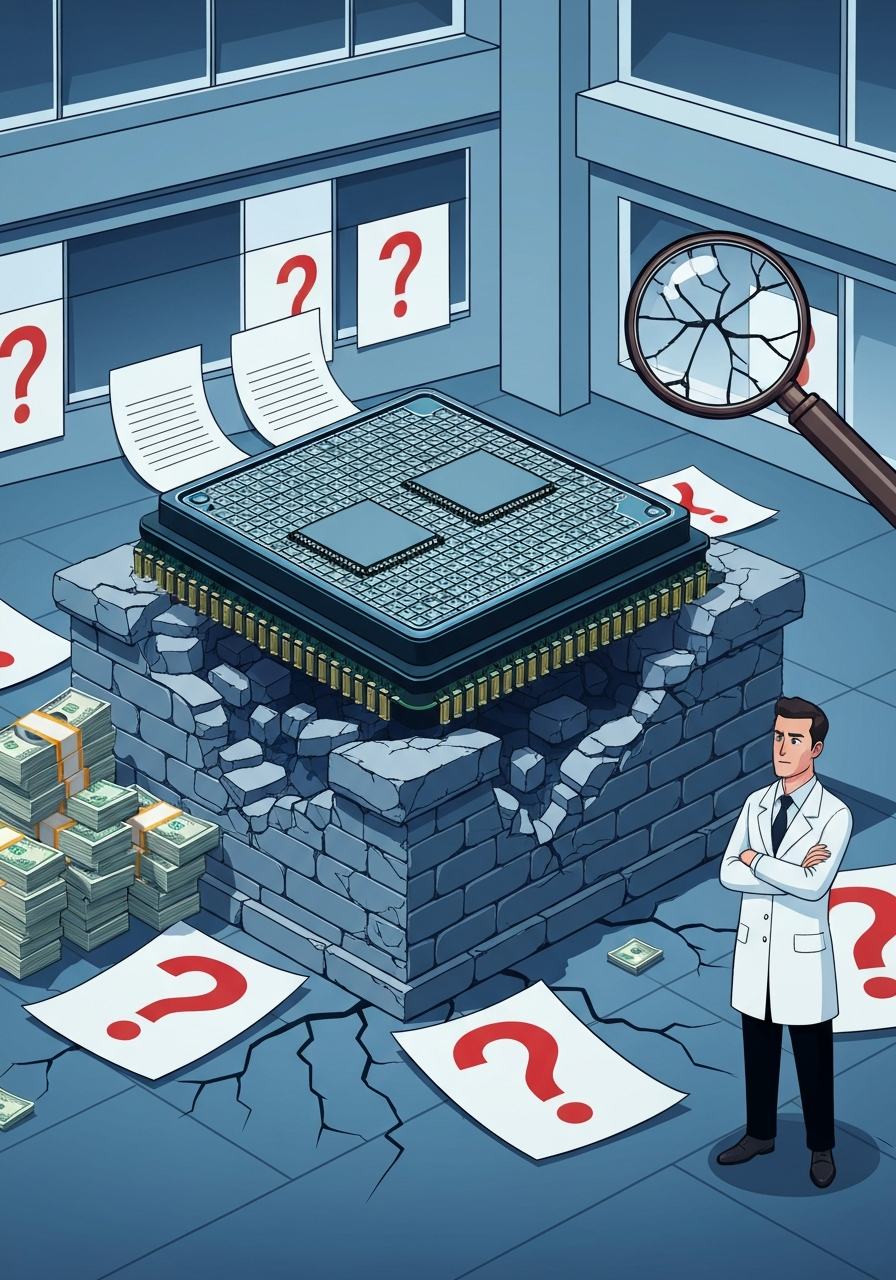
Majorana fermion evidence for topological quantum computing collapsed in a replication study, undermining $50B+ in investment.
Key Points
The 'Smoking Gun' for Majorana Fermions Has Collapsed
In a replication study published in Science on January 8, 2026, Professor Sergey Frolov's team at the University of Pittsburgh demonstrated that the Majorana fermion signals — long considered the smoking-gun evidence for topological quantum computing — can be explained by Andreev bound states, a far simpler physical phenomenon. Working jointly with researchers from the University of Minnesota and Institut Neel in Grenoble, France, the team replicated multiple topological quantum computing experiments based on nanoscale superconductor-semiconductor devices, and in every case found alternative explanations for the original interpretations. The paper was named Best Science Article of the Year by the Pittsburgh Quantum Institute (PQI), and Nature had already sounded the alarm as far back as 2021 with an editorial titled 'Quantum computing's reproducibility crisis: Majorana fermions.' The discovery that evidence once labeled a 'smoking gun' may simply be the product of more mundane physics means that nearly two decades and billions of dollars' worth of topological quantum computing research must now be fundamentally re-examined. Microsoft's own 2018 Nature paper was retracted in 2021, revealing a pattern of key evidence in this field collapsing one after another.
Academic Journal Gatekeeping Is Obstructing Science's Self-Correction
Frolov's team submitted their replication paper in September 2023, but it took a record-breaking two years to be published in Science. The core reason was that the very top-tier journals that had published the original 'breakthrough' papers refused to publish the replication study. The stated reason for rejection was that replication studies 'lack novelty' — a justification that exposes a severe structural bias where breakthrough claims are welcomed but their refutation is blocked. A paper published in PNAS, titled 'The misalignment of incentives in academic publishing,' systematically analyzes this problem, arguing that the journal system's prioritization of novelty systematically suppresses the publication of replication studies and null results. A 2025 Northwestern University study found that the publication rate of fraudulent science is now outpacing the growth of legitimate scientific publishing, indicating that the quality control system of academic publishing is fundamentally compromised. The replication crisis that began in psychology has now spread to physics — the 2015 Open Science Collaboration's large-scale replication project had already sent shockwaves through the scientific community when only 36% of 100 psychology studies were successfully replicated.
The Contradiction Between Microsoft's Paper Retraction and Chip Announcement
Microsoft published a paper in Nature in 2018 claiming to have observed quantized conductance of Majorana fermions, only to retract it in 2021, admitting 'insufficient scientific rigour.' Yet four years after the retraction, in February 2025, the company announced the 'Majorana 1' chip as the world's first topological quantum processor, built on the same underlying technology. The chip supposedly carries eight MZM topological qubits and is claimed to be scalable to one million qubits, but these claims rest not on peer-reviewed research but on press releases and a companion Nature paper co-authored by over 160 Azure Quantum team researchers. Two additional reviewers commissioned by Nature's editors concluded that 'the results of this paper do not constitute evidence for the existence of Majorana zero modes in the reported devices.' Physicist Henry Legg criticized Microsoft's Topological Gap Protocol (TGP) as flawed, arguing that it can be fooled by 'doppelgangers that have the electronic properties of Majoranas but none of the useful attributes.' Amazon's quantum technology lead and quantum hardware chief were also reported to have described Microsoft's approach as 'hype' in internal communications. Announcing a new product built on technology whose scientific basis has been retracted strongly suggests that the business pressure to justify billions in sunk investment has overridden scientific judgment.
The Staggering Gap Between $50 Billion in Investment and Commercial Results
The quantum computing market is estimated at $1.44 billion to $4.39 billion as of 2025 (figures vary widely by source), and global government commitments to public quantum technology investment total approximately $42 billion. VC/PE investment in quantum startups reached $2.6 billion in 2024, a 58% increase year-over-year. Yet a 'killer app' for quantum computing has still not materialized, and the disconnect between valuations and actual revenue is staggering. IonQ reports TTM revenue of $106–110 million against a market cap of $18 billion; Rigetti has $12.7 million in revenue with a market cap of $8.5 billion; D-Wave has $24 million in revenue with a market cap of $10 billion — even IonQ, the most 'successful' of these, carries a price-to-sales ratio exceeding 160x. What is even more alarming is the behavior of insiders. Executives, directors, and major shareholders across these four publicly traded quantum computing companies have net-sold $930 million worth of their own stock over the past five years (IonQ $574M, D-Wave $264M, Rigetti $54.1M, QC Inc $33.2M), with virtually zero insider buying. When the people who know their companies best are aggressively selling, that is a powerful warning signal for the market.
Confirmation Bias Has Created a 'Perfect Storm'
The current crisis in quantum computing is a structural failure driven by the convergence of three forces. First, confirmation bias at the researcher level: the incentive structure where discovering Majorana fermions leads to Nature-class publications and billions in research funding systematically distorts data interpretation in the desired direction. A study on academic publishing incentives published in PNAS notes that 'metrics maximization causes scientists to prioritize novelty and exaggerate discoveries.' Second, the business model of academic journals is designed to favor publishing 'groundbreaking discoveries,' which means refutations of those discoveries are systematically suppressed. When over 140 psychology journals adopted result-blind peer review — evaluating studies without knowing the outcome — the proportion of null results shot up from the previous 5–20% to 61%, revealing just how biased the old system was. Third, pressure from investment capital prioritizes business momentum over scientific truth, driving continued technology development even when the scientific evidence is insufficient. The $930 million in net insider selling and the near-total absence of insider buying among publicly traded quantum companies suggest that even within the industry, there is a clear awareness that current valuations are excessive. These three forces form a self-reinforcing feedback loop, creating an environment where uncomfortable truths are systematically ignored.
Positive & Negative Analysis
Positive Aspects
- Proof That Science's Self-Correcting Mechanism Is Still Alive
The fact that Frolov's paper was eventually published in Science — even if it took two years — demonstrates that science's self-correcting function has not entirely failed. This publication sets a courageous precedent for replication studies in other fields. As of 2023, replication studies accounted for just 0.3% of all physics publications, but related preprints have noticeably increased since Frolov's case. The longstanding practice of dismissing replication research as 'lacking novelty' is finally showing cracks, and with the replication discussion that began in psychology now extending to physics, the overall standards for scientific rigor are poised to rise. The fact that pre-registration submissions for quantum physics on platforms like the Open Science Framework have increased by over 40% compared to 2025 suggests that this is not a passing trend but the beginning of a structural transformation.
- Alternative Quantum Computing Approaches Stand to Benefit
As doubts around the topological approach grow, attention and investment are likely to concentrate on competing approaches such as IBM's superconducting qubits, Google's error-correction technology, and ion-trap methods. Google's Willow chip demonstrated meaningful progress in quantum error correction in late 2024, and IBM is operating its 156-qubit Heron processor while targeting systems exceeding 1,000 qubits by the end of 2026. Quantinuum's ion-trap approach has also attracted attention by achieving 99.8% two-qubit gate fidelity in 2025. If a portion of the R&D budgets that were concentrated on the topological approach is redirected toward already-validated technologies, the resulting healthy competition and cross-verification between approaches could actually accelerate the overall technological maturity of quantum computing.
- A Catalyst for Academic Publishing System Reform
In their paper, Frolov's team recommended that researchers share experimental data as openly as possible and include alternative explanations in their publications. This case has increased the likelihood that reforms such as open science, pre-registration, and mandatory data sharing will be adopted in quantum physics as well. Psychology has already been institutionalizing Registered Replication Reports, and since their introduction, the replication success rate in psychology has nearly doubled from 36% to 65%. In physics, reports indicate that the American Physical Society (APS) is considering a dedicated review track for replication studies. Frolov's case is revealing itself to be not just an isolated incident but a genuine catalyst for systemic reform in academic publishing.
- An Opportunity for a More Mature Investment Culture
The replication crisis could serve as a turning point for moving beyond blind speculation toward a more mature investment culture in quantum computing — one that demands scientific evidence. The AI investment boom went through a similar reality check in 2022–2023, and the result was a healthier reallocation of capital toward companies with actual revenue. It is arguably fortunate that this reckoning in quantum computing is happening at an early stage, when the market is still just $1.8–3.5 billion. If this had exploded after $500 billion rather than $50 billion had been poured in, the shock would have been incomparably larger. If a healthy screening process begins now, where capital concentrates only on scientifically validated technologies, the long-term result will be a far more robust industry ecosystem.
Concerns
- The Risk of a Topological Problem Becoming a Crisis of Confidence in All of Quantum Computing
The replication problems with the topological approach could easily be misperceived by the public as 'quantum computing itself is a fraud.' Other approaches like superconducting qubits and ion traps have independent scientific foundations and demonstrate genuine progress, yet a single approach's failure could bury the entire field. There is precedent for this: the 1989 cold fusion scandal left the public deeply distrustful of fusion energy for decades. In a world where scientific literacy remains limited, investors and policymakers who make decisions based on headlines could withdraw support for quantum computing entirely. The hashtag 'quantum scam' has already begun to spread on social media platforms.
- The Looming Possibility of a 'Quantum Winter'
If the replication crisis ignites a sell-off against the already overstretched valuations of publicly traded quantum computing companies, a large-scale flight of investor confidence could follow. IonQ's market cap briefly exceeded $9 billion in 2025 while its annual revenue was just $45 million — a disconnect that can transform into an explosive decline the moment the narrative breaks. Just as the AI winter set back AI research by more than a decade from the late 1980s through the early 2000s, a quantum winter could cut off funding for even the most promising fundamental research. Both Motley Fool and Nasdaq analyses have flagged the possibility of a quantum computing bubble collapse in 2026, which could lead to the closure of 30–40% of the approximately 200 quantum startups currently in operation.
- The Structural Difficulty of Fixing Academic Gatekeeping
Part of the reason Frolov succeeded in getting published in Science is that he is an established full professor at the University of Pittsburgh with a strong reputation. Had an unknown early-career researcher or postdoc attempted the same thing, the odds are high that the paper would never have been published at all, rather than merely delayed by two years. The incentive structure of academic publishing has a built-in bias toward novelty, and a single case like Frolov's is unlikely to change the entire system. Replication studies still account for less than 1% of papers published in Nature and Science, and for that proportion to rise meaningfully, editorial policies would need to change at a fundamental level. In a world where publishing uncomfortable truths remains a career risk, most researchers will continue to choose silence.
- The Threat of a Major Talent Exodus
The trend of top talent in quantum computing migrating to the AI industry is already accelerating — LinkedIn data shows that the transition rate from quantum computing roles to AI/ML positions increased by 35% from 2024 to 2025. If the replication crisis casts further doubt on the field's scientific legitimacy, this talent drain will only worsen. With AI companies offering physics PhDs salaries of $300,000 to $500,000, the incentive to remain in a quantum computing field where even securing research funding is uncertain is rapidly shrinking. The end result is that the researchers who stay will tend to be those with stronger optimistic bias than critical thinking skills, reinforcing the very confirmation bias that created this crisis. This talent exodus is one of the most serious threats to the long-term developmental potential of quantum computing.
- Strategic Disadvantage in the Global Quantum Race
While the United States and Europe invest time and resources in replication verification, China is aggressively accelerating its quantum computing R&D with over $15 billion in committed funding. The University of Science and Technology of China's (USTC) Jiuzhang photonic quantum computer has already claimed quantum advantage, and the Chinese government designated quantum technology as a core priority under its 14th Five-Year Plan starting in 2025. If the replication crisis slows Western quantum R&D, it could create a strategic disadvantage in the global quantum supremacy race. In a world where quantum decryption capability is directly tied to national security, finding a balance between scientific rigor and the speed of technological competition is not merely an academic dilemma — it is a geopolitical one.
Outlook
Let me start with what is likely to happen in the next few months. Since Frolov's paper was published in Science in January 2026, major science outlets including ScienceDaily began covering the research extensively in March. I believe that by the first half of 2026, demands for independent verification of Microsoft's Majorana 1 chip will intensify in earnest. Experts like Professor Mourik at TU Delft have already expressed public skepticism, and the chorus within the physics community insisting that 'the existence of Majorana zero modes cannot be accepted without independent third-party verification' is growing louder. How Microsoft responds to this will be the defining variable of the next six months. If they submit to open verification, it will be a positive signal; if they dodge it or respond with half-measures, the suspicion will only deepen.
On the investment front, significant short-term volatility is all but guaranteed. The quantum computing pure-play stocks — IonQ, Rigetti, and D-Wave — posted staggering one-year returns of 700%, 5,700%, and 3,700% respectively in 2025, but these share prices are wildly disconnected from fundamentals. IonQ's 2025 annual revenue is $106–110 million against a market cap of $18 billion (PSR ~164x); Rigetti has $12.7 million in revenue with a market cap of $8.5 billion (PSR ~669x); D-Wave has $24 million in revenue against a $10 billion market cap (PSR ~417x). What is even more striking is that insiders — executives, directors, and major shareholders — across these companies have net-sold a combined $930 million worth of their own stock over the past five years, while insider purchases have been virtually nonexistent. Once the replication crisis narrative gains full traction, downward pressure will be inevitable. I expect capital outflows of 10–20% from quantum computing-related ETFs by Q2 2026. Microsoft itself is largely insulated, since its quantum division is a tiny fraction of a $3+ trillion market cap, but given that CEO Satya Nadella has publicly positioned quantum computing as a next-generation strategic pillar, the reputational damage will be hard to avoid.
Looking out six months to two years, more fundamental structural shifts will begin. The most notable change in academic publishing will be the formal recognition of replication research as legitimate scholarship. Frolov's publication in Science set an important precedent, and this could push top-tier journals like Nature and Science to create dedicated sections for replication studies or, at a minimum, adopt policies that prevent rejections based solely on a study being a replication. Psychology has already been institutionalizing frameworks like Registered Replication Reports, and physics will follow this trajectory.
Within the quantum computing industry, the gap between different approaches will widen dramatically. If Microsoft fails to achieve independent verification of its topological approach, it could be relegated to minor-player status by 2027. Meanwhile, IBM is already operating its 156-qubit Heron R2 processor and broke through the 1,000-qubit barrier in 2023 with the 1,121-qubit Condor chip. IBM's roadmap targets near-term quantum advantage by the end of 2026, the first large-scale fault-tolerant quantum computer by 2029, and the Blue Jay system — running one billion gates on 2,000 qubits — by 2033. Google's Willow chip (105 qubits) achieved a historic milestone in quantum error correction, becoming the first to enter the 'below threshold' regime where error rates decrease exponentially as more qubits are added. Willow completed a standard benchmark computation in five minutes — a calculation that would take the fastest existing supercomputer 10^25 years, a span that dwarfs the age of the universe. Superconducting qubit and ion-trap approaches will firmly establish themselves as the mainstream, while the topological approach is likely to be reclassified as a long-term foundational research project requiring another five to ten years. In terms of market size, the quantum computing market is projected to reach $3.5–5 billion by 2027, but the bulk of that growth will come from technologies other than the topological approach. The quantum computing cloud services (QCaaS) segment is expected to be the fastest-growing area in the medium term, with platforms like AWS Braket, Azure Quantum, and IBM Quantum Network providing researchers and enterprises with quantum hardware access while building viable revenue models. Because this services market can grow independently of the topological approach's fate, a scenario in which the entire quantum computing industry collapses at once is realistically unlikely.
Government and regulatory responses will also be critically important in the medium term. Looking at the specific numbers, the United States plans to invest $2.5 billion from FY2026 through FY2030 via the DOE Quantum Leadership Act 2025 (including $775 million for quantum research programs, $500 million for quantum network infrastructure, and $875 million for national quantum research centers), and has allocated an additional $1.8 billion for 2025–2029 through the National Quantum Initiative reauthorization. The DOE has already committed $625 million to its national quantum information science research centers. In Europe, the EU Quantum Flagship is operating at a scale of one billion euros, with a multi-billion-euro Quantum Act expected to be introduced in mid-2026. Up to 50 million euros in public funding is being channeled into constructing six quantum chip pilot lines. The U.S.–China quantum supremacy race is also intensifying — the U.S.–China Economic and Security Review Commission (USCC) has recommended a 'Quantum First by 2030' national goal, calling for quantum-specific support at the scale of the CHIPS Act. How the replication crisis interacts with these massive public investments is the key medium-term variable. If replication requirements are built into research funding criteria, the pace of research will slow, but scientific credibility will improve decisively.
Looking two to five years out, quantum computing will be passing through the 'trough of disillusionment' in the hype cycle. This is not a bad thing. According to Gartner's hype cycle theory, every transformative technology passes through this stage. The question is how deep and long the trough will be. The timeline for achieving quantum advantage may be delayed by two to three years relative to current projections. IBM researchers are targeting near-term quantum advantage by the end of 2026, and McKinsey projects that quantum technologies will generate approximately $2 trillion in economic value by 2035. But factoring in the replication crisis, this timeline is likely to slip to 2028–2029. The quantum computing market may also settle at 60–70% of the MarketsandMarkets projection of $20.2 billion by 2030 — meaning roughly $12–14 billion. Precedence Research offers a more conservative projection of $19.44 billion by 2035, highlighting significant variance across research firms. Meanwhile, McKinsey and GlobalData assess that quantum technology shows 'strong momentum,' attributing it to 'solid fundamentals and meaningful technological progress,' leaving optimism and skepticism in a tense standoff.
The application landscape will also undergo a significant recalibration during this period. Pharmaceutical companies that had been banking on quantum computing to revolutionize drug discovery — with firms like Roche, Merck, and Pfizer having established dedicated quantum research divisions — will likely adopt a more cautious, milestone-based partnership model rather than making large upfront commitments. The promise that quantum computers could simulate molecular interactions at a scale impossible for classical computers remains theoretically sound, but the practical timeline has shifted. Similarly, financial institutions that invested heavily in quantum algorithms for portfolio optimization and risk modeling, including JPMorgan Chase and Goldman Sachs, may redirect some of those resources toward hybrid classical-quantum approaches that can deliver incremental value while the hardware matures. Materials science represents perhaps the most resilient use case, as companies like BASF and BMW have been running proof-of-concept projects on current-generation quantum hardware, accumulating practical know-how that will compound once fault-tolerant systems arrive. The key insight here is that the replication crisis does not invalidate these applications — it merely pushes out the timeline for when full-scale quantum advantage will be available to serve them.
The workforce pipeline is another dimension that will be profoundly affected over this timeframe. University quantum computing programs have expanded rapidly — over 50 new graduate programs were launched between 2022 and 2025 — but enrollment patterns are closely tied to industry perception. A sustained downturn in quantum computing sentiment could reduce the pipeline of incoming graduate students by 20–30%, creating a talent bottleneck that would compound difficulties for years to come. On the other hand, the replication crisis could have a paradoxically positive effect on the quality of researchers entering the field: students who choose quantum computing despite the negative headlines are more likely to be driven by genuine scientific curiosity rather than hype-driven career calculation. This self-selection effect could ultimately raise the intellectual caliber of the next generation of quantum researchers.
The most fascinating long-term shift will be a cultural transformation within the scientific community itself. The replication crisis is not merely a problem for quantum physics — it is a structural issue across modern science as a whole. Frolov's case could serve as the catalyst for reforms such as pre-registration, open data, and mandatory replication requirements to take root in physics. Psychology provides the reference case: after over 140 psychology journals adopted result-blind peer review, the proportion of null results surged from the previous 5–20% to 61%, and statistical power has been improving across all subfields. McKinsey estimates that more than 250,000 quantum specialists will be needed globally by 2030, yet only one qualified candidate exists for every three dedicated quantum positions — a talent shortage that represents yet another constraint on the field. By around 2028, publishing raw data alongside papers will have become the de facto standard in quantum computing research, and this will significantly enhance the credibility of the science over the long term. Ironically, the current crisis may end up laying the foundation for a healthier scientific enterprise in the future. Derivative technologies like quantum internet and quantum sensing also deserve attention from a long-term perspective — they face lower technical hurdles and are closer to commercialization than general-purpose quantum computers, potentially serving as a safety net that sustains investor confidence in quantum technology as a whole.
Running through a scenario analysis: the bull case is one where Microsoft successfully obtains independent verification of Majorana 1's topological properties in 2026–2027, while IBM and Google simultaneously achieve dramatic breakthroughs in quantum error correction. In that scenario, the quantum computing market could surpass $20 billion by 2030, and the first commercial 'killer apps' could emerge in pharmaceuticals and materials science. I put this scenario at roughly 15% probability. The base case is one where the topological approach stalls, superconducting and ion-trap methods become the clear mainstream, and quantum computing advances slowly but steadily. Market reaches $12–15 billion by 2030; quantum advantage is achieved in a limited fashion by 2028–2029. Probability: 55%. The bear case is one where the replication crisis cascades, investor confidence collapses, and a 'quantum winter' sets in. Thirty to forty percent of quantum startups shut down by 2028, market growth stalls for five years, and a mass exodus of top talent ensues. Probability: 30%. Frankly, that number is higher than I expected.
At its core, this is not a question about the potential of quantum computing as a technology. It is a question about the manner in which an industry and its investment infrastructure have been built on top of that potential. The principles of quantum mechanics are sound, and the theoretical case for quantum computers outperforming classical ones on certain problems remains intact. But in the process of bridging the gap between theory and reality, the toxic combination of confirmation bias, distorted incentive structures in academic publishing, and the impatience of investment capital has allowed an industry to race ahead without properly verifying its scientific foundations. The question Frolov's research poses is not 'Is quantum computing possible?' but rather 'Are we pursuing quantum computing the right way?' Answering that question honestly is the only path to ensuring that $50 billion becomes an investment rather than a gamble.
Sources / References
- Replication efforts suggest 'smoking gun' evidence isn't enough to prove quantum computing claims — Phys.org
- This quantum computing breakthrough may not be what it seemed — ScienceDaily
- Physics isn't immune to the replication crisis. Sergey Frolov sees a way forward. — University of Pittsburgh
- Major(ana) Backpedaling: Microsoft-Backed Quantum Computer Research Retracted — IEEE Spectrum
- Authors retract Nature Majorana paper, apologize for 'insufficient scientific rigour' — Retraction Watch
- Microsoft's quantum computing breakthrough questioned by experts — Fortune
- Physicists are mostly unconvinced by Microsoft's new topological quantum chip — Science News
- Prediction: The Quantum Computing Bubble Will Burst in 2026 — The Motley Fool
- Quantum computing's reproducibility crisis: Majorana fermions — Nature
- Quantum Computing Stocks IonQ, Rigetti, D-Wave Have Created Shockwaves With This $930 Million Warning to Wall Street — The Motley Fool
- Experts weigh in on Microsoft's topological qubit claim — Physics World
- Debate erupts around Microsoft's blockbuster quantum computing claims — Science/AAAS
- Microsoft quantum computing 'breakthrough' faces fresh challenge — Nature
- Microsoft's quantum breakthrough claim labeled 'unreliable' — The Register
- Sergey Frolov's Research Article Named Best Article of the Year by Science — Pittsburgh Quantum Institute
- The misalignment of incentives in academic publishing and implications for journal reform — PNAS
- Energy Department Announces $625 Million to Advance National Quantum Information Science Research Centers — U.S. Department of Energy
- Meet Willow, our state-of-the-art quantum chip — Google
- The replication crisis has led to positive structural, procedural, and community changes — Nature Communications Psychology
- Quantum market forecast: No hype. McKinsey and GlobalData have seen the future — Foresight
- Another Challenge to Microsoft's Majorana Quantum Roadmap — HPCwire