
Zero Percent Chance of Impact — And the Actual Reason Apophis Still Keeps Scientists Up at Night
Summary
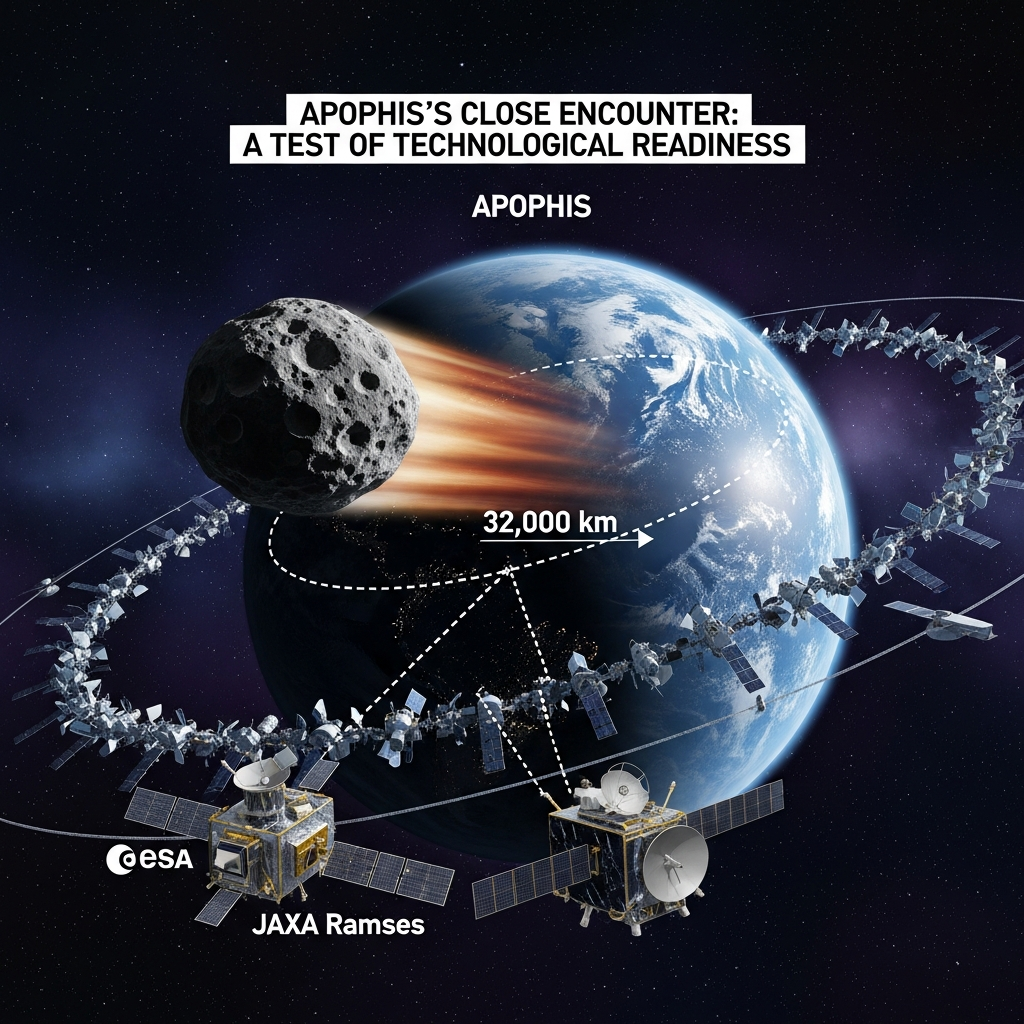
Apophis (99942 Apophis), a 370-meter asteroid, will pass within just 32,000 kilometers of Earth on Friday, April 13, 2029 — closer than the geostationary satellite belt and roughly one-twelfth the distance to the Moon, a close-approach event with an estimated recurrence frequency of once per ten thousand years. In May 2026, the European Space Agency (ESA) and the Japan Aerospace Exploration Agency (JAXA) formalized the joint Ramses mission through a binding bilateral agreement, with the primary scientific objective of observing unprecedented tidal deformation as Earth's gravitational field physically reshapes the asteroid in real time during the flyby. Despite a formally confirmed zero percent impact probability for the next hundred years, the mission commands a budget approaching 300 million euros, driven by the strategic imperative to acquire first-ever empirical physical data on near-Earth asteroid behavior following the DART kinetic impactor success of 2022. The United Nations has designated 2029 as the International Year of Asteroid Awareness and Planetary Defence, and approximately two billion people across Europe, Africa, and Asia are projected to observe Apophis with the naked eye — making it the first Potentially Hazardous Asteroid (PHA) in history visible without optical instruments. NASA's conspicuous absence from the Ramses framework signals an emerging Euro-Asian axis in space exploration and previews a more multipolar planetary defense governance structure for the 2030s, marking a meaningful fracture in the U.S.-centric post-Artemis space order.
Key Points
Observing Real-Time Gravitational Reshaping of an Asteroid — A First in Human History
When Apophis passes Earth at 32,000 kilometers, the gravitational forces our planet exerts on the asteroid are expected to produce measurable physical changes — alterations to its rotation speed, surface structure, and potentially its overall shape through what scientists call tidal deformation. This phenomenon has been theoretically modeled for decades, but it has never been directly observed on a rocky asteroid, because no rocky asteroid has ever passed close enough to a major planet for long enough to allow real-time measurement. The Ramses spacecraft is designed to arrive at Apophis months before the flyby, establish a precise baseline dataset of the asteroid's physical properties, and then compare that baseline against measurements taken during and after the 32,000-kilometer passage. This before-and-after comparison is the core scientific deliverable of the entire mission — without the "before," there is no comparison, which is why the pre-flyby observation window is treated as the non-negotiable schedule anchor for every other project milestone. The data collected will be directly applicable to future deflection mission planning, because understanding how much force is required to change an asteroid's orbit depends fundamentally on knowing how that asteroid is structured internally — whether it is a solid monolithic rock or a loosely bound "rubble pile" held together by gravity rather than physical cohesion. In my assessment, the dataset generated by this single mission has the potential to exceed, in both volume and scientific utility, the cumulative planetary science data on near-Earth asteroids collected from ground-based observations over the past three decades. This is what genuine planetary science breakthroughs look like — not incremental improvements, but the insertion of an entirely new class of empirical measurement into a field that has been working from estimates.
A New Model for Space Collaboration — ESA and JAXA Without NASA at the Helm
The Ramses mission's institutional structure is as scientifically interesting as its physical objectives. ESA takes responsibility for spacecraft design, assembly, integration, and mission operations; JAXA contributes lightweight solar array technology, an infrared imaging instrument, and the H3 heavy-lift rocket for launch. The agreement signed by the heads of both agencies on May 7 and 8, 2026, is not a vague letter of intent — it is a binding document specifying hardware delivery schedules, financial contributions, and data-sharing obligations in concrete terms. What makes this configuration historically significant is the conspicuous absence of NASA from the framework, particularly for a mission targeting a planetary defense objective that is, in principle, as relevant to the United States as to any other country. The emerging pattern here is not that ESA and JAXA are excluding NASA — it is that they are demonstrating for the first time at scale that they do not need NASA's institutional architecture to execute complex deep-space science at the highest level. This matters enormously for the geopolitical future of space exploration: if the Ramses mission succeeds, it will be cited for decades as the proof-of-concept that non-U.S.-led space collaborations can deliver flagship planetary science. ESA's annual budget is approximately 7.5 billion euros, and JAXA's is roughly 2 billion dollars — together less than half of NASA's budget — but strategic focus and efficient cost management can compensate for raw resource advantages. I believe this institutional demonstration may ultimately be remembered as the most historically consequential aspect of the Ramses mission, outlasting the scientific data in long-term geopolitical significance.
The Largest Mass-Participation Astronomy Event in Human History
The scale of public engagement with the Apophis flyby is simply without precedent in the history of astronomy as a human activity. Approximately two billion people across Europe, Africa, and western Asia will be able to observe Apophis with the naked eye on the night of April 13-14, 2029 — watching it move visibly across the star field as it passes inside the orbital altitude of geostationary satellites. At its predicted peak brightness of approximately magnitude 3.1, Apophis will be easily visible from suburban and rural locations, though city dwellers with significant light pollution may need to travel short distances for a clear view. For comparison, the Apollo 11 Moon landing in 1969 was watched on television by an estimated 600 million people, and Halley's Comet in 1986 required binoculars or a telescope for most observers in the northern hemisphere. Apophis will deliver something qualitatively different: a naked-eye, real-time experience of a near-Earth object's passage that carries the additional weight of being officially classified as a Potentially Hazardous Asteroid. The UN has specifically leveraged this moment by designating 2029 as the International Year of Asteroid Awareness and Planetary Defence, which will translate into coordinated educational campaigns, school observation programs, and public outreach initiatives in virtually every country with a science education infrastructure. The generational impact of this kind of direct astronomical experience — particularly on young people who are at formative stages of deciding whether science matters to them personally — is real even if it is difficult to quantify precisely. If the Apollo moment created the generation that built the modern space industry, the Apophis event has the potential to create the generation that builds the planetary defense infrastructure the world currently lacks.
DART Proved We Can Hit It — Ramses Will Show How to Hit It Right
NASA's 2022 DART mission accomplished something genuinely historic: it demonstrated that a spacecraft can be targeted at an asteroid with sufficient precision to meaningfully alter its orbital period. The test was a scientific and engineering success by every measurable standard — Dimorphos's orbital period around its larger companion Didymos was shortened by approximately 33 minutes, substantially more than the 73-second minimum threshold that would have constituted a successful demonstration. However, DART was explicitly a proof-of-concept test of the kinetic impactor method's basic feasibility, not a comprehensive investigation of asteroid physical response to impact. The data it generated told us that we can hit an asteroid hard enough to change its orbit — it did not tell us the precise relationship between asteroid composition, internal structure, impact energy, and resulting orbital change for the full range of near-Earth object types we might eventually need to deflect. Ramses fills precisely this gap. By measuring Apophis's tidal response to Earth's gravitational field — which is a controlled, calculable force applied over a known duration — scientists will be able to infer the asteroid's mechanical properties, internal structure, and effective density distribution with far greater precision than any alternative observation method could achieve. This physical characterization is the missing input for every second-generation deflection technology currently in the theoretical pipeline, from gravity tractors to ion beam shepherding to nuclear standoff detonation. I consider Ramses and DART to be sequential chapters in a single story: DART proved the concept, and Ramses supplies the physics textbook that makes the concept work reliably in practice.
Three Years to Launch a Deep-Space Mission: Cost Efficiency and Timeline Risk in Extreme Close-Up
The development timeline of the Ramses mission presents what is simultaneously its most impressive engineering ambition and its most significant practical risk. A sub-three-year development-to-launch schedule for a deep-space spacecraft is extraordinarily compressed by any historical standard — the Cassini-Huygens mission required over a decade of development, OSIRIS-REx took nearly seven years from selection to launch, and even the relatively streamlined DART mission required five years of development. ESA is attempting to deliver Ramses within approximately 30 to 36 months from formal program initiation to launch readiness, achieving this by maximizing the use of existing flight-proven hardware and subsystem designs rather than developing new components, by running development workstreams in parallel rather than sequentially, and by targeting a total mission cost of approximately 300 million euros compared to OSIRIS-REx's roughly one billion dollar price tag. The cost efficiency ambition, if realized, would establish a compelling new paradigm for rapid-response planetary defense missions — the kind of missions that would actually be needed in a scenario where a newly discovered asteroid had a confirmed short-fuse collision trajectory. Success would prove that space agencies can respond to real-world planetary threats on politically and financially viable timescales, not just ideal academic ones. Failure — whether through technical problems, launch delay, or budget shortfalls — would equally demonstrate the risks of attempting to compress complex space hardware development beyond the margins that the field has historically found manageable. I consider the outcome of this development timeline challenge to be one of the most important practical questions in planetary defense for the next three years.
Positive & Negative Analysis
Positive Aspects
- An Unprecedented Tidal Deformation Dataset That Changes Planetary Defense Forever
If the Ramses mission executes as planned, the scientific output will represent a genuinely transformative leap in humanity's empirical understanding of near-Earth asteroid physics. The dataset would include pre-flyby, during-flyby, and post-flyby measurements of Apophis's rotation state, shape model, surface topology, and estimated internal density distribution — all captured with sub-meter precision during the asteroid's maximum gravitational perturbation. This type of data has never existed before for any near-Earth object, because no previous mission was designed around the specific scientific opportunity of observing tidal deformation in real time. The practical implications for planetary defense engineering are direct and substantial: deflection mission designers currently work with significant uncertainty margins because the physical response of a target asteroid to any applied force depends on internal properties that cannot be reliably inferred from remote observation alone. Ramses's tidal deformation measurements provide a controlled natural experiment that directly constrains these properties in a way that no artificial test can replicate. I believe a single successful Ramses mission would generate more practically applicable planetary defense data than the entire previous history of asteroid observation from Earth's surface — not because previous work was inadequate, but because the quality of in-situ physical measurement during a gravitational event is categorically different from anything ground-based instruments can produce. At an investment level of approximately 300 million euros, the expected scientific return relative to cost is extraordinary by any comparable benchmark in the field.
- A Historic Proof-of-Concept for Non-U.S.-Led International Space Collaboration
The successful execution of a flagship planetary defense mission by ESA and JAXA operating independently of NASA would establish the most significant institutional precedent in deep-space exploration since the formation of the major space agencies themselves. For the first time, a high-stakes, technically demanding mission at the frontier of planetary science would have been conceived, funded, built, launched, and operated entirely within a non-American institutional framework — and would have succeeded. This precedent would be immediately leveraged by emerging space agencies in India, South Korea, Australia, and elsewhere as evidence that the path to serious deep-space capability does not require American institutional partnership as a prerequisite. The geopolitical implications extend beyond the immediate scientific result: a proven multilateral planetary defense model provides the institutional skeleton for the kind of international cooperation treaty that the field has been unable to establish at a serious level, because there was no demonstrated capacity to operate outside the U.S.-centric framework. I expect this precedent, if established cleanly, to directly accelerate three to five additional non-U.S.-anchored multilateral space missions within the decade following 2029, fundamentally changing the geopolitical landscape of space science. Furthermore, the 7:1 or better cost advantage of the Ramses model compared to NASA's flagship mission costs — if validated — provides an economic rationale that will be cited in budget discussions across every space agency worldwide.
- Two Billion People Experiencing Planetary Science as a Personal Event
The transformative public engagement potential of the Apophis flyby cannot be overstated. Having two billion individuals personally witness a Potentially Hazardous Asteroid passing through the operational zone of Earth's satellite infrastructure is a completely different kind of public education moment than anything the planetary science community has previously had access to. The distinction between watching something on a screen and watching it with your own eyes, in real time, at astronomical scale, is not merely aesthetic — it creates a different category of personal memory and emotional registration that shapes attitudes and interests in ways that passive media consumption does not. The UN's International Year designation amplifies this by coordinating educational infrastructure around the world to use the event as an active teaching tool, with curriculum resources, observation programs, and public engagement activities planned across schools, universities, science museums, and community organizations in dozens of countries. The expected result is a cohort of young people whose earliest visceral experience of astronomy involves watching a potentially dangerous space rock pass close enough to touch their satellite network — a foundational experience for a generation that will determine whether planetary defense gets the political and financial support it needs over the following decades. I consider this one of the most valuable secondary benefits of the Ramses mission precisely because it is self-reinforcing: more public awareness leads to more political support, which leads to more funding, which leads to better detection and response capability, which eventually leads to better actual protection for the civilization that will one day need it.
- Creating the Political Mandate to Fund Planetary Defense Properly
The Apophis flyby has the potential to accomplish something that decades of scientific papers, congressional testimony, and public advocacy have failed to achieve: making planetary defense feel real and urgent to the political decision-makers who control national budgets. Current global investment in planetary defense totals less than five hundred million dollars annually across all countries — a number that is genuinely difficult to justify given that a large-scale asteroid impact remains one of the few natural processes capable of ending human civilization as a functioning system. The reason this underfunding persists is primarily that the threat is abstract to people who have not personally experienced evidence of it. A two-billion-person naked-eye viewing event, accompanied by well-executed scientific communication explaining what they are watching and why it matters, could shift the political context for planetary defense budget discussions in a lasting way. I expect that within three years of the flyby, at least eight to ten major spacefaring nations will have initiated formal reviews of their planetary defense posture and budget allocation as a direct consequence of the political attention generated. This shift, once institutionalized in national security documents and budget line items, will be difficult to reverse — and the compounding effect of even modest funding increases applied consistently across detection networks, deflection technology development, and international early-warning systems over a ten-to-twenty year period would represent a genuine step-change in humanity's actual protective capacity.
- A Rapid-Response Mission Model That Could Define How We Handle Real Threats
If Ramses launches and succeeds on its compressed timeline, it establishes something the planetary defense community has needed proof of for years: that a capable, scientifically valuable deep-space mission can be developed and deployed in under three years when circumstances demand it. Real asteroid threats — the kind where a newly discovered near-Earth object suddenly appears in a catalog with a meaningful collision probability — will not wait seven to ten years for a traditional development cycle. The political and public response to such a discovery would demand action on a timescale that the current paradigm of flagship mission development cannot accommodate. A validated rapid-response mission model, with ESA's cost-managed, heritage-hardware-intensive approach as the blueprint, gives planetary defense planners a credible framework for the scenario they most urgently need to prepare for. The fact that this approach also achieves a target cost of approximately 300 million euros — three times lower than comparable NASA flagship missions — means that the financial barrier to rapid deployment is simultaneously reduced. I consider the institutional learning generated by Ramses's development process — regardless of ultimate mission outcome — to be a lasting contribution to the field's operational readiness, because the capability to move quickly is as important as the capability to move accurately.
Concerns
- Extreme Schedule Compression Creates Mission Failure Risk That Cannot Be Wished Away
The fundamental vulnerability of Ramses is the timeline, and it is worth being direct about the magnitude of this risk rather than treating it as a manageable caveat. Developing a deep-space spacecraft capable of precision navigation, long-range communication, and scientific instrument operation within thirty to thirty-six months is an undertaking without close historical precedent among the missions it is being compared to — and the European space industry's own track record on complex multi-agency missions suggests that schedule confidence should be treated with skepticism. The Rosetta cometary mission slipped approximately twelve months; BepiColombo's Mercury mission was delayed by more than a year for technical reasons. Ramses has no comparable buffer. A three-to-six-month launch delay — well within the range of what "normal" technical problem-solving could produce — would mean the spacecraft arrives at Apophis after the flyby rather than before it. Without the pre-flyby baseline measurements, the entire scientific case for the mission evaporates, because the tidal deformation comparison requires a "before" state to compare against. JAXA's H3 rocket adds a second independent risk factor, having experienced a public launch failure in 2023 before recovering reliability. When I assess these compounding uncertainties honestly, the probability of achieving the complete scientific dataset the mission is designed to produce sits in the 50 to 60 percent range — a meaningful level of risk for a 300-million-euro program where partial success still counts as a significant fraction of failure.
- The Reassurance Paradox: A Smooth Flyby Could Harm Long-Term Planetary Defense Investment
The most counterintuitive risk associated with the Apophis event is what happens politically if everything goes exactly as planned and the flyby passes without drama. The public narrative in this scenario — "see, the asteroid came, nothing happened, we're fine" — is one of the most dangerous outcomes for the long-term health of planetary defense as a funded priority, precisely because it is emotionally satisfying and politically convenient. NASA's NEO Surveyor space telescope project has already experienced repeated funding challenges in the U.S. Congress based on exactly this kind of reasoning, and the pattern of "abstract threats don't survive budget cycles" is well-established across multiple domains. The core problem is that a successful, uneventful Apophis observation does nothing to change the underlying reality: approximately 40 percent of near-Earth asteroids in the 140-meter-plus size category remain completely undetected by current survey programs, meaning the population of genuinely threatening objects we don't yet know about substantially exceeds the population we are tracking. A 2029 "all clear" narrative, if not aggressively counterprogrammed by the scientific community, could realistically reduce rather than increase the political support for expanded detection networks and deflection capability development — an outcome that would be both ironic and deeply counterproductive from a genuine planetary defense standpoint.
- NASA's Absence Creates Governance Gaps That Will Complicate Data Utilization
The decision to proceed without NASA as a formal mission partner creates structural complications that extend well beyond the immediate scientific collaboration. NASA operates the Deep Space Network, the only globally distributed ground-station infrastructure capable of providing deep-space communication support at the volume and precision that a mission like Ramses might require during critical observation periods. ESA operates its own Deep Space Antenna network, which provides meaningful coverage but lacks the redundancy and raw aperture of DSN support — meaning that during the flyby's most scientifically valuable hours, the data pipeline from Ramses to Earth will operate without the backup capacity that NASA participation would have provided. The more consequential gap, however, is in post-mission data integration. Apophis is a globally relevant object, and any future decisions about planetary defense response to changes in its orbital parameters following the 2029 flyby would appropriately involve all major space agencies. If the authoritative physical dataset for Apophis is owned and curated by ESA and JAXA, and the United States is not a formal partner in the data architecture, the pathway from new orbital data to coordinated international response is slower and more politically complicated than it would otherwise need to be. I believe this governance gap will become apparent in the first major Apophis orbital refinement that occurs after 2030, and resolving it retroactively will be significantly more difficult than building the institutional bridge in advance.
- One Asteroid's Data Is Not a General Solution for the Near-Earth Object Population
There is a significant scientific limitation to what Ramses can actually deliver, and it deserves honest acknowledgment rather than being treated as a minor footnote. Apophis is classified as an S-type asteroid — a silicate-rich rocky body that represents one significant category of near-Earth object composition. But the near-Earth population encompasses C-type carbonaceous asteroids, M-type metallic bodies, likely extinct comet nuclei with low-density porous structures, and a range of compositional hybrids that do not fit neatly into the standard taxonomic categories. The physical response to tidal forces, the structural behavior under deflection impulse, and the effective strength properties differ substantially across these categories — sometimes by factors of two to ten or more, depending on the specific property in question. What Ramses measures for Apophis will be directly applicable to future missions targeting S-type asteroids of similar size, but generalizing those findings to other compositional types requires significant additional inference and carries corresponding uncertainty. Beyond compositional diversity, the Yarkovsky effect — the subtle but cumulative orbital perturbation produced by differential thermal emission as an asteroid rotates — remains a source of long-term orbital uncertainty for Apophis even after the flyby. I consider scientific humility on this point to be not just appropriate but necessary: a single successful Ramses mission is a major advance, but it would be a mistake to treat it as settling the question of asteroid physics broadly. The population of potentially threatening objects is diverse enough that Apophis provides one data point, not a complete answer.
- Planetary Defense Technology Carries Dual-Use Risk That Deserves Serious Attention
The geopolitical implications of advancing planetary defense capabilities deserve explicit acknowledgment rather than being relegated to speculative footnotes, because the technical capabilities involved are genuinely dual-use in a meaningful sense. A kinetic impactor spacecraft designed to deflect an asteroid toward a safer trajectory requires the same fundamental capabilities — precise deep-space navigation, high-velocity terminal guidance, and significant impact momentum delivery — that would also be required to redirect a small asteroid toward a more dangerous trajectory if that were someone's objective. This is not a hypothetical concern invented for rhetorical effect: the physics of asteroid deflection is symmetric, and the distinction between "making the rock miss Earth" and "making the rock hit Earth" is entirely a matter of how the velocity change is applied. As planetary defense technology matures and the number of countries with operational deflection capability increases over the 2030s and 2040s, the absence of an international governance framework — analogous to nuclear non-proliferation treaties for nuclear weapons — creates a structural vulnerability that grows with each new entrant to the field. I believe the scientific community's current tendency to treat planetary defense as purely a cooperative international good, rather than as technology with serious dual-use implications requiring formal institutional management, is a governance gap that needs to be addressed substantially earlier than the field currently appears to be planning for. The Ramses mission is an excellent opportunity to begin that conversation at the international institutional level, but I am not confident that the opportunity will be fully taken.
Outlook
In the next six months, the single most critical variable to monitor is hardware assembly progress at ESA's spacecraft integration facility in the Netherlands. The agency's official schedule calls for flight model assembly to begin in earnest during the second half of 2026, which requires JAXA's infrared camera module and lightweight solar panel array to be physically shipped from Japan to Europe for integration testing. This logistics-and-integration phase represents the highest-risk portion of the entire program timeline because any delay here cascades directly into every subsequent development milestone. ESA has publicly committed to completing all major hardware integration by the first half of 2027 in order to preserve the late-2028 launch window. I would describe this schedule as technically achievable but managerially precarious — the margin for the kinds of unexpected technical problems that invariably arise during spacecraft integration is essentially zero, and the operational pace required is roughly double what ESA typically sustains on flagship science missions. The next six months will reveal whether the project management discipline required to execute this timeline is actually in place.
Simultaneously, the global ground-based scientific community is accelerating its pre-mission observation campaign, and this work will directly shape how well Ramses performs. Between late 2026 and early 2027, a coordinated international telescope network will begin intensive Apophis characterization, building on precision radar mapping already in progress at Goldstone and successor facilities. The European Southern Observatory has confirmed a major observing program targeting Apophis, and Japan's Subaru Telescope on Mauna Kea will contribute complementary multi-wavelength high-resolution imaging. By 2027, the pre-flyby characterization dataset for Apophis — covering its rotation period (currently measured at approximately 30.4 hours), surface composition, shape model, and internal structure estimates — will be more complete than that of any other near-Earth asteroid in recorded history. This ground-based work is not merely scientific background; the precision of Apophis's shape model and spin-state measurements will directly determine how Ramses schedules its most scientifically critical observation sequences during the flyby approach. The quality of the ground-based campaign conducted before launch will, in significant part, determine whether Ramses is positioned to capture the moments that carry the most scientific weight.
Looking toward the 2027-to-2028 window, the depth of international participation in the Ramses framework will be seriously tested and, in my expectation, substantially expanded beyond the current bilateral structure. The ESA-JAXA partnership is almost certainly not the final configuration of this collaboration. My expectation is that the Korea Aerospace Research Institute (KARI) and the Indian Space Research Organisation (ISRO) will both seek formal observer or data-sharing arrangements within this period. India publicly announced an independent asteroid exploration mission concept in 2025, and South Korea has documented asteroid rendezvous capability development targeting the early 2030s. If both agencies join the Ramses data consortium, it establishes the foundational architecture for a genuine multilateral planetary defense governance body — something the field has lacked for decades. Australia, Canada, and the UAE have each expanded their space agency capabilities recently and could contribute meaningfully through ground-based observation network participation. What begins as a bilateral mission could plausibly become the nucleus of a Planetary Defence Paris Agreement: a binding international coordination framework where shared existential risk generates political will that geopolitical competition otherwise erodes.
The question of NASA's trajectory over this same period is the most unpredictable medium-term variable. I assign approximately 50-50 odds that the current U.S. non-participation status holds through 2028. The political calculus is genuinely difficult: allowing the globally anticipated, once-per-ten-millennia Apophis event to unfold without an explicit American scientific presence is a difficult argument to sustain in Washington. My best estimate of the most likely scenario is that NASA announces a complementary observing asset — probably a small CubeSat or a piggyback instrument on an unrelated spacecraft — sometime between late 2027 and early 2028, coupled with a retroactive data-sharing agreement connecting the Ramses dataset to U.S. planetary defense planning. This would establish a meaningful new precedent: a non-U.S.-led planetary defense mission that the United States subsequently joins as a secondary partner rather than a primary architect. If this pattern holds for even two or three additional missions over the following decade, the geopolitics of deep-space science begins to look genuinely different from the NASA-dominant model that has defined the field since the 1970s.
In the longer arc extending beyond 2029, the Apophis flyby dataset will almost certainly trigger a comprehensive reassessment of planetary deflection strategy at the technical level. Today, kinetic impactors of the DART variety represent the only operationally validated deflection method. Once Ramses has delivered empirical measurements of Apophis's internal structure, surface tensile properties, and tidal deformation response under actual gravitational stress, the engineering feasibility of second-generation approaches can be evaluated against real physical inputs rather than purely theoretical models. Gravity tractors, ion beam shepherding, and solar ablation techniques are all theoretically viable deflection options but currently lack the empirical physical inputs needed to advance from conceptual design to engineering development. I project that at least two additional deflection technologies will enter the formal demonstration phase by 2033, using the Apophis dataset as their foundational empirical baseline. The commercial dimension of this transition is also substantial: the global planetary defense market, currently estimated at under five hundred million dollars annually, could reach one point five billion dollars or more by 2035 as private operators from SpaceX to Rocket Lab recognize the growing technological convergence between planetary defense mission requirements and commercial asteroid exploration infrastructure.
The political economy of planetary defense budgets is where the long-run stakes are most consequential and most dependent on the Apophis event going well. Current global spending on planetary defense — all national programs combined — amounts to less than five hundred million dollars per year, a figure representing approximately 0.06% of the U.S. defense budget alone and starkly inadequate given the potential consequences of a large-scale impact event. This underfunding persists primarily because the threat remains abstract to policymakers who have never personally witnessed it. When two billion people directly watch an asteroid pass through the operational altitude of their communication and navigation infrastructure, that abstraction dissolves in a way that no chart, congressional briefing, or documentary film has ever achieved. My projection is that by 2032, at least ten major spacefaring nations will have formally incorporated planetary defense into their national security strategy documents for the first time, driving coordinated spending increases across the detection, early-warning, and response capability chain that currently exists in fragmented and underfunded form.
Let me now work through the explicit scenario analysis. In the bull-case scenario, Ramses launches on schedule in late 2028, arrives at Apophis in February 2029, and captures a complete and scientifically usable pre-flyby, during-flyby, and post-flyby dataset without significant data gaps. This output underpins a binding International Planetary Defence Treaty by 2031 establishing shared detection protocols and joint response obligations among major spacefaring nations, with a permanent international coordination center becoming operational by 2035. I assign this scenario approximately 25% probability. In the base-case scenario, Ramses experiences a three-to-six-month delay that causes the pre-flyby baseline window to be partially missed, but the spacecraft successfully captures the critical during-flyby tidal deformation sequence and post-flyby orbital evolution data. International cooperation advances meaningfully but stops short of a binding treaty, with individual nations strengthening planetary defense capabilities independently while informal data-sharing arrangements serve as the coordination layer. I assign this approximately 50% probability.
In the bear-case scenario, technical failures, budget disruptions, or launch vehicle problems push Ramses delivery to after the flyby, causing the central scientific comparison to collapse entirely. Without the pre-flyby baseline, the tidal deformation analysis cannot be performed, and the mission's scientific value drops precipitously. International cooperation momentum dissipates, and the next credible planetary defense observation opportunity is effectively delayed by a decade or more. I assign this approximately 25% probability. The distribution of these three scenarios — roughly 25% bull, 50% base, 25% bear — reflects my honest read of the mission's structural risks rather than a default optimism about space program outcomes.
I want to be transparent about where my forecasts could be substantially wrong. If an unexpected large asteroid is discovered between 2027 and 2029 on a confirmed short-warning collision trajectory, the entire "research mission" framing of Apophis and Ramses becomes immediately obsolete — the global response system shifts to genuine emergency mode, and every gradual timeline in my analysis becomes irrelevant overnight. At the opposite extreme, if the Apophis flyby generates less public engagement than anticipated — perhaps because it coincides with a major geopolitical crisis or occurs during cloudy weather across key observation regions — the window for converting the event into sustained planetary defense investment could close much faster than expected. There are also internal agency variables that cannot be modeled from the outside: budget reallocations under new ESA or JAXA leadership, launch vehicle anomalies unrelated to Ramses, or a political decision to redirect mission resources to a different scientific priority. My forecasts are offered with genuine epistemic humility. What I hold with high confidence is the underlying logic: the question is not whether Earth will face a serious asteroid threat in the coming centuries — statistically it will — but whether humanity will have the institutional coordination, technical readiness, and political will to respond effectively when that moment arrives. Apophis is the rehearsal we did not know we needed. Ramses is humanity finally showing up to take notes. Make sure you're watching on April 13, 2029.
Sources / References
- ESA and JAXA team up on planetary defence: Ramses mission to asteroid Apophis — ESA
- ESA and JAXA finalize agreement on Apophis asteroid mission — SpaceNews
- Asteroid Apophis to skim Earth in joint ESA-JAXA mission — Phys.org
- Earth's gravity will reshape asteroid Apophis during its 2029 flyby — Earth.com
- Apophis flyby in 2029 will be the first time a potentially hazardous asteroid has been visible to the naked eye — LiveScience
- International Year of Asteroid Awareness and Planetary Defence 2029 — UN
- JAXA Press Release: ESA-JAXA Ramses Mission Agreement — JAXA