
CO2's Double Life: The Molecule That Warms the Surface and Freezes the Sky
Summary
A landmark study published in Nature Geoscience has for the first time resolved the physical mechanism explaining why CO2 simultaneously warms the lower atmosphere while cooling the stratosphere — a paradox that has puzzled climate scientists for six decades. Researchers led by Professor Robert Pincus at Columbia University's Lamont-Doherty Earth Observatory identified a "Goldilocks Zone" of infrared wavelengths in which CO2 molecules radiate heat directly into space with exceptional efficiency, rather than transferring that energy to neighboring air molecules. Observational records show that since the mid-1980s the stratosphere has cooled by roughly 2 degrees Celsius — more than ten times the rate that would occur from natural variability alone — confirming a prediction made by Nobel laureate Syukuro Manabe in 1967 but left unexplained until now. Paradoxically, this stratospheric cooling intensifies surface warming through a feedback loop: as the upper atmosphere loses more energy to space, less infrared radiation descends back into the troposphere, trapping additional heat near the surface. Perhaps most urgently, the research reveals that ongoing stratospheric cooling promotes polar stratospheric cloud formation that catalyzes ozone destruction, threatening to push the Antarctic ozone hole's recovery timeline ten to twenty years beyond the currently projected 2066 date and exposing a structural link between climate change and the ozone crisis that conventional policy frameworks have yet to confront.
Key Points
CO2's Dual Mechanism — Tropospheric Warming and Stratospheric Cooling in One Molecule
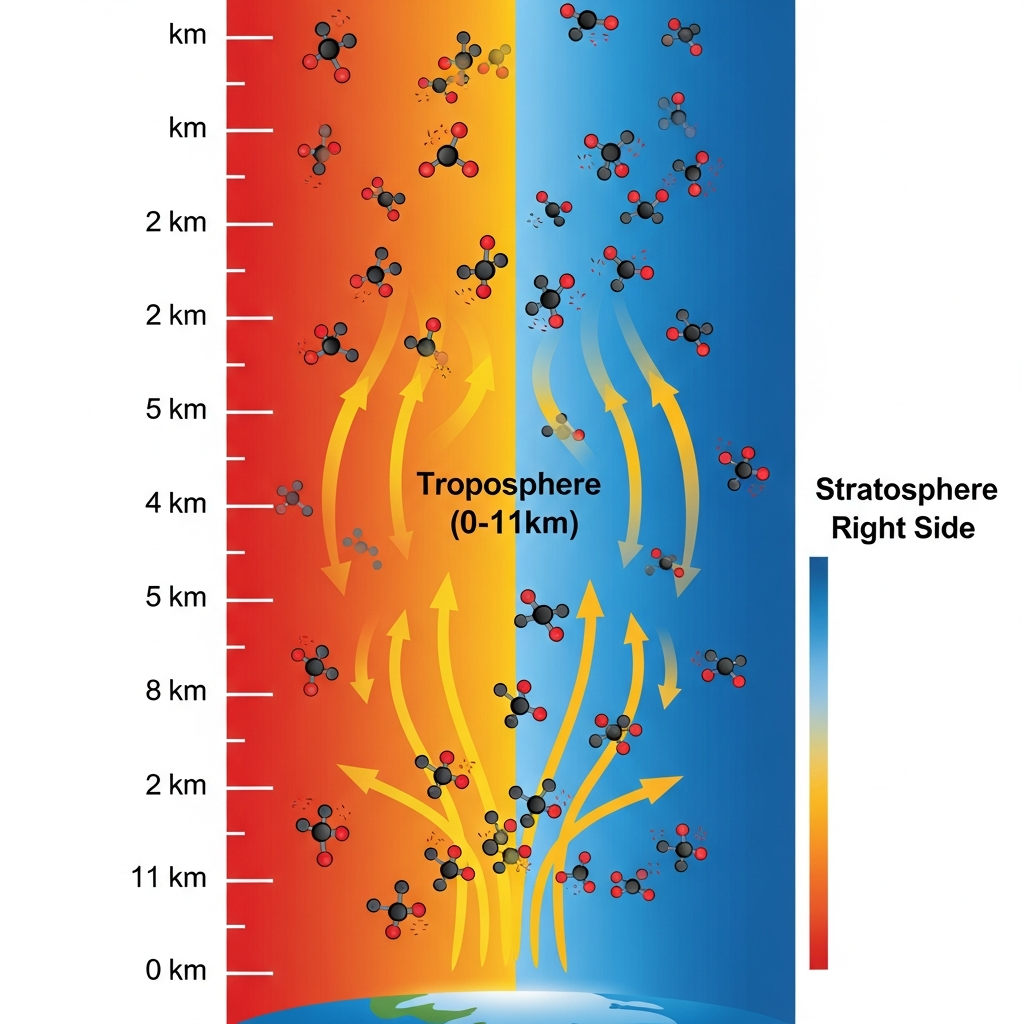
CO2 behaves in diametrically opposite ways depending on where in the atmosphere it sits, and that duality has just been explained at the level of first-principles physics for the first time. In the troposphere — the layer from the surface up to about 11 kilometers — CO2 absorbs outgoing infrared radiation and, because the air is dense with neighboring molecules, transfers that captured energy through collisions, effectively trapping heat and warming the layer. In the stratosphere, spanning roughly 11 to 50 kilometers, the air is far more sparse: CO2 absorbs infrared energy but has far fewer collision partners, so instead of passing the heat along it re-emits that energy as infrared radiation directly into space. The Columbia University team led by Professor Robert Pincus identified the specific infrared wavelength range — which they term the "Goldilocks Zone" — where this stratospheric radiative cooling is most efficient. This sweet spot exists because wavelengths that absorb too strongly cause re-emitted energy to be immediately reabsorbed by nearby molecules, while wavelengths that absorb too weakly make the mechanism negligible; only the Goldilocks range allows CO2 to act as a highly effective heat pump extracting thermal energy from the stratosphere. Critically, as atmospheric CO2 concentrations increase, the Goldilocks Zone widens in a non-linear fashion, meaning the cooling effect accelerates rather than simply scales proportionally with rising CO2 — a finding that has significant implications for projecting future stratospheric temperatures and their downstream climate consequences.
A 60-Year Mystery Solved — Syukuro Manabe's 1967 Prediction Finally Explained
In 1967, Japanese-American meteorologist Syukuro Manabe used one of the first modern climate models to predict that increasing CO2 would warm the troposphere while simultaneously cooling the stratosphere, and that prediction was eventually confirmed by decades of observational data collected via satellites and weather balloons. Manabe received the Nobel Prize in Physics in 2021 in part for this and related climate modeling work, cementing the stratospheric cooling finding as one of the field's foundational achievements. Among professional climate scientists, the cooling itself became such accepted consensus that it required no further discussion at conferences or in textbooks — everyone already nodded in agreement. Yet the field carried a quiet but damaging blind spot: ask why the stratosphere cooled as CO2 rose, at a mechanistic level, and the honest answer was that no one could fully explain it with first-principles physics. The Pincus team's paper in Nature Geoscience closes that gap by demonstrating the Goldilocks Zone mechanism, providing the physical explanation that Manabe's model output implied but could not itself supply. This matters far beyond academic completeness: in science communication, a conclusion without a mechanism is vulnerable to dismissal, and the sixty-year mechanistic gap between Manabe's prediction and this paper's explanation represents a structural weakness that climate deniers have exploited repeatedly. The field must now reckon honestly with what the absence of that explanation cost in terms of public trust over more than half a century.
The Scale of Stratospheric Cooling — More Than Ten Times the Natural Background Rate
The stratosphere has cooled by approximately 2 degrees Celsius since the mid-1980s, and the Pincus team's calculations reveal that this rate of cooling is more than ten times greater than what natural variability would have produced in the absence of anthropogenic CO2 emissions. This number deserves to be held next to another data point for perspective: over the same time period, global surface temperatures rose by approximately 1 degree Celsius. The same molecule — carbon dioxide — produced 1 degree of warming below and 2 degrees of cooling above simultaneously, which makes CO2's so-called double life more than a metaphor. Satellite temperature records and radiosonde balloon measurements have tracked this stratospheric cooling trend consistently for decades, and the trend's persistence across multiple independent measurement systems gives it high confidence in the scientific literature. The non-linear amplification discovered by the Pincus team is perhaps the most practically important aspect: with current atmospheric CO2 at approximately 425 parts per million and climbing at roughly 2.5 ppm per year, the Goldilocks Zone is progressively widening, meaning stratospheric cooling should accelerate in the coming decades rather than plateau. Simple linear extrapolation from past cooling trends will therefore systematically underestimate future stratospheric temperature changes, a modeling error with cascading consequences for any analysis that depends on stratospheric conditions — including ozone chemistry, jet stream dynamics, and surface climate feedbacks.
The Feedback Loop — How Stratospheric Cooling Amplifies Surface Warming
The stratospheric cooling mechanism does not operate in isolation from surface climate; it is coupled to tropospheric warming through a feedback pathway that climate models have previously handled imprecisely. When the stratosphere cools, it emits less downward infrared radiation toward the troposphere, which means the lower atmosphere receives less of its heat from above and must instead retain more of the heat it generates at the surface. This reduction in downward infrared flux is effectively an amplifier for surface warming: the troposphere, cut off from part of its normal radiative supply from the stratosphere, clings more tightly to its own thermal energy. The Pincus team's findings suggest this feedback has been contributing to surface warming at a magnitude that existing climate models may not have fully captured, because those models parameterized the stratosphere-troposphere coupling empirically rather than deriving it from first principles. Now that the mechanism is understood, modelers can replace the empirical patch-up with physics-based simulation, which should narrow the uncertainty band around key climate parameters including the Equilibrium Climate Sensitivity. If the feedback proves larger than current parameterizations assumed, the effective climate sensitivity will shift upward, reducing the remaining carbon budget for the 1.5-degree Paris Agreement target — making this not merely a scientific refinement but a direct input into the most consequential policy calculations on the planet.
A New Threat to Ozone Layer Recovery
The Montreal Protocol, adopted in 1987 and subsequently ratified by every nation on Earth, stands as the most successful international environmental agreement in history: by phasing out chlorofluorocarbons and other ozone-depleting substances, it set the Antarctic ozone hole on a path toward recovery, currently projected to reach 1980 baseline levels around 2066. What this success story did not account for is the role of stratospheric temperature in governing the chemistry of ozone destruction. Polar stratospheric clouds form preferentially at extremely low stratospheric temperatures, and the surfaces of those clouds provide the chemical reaction sites where chlorine compounds from residual CFCs and other halocarbons efficiently catalyze the destruction of ozone molecules. As CO2-driven stratospheric cooling continues and accelerates, the conditions favorable for polar stratospheric cloud formation become more prevalent, effectively prolonging the window of ozone vulnerability even as the concentration of ozone-depleting substances gradually declines. The result is that two global environmental problems — climate change and ozone depletion — are coupled through stratospheric temperature in a way that means solving one without solving the other is structurally insufficient. If cooling-induced ozone delays run to ten to twenty years beyond the current 2066 projection, the period of elevated UV exposure at the Earth's surface extends correspondingly, with quantifiable increases in skin cancer incidence rates, harm to marine phytoplankton at the base of oceanic food chains, and reductions in crop yields in the most UV-exposed agricultural regions of the world.
Positive & Negative Analysis
Positive Aspects
- A Quantum Leap in Climate Science's Explanatory Power
The most fundamental value this research delivers is explanatory power — the ability to answer why at a mechanistic level rather than simply reporting what observational data shows. For sixty years, climate science could tell the public and policymakers that the stratosphere was cooling, but could not explain the physical process driving that cooling in terms that connect logically from first principles to observable outcome. That explanatory gap is now filled by the Goldilocks Zone mechanism, and the difference between trust the model and here is the physics behind what the model shows is enormous for public understanding and political legitimacy. Climate educators can now present CO2's behavior as a two-layer story — warming the troposphere by trapping heat and cooling the stratosphere by radiating it into space — and then explain how those two behaviors interact through feedbacks to make the surface warmer than either mechanism alone would predict. IPCC working groups incorporating this mechanism into their reports will deliver more coherent scientific narratives to policymakers, and the improved coherence matters enormously for translating science into durable political support for emissions reductions. The Goldilocks Zone is, ultimately, the kind of elegant physical explanation that turns a model output into a teachable moment, and climate education has been desperately short of such moments.
- The Critical Missing Piece for More Accurate Climate Models
Before this research, climate models handled the stratosphere-troposphere coupling primarily through parameterization — calibrated empirical adjustments derived from observational data rather than from underlying physics. The honest shorthand for parameterization is an educated fudge factor: you know what outcome needs to be reproduced, so you tune the parameter until the model matches observations, without necessarily understanding why the parameter takes the value it does. This approach works reasonably well within the range of historical conditions used for calibration, but it becomes increasingly unreliable when extrapolating to future atmospheric CO2 levels that exceed anything in the observational record. With the Goldilocks Zone mechanism now articulated, modelers can replace empirical parameterization with physics-based simulation derived from the intrinsic radiative properties of CO2 molecules — a qualitative improvement in model architecture. The practical payoff should be a meaningful narrowing of the uncertainty range around the Equilibrium Climate Sensitivity, which currently spans 2.5 to 4 degrees Celsius — a range so wide that policy decisions about acceptable emissions levels can vary enormously depending on which end of the range a given analysis assumes. Reducing that uncertainty range is one of climate science's highest-priority practical challenges, and this mechanism represents a concrete contribution toward that goal.
- A Powerful Scientific Counter-Argument to Climate Denial
There is an irony embedded in this discovery that climate communicators should recognize and exploit rather than avoid. The same finding that climate deniers will attempt to weaponize as evidence that CO2 is not so bad — it cools the stratosphere, after all — is, when understood in full, one of the most compelling arguments for the severity of the climate challenge. The complete mechanism shows that CO2 cools the upper atmosphere in a way that reduces downward infrared flux into the troposphere, forcing the lower atmosphere to retain more heat, amplifying surface warming beyond what the simple single-layer greenhouse model predicts. That is not a reason for reassurance; it is a reason for greater urgency. The narrative arc from stratospheric cooling to surface warming amplification is counter-intuitive enough to capture public attention and then surprising enough in its conclusion to stick in memory. Effective science communicators who master the full story — starting with the apparently paradoxical stratospheric cooling and ending with the amplified surface warming — have a pedagogical tool that can reach audiences that the standard CO2 is a greenhouse gas, end of story framing has failed to engage. This is not spin; it is the accurate science, delivered in a way that matches how human curiosity actually works.
- Triggering a Renaissance in Stratospheric Research
For decades the stratosphere occupied a secondary position in climate research — a layer that climate models were required to simulate but that attracted far less investigative energy than the troposphere and ocean systems that more directly determine the weather and sea levels that people experience in daily life. This research changes that equation fundamentally by demonstrating that the stratosphere is not a passive bystander to climate change but an active participant in the feedbacks that determine the rate and magnitude of surface warming. When a major paper in Nature Geoscience establishes that a poorly understood mechanism in the stratosphere has first-order implications for climate sensitivity and ozone recovery, it creates both scientific motivation and institutional justification for expanded stratospheric research investment. Both NASA and the European Space Agency have next-generation stratospheric observation satellite missions in planning stages; this paper strengthens the scientific case for those missions and may accelerate their funding approval. Atmospheric science graduate programs will find it easier to attract students and grant funding toward stratospheric work, and the modelers who now need to incorporate the Goldilocks Zone mechanism into their code will generate a new generation of scientific questions about non-linear CO2 effects, latitude-dependent cooling patterns, and interactions with water vapor and methane. A research renaissance, once started, tends to compound — and the Goldilocks Zone mechanism has all the characteristics of a finding that launches a sustained research program.
Concerns
- The Risk of Sophisticated Cherry-Picking by Climate Deniers
The most immediate and practical risk attached to this research is that climate-skeptic communities will extract the finding that CO2 cools the upper atmosphere from its mechanistic context and use it to argue, misleadingly, that CO2 is not unambiguously harmful or that the climate system has self-correcting properties that reduce the urgency of emissions reductions. This pattern is well established: the so-called global warming hiatus of the 2000s, which reflected a temporary slowdown in surface temperature rise driven by natural variability and deep ocean heat uptake, was systematically misrepresented by denial communities as evidence that climate models had failed and projections were overstated. The Goldilocks Zone is a more sophisticated and genuinely counter-intuitive finding than the hiatus, which means the cherry-picked version of it will be correspondingly more difficult to debunk in a short social media format. The damage from this misrepresentation is not purely rhetorical — it can materially affect public opinion polling on climate policy, the political viability of carbon pricing legislation, and the domestic politics of countries whose international climate commitments depend on sustained popular support. Science communicators, major science media outlets, and fact-checking organizations need to engage this risk proactively, with pre-emptive explainers that establish the correct interpretive frame before the distorted version achieves viral momentum.
- The Ozone Recovery Timeline Is Now Under Genuine Threat
The Montreal Protocol's success in halting ozone layer depletion has been one of the rare genuine victories in international environmental governance, and the projected recovery of the Antarctic ozone hole to 1980 levels by 2066 has been a touchstone achievement that demonstrated global cooperation on environmental challenges was possible. This research introduces a serious qualification to that narrative: the recovery timeline was calculated under assumptions about stratospheric temperatures that CO2-driven cooling now puts directly in question. If polar stratospheric cloud formation increases due to ongoing stratospheric cooling, the chemical conditions that allow residual halocarbons to destroy ozone will persist longer than the Montreal Protocol's phaseout schedule anticipated, effectively neutralizing part of the treaty's effect. A delay of ten to twenty years in ozone recovery — extending full restoration into the 2080s — has real and quantifiable human health consequences: elevated ultraviolet radiation exposure increases skin cancer incidence rates along well-documented dose-response curves, impairs the immune system, and harms marine phytoplankton that anchor oceanic food webs and perform a significant fraction of global carbon sequestration. The deeper structural problem exposed by this research is that climate change and ozone depletion are coupled through stratospheric temperature in a way that makes them impossible to fully solve independently, yet the international governance architecture — two separate treaties with separate secretariats, different negotiating tracks, and different political constituencies — was not designed with that coupling in mind.
- Temporary Expansion of Climate Model Uncertainty
While the long-term effect of this research on climate models should be to improve accuracy by replacing empirical parameterization with physics-based simulation, the near-term effect may paradoxically be to increase apparent uncertainty in model projections. Incorporating the Goldilocks Zone mechanism into existing model architectures is not a trivial software update — it requires fundamental changes to radiative transfer codes that are among the most computationally intensive components of any climate model. The behavior of those updated codes will need to be validated across a wide range of atmospheric conditions before modelers can trust their outputs, a process that could span two to four years across the thirty to forty major modeling centers operating worldwide. During that integration period, different centers will incorporate the mechanism in different ways and at different levels of fidelity, producing a temporary divergence in projections that reflects varying stages of implementation rather than genuine scientific disagreement. Climate deniers have exploited exactly this kind of model spread before, most notably during the 2013 ECS debate when projection divergence was framed as proof that climate scientists simply cannot settle on the basics. Science communicators and policymakers need to be prepared to explain proactively why temporary model uncertainty expansion is actually a sign of the field self-correcting and improving, not evidence of foundational weakness in the underlying science.
- Growing Complexity in Climate Policy Design
The stratosphere-troposphere coupling this research reveals creates a new layer of complexity for climate policy that existing governance frameworks are poorly equipped to handle. If the stratospheric cooling feedback raises effective climate sensitivity by 0.2 to 0.5 degrees Celsius, the remaining carbon budget for the Paris Agreement's 1.5-degree target shrinks correspondingly, which would logically require upward revision of national emissions reduction targets — targets that the vast majority of signatory nations are already failing to meet under current commitments. Asking countries to accept tighter budgets while simultaneously failing to meet looser ones is politically near-impossible and risks undermining the legitimacy of the entire Paris framework. The ozone dimension adds a further complication: if the Montreal Protocol's 2066 recovery target is at risk due to CO2-driven stratospheric cooling, addressing that risk requires either accelerating climate action or pursuing new ozone-related interventions — both of which operate under separate governance structures that were not designed to coordinate with each other. The discovery that climate change and ozone depletion are mechanistically linked through stratospheric temperature therefore creates an implicit demand for integrated atmospheric policy that no existing international institutional framework is currently capable of delivering, and building that integration will require political will, diplomatic creativity, and time that the physical system may not afford.
Outlook
The most immediate ripple from this research will be felt in the climate modeling community, and I expect the pace of response to be faster than most observers anticipate. The Goldilocks Zone mechanism is not a vague conceptual breakthrough — it is specific enough to be translated directly into the radiative transfer codes that power global climate models. My forecast is that by the end of 2026, at least three or four major modeling centers — GFDL in the United States, NCAR, the European Centre for Medium-Range Weather Forecasts, and likely Japan's Meteorological Agency — will have begun active integration tests. The timing matters: COP31 is scheduled for November 2026 in Baku, Azerbaijan, and there will be strong institutional pressure to present updated science at that forum. The near-term signal to watch is whether IPCC's Working Group I formally incorporates this mechanism into its official reference literature ahead of that conference, which would immediately signal a shift in the scientific baseline used for emissions target negotiations.
The climate denial community's response is the second short-term development I am watching closely. I predict that within two to three months of this study's wide circulation, a wave of content will appear on skeptic blogs, YouTube channels, and social media accounts bearing some variation of "CO2 Cools the Planet" as a headline. This is not speculation — stratospheric cooling has been a recurring tool in the denialist repertoire for years, and the Goldilocks Zone now provides a more concrete and communicable mechanism than deniers previously had access to. The window for effective preemption by science communicators is roughly six to eight weeks from publication. After that, corrections are fighting an established narrative, which is exponentially harder to dislodge. Major science media outlets need to produce proactive, clearly framed explainers on what stratospheric cooling actually means for global warming — not reactive fact-checks, but preemptive narratives that establish the correct framing before the distortion machine takes over.
In the medium term — spanning roughly six months to two years — the most consequential development will be the adjustment of climate sensitivity estimates. The Equilibrium Climate Sensitivity, or ECS, is the central parameter in long-range climate projections: how much global average temperature rises when atmospheric CO2 doubles relative to pre-industrial levels. The current consensus central estimate is approximately 3 degrees Celsius, with a plausible range of 2.5 to 4 degrees. When the stratosphere-troposphere feedback is accurately incorporated into models — requiring non-trivial computational work — I believe we will see an upward revision of 0.2 to 0.5 degrees, shifting the central estimate to something in the 3.2 to 3.5 degree range. A 0.3-degree revision in ECS could reduce the remaining 1.5-degree Paris Agreement carbon budget by 50 to 80 gigatons — effectively shortening the emissions runway by one to two more years at current global emission rates of around 40 gigatons annually. For negotiators working on the next round of Nationally Determined Contributions, that number is not an abstraction.
The ozone layer dimension represents the most politically sensitive medium-term implication of this research. The Montreal Protocol is routinely cited as humanity's greatest environmental policy achievement, and scientists currently project the Antarctic ozone hole will return to 1980 levels around 2066. However, that projection assumed broadly stable stratospheric temperatures — an assumption CO2-driven cooling now puts under direct scrutiny. I predict that within one to two years, the World Meteorological Organization will publish an updated ozone assessment that, for the first time in its history, officially flags CO2-driven stratospheric cooling as a risk factor for ozone recovery delay. This would mark a historically significant acknowledgment: the problem the Montreal Protocol solved may be partially undone by a mechanism entirely outside the Protocol's jurisdiction. The practical stakes are not trivial — a delay of ten to twenty years in ozone recovery would mean decades of elevated UV exposure, associated increases in skin cancer incidence, disruption to marine phytoplankton ecosystems that underpin ocean food chains, and measurable reductions in agricultural productivity across high-UV regions.
Over the longer horizon — two to five years out — I believe this research has genuine paradigm-shifting potential for how the scientific community conceptualizes the climate system. The dominant mental model in public discourse treats climate change as fundamentally a tropospheric story: surface temperatures, sea levels, precipitation patterns, extreme weather events. The stratosphere has been treated as a supporting character at best. This study makes a compelling case that it is a co-protagonist in the climate drama. In the IPCC's Sixth Assessment Report, stratosphere-troposphere coupling appeared as a secondary consideration within broader chapters. I assess there is better than a 50 percent probability that the Seventh Assessment Report, expected around 2028 to 2030, will dedicate a standalone chapter to vertical atmospheric dynamics and stratosphere-troposphere coupled climate mechanisms. If that happens, it will reshape research funding priorities — the current distribution allocating 70 to 80 percent of global climate research budgets to tropospheric and oceanic dynamics will face genuine pressure to rebalance toward stratospheric monitoring and modeling.
The geoengineering angle is perhaps the most underappreciated long-term implication of this discovery. Stratospheric Aerosol Injection — the proposed technique of deploying reflective particles into the stratosphere to reduce incoming solar radiation — is increasingly discussed as a potential emergency intervention if emissions reductions prove insufficient to meet temperature targets. But SAI would directly alter stratospheric thermal dynamics. If CO2's Goldilocks Zone cooling and SAI's aerosol-induced thermal changes interact synergistically, the combined cooling effect could exceed either mechanism alone, with uncertain consequences for the polar vortex, the jet stream, and monsoon circulation patterns across multiple continents. I expect that by 2027 to 2028, SAI simulation studies will begin explicitly incorporating the Goldilocks Zone mechanism, producing updated risk assessments that land squarely in the middle of one of the most contentious debates in climate policy — whether to treat geoengineering as a permissible tool at all. These findings have the potential to shift that debate materially in either direction, and the uncertainty alone may warrant a pause in current SAI field trial discussions.
Let me sketch three scenarios for how this research ultimately affects the trajectory of climate science and policy over the next decade. In the optimistic scenario — probability roughly 25 percent — the Goldilocks Zone mechanism is rapidly integrated into leading climate models, producing a materially improved ECS estimate that drives accelerated revision of national emissions targets before 2030. A formal linkage between the Montreal Protocol and Paris Agreement frameworks emerges, enabling coordinated atmospheric policy for the first time. Science communicators successfully preempt denial cherry-picking, and the research ultimately strengthens public confidence in climate science. In the baseline scenario — probability roughly 50 percent — model integration is gradual and uneven, ECS estimates edge upward modestly without triggering dramatic policy revision cycles, and the ozone delay risk is flagged but treated as secondary pending further research. Climate deniers score short-term communications wins, but these are effectively countered within twelve to eighteen months.
In the pessimistic scenario — probability roughly 25 percent — model integration encounters unexpected theoretical and computational complications, temporarily widening uncertainty bands in ways that create messaging vulnerabilities. The cherry-picking campaign achieves significant viral reach before fact-checkers respond effectively. Ozone recovery data begins showing delay signals, but international political will for coordinated action falls short of what the science demands. The historical parallel that comes to mind is the 2013 climate sensitivity debate, when a cluster of studies suggesting lower ECS values led skeptic media to declare that warming projections were overstated. It took several years of refined research before the IPCC AR6 narrowed the plausible range to 2.5 to 4 degrees with increased confidence. The interim period was damaging — the "scientists don't even agree on basic sensitivity" narrative embedded itself in public discourse and proved remarkably resistant to correction even after the science resolved. This study is likely to follow a similar arc, and how swiftly climate communicators develop clear, accessible framings to distinguish "new mechanistic detail" from "contradiction of established science" will determine which scenario dominates.
To anyone reading this as the research makes its way into the news cycle, here is what I want to convey directly. If you see a headline claiming CO2 "cools the atmosphere" or that this study somehow undermines the case for urgent emissions reductions, you are watching a predictable misinformation arc begin in real time. The actual finding is the opposite of reassuring: CO2 cools the stratosphere in a way that amplifies surface warming through a self-reinforcing feedback loop, and it does so while simultaneously threatening to delay ozone layer recovery by a decade or more. Climate science just became more mechanistically grounded, more accurate, and more urgent — not less. What the Pincus team published in Nature Geoscience is a genuine breakthrough in scientific understanding, but the political and communicative challenge of translating that understanding accurately to a broad public remains, as always, the harder problem.
Sources / References
- Nature Geoscience — CO2-Driven Stratospheric Cooling Mechanism: The Goldilocks Zone — Nature Geoscience
- Columbia University Climate School Newsroom — A New Study Explains How Carbon Dioxide Cools the Upper Atmosphere and Warms Earth Below — Columbia University
- ScienceDaily — Carbon Dioxide and Upper Atmosphere Cooling: Mechanism Revealed — ScienceDaily
- Phys.org — How Carbon Dioxide Cools the Upper Atmosphere — Phys.org
- Yale Environment 360 — Climate Change and Upper Atmosphere Cooling — Yale Environment 360
- UCLA Newsroom — Stratospheric Cooling as Vertical Fingerprinting of Climate Change — UCLA Newsroom