
I Think the Immunosuppression Era Just Ended — And the Pharma Industry Should Be Terrified
Summary
CAR-T cell therapy has crossed from oncology into autoimmune medicine and produced something lifelong lupus patients were told would never exist — durable drug-free remission inside twenty-four weeks of a single infusion. The Zorpo-cel CASTLE trial in Nature Medicine (January 2026, twenty-four patients across systemic lupus, systemic sclerosis, and myositis) achieved ninety percent DORIS remission in its lupus arm, and the Erlangen cohort's longest-treated patient now stands five years drug-free while the Müller NEJM 2024 extension of fifteen patients held remission through twenty-nine months of median follow-up. Independent Chinese cohorts under Wang, Feng, and an allogeneic CD19 program add another forty-three patients to the replication pile across a different continent and different manufacturing processes. Beneath that clinical convergence sits a brutal economic and ethical reality — ex vivo infusions currently list between four hundred thousand and six hundred fifty thousand US dollars, and roughly ninety percent of the world's three to five million lupus patients live in countries where no reimbursement pathway exists. The year 2026 marks the credible beginning of immunosuppression's retirement as the default treatment philosophy in severe autoimmune disease. The real story is not the science itself but the fight — now just beginning — over who gets to participate in it.
Key Points
CD19 CAR-T is a true immune factory reset, not another DMARD
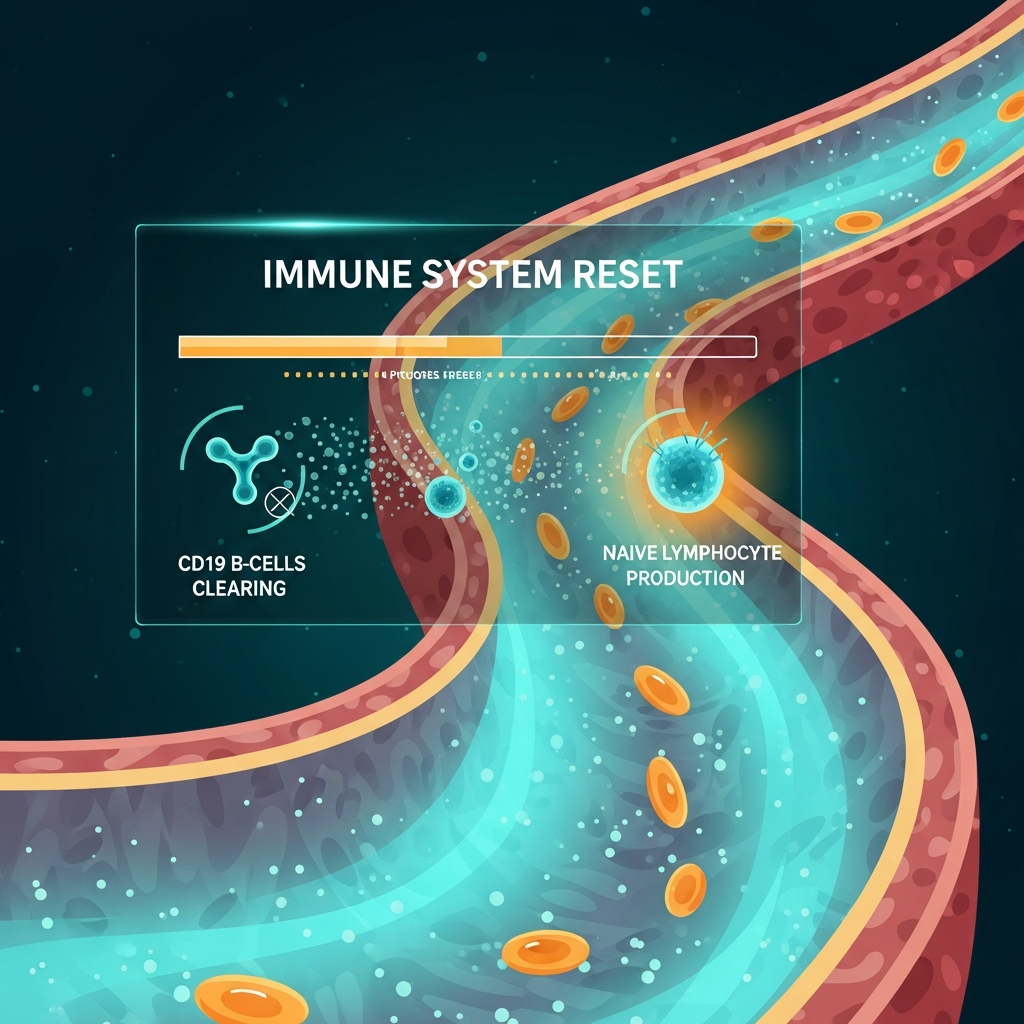
The trick is not suppression but deletion. Engineered T-cells hunt down every CD19-positive B-cell in the body — exactly where the pathogenic clones pumping out anti-nuclear antibodies or anti-collagen antibodies live — and eliminate them entirely rather than simply holding them in check. After the clear-out, the bone marrow repopulates from naive B-cell precursors that have never encountered the autoantigen, so the immune system effectively reboots in a clean state with no memory of attacking self. This is categorically different from every biologic, every JAK inhibitor, every methotrexate regimen that came before, because those compounds hold the autoimmune fire down while leaving the firewood in place. CAR-T removes the firewood. Calling it 'another DMARD with better efficacy' is a category error, and regulators, payers, and physicians who still frame it that way are going to misunderstand every consequential decision that follows.
Drug-free remission is now measured in years, not weeks
Erlangen's original five lupus patients — the Schett group's 2021–2022 cohort — include at least one patient still drug-free at the five-year mark in 2026 per STAT News's April 9th retrospective, and the Müller NEJM 2024 extension out to fifteen patients held remission through roughly twenty-nine months of median follow-up. Independent Chinese cohorts under Wang (thirteen patients) and Feng (twelve patients), plus a separate allogeneic CD19 program of eighteen patients published in Cell Research in 2025, replicated the core finding across entirely different manufacturing processes on a different continent. Zorpo-cel itself, in the CASTLE trial published in Nature Medicine in January 2026, hit ninety percent DORIS remission across its ten systemic lupus patients by the twenty-four-week endpoint, with all twenty-four enrolled participants across lupus, scleroderma, and myositis off glucocorticoids and immunosuppressants by that point. Three cohorts, three continents, three manufacturing platforms, the same answer — that is exactly the pattern that converts a curiosity into a result. Relapse is not impossible because autoimmunity is genetically and environmentally reinforced, but 'never coming back' is no longer a rhetorical flourish — it is a measurable clinical outcome in a non-trivial fraction of treated patients.
The economic model of chronic autoimmune care is the real collateral damage
Autoimmune biologics are arguably the most lucrative chronic-disease franchise in pharmaceutical history. AbbVie's Humira alone cleared more than two hundred twenty-eight billion dollars in cumulative lifetime sales, and belimumab, rituximab, anifrolumab, and the growing JAK inhibitor class all orbit the same fundamental premise — the patient takes something forever, and that subscription generates revenue indefinitely. A one-shot treatment, priced once, collapses that premise without leaving a polite exit ramp. The question is not whether pharma resists the transition — it will, through pricing strategies, IP maneuvers, endpoint selection, and trial designs engineered to understate durable remission. The question is how long that resistance holds once in vivo CAR-T starts approaching vaccine-style economics, and the history of biologic-to-biosimilar transitions suggests the resistance lasts exactly as long as incumbents' lobbying budgets allow.
In vivo CAR-T changes the access calculus more than anything else in the pipeline
Ex vivo manufacturing — harvesting the patient's T-cells, engineering them, expanding them in a dedicated clean room, reinfusing them — is what pushes sticker prices into the four-to-six-hundred-fifty-thousand-dollar range, with Kymriah now listing around six hundred thirty-three thousand dollars and Yescarta around five hundred thirty-seven thousand at 2025 prices. The cost is not primarily intellectual property or the molecule itself but the cell-engineering logistics wrapped individually around each patient, making every infusion essentially a custom production run. In vivo CAR-T is already in first-in-human territory: MagicRNA's HN2301 published a five-patient systemic lupus pilot in NEJM in October 2025, with CD8+ T-cells converting to functional CAR-T within six hours of a four-milligram LNP-mRNA dose and B-cells depleting in seven to ten days without any Grade 3+ cytokine-release events, and Capstan Therapeutics' CPTX2309 autoimmune program was acquired by AbbVie for roughly two point one billion dollars in June 2025 while still at Phase 1. If those platforms hold up as they exit Phase 1 and enter Phase 2 over the next two to three years, manufacturing cost drops by roughly eighty percent, and the therapy starts looking less like a custom Ferrari and more like a biologic a mid-income national health system could plausibly buy at scale.
Cure is the wrong word, and the word you pick shapes the next decade
The pathogenic B-cells come back eventually — that much is biology and not in dispute. Autoantibody titers come down and, in Erlangen's five-year data on the longest-treated patient and the twenty-nine-month Müller NEJM 2024 extension across fifteen patients, stay down for the majority, but the HLA risk alleles, the EBV history, the ultraviolet exposure, the gut microbiome, every upstream driver of autoimmunity still persists intact. What Erlangen shows is that late autoantibody return, when it occurs, does not always reinstate clinical disease. What it cannot yet show, because the calendar will not allow it, is whether ten-year and fifteen-year timelines look the same as year five. 'Cure' implies permanent absence and triggers a very particular set of regulatory, marketing, and reimbursement behaviors that are genuinely difficult to walk back, while 'durable drug-free remission' is more accurate, demands a different ecosystem, and leaves room for a slower and more honest rollout. I think the industry will sprint toward the 'cure' label because it sells better, and patient advocacy groups are going to have to be the ones who insist on the more conservative framing.
Positive & Negative Analysis
Positive Aspects
- Real freedom from daily immunosuppression for the first time in decades
For thirty years, lupus, scleroderma, myositis, and refractory rheumatoid arthritis have meant a calendar built relentlessly around steroid schedules and biologic infusion appointments. One week after a successful CAR-T infusion, that calendar empties in a way no biologic has ever managed to deliver. Patients in the Erlangen cohort describe it as 'getting their twenties back,' and quality-of-life measures in early cohorts improve beyond anything the modern DMARD era has produced across three decades of incremental progress. The psychological weight of chronic dosing — the missed doses, the steroid-induced weight gain, the constant infection anxiety, the prednisone mood swings — simply lifts. That lived-experience shift is why patient demand will, by itself, force faster adoption than regulators or insurers currently anticipate.
- One mechanism, many diseases — a genuine platform, not a single indication
CD19 is not lupus-specific. It is the shared surface marker of essentially every autoantibody-mediated disease, which is why the CASTLE trial already enrolled patients with systemic lupus, systemic sclerosis, and myositis, and why early case series beyond CASTLE span myasthenia gravis, anti-synthetase syndrome, pemphigus vulgaris, and refractory progressive multiple sclerosis. A single engineered product line, with minor protocol variation, plausibly addresses twenty or more orphan and semi-orphan autoimmune diagnoses that each independently lack commercial development momentum. In clinical-development economics, that collapses two dozen separate trial programs into something that behaves like a genuine platform and attracts capital at platform-level valuations. Platforms attract talent and capital in ways single-indication programs simply cannot, and the pace of secondary-indication readouts over the next thirty-six months will look unusually fast precisely because of that dynamic.
- The first genuine reset tool in the history of autoimmune medicine
Medicine has built remarkable suppression tools over the past seventy years — glucocorticoids, methotrexate, anti-TNF biologics, JAK inhibitors, complement blockers — but essentially no reset tools capable of removing the disease mechanism rather than managing it. Bone-marrow transplantation was the closest historical analogue, and its morbidity and treatment-related mortality kept it permanently niche. CAR-T, carrying the lymphodepletion toxicity of a tough chemotherapy week but without the graft-versus-host disease risk that defines transplant medicine, sits in a completely different risk tier that a competent autoimmunity specialist can manage outside a transplant center. For the first time, medicine has a treatment that removes the autoimmune disease process rather than suppressing it — at a risk-benefit profile genuinely discussable for a relatively young, otherwise-healthy lupus patient in 2026. That is the conceptual shift, and it is considerably larger than any single trial readout will capture.
- Potential to dissolve the biologic-pricing cartel on a ten-year horizon
The current autoimmune biologic market is, practically speaking, a cartel of lifetime-subscription drugs where competition runs among similar mechanisms at similar price points and nobody wins on actual cure. A one-time treatment that permanently obsoletes the subscription model cannot be defended indefinitely through clever marketing and me-too launches at similar price points. Even if initial CAR-T pricing is predatory — and at $400K-$650K per infusion, it clearly is — the in vivo platforms are coming, and generic-style competition in the durable-treatment market is a realistic five-to-seven-year prospect once MagicRNA-style LNP manufacturing normalizes. The knock-on effect on chronic-care pricing across autoimmunity is hard to overstate: once a durable treatment exists at a defensible price point, every legacy biologic's value proposition must be completely re-underwritten from scratch. That repricing is deeply uncomfortable for pharma and genuinely outstanding for every patient and payer currently locked outside the existing revenue stream.
- Data quality that compounds every quarter instead of eroding
Most hyped therapies look worse as data matures, because selection effects and outcome curation gradually wash out under scrutiny. This one is getting stronger with each passing quarter. The Erlangen follow-up now stretches to five years on the longest-treated patient and to roughly twenty-nine months median across the fifteen-patient Müller NEJM 2024 extension, more durable than skeptics had predicted at every milestone. The independent Chinese cohorts under Wang and Feng replicated the Western cohort across different manufacturing processes and patient populations. Toxicity profiles in autoimmune patients, who do not carry lymphoma tumor burden, are milder than in cancer CAR-T applications — cytokine-release syndrome typically caps at grade one or two and neurotoxicity remains rare. The pattern of independent cohorts confirming each other across continents, manufacturing platforms, and publication venues is historically uncommon in translational medicine, and it is why confidence in this signal is growing rather than eroding.
Concerns
- Sticker price that locks out the majority of the global patient population
At four hundred thousand to six hundred fifty thousand US dollars per ex vivo infusion based on 2025 list prices — Kymriah at roughly six hundred thirty-three thousand, Yescarta at about five hundred thirty-seven thousand, before separate hospital and inpatient management costs — CAR-T autoimmune therapy is unaffordable for essentially every health system outside a narrow band of wealthy OECD countries. Lupus, with its particular epidemiology, is disproportionately prevalent in Black and Hispanic populations and in women across the global South, where national health budgets cannot absorb six-figure one-time bills. The therapy most likely to help those patients is structurally the one most likely to be unavailable to them, and that inversion is not a minor ethical footnote — it is the defining equity problem of this decade in medicine. Until in vivo CAR-T lands at genuinely lower manufacturing cost or volume-based pricing is negotiated through international pressure, the equity gap worsens rather than closes. The pharma industry has no meaningful track record of voluntarily closing a gap of that geographic and economic magnitude.
- Long-term relapse data is still thin and the word cure outpaces the evidence
A five-year follow-up on the longest-treated original Erlangen patient, plus a twenty-nine-month Müller NEJM 2024 extension across fifteen patients, is a compelling and growing signal — but it is not a guarantee that holds across populations, disease subtypes, and extended timelines. Autoimmunity is lifelong by definition — pathogenic T-cell help, HLA susceptibility, and environmental triggers all persist and are not erased by a B-cell clearance event. A ten-year or fifteen-year dataset on whether autoantibody reappearance at year five or year eight translates into clinical relapse simply does not exist yet, and the honest answer is that nobody currently knows. The pharma marketing apparatus will sprint past 'durable remission' and arrive at 'cure' well before the data earns that word. Regulators, journalists, and patient advocacy groups must actively slow that framing down — the difference between those two words reshapes reimbursement structures and patient decision-making in ways that are very difficult to reverse once they calcify into regulatory language.
- Lymphodepletion toxicity is not trivial and narrows the eligible patient pool
Before CAR-T cells can be infused, the patient must undergo a fludarabine-cyclophosphamide lymphodepletion regimen that is roughly equivalent to a severe chemotherapy conditioning week in terms of physiological burden. Neutropenia, opportunistic infection risk, fertility concerns, and a small but real risk of long-term cytopenias all follow as anticipated consequences of that conditioning. For a lupus patient with reasonable quality of life on belimumab and hydroxychloroquine, the risk-benefit calculation is not straightforward in 2026 and will likely remain genuinely uncertain into 2027 as real-world safety data accumulates. The therapy is genuinely unsuitable for the many autoimmune patients currently well-controlled on existing drugs, concentrating the eligible pool heavily among the refractory and severe cases where the risk trade-off is more defensible. That narrower denominator significantly shapes every market-size estimate currently in circulation, most of which are substantially overstated.
- Insurance and reimbursement architectures are not built for one-time treatments
American commercial payers, European single-payer systems, and Asian national insurers are all structurally architected around recurring drug expenditure that spreads predictably across fiscal years and actuarial models. A single six-figure bill that subsequently eliminates all downstream pharmaceutical costs is, counterintuitively, harder to finance in many systems than fifteen years of predictable monthly biologics in annual budget cycles. Pay-for-outcomes models, annuity-based reimbursement structures, and multi-year risk-sharing contracts currently exist only in small pilot form with limited real-world track records to validate them. Without rapid reimbursement innovation — and without sustained regulator pressure to accelerate that innovation through frameworks rather than leaving it to voluntary payer action — access collapses even for patients whose national systems could theoretically afford the therapy. The structural problem is less about total money than about plumbing, and healthcare reimbursement plumbing takes a long time to redesign.
- Manufacturing quality risk grows as volume scales
Ex vivo CAR-T manufacturing is, in its current industrial form, essentially artisanal production at scale. Each batch is bespoke — variability in vector copy number, cell viability, and expansion kinetics translates directly into variable clinical response, and the failure modes are not always predictable ahead of infusion. As volume scales from a few thousand hematology patients per year to potentially tens of thousands of autoimmune patients annually, manufacturing consistency becomes a frontier engineering problem the industry has not yet fully solved at that throughput. Failed batches, out-of-specification infusions, and contamination events are foreseeable failure modes at scale, and they will matter far more as the patient pool shifts from late-stage lymphoma patients to otherwise-healthy young women with lupus who have far more to lose from a compromised product lot. Safety signal monitoring, quality management systems, and post-market surveillance must mature considerably faster than current commercial launch timelines seem to assume.
Outlook
The short-term window, the six to twelve months immediately in front of us, looks dominated by regulatory and reimbursement choreography rather than fresh clinical data. I expect the FDA's Oncologic Drugs Advisory Committee and, separately, a newly formed Autoimmune CAR-T advisory subgroup to convene before the end of 2026 to debate label language for Zorpo-cel. The central fight will be over whether the label reads "drug-free remission" or the more aggressive "durable clinical response," and the answer shapes every downstream reimbursement conversation that follows. European Medicines Agency guidance is likely to lag the FDA by roughly nine months, as has been the consistent pattern with prior CAR-T cancer approvals. In parallel, I expect at least two large US commercial payers to announce pay-for-outcomes pilots tied to specific Lupus Disease Activity Index thresholds at twenty-four and fifty-two weeks, which is exactly the reimbursement plumbing work that needs to happen for any one-time treatment to scale into routine clinical practice. On the investor side, watch for a wave of secondary financings across Umoja, MagicRNA, and the next wave of lipid-nanoparticle-based in vivo CAR-T platforms — Capstan already went to AbbVie in mid-2025 for roughly two point one billion dollars, and the capital that missed that window wants in before the next Phase 2 readouts. My base case for the next twelve months is cautious optimism with a lot of procedural noise, not dramatic new clinical headlines.
Inside that same short-term window, expect the pharma incumbent response to sharpen considerably. AbbVie, Bristol Myers Squibb, and Roche all have rheumatology franchises that are now, for the first time, defending against something genuinely different rather than just another me-too biologic competing on efficacy data at similar mechanism. I expect at least one major acquisition of a mid-stage CAR-T autoimmune company by a large-cap pharma before the end of 2026, priced somewhere in the two-to-five-billion-dollar range, justified publicly as "platform expansion" but operationally aimed at controlling the pace of commercial rollout. I also expect combination-protocol trials to start appearing on ClinicalTrials.gov in volume — CAR-T plus ongoing low-dose biologic, CAR-T plus a novel tolerance-induction compound — because combining the one-time treatment with a legacy subscription is the obvious commercial defense for incumbents who need to preserve revenue during the transition period. None of that changes the underlying science, but it changes the commercial timeline in ways patients and clinicians should be watching closely.
The mid-term window, roughly the eighteen months from late 2026 through early 2028, is where the story either consolidates or fragments. The consolidation scenario runs like this: Zorpo-cel Phase III reads out positively at twenty-four and fifty-two weeks across systemic lupus erythematosus, lupus nephritis, and at least one additional autoimmune indication such as systemic sclerosis or myasthenia gravis. FDA grants a broad label in late 2027. At least one in vivo CAR-T program — most likely MagicRNA HN2301 or an Umoja VivoVec-based program — posts clean Phase II efficacy data in 2027, validating the cost-reduction thesis the field needs to solve the equity problem. Major health systems in the US, Germany, and the UK begin operationalizing CAR-T autoimmune programs outside transplant centers, building the referral and infusion infrastructure the field currently lacks. Global treated patient count moves from hundreds in 2026 to roughly ten thousand by end of 2028. In this scenario, the immunosuppression-forever paradigm is functionally dead by 2028 as a matter of clinical aspiration even though most patients still receive legacy therapy, because the direction of travel is unambiguous to any clinician who reads the data.
The fragmentation scenario, which is not unlikely and which I think the field underweights, looks meaningfully different. Zorpo-cel Phase III reads out with mixed data — strong in refractory lupus, weaker in earlier-stage or milder disease, with one or two high-profile relapses near the fifty-two-week mark that media coverage seizes on and amplifies beyond their statistical significance. The FDA issues a narrow label confined to refractory SLE with prior biologic failure. In vivo CAR-T Phase II data is ambiguous — efficacy signals present but heterogeneous across patients, manufacturing consistency problems emerging at scale. Pharma incumbents successfully push combination-protocol trial designs that effectively re-insert biologics into the CAR-T workflow as a commercial and safety standard. Reimbursement lags, particularly in Europe where HTA bodies are still developing frameworks for one-time curative therapies. Global treated patient count stays under three thousand through 2028. In this scenario the immunosuppression paradigm survives, bruised but intact, and the CAR-T revolution becomes a premium option for a narrow subset of refractory patients rather than a new standard of care. I think the consolidation scenario is somewhat more likely than fragmentation — maybe a sixty-forty split in probability — but the fragmentation risk is real enough that I would not bet heavily on the optimistic timeline.
The long-term window, the three-to-seven-year horizon through roughly 2033, is where the truly large numbers live and where the equity question resolves one way or another. If in vivo CAR-T matures as the early data and the AbbVie acquisition logic suggest it will, the per-patient cost drops from the roughly four-to-six-hundred-thousand-dollar range today to something in the sixty-thousand to ninety-thousand dollar range by 2030 as LNP manufacturing scales and competition enters the market. Global treated patient count plausibly reaches one hundred fifty thousand per year by 2031 across all autoimmune indications, which is small relative to the three-to-five-million global lupus patient pool but large enough to fundamentally reshape the autoimmune biologic market dynamics. I expect the global autoimmune biologic market, which sits around one hundred fifty billion dollars today, to lose roughly twenty to thirty percent of its value by 2033 as durable-remission patients exit the chronic-subscription cohort in growing numbers. That is a thirty-to-forty-billion-dollar erosion, concentrated in the companies with the largest legacy franchises in lupus, scleroderma, and refractory rheumatoid arthritis, and it is the single largest pharmaceutical disruption event I can identify on any current visible horizon. Second-order effects on insurance premiums, disability statistics, and labor-force participation among young women with autoimmune disease are real and potentially substantial, but harder to size with precision given the access uncertainty.
The bull scenario over the same horizon runs considerably further than my base case. In vivo CAR-T hits genuine mass-production economics in 2030, per-patient cost drops to under forty thousand dollars, WHO prequalification makes CAR-T accessible in lower-and-middle-income-country health systems by 2032, and the equity problem that runs through every section of this analysis actually resolves in a meaningful and durable way. Treated patient count reaches half a million per year by 2033. The global autoimmune biologic market loses closer to fifty percent of its value as durable remission patients exit the chronic-prescription cohort at scale. Rheumatology training curricula worldwide retool around CAR-T referral pathways and management protocols rather than around biologic selection algorithms and monitoring schedules. The word "cure" becomes appropriate for a genuine majority of treated patients across the followed cohorts, not just a generous minority in highly selected early cohorts. This scenario requires essentially everything to go right simultaneously — manufacturing scale, reimbursement innovation, in vivo platform clinical success across multiple indications, pharma incumbents losing their defensive commercial fights, and policymakers actively choosing universal access over default luxury. I put its probability at roughly twenty to twenty-five percent, which is low enough to not plan for but high enough to not dismiss.
The bear scenario is darker and, frankly, more plausible than the bull scenario when you look at the base rates for this kind of structural therapeutic transition. In vivo CAR-T programs fail in Phase II over the next three years, locking the field into ex vivo manufacturing and its inherent premium pricing indefinitely. A clinically meaningful relapse rate — something above fifteen or twenty percent by year five — appears in the extended follow-up data from Erlangen and the Chinese cohorts, substantially undermining the "durable remission" narrative and triggering media coverage that overgeneralizes individual relapses into treatment failure. Pharma combination protocols successfully preserve the biologic subscription model in commercial practice by embedding CAR-T as an induction therapy followed by mandatory maintenance biologics. Reimbursement innovation stalls, particularly in Europe and Asia, where single-payer systems struggle to create workable long-term frameworks for one-time curative therapies. Global treated patient count plateaus at roughly twenty thousand per year by 2033, concentrated almost entirely in wealthy OECD specialty centers. The immunosuppression paradigm survives in most patients' lived reality even while the scientific and media conversation continues to discuss a coming revolution. I put this scenario at roughly thirty percent probability, which means any reader calibrating their real-world expectations should weight somewhere between the base case and the bear case rather than between base and bull.
My base case sits in the middle, somewhat closer to consolidation than fragmentation but well short of bull-scenario outcomes. Per-patient cost lands around one hundred twenty thousand dollars by 2030, driven by incremental manufacturing efficiency improvements and the beginning of in vivo platform competition. Treated patient count reaches roughly seventy-five thousand per year by 2032 across all autoimmune indications combined. The autoimmune biologic market loses around twenty percent of its value, concentrated in the lupus, scleroderma, and refractory rheumatoid arthritis franchises where remission rates in CAR-T cohorts are strongest and patient advocacy for access is most organized. The "cure versus durable remission" semantic fight matures into regulatory precedent by 2028, with the more conservative and accurate framing winning in official label language even if popular press coverage continues to prefer the simpler word. In vivo CAR-T launches in lower-income markets between 2031 and 2033 at cost points that meaningfully expand access beyond current OECD concentration, though genuinely universal access remains a longer-term aspiration rather than a 2033 reality. Patient advocacy groups split along the access-versus-caution fault line I described, and that split becomes productive as different factions pressure different parts of the system. I would rate this base case at roughly forty-five to fifty percent probability, leaving genuine room for surprise in both directions depending critically on the Phase 2 in vivo readouts over the next two to three years.
Practically speaking, for a patient reading this today with a new or active lupus diagnosis, the right framing is: the biologic or DMARD you are starting now is still the appropriate first-line therapy, CAR-T is not yet indicated for newly diagnosed or currently well-controlled patients, but within three to five years the escalation calculus — when and why to consider CAR-T — will look radically different from how it appears today. For a clinician, the right move is to start building familiarity with autoimmune CAR-T referral pathways and eligibility criteria now, before patient demand arrives in volume and the logistics are scrambled to catch up. For an investor, the long thesis runs through in vivo CAR-T platforms and the reimbursement-innovation companies building pay-for-outcomes infrastructure, not through legacy rheumatology franchises. For a policymaker, the next three years of reimbursement architecture decisions will determine whether this therapy becomes genuinely universal medicine or a luxury product for patients in wealthy countries, and the default trajectory without active intervention leads to luxury. That last point is the one the default path consistently gets wrong, and it is the one worth fighting hardest and earliest to change.
Sources / References
- Zorpo-cel (CASTLE trial): CD19 CAR-T in SLE, systemic sclerosis, and myositis — 24-patient multi-indication study, 90% DORIS remission in SLE arm at 24 weeks (Nature Medicine, 2026-01) — Nature Medicine
- In Vivo CD19 CAR T-Cell Therapy for Refractory SLE — MagicRNA HN2301 first-in-human, 5 systemic lupus patients, LNP-mRNA platform (NEJM, 2025-10) — New England Journal of Medicine
- CD19 CAR T-Cell Therapy in Autoimmune Disease — Müller et al., 15-patient extension of the Erlangen cohort, 29-month median follow-up (NEJM, 2024-02) — New England Journal of Medicine
- Anti-CD19 CAR T cell therapy for refractory systemic lupus erythematosus — Mackensen et al., original Erlangen 5-patient series (Nature Medicine, 2022) — Nature Medicine
- Five years after the lupus breakthrough: CAR-T's autoimmune reckoning — original Erlangen patient drug-free at 5 years (STAT News, 2026-04-09) — STAT News
- Anti-CD19 CAR-T Therapy Zorpo-cel Safe and Effective for SLE — Lupus Foundation summary of CASTLE trial (2026) — Lupus Foundation of America
- Could a Cancer Breakthrough Cure Autoimmune Diseases? (2026-04) — Roswell Park Comprehensive Cancer Center
- Roads and detours for CAR T cell therapy in autoimmune diseases (2025) — Nature Reviews Drug Discovery
- FDA boxed warning on T-cell malignancies following CD19- or BCMA-directed CAR-T therapy — U.S. Food and Drug Administration
- MagicRNA first-in-human in vivo CAR-T in SLE — press release summarizing the NEJM 2025 publication (BioSpace) — BioSpace