
The Inconvenient Truth 142,000 People Proved — The Dream of Catching Cancer with a Drop of Blood Is Still Just a Dream
Summary
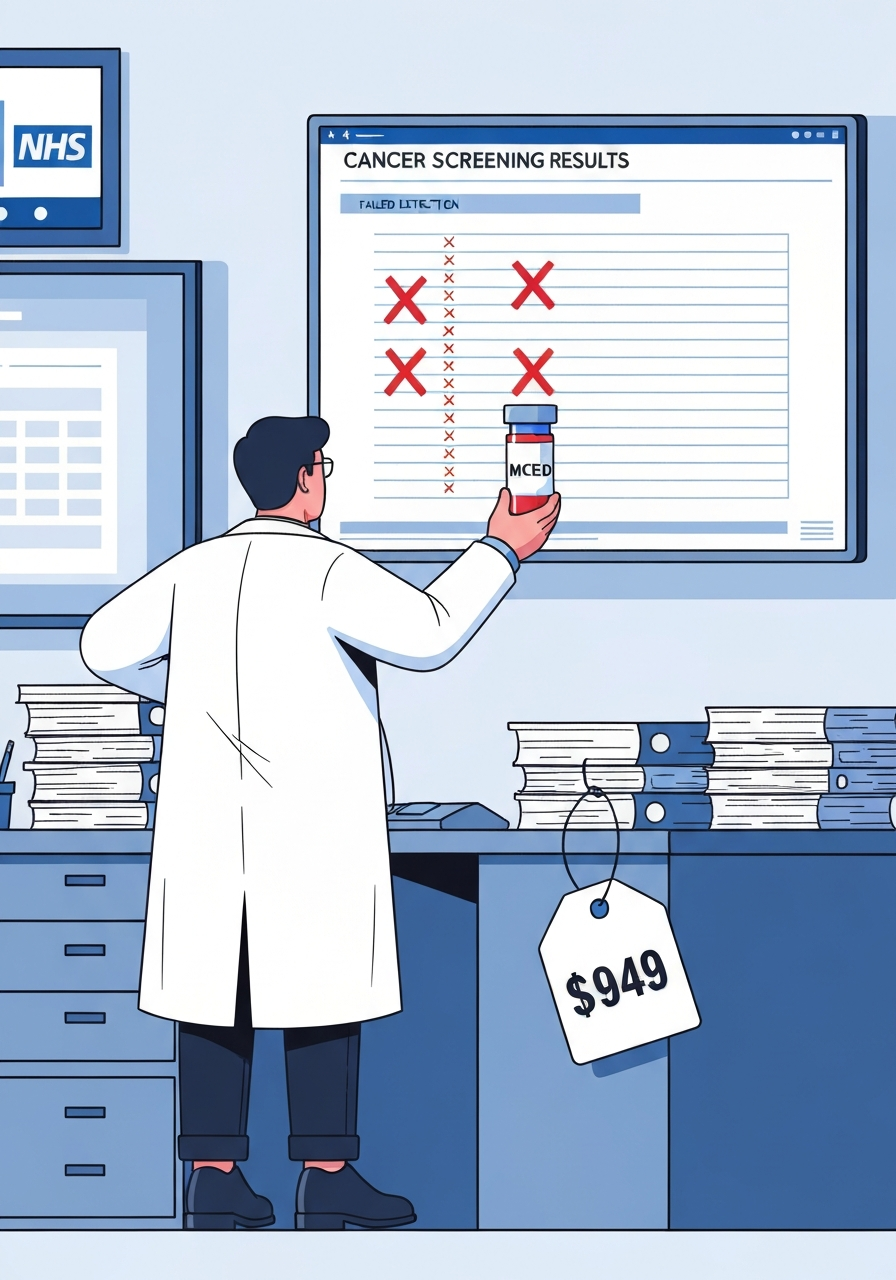
The NHS-Galleri trial with 142,000 participants failed its primary endpoint of reducing late-stage cancer diagnoses, with no mortality data presented. The U.S. signed MCED Medicare legislation despite zero FDA-approved tests, exposing a science-policy divide. At $949 per test, overdiagnosis risks and cost barriers challenge the premise that early detection saves lives.
Key Points
NHS-Galleri Trial: The Largest MCED Clinical Study in History Missed Its Primary Endpoint
The UK's National Health Service enrolled 142,000 participants in the world's first and largest randomized controlled MCED trial, conducted over three years. The trial's pre-specified primary endpoint — a 20% reduction in Stage III and Stage IV cancer diagnoses — was not achieved. Grail emphasized that the 12 deadliest cancers showed a reduction in Stage IV diagnoses and an increase in Stage I-II detections, but Stage III cancers were identified at higher-than-expected rates, which meant the composite endpoint failed to reach statistical significance.
Immediately following the results announcement, Grail's stock price crashed approximately 50%, sending shockwaves through the entire MCED industry's credibility. Mortality data was not included in this release, leaving the fundamental question unanswered: does early detection through MCED actually improve survival? Grail has stated it will submit detailed data to the ASCO 2026 Annual Meeting (May 29 - June 2, Chicago) and extend the follow-up period by 6 to 12 months. Notably, three weeks before the trial results were published, on January 29, 2026, Grail had already submitted the final module of its FDA Premarket Approval (PMA) application for Galleri, based on PATHFINDER 2 registry study data.
A Dramatic Policy Contrast Between the U.S. and the U.K. — Legislation Signed vs. Trial Stalled
During the very same period that the NHS-Galleri trial was delivering disappointing results, something remarkable was happening on the other side of the Atlantic. On February 3, 2026, President Trump signed the Nancy Gardner Sewell Medicare MCED Screening Coverage Act into law. This legislation authorizes Medicare coverage for FDA-approved MCED tests starting in 2028. The irony is hard to miss: not a single MCED test has received FDA approval to date.
The bill passed with bipartisan support (House H.R. 842, Senate S. 339), and its significance lies in proactively establishing the institutional framework before the technology is ready. That is either visionary policymaking or evidence of regulatory capture running ahead of science, depending on your perspective. While the U.K. waited for clinical evidence, the U.S. built the coverage infrastructure first. This contrast reveals that MCED is no longer a purely scientific discussion — it has become entangled in political dynamics, industry lobbying, and healthcare policy considerations that extend far beyond the laboratory.
The Overdiagnosis Paradox — A Four-Fold Increase in Cancer Detection Could Be Bad News
Galleri increased cancer detection rates by more than four times compared to existing screening programs, but experts interpreted this not as a triumph but as a worrying signal of overdiagnosis. The pattern has been observed before: thyroid and kidney cancer detection rates surged dramatically over recent decades, yet mortality rates remained flat or even declined. In those cases, higher detection simply led to more unnecessary surgeries, chemotherapy, and radiation treatments for cancers that would never have caused symptoms in a patient's lifetime.
In medicine, 'lead-time bias' refers to the phenomenon where early detection merely extends the period during which a patient knows about their cancer without actually prolonging their life. With no mortality data available from the NHS-Galleri trial, this bias cannot be ruled out. A joint research team from Harvard Medical School, Brigham and Women's Hospital, and Dell Medical School published a 2025 study showing that the increase in early-onset cancer diagnoses in the United States was attributable not to a genuine rise in disease prevalence but to advances in imaging technology and expanded screening — a phenomenon they termed 'detection increase.' The uncomfortable truth that detecting more does not automatically mean saving more is being documented with growing precision.
The $949 Barrier — How Cost Creates Structural Healthcare Inequality
Galleri is sold at $949 per test without FDA approval, and in 2025 alone, 185,000 tests were purchased, generating $136.8 million in revenue. A study published in Health Affairs Scholar surveying 19 private insurers covering 150 million members found that 74% of these payers believed MCED would fail to reduce healthcare disparities, citing concerns about follow-up care access barriers and overtreatment risks.
Exact Sciences launched its competing product Cancerguard in September 2025 at $689 per test — $260 less than Galleri — but this still represents a substantial financial barrier for most individuals. In rural and remote areas, access to the imaging equipment, specialist oncologists, and biopsy services required for follow-up after a positive MCED result is severely limited. Even if someone can afford the test, they may not be able to access the full continuum of care that makes early detection meaningful. MCED is on a trajectory to become a technology that delivers additional benefits exclusively to populations who are economically comfortable and live near well-equipped medical infrastructure, while systematically excluding the most vulnerable communities that bear the heaviest cancer burden.
The Cracking Equation of 'Early Detection Equals Lives Saved'
The list of cancers for which early detection has robust evidence of mortality reduction is surprisingly short: breast cancer, colorectal cancer, cervical cancer, and lung cancer in high-risk populations. For the vast majority of the 50-plus cancer types that MCED claims to detect, the clinical benefit of early detection remains unproven. The fact that the NHS-Galleri trial did not release mortality data is itself an admission that this fundamental question does not yet have an answer.
A microsimulation modeling study presented at ASCO 2025 (JCO Abstract 10542) estimated that annual MCED screening could reduce advanced-stage cancers by over 40% and mortality by up to 18% in high-risk populations. However promising those numbers sound, they remain outputs of a model, not evidence from an actual clinical trial. Between detection and survival lies a complex web of variables — treatment access, the biological behavior of each cancer, and the patient's overall health status. The gap between finding cancer and saving lives is far wider than the marketing materials suggest.
Positive & Negative Analysis
Positive Aspects
- Expanding Awareness of Screening Blind Spots
Standard cancer screening today covers a narrow set of cancers — breast, colorectal, cervical, and lung — leaving dozens of other cancer types effectively undetected until symptoms appear. MCED has succeeded in forcing mainstream medicine to confront this enormous gap. The PATHFINDER 2 trial demonstrated that adding Galleri to standard recommended screening increased cancer detection rates by more than seven-fold, proving that the technical capability to find these hidden cancers is real.
This matters because it represents the first systematic approach to screening for cancers that have never had a screening program. The medical significance of opening a door that was previously closed entirely should not be minimized, even if the current execution has serious limitations. Awareness is the precursor to action, and MCED has permanently changed the conversation about what comprehensive cancer screening could look like.
- Institutional Infrastructure for Medicare Coverage Now in Place
The passage of the Nancy Gardner Sewell Act in February 2026 with bipartisan support established the legal framework for Medicare coverage of FDA-approved MCED tests. This means that when a test eventually secures FDA approval, the insurance pathway is already built rather than requiring a separate legislative battle.
For MCED companies, this provides commercial certainty and a clear regulatory horizon. For patients, it represents the starting point for eventual cost reduction through insurance coverage and broader population access. The legislation could also serve as a policy benchmark for other nations developing their own MCED coverage frameworks. The institutional groundwork is in place, and that is not nothing — even if the technology has not yet caught up to the policy.
- A Partial but Meaningful Signal in Stage IV Cancer Reduction
While the NHS-Galleri trial missed its primary composite endpoint, the data showed something worth noting: among the 12 deadliest cancers, Stage IV diagnoses decreased and Stage I-II detections increased. Stage IV cancers carry the highest treatment costs and the lowest survival rates, so any reduction at this stage has value both for patient outcomes and for healthcare system economics.
The result did not reach statistical significance, and without linked mortality data the clinical meaning remains uncertain. But the directional signal — catching deadly cancers earlier in their progression — aligns with what the technology was designed to do. Dismissing the entire trial as a failure overlooks this nuance. The question is whether extended follow-up will validate or undermine this early signal.
- Competition Is Driving Innovation and Pushing Prices Down
The MCED market is no longer a Grail monopoly. Exact Sciences launched Cancerguard in September 2025 at $689 per test, available through Quest Diagnostics' 7,000 access points nationwide, with development study data showing 64% overall sensitivity and 97.4% specificity. Multiple biotech companies are developing next-generation MCED tests using multi-omics approaches that combine genomics, proteomics, and metabolomics data.
This competitive dynamic is exactly what healthcare innovation needs. Competition accelerates improvements in sensitivity and specificity while gradually putting downward pressure on pricing. The first-generation MCED tests are expensive and imperfect, but the trajectory of the market suggests that each successive generation will address current limitations. Market forces, when they work as intended, are one of the most reliable engines for making emerging technologies both better and more affordable.
- Large-Scale RCT Data as a Foundation for Future Decision-Making
The NHS-Galleri trial may have missed its primary endpoint, but the 142,000-person population-level randomized controlled trial dataset itself is an invaluable scientific asset. Real-world data at this scale, with proper randomization and control groups, provides a foundation for evidence-based policy that no modeling study or small-scale observational study can replicate.
As the extended follow-up period of 6 to 12 months generates mortality data, the scientific community will finally have a basis for answering the most important question in this field: does MCED screening actually extend lives? Learning from a well-designed trial that produced disappointing results is more valuable than building policy on optimistic projections that have never been tested. The data from NHS-Galleri will inform regulatory decisions, clinical guidelines, and health economics analyses for years to come.
Concerns
- Missed Primary Endpoint Undermines the Technology's Credibility
Failing to meet the pre-specified primary endpoint in the world's largest MCED randomized controlled trial represents a serious credibility blow — not just for Galleri, but for the entire MCED concept. The target of a 20% reduction in Stage III-IV cancer diagnoses was deliberately set as a clinically meaningful minimum threshold, and the technology could not clear even that bar. Grail's stock price collapsed 51% on February 20, 2026, a market verdict that speaks for itself.
Coupled with 2025 net losses of $408.4 million (including intangible asset amortization and impairment) and a revenue base of $136.8 million that cannot sustain long-term research investment, the financial implications compound the scientific ones. The missed endpoint will likely weigh heavily in FDA review proceedings, and if additional confirmatory trials are required, commercialization timelines could be pushed back by years. The gap between the promise and the proof has never looked wider.
- Overdiagnosis and Overtreatment at a Potentially Unprecedented Scale
The expert concerns about four-fold higher detection rates being an overdiagnosis signal are grounded in well-documented medical history. Thyroid cancer offers the most instructive parallel: detection rates skyrocketed following the adoption of ultrasound screening, but mortality rates did not budge. What did increase was the number of patients undergoing thyroidectomies and lifelong hormone replacement therapy for cancers that would have remained harmless.
Because MCED simultaneously screens for more than 50 cancer types, the potential scale of overdiagnosis dwarfs anything seen with single-cancer screening programs. Each false alarm or indolent cancer detection triggers a cascade of follow-up imaging, biopsies, specialist consultations, and potentially unnecessary treatment — all of which impose physical suffering, psychological distress, and financial burden on the individual. These are not abstract risks. They are the lived experience of every person who receives a cancer diagnosis for a disease that would never have harmed them.
- The Fundamental Void: No Mortality Reduction Evidence
The most critical issue with the NHS-Galleri three-year results is not what they showed, but what they did not show. The absence of mortality data from a trial of this magnitude is the single most significant gap in the MCED evidence base. Without proof that early detection through MCED actually saves lives, every claim about the benefits of these tests rests on an assumption rather than a demonstrated fact.
Marketing MCED to consumers as offering 'the peace of mind of early detection' while the survival benefit remains unproven is ethically questionable at best. Lead-time bias — the possibility that detection merely extends the time a patient lives knowing about their cancer without extending their lifespan — cannot be excluded until the extended follow-up data is published. This is not a minor caveat. It strikes at the very foundation of what MCED promises to deliver.
- $949 Per Test Structurally Deepens Healthcare Inequality
At $949 per test without FDA approval or insurance coverage, Galleri is accessible primarily to the affluent and the well-insured. The Health Affairs Scholar survey found that 35% of respondents cited cost as a concern, and 74% of private insurers expressed skepticism about MCED's ability to reduce healthcare disparities. This is not a technology poised to democratize cancer detection — at its current price point, it is a technology that will selectively benefit those who already have the greatest access to healthcare.
The populations that bear the highest cancer burden — low-income communities, the uninsured, rural residents — are precisely the ones priced out of MCED testing. If the technology proves beneficial, this pricing structure means that its benefits will accrue to those who least need them, while those most at risk continue without access. Technology that widens existing disparities rather than narrowing them is a failure of equity that cannot be fixed by clinical trials alone.
- A Severe Gap in Follow-Up Diagnostic and Treatment Infrastructure
A positive MCED result is not an endpoint — it is the beginning of a diagnostic journey that requires PET-CT scans, biopsies, and specialist oncology consultations. In rural and remote areas, this infrastructure simply does not exist in adequate supply. Even when someone has the financial means to pay for the initial blood test, the follow-up care required to act on the results may be hundreds of miles away.
From a global perspective, the picture is even starker. Across sub-Saharan Africa, South Asia, and significant portions of Latin America, basic cancer treatment infrastructure is insufficient to manage the cancers already being diagnosed through symptoms. Adding an MCED screening layer to these healthcare systems without corresponding investment in treatment capacity would generate anxiety without outcomes. MCED risks becoming a tool exclusively for wealthy nations and wealthy individuals within those nations — a pattern that would make the technology a contributor to, rather than a solution for, global health inequality.
Outlook
Let's start with what is likely to unfold in the coming months. The single most important event to watch in the second half of 2026 is the ASCO 2026 Annual Meeting. Grail has committed to submitting detailed NHS-Galleri trial data at this conference, and the critical focus will be on what lies beneath the headline of a missed primary endpoint. Cancer type-specific breakdowns, age-stratified efficacy differences, and above all, any early signals regarding mortality reduction will determine whether this technology still has a viable path forward. If even modest positive mortality signals emerge, market sentiment could reverse sharply. If the mortality picture remains opaque, the skepticism that followed the initial announcement will deepen into something more permanent.
Grail's financial trajectory is another immediate concern. The stock lost approximately 50% of its value following the trial results, and 2025 revenue of $136.8 million from 185,000 tests sold is insufficient to sustain the kind of long-term research and development investment that second-generation MCED technology demands. The NHS has announced a 6-to-12-month extension of the trial follow-up period, and the additional costs and persistent uncertainty during that window will pressure Grail's ability to raise capital. With Exact Sciences having already commercially launched Cancerguard, Grail's competitive position is eroding in real time. If strategic partnerships or additional funding fail to materialize by late 2026, serious questions about the company's viability as an independent entity become unavoidable. The possibility of a distressed acquisition by a larger diagnostics or pharmaceutical company is not speculative — it is a scenario that Wall Street analysts are already modeling.
One more short-term dynamic deserves attention: the medical community's response on the ground. Richard Hoffman, lead author of the American Cancer Society consensus statement, wrote in Cancer Discovery that the Galleri trial results raised 'more questions than answers.' The ASCO Educational Book has previously criticized MCED for being 'commercially launched ahead of definitive evidence.' In the wake of the NHS-Galleri results, expect a wave of primary care physicians reconsidering whether to recommend MCED testing to their patients. The conversation in exam rooms is about to get uncomfortable, because physicians who recommended the test now face patients asking whether that recommendation was premature.
There is also the matter of the 185,000 consumers who have already paid $949 for a Galleri test — how they process these results is a genuine wildcard. The question of 'how much should I trust the test I already took' will generate confusion and anxiety that complicates the physician-patient relationship in ways that are difficult to predict. For individuals who received a positive Galleri result and are in the middle of follow-up diagnostic workups — undergoing PET-CT scans, biopsies, and specialist consultations — this will be a psychologically destabilizing period. The test they took in hope of reassurance has now been cast into doubt by the very trial designed to validate it. And for those who received negative results, a different kind of anxiety may set in: the nagging question of whether a negative MCED result provided false reassurance that delayed investigation of actual symptoms.
As the timeline extends to one to two years, the landscape grows significantly more complex. 2028 is the year the MCED legislation takes actual effect. Under the Nancy Gardner Sewell Act, Medicare coverage begins for FDA-approved MCED tests, but the pivotal question is whether any approved test will exist by then. As of today, no MCED test has received FDA approval. For Grail to advance Galleri through the FDA approval process, additional clinical data is needed, and how the agency evaluates the NHS-Galleri primary endpoint failure represents the single biggest regulatory uncertainty in this space. In an optimistic reading, the partial success of Stage IV cancer reduction among the deadliest cancers could support a high-risk-population-limited approval. In a pessimistic reading, the FDA demands mortality reduction evidence, and the approval timeline slides past 2030.
The overdiagnosis debate will intensify considerably in the medium term. When the NHS-Galleri extended follow-up results are published in 2027 or 2028, the field will finally have preliminary answers on whether early detection through MCED translated into actual mortality reduction. If mortality differences remain undetectable, the overdiagnosis narrative will become the dominant frame through which the public and regulators view MCED as a whole. In that scenario, regulatory authorities would likely restrict MCED test indications to high-risk populations or specific age groups. Conversely, if mortality reduction is observed — even a modest one — MCED could be elevated to standard screening status alongside mammography and colonoscopy. This fork in the road will be determined around 2028, and the path it takes will shape the trajectory of cancer screening for the next generation.
Cost-benefit analyses will also proliferate during this period. Springer Nature has already published modeling research on the long-term economic value of MCED, and health economists and insurers will scrutinize whether the $949 per-test investment generates sufficient healthcare cost savings and life-years gained to justify population-level deployment. Given that 74% of private payers expressed skepticism about MCED's ability to reduce healthcare disparities, private insurance expansion of MCED coverage will move far more slowly than Medicare. By 2028 to 2029, MCED accessibility will likely be concentrated among two groups: Medicare beneficiaries aged 65 and older, and high-income self-payers who can absorb the out-of-pocket cost. Between these two groups lies a vast unserved population — working-age adults without Medicare eligibility and without the disposable income to pay out of pocket — who will be left without access to a technology whose proponents describe as potentially life-saving.
The ripple effects on adjacent industries also warrant medium-term attention. Widespread MCED adoption would create secondary demand in the precision medicine, targeted therapy, and immunotherapy markets. If more cancers are detected at earlier stages, the pool of treatment-eligible patients expands, which could make clinical trial recruitment easier and accelerate pharmaceutical development pipelines. On the other hand, if overdiagnosis becomes a widespread reality, the unnecessary treatment costs will burden the entire healthcare system, potentially manifesting as insurance premium increases passed on to the general population. In the United States, where annual cancer treatment costs already exceed $200 billion, additional cost pressure from MCED-driven overtreatment could become a politically explosive issue that spills from medical journals into congressional hearings and campaign platforms.
Looking three to five years ahead, the genuine paradigm shift will occur not in MCED testing technology itself but in the treatment ecosystem that must exist downstream of it. Next-generation MCED technology will become significantly more sophisticated. Galleri's current sensitivity varies substantially by cancer type, but second-generation MCED tests expected to emerge between 2028 and 2030 will leverage multi-omics approaches — combining genomic, proteomic, and metabolomic data — to improve both sensitivity and specificity simultaneously. The technology will get better. That much is almost certain. Companies are already investing in liquid biopsy platforms that integrate cell-free DNA methylation analysis with circulating tumor protein markers, and the computational models used to interpret these multi-dimensional signals are improving rapidly as training datasets from large-scale trials like NHS-Galleri become available.
But technological improvement alone will not resolve the structural bottleneck. Even if a future MCED test achieves 90% sensitivity and 99% specificity across all cancer types, the value of that test is zero for a patient who cannot access timely treatment after receiving a positive result. For MCED to deliver on its foundational promise, the entire pathway from blood draw to treatment must be seamless and equitable. Detection without treatment is not healthcare — it is information that generates anxiety. If this structural gap between testing capacity and treatment capacity is not addressed, MCED will remain trapped in a paradox: a technology that finds more cancers but does not save more lives. As the technology evolves through second and third generations, if this structural bottleneck remains unresolved, we will be left with a technology that is impressively precise at detection but fundamentally incomplete as a healthcare intervention. The long-term outlook hinges not on the accuracy of the test but on the efficiency and equity of everything that comes after it.
From a global vantage point, the picture is sobering. MCED is on course to become a technology for wealthy developed nations — and only the wealthiest segments within those nations. Across sub-Saharan Africa, South Asia, and Latin America, where basic cancer treatment infrastructure remains insufficient, a blood test costing several hundred dollars per administration offers no practical benefit. WHO scientists publicly questioned Grail's evaluation methodology ahead of the April 2024 AACR meeting, and The Lancet published a 2023 editorial expressing concern that the NHS-Galleri trial was being assessed using surrogate endpoints rather than cancer-specific mortality. These are not fringe critiques — they come from the global health community's most authoritative voices, and they reflect a growing consensus that MCED, as currently designed and priced, is more likely to widen global healthcare disparities than to reduce the cancer burden. Five years from now, this dynamic will not have changed substantially. The technology will reach the people who need it least first and the people who need it most last, if it reaches them at all. The paradox of medical technology that deepens the very inequities it claims to address is not unique to MCED — it is a recurring pattern in global health innovation — but the scale and visibility of the MCED promise makes this instance particularly conspicuous. The expansion of MCED may actually widen the gap in cancer outcomes between developed and developing nations, as wealthy populations gain access to detection tools while the treatment infrastructure gap remains unaddressed in the regions that carry the heaviest cancer burden.
Synthesizing everything above, three scenarios emerge for the trajectory of MCED over the next several years. In the bull case, the NHS-Galleri extended follow-up reveals statistically significant mortality reduction, Grail or a competitor secures FDA approval by 2028, and Medicare coverage launches on schedule, triggering rapid market expansion. Under this scenario, the MCED market could approach $10 billion by 2030, and Galleri or a successor product could become part of standard screening protocols recommended by major medical associations. The estimated probability of this scenario materializing is approximately 20%.
In the base case, mortality reduction evidence emerges but is partial — statistically significant for some cancer types but not others, or significant only in specific age groups. The FDA grants a limited approval restricted to high-risk populations, and Medicare coverage begins on a restricted basis in 2029 or 2030. Testing costs gradually decline to the $500 to $700 range as competition intensifies, but expansion to universal screening is deferred beyond 2030. Medical guidelines adopt a conservative stance, recommending MCED only for high-risk individuals aged 50 and above. This scenario carries an estimated probability of approximately 50%.
In the bear case, extended follow-up data still fails to demonstrate mortality reduction, cases of harm from overdiagnosis and overtreatment are documented and publicized, and regulatory pressure intensifies. FDA approval is delayed beyond 2032 as the agency demands additional large-scale confirmatory trials. Grail faces financial distress, resulting in acquisition or significant downsizing. The entire MCED industry becomes entangled in a cautionary narrative reminiscent of Theranos, and a promising technology enters a decade of dormancy. The estimated probability of this scenario is approximately 30%.
The uncomfortable reality is that the probability-weighted outlook tilts toward caution. The base and bear cases together account for 80% of the estimated probability space, which means that anyone making financial, medical, or policy decisions around MCED today should plan for a longer, rockier road than the industry's marketing materials suggest. For patients considering whether to spend $949 on a Galleri test right now, the calculus has shifted meaningfully: the largest trial ever conducted for this technology did not deliver the results it was designed to demonstrate. For investors, the lesson is that the distance between a compelling scientific concept and a validated medical product can be measured in decades, not quarters. And for policymakers, the NHS-Galleri results are a reminder that legislating coverage for a technology before that technology has proven its clinical value carries risks that go beyond budgetary exposure — it shapes public expectations in ways that may be difficult to walk back if the evidence never materializes.
Sources / References
- Landmark NHS-Galleri Trial Demonstrates a Substantial Reduction in Stage IV Cancer Diagnoses — GRAIL
- Key Study of Grail's Cancer Detection Test Fails in Setback for Company — STAT News
- H.R.842 - Nancy Gardner Sewell Medicare Multi-Cancer Early Detection Screening Coverage Act — Congress.gov
- Implosion of Grail's Galleri Cancer Screening Test? — PMC / National Institutes of Health
- Multi-Cancer Early Detection (MCED) Tests: Prioritizing Equity from Bench to Bedside — PMC / National Institutes of Health
- Cancer Blood Test Fails to Catch Disease Earlier in Major Study — U.S. News & World Report
- Potential Economic Value of Multi-Cancer Early Detection Testing Under Differential Cost Trends — Springer Nature / PharmacoEconomics
- More Questions Than Answers in Trial of GRAIL's Galleri — Cancer Discovery / American Association for Cancer Research (AACR)
- GRAIL-Galleri: Why the Special Treatment? — The Lancet
- Perspectives of Private Payers on Multicancer Early-Detection Tests: Informing Research, Implementation, and Policy — Health Affairs Scholar / Oxford Academic
- GRAIL Submits FDA Premarket Approval Application for the Galleri Multi-Cancer Early Detection Test — GRAIL
- GRAIL Reports Fourth Quarter and Full Year 2025 Financial Results — GRAIL Investor Relations
- Exact Sciences Launches Cancerguard, First-of-Its-Kind Multi-Cancer Early Detection Blood Test — Exact Sciences
- WHO Scientists Question Grail's Plan for Evaluating Its Multi-Cancer Galleri Blood Test — STAT News
- Bipartisan Support Secures MCED Coverage in Medicare — The American Journal of Managed Care (AJMC)