
We're Now Prescribing Supplements to Honeybees — The Moment Nature Gets Hooked Up to Life Support
Summary
CRISPR-edited yeast boosted honeybee colonies 15-fold, but fixing nature with tech may start dependency, not salvation.
Key Points
CRISPR-Edited Yeast Boosted Honeybee Colony Reproduction 15-Fold
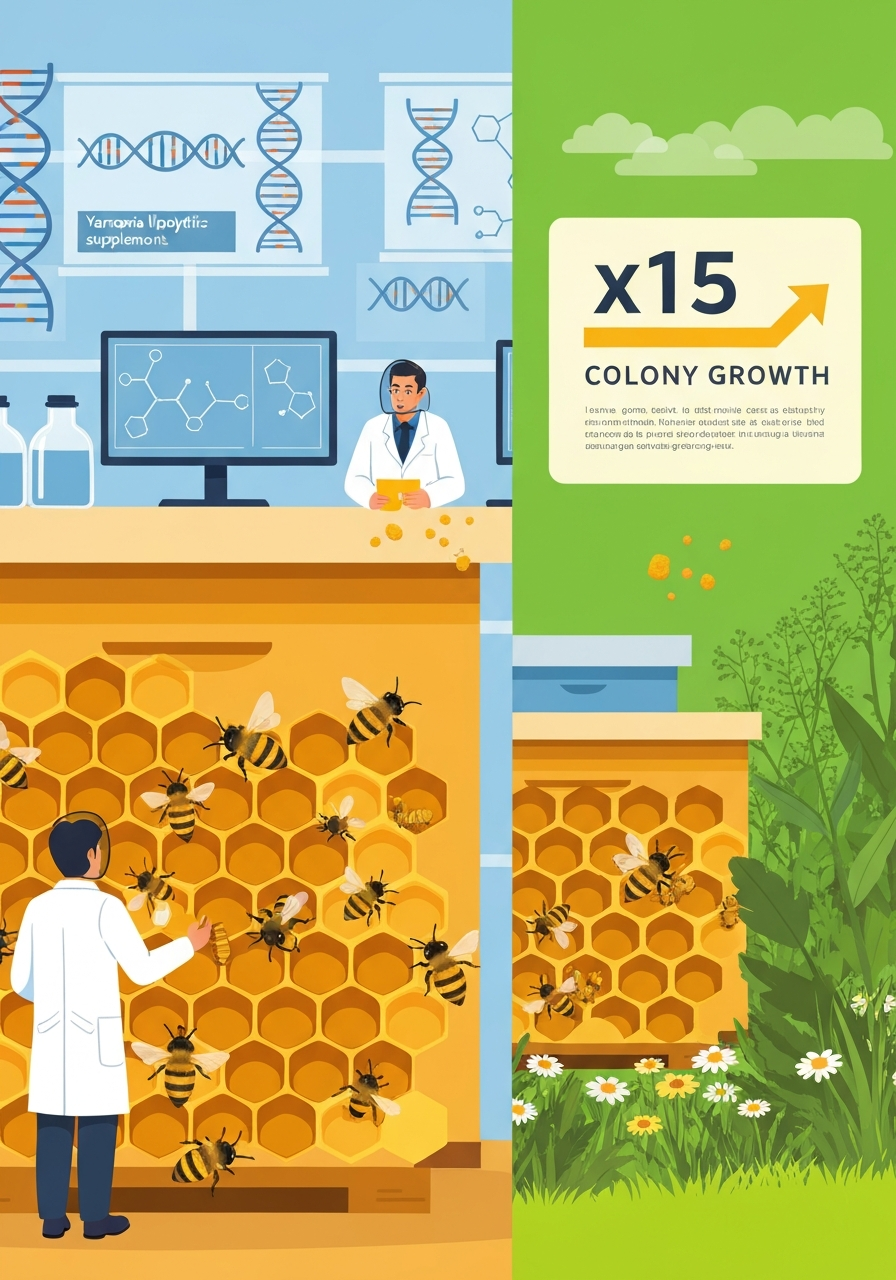
A research team from the University of Oxford and the University of Greenwich used CRISPR-Cas9 to genetically edit the industrial yeast Yarrowia lipolytica, programming it to produce six sterols essential for honeybees: 24-methylenecholesterol, campesterol, isofucosterol, beta-sitosterol, cholesterol, and desmosterol. Colonies fed this yeast supplement saw larvae reaching the pupal stage increase by up to 15 times compared to standard diets, and the nutritional profile of the larvae was nearly identical to bees fed natural pollen. Published in Nature in 2025, this study stands as a landmark case demonstrating that synthetic biology can directly intervene in ecosystem crises. At the same time, the very concept of replacing natural pollen with engineered alternatives carries a bitter irony — it testifies to just how severe the destruction of our ecosystems has become.
U.S. Managed Honeybee Colony Loss Hit 62% in 2024-2025 — The Worst on Record
From the summer of 2024 through spring 2025, 1.7 million managed honeybee colonies perished in the United States alone, with commercial beekeepers averaging a 62% loss rate. Some reported 70-100% losses — essentially total wipeouts — far exceeding the 15-year annual average of 40% and more than triple the 15-20% threshold that beekeepers consider manageable. USDA researchers identified the primary culprit as Varroa destructor mites that have acquired resistance mutations against the standard miticide amitraz. This crisis transcends the beekeeping industry: given that 75% of global crop production depends on pollinators, these numbers represent a ticking time bomb for worldwide food security.
The Economic Value of Pollination Services — Up to $577 Billion Annually
The economic value of ecosystem services provided by pollinators worldwide ranges from $195 billion to $577 billion annually, depending on the estimation methodology. If global pollinator populations were to collapse entirely, crop prices would surge by 30%, resulting in an estimated $729 billion in global welfare losses — equivalent to 0.9% of world GDP. Pollinator-dependent crops such as almonds, apples, cherries, blueberries, coffee, cocoa, and avocados are also major exports for low-income countries, meaning pollinator decline exacerbates global trade imbalances. With projected 8% reductions in vitamin A supply and other micronutrient deficiencies, this issue extends well beyond economics into a full-blown public health crisis.
Neonicotinoid Regulation — 200 Bills Across 30 States, Yet the Response Remains Too Slow
The EU has already imposed a blanket ban on three neonicotinoid insecticides, and in the United States, more than 200 pollinator-protection bills were introduced across over 30 states in 2025 alone. Vermont passed Act 182, prohibiting neonicotinoid-coated seeds and outdoor application, while California restricted sales of non-agricultural neonicotinoids to licensed operators only. However, these regulations will take years to show tangible results, and a unified federal-level framework remains conspicuously absent. The EPA suspended new outdoor-use approvals for neonicotinoids, but previously approved products continue to circulate freely, raising serious questions about enforcement effectiveness. Responses to the structural drivers — habitat destruction and climate change — are advancing even more slowly than pesticide regulation.
Feeding GMO Supplements to Wildlife — A New Ethical Frontier
Introducing genetically edited yeast into natural ecosystems opens an entirely new front in the GMO debate. Until now, GMO controversies have largely centered on crops and human food. This time, however, the proposition involves artificially engineering the diet of wild animals — a qualitatively different matter. Even synthetic biology pioneer Martin Beye has acknowledged that creating GMO bees would be a 'foolish idea,' arguing instead for transitioning to agricultural practices that don't harm bees in the first place. If colonies become dependent on yeast supplements and gradually lose the ability to survive on natural pollen alone, honeybees would effectively cease to be wild animals and become livestock tethered to human technology. That wouldn't be a triumph of science — it would be evidence that the fundamental relationship between nature and humanity has been irreversibly distorted.
Positive & Negative Analysis
Positive Aspects
- Immediate and Dramatic Improvement in Colony Survival
A 15-fold increase in larvae reaching the pupal stage is a result that dwarfs every existing honeybee supplement on the market. Current commercial supplements are composed of protein powder, sugar, and oils — completely lacking the sterol compounds that bees actually need. This engineered yeast supplement precisely replicates six critical sterols, delivering a nutritional profile virtually indistinguishable from natural pollen. Given the record-shattering 62% colony loss rate in the 2024-2025 season, the practical value of a solution that beekeepers can deploy immediately cannot be overstated.
- Realistic Pathway to Industrial-Scale Production
Yarrowia lipolytica is an industrial yeast originally optimized for lipid production, already deployed at scale in biofuel manufacturing and food additive production. This means existing fermentation infrastructure can be repurposed without building new facilities from the ground up. The yeast's established food-grade safety profile also lowers the regulatory approval barrier considerably. The transition from laboratory to field application could happen faster than almost any other synthetic biology project — commercial availability within 2-3 years is a realistic timeline.
- An Insurance Policy for Global Food Security
With projections of a 30% surge in crop prices and $729 billion in global welfare losses if pollinators collapse, this technology serves as an insurance policy against the worst-case scenario. For crops that are 100% pollinator-dependent — almonds being the textbook example — colony health directly determines industry survival. California's almond industry alone spends roughly $500 million annually on pollination services, and colony shortages drove rental fees up 30% in 2025 compared to the previous year. In the near term, this technology can meaningfully shore up critical vulnerabilities in the food supply chain.
- Proof of Concept for Synthetic Biology in Environmental Restoration
This research constitutes a proof of concept that synthetic biology can serve as a tool for reversing environmental destruction. Similar approaches could be applied to other ecosystem crises: editing heat-resistant algae for coral reef restoration, designing custom bacteria for soil microbiome recovery, and bolstering the genetic diversity of endangered species. The fact that UKRI (UK Research and Innovation) funded this work signals that governments are beginning to strategically support environmental applications of synthetic biology.
- A Scientific Leap Forward in Pollinator Research
The research process itself deepened our understanding of honeybee nutrition considerably. The discovery that six specific sterols are critical to bee development represents a foundational contribution to basic science, opening pathways to characterize the nutritional requirements of wild pollinators including bumblebees and solitary bees. If this work extends to the more than 20,000 species in the Apoidea superfamily, it could trigger a paradigm shift across the entire field of pollinator ecology.
Concerns
- The Dependency Paradox — Colonies That Can't Survive Without Engineered Yeast
There is a genuine risk that colonies dependent on yeast superfood will progressively lose their ability to survive on natural pollen alone. If beekeepers continuously supply this supplement, the colony's natural foraging behavior and immune system could weaken over time. The mechanism is analogous to how antibiotic overuse degrades the human immune system. In the long run, if honeybees can no longer survive without human technology, what we're witnessing is the domestication of a wild animal. Whether it is truly 'salvation' to make a species that has evolved independently for over 100 million years dependent on human technological infrastructure is a question that demands serious reflection.
- Root Cause Avoidance — The Danger of Repackaging First Aid as a Cure
The core drivers of honeybee decline are neonicotinoid pesticides, habitat destruction, climate change, and Varroa mite resistance. The yeast supplement addresses none of these causes — it merely alleviates symptoms. What is even more concerning is that such technological fixes can sap political will. When the narrative shifts to 'technology will fix it,' the political capital and funding that should flow toward pesticide regulation and habitat restoration can dry up. As the EU neonicotinoid ban and the 200 bills across 30 U.S. states demonstrate, regulatory solutions are already moving slowly. Add a technological shortcut to the mix, and they will move even slower.
- Ecological Risks of Releasing GMO Feed into the Environment
The possibility that genetically edited yeast escaping hives and spreading into natural ecosystems cannot be entirely ruled out. While some argue that the yeast would lack competitive fitness in natural environments, deploying it across billions of hives at industrial scale could trigger unpredictable ecological interactions. There are already documented cases of genetically edited crop pollen transferring to wild relatives. Given the inherent complexity of ecosystems, rushing to large-scale deployment without thorough long-term impact assessment would be reckless.
- Distortion of Beekeeping Economics and Marginalization of Small-Scale Operators
If the genetically edited yeast supplement is commercialized, large industrial beekeeping operations would adopt it readily, but small-scale beekeepers and operators in developing countries may find the cost prohibitive. American beekeepers are already under extreme financial strain from Varroa treatment costs and colony replacement expenses. Adding another technology input could deepen the polarization of the beekeeping industry. Considering that over 80% of the world's beekeepers are small-scale family operations, the benefits of this technology are likely to concentrate among a handful of industrial players.
- Diverting Attention from Wild Pollinators
This research focuses exclusively on managed honeybees, which risks marginalizing the crisis facing over 20,000 species of wild bees, butterflies, bats, and other pollinators. In many cases, wild pollinator populations are declining at rates even more alarming than managed honeybees, and some wild bee species are already on the brink of extinction. If the misconception spreads that saving honeybees alone resolves the pollination crisis, the comprehensive approach needed to preserve the entire pollination network of our ecosystems will be weakened.
Outlook
Let me start with what is likely to unfold in the next few months. This Nature paper was originally published in August 2025 and then received massive renewed attention when outlets like ScienceDaily picked it up again in March 2026. The response from both the academic community and the beekeeping industry has been swift and intense. My expectation is that by the first half of 2026, at least 3-5 major agricultural biotech companies will announce pilot programs evaluating the commercial viability of Yarrowia lipolytica-based honeybee supplements. The reasoning is straightforward — this yeast already has established large-scale cultivation infrastructure from its industrial applications, making the lab-to-field transition considerably faster than most synthetic biology projects.
The U.S. beekeeping industry will likely be the first mover, and for good reason. After recording the worst-ever colony loss rate of 62% in the 2024-2025 season, beekeepers are grasping at anything that might help. With the USDA officially tallying losses at $600 million, beekeeping trade organizations will almost certainly begin lobbying for expedited approval of this technology. Consider that California's almond industry alone spends $500 million annually on pollination services and saw rental fees spike 30% in 2025 due to colony shortages — the desperation is difficult to overstate. An application for pilot-use authorization with the FDA or EPA could realistically be filed by summer 2026.
But here is where the paradox kicks in. The faster this technology reaches the field, the weaker the political momentum for addressing root causes may become. In 2025, more than 200 pollinator-protection bills were introduced across over 30 U.S. states, many of them focused squarely on neonicotinoid regulation. If the yeast supplement gets wrapped in a 'we fixed the bee problem' narrative, the legislative energy behind those bills could dissipate. Frankly, this is the scenario that concerns me most. The moment technology substitutes for politics, the underlying causes get ignored and we lock ourselves into an endless loop of symptom management.
There is also the intellectual property dimension that will shape how quickly this technology spreads. The Oxford and Greenwich teams have almost certainly filed patent applications covering the specific sterol-producing gene cassettes inserted into Yarrowia lipolytica. This means that any company wanting to commercialize the supplement will need to negotiate licensing terms, and the structure of those agreements will determine whether the technology reaches small-scale beekeepers or remains a premium product for industrial operations. If the patents are licensed exclusively to one or two agribusiness giants, we could see a repeat of the Monsanto seed patent model — immensely powerful technology locked behind paywall economics. Conversely, if the universities adopt a public-benefit licensing framework, the supplement could become as accessible as generic veterinary medicine within a few years.
Looking at the medium term — roughly six months to two years out — full-scale field trials will get underway. The Oxford team's experiments were conducted under controlled conditions, so the central question is whether the 15-fold effect replicates in actual outdoor beekeeping environments. My estimate is that field performance will come in at roughly 50-70% of laboratory results, meaning a 7-10x increase in reproduction. That is still an extraordinary improvement over existing supplements. By mid-2027, field trial results should be published from at least five countries: the United States, the United Kingdom, Australia, New Zealand, and Canada.
The field trial phase will also reveal whether the supplement interacts with existing beekeeping treatments in unexpected ways. Most commercial beekeepers already apply multiple interventions: miticides for Varroa, antibiotics for foulbrood, and various pollen substitutes during dearth periods. The cumulative effect of stacking a gene-edited yeast supplement on top of this already complex chemical regimen is genuinely unknown. If interactions between the yeast sterols and miticide residues trigger adverse effects — reduced queen fecundity, altered worker behavior, or increased susceptibility to viral pathogens — the field trial results could look markedly different from laboratory outcomes.
The regulatory landscape will produce some fascinating dynamics. The EU maintains the world's most stringent GMO regulatory framework, which could mean a 3-5 year approval timeline for the yeast supplement. The European Food Safety Authority would need to conduct its own risk assessment, and the precautionary principle embedded in EU governance could slow the process further. The United States, by contrast, has a track record of relatively flexible treatment of gene-edited agricultural products through the USDA. If the supplement is classified as an animal feed additive rather than a GMO organism, the regulatory pathway could be significantly shorter. Australia and New Zealand, both of which relaxed their gene-editing regulations in 2024, are also positioned for comparatively fast approval. Under this trajectory, it is realistic to project that gene-edited yeast products could capture 10-15% of the global beekeeping supplement market by 2028.
The economic ripple effects through pollinator-dependent agriculture deserve quantification. The global beekeeping supplement market is currently valued at roughly $600-700 million annually. A gene-edited yeast product that demonstrably reduces colony losses could command premium pricing — perhaps $30-50 per colony per season — and rapidly grow the total addressable market to $1.5-2 billion. But the real economic story is in the downstream: if colony health improves enough to ease the pollination services shortage, almond rental prices could stabilize or decline by 15-20%, saving California growers alone $75-100 million annually. Similar savings would cascade through apple, cherry, and blueberry production across the northern hemisphere.
The ripple effects across the broader synthetic biology industry deserve close attention as well. If the honeybee yeast is successfully commercialized, environmental restoration applications of synthetic biology will likely proliferate rapidly. Editing heat-resistant symbiotic algae to combat coral bleaching, designing tailored bacteria for soil microbiome restoration, and enhancing the environmental adaptability of endangered plant species are all plausible follow-on projects. McKinsey projected the synthetic biology market at $30-40 billion by 2030, and my estimate is that environmental restoration could account for 15-20% of that total. The venture capital community is already paying attention — at least three SynBio-focused VC funds have flagged pollinator health as a priority thesis area for 2026 deployments.
Zooming out to the long-term horizon of two to five years, the truly fundamental questions surface. Will genetic divergence emerge between colonies that depend on yeast supplements and those that survive on natural pollen? Theoretically, selection pressure on natural foraging ability weakens in supplement-dependent colonies, meaning that over successive generations, their capacity to adapt to natural environments could deteriorate. Even 10-20 generations — which, given honeybee generation cycles, translates to roughly 3-5 years — could produce measurable behavioral and genetic differences. This is the classic pattern of domestication. Think about how dramatically cattle, pigs, and chickens have diverged from their wild ancestors.
There is a related concern that few are discussing yet: the potential for queen breeding programs to inadvertently select for supplement dependency. Commercial queen breeders already select for traits like gentleness, honey production, and Varroa resistance. If supplement-fed colonies consistently outperform natural-foraging colonies in production metrics — which is virtually guaranteed at 7-15x reproductive rates — breeders will preferentially propagate queens from supplemented stock. Within 5-10 years, the genetics of commercially available queen bees could shift toward genotypes that perform optimally with supplementation but poorly without it. This would create a structural lock-in effect that makes the beekeeping industry permanently dependent on the product.
The global south dimension is particularly underexplored. Africa, South America, and South Asia collectively host the majority of the world's wild bee diversity and support millions of small-scale beekeepers. These regions face pollinator crises driven by different vectors — deforestation in the Amazon, pesticide overuse on African smallholder farms, and climate-driven range shifts in the Himalayas. A gene-edited yeast supplement designed for the North American and European beekeeping context may be irrelevant to their needs, or worse, it may divert international conservation funding away from the habitat preservation and agricultural reform programs that would actually address their pollinator declines.
On a broader canvas, this technology adds another data point to the most consequential question of the 21st century: do we engineer nature, or do we step back and let it recover? It sits in the same conceptual space as geoengineering proposals to combat climate change, gene drive projects to eradicate malaria-carrying mosquitoes, and direct air capture (DAC) technology for deep decarbonization. Global investment in these 'technological nature intervention' projects is on track to exceed $50 billion annually by 2030, and the honeybee yeast will be at the vanguard. Each of these projects shares the same underlying wager: that human ingenuity can manage complexity at planetary scale. History offers mixed evidence on that bet. The Green Revolution averted famine but created nitrogen runoff crises; antibiotics conquered bacterial infection but bred superbugs. The question is not whether the honeybee yeast will work, but whether we can deploy it without repeating the pattern of solving one problem while seeding the next.
Let me lay out some scenario analysis. In the bull case, the yeast supplement achieves commercial availability in major beekeeping nations by 2028, and colony loss rates stabilize below 40%. Simultaneously, the technology's success builds public trust in synthetic biology, creating a synergy effect that actually accelerates neonicotinoid regulation and habitat restoration policies. The supplement transitions from 'emergency first aid' to 'a therapeutic supplement supporting the healing process,' with root-cause solutions and technological support advancing in parallel. Venture capital floods into related environmental SynBio projects, and by 2030 we see gene-edited solutions for at least three additional pollinator species. I would assign roughly a 20% probability to this outcome.
The base case sees commercial rollout in the U.S., U.K., and Australia by 2028-2029, but regulatory hurdles delay EU and Asian market entry until 2030 or later. Colony loss rates improve to the 45-50% range, easing the financial burden on beekeepers somewhat, but wild pollinator populations continue to decline. Neonicotinoid regulations tighten incrementally, but habitat restoration falls 30-40% short of targets due to budget constraints. The yeast supplement proves useful but not miraculous — one tool in the pollinator crisis response toolkit rather than a silver bullet. Most small-scale beekeepers globally cannot afford it, creating a two-tier beekeeping economy where industrial operations stabilize while family operations continue to suffer attrition. I put this scenario at about 55% probability.
In the bear case, field trials fail to replicate laboratory-scale results, or unexpected side effects emerge. For instance, colonies fed the supplement might show reduced immunity to specific pathogens, or the yeast could disrupt the microbial ecosystem inside the hive in ways that increase susceptibility to Nosema or chronic bee paralysis virus. Concurrently, anti-GMO movements brand the technology as 'Franken-feed,' triggering public backlash that stalls regulatory approval indefinitely. The patent holders become embroiled in litigation that delays commercialization by years. Meanwhile, colony losses continue unabated, and further resistance evolution in Varroa mites triggers another mass die-off event in 2027-2028, pushing the U.S. colony loss rate above 70%. I estimate this scenario at roughly 25% probability.
Regardless of which scenario materializes, one thing is unambiguous. The very situation in which we find ourselves — having to feed genetically edited yeast to honeybees — is itself proof of how far humanity has strayed from a sustainable relationship with nature. This is not an argument for rejecting the technology. If it can save colonies that are in immediate danger, then by all means, use it. But it cannot be the end of the conversation.
The yeast supplement is the epinephrine administered to a heart attack patient — it is not a cure for heart disease. If you keep taking epinephrine shots while refusing to change your diet, the next cardiac event is just a matter of time. Strengthening pesticide regulation, restoring habitats, and transforming our monoculture-dominated agricultural paradigm — those are the real prescriptions. Here is what I would recommend watching: if, by late 2027, the U.S. has approved commercial use of the supplement but has not passed a single new federal-level neonicotinoid restriction, we will know that the technological fix has indeed substituted for political action. When you revisit this piece in 2028, check whether the yeast supplement remained mere 'first aid' or became a 'stepping stone toward fundamental treatment.' The answer will reveal whether humanity has the capacity to reset its relationship with the natural world.
Sources / References
- Engineered yeast provides rare but essential pollen sterols for honeybees — Nature
- Scientists uncovered the nutrients bees were missing — Colonies surged 15-fold — ScienceDaily
- Saving bees with superfoods: new engineered supplement found to boost colony reproduction — University of Oxford
- Engineered superfood boosts bee colony growth — UK Research and Innovation (UKRI)
- U.S. Beekeeping Survey reveals highest honey bee colony losses during 2024-2025 — Auburn University
- Bee Apocalypse: U.S. Beekeepers Report 70-100% Colony Collapse in 2025 — YourNEWS
- Harnessing biotechnology for bee pollinator health — Trends in Biotechnology
- EPA Actions to Protect Pollinators — U.S. Environmental Protection Agency
- Pollinator declines, international trade and global food security: Reassessing the global economic and nutritional impacts — Ecological Economics
- USDA Researchers Find Viruses from Miticide Resistant Parasitic Mites are Cause of Recent Honey Bee Colony Collapses — USDA Agricultural Research Service
- Assessment Report on Pollinators, Pollination and Food Production — IPBES (Intergovernmental Science-Policy Platform on Biodiversity and Ecosystem Services)
- Pollinator Week 2025: The Change May Be in Your Backyard — National Caucus of Environmental Legislators (NCEL)
- The use of experimentally evolved coral photosymbionts for reef restoration — Trends in Microbiology
- New Data Confirm Catastrophic Honey Bee Colony Losses, Underscoring Urgent Need for Action — Honey Bee Health Coalition
- Bill Status H.706 (Act 182) - Pollinator Protection Act — Vermont Legislature