
The Y Chromosome Is Vanishing From the Blood of Half of All Men Over 60 — And It Might Explain Why Men Die Younger
Summary
The quiet disappearance of the Y chromosome from men's blood cells is emerging as a massive puzzle connecting heart disease, cancer, and Alzheimer's. What was dismissed for decades as a harmless aging artifact may hold the key to the longevity gap between men and women.
Key Points
Y Chromosome Loss Affects 40% of Men by Age 60
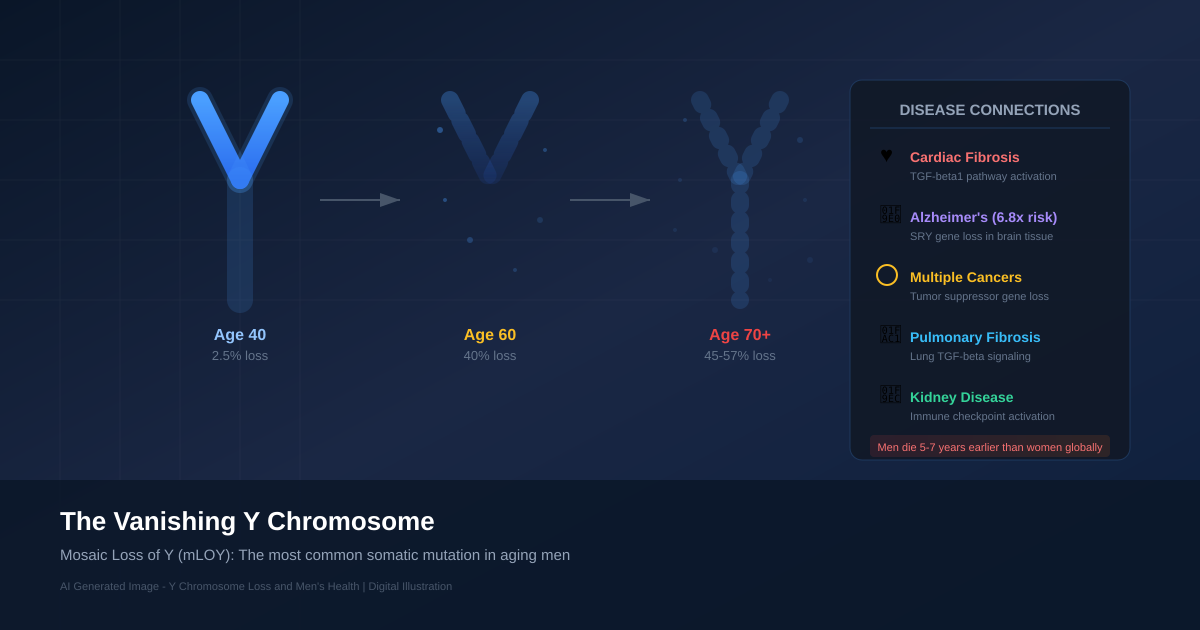
Mosaic loss of Y (mLOY) is the most common somatic mutation in humans, first discovered in 1963 but dismissed as harmless for nearly 60 years. It progresses from 2.5% prevalence at age 40 to 40% at 60, 45% at 70, and 57% above age 93. The 2022 breakthrough study in Science by the University of Virginia team shattered the old consensus by demonstrating that Y chromosome loss directly causes cardiac fibrosis and reduces lifespan in mice.
TGF-beta1 Pathway Drives Cardiac and Pulmonary Fibrosis
Macrophages that lose the Y chromosome overproduce TGF-beta1, a pro-fibrotic signal that triggers excess collagen production by cardiac fibroblasts. A 2025 study identified RPS5 as a key mediator. Y chromosome loss exceeding 17% is associated with significantly higher all-cause and cardiovascular mortality. The same mechanism drives pulmonary fibrosis through enhanced TGF-beta signaling in lung-infiltrating leukocytes.
Alzheimer's Risk Increases 6.8-Fold
Men with blood cell Y chromosome loss face a 6.8-fold increase in Alzheimer's risk, a multiplier comparable to smoking and lung cancer. The Y chromosome's SRY gene remains active in the brain. Bladder, prostate, and colorectal cancers also show frequent Y chromosome loss with worse survival outcomes. Through clonal hematopoiesis, Y-deficient stem cells expand abnormally, elevating risks of leukemia.
TGF-beta1 Neutralizing Antibody Shows Treatment Promise
In the University of Virginia mouse experiments, TGF-beta1 neutralizing antibody administration significantly reduced cardiac fibrosis caused by Y chromosome loss. Drugs targeting the TGF-beta pathway are already in development for pulmonary fibrosis, enabling potential clinical application through drug repurposing. However, human clinical trials have not yet commenced.
A Next-Generation Biomarker for Multi-Disease Prediction
A routine blood test measuring Y chromosome loss could predict risk for heart disease, cancer, and Alzheimer's years before symptoms appear. Smoking accelerates Y chromosome loss while regular exercise may slow it. However, standardized measurement methods and clinically meaningful thresholds have yet to be established.
Positive & Negative Analysis
Positive Aspects
- Biological Explanation for the Male Longevity Gap
The discovery that Y chromosome loss directly connects to heart disease, cancer, and dementia provides the first unified biological mechanism for why men globally die 5 to 7 years earlier than women. This molecular-level understanding enables fundamentally more precise medical interventions.
- Treatable Drug Targets Already Identified
The successful reduction of cardiac fibrosis through TGF-beta1 neutralizing antibodies in animal models means pharmaceutical intervention is possible even after Y chromosome loss. The drug repurposing pathway offers a relatively expedited route to clinical application.
- Revolutionary Biomarker Potential
The ability to predict risk for heart disease, cancer, and Alzheimer's from a single blood test years before symptom onset would be transformative for preventive medicine, offering superior cost efficiency.
- New Scientific Basis for Lifestyle Interventions
Smoking accelerates Y chromosome loss, extending the motivation for quitting beyond lung cancer prevention to chromosomal protection. Exercise and healthy diets are linked to slower loss rates.
- Foundation for Sex-Specific Medicine
Y chromosome loss as a uniquely male disease pathway provides scientific justification for sex-specific medical approaches, addressing a systematic blind spot in male-specific health vulnerabilities.
Concerns
- Long Road from Animal Models to Human Application
The cardiac protective effects of TGF-beta1 neutralizing antibodies have only been demonstrated in mice. The timeline from clinical trial design to regulatory approval is estimated at a minimum of 5 to 10 years.
- Biomarker Standardization Challenges
No standardized method for quantitatively measuring Y chromosome loss has been established. Validation across different racial and ethnic populations is needed.
- Ethical Debates Around Sex-Based Medicine
Male-specific screening will raise equity concerns about healthcare resource allocation. Insurance companies seeking to use Y chromosome loss data could create genetic discrimination issues.
- Risk of Overinterpretation and Unnecessary Anxiety
Over 40% of men above 60 experience Y chromosome loss, but not all develop disease. Sensationalized media coverage risks driving overdiagnosis and overtreatment.
- Complex Interactions with Other Age-Related Mutations
Y chromosome loss interacts in complex ways with mutations in genes like DNMT3A, TET2, and ASXL1. Isolating it as an independent risk factor may prove difficult.
Outlook
Right now, across the globe, hundreds of millions of middle-aged and older men are experiencing the silent erasure of the Y chromosome from their blood cells. As the recognition solidifies that this is not merely an aging curiosity but a central pathway to heart disease, cancer, and dementia, the paradigm for men's health is poised for a fundamental transformation.
In the near term, over the next 6 months to 2 years, expect an acceleration of research infrastructure and diagnostic tool development. NIH funding for Y chromosome loss research has approximately tripled since 2020, and the EU Horizon Europe program is sponsoring large-scale cohort studies. Most significantly, analyses of UK Biobank data from 500,000 participants on the mLOY-disease association are expected to publish major results in the second half of 2026. If these results firmly establish causation beyond the current correlation evidence, diagnostic development will gain serious momentum. Pilot programs for transitioning next-generation sequencing-based Y chromosome loss quantification from research use to clinical application are likely to launch in the United States and Sweden. Uppsala University in Sweden, a world leader in this field, is already tracking Y chromosome loss in large prospective cohorts.
Over the medium term, 2 to 5 years out, two critical milestones are anticipated. First, Phase 1/2 human clinical trials of TGF-beta1 neutralizing antibodies or similar compounds for the specific indication of preventing male cardiac fibrosis should begin. Several TGF-beta targeting drugs currently in development for pulmonary fibrosis are well positioned to expand their clinical trial protocols to include this new indication. Their existing safety data should lower the regulatory approval barrier. Second, clinical threshold values for the Y chromosome loss biomarker will begin to be established. While the 17% cutoff is currently the strongest candidate, refined tables accounting for age, ethnicity, and other variables will be developed. Japan and South Korea, both experiencing rapid population aging with surging populations of men over 65, are likely to become active participants in clinical research, driven by strong national interest in cardiovascular disease and dementia prevention.
In the long term, beyond 5 years, Y chromosome loss testing has a realistic chance of becoming a standard screening component for men over 60. This would represent a paradigm shift comparable to the introduction of PSA testing for prostate cancer screening. However, just as PSA has been plagued by overdiagnosis controversies, Y chromosome loss testing will face prolonged debates about intervention thresholds. In the bull case scenario, TGF-beta1 targeted therapy gains approval around 2030, establishing a "male cardiac protection protocol" for high-risk men with confirmed Y chromosome loss. This could narrow the male-female life expectancy gap by 2 to 3 years.
In the base case scenario, Y chromosome loss screening is adopted but therapeutic development lags, limiting clinical response to risk awareness and lifestyle intervention. Smoking cessation, exercise, and weight management receive a powerful new scientific framing as "Y chromosome protection strategies," providing fresh motivation for men's health behavior change. Even in this scenario, early detection enables aggressive monitoring that allows earlier intervention against heart disease and dementia, yielding significant health benefits.
In the bear case scenario, the causal relationship between Y chromosome loss and disease proves more complex than hoped, with interactions among various clonal hematopoiesis mutations requiring more than a decade to untangle. Drug development stalls in the "valley of death" between animal models and human application, and biomarker standardization encounters persistent obstacles. Even in this scenario, the scientific consensus that Y chromosome loss is a key indicator of men's health will endure, but practical clinical implementation gets pushed beyond 2035.
Regardless of which scenario materializes, one thing is certain: the scientific perception of the Y chromosome has undergone an irreversible transformation. From "degenerating useless chromosome" to "sentinel of men's health," the rediscovery of the Y chromosome will be recorded as one of the most unexpected plot twists in 21st-century medicine. One small chromosome, ignored for 60 years, is redrawing the map of male medicine.
Sources / References
- Men are losing a key chromosome with age and it may be deadly — ScienceDaily
- Hematopoietic loss of Y chromosome leads to cardiac fibrosis and heart failure mortality — Science
- Somatic loss of the Y chromosome complements polygenic risk scores for type 2 diabetes risk prediction — Nature Medicine
- Hematopoietic loss of Y chromosome activates immune checkpoints and contributes to impaired senescent cell clearance and renal disease — Science Translational Medicine
- A complex systems approach to mosaic loss of the Y chromosome — PMC / Nature Reviews Genetics
- Loss of Y chromosome: An emerging next-generation biomarker for disease prediction and early detection? — Mutation Research - Reviews in Mutation Research
- Mosaic loss of Y chromosome and mortality after coronary angiography — European Heart Journal