
A Secret Factory Was Hiding Inside the Cell Nucleus — Why the Discovery of 200+ Metabolic Enzymes Working on DNA Could Completely Upend Cancer Treatment
Summary
Energy-producing enzymes have been found sitting directly on DNA rather than in mitochondria, forming a nuclear metabolic fingerprint. This discovery could be the key to understanding why each cancer grows differently and responds to the same drugs in vastly different ways.
Key Points
Over 200 Metabolic Enzymes Discovered Inside the Cell Nucleus
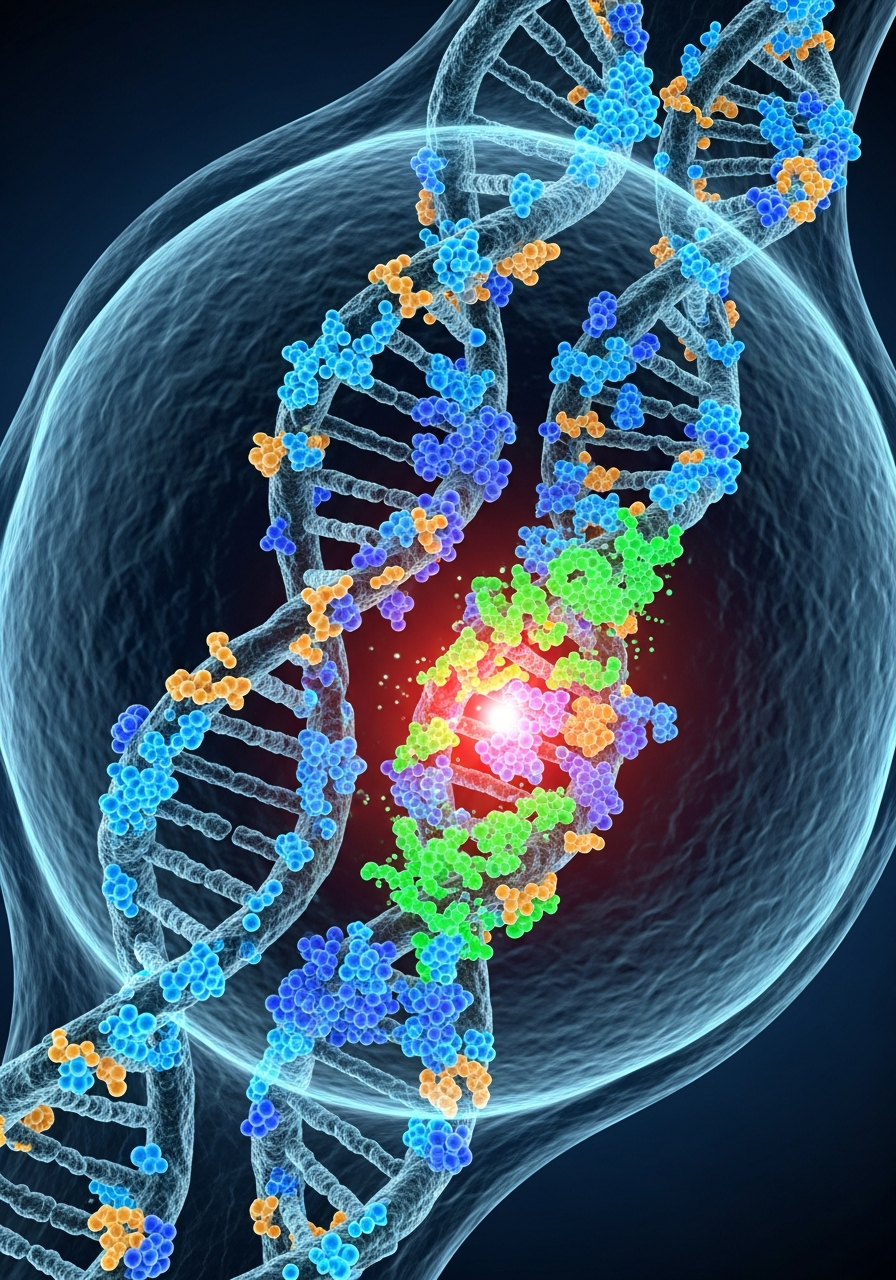
A study published in Nature Communications revealed that approximately 7% of all proteins physically attached to chromatin are metabolic enzymes. Using native chromatome profiling across 44 cancer cell lines and 10 healthy cell types, researchers identified over 200 enzyme species involved in core metabolic pathways including oxidative phosphorylation, glycolysis, and nucleotide synthesis actively working on DNA. This constitutes the first large-scale evidence that enzymes conventionally expected only in mitochondria or cytoplasm also function within the nucleus, demanding a fundamental reassessment of cellular compartmentalization models.
Cancer-Type-Specific Nuclear Metabolic Fingerprints
Each cancer type displays a unique pattern of nuclear metabolic enzyme arrangement, which researchers termed the nuclear metabolic fingerprint. Oxidative phosphorylation enzymes were abundantly attached to chromatin in breast cancer cells but largely absent in lung cancer cells. This difference provides a new clue explaining the dramatically different responses patients show to the same chemotherapy drugs. The nuclear metabolic fingerprint could become a new diagnostic biomarker dimension added to existing genomic profiling, forming a new axis for precision medicine with the potential to enable truly personalized treatment prescriptions.
Direct Connection Between DNA Damage Repair and Metabolic Enzymes
The research team experimentally demonstrated that enzymes involved in nucleotide synthesis cluster around chromatin when DNA damage occurs, helping repair the genome. This provides strong evidence that nuclear metabolic enzymes are not accidental visitors but strategically positioned for specific functions. Existing DNA repair-targeting therapies like PARP inhibitors may need reinterpretation in light of this discovery, with potential implications for the approximately 8 billion dollar annual PARP inhibitor market and new treatment strategies for patients currently resistant to these drugs.
Physical Integration of Metabolism and Gene Regulation — A Paradigm Shift
This discovery demonstrates that metabolism and gene regulation physically interact in the same space, transforming the existing unidirectional model of metabolism to epigenome to gene expression into a bidirectional feedback model where metabolism, chromatin, and gene expression cycle together. While the epigenetics field had established that metabolites like S-adenosylmethionine and acetyl-CoA affect chromatin modifications, the finding that the enzymes themselves reside in the nucleus producing these metabolites on-site represents an entirely new dimension. The conceptual framework presented in Nature Metabolism review papers now has experimental backing.
Possibility of a Semi-Autonomous Nuclear Metabolic Network
The over 200 species of metabolic enzymes attached to chromatin represent sufficient scale to constitute a complete metabolic network, which researchers call mini metabolism. This suggests the nucleus may not be a simple genetic information repository but a semi-autonomous compartment capable of making its own metabolic decisions. Just as mitochondria were once independent organisms that became symbiotic, the nucleus may maintain its own metabolic autonomy. This perspective has implications extending beyond cancer research into aging biology, stem cell research, and regenerative medicine.
Positive & Negative Analysis
Positive Aspects
- New biomarker dimension for cancer diagnostics
Adding nuclear metabolic fingerprints to existing genomic profiling enables finer classification of cancer subtypes previously indistinguishable. Massachusetts General Hospital research shows metabolic biomarker-based patient stratification can improve treatment response prediction accuracy by 15 to 25 percent. This accelerates realization of precision medicine by reducing unnecessary treatment attempts and prescribing optimal drug combinations per patient.
- Cancer-specific nuclear enzyme drug targets
Drugs can be designed to selectively inhibit nuclear metabolic enzymes specific to particular cancer types. While existing metabolic-targeting drugs attack metabolism indiscriminately across normal and cancer cells causing severe side effects, nuclear metabolic fingerprint-based approaches target enzyme patterns existing only in cancer cell nuclei, minimizing normal tissue damage. This provides a structural solution to the longstanding problem of chemotherapy side effects.
- New layer of DNA repair mechanism understanding
The phenomenon of nucleotide synthesis enzymes clustering around DNA damage sites provides new understanding of how cells maintain genomic integrity. Existing drugs like PARP inhibitors may be reinterpreted, potentially opening new treatment strategies for currently resistant patient populations. The approximately 8 billion dollar PARP inhibitor market could see significant shifts.
- Cell biology paradigm transformation
The physical integration of metabolism and gene regulation transforms the existing unidirectional model into a bidirectional feedback model. This fundamental reinterpretation will have ripple effects beyond cancer into aging, metabolic diseases, and neurodegenerative disorder research. Combined with AI-based metabolomics analysis, subtle patterns invisible to human eyes can be discovered to improve diagnostic precision.
- Liquid biopsy market expansion potential
If traces of nuclear metabolic profiles can be detected from circulating tumor cells or ctDNA in blood, non-invasive cancer diagnostic precision rises by an entire level. The global liquid biopsy market stands at approximately 12 billion dollars as of 2025, growing over 15 percent annually. Adding nuclear metabolic fingerprints as a new diagnostic axis would further accelerate market expansion.
Concerns
- Cell line-based research limitations
While 44 cancer cell lines and 10 healthy cell types are impressive, cell lines cultured for decades develop characteristics diverging from actual tumors. Verification in actual patient tumor tissue and analysis of tumor microenvironment effects have not yet been conducted. The reality that in vitro discoveries typically require 10 to 15 years for clinical translation must be factored in.
- Unverified stability and reproducibility
For biomarker use, nuclear metabolic profiles must remain consistent over time within the same patient and be reproducible across laboratories. The native chromatome profiling technique itself is not yet standardized, limiting inter-study comparability. Without large-scale multi-center validation, this could remain at the basic science level.
- Unresolved causation directionality
Whether the nuclear presence of metabolic enzymes is a cause or consequence of cancer remains unclear. Abnormally rapid cancer cell division may simply increase DNA repair demand, recruiting enzymes to the nucleus as a result. Without establishing cause-and-effect directionality, treatment strategies based on this finding might address symptoms rather than root causes.
- Pharmaceutical pipeline conflicts
For companies developing metabolic-targeting drugs and DNA repair inhibitors separately, the news that these are connected inside the nucleus may require reconsidering clinical trial designs and reinterpreting marketed drug mechanisms. When scientific progress collides with industrial inertia, the timeline to patient benefit can extend.
- Academic overhype risk
While the secret factory framing captures public attention, the distance from basic science paradigm shift to patient bedside is far greater than most imagine. Excessive expectation-setting can lead to undervaluation of subsequent incremental research achievements and negatively affect research funding allocation.
Outlook
Thinking about the trajectory this discovery will follow, the first thing to happen will be replication experiments in laboratories worldwide. Within the next 6 months to a year, other research groups will publish papers either performing their own native chromatome profiling or using modified methodologies to verify the existence of nuclear metabolic enzymes. The critical test at this stage is validation in actual patient tissue rather than cell lines. If unique nuclear metabolic fingerprints are confirmed in primary tumors and metastatic tumors alike, this field will explode in growth. Conversely, if the phenomenon is observed only in cell lines, it will remain an interesting basic science finding. I assign roughly 70 percent probability to the former scenario, because the epigenetics field has already established that metabolites affect chromatin, and this study illuminates the supplier side of that mechanism, giving it strong logical coherence.
In the medium term, within 1 to 3 years, development of nuclear metabolic fingerprint-based cancer diagnostic tools will likely begin. Liquid biopsy technology is advancing rapidly, and if traces of nuclear metabolic profiles can be detected from circulating tumor cells or circulating tumor DNA in the blood, the precision of non-invasive cancer diagnostics could be elevated by an entire level. As of 2025, the global liquid biopsy market stands at approximately 12 billion dollars and is growing at over 15 percent annually. If nuclear metabolic fingerprints add a new diagnostic axis to this market, the market size will expand even faster. On the drug development front, screening for novel drug candidates targeting nuclear-specific metabolic enzymes will also begin. Just as PARP inhibitors revolutionized treatment for triple-negative breast cancer and ovarian cancer by targeting DNA repair mechanisms, nuclear metabolic enzyme inhibitors could create an entirely new therapeutic category.
Looking at the long term, 3 to 5 years and beyond, three scenarios can be outlined. In the bull case, nuclear metabolic fingerprints become a standard tool in cancer diagnosis and treatment. Analyzing a patient tumor for its nuclear metabolic profile and prescribing customized drug combinations matched to that profile — nuclear metabolic precision medicine — becomes reality. In this scenario, cancer treatment response rates could improve from the current 20 to 30 percent to over 50 percent, with dramatic reductions in unnecessary treatment side effects and wasted medical expenditures. In the base case, nuclear metabolic fingerprints gain recognition as a research tool and are used as supplementary biomarkers for a few specific cancer types. They do not develop into universal diagnostic tools, but they deepen understanding of the metabolism-epigenetics connection and indirectly contribute to new treatment development. In the bear case, the existence of nuclear metabolic enzymes is confirmed, but they prove to be consequences rather than causes of cancer, with limited therapeutic value. Standardization difficulties create reproducibility problems, and the clinical utility of nuclear metabolic fingerprints is never demonstrated, remaining confined to academic curiosity.
The scenario I consider most likely falls somewhere between the base case and the bull case. Nuclear metabolism research will not revolutionize cancer treatment overnight, but the paradigm of physical connection between metabolism and gene regulation will firmly establish itself. On top of this paradigm, incremental but meaningful progress will unfold over 5 to 10 years. The application of AI and machine learning to analyze large-scale nuclear metabolic profiling data will be particularly impactful, discovering subtle patterns that human eyes cannot catch and improving diagnostic precision. The fact that AI-based metabolomics analysis papers have increased by over 40 percent year-over-year as of 2026 suggests this convergence is already underway.
One final word for readers: the true value of this discovery lies not in the short-term promise of a new cancer treatment is coming soon, but in the fact that the very way we understand cells is changing. The nucleus is not a simple genetic information warehouse — it is a semi-autonomous world operating its own metabolic network. The ripple effects of this perspective shift will extend beyond cancer research into aging biology, stem cell research, and regenerative medicine. The richest harvests in science have always started from discoveries that change the question itself. The nuclear metabolic fingerprint is that kind of discovery.
Sources / References
- Native chromatome profiling reveals hundreds of metabolic enzymes in the nucleus across tissues — Nature Communications
- Hidden metabolism found operating inside the cell nucleus — ScienceDaily
- Cancer has a unique nuclear metabolic fingerprint, researchers discover — MedicalXpress
- Research reveals nuclear metabolic fingerprint in human cells — News-Medical
- First Evidence Of Nuclear Metabolic Enzymes — BioTechniques
- Nuclear metabolism and the regulation of the epigenome — Nature Metabolism
- The emerging intertwined activities of metabolism and epigenetics unveils culprits and prospects in cancer — Experimental & Molecular Medicine