
The Planet Stopped Crawling and Started Sprinting — What a Doubled Warming Rate Actually Means
Summary
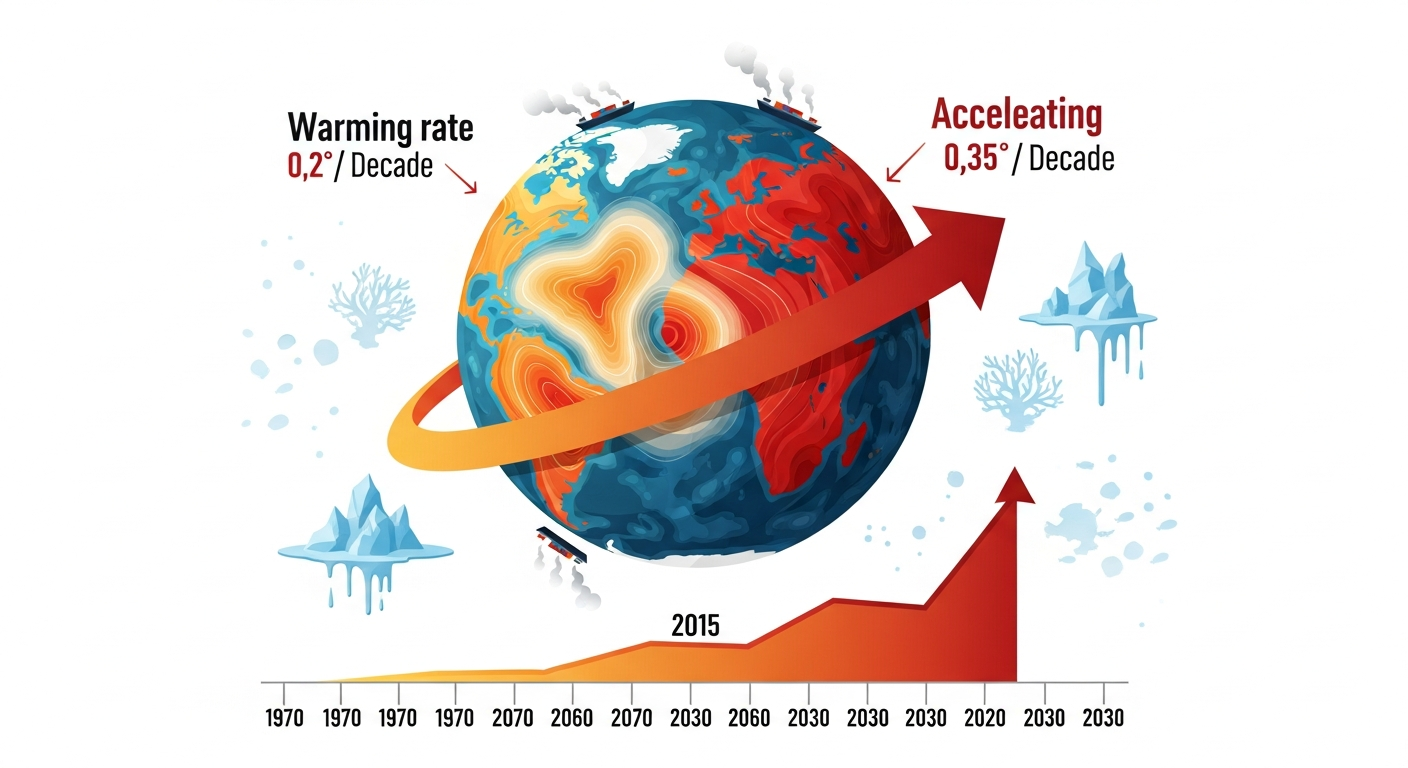
Statistical analysis has confirmed for the first time that Earth's warming rate has nearly doubled since 2015, from 0.2 to 0.35 degrees per decade, with 98% confidence across five global datasets. The Paris Agreement's 1.5-degree threshold could be breached before 2030.
Key Points
Warming rate nearly doubled since 2015, confirmed at 98% confidence
Stefan Rahmstorf of Germany's Potsdam Institute for Climate Impact Research and statistician Grant Foster published a paper in Geophysical Research Letters confirming that after removing natural variability from El Nino, volcanic eruptions, and solar cycles, Earth's heating rate jumped from about 0.2 degrees per decade to roughly 0.35 degrees per decade since 2015. This result held across all five major global temperature datasets — NASA, NOAA, HadCRUT, Berkeley Earth, and ERA5 — with over 98% confidence.
Shipping fuel regulations paradoxically accelerated warming
The International Maritime Organization's 2020 mandate to cut sulfur content of shipping fuel by 80% was correct for air quality, but sulfur dioxide aerosols had been reflecting sunlight and brightening clouds, creating a cooling effect that partially masked greenhouse warming. Removing this dirty umbrella exposed the full force of greenhouse effects. Research in Nature found that this could double the warming rate of the 2020s compared to the post-1980 baseline.
1.5-degree threshold projected to break before 2030
If the 0.35 degrees per decade acceleration persists, there is a very high probability that the 1.5-degree threshold will be breached before 2030. With 2025 global average temperature already reaching 1.47 degrees above pre-industrial levels according to Copernicus observations, the breach is no longer a question of if but when. The remaining carbon budget of approximately 130 billion tonnes gets burned through in just over three years at current emission rates.
Positive feedback loops and cascading tipping point risks
Arctic sea ice melt exposes dark ocean water that absorbs more solar heat, while permafrost thaw releases trapped methane, creating self-reinforcing warming spirals. A 2022 Science study found that even within the 1.5 to 2-degree range, at least six climate tipping points become likely to trigger. Current assessments put the probability of triggering at least one of sixteen major tipping elements at 62%, with nine individually exceeding 50% probability.
Renewable energy transition outpacing expert forecasts
Global solar capacity in 2025 tripled compared to 2020, and combined with wind, renewables accounted for more than half of all new power generation. China has entered a coal consumption decline trajectory, and the EU has begun internalizing carbon costs through its Carbon Border Adjustment Mechanism. Technologies like Direct Air Capture, next-generation nuclear, and green hydrogen are moving from concept to pilot and commercialization phases.
Political headwinds and the moral urgency of climate justice
Follow-up support for the IRA in the US has grown uncertain, fossil fuel lobbying remains formidable, and energy cost backlash has triggered climate policy rollbacks in Europe. Meanwhile, the costs of accelerated warming fall first and heaviest on those who contributed least to emissions — Sub-Saharan Africa, South Asia, and small island developing states. From a climate justice perspective, this acceleration is not merely a scientific finding but a moral emergency.
Positive & Negative Analysis
Positive Aspects
- Renewable energy transition outpacing expert predictions
Global solar capacity in 2025 tripled compared to 2020, and combined with wind, renewables accounted for more than half of all new power generation. China has entered a coal consumption decline trajectory, and the EU has begun internalizing carbon costs through its Carbon Border Adjustment Mechanism (CBAM). The economic reality that solar is already cheaper than fossil fuels in many regions is accelerating the transition beyond policy mandates alone.
- Climate science precision has matured into a powerful policy tool
As Foster and Rahmstorf's work demonstrates, the techniques to isolate natural variability and extract the purely anthropogenic warming signal have matured. Confirming acceleration at 98% confidence means the excuse of we don't know yet has expired. When the data is unambiguous, the defense of uncertainty collapses and pressure to act intensifies. This level of scientific certainty removes the justification for policy inaction.
- International climate governance density has reached a fundamentally different level
COP30 in 2025 discussed a concrete target of 60% greenhouse gas reduction by 2035, and the Global Methane Pledge now counts over 150 signatory nations. While the pace is insufficient and commitments imperfect, the institutional density of climate governance has reached a fundamentally different level compared to a decade ago. Mechanisms like the EU's CBAM that internalize carbon costs into trade systems structurally incentivize emissions reduction.
- Technology innovation pipeline moving from concept to commercialization
Direct Air Capture (DAC), next-generation nuclear (SMR), green hydrogen, and long-duration energy storage were at the concept stage in the early 2020s. Now they are moving into pilot and commercialization phases. While getting these technologies down the cost curve to solar-competitive levels will take time, the barrier of technical impossibility has been cleared. DAC technology costs are projected to fall below 200 dollars per tonne by 2030.
Concerns
- Current NDC trajectories heading toward 2.6 to 2.7 degrees of warming
Current national policies and NDC commitments taken together put the world on a path toward 2.6 to 2.7 degrees of warming. The gap between 1.5 and 2.6 degrees is only 1.1 degrees on paper, but compressed within that gap are the survival or extinction of coral reefs, meters of sea level difference, and whether hundreds of millions become climate refugees. The divergence between Paris Agreement goals and reality is growing increasingly severe.
- Aerosol paradox reveals a fundamental dilemma in climate policy
Reducing air pollution is something we must do for public health, but in doing so we unmask the full scale of greenhouse warming — effectively admitting we have been living atop a bizarre equilibrium where the side effects of dirty energy partially cancelled out other side effects. Acknowledging this is uncomfortable but essential, because it means future reduction targets need to be far more aggressive than previously estimated.
- Positive feedback loops remain incompletely incorporated into current models
The volume of methane released by permafrost thaw, the rate at which ocean carbon absorption declines, and the direction and magnitude of cloud feedbacks remain incompletely incorporated into current models. This means current projections may actually be optimistic. We need to reckon with the uncomfortable possibility that 0.35 degrees per decade is not the worst case — it might be the middle scenario.
- Political headwinds blocking translation of scientific consensus into action
In the United States, follow-up support for the IRA has grown uncertain, and fossil fuel industry lobbying remains formidable. In Europe, backlash against rising energy costs has triggered climate policy rollbacks in several countries. No matter how clear the science becomes, translating scientific consensus into political action still encounters enormous friction.
- Disproportionate impact on developing nations and the climate justice crisis
The costs of accelerated warming fall first and heaviest on those who contributed least to emissions. Sub-Saharan Africa, South Asia, and small island developing states possess the least adaptive capacity while facing the most extreme climate impacts. From a climate justice perspective, this acceleration is not merely a scientific finding — it is a moral emergency.
Outlook
In the short term (1 to 6 months), this study will reshape the framing of climate policy discussions. As countries prepare their NDC updates in the second half of 2026, this data will serve as a critical reference point. The argument that current pathways are sufficient will lose significant ground, particularly in the run-up to COP31 in November 2026. The IPCC's Seventh Assessment Report (AR7) is also likely to incorporate this acceleration trend, potentially triggering a comprehensive reassessment of existing scenarios.
If the 0.35 degrees per decade acceleration persists over the next five years — and no mechanism to reverse it is currently visible — there is a very high probability that the 1.5-degree threshold will be breached before 2030. Copernicus observations showing that 2025's global average temperature already reached 1.47 degrees above pre-industrial levels make this timeline concrete: the breach is no longer a question of if but when. And that when is arriving faster than most policy documents assume.
In the medium term (6 months to 2 years), the key development to watch is the full manifestation of the aerosol reduction effect. The IMO's 2020 shipping fuel regulation has only been in full force for six years, and it could take several more years for the decrease in atmospheric aerosol concentrations to be fully reflected in the climate system. This raises the concern that the currently observed 0.35 degrees per decade may not yet represent the final acceleration rate. Carbon Brief's analysis suggests that the additional radiative forcing from reduced shipping aerosols could continue to increase through the mid-2030s.
Simultaneously, climate adaptation investment is expected to surge dramatically in the medium term. With warming acceleration now confirmed, the position that mitigation alone suffices becomes untenable. Investment in coastal flood defenses, agricultural climate resilience, and extreme weather early warning systems should expand significantly between 2027 and 2028. The World Bank and the Green Climate Fund (GCF) will face mounting pressure to scale up adaptation financing.
Looking at the long term (2 to 5 years), three scenarios emerge.
In the bull case, this research acts as a catalyst, spurring major emitters to significantly strengthen their reduction targets during the 2026-2027 NDC update cycle. The U.S. adopts a federal carbon pricing mechanism, China declares a pre-2030 carbon peak, and the EU strengthens its CBAM. DAC technology costs drop below 200 dollars per tonne by 2030, enabling large-scale deployment. Under this scenario, the acceleration could begin moderating by the late 2030s.
In the base case, political inertia limits NDC updates to modest improvements, and emissions reductions depend primarily on renewable energy's economic competitiveness. The 1.5-degree threshold is breached in 2029-2030, and some early tipping points — tropical coral die-off, partial permafrost thaw — are triggered. Adaptation costs spike, driving explosive demand for climate finance. The global climate insurance market surpasses 1 trillion dollars by 2030.
In the bear case, geopolitical conflict and economic recession cause climate policy to retreat. IRA follow-up legislation in the U.S. fails, and energy transition support for developing countries falls short of half of what was promised. Positive feedback loops activate faster than expected, pushing the warming rate from 0.35 to 0.4-0.45 degrees per decade. The 2-degree mark is breached in the early 2030s, and multiple tipping points begin cascading. Climate migration materializes far sooner and at far greater scale than current projections of 200 million by 2050.
Regardless of which scenario materializes, one fact confirmed by this research does not change: existing timelines are no longer valid. Every plan, every target, every projection needs to be moved forward. On a planet where the accelerator pedal has been pressed, continuing to respond at the old speed means hitting the wall before we can make the turn.
Sources / References
- Global Warming Has Accelerated Significantly — Geophysical Research Letters
- Significant acceleration of global warming since 2015 — Potsdam Institute for Climate Impact Research
- Climate change has sped up — analysis of warming acceleration — Nature
- Unintended warming: How reduced ship emissions may accelerate climate change — NOAA Climate.gov
- Global warming acceleration confirmed by statistical analysis — ScienceDaily
- Exceeding 1.5C global warming could trigger multiple climate tipping points — Science
- Global temperature projections and carbon budget analysis — Climate Action Tracker