
CERN Just Caught a 20-Year-Old Ghost — The Doubly Charmed Baryon That Cracked Open the Standard Model's Next Door
Summary
The proton's heavy cousin has been experimentally confirmed after 20 years. The doubly charmed baryon Xicc+ at 3620 MeV fills one gap in the quark model but sharpens unresolved puzzles in strong-force physics.
Key Points
First New Particle from Upgraded LHCb Detector
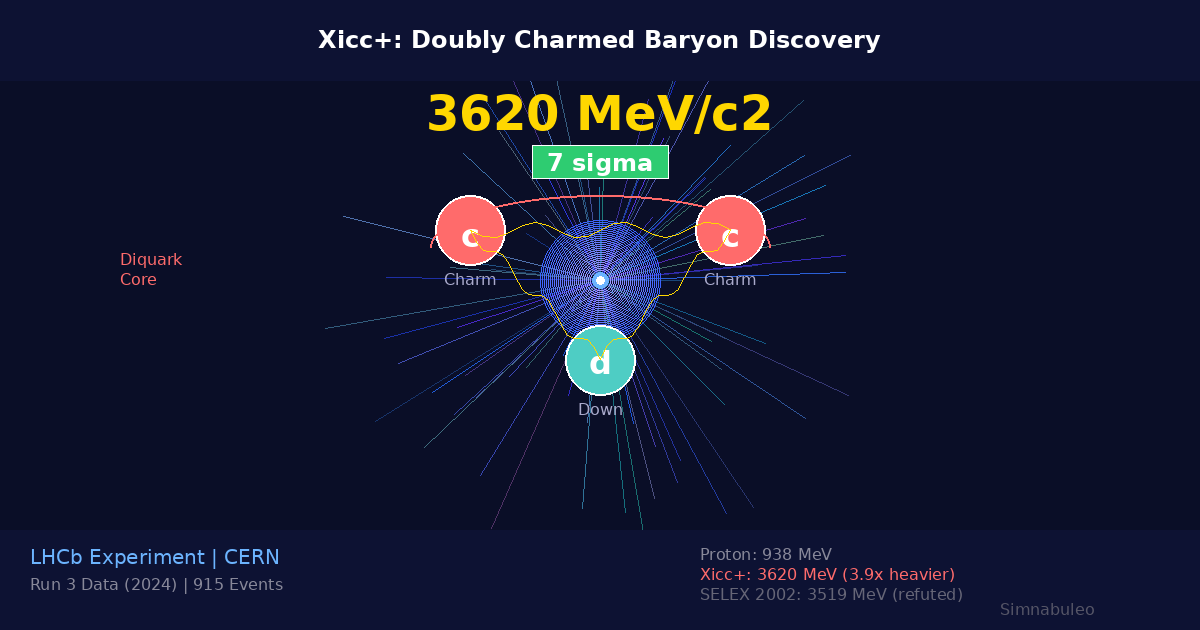
The LHCb upgrade completed in 2023 introduced a pixel VELO, scintillating fiber tracker, and 30 MHz all-channel software trigger. In 2024 Run 3 data, approximately 915 Xicc+ events were observed near 3620 MeV with statistical significance exceeding 7 sigma. This is the first new particle discovered with the upgraded detector, proving the power of the fully software-based trigger system in practice. Precision analyses impossible with hardware triggers are now routine.
Effective End of the 20-Year SELEX Mystery
The SELEX experiment at Fermilab in 2002 claimed to observe Xicc+ at approximately 3519 MeV, but no subsequent experiment — BaBar, Belle, FOCUS, or early LHCb data — could reproduce the result. LHCb confirmed mass of 3620 MeV differs from SELEX by over 100 MeV while matching the 2017 charge partner Xicc++ (3621 MeV) within isospin symmetry predictions. This strongly suggests SELEX observed a statistical fluctuation or a different phenomenon entirely.
Ideal Laboratory for QCD Verification
In doubly charmed baryons, two heavy quarks form a diquark core with a lighter quark orbiting around it, resembling the nucleus-electron structure of a hydrogen atom. This structure is far easier to handle theoretically than ordinary baryons. Lattice QCD simulation predictions can now be directly compared with experimental values. This data could be a key to understanding the non-perturbative domain of the strong interaction.
New Horizons in Exotic Hadron Searches
Confirmation of doubly charmed baryons fuels the possibility of even more exotic matter states. A 2017 Physical Review Letters theoretical study predicted that a doubly bottom tetraquark could exist as a stable state that cannot decay through the strong interaction. A stable bound state of two quarks and two antiquarks implies matter diversity far beyond the proton-neutron paradigm.
Deepening the Standard Model Paradox
The discovery of Xicc+ is another Standard Model victory, but each such victory deepens a paradox. What physics most urgently needs is to find where the Standard Model breaks — clues to dark matter, dark energy, and quantum gravity. Yet every result confirms the model again. A model that cannot explain 95 percent of the universe works perfectly within the 5 percent it can explain, creating a double-edged sword for physicists advocating next-generation colliders.
Positive & Negative Analysis
Positive Aspects
- Dramatic Reconfirmation of Quark Model Predictive Power
The reserved seat in the SU(4) multiplet predicted half a century ago has been experimentally filled. The precise agreement in mass values between theory and experiment is particularly impressive, confirming our understanding of the strong interaction's fundamental structure is on the right track.
- Real-World Validation of LHCb Software Trigger
The 30 MHz all-channel software trigger has been proven successful in practice. This paradigm shift affects not just LHCb but directly influences next-generation collider design. The approach of analyzing all data without discarding events fundamentally expands discovery potential in high-energy physics.
- Path to Precision QCD Verification via Diquark Structure
The diquark-quark structure of doubly charmed baryons provides an ideal benchmark for directly comparing lattice QCD simulation predictions with experimental values. Critical data for solving the origin of proton mass — a problem the Higgs mechanism alone cannot address — has now been secured.
- Confirmation of Scientific Self-Correction
The final verification of the 20-year unreproducible SELEX result by a more precise experiment demonstrates that the scientific community's self-correction mechanism is functioning. The principle that even peer-reviewed results face revision when unreproduced has been confirmed once again.
Concerns
- Continued Absence of Beyond Standard Model Breakthrough
The pattern of predicted particles appearing at predicted masses continues. Solving fundamental problems like dark matter, dark energy, and quantum gravity requires clues from beyond the Standard Model, yet this discovery shows only another success within the model.
- Difficulty Justifying Costs to the Public
Justifying the hundreds of millions to billions of euros invested in the LHCb upgrade and LHC operations requires a compelling public narrative. Confirming a particle whose existence was already predicted is far less dramatic than the Higgs boson discovery.
- Unresolved Questions About SELEX Data
While LHCb effectively refutes SELEX, it does not explain what SELEX actually observed. Whether a peer-reviewed experimental result can simply be dismissed as statistical fluctuation remains an open question.
- Risk of Exotic Hadron Discovery Inflation
LHCb has announced dozens of exotic hadron candidates over the past decade, but consensus on whether these are independent particle states or molecular-like bound states has not been reached for many of them. Truly important physical insights risk being buried in a flood of discovery announcements.
Outlook
In the short term, over the next six months to a year, LHCb will produce precision measurements of Xicc+ decay properties — lifetime, branching ratios, and production cross sections. The current sample of 915 events is sufficient for discovery but not for precise measurements. As additional Run 3 data accumulates, these values will be compared against lattice QCD predictions. This comparison will constitute the first direct test of theoretical tools describing quark interactions in this regime, and any discrepancy would itself become a potential clue to new physics. In the medium term, one to three years out, searches for other members of the doubly charmed baryon family will intensify. The Omega-cc (charm-charm-strange) remains unobserved, and its mass and decay patterns will be decisive for understanding the role of the strange quark. Simultaneously, the search for doubly bottom baryons (Xibb) will begin. Because the bottom quark is roughly three times heavier than charm, production rates will be extremely low, potentially requiring years before a discovery signal emerges. But if found, it would test the universality of the diquark model. Over the longer term, three to five years and beyond, the High-Luminosity LHC and next-generation collider plans will determine this field's future. The HL-LHC, scheduled around 2029, will accumulate more than ten times current data. At that scale, precision spectroscopy of doubly heavy baryons becomes feasible, and the search for the predicted stable bottom-bottom tetraquark becomes realistic. If found, it would fundamentally expand our understanding of matter's possible forms. In the best case, precision measurements reveal subtle QCD disagreements hinting at new physics. In the baseline scenario, Standard Model predictions continue to be confirmed. In the worst case, particle physics becomes trapped in a confirmation desert. The baseline scenario is most likely, but physics history repeatedly shows that revolutions begin in unexpected places.
Sources / References
- LHCb Collaboration discovers new proton-like particle — CERN
- Observation of the doubly charmed heavy proton Xicc+ — LHCb Outreach
- Physicists discover a charmed new particle — Scientific American
- First doubly charmed baryon spotted by LHCb — Physics World
- Physicists Discover New Proton-Like Particle — SciTechDaily
- University of Manchester scientists play key role — University of Manchester
- CERN Adds a New Particle to LHCs Subatomic Zoo — Universe Today