
Science

CERN Just Caught a 20-Year-Old Ghost — The Doubly Charmed Baryon That Cracked Open the Standard Model's Next Door
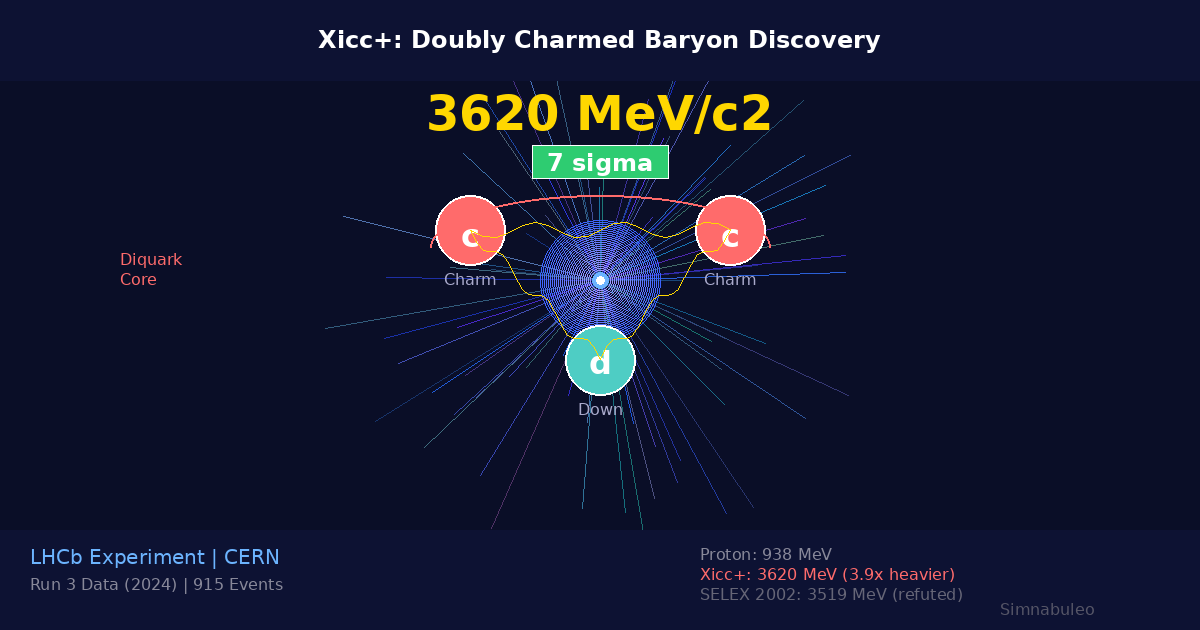
(AI-generated images) CERN LHCb Doubly Charmed Baryon Xicc+ Discovery Infographic - 3620 MeV mass, 7-sigma significance, charm-charm-down quark structure
(AI-generated images) Quark structure and key data of the doubly charmed baryon Xicc+ discovered at CERN LHCb

Summary

The proton's heavy cousin has been experimentally confirmed after 20 years. The doubly charmed baryon Xicc+ at 3620 MeV fills one gap in the quark model but sharpens unresolved puzzles in strong-force physics.

Key Points

1

First New Particle from Upgraded LHCb Detector

The LHCb upgrade completed in 2023 introduced a pixel VELO, scintillating fiber tracker, and 30 MHz all-channel software trigger. In 2024 Run 3 data, approximately 915 Xicc+ events were observed near 3620 MeV with statistical significance exceeding 7 sigma. This is the first new particle discovered with the upgraded detector, proving the power of the fully software-based trigger system in practice. Precision analyses impossible with hardware triggers are now routine.

2

Effective End of the 20-Year SELEX Mystery

The SELEX experiment at Fermilab in 2002 claimed to observe Xicc+ at approximately 3519 MeV, but no subsequent experiment — BaBar, Belle, FOCUS, or early LHCb data — could reproduce the result. LHCb confirmed mass of 3620 MeV differs from SELEX by over 100 MeV while matching the 2017 charge partner Xicc++ (3621 MeV) within isospin symmetry predictions. This strongly suggests SELEX observed a statistical fluctuation or a different phenomenon entirely.

3

Ideal Laboratory for QCD Verification

In doubly charmed baryons, two heavy quarks form a diquark core with a lighter quark orbiting around it, resembling the nucleus-electron structure of a hydrogen atom. This structure is far easier to handle theoretically than ordinary baryons. Lattice QCD simulation predictions can now be directly compared with experimental values. This data could be a key to understanding the non-perturbative domain of the strong interaction.

4

New Horizons in Exotic Hadron Searches

Confirmation of doubly charmed baryons fuels the possibility of even more exotic matter states. A 2017 Physical Review Letters theoretical study predicted that a doubly bottom tetraquark could exist as a stable state that cannot decay through the strong interaction. A stable bound state of two quarks and two antiquarks implies matter diversity far beyond the proton-neutron paradigm.

5

Deepening the Standard Model Paradox

The discovery of Xicc+ is another Standard Model victory, but each such victory deepens a paradox. What physics most urgently needs is to find where the Standard Model breaks — clues to dark matter, dark energy, and quantum gravity. Yet every result confirms the model again. A model that cannot explain 95 percent of the universe works perfectly within the 5 percent it can explain, creating a double-edged sword for physicists advocating next-generation colliders.

Positive & Negative Analysis

Positive Aspects

  • Dramatic Reconfirmation of Quark Model Predictive Power

    The reserved seat in the SU(4) multiplet predicted half a century ago has been experimentally filled. The precise agreement in mass values between theory and experiment is particularly impressive, confirming our understanding of the strong interaction's fundamental structure is on the right track.

  • Real-World Validation of LHCb Software Trigger

    The 30 MHz all-channel software trigger has been proven successful in practice. This paradigm shift affects not just LHCb but directly influences next-generation collider design. The approach of analyzing all data without discarding events fundamentally expands discovery potential in high-energy physics.

  • Path to Precision QCD Verification via Diquark Structure

    The diquark-quark structure of doubly charmed baryons provides an ideal benchmark for directly comparing lattice QCD simulation predictions with experimental values. Critical data for solving the origin of proton mass — a problem the Higgs mechanism alone cannot address — has now been secured.

  • Confirmation of Scientific Self-Correction

    The final verification of the 20-year unreproducible SELEX result by a more precise experiment demonstrates that the scientific community's self-correction mechanism is functioning. The principle that even peer-reviewed results face revision when unreproduced has been confirmed once again.

Concerns

  • Continued Absence of Beyond Standard Model Breakthrough

    The pattern of predicted particles appearing at predicted masses continues. Solving fundamental problems like dark matter, dark energy, and quantum gravity requires clues from beyond the Standard Model, yet this discovery shows only another success within the model.

  • Difficulty Justifying Costs to the Public

    Justifying the hundreds of millions to billions of euros invested in the LHCb upgrade and LHC operations requires a compelling public narrative. Confirming a particle whose existence was already predicted is far less dramatic than the Higgs boson discovery.

  • Unresolved Questions About SELEX Data

    While LHCb effectively refutes SELEX, it does not explain what SELEX actually observed. Whether a peer-reviewed experimental result can simply be dismissed as statistical fluctuation remains an open question.

  • Risk of Exotic Hadron Discovery Inflation

    LHCb has announced dozens of exotic hadron candidates over the past decade, but consensus on whether these are independent particle states or molecular-like bound states has not been reached for many of them. Truly important physical insights risk being buried in a flood of discovery announcements.

Outlook

In the short term, over the next six months to a year, LHCb will produce precision measurements of Xicc+ decay properties — lifetime, branching ratios, and production cross sections. The current sample of 915 events is sufficient for discovery but not for precise measurements. As additional Run 3 data accumulates, these values will be compared against lattice QCD predictions. This comparison will constitute the first direct test of theoretical tools describing quark interactions in this regime, and any discrepancy would itself become a potential clue to new physics. In the medium term, one to three years out, searches for other members of the doubly charmed baryon family will intensify. The Omega-cc (charm-charm-strange) remains unobserved, and its mass and decay patterns will be decisive for understanding the role of the strange quark. Simultaneously, the search for doubly bottom baryons (Xibb) will begin. Because the bottom quark is roughly three times heavier than charm, production rates will be extremely low, potentially requiring years before a discovery signal emerges. But if found, it would test the universality of the diquark model. Over the longer term, three to five years and beyond, the High-Luminosity LHC and next-generation collider plans will determine this field's future. The HL-LHC, scheduled around 2029, will accumulate more than ten times current data. At that scale, precision spectroscopy of doubly heavy baryons becomes feasible, and the search for the predicted stable bottom-bottom tetraquark becomes realistic. If found, it would fundamentally expand our understanding of matter's possible forms. In the best case, precision measurements reveal subtle QCD disagreements hinting at new physics. In the baseline scenario, Standard Model predictions continue to be confirmed. In the worst case, particle physics becomes trapped in a confirmation desert. The baseline scenario is most likely, but physics history repeatedly shows that revolutions begin in unexpected places.

Sources / References

Related Perspectives

Science

The "Harmless Passenger" Virus — Nature Just Questioned That Name

A landmark multi-omics study of 1,154 hospitalized COVID-19 patients across approximately 20 hospitals and 15 research centers in the United States, published in Nature on August 5, 2026, documented significant reactivation of at least 11 latent viruses during acute SARS-CoV-2 infection — including members of the Herpesviridae and Anelloviridae families — within 40 days of hospital admission. The IMPACC cohort study analyzed over 200,000 biological samples and more than 1 billion data points through simultaneous genomic, proteomic, metabolomic, and immunological profiling, making it one of the largest and most methodologically comprehensive infectious-disease datasets ever assembled. Among the reactivating viruses, anelloviruses — carried by roughly 90% of the human population and historically classified as harmless, disease-free passengers — showed a statistically significant association with subsequent long COVID development and long-term physical impairment. The authors themselves explicitly stated: "Although our results do not establish causation between virus reactivation and clinical outcomes," the data nonetheless open a new door toward predictive biomarkers and a reconceptualization of long COVID's underlying mechanism. Arriving in a moment when an estimated 400 million people worldwide have experienced long COVID with no FDA-approved specific treatment available, this paper offers a significant — and long-overdue — directional signal about where the research compass may need to point next.

Science

For a Hundred Years We Carved Space. In Dresden, They Just Carved Time for the First Time.

The world's first all-optical photonic time crystal in the terahertz frequency range was experimentally realized in late July 2026 and published in Nature under the title "Plasmonic metamaterial time crystal," by an international team from École Polytechnique, Collège de France, and Germany's Helmholtz-Zentrum Dresden-Rossendorf (HZDR). The research team constructed a plasmonic metasurface of gold nanostripes on indium antimonide (InSb) semiconductor and, using the TELBE superradiant terahertz source inside HZDR's ELBE accelerator, drove periodic modulation of the material's optical properties on picosecond (one trillionth of a second, 10⁻¹²) timescales at near-unity modulation depths — achieving a regime that had eluded experimentalists for over a decade. In the resulting photonic time crystal (PTC) regime, non-radiative plasmonic losses were reduced by more than 50%, a counterintuitive result in which increasing the drive intensity paradoxically decreases energy losses, mediated by an exceptional point where two Floquet-driven optical eigenmodes coalesce. This discovery adds "time" as a genuinely new active design dimension to a field that for a century relied exclusively on spatial engineering — lenses, fiber optics, photonic crystals, and semiconductor circuits are all, without exception, spatial structures — representing a conceptual expansion of the design space itself rather than merely an improvement of existing components. While the team acknowledged "severe experimental challenges" in their paper and while historical parallels with high-temperature superconductors and laser physics suggest the gap from proof-of-principle to practical application can span decades, the experiment's significance is unambiguous: for the first time, time itself has been added to the toolkit for controlling light.

Science

What We Found on LHS 1140b Isn't Life — It's a 3-Billion-Year Mystery

LHS 1140b, a rocky super-Earth orbiting within the habitable zone of an M dwarf star 48 light-years away, became the first such world to show confirmed atmospheric signals when the WINERED spectrograph mounted on the Magellan Clay telescope at Las Campanas Observatory detected escaping helium in 2024 observations. The study, led by Collin Cherubim of Harvard and co-authored by David Charbonneau, Robin Wordsworth, Jason Dittmann, and Shreyas Vissapragada, was published in Science on July 16, 2026 under DOI 10.1126/science.aea9708. What most media coverage missed is that the genuinely remarkable finding is not the detection itself but the inference that this helium has been actively escaping for more than three billion years while remaining present — meaning something inside the planet must be continuously replenishing it. Co-author Jason Dittmann was explicit about the fundamental ambiguity at the heart of this discovery, asking openly whether the planet hosts a genuine steady-state atmosphere or is simply a bare rock that occasionally burps geological gas that immediately escapes into space. The helium signal detected in 2024 was not replicated in 2025 observations, creating a variability problem that complicates interpretation in ways that confident headline language did not reflect. This discovery does not mark the dawn of evidence for extraterrestrial life; it opens a far more fascinating scientific puzzle about how a rocky planet can sustain an escaping atmosphere across geological time, and what that implies for the billions of M-dwarf habitable-zone planets throughout our galaxy.

Science

India: $15/Month Anti-Aging Shot. U.S.: $1,027 — Insurance Denied. The Paradox Ozempic's Patent Cliff Created.

The first randomized controlled trial demonstrating that semaglutide slows epigenetic aging — with PCGrimAge declining by 3.08 years, PhenoAge by 4.90 years, and DunedinPACE by 9% — was published in Nature Communications, yet the study carries inescapable limitations: 84 HIV-associated lipodystrophy patients, a 32-week window, and aging measurements added as a post-hoc endpoint rather than the trial's primary objective. Lead author Michael Corley explicitly stated, "We are not saying that semaglutide reverses aging or makes people younger" — a caveat stripped from media headlines that instead proclaimed a 3.1-year biological age reversal. The divergence across three clocks — from 3.08 to 4.90 years of apparent benefit — itself exposes the interpretive limits of epigenetic timing tools, which capture population-level statistical associations rather than individual causal mechanisms. Far more transformative than this single study, however, is what happened on March 20, 2026: India's core semaglutide patent (IN 262697) expired, unleashing more than 55 generic brands at prices as low as ₹1,290 per month (~$15), while the United States maintains brand exclusivity through 2031–2036 at $1,027/month with Medicare obesity coverage legally excluded by a 2003 law. For the first time in biomedical history, the benefits of a major pharmaceutical innovation are reaching scale in a developing nation before they are broadly accessible to citizens of the country that built the regulatory system enabling that innovation — a structural reversal that mirrors Cipla's 2001 HIV drug revolution, which expanded African patient access from 8,000 to 12 million people.

Science

We "Solved" Ebola. That Illusion Is Now Killing 700 People in Congo.

The 2026 Ebola outbreak in the Democratic Republic of Congo, driven by Bundibugyo ebolavirus rather than the better-known Zaire strain, has recorded 1,963 confirmed cases and 719 deaths as of mid-July, making it the largest non-Zaire Ebola event in recorded history. Every licensed medical countermeasure — Ervebo, Inmazeb, and Ebanga — was engineered exclusively against Zaire ebolavirus, and a 2026 CDC study confirmed that cross-reactive antibody titers against Bundibugyo fall 73% lower than Zaire-specific responses, prompting WHO to explicitly prohibit Ervebo's programmatic use against this species. Nineteen years elapsed between Bundibugyo's first confirmed emergence in Uganda in 2007 and this outbreak, and during that entire period no species-specific vaccine, therapeutic, or rapid diagnostic test was developed — a direct consequence of the pathogen's rarity eliminating commercial investment incentives. WHO declared a Public Health Emergency of International Concern on May 17, 2026, yet the sole available control tools remain isolation, contact tracing, and safe burial, the same non-pharmacological measures used since 1976. This outbreak constitutes a systemic indictment of a global R&D incentive structure that prices human lives against commercial viability, and of the structural illusion that defeating one ebolavirus species constitutes preparedness against the entire genus.

SimNabuleo AI

AI Riffs on the World — AI perspectives at your fingertips

simcreatio [email protected]

Content on this site is based on AI analysis and is reviewed and processed by people, though some inaccuracies may occur.

© 2026 simcreatio(심크리티오), JAEKYEONG SIM(심재경)

enko