
The Real Reason Batteries Explode Has Finally Been Revealed — Metal Needles 100 Times Thinner Than Hair Were Snapping Like Dry Spaghetti
Summary
A new study published in Science reveals that lithium dendrites inside batteries are not soft as long assumed, but 250 times stronger than bulk lithium and brittle — snapping without deformation, fundamentally challenging 30 years of battery safety design.
Key Points
First-ever direct measurement: lithium dendrites are 250x stronger than bulk lithium
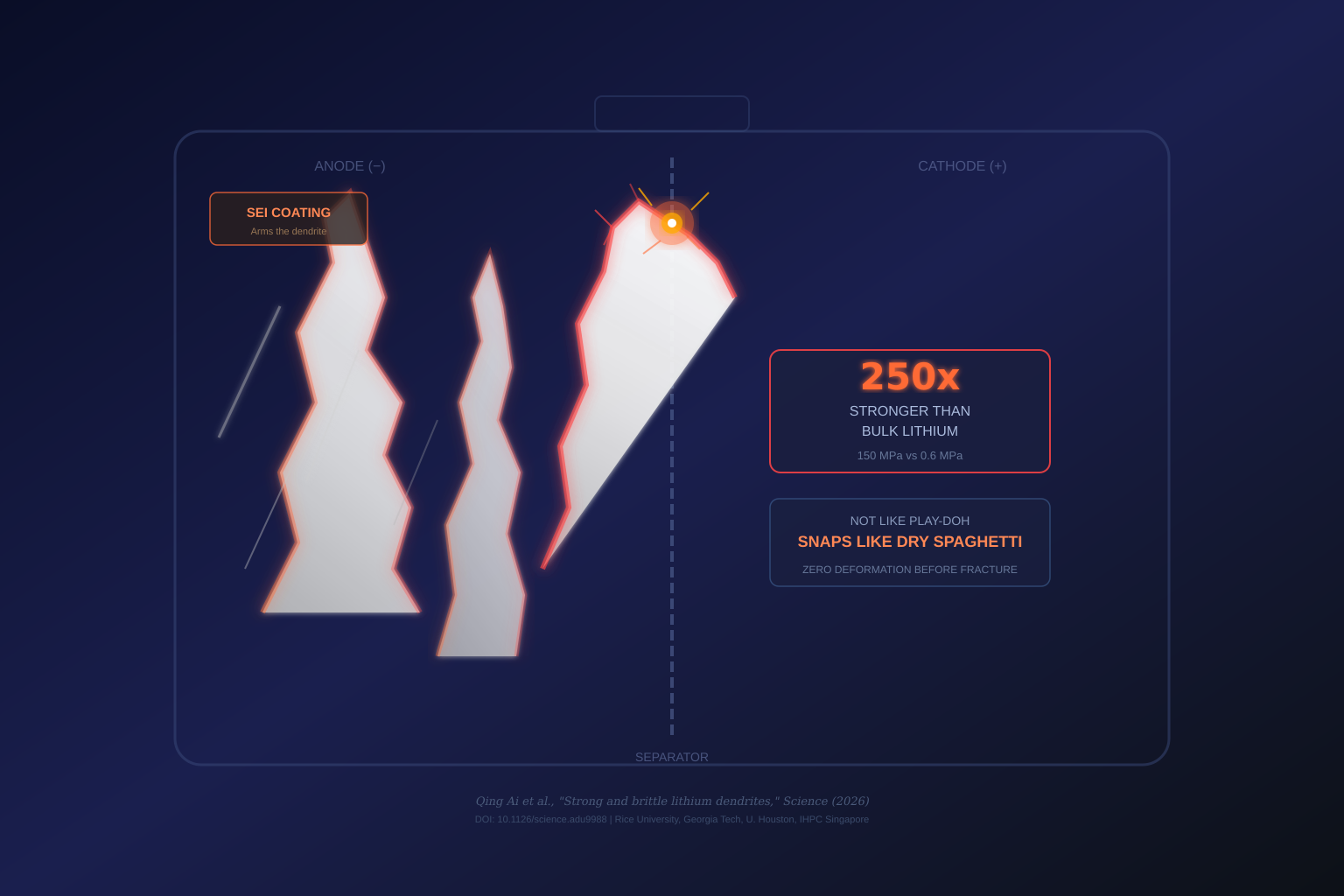
An international team led by Dr. Qing Ai of Rice University published in Science the first-ever direct nanomechanical measurements of individual lithium dendrites. Individual dendrites fractured at stresses exceeding 150 MPa — more than 250 times stronger than bulk lithium at 0.6 MPa. No plastic deformation was observed before fracture. Rather than soft Play-Doh, dendrites snap like dry spaghetti. This overturns the 30-year assumption that dendrites are soft and ductile like bulk lithium.
SEI coating arms the dendrite — a dangerous dual role
The second key finding is that the abnormal strength comes from the SEI (Solid Electrolyte Interphase) coating that forms naturally on dendrite surfaces during battery cycling. This nanometer-thin protective layer, critical for battery life, simultaneously prevents the lithium core from plastic deformation, making the entire dendrite behave like stiff ceramic rather than soft metal. The very layer meant to protect the battery is arming its most dangerous internal structure.
Air-free chamber nanoindentation — making the impossible possible
Lithium dendrites are 1/100th the width of a human hair and chemically degrade instantly in air. The team developed the world first sealed air-free chamber housing a nanoindenter inside a scanning electron microscope, enabling controlled stress application and real-time deformation observation of individual dendrites. This technical breakthrough involved collaboration across 6 institutions in 4 countries: Rice University, Georgia Tech, University of Houston, NJIT, and IHPC Singapore.
Battery safety design paradigm must fundamentally shift
For 30 years the dominant battery safety strategy was making separators harder to block dendrite penetration, based on the assumption that dendrites are soft. If dendrites are 250x stronger than assumed, physical separator strength alone cannot prevent penetration. This study points to a new approach: controlling SEI composition and structure to weaken dendrite mechanical properties at the source — stripping the enemy of weapons rather than building higher walls.
EV-era battery fire risk and consumer safety
According to the U.S. Consumer Product Safety Commission, at least 25,000 lithium-ion battery fire and overheating incidents occurred in a recent five-year period. During thermal runaway, battery temperature surges from 212F to 1800F in one second. With EV adoption accelerating, the discovery that dendrite danger is far greater than assumed demands reexamination of battery safety standards and verification protocols.
Positive & Negative Analysis
Positive Aspects
- A 30-year wrong assumption has been scientifically corrected
The textbook assumption that lithium dendrites are soft has been overturned by direct measurement data. If knowing your enemy is half the battle, this research provides game-changing intelligence for the battery safety war. Future separator design, electrolyte development, and charging protocol optimization can now be built on accurate data.
- SEI engineering opens an entirely new solution pathway
The discovery that SEI coating decisively affects dendrite strength enables a completely new safety strategy: not preventing growth, but making dendrites harmless even as they grow. If SEI composition and structure can transform dendrites from strong piercing needles into soft harmless threads, it would be a genuine game-changer for battery safety.
- Innovation in nanoscale mechanical measurement technology
The air-free SEM nanoindentation system can be broadly applied to study air-sensitive nanoscale materials beyond lithium dendrites. It will become a critical tool for investigating similar problems in next-generation battery systems including sodium-ion, zinc-ion, and solid-state batteries.
- A successful model of international research collaboration
The cooperation of six institutions across four countries — US (Rice, Georgia Tech, Houston, NJIT) and Singapore (IHPC) — made this discovery possible. It demonstrates how complex technical challenges can be solved through multidisciplinary international collaboration on global challenges like battery safety.
Concerns
- Questions the effectiveness of existing battery safety designs
Billions of lithium-ion batteries in the market use safety systems designed assuming dendrites are soft. If actual attack power is 250x greater, existing separator safety margins may be far smaller than assumed. Not an immediate recall, but a clear signal that safety design revalidation is needed.
- Long distance from basic discovery to practical solutions
Knowing dendrites are strong and brittle versus engineering SEI to make them weak are completely different challenges. SEI composition depends on countless variables and the typical timeline from basic discovery to commercial technology is 5-10 years.
- Potential to trigger psychological anxiety in the EV market
Headlines about battery needles being 250x stronger than expected could trigger consumer anxiety at a moment when EV adoption is accelerating. The risk of context-free exaggeration in popular coverage is real and could impact market growth.
- Sounds alarm for solid-state battery expectations
Solid-state batteries have been positioned as the ultimate dendrite solution, but this study suggests dendrites can penetrate solid electrolytes too. Companies like Toyota, BMW, and Samsung SDI with heavy solid-state investments face a significant new variable.
- Exposes structural neglect of fundamental research for 30 years
The fact that the most basic mechanical properties of the material causing the most catastrophic battery failure mode were never directly measured for 30 years suggests insufficient investment in fundamental versus applied research. This structural gap may exist in other battery safety unknowns.
Outlook
In the short term (next 6 months to 1 year), this research will send immediate shockwaves through the battery science community. With the 30-year textbook assumption overturned, existing research will undergo revalidation — particularly studies on separator design, electrolyte additives, and charging protocols. The air-free nanomechanical measurement system developed by Rice University will be replicated and extended by other research groups, and dendrite property data under various conditions will accumulate rapidly.
Major battery manufacturers — CATL, LG Energy Solution, Samsung SDI, Panasonic — will likely initiate internal reviews of their products' safety margins. Expect R&D direction adjustments before any product changes.
In the medium term (1-3 years), SEI engineering will emerge as the hottest new field in battery safety research. The strategy of controlling dendrite mechanical properties through SEI is theoretically attractive but requires far deeper understanding of SEI's nanoscale composition-structure-property relationships. Research investment in this area will grow significantly.
Solid-state battery development will also be affected. Since this study suggests dendrites can penetrate solid electrolytes, research into the mechanical interactions at the dendrite-solid electrolyte interface will become essential — moving beyond the simple "solid means safe" logic. For Toyota, BMW, Samsung SDI, and others who have bet heavily on solid-state, this is a significant new variable.
Looking long-term (3-5 years), in the bull case, SEI engineering enables fundamental control over dendrite mechanical properties. If dendrites can be kept weak enough that they cannot puncture separators even as they grow — the "safe dendrite" concept — it would represent a paradigm shift in battery safety. I put this scenario's probability at about 25%.
In the base case, this discovery contributes to incremental improvements. New separator materials, improved electrolyte additives, and optimized charging algorithms are developed, gradually improving battery safety. But the fundamental dendrite problem remains unsolved, and battery fires still occur intermittently. Probability: 55%.
In the bear case, the "dendrites are 250x stronger" news triggers consumer fear and regulatory tightening, but actual technological progress is slow. SEI engineering proves more complex than hoped, solid-state batteries turn out not to be dendrite-free either, and investment sentiment toward next-generation battery technology cools. Probability: 20% — but given the uncertainties of technology development, it should not be underestimated.
Regardless of which scenario plays out, one thing is certain. Now we know our enemy. The discovery that what we thought was Play-Doh for 30 years was actually a ceramic 250 times stronger — the difference between knowing that and not knowing it is enormous. In science, discovering you were wrong is always more valuable than confirming you were right.
Sources / References
- Strong and brittle lithium dendrites — Science
- Thorny issue plaguing lithium-ion batteries laid bare in new study — Rice University News
- New lithium battery dendrite strength revealed — New Atlas
- Thorny issue plaguing lithium-ion batteries laid bare in new study — Phys.org
- Why Do Lithium-ion Batteries Fail? Scientists Find Clues in Microscopic Metal Thorns — NJIT News
- Hard truth: Here is the reason most lithium-ion batteries fail — The Brighter Side of News
- Lithium-ion battery fires are a growing public safety concern — Clemson University News