
Five Michelin-Worthy Stars for Ingredients, Zero Standards for Labor - Why World's Top Restaurant Awards Stay Silent
Summary
The 2026 revelations surrounding Copenhagen's Noma — named the world's best restaurant five times — exposed a systemic pattern of workplace abuse spanning nearly a decade, with close to 35 former and current employees testifying to physical violence, psychological torment, and sustained harassment. Chef René Redzepi's formal resignation in March 2026 was effectively nullified within months when he returned under the title "creative director," an arrangement that performs accountability while preserving power. The North America's 50 Best Restaurants ceremony in New Orleans in May 2026 declined to make kitchen labor conditions a central agenda item, and a juror reportedly defended brutal kitchen culture by invoking military training analogies, laying bare a structural complicity that no individual's apology can address. Fine dining's award ecosystem evaluates the geographic provenance, sustainability credentials, and carbon footprint of ingredients with meticulous rigor, yet systematically excludes worker treatment from its criteria — a deliberate asymmetry rooted in the industry's long-standing dependence on unpaid and underpaid stagiaire labor. This article argues that the silence is not ignorance or mere indifference, but an act of institutional self-preservation, and examines short-, medium-, and long-term scenarios for structural reform, concluding that meaningful change will not emerge voluntarily from within the industry but will require sustained external pressure from journalism, litigation, capital markets, and a generational shift in how culinary excellence itself is defined.
Key Points
Inside the Kitchen of a Five-Time World's Best Restaurant
In March 2026, The New York Times and multiple other major outlets published accounts from close to 35 former and current Noma employees describing a sustained pattern of workplace abuse. The testimonies went well beyond "demanding boss" territory: they described incidents involving near-physical assault, the use of kitchen objects as instruments of intimidation, and prolonged psychological harassment repeated across a span from approximately 2009 through 2017. The sheer number of independent, corroborating accounts — close to 35 people describing the same pattern over the same period — indicates something far beyond isolated bad days or clashing personalities. What strikes me as the genuine shock of this story is not the abuse itself, as horrifying as it is, but the fact that it occurred inside a kitchen that was being crowned the world's best by the most prestigious institutions the industry has to offer — and that it kept occurring, year after year, while those crownings continued. The single-bad-actor explanation collapses under that arithmetic. One bad chef can abuse one kitchen; a structural problem is required to sustain a pattern this durable, this invisible, across this many cycles of industry validation.
What makes this even harder to sit with is that Noma's brutality was not a well-kept secret inside the industry. The kitchen's intensity was something of an open legend, circulating in the way that stories about formative, grueling, life-changing experiences do. But that framing — the idea that Noma's harshness was an expression of its seriousness, its uncompromising pursuit of perfection — is exactly the cultural mechanism that allowed abuse to be laundered into mythology. When you tell the story of a difficult place as a story about excellence, the people harmed inside that story lose their standing to call harm by its proper name. I believe that cultural reframing — "this is what greatness costs" — is at least as responsible for the duration of the abuse as anything Redzepi himself did. The industry didn't just permit the abuse; it built a narrative that made witnessing it feel like witnessing something admirable. That collective reinterpretation of harm as rigor is a form of institutional complicity that no resignation or title change can fully address.
The Precise Architecture of an Accountability-Free Return
Redzepi's resignation landed with the weight of a significant moment. A lot of people interpreted it as a genuine reckoning — a chapter closing, an era ending. Within months, he was back inside the organization as "creative director," and I think it's worth taking the architecture of that move seriously, because it deserves to be understood rather than simply criticized.
The "creative director" title is a carefully constructed piece of institutional language. It sheds the accountability-laden signifiers — head chef, owner, director — and reattaches the person to the organization through an identity that is explicitly aesthetic rather than managerial. You are now the source of vision, inspiration, and creative energy; not the person who makes staffing decisions, sets kitchen culture, or takes responsibility for operational outcomes. The move is elegant in the way that all effective evasions are elegant: it gives observers enough of what they need to feel that something happened while ensuring that the actual distribution of power changes as little as possible.
What concerns me most about this precedent is not what it says about Redzepi specifically but what it offers as a template to every other star chef who finds themselves in a similar position going forward. The existence of this exit-and-return pathway means the industry now has a tested model for navigating serious misconduct allegations without genuinely surrendering authority. Resignation becomes a pause, not a conclusion. And once that's understood — once it has been demonstrated publicly and survived without consequence — the reputational and professional deterrence that serious misconduct should carry is significantly diminished. I believe any industry attempting genuine reform needs to close this loophole explicitly: not through character judgments about individuals, but through structural rules about what "stepping back" from leadership must actually entail, and what kinds of organizational roles may not be resumed by someone who resigned under these circumstances.
The Award System's Asymmetry: Meticulous About Ingredients, Silent About Workers
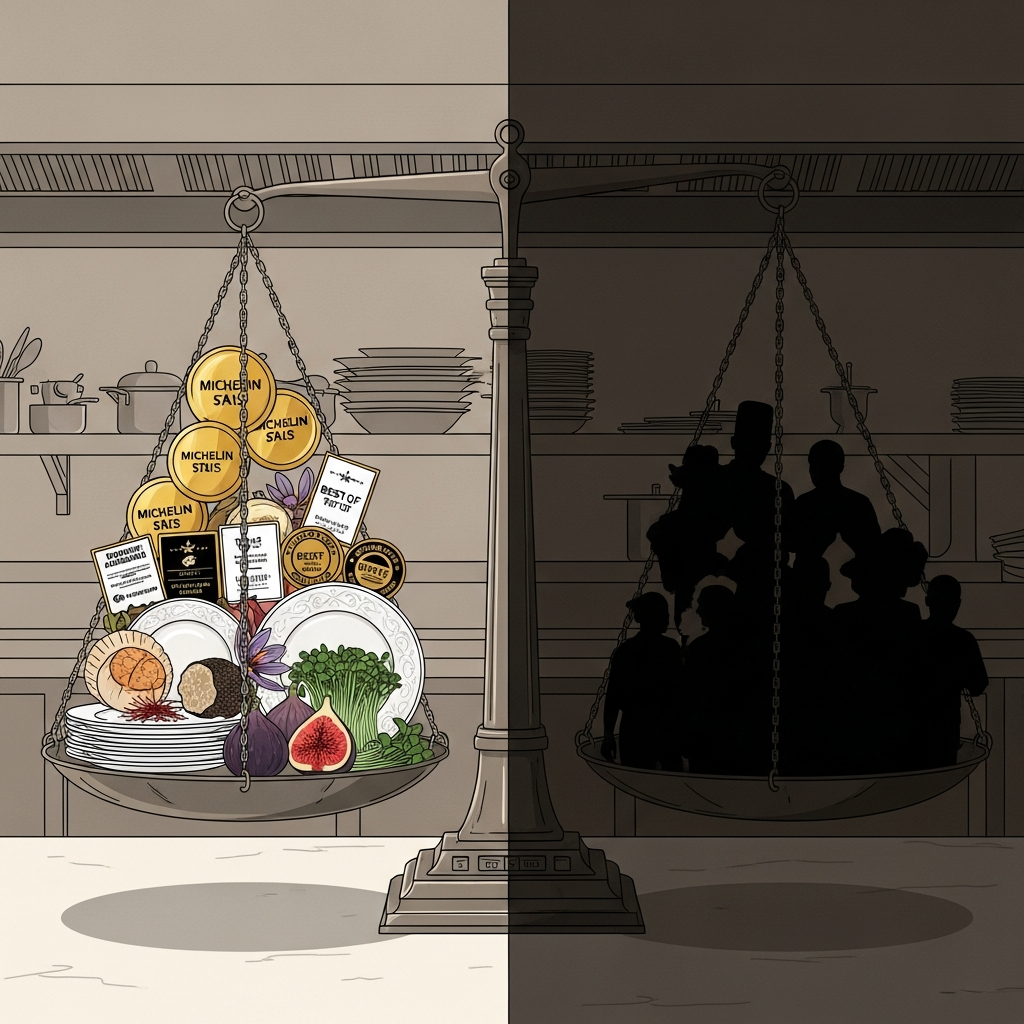
This is the argument I keep coming back to, because I think it exposes something more fundamental than any individual's behavior. The world's leading restaurant awards have, over the past fifteen years, built genuinely sophisticated frameworks for evaluating environmental and sourcing ethics. A restaurant's suppliers are scrutinized. The provenance of ingredients is traced. Foraging practices, water usage, food waste reduction, and in some cases actual carbon accounting are factors in how restaurants are evaluated and ranked. That is a real and significant development in how the industry defines excellence.
Now hold that picture alongside this one: those same evaluation frameworks contain no meaningful criteria for how the humans preparing the food are treated. Whether a kitchen pays its workers lawfully, whether it uses unpaid stagiaire labor for core operations, whether workers have access to any formal channel for reporting harassment or abuse — none of these questions appear in the scorecard. The tomato has been given an ethics audit. The person who washed, sliced, and plated that tomato has not. That asymmetry is not an oversight — it is a reflection of a deliberate hierarchy of values. Ingredient ethics is a story you can market to media-savvy customers; labor ethics is a cost line that, if honestly accounted for, threatens the current economic model of much of the fine dining world.
I think the language here matters enormously. When award bodies frame their ingredient-provenance criteria in terms of "sustainability," they're implicitly defining what the industry is sustaining. Right now, that definition includes ecosystems, regional agriculture, and biodiversity. It excludes the psychological and physical safety of the people doing the cooking. Changing what gets measured is the single most powerful tool available to the awards — they used it to transform sourcing ethics from a niche concern to an industry-wide standard within roughly fifteen years, and the exact same mechanism could be applied to labor. The question of why they haven't done so yet has an answer that's uncomfortable for everyone inside the industry: because measuring it would reveal how many of the most celebrated kitchens would fail the audit.
The Stagiaire System: How the Industry Institutionalized Precarity as Exploitation's Foundation
The unpaid and near-unpaid stagiaire system is so embedded in fine dining culture that discussions of it tend to be met with a mixture of nostalgia and defensiveness from industry veterans. But I think it's essential to call it what it actually is, because it is the structural foundation that makes everything else in this story possible. Young cooks, typically fresh out of culinary school, spend months working for free or near-free in exchange for a prestigious name on their résumé. That arrangement is packaged and sold — to the cooks themselves, to their families, to the broader culture — as an opportunity, a privilege, a rite of passage. The framing is so effective that many of the people subjected to it internalize it as something to be grateful for.
I believe this is the specific mechanism through which sustained workplace abuse becomes possible at the highest levels of fine dining. When you engineer a situation in which someone is professionally and financially unable to leave — where walking out means sacrificing an opportunity they may have spent years and significant money to reach — you have created a condition in which almost any treatment can be endured. The power differential is not incidental; it is the system's design. The stagiaire arrangement ensures a constant supply of workers who are highly motivated, technically trained, and structurally unable to assert basic employment rights without catastrophic personal cost.
What I find particularly revealing is the rhetorical move that accompanies this system. The institution taking the free labor doesn't say "we are taking advantage of your precarity." It says "we are giving you something invaluable." The person doing the unpaid work is positioned as the recipient of a gift, not as a worker being denied wages. This inversion of the actual power relationship — making exploitation look like generosity — is, in my view, the most sophisticated and durable feature of the system. It is also why reform faces such deep cultural resistance: you are not just changing a labor practice, you are challenging an entire mythology of what serious culinary training means and what young cooks should be grateful for.
The Industry's Silence Is a Survival Mechanism, Not a Character Flaw
At the North America's 50 Best Restaurants ceremony in New Orleans on May 28, 2026, the Noma situation and kitchen labor conditions were not central agenda items. A juror reportedly used military training analogies to defend harsh kitchen culture. This is easy to condemn as moral cowardice, and it is. But I think there's a more important analysis underneath the condemnation, because if you understand why the silence exists, you have a much clearer picture of what it would actually take to break it.
The economic logic runs like this: if a major award body introduced genuine, enforceable labor standards — real minimum wage requirements, prohibition of unpaid stagiaire work for core operations, mandatory anonymous reporting mechanisms — a significant portion of acclaimed fine dining establishments would struggle to survive under their current cost structures. Fine dining operates on thin margins with enormous labor intensity and ingredient costs. The current model absorbs that tension by externalizing labor costs onto young cooks who subsidize it with their free work and their silence. The award bodies know this, the chefs know this, and the restaurant investors know this. Genuine reform threatens not just a few bad actors but the economic architecture of the entire top tier of the industry.
Understanding this doesn't excuse the silence. But it does explain why external pressure — rather than internal reform — is the most realistic mechanism for change. The chefs who stayed silent at the May 2026 ceremony may not all be uniformly callous; many of them are operating kitchens that would also fail a rigorous labor audit. Calling out someone else's kitchen invites scrutiny of your own. That collective complicity is not primarily a moral failure of individuals — it is a rational response to structural incentives that reward silence and punish transparency. You cannot dissolve that structure by appealing to individual conscience. You can only change it by changing the structural rules under which everyone operates simultaneously.
Positive & Negative Analysis
Positive Aspects
- The Silence Has Finally Been Broken — And That Matters More Than It Might Seem
The single most important thing this story has done, in my view, is make visible something the industry had successfully kept invisible for over a decade. The mechanisms of that invisibility were sophisticated: stagiaires who couldn't afford to complain, a culture that aestheticized difficulty, fellow chefs who understood their own exposure, and award bodies with every incentive to protect the reputations of the restaurants they had crowned. What broke through all of that was not a new law or a regulatory body or an institutional investigation — it was the accumulation of individual testimonies reaching a critical mass at which major journalism outlets treated the pattern as a verified structural story rather than a collection of personal grievances.
That shift from "individual complaint" to "structural problem" is not automatic, and it doesn't happen often. It required journalists, editors, and sources to do something courageous, and it required a cultural moment in which the old dismissals — "they were too sensitive," "that's how great kitchens work" — had lost enough of their authority that they couldn't shut the story down. We are now past the point where this conversation can be fully reversed. The language exists. The testimonies are public record. The next person who experiences something similar in a fine dining kitchen will have a reference point that their predecessors didn't. Once a pattern of abuse acquires public language and documented history, it becomes significantly harder to sustain — not impossible, but meaningfully harder. That is real progress, even if it feels modest against the scale of what was tolerated for so long.
The generational dimension of this visibility is worth dwelling on separately. Younger cooks are increasingly documenting their working conditions on social media in real time — not after the fact, not anonymously, but in the moment. The closed-kitchen opacity that protected abusive environments for generations is structurally incompatible with a workforce that uses smartphones and social platforms as default communication tools. That incompatibility is a one-way ratchet. It cannot be reversed by any amount of kitchen authority, and it will only become more pronounced as the next generation enters the workforce with these tools and habits already fully embedded.
- Sponsor Capital Is Speaking the Only Language the Industry Universally Understands
Reports that American Express, Cadillac, and other major sponsors moved to distance themselves from events associated with the Noma controversy represent something more significant than corporate brand management. They represent the translation of a moral argument into the one language that every part of the industry — awards, restaurants, investors — is structurally obligated to respond to: financial risk. I've observed this dynamic in multiple industries, and it follows a consistent pattern. Moral arguments about labor practices can be neutralized or simply ignored for years by insiders who have the cultural authority to define what counts as acceptable. But when a major corporate sponsor calculates that reputational exposure exceeds marketing value, that calculation is public, quantifiable, and very difficult for the industry to dismiss.
The deeper significance is that sponsor withdrawal creates pressure not just on specific events but on the entire ecosystem. Award ceremonies without top-tier sponsors lose their ability to attract the chefs, media, and investors that make them consequential. The awards that remain consequential are the ones that can attract and keep major sponsors. If "labor ethics controversy" becomes a predictable sponsor-departure trigger, then maintaining those sponsorship relationships becomes a material incentive for award bodies to get ahead of the issue — not because they've suddenly developed a conscience, but because the economics of their own operation now depend on it.
I'm not saying this is how things should work — I'm saying this is, realistically, how industry-wide change tends to actually happen, and it's already happening here. The moral case for labor reform in fine dining is strong and has been available for years. The economic case is the one that's just now entering the conversation, and I believe it will prove far more disruptive than any op-ed or award ceremony speech. Capital moving signals that the broader market has already made a judgment — and that judgment, unlike an editorial, has consequences that compound over time.
- A Generational Values Shift Is Quietly Restructuring the Labor Pipeline
Something has changed in how the newest generation of culinary professionals understands and articulates their relationship to labor in the kitchen. The cultural framework in which unpaid stagiaire work was framed as a privilege, and in which the severity of a kitchen's demands was taken as a marker of its seriousness, is losing its grip on a cohort of young cooks who arrived in the industry with very different baseline assumptions about work, dignity, and what they're entitled to expect from an employer. This matters enormously for the industry's long-term trajectory, because the kitchen culture of any given decade is substantially shaped by the assumptions and tolerances of the people who run those kitchens — and today's stagiaires and junior cooks are tomorrow's sous chefs, head chefs, and owner-operators.
If a significant portion of that generation genuinely internalizes the view that unpaid labor is exploitation rather than opportunity, that verbal abuse is misconduct rather than mentorship, and that a prestigious name on a résumé does not justify any treatment incurred while earning it — those beliefs will propagate forward through the industry's own career pipeline. You cannot mandate that belief through regulation. You cannot enforce it through award criteria. But you also cannot stop it once it's embedded in the values of the people who will actually be running kitchens in fifteen years. I want to be careful not to overstate this: values shifts in professional cultures are slow, partial, and vulnerable to backsliding, especially in industries with strong prestige hierarchies. But the directional signal is real, and it represents a more durable source of structural change than any external policy intervention, precisely because it operates from the inside out.
The social media dimension amplifies this generational shift considerably. Young cooks today do not process their professional experiences privately; they document and share them in real time. The closed-kitchen opacity that protected abusive environments for generations is structurally incompatible with a workforce that communicates publicly by default. Each testimony shared, each kitchen culture described, each comparison made between what's tolerated here and what would be unthinkable in other professions builds the cultural vocabulary for a generation that will eventually redesign the environment it currently inhabits.
- This Conversation Is an Invitation to Redefine What "Great Food" Actually Means
For most of the history of fine dining criticism and award culture, "great food" has been defined along axes of taste, creativity, technique, ingredient quality, and the chef's philosophical and aesthetic vision. The ethical status of the labor that produced the food — whether workers were paid, whether they were treated with dignity — has been almost entirely outside the frame. This story represents a genuine opportunity to argue, successfully, that those two things belong together: that a dish produced through systematic exploitation is not, in any complete sense, an excellent dish. That argument is beginning to be made in food media, and I think the version of fine dining that emerges on the other side of this conversation will be richer rather than poorer for having added labor ethics to its evaluative vocabulary.
Consumers who ask "where does this ingredient come from" and also "what were the people who made this paid, and how were they treated" are not diminishing their enjoyment of food — they are deepening their engagement with it, adding a dimension of ethical consideration that makes pleasure more coherent and more defensible. The fashion industry analogy is instructive here too: many consumers now report that clothes they know were made under fair labor conditions feel genuinely better to wear — not because the fabric is different, but because the knowledge is different. There is no structural reason the same psychic value shouldn't attach to food. The best version of fine dining that this industry can grow into is one where the same rigor applied to sourcing a heritage grain is applied to the treatment of the person who milled it.
What excites me about this particular moment is that the conversation is happening at the right level of abstraction — not just "Redzepi was bad" but "what should excellence in fine dining actually require of the people who pursue it." That's a conversation that can produce lasting change in how the industry defines itself, and it's far more important than any individual accountability outcome. The invitation is on the table. Whether the industry accepts it, and what "accepting it" actually looks like in practice, is the question that will define the next chapter of culinary culture.
Concerns
- The Art of Returning Without Actually Leaving Has Set a Dangerous Industry Precedent
The most immediate and concrete harm done by the "creative director" resolution — beyond whatever it means for Redzepi personally — is that it has created a tested template that the broader industry now has available for future crises. An acknowledged pattern of serious workplace abuse has resulted in a title change, not a genuine exit from power. That outcome has been publicly visible, has survived without meaningful consequence, and has therefore been demonstrably established as a viable path. Other chefs, other industry figures, and other institutions facing similar reckonings will have studied it carefully, and the existence of this model degrades the deterrent function that accountability for serious misconduct should carry.
What troubles me most is not the specific outcome in this case but the precedent it establishes for the credibility of accountability language itself. When public apologies, formal resignations, and expressions of accountability can be structured to preserve power while performing its surrender, the language of accountability becomes weaponized. "Stepping down" comes to mean "strategic repositioning." "Taking responsibility" becomes a PR maneuver rather than an action. Each time this structure is deployed successfully, it becomes harder for genuine accountability — the kind that actually involves surrendering authority — to be legible or distinguishable from the performance of it. I believe any industry attempting genuine reform needs to close this loophole explicitly through structural rules about what "stepping back" from leadership must actually entail.
There is also a significant perceptual problem: many casual observers processed Redzepi's resignation as a resolution. The story, in the public imagination, acquired a sense of closure that the facts don't support. That false closure is dangerous because it absorbs the moral energy that might otherwise have sustained pressure for structural change. You cannot build momentum for reform if a significant portion of the audience believes the reform has already happened. The "creative director" move, in this sense, didn't just preserve Redzepi's position — it dissipated the social pressure that might have produced something more meaningful.
- The Award Bodies' Structural Conflict of Interest Is Deeper Than It Appears
The World's 50 Best and Michelin operate at the center of an economic ecosystem that includes the restaurants they rank, the tourism industries those rankings fuel, the publishing and media enterprises that monetize culinary culture, and the corporate sponsors who use association with these lists to market luxury brands. An award body that introduced genuine, enforceable labor standards would be acting against the immediate economic interests of many of the establishments it has spent years building into globally recognized brands — and would simultaneously be acknowledging, implicitly, that its own historical rankings were granted to organizations with serious labor ethics failures.
That second point is worth sitting with. The 50 Best cannot add a labor ethics criterion to its scorecard without also raising the question of what its scorecard was doing for all the years it didn't have one. The implicit admission of prior negligence — "we were giving our highest honor to kitchens we never bothered to evaluate on this dimension" — is a significant reputational cost that the award body would need to absorb. That's a real institutional barrier to voluntary reform, independent of any economic conflict of interest. Institutions faced with the choice between acknowledging past negligence and maintaining the appearance of consistent standards almost always choose the latter, at least initially. The external pressure required to override that institutional self-protection instinct has to be strong enough and sustained enough to make the cost of resistance exceed the cost of change.
I believe this is why the realistic reform pathway runs through external pressure rather than internal reform. The award bodies are structurally incentivized to manage this crisis in the way that minimizes their own exposure — making the minimum necessary visible concessions while preserving as much of the existing power structure as possible. History in other industries consistently shows this is exactly how institutions behave when the internal cost of genuine reform exceeds the internal cost of resistance. The accumulation of external pressure — sustained journalism, litigation outcomes that create precedent, consumer behavior that materially affects reservations and revenue — is the mechanism, not moral appeal to insiders.
- Genuine Reform Could Harm the Most Vulnerable Players in the Industry First
This is the uncomfortable argument that critics of the current system need to take seriously rather than dismiss. Fine dining is not a high-margin industry. Many of the most critically acclaimed restaurants operate at the margins of financial viability, subsidizing the costs of exceptional ingredients, highly skilled labor, and ambitious cuisine through a combination of premium pricing, thin operating margins, and — yes — the unpaid or underpaid work of stagiaires and young cooks who subsidize the model with their time and their silence.
If labor standards were introduced rapidly — full minimum wage requirements for all kitchen workers, prohibition of unpaid stagiaire arrangements for core operations, mandatory employment benefits — many of these establishments would face a genuine cost crisis. And the restaurants most likely to close first are not the large, well-capitalized flagship operations of globally famous chefs with brand value that extends well beyond any single restaurant. The restaurants most likely to close first are the smaller, less-celebrated places: regionally important, critically respected, financially marginal establishments that are one bad season or one rent increase from the edge already. There is a real risk that labor reform as currently conceived could accelerate a consolidation of the fine dining landscape toward large capital, eliminating the mid-tier that contributes the most to genuine culinary diversity and regional food culture.
I don't think this argument should be used to oppose labor reform — I think it should be used to design labor reform well. Any serious reform framework needs transition support mechanisms built in from the start: phased implementation timelines that give smaller establishments time to adjust their cost models, tax incentives for businesses that voluntarily adopt fair labor practices ahead of requirements, and accreditation benefits that create positive market differentiation for ethical employers. The goal is not to punish the industry but to restructure its cost model in a way that doesn't simply transfer harm downward from visible abusers onto the less-visible small operators who were never the primary problem.
- The Industry's News Cycle Is Structurally Hostile to Sustained Reform Attention
Fine dining and food media operate on a relentlessly forward-looking cultural logic. The entire apparatus — the award announcements, the chef profiles, the restaurant openings, the trend pieces — is organized around the discovery and promotion of what is new, emerging, and exciting. Sustained investigative attention to what went wrong in the past is culturally orthogonal to that logic. The economic incentives of food media run almost entirely toward the next story, not toward holding the previous one accountable over time.
This is one of the most underappreciated structural obstacles to reform in this industry. Even the journalists who broke the Noma story face institutional pressure — from editors, from advertisers, from the audience — to move on to something fresh once the initial wave of coverage has run its course. The story that generates the most engagement in food media is not "six months later, has anything changed at the 50 Best?" — it's the next debut, the next closure, the next chef to watch. That structural bias toward novelty makes sustained reform coverage feel like it's swimming against the current, and the current is strong.
The award cycle itself functions as a reset mechanism that compounds this problem. When the next rankings are published — and they will be, on schedule, as if nothing happened — the implicit narrative framing of those rankings is forward-looking and celebratory: here are the best, here is what excellence looks like this year. That framing creates a powerful social pressure to participate in the new conversation rather than relitigating the previous one. The machinery of culinary culture is extraordinarily good at producing new things to be enthusiastic about, and each new wave of enthusiasm dilutes the moral urgency of conversations about old failures. Keeping this story in the public conscience long enough to produce structural change will require a deliberate and sustained journalistic and advocacy commitment that runs directly against the industry's own cultural machinery.
- The Rhetorical Infrastructure That Enables Abuse Is Still Fully Intact
The "special forces training," "all great artists are difficult," and "that's just what serious kitchens are like" frameworks did not dissolve because of one news cycle. They were still being deployed as recently as the May 2026 ceremony. These analogies and rhetorical moves are cultural technologies with a long history and significant institutional investment behind them, and they perform a specific function: they transform the experience of the person being abused from "I am being harmed" to "I am being forged." As long as that transformation is available — as long as the language for making abuse look like mentorship retains its cultural currency — structural reform faces a ceiling that no award criterion or labor law can fully lift.
The insidious dimension of this is that the analogies do their deepest damage not in the minds of outside observers but in the minds of the people inside the kitchen. Young cooks who have absorbed years of cultural messaging that serious kitchens are harsh, and that harshness is the price of seriousness, will often experience their own mistreatment through that interpretive frame. They will tell themselves the story in the version that makes the harm acceptable — "this is what great cooks go through," "I signed up for this," "complaining means I'm not serious enough." That internalization — abuse experienced as growth — is one of the most durable barriers to reporting, because you cannot report what you have been trained not to recognize as harm.
I believe this means that alongside structural labor reforms, the industry needs an explicit, sustained cultural campaign to build a different language for what rigor and seriousness mean in a kitchen context. The goal is not to pretend that demanding, high-pressure cooking environments don't exist or aren't sometimes genuinely transformative — they are. The goal is to articulate clearly and repeatedly the specific line between demanding and abusive, and to remove the social and professional rewards that currently attach to crossing it. Culinary schools, award bodies, mentors, and industry associations all have roles to play in that cultural work. None of them have yet played those roles adequately, and until they do, the rhetorical infrastructure for abuse will remain available for the next person who needs it.
Outlook
Let me start with the short term — the next one to six months. My base scenario here is a rapid surface-level cooling. The Noma organization and Redzepi's camp will minimize further public statements and work to quietly normalize the "creative director" arrangement. Award bodies will produce carefully worded language about "reviewing labor guidelines" or "consulting with industry stakeholders on workplace standards" — language designed to acknowledge the issue while committing to nothing concrete and setting no timeline for action. In the short term, reputation management will have more operational control over this story than any accountability mechanism.
Within the base scenario, I expect two to three additional high-profile exposés from other acclaimed kitchens within the next six months. The Noma story has done what first dominoes do: it created a cultural permission structure for other testimonies. Journalists are now actively pursuing similar stories from other top-tier kitchens, and sources who previously calculated the professional cost of speaking as too high are recalculating that equation in light of Noma's visibility. I give better than even odds that at least one more chef with a Michelin three-star rating or a top-twenty 50 Best placement will be named in a substantive labor abuse story before the end of the year. Structural problems this widespread do not contain themselves to one kitchen; they simply concentrate visibility in one place at a time, and the pressure has now been released enough to let other stories through.
The bull scenario for the short term — the fastest realistic positive outcome — involves one or two additional major sponsors formally withdrawing support, creating enough financial pressure on the award ecosystem that at least one award body announces a concrete, dated commitment to including minimum labor standards in its next evaluation cycle. I put the probability of this scenario at approximately 25 to 30 percent. The bear scenario — the most realistic negative outcome — is that the news cycle completes a natural rotation within two to three months, a new dominant food story emerges, and the next round of 50 Best rankings publishes with no meaningful change to evaluation criteria. I put this probability at approximately 40 percent, which makes it my single most likely short-term scenario. That's a sobering assessment, but it reflects the structural inertia I've described throughout this piece. The industry has survived scandals before by outlasting the attention cycle, and it knows how to do it.
The remaining 30 percent of short-term probability sits in what I'd call the constructive gray zone — the most historically common shape of institutional change. In this version, no major award announcement happens and no dramatic sponsor exodus occurs, but something quieter starts moving: individual restaurant groups begin voluntarily revising their stagiaire and kitchen culture policies; "ethical kitchen" as a consumer search term and social conversation keyword starts accumulating volume; food media coverage begins treating labor conditions as a standard element of restaurant reporting rather than a special feature. I believe this gray zone is actually where the real transformation begins, even though it looks like stasis from the outside. Major institutional change almost always looks, from the inside of its own early stages, like very little happening. The pressure builds invisibly until it doesn't.
Moving to the medium term — six months to two years out — the picture becomes more dimensional and more consequential. My base scenario for this window is the emergence of what I'd call soft standards: rather than hard labor requirements integrated directly into the ranking scorecard, one or more major award bodies or culinary guides introduces an optional "ethical kitchen" certification or "labor-conscious" designation — a voluntary label that participating restaurants can earn. This is politically the path of least resistance for award bodies because it creates the appearance of engagement with the issue without requiring them to penalize any existing top-ranked establishment. I assess the probability of at least one such soft-standard initiative launching within two years at above 55 percent.
The important caveat is that soft standards have a well-documented failure mode: they tend to be adopted primarily by establishments that were already doing things right, creating a positive signal for the already-compliant while having minimal impact on the establishments where the problems actually live. For soft standards to function as genuine reform instruments rather than marketing badges for the already-virtuous, they need to incorporate a clear trajectory toward compulsory integration into the main ranking criteria, ideally with a published timeline committing to partial weighting within a defined period. Whether any award body will have the institutional courage to build that escalation pathway into the initial design of its soft standard is the central question that will determine whether the medium-term initiative amounts to real change or sophisticated optics. The difference between those two outcomes looks identical from the outside for the first several years.
The medium-term development I watch with the most interest is what happens in insurance and legal exposure. Workplace harm litigation and the rising cost of employment practices liability insurance translate moral arguments into economic language — and that translation is, practically speaking, more powerful than any number of critical essays. I believe that within the next two years, kitchen labor environment will become a standard line item in restaurant insurance underwriting and a standard due diligence question in fine dining investment transactions. When investors begin pricing "labor practices risk" into their valuations — as has happened in supply chain ethics after major corporate scandals in apparel and electronics — the cost structure of abusive kitchen management changes in ways that are impossible to ignore regardless of how any individual chef or award body feels about the issue. The history of other industries is clear: the first major class-action verdict or regulatory fine specifically tied to kitchen labor conditions will have more immediate behavioral impact on the industry than years of advocacy and editorial pressure combined.
In the long term — two to five years out — I believe the award power structure itself will be partially restructured. The key variable is generational turnover. The cohort of young cooks currently framing unpaid stagiaire work as exploitation rather than opportunity will become the sous chefs, head chefs, and restaurant owners of this period. I expect at least one entirely new rating system or restaurant evaluation framework — an "anti-award," positioned explicitly as an alternative to 50 Best and Michelin — to emerge within this window, built around labor sustainability and kitchen culture as primary criteria alongside food quality. The authority of any award depends on a shared social consensus that the things it measures are the things worth measuring. When a generation of culinary professionals no longer shares that consensus, the authority fractures, and new authority structures fill the space. I assess the probability of at least one major established award body incorporating labor criteria as formal, weighted evaluation components within five years at above 50 percent.
The long-term bull scenario is genuinely encouraging: by the end of this period, "labor sustainability" has become what "ingredient sustainability" is today — a standard vocabulary item in award criteria, restaurant marketing, culinary journalism, and consumer decision-making. A new generation of chefs builds their reputations partly on how they run their kitchens, not just on what comes out of them. The most prestigious places to work are the ones with the most transparent and ethical workplace cultures, and that shift in professional aspiration reshapes what kinds of kitchens aspiring cooks choose to enter. That future is achievable — it's essentially the direction the industry was already slowly moving before this story broke, just dramatically accelerated.
The long-term bear scenario is the greenwashing problem applied to labor: labor ethics becomes a widely adopted marketing credential, complete with certifications, badges, and press releases, while the actual conditions in kitchens remain substantially unchanged. The certification infrastructure is real, but the verification mechanism is controlled by the industry itself — meaning the badge guarantees nothing beyond the ability to obtain the badge. I take this risk very seriously, because it is the path of least resistance for an industry that needs to appear to change while maintaining its actual economic model. The specific design question that will determine which long-term scenario materializes is: who does the auditing? If award bodies or industry associations self-certify, we get sophisticated greenwashing with better branding. If independent auditors, former kitchen workers, and labor advocates are given genuine verification authority — with the ability to strip certifications and remove restaurants from rankings — we get actual change. That governance design choice is the single most important thing to watch as the soft-standard era begins.
To close with concrete recommendations: for chefs and restaurant owners, the most urgent action item is establishing a clear internal definition of the difference between demanding and abusive, paired with a genuinely independent anonymous reporting mechanism that kitchen management cannot access or influence. For policymakers, the most direct lever is closing the unpaid-internship loopholes that allow stagiaire arrangements to evade minimum wage law — several European jurisdictions have already moved in this direction, and the legal precedents are available to follow. For award bodies, the minimum credible visible action is publishing the criteria by which they currently do or do not evaluate labor conditions, so that the public can assess the gap between current practice and the standards the industry claims to hold itself to. Transparency about what is being measured is the precondition for any other accountability.
For the consumers who eat in these restaurants and read these rankings: the most powerful single behavior change available is asking the question — not in an accusatory way, but as a matter of genuine curiosity — "what is this restaurant's kitchen culture like?" You don't have to know the answer. You just have to make it a question worth answering. The moment that question is regularly asked and expected to receive a serious response, the entire information environment around restaurant labor changes. Awards cannot ignore what diners consistently want to know. The leverage available to the people sitting at the table is real — it's been mostly unused, because the question itself hasn't been regularly asked. I believe it's beginning to be asked now. And once a question like that starts, it doesn't stop. It only gets louder.
Sources / References
- Redzepi, Noma, and the 50 Best Restaurants' Silence — Slate
- René Redzepi Resigns from Noma Over Abuse Allegations — CNN
- Noma's René Redzepi Resigns Amid Abuse Allegations — The Washington Post
- Fine Dining Wouldn't Exist Without Unpaid Labor — Vice
- The Travails of Noma: God Chefs, Brutal Kitchens, and the Cult of Fine Dining — CounterPunch
- North America's 50 Best Restaurants 2026 List — World's 50 Best
- Noma, Redzepi, and Abuse in Restaurant Kitchens — The Boston Globe
- Noma Was the World's Top Restaurant. Redzepi Just Resigned Over Abuse Allegations. — PBS NewsHour