
The $80 Billion Illusion: Who Actually Profits From the 2026 World Cup Tourism Boom
Summary
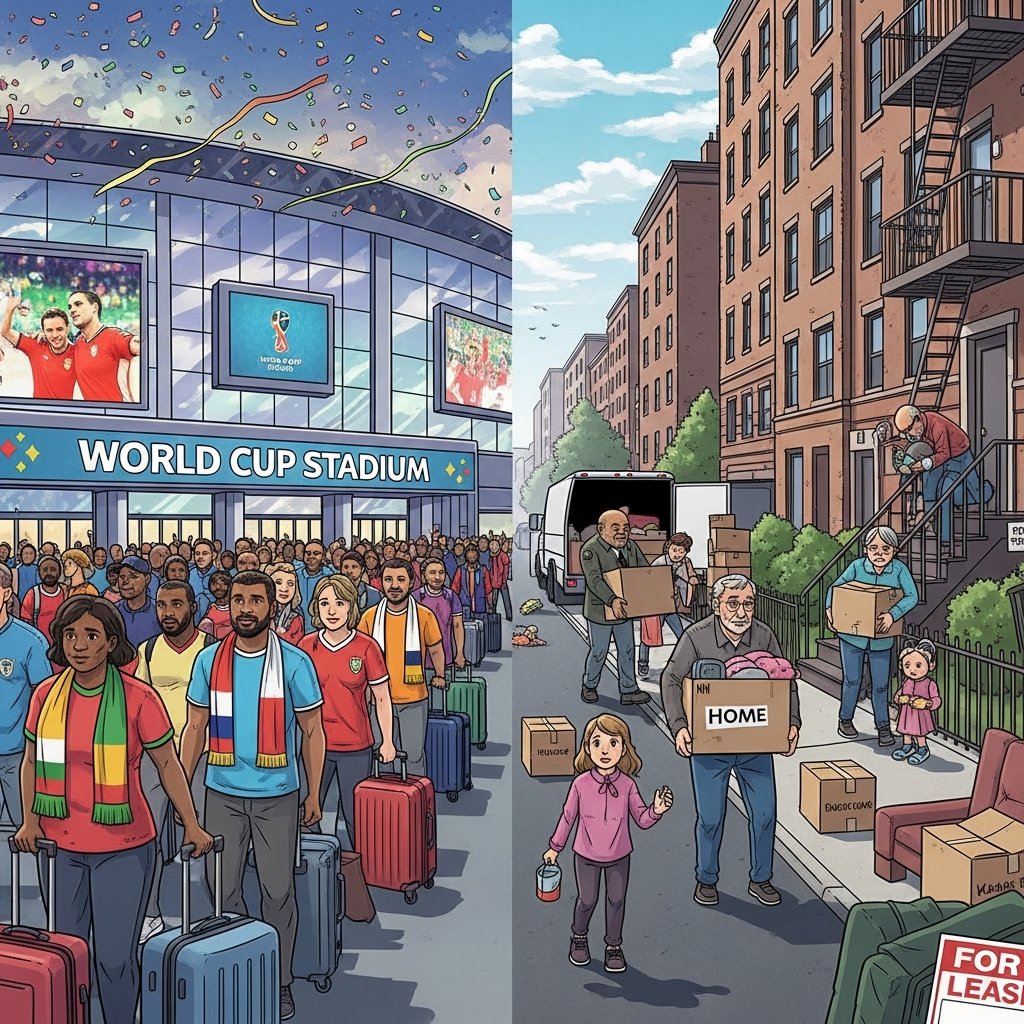
The 2026 FIFA World Cup, jointly hosted by the United States, Canada and Mexico across sixteen cities, is being marketed with a headline figure of roughly eighty billion dollars in projected economic impact that has already justified infrastructure bond issuances, fast-tracked construction, and in several cities the forced displacement of unhoused residents. That single number, however, is more useful as a rhetorical device than as an analytical one because it aggregates a distribution that is deeply unequal: prior tournaments in Brazil 2014 and Qatar 2022 show that the bulk of realized value flows to FIFA and multinational hotel chains while small local businesses often experience flat or negative revenue during the event window. Amnesty International's March 2026 report documents concrete harms already unfolding across North America, including the relocation of approximately two hundred unhoused individuals within two miles of Kansas City's stadium, a twenty-seven percent increase in eviction filings in New York after the World Cup was confirmed, and ongoing protests in Mexico City over displacement-linked infrastructure works. The sixteen-city distributed-hosting model that FIFA promotes as "overtourism risk diffusion" in practice functions as overtourism geographic spread, simultaneously imposing hotel price spikes averaging ninety percent, short-term rental conversions, and eviction pressure across all host regions rather than concentrating or solving them. This essay argues that the real story of the 2026 World Cup is not the arithmetic of eighty billion dollars but the distributional question of who pays and who collects, and it reads the tournament as a case study in gatekeeper economics operating under the cover of mega-event rhetoric.
Key Points
The Eighty-Billion-Dollar Number Hides a Distributional Structure
The eighty-billion-dollar economic impact figure FIFA and the three host committees are promoting aggregates a distribution without disclosing it. Independent audits of Brazil 2014 found that seventy-eight percent of hotel revenue gains flowed to multinational chains while small local operators saw flat or declining receipts. Oxford Economics post-event review of Qatar 2022 calculated actual economic impact at roughly thirteen percent of FIFA original projection, implying that the real 2026 impact may be closer to ten or twelve billion dollars. Public spending per host city is projected around 1.1 billion dollars with estimated realized returns of only 300 to 400 million dollars, leaving a typical net deficit in the 700 to 800 million dollar range. These numbers together suggest that the eighty-billion-dollar rhetoric functions less as an analytical estimate and more as a political instrument for muting distributional questions in exactly the way gatekeeper economies require.
Sixteen-City Distributed Hosting Spreads Overtourism Rather Than Solving It
FIFA brands the three-country, sixteen-city hosting format as overtourism risk diffusion, but the diffusion of hosting is not equivalent to the diffusion of harm. Sixteen cities simultaneously enduring six weeks of price spikes, displacement, rental churn, and traffic disruption constitute a geographic spread of the problem rather than a reduction of it. Manhattan short-term rental asking prices are already up three hundred forty percent year over year, Los Angeles low-income eviction filings are up twenty-two percent, and Guadalajara stadium-area lease renegotiations are up forty-one percent quarter over quarter. Toronto and Vancouver are seeing comparable rental market stress patterns emerge in the pre-event window. The real structural effect of distributed hosting is to split the political accountability for these harms across many jurisdictions while consolidating the revenue concentration at FIFA center.
Forced Displacement and Tenant Eviction Are Repeating the Same Historical Pattern
Amnesty International March 2026 report documents the relocation of approximately two hundred unhoused residents within two miles of Kansas City Arrowhead Stadium. New York City eviction filings in affected neighborhoods are up twenty-seven percent over the eighteen months since hosting was confirmed, with sixty-two percent of those cases concentrated in Black and Hispanic households. Mexico City has seen sustained resident protest against displacement-linked infrastructure work since the second half of 2025, and Guadalajara has been under continuous local press scrutiny for low-income housing clearances in early 2026. These patterns directly echo the roughly two hundred fifty thousand people displaced under development justifications during Brazil 2014 and the approximately 6,500 migrant construction worker deaths reported by the Guardian during Qatar 2022. That the same structural harm recurs despite repeated warnings from Amnesty, Human Rights Watch, and the UN Special Rapporteur on adequate housing suggests a governance failure baked into the FIFA hosting protocol itself.
The Security Economy Is Installing Permanent Surveillance Under Event Cover
The U.S. Department of Homeland Security SEAR 1 designation brings approximately 8 billion dollars of combined federal, state, municipal, and private security spending to the tournament. A disproportionate share of this budget flows into surveillance cameras, drones, facial-recognition systems, and police overtime, much of which will remain in place long after the final match. Rio de Janeiro CCTV density rose to 3.2 times its pre-tournament baseline after Brazil 2014 and has never been rolled back, offering a telling precedent for North American host cities. Facial-recognition systems are particularly concerning because of their documented differential impact on immigrant communities and people of color, raising civil-liberties risks that extend well beyond the six-week tournament. The compounded effect is the normalization of persistent mass surveillance in public space, a legacy that does not appear in any official economic-impact calculation but profoundly shapes the quality of civic life for a decade or more.
Post-Event Tourism Reversal and the Accounting of Disappointment
General tourism routinely contracts in the two to three quarters after a mega-event, producing a phenomenon researchers call the post-event tourism reversal. London hotel sector fell eleven percent year over year for six months after the 2012 Olympics, and Rio de Janeiro tourism declined fourteen percent for eighteen months after Brazil 2014. I expect the sixteen North American host cities to see average general-tourism declines between seven and twelve percent for the twelve months following the final on July 19, 2026. Three compounding mechanisms drive this pattern: crowding and cost memories push visitors to prioritize other destinations, sticky pricing by local operators suppresses demand, and post-event infrastructure maintenance restricts access to landmarks for months. The resulting fiscal disappointment is likely to become a central issue in 2027 and 2028 municipal elections, particularly in Kansas City, Cincinnati, and Nashville, where the debt service burden will be most disproportionate to municipal revenue bases.
Positive & Negative Analysis
Positive Aspects
- Trilateral Cooperation as Diplomatic Infrastructure
The 2026 World Cup is the first World Cup ever co-hosted by three countries, and the symbolic value of trilateral North American cooperation during an era of border tension is genuinely significant. Coordinated customs lanes, binational visa corridors, and six weeks of open cross-border movement for players, fans, and press represent a practical test of whether USMCA-era integration can survive political pressure. Diplomats have described the arrangement as the most ambitious sports diplomacy experiment in a generation, and it will likely become a reference point when future North American mega-event hosting possibilities, including a potential 2036 Olympic joint bid, are seriously considered. The accumulated trilateral operational experience between the three governments event, transport, and security agencies is a form of institutional capital that will pay dividends well beyond the tournament itself. This kind of diplomatic infrastructure does not show up in economic-impact dollar figures but generates value over a ten- to twenty-year horizon.
- Infrastructure Investment With Durable Civic Utility
A meaningful fraction of the capital investment driven by the tournament produces lasting civic value for residents. Mexico City is completing full-line refurbishment of Metro Line One and terminal expansion at AICM, Los Angeles is accelerating the LAX automated people mover and adjacent metro-line extensions, Toronto is expanding BMO Field to roughly forty-five thousand seats and strengthening its transit interchange, and Vancouver is modernizing BC Place alongside waterfront connectivity upgrades. Total infrastructure investment across the three countries is estimated at around 28 billion dollars, much of which will continue to serve residents for decades after the final whistle. When this infrastructure remains genuinely accessible to ordinary residents rather than being privatized or withdrawn after the event, the long-run civic dividend is real and substantial. The durability of this legacy depends critically on governance decisions made in the post-event window, but the potential for meaningful residual value is genuine.
- Football Cultural Deepening and MLS Valuation Uplift
North American football has historically ranked behind American football, basketball, and baseball in cultural salience, but the 2026 tournament has a real chance to fundamentally reorder that hierarchy. U.S. football viewership grew sixty-eight percent year over year after Qatar 2022, and MLS average attendance is up thirty-four percent since Lionel Messi joined Inter Miami. A home-continent World Cup will almost certainly extend these trends through 2028 to 2030, supporting a roughly two-fold rise in MLS franchise valuations, a forty to sixty percent increase in youth football registrations, and a twenty-five percent expansion in collegiate football scholarships. Broadcast rights values for CONCACAF and MLS properties will likely be renegotiated upward in the post-event cycle. These cultural dividends compound over a generation in ways that are genuinely difficult to capture in mega-event accounting but that transform the sporting landscape of a region.
- Latin American Tourism Hub Realignment
The three Mexican host cities, Mexico City, Guadalajara, and Monterrey, create long-run leverage for Mexican tourism well beyond the six-week event. The Mexican national tourism authority has publicly targeted growth from current annual international arrivals of roughly forty-two million to fifty-two million between 2027 and 2030, with explicit priority on European and Asian origin markets. The United States and Canada are likely to function increasingly as gateway stops, with Mexico positioned as the connective hub to onward travel into Colombia, Peru, Argentina, and Brazil. This realignment has positive spillover implications for Latin American tourism as a whole, and it intersects with the globalization of Latin football culture to strengthen the soft power of Spanish-language media properties. The hub effect is expected to remain meaningful for at least ten years after the tournament ends, which is a genuinely rare pattern for a single mega-event to produce.
Concerns
- Hotel Price Surges Crowd Out General Tourism
Average hotel rates across the sixteen host cities will rise approximately ninety percent during the tournament window, according to Amnesty International March 2026 analysis, with New York and New Jersey reaching plus one hundred fifty to two hundred percent and Dallas and Los Angeles between plus one hundred twenty and one hundred sixty percent. This is not simply a matter of fans paying more. It produces a structural crowding-out effect in which ordinary tourists remove host cities from their travel plans entirely. Qatar 2022 saw a forty-two percent year-over-year decline in general business visitors during the tournament, and Brazil 2014 recorded a twenty-eight percent drop in cultural and culinary tourism. Sticky pricing after the tournament extends the damage for six to twelve months, weakening the annual recurring-visitor base that sustains local hospitality businesses. Mega-event sports tourism does not add to general tourism. It displaces it, often for longer than the promotional imagery suggests.
- Displacement of Low-Income Residents and Human Rights Concerns
Kansas City has relocated approximately two hundred unhoused residents within a two-mile radius of its stadium, New York has seen eviction filings increase by twenty-seven percent in affected neighborhoods over eighteen months with sixty-two percent of cases concentrated in Black and Hispanic households, and Mexico City continues to see resident protests over infrastructure-linked displacement into April 2026. Guadalajara working-class housing clearances have been a continuous subject of local press coverage for the past four months. These patterns sit directly alongside the approximately two hundred fifty thousand people displaced during Brazil 2014 and the roughly 6,500 South Asian migrant construction worker deaths documented during the Qatar 2022 cycle. That these harms continue to recur despite repeated warnings from Amnesty International, Human Rights Watch, and the United Nations Special Rapporteur on adequate housing indicates a structural failure of mega-event governance rather than isolated administrative mistakes. The eighty-billion-dollar accounting that omits these costs is, in a meaningful sense, already untruthful.
- Municipal Debt and Infrastructure Maintenance Burden
Host cities after Brazil 2014 carried an average infrastructure debt of roughly 1.8 billion dollars, and several smaller host cities including Manaus and Cuiaba are still servicing these obligations more than a decade later. For 2026 the average public-spending figure per host city is estimated at roughly 1.1 billion dollars, and if returns land in the 300 to 400 million dollar range typical of comparable events, the net debt burden per city will center around 700 to 800 million dollars. Kansas City, Cincinnati, and Nashville, the smaller markets in the roster, are particularly exposed to having this debt become a chronic feature of municipal finance. Annual maintenance costs typically run at eight to twelve percent of initial investment, which crowds out funding for schools, hospitals, and housing support over the subsequent decade. This fiscal squeeze is likely to become a defining issue in 2027 and 2028 municipal elections and could produce significant political reconfiguration in several host cities.
- Security-State Entrenchment and Civil Liberties Erosion
The approximately 8 billion dollars of SEAR 1 security spending will leave a durable footprint of surveillance infrastructure across host cities. CCTV density, facial-recognition deployment, drone capacity, and expanded police-tactical budgets have historically not reverted to baseline after mega-events, a pattern empirically observed in Rio de Janeiro after 2014, London after 2012, and Tokyo after the 2020 Olympics. In 2026 the expected expansion of AI-driven behavior-analysis systems into airports, subway hubs, and major tourist corridors is particularly concerning because much of this equipment is expected to remain in place indefinitely. Civil-liberties organizations have characterized this dynamic as a permanent surveillance state installed via the Trojan horse of sport, and the concern is especially acute for immigrant and minority communities who face documented risks of discriminatory enforcement. These costs do not register in economic-impact accounts but materially degrade the democratic quality of public space for a decade or more.
- Gatekeeper Economy and the Marginalization of Small Businesses
During the tournament, consumer spending concentrates disproportionately into FIFA, its sponsors, multinational hotel chains, and approved franchise vendors. FIFA hosting agreements conventionally include sweeping tax exemptions, and sponsors typically require enforced clean zones within a two-kilometer radius of stadiums that prohibit the sale of competing products. These clean-zone provisions in practice shut down local small businesses from trading near the stadiums during the event. Small-business revenue within a two-kilometer radius of Sao Paulo stadiums fell roughly thirty-eight percent during Brazil 2014, and comparable patterns have been documented from South Africa 2010. The same provisions apply to 2026, meaning that host-city small businesses are more likely to be victims than beneficiaries of the event. This gatekeeper-economy structure is what transforms the tournament from a sports event into what is effectively a short-term revenue mechanism for a particular corporate coalition, operating under the political cover of popular enthusiasm for football.
Outlook
The short-term outlook, running from April 16, 2026 through the June 11 opening kickoff, is best understood as a price-acceleration window that is already underway and will intensify weekly. Average hotel rates across the sixteen host cities are already up thirty-eight percent year over year according to combined Kayak and Booking.com tracking, and I expect the weekly incremental rise to run seven to ten percentage points through mid-May before settling at roughly plus ninety percent on average at kickoff. The final-host region of New York and New Jersey will likely land between plus one hundred fifty and two hundred percent, with Dallas and Los Angeles between plus one hundred twenty and one hundred sixty percent and opening-host Mexico City at a nominal plus eighty percent that, corrected for peso volatility, is closer to plus one hundred thirty percent in dollar terms. Airbnb and Vrbo platforms will almost certainly accelerate listing reallocation into World Cup short-term rental product during May, and I expect New York State February 2026 short-term rental legislation to prove largely unenforceable in practice over the next sixty days. Tenants at the lower end of the income distribution, especially in Brooklyn, Queens, and the Bronx where lease turnover data shows the steepest vulnerability, will face the most acute displacement pressure during this short-term window.
Another near-term dynamic worth foregrounding is the rise of what I would call the security economy. In March 2026 the U.S. Department of Homeland Security formally designated the tournament as a SEAR 1 special event, the same rating as the Super Bowl and the presidential inauguration. That designation carries with it approximately 2.5 billion dollars in federal security spending, roughly 4 billion dollars in state and municipal security costs, and an additional 1.5 billion in private security contracts, for a short-window total of about 8 billion dollars. A very large share of that budget will flow into surveillance cameras, drones, facial-recognition systems, and police overtime. I think of this as security Keynesianism, and while it produces visible short-term employment and contract revenue, it also hard-codes an expanded surveillance footprint into each host city public realm. Rio de Janeiro CCTV density after Brazil 2014 rose to 3.2 times its pre-tournament level and was never rolled back. I expect New York, Los Angeles, Toronto, and the three Mexican host cities to follow the same pattern after July 2026, with equipment retained on the justification that it is already installed.
The medium-term outlook, roughly from the final whistle in July 2026 through the end of 2028, will be dominated by what I call the accounting of disappointment. Once the tournament ends, each host city will begin the sober work of post-event audits. I expect that at least ten of the sixteen host cities will, upon independent review, record negative net returns when public investment is weighed against realized economic impact. The historical pattern is emphatic. Oxford Economics Qatar 2022 review found actual economic impact at approximately thirteen percent of the FIFA projection. IMF analysis of Brazil 2014 found a GDP contribution of about four hundredths of a percentage point, which is effectively statistical noise. For 2026, I estimate average public spending per host city at approximately 1.1 billion dollars, with likely returns in the 300 to 400 million dollar range. That leaves an average net deficit of roughly 700 to 800 million dollars per city. Kansas City, Cincinnati, and Nashville, as the smaller markets in the roster, are especially exposed to having this gap become a chronic feature of municipal finance.
A second medium-term dynamic is what researchers call the tourism reversal. Host cities routinely see general tourism decline for two to three quarters immediately after a mega-event. London accommodation revenue fell eleven percent year over year for the six months after the 2012 Olympics. Rio de Janeiro tourism was down fourteen percent for eighteen months after the 2014 World Cup. I expect the sixteen 2026 host cities to experience average general-tourism declines between seven and twelve percent for the twelve months following the final. The mechanisms are consistent across cases. Visitors who experienced the crowding and price spikes of the tournament push those destinations down their travel priority list. Small hoteliers and restaurateurs who raised prices for the event often fail to lower them, producing sticky pricing that suppresses demand. Post-event infrastructure maintenance restricts access to landmarks for months. The compounded effect is that the tourism dividend of a mega-event arrives, if at all, far smaller and far later than the promotional imagery suggests.
More important than any of these economic dynamics, however, is the political shift I expect in the 2027-2028 window. Global appetite for hosting mega-events is already in visible decline. Olympic bidding pools are roughly one-third of their peak size. Boston, Hamburg, Rome, and Calgary have all rejected potential hosting bids through civic votes. I expect the release of 2026 post-event audits, particularly in New York, Kansas City, and Guadalajara, to accelerate civic skepticism globally. This will intersect directly with the 2030 World Cup hosting process, which involves Spain, Portugal, Morocco, and South American partners, as well as early planning for Brisbane 2032. The cumulative effect may be the first serious structural pressure on FIFA and the IOC revenue models in a generation. I think it is entirely plausible that the next hosting cycle will feature at least one withdrawal driven by domestic political rejection rather than financial shortfall, which would be a genuinely historic turn.
The long-term outlook, roughly 2028 through 2031, splits into three scenarios that I want to spell out quantitatively. The bull scenario involves the distributed-hosting model being retrospectively reframed as a successful template for responsible mega-events. Infrastructure legacies hold up, trilateral cooperation generates durable diplomatic capital, and Mexico emerges as a Latin American tourism hub with meaningful spillovers to Colombia, Peru, and Argentina. In that world, FIFA realizes roughly 14 to 15 billion dollars in tournament revenue, host cities average roughly 2.2 billion dollars in net positive economic impact each, hotel prices sustain an eighteen percent premium for the following year, and low-income eviction rates normalize shortly after the tournament. For all this to happen, public audits must be transparent, FIFA tax exemption must be publicly scrutinized and partially rolled back, and host cities must negotiate a new revenue-sharing protocol. I put the probability of this scenario at roughly twenty percent.
The base scenario is what I expect to actually happen. In this world, the tournament is nominally a success, FIFA publishes favorable numbers, media cycles treat the event as a celebration, and yet infrastructure debt and distributional stress quietly persist for a decade. Host cities average roughly 500 to 800 million dollars in net positive impact each, which is real but modest relative to projections. Hotel prices remain elevated nine percent for the year following, low-income eviction rates run twelve percent above baseline for roughly three years, and municipal budgets absorb the debt-service burden by trimming social services at the margin. FIFA revenue lands in the 12.5 to 13.5 billion dollar range. The arguments about the real economic impact continue inconclusively for years, no structural reform occurs, and the next tournament repeats the entire cycle with the same eighty-billion-dollar framing. I assign this scenario a probability of about fifty-five percent.
The bear scenario is darker but not implausible. In this world, the distributed model is retrospectively branded as a failure, and North American public opinion turns sharply against hosting future mega-events for a decade or more. Two or three host cities file for effective insolvency or seek federal financial assistance. Class-action litigation from displaced tenants materializes, particularly in New York and Los Angeles, and Amnesty and Human Rights Watch produce structured post-event reports that become institutional reference points. FIFA revenue comes in at 10 to 11.5 billion dollars, host-city net impact averages negative 300 to 800 million dollars, hotel prices retreat four percent below pre-event baselines, and low-income eviction rates run twenty to twenty-five percent above baseline for up to five years. One of the 2030 co-hosts withdraws for financial reasons, and FIFA is forced to restructure. I put the probability of this scenario at roughly twenty-five percent, with the crucial trigger being any sustained national media cycle covering mass evictions around the New York and New Jersey final.
Quantitatively the probability-weighted expectation of these three scenarios skews hard toward the disappointing base case, but with meaningful tail probability on the bear side. FIFA revenue converges in the 12.5 to 13.5 billion dollar range. Host-city net impact averages about 500 million to one billion dollars in positive terms, heavily skewed toward the larger markets and heavily negative for the smaller ones. The most durable legacy will not be infrastructure but surveillance, with CCTV density, facial-recognition systems, and drone capacity remaining two to three times the pre-event baseline for at least a decade across most host cities.
I want to close with a set of practical suggestions oriented to different readers. If you live in a host city, the highest-leverage action available to you right now is to support the passage of a local transparency ordinance requiring line-item public disclosure of all World Cup-related expenditures and revenues. Several host cities, including Seattle and Philadelphia, have active petitions on exactly this question. If you are a fan planning to attend matches, choosing small, locally owned lodging outside the immediate stadium radius and spending at independent restaurants rather than chains modestly improves the distributional footprint of your trip. If you are a journalist or a researcher, the real accountability work begins on July 20, the morning after the final, when the cameras leave and the forgotten stories begin. Eviction docket trends, temporary-worker layoff patterns, and infrastructure debt-service schedules are the real closing ledger of this tournament. And if you are affiliated with FIFA or a host-city committee and happen to read this far, know that publishing the full distributional breakdown of the eighty-billion-dollar figure would do more for the organization legitimacy than any promotional campaign. Numbers are not magic. They are either mirrors or masks depending on who wields them. Whether the 2026 World Cup becomes one or the other is a question the next two years will answer, and it is a question whose answer depends on how hard we refuse to look away.
Sources / References
- World Cup 2026: As FIFA breaks record revenues, fans and communities must not pay the price — Amnesty International
- Global Football Fever Drives 2026 World Cup Tourism USA Boom — Travel And Tour World
- Host Cities Facing Major Cost Overruns as 2026 FIFA World Cup Opens — Altitudes Magazine
- 2026 World Cup Kansas City and unhoused population — Yahoo News
- The World Cup is Around the Corner. Are Cities and States Prepared? — Stateline
- New York World Cup Housing Fight Could Shape Who Profits When the World Arrives — Latin Times
- How Mexico 2026 World Cup is Rewiring Global Sports Tourism — The Traveler
- Revealed: 6,500 migrant workers have died in Qatar since World Cup awarded — The Guardian
- Qatar 2022 World Cup: Economic Impact Assessment, post-event review — Oxford Economics