
The Age of Brain Investing Is Here — The $11 Billion 'Brain Wealth' Industry Is Coming for What's Inside Your Skull
Summary
Cognitive function managed like a stock portfolio, a Brain Capital Index posted alongside GDP. In 2026, wellness has shifted from body to brain. We examine the $11B nootropics boom and whether Brain Wealth is real or over-optimization.
Key Points
Explosive Growth of the $11 Billion Nootropics Market
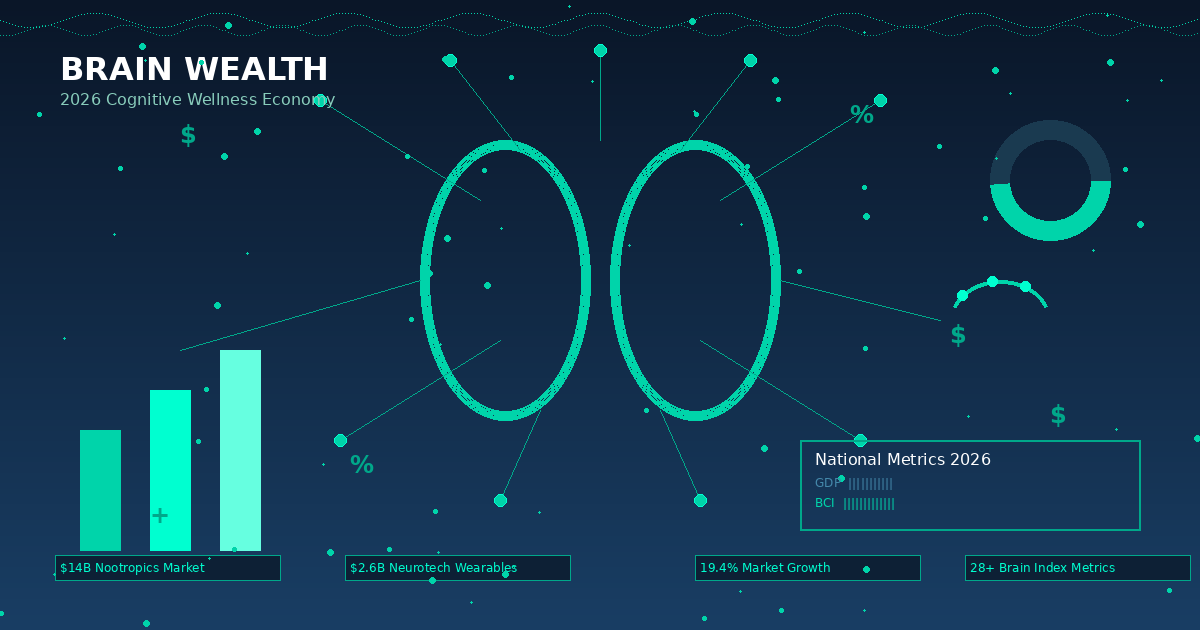
The global brain health supplement market stands at approximately $14 billion in 2026, with nootropic supplements commanding over 50% market share. Yesterday's generic multivitamin is being replaced by AI-formulated personalized bio-identical nootropics. Services have emerged that prescribe individually optimized cognitive enhancement compounds based on real-time blood tests and biometric data. The stress and anxiety segment is projected to grow at 14.6% annually between 2025 and 2030, the fastest rate in the market. North America commands 48.86% of the market, revealing significant geographic concentration.
Democratization of Wearable Neurotech and the Focus Subscription Era
The wearable neurotech market is growing from $2.18 billion in 2025 to $2.61 billion in 2026, a 19.4% growth rate, with projections reaching $5.34 billion by 2030. Consumer devices like Muse Athena consistently rank among Amazon bestsellers, and Indian startup Mave Health secured $2.1 million in seed funding to launch a tDCS wearable promising improved focus in just 20 minutes daily. Consumer price points now range from $100 to $1,500, rapidly lowering barriers to entry. High performers are subscribing to non-invasive TMS and tDCS to fine-tune neural circuits during 12-hour workdays in what has been dubbed focus as a service.
Nordic Countries Adopt Brain Capital Index Alongside GDP
In early 2026, several Nordic countries began integrating the Global Brain Capital Index into official policy frameworks alongside traditional GDP. The index synthesizes over 28 indicators spanning brain health, brain skills, and enabling environments including education quality, health systems, governance, and environmental risks like air pollution. Where GDP measures output, the Brain Capital Index measures capacity, treating neural health as core infrastructure on par with power grids and transport networks. McKinsey estimates scaling cost-effective interventions could prevent 267 million DALYs globally by 2050 and generate up to $6.2 trillion in cumulative GDP gains.
The Astronomical Economic Cost of Brain Health Disorders
According to Fortune, brain health disorders currently cost the global economy $5 trillion annually, with projections reaching $16 trillion by 2030. This means investment in brain health has become a macroeconomic imperative, not merely personal wellness. The World Economic Forum at Davos officially launched an initiative to make brain capital an economic development indicator in this context. McKinsey's declaration that humanity's greatest competitive advantage in the AI era is stronger brains captures the essence of this movement.
The Emergence of Cognitive Inequality as a New Class Structure
The biggest shadow of Brain Wealth is the deepening of cognitive inequality. AI-personalized nootropic subscriptions cost hundreds of dollars monthly, clinic-grade neurofeedback runs $150-300 per hour, and the market is concentrated among high-income urban residents in developed nations. A vicious cycle is forming where cognitive gaps translate into income gaps, which feed back into cognitive investment gaps. If cognitive ability is the key competitive advantage in the AI era, cognitive inequality becomes the class-determination mechanism of the future. The challenge remains to make scientific brain health management a universal right rather than a privilege of the few.
Positive & Negative Analysis
Positive Aspects
- Dismantling Mental Health Stigma
The frame of managing cognitive function as an asset relocates mental health from the domain of illness to investment. In Silicon Valley and on Wall Street, neurofeedback sessions have become as natural as having a personal trainer, and as this culture spreads, social resistance to seeking help drops dramatically. Overall demand for and access to mental health services will rise.
- Surge in Private Investment in Neuroscience Research
Demand from the $11 billion nootropics and $2.6 billion neurotech markets flows directly into research funding. A virtuous cycle is forming where Alzheimer's, Parkinson's, and ADHD research rides the coattails of cognitive enhancement research for healthy people, opening foundational science breakthroughs. Realizing McKinsey's projection of 267 million DALYs prevented by 2050 requires this accelerating investment.
- Technology Democratization and Expanded Access
Neurofeedback equipment that cost thousands at clinics 2-3 years ago now starts at $100. Muse Athena consistently ranks among Amazon top sellers, and cognitive training via smartphone apps is essentially free. While a gap persists with cutting-edge personalized services, basic brain health management tools have become incomparably more accessible.
- Paradigm Shift at the National Policy Level
When a Brain Capital Index stands alongside GDP, education, health, and environmental policies are evaluated not only on economic growth contribution but also on enhancing citizens cognitive capacity. Air pollution regulations can be justified on brain health grounds, and education investment expanded from a brain capital perspective. Such policy frame shifts are slow but their impact is enormous.
- Redefining Human Competitiveness in the AI Era
As McKinsey declared, humanity's greatest competitive advantage in the AI era is stronger brains. The Brain Wealth trend promotes investment in uniquely human values that resist technological replacement: creativity, critical thinking, and emotional intelligence. This serves as a positive starting point for redefining the human role in an AI-coexistent future.
Concerns
- Deepening Cognitive Inequality
Premium services are overwhelmingly concentrated among developed nations, high-income earners, and urban residents, with North America commanding 48.86% of the market. Personalized nootropic subscriptions cost hundreds monthly, neurofeedback runs $150-300 per hour, creating a vicious cycle where cognitive gaps become income gaps that feed back into cognitive investment gaps. Cognitive inequality may become the class-determination mechanism of the future.
- Insufficient Scientific Evidence
While the $11 billion market explodes, clinical evidence for most cognitive enhancement supplements remains limited. Given looser FDA regulation for supplements versus pharmaceuticals, a substantial gap exists between marketing claims and actual efficacy. Consumers may spend hundreds on unverified products while neglecting fundamentally effective health habits like sleep, exercise, and social connection.
- Commodification of the Mind and the Final Evolution of Hustle Culture
Framing the brain as an asset and cognitive function as returns risks reducing human consciousness and experience to purely economic value. Normalizing neural circuit fine-tuning during 12-hour workdays could evolve into a new form of labor exploitation. Even the Global Wellness Summit identified backlash against over-optimization as a top 2026 trend.
- Brain Data Privacy Threats
Neurofeedback devices and cognitive monitoring apps collect brainwaves, focus patterns, and emotional states, the most intimate biometric data imaginable. Data leaks or commercial exploitation would have fallout of a completely different magnitude from credit card breaches. The dystopia where employers monitor brain states and insurers adjust premiums based on brain health scores is already technically possible.
- Health Risks from Unverified Nootropics
Many brands flooding the market claim cognitive enhancement effects without adequate clinical trials. With insufficient long-term side-effect data accumulated, consumers self-prescribing pose potential health risks. The tendency for AI-personalized marketing to substitute for scientific validation is particularly concerning.
Outlook
In the short term, over the next one to six months, the Brain Wealth market will hit the accelerator. The second half of 2026 is expected to see a parade of new wearable neurotech product launches from major tech companies. Industry rumors persist that Apple may integrate brainwave monitoring into AirPods, and Samsung is reportedly considering cognitive function tracking in follow-up models to the Galaxy Ring. With startups like Mave Health entering the market on $2.1 million seed rounds, multiple sub-$100 mass-market neurofeedback devices are likely to appear among Amazon bestsellers by late 2026. In the nootropics space, AI-powered personalized cognitive subscription services are poised for explosive growth across the US and Europe, supported by the stress relief segment's 14.6% annual growth rate. The caution flag for this period, however, is over-marketing. A proliferation of unverified nootropic brands is expected, and a consumer trust crisis could become the first real test.
In the medium term, six months to two years out, three significant transitions are predicted. First, the global spread of the Brain Capital Index. The adoption that began in the Nordics in early 2026 is likely to expand to innovation-oriented nations like Canada, Singapore, and South Korea by 2027. Canada is already engaged in policy discussions to make brain capital a new pillar for its innovation economy, and South Korea's combination of intense educational ambition and mental health crisis creates substantial demand for brain capital policy. Second, consolidation of the wearable neurotech market. The currently fragmented landscape of small neurotech startups will begin restructuring through acquisitions by Big Tech players like Apple, Google, and Samsung, or through attrition. With 64% of companies in the consumer EEG segment already using this technology, differentiation is increasingly difficult, inevitably leading to an M&A wave. Third, the emergence of regulatory frameworks. As the regulatory vacuum around neurofeedback devices and cognitive enhancement supplements becomes a social issue, the EU is expected to proactively propose regulations related to Neuro Rights. GDPR-level regulations governing the collection, storage, and use of brain data could take shape by the end of 2027.
In the long term, looking two to five years ahead, three scenarios emerge. In the Bull Case, the Brain Capital Index is adopted by 30+ countries, neurotech prices fall to smartwatch levels, and cognitive health management becomes as routine as taking your temperature. The brain health supplement market surpasses $40 billion by 2030, and the wearable neurotech market reaches $5.34 billion. The convergence of AI and neurotech pushes early Alzheimer's detection rates above 80%, dramatically reducing dementia-related social costs and entering the trajectory of McKinsey's projected $6.2 trillion GDP gains. In the Base Case, the market grows steadily but at a moderated pace due to regulatory uncertainty and the limits of scientific validation. Neurotech wearables occupy a position similar to fitness trackers, and brands previously hidden behind initial hype begin to be culled. The Brain Capital Index is adopted by 10-15 countries, but tangible policy effects remain limited. Notably, even in this scenario, the brain health supplement market reaches $13.69 billion by 2034, meaning the base case still presupposes significant growth. In the Bear Case, large-scale reports of health damage from unverified nootropics collapse trust in the entire market. A wave of lawsuits over neurofeedback device malfunctions and a brain data breach scandal prompt regulators to tighten aggressively. Even in this scenario, awareness of brain health importance does not retreat, but private market growth decelerates sharply and may reorganize around hospitals and public healthcare systems.
Regardless of which scenario materializes, one thing is certain: the trajectory of brain health ascending from an individual's optional wellness activity to social infrastructure is irreversible. The question is whether this massive transition will be designed to benefit everyone, or become yet another engine of inequality. If we take Fortune's warning seriously that the global cost of brain health disorders will reach $16 trillion by 2030, we don't have much time to defer the answer.
Sources / References
- Brain Health Supplements Market Size Report [2034] — Fortune Business Insights
- Brain Health Supplements Market Size Industry Report, 2030 — Grand View Research
- Poor brain health costs the world economy $5 trillion a year — Fortune
- The Human Advantage: Stronger Brains in the Age of AI — McKinsey
- Global Brain Economy Initiative - Brain Capital Index Framework — Global Brain Economy Initiative
- 2026 Wearable Neurotech Market Analysis — WhatTech
- Neurotech Consumer Market Atlas — Centre for Future Generations
- Mave Health Raises $2.1M to Launch Focus and Stress Regulation Wearable — Las Vegas Sun