
Asia's 50 Best 2026: The Reason Your Favorite Restaurant Didn't Make the List Has Nothing to Do With Taste
Summary
The Asia's 50 Best Restaurants 2026 rankings have dropped, and once again the structural contradiction of 318 anonymous voters deciding the hierarchy of Asian gastronomy has surfaced. Alongside the cultural significance of Hong Kong's The Chairman claiming the number one spot, this piece examines how the economics of rankings have created a deepening polarization within the fine dining ecosystem.
Key Points
The Structural Contradiction of 318 Voters
Asia's 50 Best Restaurants operates through a voting system of 318 anonymous Academy members. The Academy is divided into six regions — India and the Indian Subcontinent, Southern Southeast Asia, Northern Southeast Asia, Hong Kong/Taiwan/Macau, Mainland China/Korea, and Japan — with 53 members assigned to each region, including a regional chair. Each member votes for 10 restaurants, with at least 4 required to be outside their home country. In a continent of 48 nations and 4.6 billion people, having 318 individuals determine what constitutes 'the best' is a system fundamentally lacking in statistical representativeness. The voter pool is limited to food writers, critics, chefs, restaurateurs, and gastronomic travelers, which inevitably skews the results toward fine dining establishments. Gran Tourismo Travels has systematically analyzed and criticized the structural flaws in the voting process, while the 'Occupy 50 Best' petition pointed to the absence of consistent, objective gastronomic criteria. IBTimes and TIME have also reported on a major point of criticism: there are no provisions prohibiting lobbying, where restaurants or tourism boards cover voters' dining expenses. This stands in stark contrast to the Michelin system's approach of dispatching professional inspectors, which is why the recurring label of 'popularity contest' persists year after year. While 50 Best has appointed Deloitte as an external auditor to enhance vote-counting transparency, criticism remains that the lack of standardized voting criteria and uneven expertise among voters continue to undermine the credibility of the results.
The Chairman at Number One — A Victory for Asian Culinary Identity
Danny Yip of Hong Kong's The Chairman opened his restaurant in Central in 2009, rejecting traditional luxury ingredients like shark fin and bird's nest in favor of redefining Cantonese cuisine around local, seasonal produce. He maintains his own team of fishermen who procure the finest seafood daily from local markets, collaborates with Shu Kee — a Hong Kong institution specializing in traditional beancurd skin — and sources rare ingredients such as 20-year-aged lemons from local producers. This marks The Chairman's second time at number one, following 2021, when Yip was unable to attend the ceremony due to the COVID pandemic. This time around, he expressed that 'receiving this award in Hong Kong means everything.' In 2024, he also received Asia's 50 Best Icon Award in recognition of 'changing the way Cantonese food is perceived on the world stage.' This achievement is symbolically momentous: it demonstrates that Asian cuisine can reach the pinnacle of global gastronomy on its own terms, without borrowing the grammar of French or Italian cooking. The fact that Wing, led by Chef Vicky Cheng and located in the same building (The Wellington), claimed second place only amplified Hong Kong's gastronomic standing in dramatic fashion. SCMP and Bloomberg have provided in-depth analysis of the cultural implications of this achievement, noting it as a landmark case where a philosophy of sustainable sourcing meets culinary excellence on the international stage.
The Intensifying Battle Among Asian Gastronomic Cities
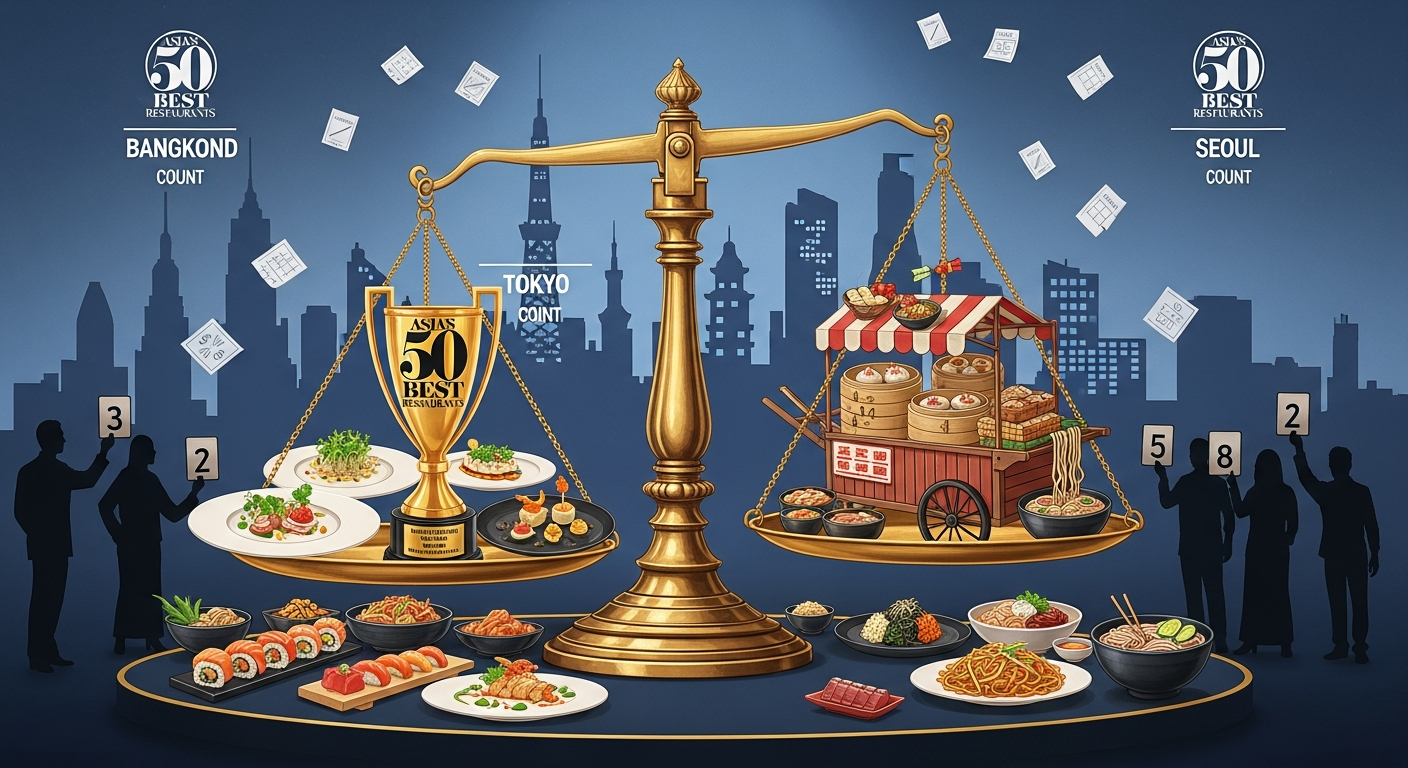
Bangkok leads the pack with 9 restaurants on the list, including Gaggan, Nusara, Sorn, Suhring, Potong, Ms Maria & Mr Singh, and Le Du. Tokyo follows with 7 (Sezanne, Sazenka, Maz, Florilege, Myoujyaku, Crony, Narisawa), while Seoul, Singapore, and Hong Kong each placed 6 restaurants. Seoul's representatives include Mingles (4th), Onjium (14th), Eatanic Garden (26th), Mosu (41st), and Bium (43rd), and Onjium's Chef Cho Eun-hee was named Asia's Best Female Chef, further elevating Korea's gastronomic profile. Thailand has positioned gastronomy as a core pillar of its tourism industry and soft power strategy; its chef training programs, led by Chef Chumpol Jangprai, expanded dramatically from 1,300 participants in 2025 to 26,786 in 2026. Thai Lights examined in depth how Bangkok chefs are forging a 'Thai Gastro Visionaries' movement that fuses culinary heritage with radical modernism. Korea Herald and Asian News Network have extensively covered the rise of Korean gastronomy on the global stage. Seoul's placement of 6 restaurants is a feat that would have been unimaginable just two or three years ago, and this intercity competition is catalyzing a virtuous cycle of government investment in gastronomy across the region.
How Rankings Create Gastronomic Polarization and Self-Reinforcing Loops
Restaurants that land on the 50 Best list see bookings fill up for a year and investors come knocking immediately after the rankings are announced, while those outside the list fade into obscurity. According to Black Box Intelligence data reported by Restaurant Dive, 10 to 15 percent of restaurants worldwide are on the brink of closure, with 9 percent of full-service and 4 percent of limited-service restaurants classified as at-risk. Restaurants that have seen revenue decline by more than 30 percent from their 2025 peak are flagged as endangered, and Black Box Intelligence VP Victor Fernandez has stated that for the 3 percent of full-service restaurants with revenue drops exceeding 50 percent, closure is 'a matter of when, not if.' With cumulative inflation since 2019 having driven costs up by roughly a third, the ranking system is actively accelerating this polarization. Restaurants on the list enter a self-reinforcing loop — increased media exposure strengthens voter recognition, which sustains high rankings the following year — ultimately reflecting not 'the best flavors' but 'the most well-known flavors.' This is a structural problem embedded in the system itself.
The Real Problem Isn't the Rankings — It's a Culture of Ranking Dependency
More troubling than the contradictions within the ranking system itself is the culture in which consumers outsource their entire gastronomic judgment to a list. Treating the 50 Best as a checklist to complete, hopping from one listed restaurant to the next for the obligatory social media photo, is less about enjoying food and more about collecting experiences. The philosophy of sustainability and symbiosis with local farmers that Danny Yip champions gets reduced to a '1 restaurant in the world, verified' post on Instagram. The structural exclusion of street food and everyday neighborhood restaurants from the evaluation system will never be resolved as long as consumers refuse to look beyond the rankings. This dependency on rankings ultimately narrows the diversity of dining experiences and disconnects people from the genuine act of discovering food through their own palate and curiosity.
Positive & Negative Analysis
Positive Aspects
- Elevating Asian Gastronomy on the Global Stage
The 50 Best has played a pivotal role in raising Asian cuisine from the margins of a Western-centric gastronomic discourse once dominated by France, Italy, and Spain. The separate Asia edition has enabled chefs in Bangkok, Tokyo, Hong Kong, and Seoul to gain international recognition, transcending a mere ranking to become a form of cultural acknowledgment. In the long march of Asian food shedding the 'ethnic food' label and entering the mainstream culinary conversation, the contribution of the 50 Best platform cannot be dismissed. The Chairman's ascent to number one in 2026 represents the zenith of this trajectory, and it sends a powerful message that Cantonese cuisine can claim the top spot without adopting Western culinary grammar. This cultural elevation has ripple effects beyond individual restaurants, reshaping how international food media covers and values Asian culinary traditions.
- Discovering Hidden Restaurants
Each year, newly listed restaurants that were virtually unknown abroad suddenly receive international attention after their inclusion on the 50 Best list. Bangkok's Potong and several newly entered Seoul restaurants have benefited from this discovery function, gaining reservations from international diners within days of the announcement. While the scope remains limited to fine dining, the platform undeniably shines a global spotlight on meaningful efforts to reinterpret traditional food cultures through a contemporary lens. This mechanism gives small, independent restaurants an opportunity to achieve global recognition that would otherwise be nearly impossible through their own marketing efforts alone. The discovery effect is particularly significant for restaurants in cities outside the traditional culinary spotlight, as it can catalyze an entirely new stream of international gastronomic tourism.
- A Cultural Victory for Cantonese Culinary Identity
The Chairman reaching number one while steadfastly refusing to adopt French techniques or Nordic aesthetics, instead holding firm to the roots of Cantonese cuisine, proves that Asian food can stand at the very top without conforming to Western standards. Danny Yip's rejection of shark fin and his insistence on local ingredients was both ethically and gastronomically the right direction, and its validation at the highest level sends a profoundly positive signal to all of Asian gastronomy. This will likely be remembered as the first time a Chinese restaurant claimed Asia's number one in a Western-originated ranking system. The significance extends beyond a single restaurant: it gives permission to the next generation of Asian chefs to pursue their culinary roots with confidence rather than defaulting to Franco-centric fine dining conventions. In a broader cultural context, this victory challenges the implicit hierarchy that has long placed European cuisine at the apex of gastronomic achievement.
- Stimulating Healthy Competition and Investment Among Cities
The competitive dynamic among Bangkok (9 restaurants), Tokyo (7), and Seoul (6) is driving government and tourism authority investment in the culinary sector across the region. Thailand's Thai Gastro Visionaries movement, Korea's strategy for globalizing Korean cuisine, and Japan's modernization of traditional kaiseki are all products of this intercity rivalry. The ripple effects extend to chef training programs, ingredient supply infrastructure, and food festival investment, collectively advancing the entire gastronomic ecosystem. Thailand's chef training programs expanded from 1,300 participants in 2025 to 26,786 in 2026, demonstrating the scale of governmental commitment. This competition ultimately contributes to national economic vitality through culinary tourism and creates a virtuous cycle where investment begets quality, which begets higher rankings, which begets further investment.
- International Recognition for Korean Fine Dining
Seoul placing six restaurants on the list — Mingles (4th), Onjium (14th), Eatanic Garden (26th), Mosu (41st), and Bium (43rd) — constitutes international validation of Korea's explosive growth in fine dining. Chef Cho Eun-hee of Onjium being named Asia's Best Female Chef, with her approach of reinterpreting historical Korean food texts, has earned global recognition for a distinctly Korean culinary philosophy. As Korea Herald reported, this achievement reflects the combined momentum of Korean cuisine going global, the expansion of millennial and Gen-Z food culture, and an outstanding pipeline of chef talent. Following K-pop, K-food is demonstrating growing global influence, with meaningful positive spillover into Korea's tourism industry. The fact that such results were unimaginable just two or three years ago underscores the sheer velocity of this growth.
Concerns
- The Statistical Representativeness Problem of 318 Voters
Evaluating the gastronomy of 48 nations and 4.6 billion people through the votes of 318 anonymous individuals is structurally deficient in representativeness. The Academy is organized into six regions of 53 members each, where every member votes for 10 restaurants with a minimum of 4 outside their home country. Voter identities remain undisclosed, and without standardized voting criteria, disparities in experience and exposure among voters can distort outcomes. Gran Tourismo Travels has systematically critiqued the structural weaknesses of the voting system, while TIME has flagged the absence of anti-lobbying provisions — specifically, the lack of rules prohibiting tourism boards or restaurants from covering voters' dining expenses. Though Deloitte serves as an external auditor for vote counting, the inherent characteristics of a voter pool embedded within international gastronomic networks makes a fine dining bias virtually inescapable. This opacity in the voting process remains the single most corrosive factor undermining the system's credibility.
- Severe Polarization in the Gastronomic Economy
Restaurants that make the list experience a flood of bookings and investment immediately after the announcement, while thousands of restaurants outside the list see their visibility evaporate. According to Black Box Intelligence data reported by Restaurant Dive, 10 to 15 percent of restaurants worldwide face closure, and the ranking system is actively accelerating this divide. The stark contrast between independent restaurants fighting for survival amid rising costs and labor shortages, and the 50 Best ceremony's glamorous gala dinners, is a microcosm of the industry's growing inequality. The 'winner-takes-all' dynamic driven by rankings poses a real threat to the diversity of the gastronomic ecosystem.
- Systematic Exclusion of Street Food and Everyday Cuisine
The 50 Best system is structurally tilted toward fine dining, which means Asia's culinary soul — street food and everyday neighborhood cooking — is systematically left out. Bangkok's Jay Fai earning a Michelin star remains an extraordinary exception; the vast majority of street food artisans never appear on any ranking whatsoever. The voices of locals who insist that Thailand's true flavors live in Chinatown stalls find no representation in this evaluation system, which amounts to a failure of gastronomic democracy. This exclusionary structure has the additional side effect of narrowing consumers' culinary horizons to the fine dining corridor.
- Ranking Ossification Through Self-Reinforcing Loops
Restaurants on the list enter a self-reinforcing cycle — increased media exposure strengthens voter recognition, which sustains high rankings the following year — creating an extremely high barrier to entry for new restaurants. The result is that rankings reflect not 'the best flavors' but 'the best-known flavors,' a mechanism that slowly strangles culinary diversity. The brand power of established top-ranked restaurants dominates the rankings regardless of actual changes in quality, generating an inertia that becomes self-perpetuating. The structural problem of innovative new restaurants being unable to receive a fair evaluation is becoming increasingly entrenched.
- The Winner-Takes-All Effect and Cognitive Bias
Consumers overwhelmingly remember number one and fail to retain anything below second place. The fact that The Chairman topped the 2026 list will be widely known, but hardly anyone can name the restaurant at number ten. This cognitive bias neutralizes the list's original purpose of introducing 50 diverse restaurants, ultimately concentrating demand on a single establishment. Restaurants in the lower half of the list find themselves trapped in a paradox: despite making the cut, they still fail to gain sufficient recognition. The imbalance between the top spot's outsized visibility and the relative anonymity of the remaining 49 undermines the very premise of a ranked list.
Outlook
Let me start with what we can expect in the coming months. In the second half of 2026, a gastronomic tourism rush toward Hong Kong — where The Chairman and Wing swept first and second place — will kick into high gear. Based on reporting from Bloomberg and SCMP, reservation waitlists have already stretched beyond three months, and this phenomenon is likely to persist through at least the end of the year. Simultaneously, Bangkok will aggressively leverage its commanding tally of 9 listed restaurants in its tourism marketing. The Tourism Authority of Thailand is almost certainly preparing a 'Bangkok: World Capital of Gastronomy' campaign as we speak. Seoul, too, will capitalize on its 6 placements to boost Korean tourism promotion, and Korea Herald reporting already signals a government-level push to amplify culinary tourism.
But behind this short-term boom lurks an uncomfortable truth. The restaurants that made the list may find themselves forced to compromise on service quality and the dining experience as they scramble to meet suddenly surging demand. In the case of The Chairman, the local seasonal ingredients that Danny Yip insists upon have inherent supply limitations — if bookings triple, can that philosophy survive intact? The restaurant works with its own team of fishermen and sources from local producers like Shu Kee, a traditional beancurd skin maker, and these artisanal supply chains simply cannot scale overnight. This is the most fascinating tension to watch in the near term. We could see the paradoxical scenario of 'the glory of being number one threatening the very identity that earned it.'
The short-term economics are equally telling. Hotels in Hong Kong's Central district will likely develop package deals bundling The Chairman reservations with luxury stays, turning a meal into a commodity. Airlines could add 'gastronomic getaway' routes targeting food tourists from mainland China, Japan, and Southeast Asia. The economic multiplier effect of a number-one ranking extends far beyond the restaurant itself, permeating hotel bookings, retail spending, and ancillary tourism revenue. For Hong Kong specifically, which has been working to rebuild its reputation as an international hub after several turbulent years, this double-crown achievement arrives at a strategically opportune moment.
As we move into a one-to-two-year horizon, these dynamics are poised to drive structural shifts in the Asian gastronomic map. The most significant mid-term trend to watch is the intensification of intercity gastronomic competition. Bangkok currently leads with 9 restaurants, but Tokyo (7) and Seoul (6) are closing in fast. Governments and tourism authorities in each city will increasingly treat ranking placements as a core KPI for their tourism industries, which will translate into investments in chef training programs, ingredient supply infrastructure, and food festival development. We are witnessing the emergence of what might be called 'gastronomic statecraft,' where culinary achievement becomes an instrument of national soft power.
Thailand has already taken a decisive lead in this institutional approach. Through the Thai Gastro Visionaries movement, the country is systematically nurturing young chefs, and its training programs expanded dramatically from 1,300 participants in 2025 to 26,786 in 2026 — an increase of more than twenty-fold in a single year. Chef Chumpol Jangprai spearheads this initiative, which focuses on marrying traditional Thai culinary heritage with radical modernism. The Thai model goes beyond mere training: it encompasses ingredient supply chains, culinary research institutions, and international exchange programs that send young Thai chefs to stages in Europe and bring foreign chefs to study Thai technique. More countries across the region are likely to benchmark this model in the years ahead.
Korea's story is equally compelling. Placing six restaurants on the list represents a feat unimaginable just two or three years ago. Korea's fine dining boom is the product of converging forces: the globalization of Korean cuisine, the expansion of millennial and Gen-Z food culture, and a pipeline of exceptional chef talent. Mingles at fourth place and Onjium at fourteenth — with Chef Cho Eun-hee earning Asia's Best Female Chef for her approach of reinterpreting historical Korean food texts — demonstrate that Korean gastronomy is developing its own distinct voice on the international stage. If this momentum holds, surpassing Tokyo by 2027 or 2028 is genuinely within reach.
However, there is a critical precondition: Korean fine dining must move beyond borrowing Western culinary grammar and elevate the uniquely Korean philosophies of fermentation, jang (fermented sauces and pastes), and seasonal ingredient sourcing to world-class standards. Just as The Chairman reached the top by staying true to its Cantonese roots, Korean chefs must find their answers in their own culinary heritage. The danger lies in chasing rankings by adopting the aesthetics and techniques that voters already recognize as 'world-class,' which often means defaulting to French and Nordic frameworks rather than developing authentically Korean ones. The restaurants that will define Korea's next chapter in global gastronomy will be those that make voters rethink what 'world-class' means, rather than conforming to existing definitions.
The 50 Best system itself will also face reform pressures in the mid-term. Criticism of the voting mechanism's transparency grows louder every year, with outlets like Gran Tourismo Travels publishing increasingly systematic analyses of the system's structural biases. The 'Occupy 50 Best' petition's demand for consistent, objective gastronomic criteria has not been addressed, and the absence of anti-lobbying provisions flagged by IBTimes and TIME remains an unresolved vulnerability. By 2027 or 2028, we can expect 50 Best to attempt reforms such as expanding the voter pool, introducing regional quotas, or standardizing voting criteria. The question is whether these reforms will be substantive or merely cosmetic — a genuine restructuring of the system's epistemological foundations, or a public relations exercise designed to deflect criticism without altering power dynamics.
The rapid expansion of Michelin across Asia is an additional competitive pressure that cannot be ignored. The Michelin Guide has already established presences in Korea, Japan, Thailand, Singapore, Hong Kong, Taiwan, and Malaysia. In October 2025, it debuted in the Philippines (Manila and Cebu), awarding 2 stars to one restaurant (Helm in Makati), 1 star to eight others, 25 Bib Gourmand selections, and a total of 108 recommended establishments. Michelin's professional inspector model offers a fundamentally different epistemology from 50 Best's peer-voting system, and as both expand across the same geography, consumers will inevitably compare their verdicts. When Michelin and 50 Best disagree — as they frequently do — it exposes the subjective foundations beneath both systems' claims to authority. The scenario of these two evaluation systems colliding head-on across Asia is no longer hypothetical; it is actively unfolding.
The most consequential disruption, however, could unfold over the next three to five years. In the long run, the traditional ranking paradigm itself faces an existential challenge. As digital platforms and social media accelerate the democratization of gastronomic information, an era in which a million reviews carry more weight than 318 expert votes may well arrive. If platforms like Google Reviews, TripAdvisor, Korea's Mangoplate, and Japan's Tabelog integrate big data analytics to build more sophisticated and personalized restaurant recommendation systems, the 50 Best model — dependent on a small pool of expert voters — could lose its reason to exist entirely. The James Beard Foundation's 2025 Independent Restaurant Industry Report and the National Restaurant Association's 2026 State of the Industry report both highlight how technology is reshaping how consumers discover and evaluate dining experiences, with algorithmic recommendation engines increasingly displacing traditional guides.
Consider the bull case scenario. If 50 Best embraces the criticism and undertakes sweeping reform of its voting system while maintaining its brand power, the outcome could be transformative. Expanding the voter pool to over 1,000 members, creating a dedicated street food category, and introducing regional allocation mechanisms to prevent concentration in specific cities would allow 50 Best to reinvent itself as a genuinely comprehensive map of Asian gastronomy. In this scenario, competition with Michelin evolves into a healthy tension that ultimately benefits consumers through more diverse and accurate gastronomic information. The combination of expert curation and broader representation could create a ranking system that is both authoritative and inclusive — something the industry has never achieved. Under this best-case scenario, the gastronomic economy's polarization begins to ease as more diverse restaurants receive recognition, and the self-reinforcing loop that currently favors established names weakens enough to allow genuine meritocratic rotation.
The base case scenario envisions 50 Best maintaining its current model with only incremental adjustments, preserving its influence through sheer brand inertia. The annual gala ceremonies continue, listed restaurants enjoy surging bookings, and while criticism persists, the absence of a viable alternative keeps the system rolling forward. Under this scenario, however, the polarization of gastronomic tourism deepens, and restaurants outside the list continue to be marginalized. Given Black Box Intelligence's statistic that 10 to 15 percent of restaurants worldwide are at risk of closure — with full-service restaurants seeing 9 percent in danger and limited-service at 4 percent — the criticism that the ranking system accelerates this inequality will only intensify. The cumulative effect of post-2019 inflation, which has driven restaurant operating costs up by roughly a third, amplifies the fragility of those outside the ranking's protective halo. VP Victor Fernandez's warning that closure is 'a matter of when, not if' for the 3 percent of full-service restaurants with revenue drops exceeding 50 percent paints a stark picture of the base case's human cost.
Then there is the bear case. This is the scenario where fatigue with the ranking system crosses a tipping point. It could be triggered by a transparency scandal in the voting process, or by repeated instances where listed restaurants fail to meet the expectations set by their ranking. If the narrative of 'I went to a 50 Best restaurant and was disappointed' goes viral on social media, the ranking's authority could collapse at startling speed. The rise of authentic, unfiltered food content on platforms like TikTok and Instagram Reels — where a viral clip of a street food vendor in Bangkok's Chinatown can generate more engagement than the entire 50 Best ceremony — suggests that the cultural ground is already shifting beneath traditional ranking systems. In this scenario, the Asian gastronomic world enters a 'post-ranking' era — which, I would argue, is not necessarily a bad thing. In a world without rankings, people would learn to trust their own palates and their own experiences more deeply.
There are also wild card scenarios worth contemplating. What if a major technology company — say, Google or Apple — leverages its vast trove of location data, spending patterns, and review analytics to create an entirely new kind of gastronomic evaluation: one that is real-time, personalized, and based on millions of data points rather than hundreds of votes? Such a system would be unrecognizable compared to today's ranking paradigm, yet it could render both 50 Best and Michelin obsolete simultaneously. Alternatively, 50 Best could partner with Netflix or a major streaming platform to transform its awards ceremony into a global entertainment event, paradoxically amplifying its influence beyond anything we have seen — the way Formula 1's 'Drive to Survive' series transformed interest in a sport that was losing younger audiences.
Of course, I could be wrong on all counts. The gastronomic world has a way of defying predictions, as anyone who bet against the resilience of fine dining during the pandemic discovered. But one thing seems certain: within the next five years, the system by which Asian gastronomy is evaluated will look substantially different from what it is today. The fundamental tension — between expert authority and democratic participation, between tradition and disruption, between the curated and the crowd-sourced — will define the next chapter of this story. And the direction of that transformation will be determined not by 318 voters, but by the hundreds of millions of Asian consumers whose appetites, choices, and voices are finally demanding to be heard. The real question is whether the industry's gatekeepers will evolve fast enough to remain relevant, or whether the gate itself will simply cease to exist.
Sources / References
- Asia's 50 Best Restaurants 2026: The Complete 1-50 List — The World's 50 Best Restaurants
- Asia's 50 Best Restaurants 2026: Hong Kong's Chairman No. 1, Wing No. 2 — South China Morning Post
- Hong Kong Restaurants The Chairman and Wing Claim Top Spots at Asia's 50 Best — Bloomberg
- Seoul's Fine Dining Scene Shines as 6 Restaurants Land on Asia's 50 Best List — Asian News Network
- Korean Restaurants Shine at Asia's 50 Best 2026 — The Korea Herald
- Asia's 50 Best Restaurants 2026 Are Out and Hong Kong Just Took the Top Two Spots — Time Out Asia
- World's 50 Best Restaurants: A Critical Analysis — Gran Tourismo Travels
- Black Box Intelligence Data: Restaurant Closures Reach Record Levels in 2026 — Restaurant Dive
- The Thai Gastro Visionaries Dominating Asia's 50 Best 2026 — Thai Lights
- The Voting System — Asia's 50 Best Restaurants — The World's 50 Best Restaurants
- About the Academy — Asia's 50 Best Restaurants — The World's 50 Best Restaurants
- The Chairman in Hong Kong Is Number One on Asia's 50 Best Restaurants 2026 — Tatler Asia
- The Chairman in Hong Kong Is Named No. 1 on the List of Asia's 50 Best Restaurants 2026 — PR Newswire (50 Best)
- The Humble Torchbearer: How Danny Yip Became the Superhero of Chinese Cooking — The World's 50 Best Restaurants
- World's 50 Best Restaurants List: Criticism Over Voting Process — International Business Times
- Why The World's 50 Best Restaurants List Is More Controversial Than Ever — TIME
- The MICHELIN Guide Makes Its Philippine Debut with One 2-Star and Eight 1-Star Restaurants — MICHELIN Guide
- 2025 Independent Restaurant Industry Report — James Beard Foundation
- 2026 State of the Restaurant Industry — National Restaurant Association
- Thailand Promotes Soft Power Through Cuisine Project — The Nation Thailand