
Apple Lost the AI War? It Never Entered the Race in the First Place
Summary
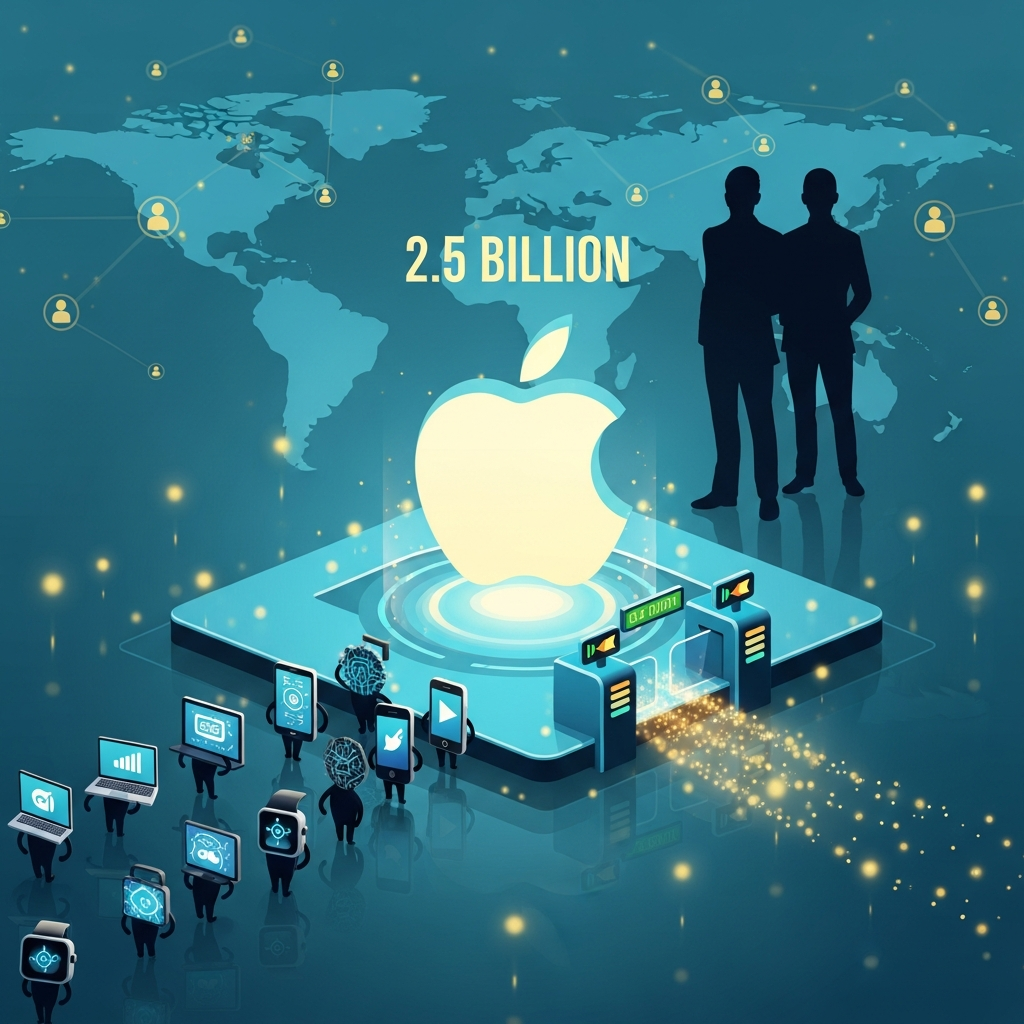
The relentless "Apple is falling behind in AI" narrative that has dominated financial media since the CEO transition fundamentally misreads what Apple actually is as a company, conflating model-building competition with platform ownership in a way that leads to systematically wrong conclusions. Q2 FY2026 results — $111.2 billion in revenue, up 17% year-over-year, with the Services segment hitting an all-time record of $31 billion at a 76.5% gross margin — demonstrate that the 2.5-billion-device hardware-services flywheel operates as a far stronger economic moat than any standalone AI model currently on the market. Under new CEO John Ternus, Apple's deliberate strategy is to embed intelligence so seamlessly into existing user experiences that it becomes effectively invisible, rather than launching AI as a separate product category that needs to prove its own value proposition. This approach frustrates Wall Street's appetite for splashy AI announcements in the short term, but it positions Apple as the indispensable platform layer precisely when AI capabilities commoditize across the industry — turning Apple into the tollbooth every AI company must pass through to reach consumers. At a current P/E of 33.9x, the market is still materially underpricing this structural advantage, and the Ternus era is being systematically underestimated by analysts who are measuring the wrong race.
Key Points
Why 2.5 Billion Devices Beat Any AI Model as a Competitive Moat
Apple's real competitive advantage isn't model performance — it's the 2.5 billion active devices already deployed globally, each equipped with a Neural Engine capable of on-device AI inference without a cloud API call. This is not merely an impressive sales figure; it represents a physical AI infrastructure layer that has already been purchased and placed into consumers' hands, requiring essentially no incremental capital expenditure from Apple to keep running. Cloud-based AI services like ChatGPT and Gemini face escalating GPU infrastructure costs — data center power expenses rose approximately 23% year-over-year in 2026 — while Apple's on-device AI runs at near-zero marginal cost per inference, since the hardware cost is already amortized into the device sale price. Google's decision to pay Apple more than $20 billion annually to remain the default search engine is perhaps the single most revealing data point in this analysis: even the world's most powerful search and AI company cannot reach Apple users without Apple's permission and a very large payment. AI models will commoditize over time — open-source alternatives are already approaching GPT-4 performance levels in 2026, and that trajectory continues — but a 2.5 billion device ecosystem with embedded Neural Engines cannot be replicated on any realistic competitive timeline. That asymmetry is the genuine structural moat, and it is one the market has not yet fully priced into AAPL's valuation.
The Ternus CEO Appointment as Apple's Clearest Strategic Signal
Tim Cook's decision to name hardware chief John Ternus as Apple's next CEO — passing over software executives and operational leaders who were widely expected to be in contention — is the strongest forward-looking signal Apple has sent about its strategic priorities for the decade ahead. Every transformative Apple product in history was fundamentally a hardware-software integration story: iPod and iTunes, iPhone and App Store, Apple Silicon and macOS — not one of those franchise-defining moments came from software alone, and the Ternus appointment signals that the next chapter runs on the same playbook. Bloomberg's Mark Gurman reported that Cook explicitly told the Apple board "hardware will define the next ten years," a statement that reflects the considered belief that when AI models commoditize, the physical device and its integrated experience will be the only remaining differentiator worth owning. Ternus personally led the Apple Silicon transition — guiding every chip generation from M1 through M4 — and his deep, hands-on understanding of the relationship between silicon architecture and software experience is precisely the expertise needed to make on-device AI a genuine competitive weapon rather than a marketing claim. The market initially read the appointment as a backward-looking hardware-first choice; the more accurate read is that it was the most strategically forward-looking decision Apple's board has made since the decision to develop proprietary silicon.
Services Revenue as a Self-Reinforcing AI Monetization Engine
Apple's Services segment is generating $31 billion per quarter at a gross margin of 76.5%, and the critical insight is that AI integration doesn't cannibalize this revenue stream — it amplifies it through multiple compounding mechanisms. On-device AI features increase users' reliance on iCloud storage tiers, AI-native applications flowing into the App Store generate higher commission revenues per transaction, and Apple Intelligence Pro at $9.99 per month is a direct AI subscription product with enormous scale potential across a 2.5 billion device base. The self-reinforcing logic matters here: more devices sold means more potential Services subscribers, more compelling AI features drive higher retention and lower churn across existing subscription products, and a richer services ecosystem makes hardware more valuable, increasing device purchase intent. Morgan Stanley has projected that Apple's annual Services revenue could reach $120 billion by 2027, and if Apple successfully launches an AI Agent Marketplace — essentially applying the App Store commission model to AI agents — even that projection could prove conservative at the midpoint of the range. The high-margin, recurring nature of this revenue stream provides a structural buffer against the inherent lumpiness of hardware upgrade cycles, and it's a business model that no pure AI company or pure hardware manufacturer can replicate.
Privacy Architecture as the Decisive Regulatory and Consumer Moat
Apple Intelligence's foundational architectural choice — on-device processing rather than cloud-based inference — is not primarily a technical design decision; it is a strategic bet on the direction of global regulation and the evolution of consumer sentiment around AI-handled personal data, and the bet is paying off. The EU's AI Act came into full force in 2025, U.S. state-level AI privacy legislation is proliferating across dozens of jurisdictions, and regulatory frameworks in Asia are tightening in parallel — all of this increasing compliance costs and liability exposure for cloud-based AI providers at an accelerating rate. Google and Microsoft face multi-billion-dollar annual compliance burdens and ongoing regulatory risk from their cloud AI architectures, costs that flow directly through to operating margins. Apple's structural answer to nearly every incoming AI regulation is architectural: user data never leaves the device, so data transfer requirements, transparency mandates, and consent frameworks apply minimally or not at all to Apple's core AI offering. PwC's 2026 Global Consumer Survey found that 67% of global consumers express concern about how AI uses their personal data — a number that represents an enormous addressable trust gap that Apple's on-device model is uniquely positioned to fill. As regulation intensifies and consumer trust becomes a meaningful differentiating factor across AI providers, Apple's structural privacy advantage widens rather than erodes.
AI Commoditization Makes Apple's Platform Position Stronger, Not Weaker
The mainstream analytical narrative treats AI model commoditization as a threat to Apple because the company lacks a frontier-class model of its own, but this logic runs exactly backward when you trace it through the full competitive structure. In 2024, GPT-4 had a meaningful quality lead over every available alternative; by 2026, Claude, Gemini, Llama, Mistral, and DeepSeek have narrowed the performance gap substantially, and open-source models are approaching commercial model performance on most standard benchmarks. Extrapolate that trajectory another three years, and the best AI capabilities will be broadly accessible to any company or individual at near-zero cost — and when that happens, model quality stops being a differentiating factor entirely. The competition then shifts to distribution, hardware integration, ecosystem depth, and user experience quality — precisely the dimensions where Apple's 30 years of investment in its integrated platform compounds most powerfully. Microsoft and Google are spending $190 billion in annual capital expenditure on AI infrastructure; Apple spent $14 billion in the same period. As models commoditize, those hundreds of billions in model training investments yield diminishing returns, while Apple's investment in integrated hardware, software, and services compounds in value. Apple isn't the arms dealer caught flat-footed — it's the company that understood the war was always about distribution and positioned itself as the essential channel years before the model race even began.
Positive & Negative Analysis
Positive Aspects
- The Hardware-Services Flywheel Is Genuinely Recession-Resistant
Apple's dual-engine business model is designed to be resilient across economic cycles in a way that no other large-cap technology company can match structurally. When iPhone upgrade rates slow during a consumer spending downturn, users are still paying monthly for iCloud, Apple Music, Apple TV+, and Apple Arcade — high-margin recurring revenue that carries zero inventory risk and minimal variable cost. When services growth temporarily plateaus, a new hardware cycle driven by meaningful capability upgrades restarts the demand engine. Services gross margins at 76.5% are nearly double the hardware segment's 36 to 38%, meaning the business mix naturally improves profitability as the installed base matures without requiring constant new device purchases. During the 2025 second-half global growth slowdown, when consumer electronics spending contracted broadly, Apple's Services segment still grew 14% year-over-year — demonstrating the structural insulation that recurring digital revenue provides against hardware cycle volatility. No other FAANG company operates this kind of structural two-sided insurance policy, and that characteristic alone justifies a sustained premium valuation multiple relative to hardware-only or software-only peers.
- Apple Silicon Creates a Durable Cost Advantage in the AI Era
The M4 chip's Neural Engine processes 38 trillion operations per second — a figure that improves approximately 20 to 30% with each annual chip generation — giving Apple a silicon foundation for on-device AI that is already three to four generations ahead of what third-party chipmakers can supply to Android device manufacturers. Cloud AI inference costs run $0.01 to $0.05 per query depending on model size and latency requirements, a cost burden that scales directly with usage volume. Apple's on-device inference runs at near-zero marginal cost because the hardware investment is already amortized into the device sale, meaning Apple's AI gets cheaper per interaction as the installed base grows, while competitors' AI gets more expensive. Microsoft and Google are collectively spending $150 billion or more annually on GPU cluster expansion to support cloud AI at scale; Apple is running AI inference on hardware users already purchased and paid for. With data center power costs up 23% year-over-year in 2026 and NVIDIA H100 infrastructure running approximately $250,000 per unit in annualized power and hosting expenses, the structural cost burden of cloud AI is intensifying with each passing quarter. Investors have not yet fully reflected this economic asymmetry in Apple's relative valuation, and it represents a compounding advantage that will become more visible as AI becomes a larger portion of the user experience.
- Ecosystem Lock-In Is Structurally Deepening With Every AI Update
Apple's switching cost has always been meaningfully high, but AI integration is making it structurally higher with each software update cycle in a way that has no obvious ceiling. Apple Intelligence now creates genuine contextual continuity across iPhone, Mac, iPad, and Apple Watch — meaning that switching from iPhone to Android doesn't just mean adjusting to a different interface, it means losing your AI context, your cross-device memory, and every personalized preference and learned behavior the system has accumulated. Standalone AI applications like ChatGPT and Gemini cannot replicate this kind of deep hardware-level integration because they operate above the OS layer, without access to the cross-app, cross-device context that makes personalization genuinely useful. In Q4 2025, iPhone-to-Android switch rates hit an all-time low of 3.2% — a figure that reflects not just brand affinity but genuine functional dependency on the integrated ecosystem that has no real substitute. Every new Apple Intelligence capability shipped deepens the cross-device dependency and raises the switching cost further, and the compounding effect of that dynamic over a 5-to-10-year horizon is one of the most structurally underappreciated valuation drivers in the entire large-cap technology universe.
- Apple Is the Maximum Regulatory Beneficiary Among AI Platforms
Global AI regulation is accelerating on every major front, and Apple's architectural decisions put it in a categorically better regulatory position than any other major AI platform operating at scale. The EU AI Act, proliferating U.S. state privacy laws, and emerging regulatory frameworks across Asia are collectively increasing compliance costs and legal exposure for cloud-based AI providers in ways that are just beginning to show up in operating expense lines. Apple's on-device processing model means it faces dramatically less regulatory surface area than competitors because there is no centralized user data collection, no algorithmic profiling pipeline subject to transparency mandates, and no third-party model receiving personal user data. Google and Microsoft are each maintaining multi-billion-dollar regulatory compliance organizations and absorbing costs associated with data handling requirements that Apple structurally avoids. As the regulatory tightening cycle continues through 2026 and 2027, this structural advantage will manifest directly in comparative operating margins and legal risk profiles — a sustained, compounding cost differential that should show up in Apple's relative stock performance over a multi-year holding period.
- Free Cash Flow and Buybacks Create a Structural Price Floor
Apple generates more than $25 billion in free cash flow per quarter — a figure that makes it one of the most capital-generative enterprises in the history of corporate America — and the company deploys that capital at a scale that creates meaningful EPS support entirely independent of revenue growth rates. Annual share repurchase programs exceeding $90 billion shrink the outstanding share count by approximately 3 to 4% annually, adding durable EPS growth even during periods of revenue deceleration or margin compression. The board's $100 billion buyback reauthorization provides a structural bid under the stock that mechanically limits how far downside scenarios can actually take the share price. With more than $60 billion in cash and marketable securities on the balance sheet and a debt-to-cash ratio that remains conservative by any measure, Apple faces essentially zero liquidity risk across any plausible macroeconomic scenario over the next three to five years. Over the past decade, Apple has repurchased more than $600 billion of its own shares — a compounding EPS enhancement machine that has consistently delivered for long-term holders who stayed patient through short-term narrative dislocations.
Concerns
- The AI Agent Threat to App Store Revenue Is Real and Structural
The most serious long-term risk to Apple's business model is not a competing smartphone hardware company — it's an AI agent ecosystem capable of transacting directly on behalf of users without requiring them to open individual applications. OpenAI and Anthropic have already launched browser-based agent capabilities that can navigate the web, complete transactions, and manage tasks autonomously, and if those capabilities extend meaningfully to mobile operating systems, the App Store's role as the mandatory intermediary between developers and consumers is genuinely threatened. Analysts estimate that 30 to 40% of Apple's total Services revenue is App Store-related, meaning even a 10% reduction in App Store transaction volumes translates to a $3 billion or more annual revenue impact — a number large enough to move the stock materially. The most vulnerable categories are transactional ones: food delivery, ride-hailing, e-commerce, and travel booking, where an AI agent can complete the entire customer journey without a native application appearing on screen. Apple can attempt to create its own native agent layer and redirect those transactions through a revised Apple-controlled commission structure, but the speed and effectiveness of that defensive response relative to the pace of external agent adoption is the key execution risk that Ternus inherits and needs to address explicitly.
- Apple Intelligence User Adoption Numbers Are Underwhelming
Six months after launch, the honest assessment of Apple Intelligence's reception is that it has not yet become a compelling reason for users to upgrade their devices or pay a meaningful premium — and that matters for the investment thesis in a significant way. Counterpoint Research's survey data shows that only 34% of compatible device users engage with Apple Intelligence features at least once per week, a number that trails Google Gemini integration on Android at 47% and Samsung Galaxy AI at 41%, despite Apple's scale and ecosystem advantages. The "nice to have, not must have" sentiment pattern is the most dangerous possible reception for a feature set that Apple needs to drive a meaningful iPhone super-cycle and justify average selling price expansion. If Apple Intelligence cannot establish itself as a genuine, irreplaceable killer feature by the iPhone 17 launch window, the hardware upgrade cycle thesis that underpins most of the bullish AAPL narrative for 2026 to 2027 looks considerably more fragile. Average selling price growth has been the primary earnings per share driver in recent years, and without a compelling AI-driven reason for users to pay premium prices for new hardware, that favorable trend faces real structural headwinds.
- China Revenue Represents a Structural Vulnerability, Not a Solved Problem
Apple's China revenue accounts for approximately 17% of total company sales at roughly $21 billion per quarter, and this position is under structural competitive and geopolitical pressure that a single strong quarterly result cannot resolve or permanently address. Huawei's return to the Chinese premium smartphone market with its Kirin 9100 chipset has already resulted in an approximately 8 percentage point market share recovery during 2025, and the continuing expansion of HarmonyOS's independent application ecosystem is directly attacking Apple's Services revenue model within the world's largest smartphone market. The Chinese government's ongoing expansion of public sector restrictions on Apple device usage represents a policy risk that is difficult to hedge and could accelerate materially if U.S.-China technology tensions escalate further from current levels. In a severe downside scenario, Chinese revenue declining 20 to 30% over two years would represent an $8 to $13 billion annual revenue headwind that India and Southeast Asian markets cannot realistically replace — India's premium smartphone market is roughly one-quarter the size of China's even under optimistic growth assumptions. This geographic concentration risk deserves a more explicit discount in Apple's valuation than it currently receives, particularly as the geopolitical environment grows less predictable.
- External AI Partnership Dependency Is a Long-Term Strategic Liability
Apple's current heavy reliance on OpenAI for Siri's most advanced capabilities represents a structural vulnerability that becomes more acute as AI functionality becomes increasingly central to the overall Apple user experience. If OpenAI raises its API pricing as compute costs increase — which is commercially likely as the company seeks a path to profitability — Apple's service economics worsen directly without a corresponding improvement in user experience. If OpenAI enters an exclusive arrangement with a major Android hardware manufacturer or pivots its business model in a direction that conflicts with Apple's privacy commitments, Apple's competitive AI capability advantage could erode significantly and rapidly. More fundamentally, when the language model and the hardware platform are developed by separate organizations with different priorities and incentive structures, the depth of integration achievable is inherently limited by organizational boundaries. Google's Gemini integration with Pixel hardware demonstrates what hardware-native model co-development produces in terms of integration depth and user experience quality, and the gap between that approach and Apple's current partnership model is meaningful. Apple needs a credible, publicly visible first-party LLM roadmap, and the current signals suggest that full solution is still at minimum 12 to 24 months away.
- Ternus CEO Leadership Premium Remains Unverified at Scale
John Ternus's credentials as a hardware engineering leader are genuinely exceptional — he guided the Apple Silicon transition through every generation from M1 to M4, delivering arguably the most successful platform architecture migration in the history of personal computing. However, the competencies required to lead a $3 trillion company through Wall Street expectation management, global regulatory negotiations at the CEO level, supply chain crises requiring strategic decision-making under uncertainty, and competitive strategy formation across multiple fronts simultaneously are categorically different from hardware engineering excellence. Historical analysis of large-cap technology CEO transitions suggests that incoming leaders absorb an average 5 to 8% valuation discount during their first four to six quarters, a pattern observed in Microsoft's Satya Nadella transition, Google's Sundar Pichai appointment, and several other large-cap examples. Tim Cook built a 15-year track record of disciplined capital allocation, consistent earnings growth, and effective supply chain management that effectively earned a measurable leadership premium for AAPL shares; that premium does not automatically or immediately transfer to Ternus. The first genuine corporate crisis — whether a supply chain disruption, a significant regulatory action, or a high-profile product issue — will be the defining inflection point that either confirms or permanently undermines market confidence in Ternus as the right leader for Apple's next chapter.
Outlook
Here's where the real conversation starts. I've thought through Apple's trajectory across multiple time horizons, and what strikes me most is how the conventional narrative collapses the further out you look. The short term is about execution and catalysts. The medium term is about monetization structure. The long term is about who owns the infrastructure layer when AI becomes ambient. Apple's position improves at every horizon.
In the immediate term — the next one to six months — the single most consequential event is WWDC 2026, which is shaping up as Ternus's first real opportunity to define his vision for the AI era on his own terms. My expectation is a substantial showcase of deep cross-app context sharing: your flight confirmation in Mail automatically syncing to Calendar and Maps, Siri understanding a photo of a receipt and handling expense reporting in one interaction, and a significant expansion of the AI API toolkit for third-party developers that could trigger a new wave of AI-native App Store submissions. If WWDC lands with genuine surprise and delight — a real "one more thing" moment for AI — I think there's a realistic 5 to 8% near-term upside in AAPL shares as the market revises its AI narrative. If it underwhelms relative to the bar Gemini and Copilot have set, the stock likely churns sideways at current levels while investors wait for the hardware catalyst.
The other near-term catalyst is the iPhone 17 launch in September, and I think this one is underappreciated. The A19 chip, derived from the M-series silicon architecture, is widely expected to deliver a 40% or better improvement in Neural Engine performance over the A18. What that means in practice is the ability to run significantly larger on-device language models — potentially 7 to 10 billion parameter models in real time, compared to the roughly 3 billion parameter practical ceiling on current devices. That is not a marginal spec bump. That is the threshold at which on-device AI begins to feel genuinely capable rather than toy-like, and it could be the catalyst for a meaningful upgrade wave among the hundreds of millions of iPhone users who have been holding onto older handsets. Whether that hardware jump actually converts into a super-cycle is the biggest near-term stock variable I'm watching.
Moving into the six-month to two-year horizon, the structural story gets considerably more interesting. My read is there's better than a 50% probability that Apple launches what I'd describe as an AI Agent Marketplace — essentially an App Store extension where verified third-party AI agents can offer services to Apple device users, with Apple taking its standard commission on transactions. This is not speculative future-casting; it's the logical extension of what the App Store already does for applications. The model is proven, the infrastructure exists, and the 2.5 billion device base provides immediate scale. If this materializes by 2027, I'd put Apple's annual Services revenue at north of $120 billion. Morgan Stanley's Erik Woodring has floated similar projections, and if the agent marketplace launches successfully and scales with Apple's typical efficiency, even that estimate could prove conservative over a two-year window.
The other critical mid-term variable is whether Apple builds or acquires a credible first-party large language model. Right now, Apple relies heavily on its OpenAI partnership for Siri's most sophisticated features, and that dependency is a structural vulnerability with several exposure points. If OpenAI raises API pricing as compute costs increase — which is likely — Apple's service economics worsen. If OpenAI enters an exclusive arrangement with a major competitor, Apple's AI capability edge disappears overnight. My prediction is that Apple will announce its own LLM by 2027, and the differentiating message will be explicit rather than technical: "This model runs entirely on your device, optimized for Apple Silicon, and your data never goes anywhere." In an era of intensifying AI regulation and growing consumer wariness about data handling, that pitch will resonate in ways that raw benchmark leaderboard positions simply cannot match. The regulatory tailwind for on-device AI is real, and Apple is uniquely positioned to ride it.
Looking out two to five years, I'm willing to make a bolder prediction: by 2028 to 2030, the framing of an "AI race" will be largely obsolete as a competitive lens. Open-source models are already approaching GPT-4 performance in 2026. Extrapolate that trajectory three years forward, and virtually anyone can access state-of-the-art AI capability for free or near-free. When that happens — and I think it's a when, not an if — the competitive advantage in AI stops being about the model entirely. It shifts to hardware integration, seamless user experience, data continuity, and privacy architecture. Those four attributes describe Apple more precisely than any other company in the technology industry. Microsoft's hundreds of billions in AI infrastructure investment will see diminishing returns as models commoditize. Apple's investment in 2.5 billion integrated devices compounds in value as the models running on them improve for free, courtesy of open-source progress.
The long-term game Apple is actually playing, in my view, is ambient computing — and it's a game where Apple's competitive advantages are unique and structural. Imagine a unified AI environment spanning iPhone, Apple Watch, AirPods, Vision Pro, HomePod, and Apple TV, where the assistant you interact with understands your habits, preferences, schedule, and context seamlessly across every device without friction, login screens, or context resets. The enabling capability is not model performance — it's contextual continuity, the ability to carry understanding of who you are across time and device transitions. And contextual continuity requires owning the hardware, the software, and the services simultaneously. Google has software. Microsoft has software and cloud. Samsung has hardware. Amazon tried to build ambient computing with Echo, reached the limits of a single-device strategy, and stalled. Apple has all three integration layers and a user base willing to pay for the experience. That combination is genuinely unique.
For scenario planning purposes, I'd frame the probability distribution this way. The bull case — I'd assign roughly 35% probability — requires Q3 and Q4 FY2026 earnings to hit the upper end of guidance at around 17% year-over-year revenue growth, meaningful acceleration in Apple Intelligence Pro subscription adoption, and a genuine upgrade wave among the massive cohort of iPhone users who haven't refreshed hardware in three or more years. In this scenario, Wedbush's Dan Ives price target of $350 and Morgan Stanley's $330 target are both achievable, and the $4 trillion market cap threshold becomes realistic within 18 months. Even modest penetration math is compelling here: 20% of the 2.5 billion device base adopting Apple Intelligence Pro at $9.99 per month opens up roughly $60 billion in new annual subscription revenue — a figure that would transform Apple's earnings profile.
The base case — which I think is most likely at around 45% probability — lands near the analyst consensus of $302, based on the 77-analyst MarketBeat aggregate. Q3 FY2026 guidance at the midpoint of roughly 15.5% year-over-year revenue growth gets delivered, Services margin holds at 76.5% even as DRAM cost inflation puts 200 to 300 basis points of pressure on hardware gross margin, and the stock delivers 10 to 15% annual appreciation as earnings growth slightly outpaces modest P/E contraction from 33.9x toward a 30 to 32x range. Steady rather than spectacular — but for a $3 trillion company with the world's strongest recurring revenue base, steady is deeply underrated as an investment outcome. This is the scenario I think is most likely to actually play out over the next 12 months.
The bear case — 20% probability — involves DRAM cost overruns compressing Q3 gross margin below the 47.5% guidance floor, continued underwhelming reception to Apple Intelligence features that fails to convert into an upgrade driver, and Huawei's Mate 80 reclaiming meaningful premium market share in China. Barclays' $248 price target represents this scenario on the downside. Even here, the downside is structurally bounded in an important way: the $100 billion buyback reauthorization and roughly $54 billion in net cash create a durable bid under the stock that limits how far a multiple compression can take it. The floor is probably around a 27x to 28x P/E on trailing earnings, which corresponds to approximately $220 to $230 per share in the most adverse conditions. That's painful but survivable, and it would represent a historically excellent entry point for patient long-term holders.
My honest risk checklist for this thesis — the conditions under which I'm wrong: first, if AI agents advance faster than my 3 to 5 year estimate and the App Store model breaks meaningfully within two years, my base case falls apart and I'll need to revise down. Second, if Apple continues to fail at building a competitive first-party LLM and external dependency deepens, the platform moat weakens gradually as partners gain leverage. Third, if U.S.-China tech restrictions escalate and Apple's supply chain gets genuinely disrupted at scale, hardware margin risk becomes existential rather than manageable. Fourth, Ternus remains untested as a CEO through a genuine corporate crisis, and leadership uncertainty deserves some valuation discount for at least the next two to three reporting cycles. I'd revisit each of these variables every quarter and update the probability weights as evidence accumulates.
For investors thinking about positioning, my current view is that AAPL is trading at or slightly above fair value at the current multiple. A P/E of 28 to 30x is a modest premium to earnings growth, but it's justified by the hardware-services flywheel's structural stability and the strongest balance sheet of any $3 trillion company in existence. Any 5 to 10% pullback around the WWDC window or iPhone 17 pricing announcements would represent a genuine buying opportunity for long-term holders. Those already holding long positions should sit tight. The market's AI narrative on Apple is wrong in a way that tends to correct sharply rather than gradually — and when that correction happens, it's better to be already positioned than waiting for confirmation.
This content is provided for informational and educational purposes only and does not constitute investment advice, a solicitation, or a recommendation to buy or sell any security. All financial figures, projections, and price targets referenced are estimates at the time of writing, sourced from publicly available disclosures and analyst reports, and are subject to change without notice. Investment decisions involve risk, including the possible loss of principal, and should be made based on your own independent research and in consultation with a qualified financial professional.
Sources / References
- Apple Q2 FY2026 Official Earnings: Revenue $111.2B +17% YoY, Services Record $31B — Apple Investor Relations
- Tim Cook Steps Down, John Ternus Named Apple CEO — CNBC
- New CEO John Ternus Faces Defining Challenge: Fixing Apple's AI Strategy — CNBC
- Apple Q2 2026 Full Segment Breakdown: iPhone $57B, Services $31B, China +28% — MacRumors
- Big Tech AI Capex Ranked: Apple $14B vs Microsoft and Google at $190B Each — Fast Company
- Apple Abandons Net Cash Neutrality, Reauthorizes $100B Share Buyback — The Next Web
- AAPL Analyst Consensus Price Target $302, 77-Analyst Aggregate — MarketBeat