
AI Is Wiping Out 16,000 Jobs a Month — And Gen Z Always Gets Hit First
Summary
Goldman Sachs's April 2026 report reveals that AI is eliminating a net 16,000 American jobs every single month — consuming 25,000 positions while creating only 9,000, adding up to 192,000 annual net losses roughly equivalent to the total population of a mid-sized American city. The devastation is not evenly distributed: Gen Z workers aged 22–25 are absorbing the sharpest blows, with employment in AI-exposed occupations down 13–20% from 2022 levels, and software development roles in that age group alone collapsing nearly 20% since 2024 according to the Stanford AI Index 2026. Entry-level job postings have fallen from 44% of all listings in 2023 to just 38.6% in March 2026, while the unemployment rate for new labor market entrants reached a 37-year high of 13.3% in July 2025 — surpassing even the worst months of the 2008–09 financial crisis. Anthropic's own research counters that AI's employment impact remains "limited," but this collision between Goldman's net job figures and Anthropic's unemployment rate data is not a contradiction — it is evidence that harm is hyperconcentrated in specific age groups and occupation categories while national aggregates stay flat. The core failure here is not algorithmic but institutional: AI is not simply destroying jobs, it is destroying the entry-level rungs of the career ladder itself before a generation has had any chance to climb them, a catastrophe of policy design rather than technological inevitability.
Key Points
Goldman Sachs vs. Anthropic: How Two Conflicting Datasets Prove Concentrated Harm
Goldman Sachs's April 2026 report established that AI is destroying a net 16,000 American jobs per month — 25,000 eliminated against 9,000 created — totaling 192,000 annual net losses. Anthropic's own labor market research fired back with a contradictory finding: since ChatGPT's launch, there has been no systematic change in unemployment rates in high AI-exposure occupations, leading Anthropic to characterize the employment impact as "limited." At first glance, this looks like a factual standoff between two credible institutions. But the deeper reality is that both can be simultaneously correct — and that possibility is precisely what should alarm us most, because it points to damage so concentrated that it is structurally invisible to standard measurement.
Goldman Sachs measured net employment change: total jobs created minus total jobs destroyed across the economy. Anthropic measured unemployment rate shifts: the percentage of people in the labor force who are actively jobless. These are fundamentally different metrics that can diverge dramatically when damage is concentrated rather than diffuse. The Dallas Fed's research provides the key to understanding how: while overall unemployment remained stable, the transition rate from outside the labor force into active employment fell by more than 3 percentage points for young workers in AI-exposed fields. This is not a layoff story. It is an entry-blockage story — the door into the labor market narrowing so gradually and so specifically that traditional unemployment metrics simply do not register it.
Anthropic's methodology, which tracks unemployment rate changes in high-exposure occupations, cannot capture the "entry blockage" effect by design — it only sees people who were employed and then lost their jobs, not people who were attempting to become employed and couldn't find a way in. This creates a systematic blind spot in the academic literature that will likely cause persistent underestimation of AI's true labor market impact for years. The collision between these two datasets is therefore not a reason for uncertainty about whether AI is harming employment. It is evidence that the harm is concentrated rather than distributed — a structurally more concerning pattern, because concentrated harm is invisible to the policy tools that were designed to address distributed harm.
The Structural Collapse of Entry-Level Work and the 37-Year Record
Entry-level job postings falling from 44% of all listings in 2023 to 38.6% in March 2026 is more than a cyclical contraction — it is a structural signal that deserves to be read carefully. Broken down by sector, junior tech positions have declined 35%, entry-level logistics roles by 25%, and entry-level finance positions by 24%. Every one of these sectors sits squarely in AI automation's primary target zone — the zone where routine, well-defined, rule-based task execution dominates the work content. The unemployment rate for new labor market entrants hit 13.3% in July 2025, the highest in 37 years, and critically this peak exceeded the worst single month of the 2008–09 financial crisis — a moment historically remembered as a catastrophic labor market dislocation.
The New York Fed data adds a further dimension: recent college graduate unemployment is now running at 5.6%, above the overall employed worker average. This is anomalous. In healthy labor markets, college graduates have lower unemployment than the workforce average, not higher — their credentials normally provide meaningful protection. The Carnegie Endowment's April 2026 research explains the mechanism driving this reversal with precision: today's best AI systems complete complex tasks at human-level performance only 4.17% of the time, but they can substitute for humans during 83% of working hours on simple, repetitive tasks. This means AI is surgically removing the low-complexity task components that constitute precisely the entry-level role portfolio — data entry, basic document drafting, simple code review, customer query routing — the specific category of work that produces "first-year experience."
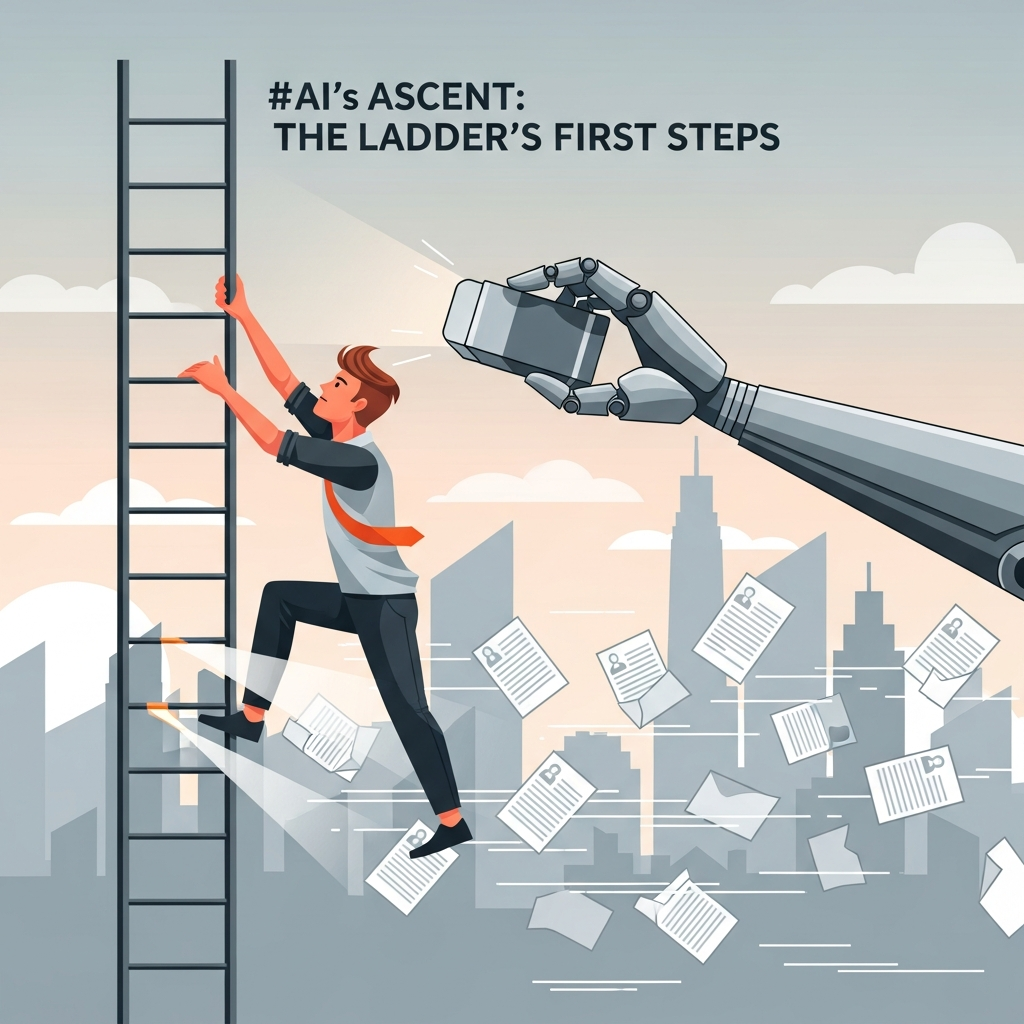
The career ladder metaphor is not merely evocative here — it describes a concrete structural mechanism. Workers develop professional judgment, relational skills, and domain knowledge by doing progressively more complex work, starting from simple tasks and building up through demonstrated competence. When AI automates the simple tasks at the base, new entrants have nowhere to start the climb. The ladder does not merely become harder to ascend. Its lower rungs are removed entirely, leaving the upper sections intact but inaccessible. IBM's decision to triple its Gen Z entry-level hiring — explicitly framed as strategic investment in AI-native talent development — demonstrates that preserving entry-level work is a deliberate choice that some organizations are making, which means the organizations that are not making that choice are also making a deliberate choice.
The Generational Labor Market Fracture and the Widening Wage Gap
Dallas Fed research found that AI-exposed occupations saw 13% employment decline for workers aged 22–25 from 2022 to 2026, while workers aged 31–50 in the same sectors saw no negative employment effect. In many cases, experienced workers in those same sectors experienced productivity gains from AI augmentation that effectively improved their relative labor market position. This is not a story about AI threatening all workers equally across the age spectrum. It is a story about AI amplifying existing experience premiums to an extraordinary degree, making accumulated professional history more valuable exactly as it makes initial labor market entry more difficult.
The wage implications compound the employment story in a reinforcing way. Dallas Fed research found that each 1 standard deviation increase in AI exposure at the occupation level widens the entry-level to experienced-worker wage gap by 3.3 percentage points. Gloat's 2026 research shows that jobs explicitly requiring AI skills carry a 56% wage premium over comparable roles without that requirement — a figure that nearly doubled in a single year from 25% the previous year. AI-fluent job postings grew from approximately 1 million in 2023 to 7 million by 2025, a seven-times expansion in two years. For workers who can access this premium, the labor market is exceptionally favorable. For those trying to enter fields where AI has automated the entry pathway, it has the character of a gate that will not open.
The double bind facing Gen Z is structural rather than personal: gaining AI competency for high-premium roles requires on-the-job experience, but gaining that experience requires entry-level employment in AI-adjacent fields, and that entry-level employment has been automated away. This feedback loop, once established, becomes self-reinforcing and widening over time. If it persists for five to ten years, the cumulative divergence in skills, professional networks, and career capital between those who gained entry before the contraction and those locked out during it will translate into a generational wealth gap that does not close automatically when the technology eventually matures and labor markets eventually adjust.
The Associate Degree Advantage and the Crisis of the Four-Year Credential
BLS data from October 2024 documents a remarkable reversal: recent associate's degree holders are employed at 78.1%, while recent bachelor's degree holders are at 69.6%. Among those not currently enrolled in school, the gap widens further — associate's degree holders achieve 83.3% employment versus 69.6% for bachelor's graduates, a 13.7 percentage point differential that is difficult to attribute to anything other than a structural shift in what skills the labor market is rewarding. And 47% of skilled tradespeople are earning above the median college graduate income. This is not a marginal statistical fluctuation. It is a categorical reversal of the educational premium structure that has defined the U.S. labor market for four decades.
The structural interpretation matters more than the headline numbers. AI is specifically targeting the standardized knowledge work that four-year university programs are designed to produce: systematic information processing, structured analysis, document synthesis, rule-based decision-making, and basic implementation of established professional procedures. These tasks are, not coincidentally, the ones that professors and professional certification programs have historically optimized curricula to develop and that employers have historically used to define entry-level white-collar roles. Associate degree programs, by contrast, tend to produce workers with physical-world competencies whose work requires dexterity, real-time situational judgment, and embodied expertise that current AI systems cannot replicate at scale.
The educational policy implication is significant and underappreciated in public discourse. If AI is automating the specific skills that justify the time and debt investment of a four-year degree, the expected return on that investment changes structurally — not just cyclically in response to a bad job market. This does not mean college produces no value. It means the curricula need to be redesigned around what AI cannot do: interdisciplinary judgment, research that generates genuinely new knowledge rather than synthesizing existing knowledge, relational and institutional competencies, and the capacity to work productively with AI systems rather than in competition with them. That redesign is not yet happening at the speed or scale the employment data suggests is needed.
Gen Z's Emotional Shift and the Long-Term Cost of Forced Informalization
The Gallup and Walton Family Foundation survey of 1,572 people aged 14–29 in February and March 2026 captured a measurable emotional inflection point. Gen Z's excitement about AI dropped from 36% to 22% — a 14-point decline in roughly one year — while anger rose from 22% to 31%, a 9-point increase. Gallup's senior researcher attributed the anger directly to AI's effect on entry-level career prospects, noting that the oldest Gen Z workers — those most directly exposed to the actual job market's deterioration — show the strongest anger responses. The critical framing detail that changes everything: AI weekly usage among this group remains stable at approximately 50%. This is not a technophobe cohort reacting to unfamiliar tools. This is a generation fluent in AI that cannot get hired because the positions have been automated away.
ZipRecruiter's survey of 3,000 recent graduates showed 38% considering entrepreneurship, 32.5% exploring gig work, 28% considering freelancing, and 11% looking at skilled trades transitions. The mainstream narrative frames these responses as adaptive flexibility — a generation creatively finding new pathways in a changed economy. I believe this framing is a serious analytical error that obscures the institutional failure making these alternatives necessary. Entrepreneurship, gig work, and freelancing in this context are not primarily chosen from a position of genuine agency — they are residual options available after the conventional pathways have been occupied or automated. Calling this "adaptation" is as accurate as calling a detour around a washed-out bridge "a scenic route."
The concrete long-term cost of this forced informalization is calculable and deeply underweighted in public discourse. Gig workers and freelancers typically do not contribute to public pension systems at the same rates as formal employees, do not receive employer health insurance contributions, and do not develop within institutional career structures that produce compounding professional capital over time. As this cohort ages through their thirties and into their forties, the pension contribution gap accumulates into a structural welfare system deficit. The United Kingdom's decision to commit nearly $965 million to youth employment support is a leading indicator: governments that are doing serious long-term fiscal accounting are recognizing that the cost of not addressing youth labor market exclusion now is substantially higher than the cost of intervention. The majority of governments are not yet doing that accounting.
Positive & Negative Analysis
Positive Aspects
- A Net 78 Million New Jobs Projected by 2030 Under WEF Forecasts
The World Economic Forum's Future of Jobs 2025 report projects that AI and associated technological innovation will create 170 million new positions globally by 2030, against 92 million displaced, for a net addition of 78 million jobs. This projection is grounded in survey data from over 1,000 global companies representing 14 million workers — not theoretical modeling — which gives it more credibility than typical long-range forecasts built on extrapolation alone. If this scenario materializes, AI's net long-term effect on employment is positive, continuing the historical pattern where mechanization and automation ultimately created more work than they destroyed, even when the transition period was painful and unequal. Goldman Sachs's separate projection that AI could boost global GDP by up to 7% provides complementary support — productivity gains of that magnitude generate new economic activity that historically translates into new categories of employment. New occupational categories are already emerging that did not exist five years ago: AI infrastructure construction and maintenance, AI ethics and governance, human-AI interaction design, AI audit and compliance, and AI training data curation at scale.
The 78 million net job gain represents a meaningful counterweight to the near-term pain documented in Goldman's monthly figures. If the projection holds, the 192,000 annual net U.S. losses are a transition cost, not a permanent condition — the downslope before a long upslope. IBM's decision to triple Gen Z entry-level hiring in the AI era demonstrates that forward-looking organizations are already investing in the talent pipeline rather than simply harvesting efficiency gains from automated entry-level tasks. The question of timing, transition support, and equitable distribution of the gains remains critical, but the macro trajectory over the relevant multi-decade horizon is not unambiguously negative. Technological optimism on this point is not naive if it is paired with honest acknowledgment of the transition costs that are being distributed unequally in the interim.
- The 56% AI Skill Premium Represents Historic Opportunity for the Fluent
Gloat's 2026 research establishing a 56% wage premium for AI-capable workers is extraordinary by historical standards — roughly equivalent to the returns to a full additional level of formal education, achieved through skill acquisition rather than years of schooling and substantial debt. The premium's growth rate is even more notable: it was 25% the previous year and nearly doubled in twelve months. AI-fluency job postings grew from approximately 1 million in 2023 to 7 million in 2025, suggesting demand for this skill set is expanding faster than supply. For Gen Z workers who acquire genuine AI fluency — not superficial familiarity, but real operational integration of AI tools into professional practice — the current labor market offers wage trajectories that would historically have required significantly more seniority or expensive specialization to access.
This creates a bifurcated picture within Gen Z itself, not just between Gen Z and other generations. Those who gain real AI capability early in their careers are entering a labor market where their skills command a premium historically reserved for senior workers with decades of experience. The 56% differential is not static — as AI demand continues to outpace supply, early movers in skill development have an accumulating structural advantage that compounds over the following years. The premium also creates genuine financial incentive for the investments in AI education that governments and employers are being urged to make: the return on AI skill development is measurable, large, and growing, which means rational actors at the individual, firm, and policy level all have aligned incentives to accelerate the supply of AI-fluent workers. The constraint is access infrastructure, not lack of motivation or demonstrated value.
- Gen Z's Entrepreneurial Adaptability Is Opening New Labor Market Pathways
ZipRecruiter's survey data showing 38% of Gen Z considering entrepreneurship, 32.5% exploring gig work, and 28% looking at freelancing reflects a cohort that is actively generating its own alternatives rather than waiting for institutions to adapt. The 2025 graduating class reported a 77% three-month employment rate — substantially up from 63.3% the previous year — suggesting that active adaptation is producing measurable results even in a structurally challenging environment. AI tools have genuinely lowered the barriers to solo entrepreneurship: a single person today can build, market, and operate a service business with AI handling content creation, customer communication, financial tracking, and basic product delivery at a level that would have required a full team five years ago. The economics of one-person businesses have been fundamentally altered by AI capability availability.
This adaptive capacity is not merely coping with adverse conditions — it is potentially the leading edge of a new labor market paradigm that will eventually be recognized as such. The historical shift from stable single-employer careers to portfolio work is accelerating under AI, and Gen Z is disproportionately positioned to help define what that acceleration looks like if the social infrastructure catches up with the economic reality. Countries and firms that build institutional support around flexible, project-based work — portable benefits, professional development pathways outside traditional employment, genuine access to capital for micro-enterprises — can potentially convert what is currently forced informalization into a legitimately more dynamic and innovative labor model. The entrepreneurial energy visible in survey data is a resource that policy design can either harness productively or waste through inattention.
- Employer Upskilling Plans and Corporate Role Restructuring Signal a Constructive Path
WEF data shows 80% of employers reporting active AI upskilling plans, and among AI-adopting firms, 60% say they are pursuing role restructuring rather than workforce reduction. This is significant because it signals that a substantial portion of the corporate sector is treating AI as a productivity enhancement to be deployed alongside existing human capital rather than purely as a substitute for it. The 60% restructuring figure represents companies that have explicitly chosen against the pure cost-cutting deployment model — the model responsible for the entry-level collapse Goldman Sachs documented — in favor of redesigning work to preserve human roles in altered and often upgraded forms.
Government investment is also beginning to materialize at meaningful scale. The U.S. AI certification program for 120,000 displaced workers, the UK's 10 million worker free AI education plan, and the EU's Digital Europe Program investments represent early institutional responses that, while insufficient in current form, establish the precedent and administrative infrastructure for scaling up. The combination of corporate restructuring preference, government program investment, and the demonstrated economic incentive of the 56% AI skill premium creates alignment conditions that could, under sustained political will and adequate funding, produce the kind of labor market transition support that makes the difference between a generation that gets left behind and one that is brought through the transition. The direction is right even when the current scale remains inadequate.
Concerns
- The AI Skill Access Gap Is Structurally Self-Reinforcing and Accelerating
Flip the 56% AI skill wage premium around: working in the same role without AI skills means earning 56% less than the colleague beside you who has them. This is not a capability differential that education and effort can straightforwardly resolve through individual initiative. It is an access differential — who gets opportunities to develop AI fluency in professional contexts, and who does not. The reinforcing structure is particularly harsh for the cohort most affected: gaining AI competency at the level that commands the premium requires working alongside AI systems in professional environments, which requires being employed in those environments, which requires passing through entry-level positions that have been automated away. The circular logic closes into a trap from which individual effort alone cannot escape.
This self-reinforcing dynamic does not merely maintain existing inequality — it amplifies it in a compounding way. Workers who gained entry to AI-adjacent professional environments in 2020–2022, before the entry-level collapse became severe, are now accumulating professional AI fluency in real work contexts. Workers who have been blocked from entry since 2023 are falling further behind in the skills that command premiums, through no failure of motivation or intelligence, simply because they lack the structural access point. Dallas Fed data showing a 3.3 percentage point widening of the entry-level to experienced-worker wage gap for every standard deviation of AI occupational exposure quantifies how rapidly this divergence is accelerating. Existing layered inequalities — by income background, first-generation college status, professional network density, and geographic labor market strength — are all amplified by the AI access differential simultaneously, which is how concentrated technological disruptions historically produce lasting structural stratification rather than temporary transition costs.
- AI's Diffusion Speed Creates a Fatal Mismatch With Societal Adaptation Capacity
Morgan Stanley and Columbia Business School research documents one of the most consequential asymmetries in this entire story: the steam engine took approximately 100 years to fully permeate the American economy from initial commercial deployment to peak penetration. AI achieved 70% corporate adoption in the United States in three years. The adaptation buffer has been compressed by a factor of 20 to 40. Every historical reassurance that "new jobs eventually emerge after disruption" was earned during disruptions that unfolded over the working lifetimes of multiple generations, giving educational systems, professional training infrastructure, social safety nets, and worker organization time to observe, iterate, and adjust. That reassurance cannot be cleanly transferred to a disruption operating at AI's temporal scale.
The policy implications are severe in a structural way. Government labor market programs — retraining systems, apprenticeship infrastructure, unemployment insurance design, educational curriculum reform — are institutional processes that characteristically operate on multi-year timelines even when political will is strong. The 2026 U.S. AI certification program for 120,000 workers and the UK's 10 million worker education plan represent commendable intentions, but the scale and timeline of deployment relative to the 192,000 annual U.S. net losses and the global exposure of 300 million positions reflects a fundamental mismatch that cannot be resolved by scaling existing program types. Jobs for the Future is direct about this: if millions of workers need to be retrained in years rather than decades, click-through online certification courses are not adequate instruments, and the institutional infrastructure required simply does not exist at the necessary scale. The qualitative character of AI displacement amplifies the challenge further — AI is replacing credentialed cognitive work, which means the policy responses developed for previous transitions that replaced physical labor may not be the right instruments for this one.
- The Historical Productivity-Wage Divergence Pattern Is Likely to Repeat Under AI
The Chicago Booth Review's analysis of U.S. economic data from 1979 to 2021 establishes a sobering baseline: productivity grew 64.6% over this 42-year period, while median hourly wages rose only 17.3%. The 47-percentage-point gap between productivity growth and wage growth represents a distributional choice — made through the interaction of capital returns, bargaining power dynamics, tax policy, and labor market structural features — to route technology-driven efficiency gains disproportionately to capital rather than to labor. There is no technological reason this had to happen. It happened because the institutional structures, incentive systems, and power balances of the period were aligned in that direction, and there is limited evidence that the current period is characterized by meaningfully different institutional alignment.
Goldman Sachs's projection of a 7% global GDP boost from AI is potentially accurate and simultaneously beside the point for the question of whether workers will benefit. If the productivity-wage divergence pattern that operated over the previous four decades continues under AI, the efficiency gains from AI deployment will accrue primarily to corporate earnings, equity valuations, and capital owners, while workers absorbing the transition costs receive wages that grow more slowly than productivity. Gen Z, whose bargaining power is structurally weakened by entry-level collapse and informal labor migration, is particularly poorly positioned to capture a fair share of AI-generated productivity gains even when those gains are real and large. The distributional question is fundamentally a political and institutional question rather than a technological one, and it requires political and institutional responses that are largely absent from the current policy conversation about AI's economic effects.
- Global Youth Labor Exclusion Is a Structural Crisis Without Commensurate Policy Response
Britain's youth unemployment rate at 14.7% in Q4 2025 — the highest in a decade and the first time it exceeded the EU average — reflects a pattern visible across the developed world. One in four young people across OECD member countries is classified as NEET: not in employment, education, or training. This figure represents a structural failure of labor market integration on a generational scale, not a cyclical downturn or a localized policy failure. The UK case is illustrative of scale: 120 university graduates competing for every available entry-level position in certain sectors means the credential-to-employment pipeline that justified the social investment in mass higher education has broken down as a system-level function, not merely as a temporarily difficult market condition.
The global character of this crisis forecloses country-specific explanations. Countries with radically different labor market regulations, educational systems, welfare states, and economic structures are producing similar youth exclusion outcomes because the underlying driver — AI automation of entry-level cognitive work, amplified by corporate deployment decisions that prioritize cost reduction over labor transition investment — operates globally and is not sensitive to most country-specific policy variables. This means the standard toolkit of domestic labor market reform is insufficient on its own, and the international coordination mechanisms needed to address a genuinely global structural shift are largely absent from the current policy architecture. The fiscal costs of not addressing youth labor market exclusion — in healthcare, welfare, lost tax revenue, and reduced intergenerational social mobility — are calculable and large, but remain largely unaccounted for in the public budgeting processes of most governments.
- Forced Informalization Creates a Decades-Delayed Social Invoice That Nobody Is Preparing For
The mass migration of Gen Z toward gig work, freelancing, and informal self-employment is being narrated as adaptive flexibility and generational entrepreneurialism. The structural reality is that it represents a massive transfer of labor market risk from institutions to individuals, without the institutional risk mitigation infrastructure that made previous generations' career trajectories sustainable over lifetimes. Roughly a third of the affected cohort is orienting toward informal work arrangements. If that represents 3–5 million workers over the 22–30 age bracket in the U.S. alone, the annual deficit in pension system contributions accumulates to tens of billions of dollars annually in reduced system funding — a slow-motion structural deterioration in retirement system adequacy whose damage will crystallize as a fiscal crisis approximately 15 years from now when this generation enters middle age.
The individual-level consequences are severe but temporally displaced in a way that makes them politically invisible in the near term. A 24-year-old who spends five years in gig work without pension contributions has lost approximately $15,000–25,000 in compounding retirement savings relative to a comparable formal employee — not through poor decision-making, but because the formal employment option was structurally unavailable. Multiplied across millions of workers and extended over a decade, the cumulative retirement savings gap becomes a generational welfare crisis. Britain's early investment in youth employment support reflects recognition of this dynamic by at least one major government. The absence of equivalent programs at scale in most other advanced economies reflects a policy failure that is still in its early stages — one where the cost of inaction is being reliably incurred but is not yet visible in the economic and fiscal indicators that drive political urgency.
Outlook
Let me project what the next several years look like with some specificity, working through the near-term, medium-term, and long-term horizons, then laying out the scenario space as honestly as I can.
In the next six months, the monthly net job elimination rate Goldman Sachs documented is more likely to accelerate than plateau. The second half of 2026 is when the major technology platforms are pushing AI agent commercialization into enterprise workflows at real scale — Microsoft Copilot, Google Gemini, and OpenAI's GPT-based agents are being embedded across corporate environments in ways that directly target entry-level task categories: customer service automation, data entry, basic coding review, document drafting and editing. The pace of replacement in these categories could accelerate by 30–40% through Q4 2026 compared to current levels. My projection is that monthly net U.S. job losses could exceed 20,000 by year-end, up meaningfully from Goldman's current 16,000 figure, as the commercial deployment wave that's been building throughout 2026 hits operational reality across a wide range of industries simultaneously.
At the same time, Gen Z's response will sharpen. ZipRecruiter already shows 38% of this cohort considering entrepreneurship and 32.5% exploring gig work. Those numbers will accelerate over the next six months as the traditional entry-level pipeline continues to narrow. The most interesting dynamic to watch is the explosion of one-person AI-powered ventures — individuals using AI tools to produce content, run marketing, manage customer service, and deliver professional services without employees or substantial overhead. This could be the defining labor formation trend of late 2026. The trap, however, is real and underappreciated: lower barriers to entry mean dramatically intensified competition, and the majority of these ventures will fail. Failure without a social safety net means direct, unmediated exposure to financial precarity. Gallup's finding that AI-related anger has already reached 31% among Gen Z suggests this emotion is approaching a tipping point — within six months it could convert from individual frustration into organized political pressure and tangible policy demands.
Over the six-month to two-year horizon, the industrial structure itself is due for a major reorganization that will be more disruptive than anything seen so far. Gartner projects that 39% of the workforce will experience meaningful role changes within two to five years — and the opening phase of that transition will be most painful precisely in this window. I believe 2027 will be the hardest single year in this cycle. This is when the first wave of AI adoption settles and corporations begin systematically classifying which functions were "replaced by AI" versus which need to be "augmented by AI," triggering large-scale restructuring programs across industries that will make the 2023–2026 entry-level contraction look like a warmup. McKinsey's estimate that 14% of global workers will need to change occupations by 2030 may turn out to be conservative — in the 22-to-30 age bracket specifically, I estimate the actual required transition rate could reach 25–30%. The mid-2027 inflection point is when the WEF's headline statistic about 59% of workers needing retraining starts becoming lived reality rather than a projection in a future-of-work report.
Policy and regulatory movement will accelerate during this two-year window, but I'm skeptical it will move fast enough. The U.S. has initiated an AI certification program targeting 120,000 displaced workers. The UK has announced free AI education for 10 million workers. The EU is scaling investment through its Social Fund linked to the Digital Europe Program. These are commendable in direction. But Jobs for the Future captures the problem precisely: if you need to meaningfully retrain millions of people over years rather than decades, click-through online certification courses are not adequate instruments. This is a generational educational infrastructure challenge, not something addressable with government grants and a training portal. I expect 2027 to 2028 to bring a major societal reckoning about whether retraining programs are producing real labor market outcomes or merely credentials, and whether the institutional investment required will materialize before the window for effective intervention closes.
Looking out two to five years, the concept of "a job" itself is heading toward fundamental redefinition, and the timeline is shorter than most people expect. By 2028 to 2030, employment will increasingly mean managing a portfolio of roles rather than performing a fixed function within an organization. One person, leveraging AI strategically, handling three or four distinct types of work simultaneously — the traditional "job" as a singular professional identity is dissolving at its edges. Goldman Sachs's global estimate of 300 million exposed positions needs to be understood in this context: it does not mean 300 million jobs disappear wholesale. It means 300 million roles are reorganized, with perhaps 6–7% fully eliminated in the U.S. and the remainder transformed in form and skill requirement. The problem is that in the reorganization process, who adapts and who gets left behind will follow historical patterns that are not encouraging — Chicago Booth's 40-year finding of productivity up 64.6% versus wages up 17.3% strongly suggests that efficiency gains will accrue to corporations and shareholders while workers absorb the transition costs without commensurate compensation.
The social impact becomes more severe the longer the timeline extends. Between 2028 and 2030, I predict a "pension contribution gap crisis" will surface as a mainstream policy concern. Today's 22-to-25-year-old Gen Z workers are moving into gig and freelance work in large numbers, which means they are not contributing to public pension systems or employer-sponsored health insurance at the rates previous generations did at the same career stage. Individually, each choice looks rational given the absence of traditional employment alternatives. Collectively, it creates structural deficits in welfare systems that will materialize as a massive social invoice 10 to 15 years from now. Britain's nearly billion-dollar commitment to youth employment support is an early signal. But globally, systematic accounting for this future liability is almost entirely absent from the policy conversation, and the OECD's finding that one in four young people are NEET today sets up a generational inequality crisis in the 2030s of historically unprecedented character if the trajectory continues uncorrected.
Let me lay out three scenarios explicitly, with probability estimates, because intellectual honesty requires acknowledging the genuine uncertainty in this analysis.
In the bull case — roughly 20–25% probability in my assessment — the WEF's optimistic projections materialize in full. One hundred seventy million new jobs emerge globally by 2030, the 78 million net gain becomes real, and AI skill premiums attract enough workers into upskilling pathways that Gen Z transitions into higher-paying AI-augmented roles at scale. The 80% of employers with upskilling plans actually execute those plans with meaningful investment, government retraining programs hit real scale, AI-fluency demand expands from 7 million to 30 million roles, and new entry pathways in AI-complementary work become established and accessible by 2028. Entry-level collapse stabilizes, and new on-ramp models — AI apprenticeships, AI-assisted internships, hybrid human-AI junior positions — become normalized institutional structures that give the next generation a genuine foothold.
The base case — which I estimate at 50–55% probability — sees current trends continuing for two to three more years before partial stabilization. Monthly net losses continue at 16,000 to 20,000, but corporate role-restructuring partially absorbs the impact, keeping overall unemployment rate increases to 0.3–0.5 percentage points above baseline. Entry-level share of job postings falls further to roughly 35% but does not vanish entirely. Gen Z splits increasingly between two tracks: a minority with strong AI fluency achieves faster wage growth than previous generations at equivalent stages, while a majority migrates to nontraditional pathways without adequate institutional scaffolding. The AI skill wage gap widens from today's 56% to somewhere between 80–100% by 2030, representing the most significant structural driver of income inequality in decades. This is the scenario where the damage is real and lasting, but not catastrophic at the macro level.
The bear case — 20–25% probability under current conditions, rising toward 35% absent active intervention — sees AI replacement outpace societal adaptation decisively. Goldman's estimated 6–7% full elimination rate in the U.S. applies or exceeds expectations globally; 45–60 million positions are fully eliminated rather than transformed. Entry-level positions become functionally extinct in several major sectors within this decade. Gen Z cohort unemployment in AI-affected occupations exceeds 20%, retraining programs are overwhelmed, and the Chicago Booth productivity-wage divergence pattern becomes extreme: corporate profits and equity valuations reach all-time highs simultaneously with record youth poverty and NEET rates, producing the "dual extremes" scenario that represents the deepest structural failure of this transition.
Finally, let me be honest about the conditions under which my projections fail. If AI's technical progress plateaus — if current systems remain at their present capability level for several years without a next capability jump — the pace of entry-level displacement slows materially, and Anthropic's "limited impact" framing could end up being the more accurate long-term picture. Alternatively, if governments move faster and more decisively than historical precedent suggests — deploying genuine AI apprenticeship programs and structured entry pathways at meaningful scale — the shock to new entrants could be substantially absorbed. I don't think either scenario is highly probable. But naming them is part of thinking honestly about what we're actually uncertain about, and about where the leverage points for intervention actually exist.
To those reading this who are 22 to 25 right now: build AI tool fluency, but recognize that fluency is table stakes, not a differentiator. The real investment that protects you is in what AI consistently cannot replicate — relational intelligence, contextual judgment under genuine ambiguity, creative problem formulation before a known solution exists. To parents, managers, and employers: stop telling young people to "just adapt" and start creating concrete opportunities for them to gain real experience. To anyone engaged with policy: the labor safety net for the AI era does not build itself. If the ladder has been removed, building a new one is a social and political project — not a technological one, and not one that resolves on its own.
Sources / References
- Goldman Sachs AI Job Displacement Report — Fortune
- Dallas Federal Reserve Young Worker AI Exposure Study — Dallas Federal Reserve
- Anthropic Labor Market Impact Research — Anthropic
- Stanford AI Index 2026 — Stanford HAI
- Carnegie Endowment AI Labor Debate: Three Views on the Future of Work — Carnegie Endowment
- WEF Future of Jobs 2025 — World Economic Forum
- Chicago Booth Review: AI Labor Disruption Analysis — Chicago Booth
- Entry-Level Jobs: 37-Year High Unemployment Rate — Fortune
- Gen Z Entrepreneurship and Gig Work Pivot — Fortune
- Gallup Gen Z AI Sentiment Survey — Axios/Gallup
- Global Gen Z Unemployment and UK Investment — Fortune
- Bureau of Labor Statistics: Associate vs. Bachelor Degree Employment Rates — Bureau of Labor Statistics