
In a Gold Rush, Sell Shovels — What MaxLinear's 82.6% Single-Day Surge Proves About AI Investing
Summary
MaxLinear's (MXL) single-day stock surge of 82.6% on April 24, 2026, following its Q1 2026 earnings report, exposed the hidden structural dynamics of AI data center infrastructure investment that most market participants had completely overlooked. While Wall Street's attention remained locked on GPU makers like NVIDIA, MaxLinear's infrastructure segment — powered by its PAM4 digital signal processing chips for high-speed optical interconnects — grew 136% year-over-year, with Q2 guidance exceeding consensus estimates by 24%, signaling a structural demand inflection rather than a one-time spike. Research from DataCenters.com reveals that up to 33% of GPU compute time in current AI clusters is wasted on network latency alone, costing over $10,000 per GPU per year — a systemic bottleneck that MaxLinear's optical DSP technology is uniquely positioned to resolve at a time when GPU-to-GPU bandwidth requirements have expanded sixfold in five years. The episode exposes a critical and persistent information asymmetry: Wall Street's consensus price target sat at just $35.88 before the surge, representing only 59.4% of the post-surge trading price — a structural underestimation that required a single earnings release to correct by 82.6% overnight. This analysis examines the fundamental underpinnings of MXL's surge, the accelerating second-wave shift in AI infrastructure investment from GPUs toward optical networking and power management systems, and the timeless gold rush principle — that the shovel sellers, not the miners, consistently capture the most durable returns in technology investment cycles.
Key Points
The Real AI Bottleneck Isn't the GPU — It's the Optical Interconnect
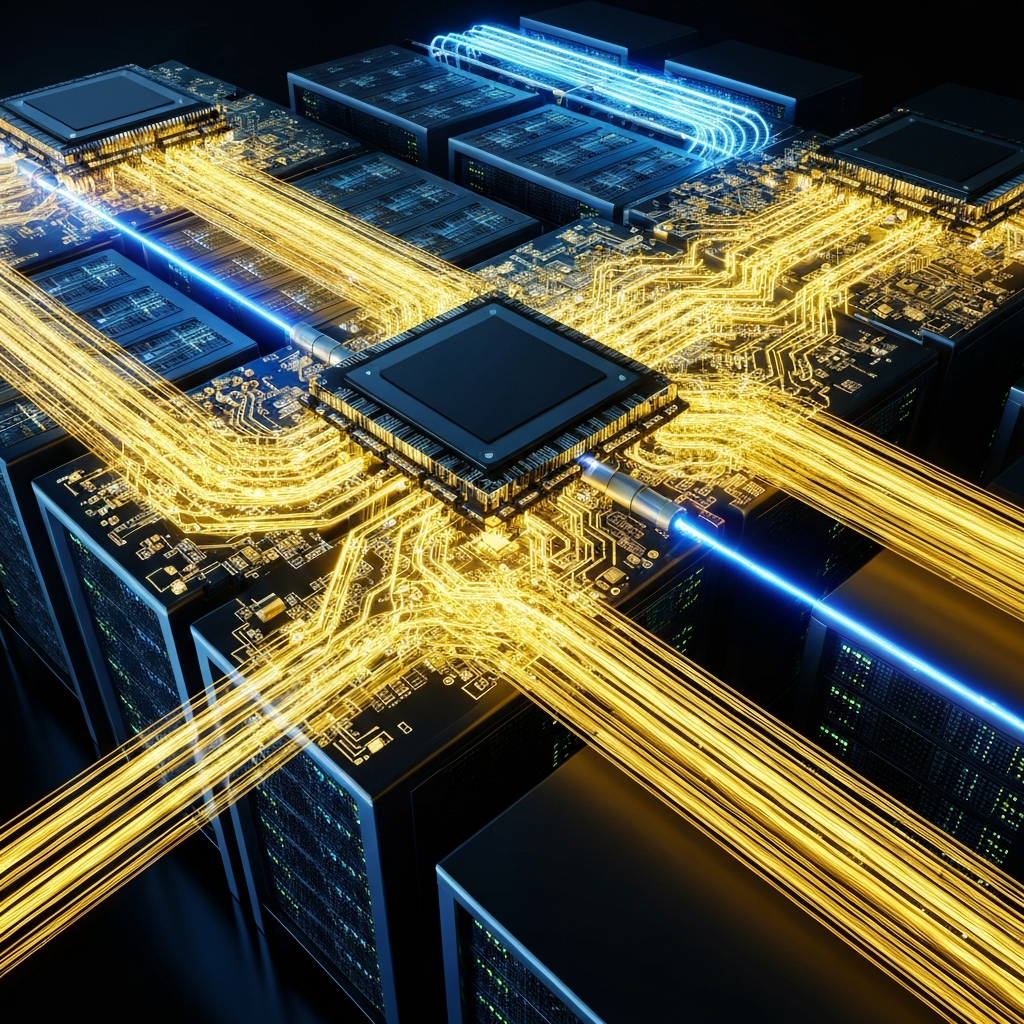
MaxLinear's 136% year-over-year infrastructure revenue surge in Q1 2026 is not merely a strong earnings number — it is empirical evidence that the true performance bottleneck in modern AI data centers has shifted from GPU computing speed to data transmission speed, and that the market had failed to price this reality. DataCenters.com analysis quantifies the problem with striking precision: up to 33% of GPU compute time in current AI clusters is wasted waiting on network transfers, translating to over $10,000 per GPU per year in idle compute cost, or $8.58 million annually for a 1,000-GPU cluster. The bandwidth requirements placed on data center interconnects have scaled sixfold in five years — from 200 Gbps per GPU in the A100 generation to 1,200 Gbps in the B200 generation — creating an insatiable structural demand for ever-faster optical signal processing chips. MaxLinear's PAM4 DSP products, including the Keystone 800G chip that has already shipped millions of units, are engineered precisely to resolve this bottleneck, and the next-generation Rushmore (1.6T) and Annapurna (1.6T AEC / 3.2T retimer) products entering production in late 2026 are designed for the bandwidth demands of the generation after that. NVIDIA's own $2 billion strategic investment in Lumentum serves as an unambiguous third-party validation that optical connectivity has become a binding constraint on AI infrastructure buildout — a constraint that MaxLinear's technology is architecturally positioned to address across every tier of the data center stack. The LightCounting forecast of the PAM4 DSP market tripling from $3.5 billion in 2024 to over $11 billion by 2030 provides the category-level market backdrop that makes MaxLinear's individual growth story structurally credible rather than cyclically dependent.
Wall Street's Information Asymmetry Created an 82.6% Overnight Correction
MaxLinear's pre-surge market cap of approximately $3 billion — less than one two-hundredth of NVIDIA's — meant the company fell well below the coverage threshold for most major Wall Street research teams, and the consequences of that institutional neglect were laid bare in a single trading session. The analyst consensus price target on the day of the surge stood at just $35.88, representing only 59.4% of the $60.32 price at which the stock immediately began trading post-earnings — a structural underestimation so severe that multiple major banks were forced to issue hasty upgrades on the day of the move itself rather than in advance of it. Needham scrambled to flip from neutral to buy with a $60 target on the same day the stock had already doubled; Stifel retroactively raised their target from $34 to $49; Roth/MKM similarly converted to buy after the fact — a parade of reactive coverage changes that reveals the depth of pre-existing analytical neglect. This is the efficient market hypothesis failing its most basic test in real time, and it illustrates a principle that consistently applies to mid-cap semiconductor companies: large-cap-biased Wall Street coverage creates persistent mispricings that only correct when earnings deliver evidence too unambiguous to dismiss. The structural implication for investors is significant: the same information asymmetry pattern that allowed MaxLinear to trade 40% below fair value for years is likely present today in other AI infrastructure supply chain companies — Credo Technology, Astera Labs, Monolithic Power — that carry the same analytical blind spot risk. Identifying those companies before the earnings catalyst, rather than chasing them after, is precisely where the investment edge lies in the current AI infrastructure cycle.
The Gold Rush Principle: In 2026 AI, the Shovel Sellers Are Winning
The most famous economic lesson of the 1849 California Gold Rush is also its most counterintuitive: the people who accumulated the greatest wealth were not the miners who rushed in to find gold, but Samuel Brannan selling picks and shovels, and Levi Strauss making denim pants durable enough for mining work — the infrastructure suppliers who profited regardless of whether any individual miner struck it rich. In 2026's AI gold rush, this structural dynamic is replicating with remarkable fidelity: the hyperscalers spending hundreds of billions to build GPU clusters and run AI services are the miners, while MaxLinear — making the optical DSP chips that connect those GPUs to each other at the speed of light — is the shovel seller. Motley Fool made this identification explicit in their April 24 analysis, labeling MaxLinear the best picks-and-shovels AI growth stock on the Nasdaq, and the underlying logic is compelling: AI service revenues remain uncertain and nascent, but the infrastructure orders enabling those services are already placed purchase orders with delivery schedules and payment terms. The critical structural difference between the shovel seller and the miner is demand certainty: AI service monetization might or might not develop as projected, but MaxLinear's DSP chips must be purchased regardless of whether the AI applications built on top of all this infrastructure ultimately succeed commercially. This principle — that infrastructure tool makers capture more reliable returns than final-product operators during technology buildout cycles — has held consistently across the railroad era, the telecom boom, and the dot-com infrastructure wave, and I see no structural reason why the AI cycle should be an exception. The pattern extends beyond MaxLinear to the broader second wave of AI infrastructure beneficiaries, suggesting that the gold rush principle will continue generating investment opportunities in the optical networking, power management, and thermal management segments for several years to come.
Structural Differences From the Dot-Com Bubble That Actually Matter
An 82.6% single-day gain inevitably triggers dot-com bubble comparisons, and intellectual honesty requires taking those comparisons seriously rather than dismissing them reflexively. The substantive distinction, however, is not that MaxLinear is immune to speculative excess — no company is — but that the underlying demand driving its revenue is empirically grounded in ways that dot-com era stocks almost never were. As Janus Henderson's comparative analysis documented, the characteristic feature of dot-com era bubble stocks was revenue at or near zero combined with exponentially rising share prices driven purely by future-state narratives; MaxLinear's Q1 2026 results featured 43% total revenue growth, 136% infrastructure segment growth, a Non-GAAP EPS swing from -$0.05 to +$0.22, and management guidance that materially exceeded rather than merely met expectations. The total addressable market, which dot-com companies routinely overstated by an order of magnitude, is here substantiated by Futurum Research's independently verified estimate of $660 to $690 billion in 2026 hyperscaler capex alone — not projected, not modeled, but committed through public statements from the five largest technology companies in the world. Forward P/E of 69.59x, double the sector median of 34.57x, does represent a meaningful valuation premium that requires sustained execution to justify — the stock is not cheap, and any quarter of underperformance will be punished. But the difference between a growth-rate-justified premium and a narrative-only premium is precisely what separates a fundamental re-rating from a bubble, and the distinction matters enormously for understanding the appropriate risk posture when approaching this investment. The lesson is not that MaxLinear is risk-free — no investment is — but that the specific risks here are execution risks and competitive risks, not the definitional bubble risk of a company valued entirely on stories rather than substance.
The Second Wave of AI Infrastructure Investment Has Begun
MaxLinear's surge is not an isolated event — it is the most visible data point yet in an emerging pattern that I believe represents a structural rotation in AI infrastructure investment from the first wave (GPU and memory) to the second wave (optical networking, power management, and thermal systems). From 2024 through 2025, NVIDIA and the HBM memory suppliers captured nearly the entirety of AI infrastructure investment returns; in 2026, the broader ecosystem of enabling components is beginning to receive the market recognition that GPU-centric AI clusters cannot function without. The pattern is already visible in the performance data: Vertiv, the data center cooling specialist, has risen 60% year-to-date; Monolithic Power Systems, supplying power management ICs to AI infrastructure, is up 40%; Credo Technology, another optical interconnect beneficiary, has gained 212% over the trailing twelve months; Astera Labs, providing connectivity solutions for AI data centers, posted 115% annual revenue growth. MaxLinear's 82.6% move completes a picture that looks less like a series of company-specific events and more like a coordinated sector re-rating driven by the realization that GPU performance alone cannot determine AI cluster efficiency. Goldman Sachs's projection of $1.15 trillion in hyperscaler capex from 2025 through 2027 implies that spending at this scale necessarily flows across the entire infrastructure stack, not just into GPU procurement; I believe the market will spend the remainder of 2026 and most of 2027 sequentially discovering the remaining supply chain beneficiaries that haven't yet seen their MaxLinear moment, with the companies building power delivery, thermal management, and advanced switching fabric infrastructure most likely to be next in the re-rating queue.
Positive & Negative Analysis
Positive Aspects
- Structurally Confirmed Revenue Growth With Years of Runway Ahead
The most powerful thing you can say about MaxLinear's investment thesis right now is that the AI demand driving its growth is not speculative — it is confirmed through actual shipped units, actual invoiced revenue, and management guidance backed by real purchase orders from the world's largest technology companies. The Q1 2026 infrastructure segment result of $63 million, up 136% year-over-year, reflects the structural ramp of 800G optical module deployments across multiple hyperscaler customers, a demand pattern that CEO Seendripu described on the earnings call as the beginning of a multi-year growth phase rather than a one-quarter surge. The decision to raise annual optical data center revenue guidance from $125 million to $150 to $170 million represents a 20 to 36% upward revision grounded in demand pipeline visibility that management would not commit to publicly without high confidence in its accuracy. The medium-term target of $300 million to $500 million in infrastructure revenue — disclosed explicitly on the earnings call — suggests management sees a multi-year growth arc, not a single cycle peak, as the trajectory for this business segment. When you combine confirmed Q1 results with raised Q2 guidance and a credible multi-year growth framework, you have the strongest combination of evidence that a growth stock investor can hope to find: present performance validating future promises, rather than future promises standing alone without present evidence to support them. This level of demand confirmation creates an investment safety margin that is categorically different from the speculative AI adjacent stories that populate much of the current market.
- The Best Technical Position for the 800G-to-1.6T Speed Upgrade Cycle
MaxLinear occupies the most strategically advantageous position in the AI data center generational transition from 800G to 1.6T optical modules — a transition that creates compounding rather than linear revenue growth because both unit volumes and per-unit economics improve simultaneously as speeds increase. CEO Seendripu's claim on the earnings call of best-in-class performance positioning at 1.6T versus two existing competitors reflects a product development execution that has kept the company ahead of the curve despite its comparatively modest R&D budget. TrendForce's projection of the AI optical transceiver market growing from $16.5 billion in 2025 to $26 billion in 2026 — a 57% annual expansion — provides the market context within which MaxLinear's Rushmore and Annapurna products will launch into an accelerating demand environment rather than a stable or declining one. The dual growth driver structure — expanding shipment volumes at rising per-chip average selling prices — is precisely the dynamic that commands premium valuations in the semiconductor sector, because it means the revenue growth compound rate reflects both market expansion and pricing power simultaneously. LightCounting's forecast of 800G-plus optical transceiver shipments growing from 24 million units in 2025 to 63 million in 2026 represents a 163% demand expansion into which MaxLinear's production ramp is timed with near-optimal precision. As data center interconnect speeds scale further from 1.6T toward 3.2T in subsequent generations, the technical barriers to entry compound at each generation boundary — making MaxLinear's early position in 1.6T technology not just a near-term revenue advantage but a longer-term competitive moat that deepens with each speed generation.
- Valuation Re-Rating Still Has Room to Run Despite the Post-Surge Price
The market has only partially repriced MaxLinear from legacy telecom components supplier to AI infrastructure critical vendor — and the gap between where the valuation currently sits and where full reclassification would take it represents meaningful additional upside independent of revenue growth. On a forward price-to-sales basis using projected 2026 revenue of $600 to $650 million, MaxLinear trades at approximately 3.2x — still a 45% discount to the semiconductor sector average of 5.8x, even after the 82.6% surge. Needham's $60 price target, derived from a 25x multiple on their 2028 Non-GAAP EPS estimate of $2.35, illustrates the re-rating math: if the market applies the same multiple to MaxLinear that it applies to AI infrastructure peers at comparable growth rates, the implied fair value is substantially above current levels even without assuming any upward revision to earnings estimates. The category itself commands premium valuations when fully recognized: NVIDIA trades above 30x forward sales, Broadcom at 12 to 15x, and pure-play AI infrastructure names at 8 to 12x — ranges that imply 2.5x to 4x additional multiple expansion for MaxLinear if and when full reclassification occurs. Historically, category re-rating events like this one — where a company's comparable peer group changes from low-multiple legacy tech to high-multiple AI infrastructure — have driven multi-year valuation appreciation cycles that outlast the initial surge. The combination of genuine revenue growth momentum and incomplete valuation recognition creates a structural condition where the investment thesis does not require investors to take an exclusively optimistic view of the future to see further upside.
- Riding $690 Billion in Committed AI Capex With Natural Demand Smoothing
The demand floor underlying MaxLinear's growth is not projected, estimated, or modeled — it is committed in the form of announced capital expenditure programs from the five largest technology companies in the world. Futurum Research's independently verified estimate of $660 to $690 billion in 2026 hyperscaler capex, with more than 75% flowing directly into AI infrastructure, represents a capital commitment of a scale and specificity that is genuinely unprecedented in the history of technology sector investment cycles. Goldman Sachs's $1.15 trillion in hyperscaler capex from 2025 through 2027 — 2.4 times the $477 billion spent from 2022 to 2024 — provides the multi-year context that explains why MaxLinear's management felt confident enough to declare a multi-year growth phase rather than hedging with quarter-by-quarter language. The data center construction cycle of 18 to 24 months creates a natural demand smoothing mechanism: orders placed in 2026 for facilities not completing until 2027 or 2028 mean that MaxLinear's revenue pipeline extends well beyond any single quarter's macro environment, buffering against short-term capex volatility that might otherwise disrupt a less strategically embedded supplier. All major hyperscalers have stated publicly that their constraints are currently supply-side rather than demand-side — they want to deploy AI capacity faster than the supply chain can provide components — which means MaxLinear is selling into a seller's market where pricing discipline is achievable and delivery commitments carry genuine scarcity premium. For a mid-cap semiconductor company with $137 million in quarterly revenue today, being structurally embedded in a $690 billion annual capex cycle represents the kind of demand backdrop that transforms growth trajectory projections from optimistic to conservative.
Concerns
- Intensifying Customer Concentration and Geographic Exposure Create Fragility
MaxLinear's most significant structural vulnerability is a customer concentration profile that is moving in the wrong direction precisely as the company's revenue is accelerating. The SEC 10-K filing discloses that the top ten customers accounted for 65% of 2025 revenue, up from 54% in 2023 and 60% in 2024 — a trend line that shows worsening concentration at every annual measurement point, not improvement. CEO Seendripu's own acknowledgment on the Q1 earnings call that we are only about halfway through hyperscaler diversification confirms management's awareness that this risk is real and that the diversification process remains incomplete. The practical implication is severe: if a single major hyperscaler customer pauses orders due to internal budget reallocation, shifts to a competing DSP supplier, or accelerates the in-house silicon development strategy that Google, Amazon, and Microsoft are all actively pursuing, MaxLinear's revenue could decline 20 to 30% in a single quarter without any deterioration in the broader AI infrastructure investment environment. Geographic concentration compounds this risk materially: 82% of MaxLinear's shipments flow to Asian destinations with Hong Kong alone accounting for 49% of the total, creating direct and substantial exposure to U.S.-China trade tensions, potential export restrictions on semiconductor components, and tariff regimes that could either disrupt shipment economics or, in an extreme scenario, require costly supply chain restructuring. At a stock price 82.6% above where it was one week ago, the asymmetric downside from a customer concentration event — the possibility of rapidly surrendering most or all of the post-surge appreciation — is the single most important risk factor that new investors entering positions today must explicitly price into their return expectations.
- Post-Surge Valuation Creates a High-Bar Execution Requirement for Multiple Quarters
The market dynamics following an 82.6% single-session surge are historically challenging for shareholders who bought at or above post-announcement prices, because the move itself prices in the most optimistic plausible forward scenario, leaving virtually no room for execution shortfalls. GuruFocus's independent valuation benchmark places GF Value at $14.86, generating a significantly overvalued designation at a 305.9% premium — a signal that the market's current price assumes multi-year execution at the high end of management's guidance range without meaningful competitive disruption. On a GAAP basis, the investment picture is less flattering than Non-GAAP metrics suggest: Q1 EPS was -$0.52 and the trailing twelve-month net loss stands at $131 million, with stock-based compensation excluded from Non-GAAP figures diluting shareholders through a 95 million fully diluted share count that represents real economic cost even if it does not appear on the Non-GAAP income statement. Q1 operating cash flow of -$8.9 million, even if attributable to timing of wafer prepayments as management explained, reinforces that the business has not yet reached the cash generation scale that fully self-funds its growth investment. Stocks that gain 80% or more in a single session have a well-documented historical tendency to give back 30 to 50% of that move within six months as early buyers take profits, leveraged long positions encounter forced liquidation, and the market recalibrates to a more balanced risk-reward distribution — and MaxLinear's limited trading liquidity as a mid-cap stock means that institutional selling activity can move the price by 10 to 15% in a single order. The disciplined investor recognizes that 82.6% can be gained as quickly as 40% can be lost, and that the post-surge entry point is historically one of the least favorable risk-adjusted moments to build a new position.
- Broadcom and Marvell Are Bringing War Chests Into MaxLinear's Market
The competitive environment that MaxLinear now inhabits, having declared itself the premier AI optical DSP provider, is populated by well-capitalized adversaries with substantially greater resources and established hyperscaler relationships that create genuine strategic risk to long-term market position. Broadcom's launch of the BCM83640 3nm-process PAM4 optical DSP chip represents a direct, committed attack on MaxLinear's revenue base backed by an annual R&D budget exceeding $7 billion — an amount that dwarfs MaxLinear's total R&D investment by a factor greater than ten, creating a fundamental asymmetry in the pace at which each company can iterate on technology generations. Marvell brings both capital scale — quarterly data center revenue of $1.52 billion compared to MaxLinear's $63 million infrastructure segment — and a recently deepened technological hand, having acquired Celestial AI specifically to strengthen its photonic interconnect capabilities while publicly targeting $1 billion in annual optical interconnect revenue by 2029. The specific competitive threat from large-resourced incumbents is not that they will beat MaxLinear at 1.6T today — the CEO's claim of best-in-class positioning at that speed tier appears credible — but that they will close the technical gap within one to two product generations through the application of superior R&D funding, potentially capturing market share at 3.2T and beyond before MaxLinear can establish sufficient technical lead to defend its position on resources alone. Broadcom's established relationships with every major hyperscaler and its history of employing bundling strategies that tie optical DSP adoption to broader networking chip packages could create sales channel disadvantages for MaxLinear that pure technical merit cannot fully overcome, particularly in procurement decisions where relationships and total system cost often outweigh component-level performance differentiation.
- LPO Technology and AI Capex Cycle Risks Could Undermine the Long-Term Thesis
Two structural risks threaten the long-term sustainability of MaxLinear's growth trajectory that most bullish analyses underweight: the technology substitution risk from linear pluggable optics (LPO) and the demand cyclicality risk from AI capital expenditure normalization. LPO achieves optical connectivity between data center components without requiring a DSP chip at all, eliminating the signal processing layer entirely and delivering power savings of 30 to 50% — a compelling value proposition in an environment where hyperscaler power consumption has become a first-order operating constraint. The technology has already moved beyond laboratory validation into production deployment: NVIDIA's Spectrum-X networking platform and Meta's AI network infrastructure both incorporate LPO at scale, and some industry forecasts project LPO capturing 40% or more of 800G short-reach applications by end of 2025. TrendForce models a three to five year timeline for LPO to approach mainstream adoption in AI data centers, but the power pressure hyperscalers face could accelerate that timeline materially if energy costs and data center power availability continue tightening. The macro demand risk is captured most clearly in the current ratio of AI capital expenditure to AI revenue — approximately 3:1, meaning the industry is spending $3 in infrastructure investment to generate $1 in AI service revenue. This ratio is structurally unsustainable at its current level; if AI service revenues fail to grow fast enough to bring the ratio toward 2:1 by 2027, hyperscalers will face pressure to slow capex growth, and the supply chain bullwhip effect ensures that optical component vendors will feel demand deceleration amplified rather than proportionate — the same dynamic that caused Cisco's stock to fall more than 80% from its peak during the 2000 to 2002 dot-com correction despite the company having genuine revenues, real customers, and actual infrastructure products.
Outlook
In the near term — the next one to six months — MaxLinear's stock will navigate extreme volatility as the market digests the post-surge reality. An 82.6% single-session move means a certain amount of profit-taking is structurally unavoidable. My expectation is that the pullback lands in the 20 to 30% range before finding durable support, rather than fully unwinding to pre-earnings levels. Here's my reasoning: the catalyst for this surge was what traders call hard data — actual reported results and binding guidance numbers, not a rumor or a speculative upgrade. The classic buy the rumor, sell the news dynamic requires the stock to have run first on anticipation, which did not happen — MaxLinear was trading in the $30s right up until the earnings call dropped. That creates a fundamentally more solid buy-support floor than you typically see after a hype-driven move. From a technical standpoint, the post-surge price of $60.32 still sits 21.7% below the all-time high of $77.07 from early 2022, meaning there's meaningful room to appreciate further before the stock reaches historically uncharted territory.
The most important near-term binary event will be the Q2 2026 earnings release, expected in late July. If MaxLinear delivers revenue at or above the $170 million high end of guidance — driven by Rushmore 1.6T early sampling wins and Keystone volume expansion — Needham's $60 price target will look conservative and the stock has a legitimate path to the mid-$70s or higher. If management misses even the $160 million low end due to order timing delays or hyperscaler capex pauses, expect 30 to 40% of the post-surge gains to reverse quickly. The intermediate catalysts to watch between now and then: institutional research notes from major banks, which should begin appearing in May and will formalize coverage that did not previously exist; and any data on Rushmore sampling progress at unnamed hyperscalers, which would signal the 1.6T ramp is on track.
The broader optical interconnect sector is entering a re-rating wave that extends beyond MaxLinear alone. The single-session surge effectively stamped AI infrastructure beneficiary across the entire optical DSP category — Coherent, Credo Technology, Lumentum, and Inphi all saw sympathy moves following the earnings release. I expect major Wall Street investment banks to publish dedicated optical infrastructure theme reports over the next three to four months, bringing institutional asset allocators formally into the space. Quiver Quantitative data showed institutional position-building in optical-related names in the weeks before MaxLinear's earnings announcement, indicating smart money was ahead of this trade. That institutional positioning process likely has another two to three months of momentum before it fully stabilizes into a new baseline.
In the medium term — six months to two years out — the single most important variable for MaxLinear's trajectory is the datacenter generational transition from 800G to 1.6T optical modules. TrendForce projects the AI optical transceiver market growing from $16.5 billion in 2025 to $26 billion in 2026, a 57% single-year expansion, with high-speed modules above 800G as the primary growth engine. The transition to higher speeds creates a compounding advantage that is structural rather than cyclical: as signal processing complexity scales up with faster speeds, DSP chip selling prices increase non-linearly, while technical barriers to entry grow higher. This means MaxLinear's revenue growth comes from both expanding unit volumes and improving per-unit economics simultaneously — a dual growth driver structure that semiconductor investors typically pay premium multiples to own. The Rushmore 1.6T product launch in late 2026 and the Annapurna production ramp in 2027 are the two milestone events that will determine whether MaxLinear lands at the high end or low end of my projected infrastructure revenue range: $200 million to $300 million in 2027, and $350 million to $500 million in 2028.
The medium-term competitive pressure from Broadcom and Marvell cannot be minimized, however. Broadcom's BCM83640 3nm-process PAM4 DSP chip represents a direct, well-capitalized assault on MaxLinear's core market, backed by an annual R&D budget exceeding $7 billion — more than ten times MaxLinear's. Marvell's Celestial AI acquisition and its $1 billion 2029 optical revenue target signal a multi-year, well-funded commitment to the space. The CEO's claim of best-in-class performance at 1.6T versus two existing competitors reflects a genuine near-term technical advantage, but sustaining that advantage with a 10x R&D budget gap is structurally challenging. My expectation is that MaxLinear increases R&D spend from the current 25 to 28% of revenue to approximately 30 to 33% by 2027, creating short-term margin compression but representing a necessary investment to defend technical leadership. There is also a non-negligible probability — I'd estimate 15 to 20% — that Broadcom makes an acquisition offer for MaxLinear given the company's suddenly elevated IP visibility. An acquisition would deliver a premium to current shareholders but would end the independent growth story that makes this investment thesis compelling.
In the long term — two to five years — the question that matters most is whether AI infrastructure investment has a sustainable ceiling, and if so, where that ceiling is. McKinsey estimates that satisfying projected AI data center demand through 2030 will require $5.2 trillion in cumulative investment. Goldman Sachs projects data center power demand growing 220% from 2023 to 2030. LightCounting forecasts the PAM4 DSP market reaching over $11 billion by 2030 at a 17% CAGR. DataM Intelligence projects the AI data center optical interconnect market hitting $18.36 billion by 2033. These are enormous numbers, and if directionally correct, MaxLinear's addressable market in 2030 will be multiple times larger than it is today. The structural demand picture, at the category level, is about as favorable as a mid-cap semiconductor company could hope for.
However, the long-term view requires tracking one crucial leading indicator: the ratio of hyperscaler AI capital expenditure to hyperscaler AI revenue. At roughly 3:1 today — meaning it currently costs $3 in capex to generate $1 in AI revenue — the investment pace is not indefinitely sustainable. If this ratio does not improve toward 2:1 or better over the next two to three years, capex growth will decelerate meaningfully after 2028, and optical DSP vendors will feel that deceleration amplified through the supply chain bullwhip effect. My base case is that AI service revenues grow fast enough to bring this ratio to approximately 2.5:1 by late 2027, supporting continued investment momentum through 2029. But if AI monetization stalls — if the applications being built on top of all this infrastructure fail to generate proportionate revenue — the investment cycle will correct, and MaxLinear will not be immune. The Cisco parallel from 2000 is worth keeping in mind: even a genuine infrastructure leader with real revenues and real customers saw its stock fall more than 80% when the cycle turned.
Architectural disruption is the wildcard that most sell-side models fail to incorporate adequately. Linear pluggable optics (LPO) achieves optical connectivity without a DSP chip entirely, delivering 30 to 50% power savings, and has already been adopted in NVIDIA's Spectrum-X and Meta's AI network infrastructure. TrendForce models a three to five year timeline for LPO to approach mainstream adoption in AI data centers. If that timeline accelerates — which is plausible given that power consumption has become the single most binding operational constraint for hyperscalers — MaxLinear's DSP-dependent revenue model could face structural headwinds earlier than most current projections assume. On the other hand, co-packaged optics (CPO), which integrates optical components directly into processor packages, could actually expand MaxLinear's DSP role if the company successfully develops CPO-compatible DSP solutions. The architecture battle between pluggable, LPO, and CPO optics will play out in ways that are genuinely difficult to model with precision today, and any long-term investment thesis in this space needs to remain intellectually honest about that uncertainty.
In the bull scenario (25% probability), AI hyperscaler capex grows 40% or more annually through 2027, the Rushmore 1.6T ramp lands six months ahead of schedule and expands to three or more major hyperscalers by mid-2027, and MaxLinear successfully adds two new major hyperscalers to meaningfully reduce concentration risk. In this scenario, 2028 infrastructure revenue exceeds $500 million, total company revenue approaches $700 to $800 million, and Non-GAAP EPS above $2.35 in 2028 with a 25 to 30x multiple puts the stock at $59 to $70 and beyond — representing more than 100% additional appreciation from today's level.
The base scenario (50% probability) has AI capex growth moderating to 20 to 25% annually as hyperscalers manage their capex-to-revenue ratios more carefully, Rushmore ramping on schedule to two major hyperscalers, and customer diversification reaching the full intended hyperscaler set by late 2027. Full-year 2026 revenue lands at $600 to $650 million with FY2026 Non-GAAP EPS near $0.91 per the street consensus, and the stock trades in a $55 to $75 range reflecting gradual, continued appreciation with periodic volatility along the way. This is the most probable path — solid execution delivering solid returns without the fireworks of the bull case.
In the bear scenario (25% probability), the AI capex cycle peaks in the first half of 2027 as hyperscaler AI revenue underdelivers, causing order cutbacks that hit optical component vendors first through the supply chain bullwhip effect. One or two major hyperscalers reduce orders significantly or accelerate in-house DSP silicon development, and LPO adoption captures 40% or more of the 800G segment ahead of base case projections. In this scenario, MaxLinear's infrastructure revenue falls below $40 million per quarter, total revenue recedes toward $350 to $400 million, and the stock retraces to the $20 to $30 range. GuruFocus's GF Value of $14.86 represents the extreme downside anchor in the most adverse version of this scenario.
For investors reading this, my concrete guidance is straightforward: do not chase the 82.6% surge with fresh capital. A 20 to 30% pullback creates a structurally more defensible entry point. Building a position alongside Coherent, Credo Technology, and Lumentum provides diversified optical networking exposure rather than concentrated single-stock risk. Monitor the Q2 2026 earnings call in July closely — MaxLinear's Rushmore customer adoption timeline and hyperscaler diversification progress will be the two data points that most directly separate the bull scenario from the base scenario. Track the ratio of AI capital expenditure to AI revenue every quarter; when that ratio starts deteriorating, it will be the first early warning signal that the broader cycle is beginning to turn. The shovel sellers won in 1849, and I believe the optical infrastructure players will win in this AI cycle. But even shovel sellers have to know when the gold rush is ending. That awareness is what distinguishes a good investment from a great one.
Sources / References
- MaxLinear Q1 2026 Financial Results (Official IR) — MaxLinear Inc.
- MaxLinear Q1 2026 Earnings Call Transcript — The Motley Fool
- PAM4 and Coherent DSPs Market Report (Updated April 2025) — LightCounting Research
- AI Optical Transceiver Market to Reach US$26B in 2026 — TrendForce
- AI Capex 2026: The $690B Infrastructure Sprint — Futurum Research
- Goldman Sachs Forecasts Data Centers Power Demand to Surge 220% by 2030 — Benzinga / Goldman Sachs Research
- Inside the AI Compute Stack: Why Infrastructure Is the Real Bottleneck — DataCenters.com
- AI vs the Dot-Com Bubble: 8 Reasons the AI Wave Is Different — Janus Henderson Investors
- The Best Picks-and-Shovels AI Growth Stock on Nasdaq — The Motley Fool
- MaxLinear Unveils Rushmore Low-Power 1.6T PAM4 DSP for AI/ML and Data Center Networks — BusinessWire / MaxLinear