
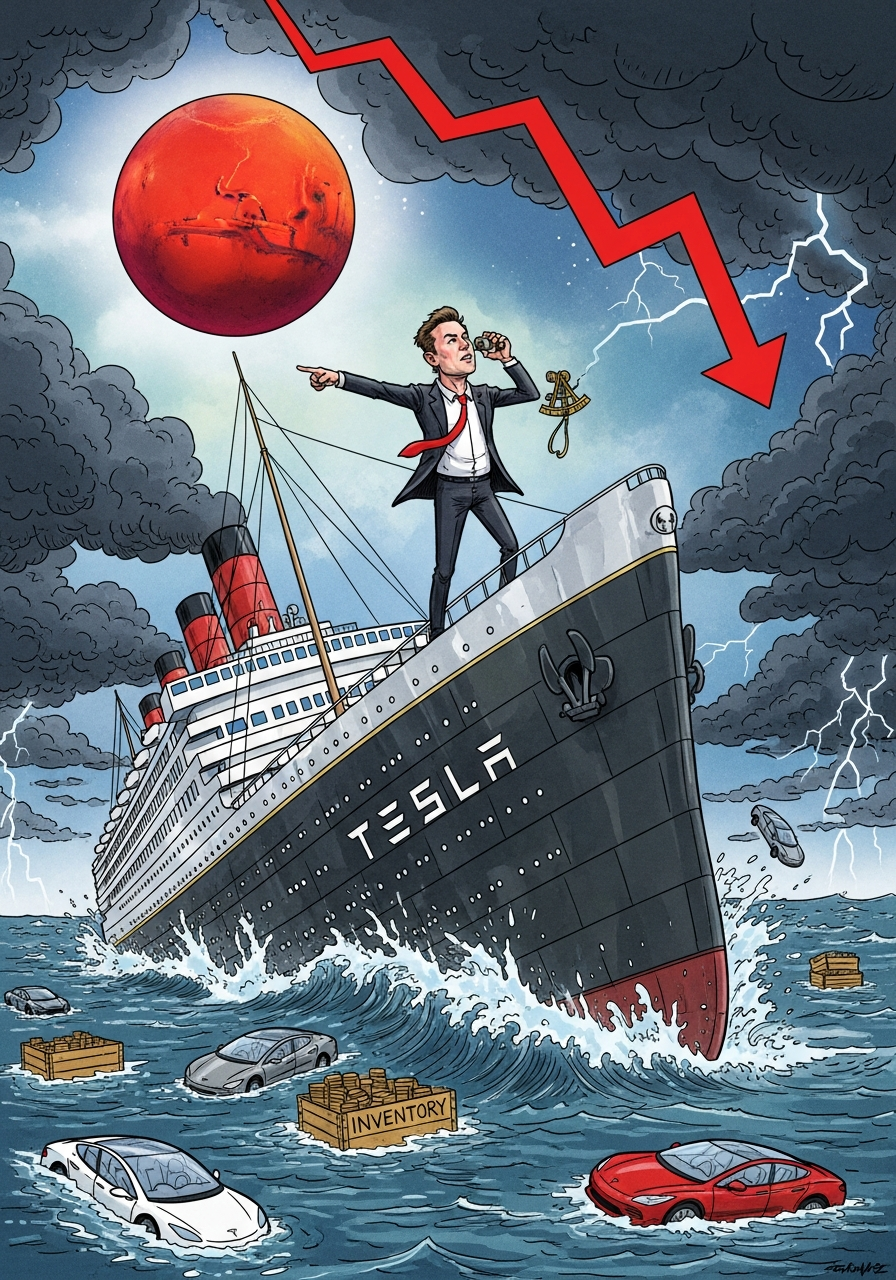
Tesla Q1 Results: The Ship Is Sinking, but the Captain Points to Mars
Summary
Tesla's Q1 2026 deliveries came in at 358,023 units, missing Wall Street consensus and declining 14.4% quarter-over-quarter. The 50,000+ unit gap between production and deliveries marks a structural shift from build-to-order to build-to-stock, pointing to a Tesla-specific demand crisis rather than a broader EV market slowdown. The energy storage segment compounded concerns by falling 38% QoQ to 8.8GWh, shaking both growth pillars simultaneously. With shares down 20% YTD and a 5.43% single-day plunge on the announcement, the market is cracking the robotaxi-Optimus-FSD narrative that has long justified Tesla's premium valuation — making the April 22 formal earnings call a potential inflection point for rebuilding credibility or accelerating the de-rating.
Key Points
Q1 Deliveries at 358,023 — Missing Wall Street and Down 14.4% QoQ
Tesla delivered 358,023 vehicles in Q1 2026, falling roughly 2% short of the Wall Street consensus of 365,645 units. The more alarming signal is the 14.4% quarter-over-quarter decline, a magnitude of sequential drop rarely seen in Tesla's recent history. While seasonal factors and the Model Y refresh transition likely played a role, the scale of the miss goes beyond simple transition effects. Notably, BYD also posted a 30% YoY decline in Q1 2026 NEV sales, with BEV deliveries falling enough for Tesla to reclaim the pure-BEV global lead — but BYD's overseas exports surged to 40% of total sales, maintaining international momentum. Tesla's weakness across both its core U.S. and European markets suggests demand issues well beyond seasonal EV market softness. This miss heightens concerns about guidance cuts at the April 22 formal earnings release and potential further stock declines.
50,000+ Unit Inventory Buildup — A Structural Shift from Build-to-Order
With production at 408,386 units versus 358,023 deliveries, approximately 50,363 vehicles went unsold in Q1 — roughly 14% of Tesla's quarterly delivery volume. Tesla has historically operated on a build-to-order model where waiting lists stretched months. The fact that 50,000+ cars are now sitting in lots signals that demand is structurally failing to keep pace with production capacity. In the automotive industry, inventory buildups of this scale typically foreshadow price cuts, margin compression, and expanded dealer incentives. The 2023-2024 precedent, when aggressive price cuts dragged Automotive Gross Margins from the 30% range down to 16-18%, raises legitimate concerns about a repeat cycle that could further erode profitability.
Energy Storage Down 38% QoQ — Both Growth Engines Stalling Simultaneously
Tesla's energy storage deployments fell to 8.8GWh in Q1, a sharp 38% decline from 14.2GWh in the prior quarter. The energy business had been Tesla's fastest-growing segment and a key pillar of the 'beyond-auto' growth narrative, anchored by surging Megapack demand. While quarterly volatility is inherent to the energy storage business, having both automotive and energy decline simultaneously undermines the 'temporary blip' explanation. According to the IEA, the global battery storage market is on a structural growth trajectory, making Q2 performance a critical test of whether Tesla can maintain its leadership. If the energy segment sustains its slowdown, the last remaining pillar justifying Tesla's valuation premium comes under serious threat.
YTD -20%, Single-Day -5.43% — The Market Is Repricing the Entire Narrative
Tesla shares have fallen 20% year-to-date in 2026, with a 5.43% single-day plunge on the Q1 delivery announcement. This price action goes beyond a simple earnings miss — it signals the market is fundamentally reassessing the Tesla thesis. With a forward P/E still hovering around 180x as of April 2026, Tesla's valuation rests on the premise that robotaxi, Optimus, and FSD will materialize as transformative businesses. When the core automotive franchise falters, the credibility of those future promises erodes, creating powerful de-rating pressure. The confluence of EV subsidy expiration, intensifying Chinese competition, and brand backlash from Musk's political activities has severely damaged investor sentiment heading into the April 22 earnings call.
Robotaxi/Optimus Narrative vs. Fundamentals — April 22 as the Watershed Moment
The central tension around Tesla is the widening chasm between future narrative and present reality. Robotaxi, the Optimus robot, and FSD have positioned Tesla as an AI/robot/energy platform rather than a mere automaker, justifying a 5-10x valuation premium over traditional car companies. But when fundamentals deteriorate, the collateral backing these narratives vanishes. Waymo already operates commercially in 10 U.S. cities, while Tesla's Austin robotaxi service runs just 31 Model Y vehicles with 14 reported crashes since its June 2025 launch. Optimus remains in factory pilot testing, and FSD still lacks Level 4 certification. The April 22 earnings call will set the next chapter: whether management provides concrete milestones and timelines, or repeats vague optimism that further erodes whatever trust remains.
Positive & Negative Analysis
Positive Aspects
- Energy storage business with structural long-term growth potential
Despite the Q1 dip to 8.8GWh, Tesla's Megapack holds a dominant position in the utility-scale battery storage market. The IEA projects global battery storage deployment must grow at 21%+ CAGR through 2030, while MarketsandMarkets estimates the BESS market expanding from roughly $50.8 billion in 2025 to $106 billion by 2030 at a 15.8% CAGR. If Tesla maintains 20-25% market share, energy segment revenue alone could reach $21-26.5 billion annually. This represents a genuine second growth engine capable of offsetting automotive weakness, and the structural growth trajectory beyond quarterly noise deserves serious attention from long-term investors.
- Industry-leading cost structure and vertically integrated manufacturing
Tesla's per-vehicle cost of goods sold remains 20-30% below competitors, enabled by Gigafactory vertical integration, in-house 4680 battery production, gigacasting unibody construction, and a software-defined vehicle architecture. This cost advantage translates directly into pricing flexibility — when demand recovers, margins can snap back rapidly. While legacy automakers hemorrhage losses on their EV transitions, Tesla maintains profitability even with compressed margins, a crucial distinction that becomes even more valuable in a potential downturn. The manufacturing moat is structural, not cyclical, and it gives Tesla room to wage price wars that competitors simply cannot afford to match.
- Supercharger network as an unmatched infrastructure moat
With Ford, GM, Hyundai, BMW, and a growing list of manufacturers adopting the NACS standard, Tesla's Supercharger network has become the de facto North American EV charging standard. Over 80,000 Supercharger stalls across 8,500+ stations worldwide create powerful network effects that lock competing automakers into Tesla's ecosystem. The charging network generates revenue independently of Tesla's own vehicle sales, providing a steady cash flow stream from non-Tesla EV owners. As overall EV adoption accelerates, this platform asset becomes more valuable regardless of Tesla's own delivery trajectory — it is one of the few Tesla assets whose value grows even if vehicle market share declines.
- $36 billion+ cash reserves provide recession-proof staying power
Tesla held approximately $36 billion in cash, equivalents, and short-term investments as of late 2025, split between roughly $17 billion in cash and $19 billion in short-term investments. This buffer allows continued investment in R&D, factory expansion, and new model development even during economic downturns or extended demand weakness. The debt-to-equity ratio remains healthy relative to industry averages, placing Tesla in stark contrast to cash-burning EV startups like Rivian and Lucid that face existential funding pressures. Tesla can weather an extended downturn without external capital raises — a luxury that most of its competitors, both legacy and startup, simply do not have.
- FSD subscription revenue as high-margin software business growth
Starting February 2026, FSD transitioned to a subscription-only model at $99 per month, generating steadily increasing software-based recurring revenue with near-perfect margins. Tesla disclosed 1.1 million FSD subscribers for the first time in its Q4 2025 report, representing 12.4% of the 8.9 million cumulative vehicles delivered. Software revenue carries near-100% margins compared to hardware, meaning each percentage point increase in FSD adoption has an outsized impact on overall profitability. The ability to improve features through OTA updates at zero marginal cost is a structural advantage absent from traditional automakers' business models, creating a compounding revenue stream that grows with every Tesla on the road.
Concerns
- Structural demand erosion and inventory-driven margin compression
The 50,000+ unit inventory buildup may signal a structural demand shortfall rather than a temporary production transition. Clearing that inventory requires further price cuts, which compress Automotive Gross Margins that already collapsed from the 30% range to 16-18% during the 2023-2024 price war. Re-entering that cycle would severely damage profitability and risk triggering a vicious spiral: price cuts leading to margin compression, reduced earnings, deteriorating investor sentiment, and further selling pressure. The uncomfortable question is whether Tesla has permanently lost pricing power in its core segments, or whether this is truly a one-time adjustment that resolves with new models.
- Brand damage from Musk's political activities with uncertain recovery
Musk's DOGE involvement, political statements, and social media controversies are directly eroding the Tesla brand in measurable ways. Europe has seen organized Tesla boycotts translating into real sales declines, while in the United States, Tesla ownership has become politically coded in ways that deter a significant portion of potential buyers. Brand damage cannot be solved with price cuts, and recovery typically requires years of sustained effort. The degree to which a single CEO's political activism has damaged a global consumer brand is virtually unprecedented in modern corporate history, and there is no playbook for how quickly — or whether — this kind of reputational erosion can be reversed.
- Intensifying competition from China and Europe amid an aging lineup
BYD, Li Auto, and NIO are pressuring Tesla on both price and technology in China, with BYD's Seagull already selling in volume at the $10,000 price point. European incumbents including Volkswagen, BMW, and Mercedes are aggressively expanding their EV lineups with competitive offerings. Tesla's current portfolio leans too heavily on Model 3 and Model Y, with Model S and X relegated to niche status and Cybertruck struggling to reach meaningful production scale. Without a $25,000 mass-market model by 2027, Tesla's share of a growing global EV market will continue to decline — growing the pie matters little if your slice keeps shrinking.
- Forward P/E of ~180x creates severe de-rating risk
Tesla's forward P/E stands at roughly 180x as of April 2026 — over 14 times the Vehicles & Parts industry median of 12.5x, and dramatically higher than both traditional automakers at 5-15x and high-growth tech companies at 25-40x. This valuation prices in flawless execution on robotaxi, Optimus, and energy business promises simultaneously. When core automotive fundamentals weaken, the assumptions underlying this premium come under direct scrutiny. If the market were to re-rate Tesla as primarily an automotive company, a fair P/E in the 15-25x range would imply 60-70% downside from current levels — a scenario that is no longer purely hypothetical given the Q1 results.
- Persistent robotaxi and Optimus delays fueling narrative fatigue
Tesla launched its robotaxi service in Austin in June 2025, but it currently operates only about 31 Model Y vehicles with 14 reported crashes — a far cry from the promised revolution. Waymo is already running commercially in 10 U.S. cities including Phoenix, San Francisco, Los Angeles, Miami, Dallas, and Houston, with plans for Denver, London, and Washington D.C., making the competitive gap impossible to ignore. Optimus remains in factory pilot testing, and FSD still lacks Level 4 certification. Each cycle of 'it is coming next year' accumulates narrative fatigue, reducing the valuation premium investors are willing to assign to the same promises — a textbook 'boy who cried wolf' dynamic that erodes credibility with each repetition.
Outlook
The next few weeks will be the most critical stretch Tesla has faced in years. The formal Q1 earnings release, scheduled for April 22, looms as the single most important catalyst for the stock in 2026. The delivery numbers are already out, and they were ugly — so the market's attention now shifts to three specific areas that will determine whether this is a recoverable stumble or the beginning of something worse.
First, Automotive Gross Margin. Consensus expectations sit around 17-18%, and anything that comes in below that floor will trigger another wave of selling. The 50,000+ unit inventory overhang makes margin guidance particularly sensitive — if management hints at additional price cuts to clear lots, analysts will immediately model lower margins for Q2 and Q3 as well, creating a cascading downward revision cycle. Remember, the 2023-2024 price war shaved margins from the low 30s to the mid-teens, and investors have not forgotten how quickly that deterioration can happen once it starts. The Street is especially focused on whether Tesla can hold the 17% line, because a sustained dip below that level raises serious questions about the company's ability to fund its ambitious R&D roadmap from operating cash flow alone.
Second, inventory management. This is arguably the most loaded topic for the earnings call. How does Tesla plan to move 50,000+ unsold vehicles without resorting to the kind of aggressive discounting that destroyed margins two years ago? Are there fleet sales, leasing incentives, or regional promotions in the pipeline? Investors will parse every word of the management commentary for signals about whether the company views this as a temporary production-delivery timing mismatch or a more fundamental demand problem. If the tone leans toward denial — 'this is normal seasonality' — expect skepticism. If it leans toward acknowledgment with specifics — 'we are adjusting production schedules and targeting these markets with these programs' — that could actually stabilize sentiment. The worst possible outcome would be management ignoring the inventory question entirely, which would signal either obliviousness or an unwillingness to engage with the core issue.
Third, robotaxi and FSD updates. Concrete timelines or evidence of regulatory progress could provide a floor under the stock. Investors have heard the promise before, but if Tesla can point to specific cities where regulatory approval is pending, or provide data showing meaningful improvement in autonomous driving safety metrics, it changes the calculus. The FSD subscriber count of 1.1 million is a starting point — what matters now is the growth trajectory and whether monthly subscription revenue is meaningfully moving the needle on blended margins. Another round of Musk-style 'fully autonomous next year' proclamations, however, would deepen the credibility gap at exactly the wrong moment.
Moving into Q2, the picture gets more complicated. The U.S. EV subsidy restructuring that took effect in late 2025 is likely to show its full impact on demand. Some federal incentives expired or were reduced, and there is a credible argument that Q1 demand was artificially inflated by buyers pulling forward purchases to capture expiring credits. If that pull-forward effect is real, Q2 deliveries could actually come in worse than Q1, which would be devastating for the recovery narrative. On the other hand, the Model Y refresh — codenamed 'Juniper' — is ramping up in global markets, and early indicators from China suggest the refreshed model is generating strong interest. European order books for the updated Model Y have reportedly been healthy as well, though it remains to be seen whether that translates into deliveries or sits as backlog. The question is whether Juniper demand is sufficient to offset the subsidy headwinds and the broader brand damage.
My estimate for Q2 deliveries is 370,000 to 390,000 units. Anything above 400,000 would be a genuine positive surprise and could trigger a meaningful rally. Failure to reclaim the 400,000-unit threshold, however, would effectively kill the 'V-shaped recovery' narrative that bulls are counting on. At that point, the conversation shifts from 'when does growth resume' to 'what is Tesla's steady-state volume,' and the valuation implications of that shift are severe. A company priced for 30-40% annual growth that delivers flat or declining volumes faces a brutal re-rating.
The medium-term outlook, spanning late 2026 through 2027, is dominated by one question: new models. Tesla's current lineup is dangerously concentrated. Model 3 and Model Y account for the vast majority of sales, Model S and Model X are niche luxury products with declining relevance, and Cybertruck — despite enormous hype — has struggled to reach meaningful production volumes. The Semi remains a specialized product with a limited addressable market in the near term. This lineup concentration is a strategic vulnerability that competitors are actively exploiting.
The most anticipated product in Tesla's pipeline is the rumored $25,000 mass-market vehicle, which is expected to dramatically expand Tesla's addressable market. If this model launches in the first half of 2027, it could reinvigorate volume growth and recapture market share being lost to Chinese and European competitors. BYD's Seagull is already selling at the $10,000 price point in China, and European manufacturers including Volkswagen, Renault, and Stellantis are preparing sub-$25,000 EVs for their home markets. Without a competitive offering in this segment, Tesla risks becoming a premium niche player in a market that is rapidly moving toward mass adoption at lower price points. Every quarter of delay in the affordable model launch is a quarter of lost market share that becomes exponentially harder to reclaim, as consumers form brand loyalties and charging habits around whatever vehicles they purchase first.
The robotaxi commercialization timeline is equally pivotal for medium-term prospects. Tesla launched its robotaxi service in Austin, Texas in June 2025, but it remains severely limited — about 31 Model Y vehicles operating at 19% availability, with 14 reported crashes that have raised safety questions among regulators and the public. Contrast this with Waymo, which is already operating commercially in 10 U.S. cities and expanding rapidly into Dallas, Houston, Miami, and additional metro areas. Waymo recently announced plans for Denver, London, and Washington D.C., establishing a first-mover advantage that Tesla may find extremely difficult to overcome.
The competitive dynamics here matter enormously for the valuation story. If Waymo establishes itself as the trusted brand in autonomous ride-hailing — the 'Uber of self-driving' — before Tesla achieves meaningful scale, the robotaxi narrative that supports a significant portion of Tesla's valuation premium could collapse. Meaningful deployment in 5-7 cities by 2027 would be a positive signal, but even that may not be enough to match Waymo's expected footprint of 20+ cities by the same timeframe. The window for Tesla to establish robotaxi credibility is narrowing with each quarter, and the safety record of the Austin pilot is not helping.
Looking further out to 2028-2030, Tesla's long-term trajectory depends on a fundamental question: does the company remain primarily an automaker, or does it successfully evolve into a diversified technology platform? The valuation spread between these two outcomes is enormous. Valued purely as an automotive company, Tesla's fair P/E sits in the 15-25x range — implying 60-70% downside from current levels. But if the platform vision materializes, with robotaxi processing millions of paid rides annually, Optimus replacing substantial portions of factory and warehouse labor, and the energy business rivaling or surpassing automotive revenue, the current premium could be justified or even understated.
Tesla's energy business trajectory deserves special attention as the most underappreciated variable in the long-term outlook. Megapack already dominates the utility-scale battery storage market, and demand is surging as global power grid decarbonization accelerates under both policy mandates and economic incentives. MarketsandMarkets projects the global BESS market to grow from approximately $50.8 billion in 2025 to $106 billion by 2030 at a 15.8% CAGR. The IEA forecasts battery storage deployment must grow at 21%+ annually through 2030 to meet climate targets. If Tesla maintains 20-25% market share in this expanding market, energy segment revenue alone could reach $21-26.5 billion annually — roughly 22-28% of Tesla's current total revenue of approximately $94.8 billion in FY2025. That would fundamentally transform Tesla's revenue mix in a way that changes how the company should be valued, shifting it from a cyclical automaker toward a utilities-adjacent infrastructure play with more predictable cash flows.
The Supercharger network adds another layer to the platform story. With NACS becoming the de facto North American charging standard, Tesla is building a toll-road business for the entire EV ecosystem. Revenue from non-Tesla vehicles using the Supercharger network will grow proportionally with overall EV adoption, regardless of Tesla's own market share trajectory. This is the kind of infrastructure asset that generates durable, high-margin cash flows — and it is often underweighted in bear case analyses that focus exclusively on vehicle sales.
Scenario analysis helps frame the range of outcomes. In the bull case, the Model Y Juniper drives strong Q2 orders and the delivery trajectory bends decisively upward through the second half of 2026. A $25,000 mass-market model launches in the first half of 2027, reigniting volume growth and recapturing share from Chinese competitors. Robotaxi achieves commercial operation in 3-5 cities by 2027, with safety metrics that satisfy regulators and consumers alike. Energy revenue surpasses $20 billion annually by 2027, and FSD subscribers grow from the current 1.1 million to over 3 million, creating a software revenue stream that materially improves blended margins. In this scenario, Tesla stock could appreciate 50-80% from current levels. The probability here is roughly 20% — ambitious, but not impossible for a company that has defied skeptics before.
The base case sees Q2 and Q3 deliveries gradually recovering, with full-year 2026 volumes reaching 1.8-1.9 million units — respectable but uninspiring. Robotaxi remains in limited pilot phase through 2027. The mass-market model arrives in late 2027 or early 2028, later than hoped but still before most competitors establish insurmountable leads. Energy grows steadily while Automotive Gross Margins remain stuck in the 16-18% range, frustrating investors hoping for a margin inflection. The stock trades sideways or drifts modestly in either direction, with a range of roughly -10% to +10% from current levels. This is the most likely outcome at approximately 45% probability — a frustrating holding pattern where nothing breaks decisively in either direction.
In the bear case, brand damage accelerates as Musk's political activities continue to alienate buyers in Europe and on the U.S. West Coast, two of Tesla's historically strongest markets. Chinese market share falls to single digits as BYD and its peers dominate with cheaper, increasingly sophisticated EVs that match or exceed Tesla's technology. Annual deliveries drop below 1.7 million, and price pressure drives Automotive Gross Margin below 14%. Robotaxi and Optimus continue to miss deadlines, and the market begins re-rating Tesla from an 'AI and robotics company' to a 'struggling automaker with expensive ambitions.' A P/E de-rating to 30-40x would imply 40-50% downside from current levels. The probability here is roughly 35%, which is frankly uncomfortable — one in three odds of a severe correction is not a tail risk, it is a plausible scenario that investors must account for in their position sizing.
There are, of course, scenarios where these projections prove entirely wrong. If Musk steps back from DOGE and political activities to refocus on Tesla operations and brand recovery, the narrative could shift with startling speed. If FSD achieves Level 4 certification faster than expected, robotaxi becomes reality rather than aspiration. If a geopolitical shift or new tariff regime suddenly disadvantages Chinese EV exports to Western markets, Tesla's competitive position improves overnight. Tesla has a long history of defying consensus expectations in both directions, and dismissing the upside tail risk would be just as foolish as ignoring the downside.
That duality is the essence of owning Tesla stock. When the direction is right, the rewards are extraordinary — early believers have been handsomely rewarded multiple times over the company's history. But if fundamentals continue to deteriorate while investors wait for the promised future to arrive, that future may never come — or it may arrive too late to justify the price paid for waiting. The opportunity cost of capital tied up in a stagnant or declining position is real, even if the long-term thesis eventually proves correct.
One practical suggestion for investors watching this unfold: mark April 22 on your calendar and pay close attention to the earnings call. The numbers matter, but management tone matters more. If the executive team defaults to 'temporary blip, robust Q2 recovery' optimism without providing specifics, treat that as a warning signal — companies that minimize problems rarely solve them quickly. If, on the other hand, they acknowledge the inventory challenge, outline concrete remediation steps, and demonstrate awareness of the brand perception issue, that kind of sober realism could paradoxically represent a buying opportunity. In my experience, management teams that admit to crisis almost always outperform those that deny it. The captain who acknowledges the leak and starts bailing water is infinitely more trustworthy than the one who insists the ship is unsinkable while pointing at the stars.
Sources / References
- Tesla Q1 2026 Production & Deliveries Report — Tesla Investor Relations
- Tesla Q1 Deliveries Fall Short of Wall Street Estimates — Reuters
- Tesla Inc (TSLA) Stock Price & Analyst Consensus — Bloomberg
- Global EV Sales Tracker — Q1 2026 Quarterly Report — CleanTechnica
- Global Battery Storage Outlook 2025-2030 — Goldman Sachs
- Autonomous Vehicle Testing Permit Holders — California DMV
- Tesla First Quarter 2026 Production, Deliveries & Deployments — Tesla Investor Relations
- Tesla (TSLA) Q1 2026 deliveries miss expectations at 358,000 — Electrek
- Tesla's stock suffers steepest drop of 2026 on disappointing deliveries report — CNBC
- Waymo robotaxis are now operating in 10 US cities — TechCrunch
- Battery Energy Storage System (BESS) Market Report 2025-2030 — MarketsandMarkets
- Tesla discloses FSD subscriber count for the first time: 1.1 million — Electrek
- Tesla Robotaxi status check: 8 months in, 19% availability — Electrek