
Revenue +16%, EPS Beat by 62%, Stock −10% — The Paradox That Reveals Wall Street's Real Playbook
Summary
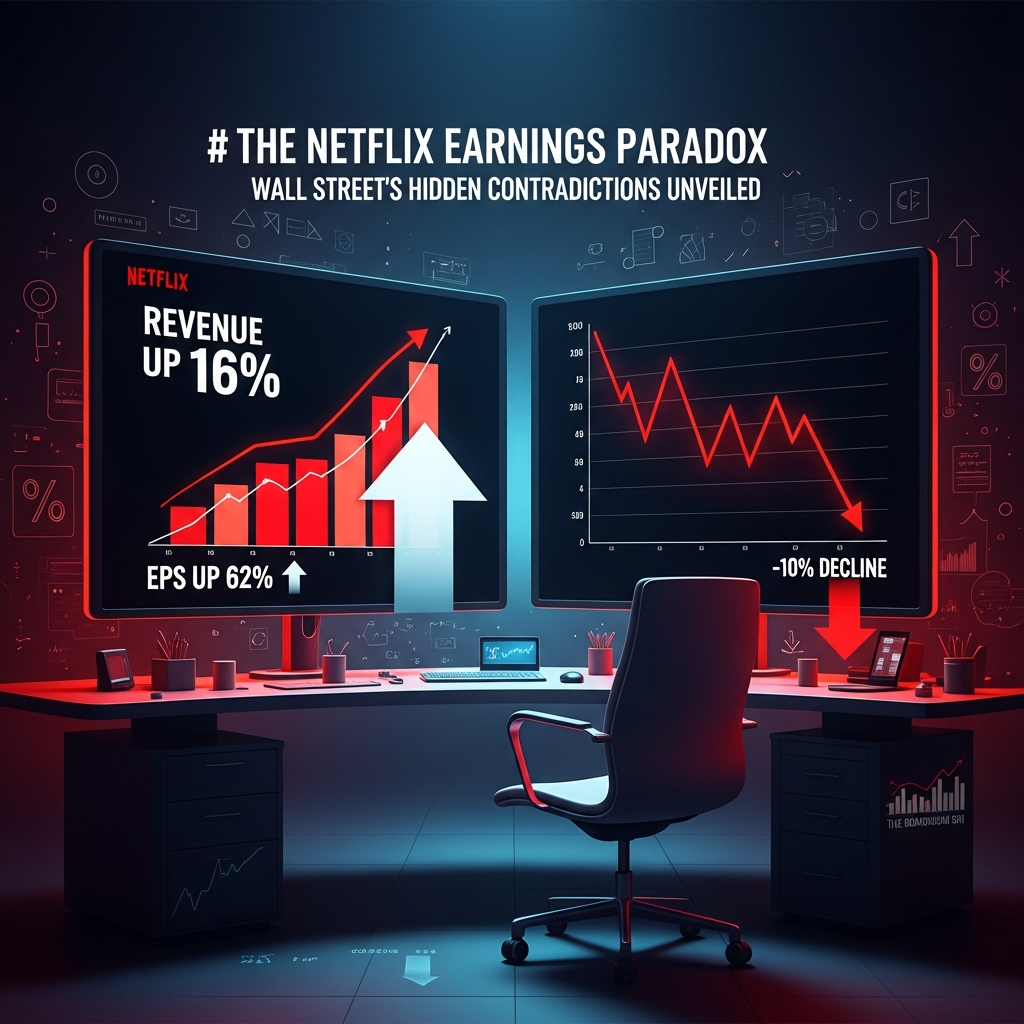
Netflix reported Q1 2026 results on April 16, 2026, posting revenue of $12.25 billion and EPS of $1.23 — crushing consensus estimates of $12.18 billion and $0.76, with the EPS beat exceeding expectations by 62%, making it one of the company's strongest quarters on record by headline metrics. Revenue grew 16% year-over-year, the operating margin reached 32.3%, and free cash flow surged 91% to $5.09 billion, fueled in part by a $2.8 billion termination fee from the collapsed Warner Bros. Discovery merger that was recorded under interest and other income rather than operating revenue.
Despite these figures, the stock fell more than 10% in the following trading session, driven by Q2 revenue guidance of $12.57 billion that fell $70 million short of Wall Street's $12.64 billion target and Q2 EPS guidance of $0.78 that missed the $0.84 estimate. On the same day, co-founder Reed Hastings announced he would not stand for re-election to the board when his term expires at the June 2026 annual meeting, adding a governance dimension that amplified investor uncertainty and compressed sentiment further.
This essay dissects the beat-and-drop paradox through the lens of growth stock pricing mechanics, examines how the one-time WBD fee distorted headline EPS, and evaluates what this earnings episode signals about Netflix's ongoing structural transition from a pure growth platform to an advertising infrastructure company with a fundamentally different valuation profile.
Key Points
Earnings Beats Are Lagging Indicators — The Market Trades on Future Expectations, Not Past Results
Netflix's Q1 2026 EPS of $1.23 crushed the $0.76 consensus by 62%, and by any historical standard that is a remarkable headline number worthy of celebration. But the 10% stock drop that followed is not a paradox or a market failure — it is the growth stock pricing mechanism doing exactly what it was engineered to do. Stock prices are a forward-looking discounting system, not a scorecard for past performance, and the moment a quarterly earnings report is released, that quarter belongs to history. What drives price from that moment forward is the updated expectation for future cash flows, which in Netflix's case was reset downward by Q2 guidance implying deceleration from 16% to roughly 12% revenue growth. What makes this particularly instructive is that the same dynamic plays out with almost every high-multiple growth stock: the moment forward expectations soften even slightly, the multiple compresses, and the percentage drop can look wildly disproportionate to the actual magnitude of the miss. FactSet data from April 17, 2026 confirms this is not a Netflix-specific phenomenon — 88% of S&P 500 companies that reported Q1 results beat EPS estimates, yet the average price reaction was negative 0.2%, well below the five-year historical average of positive 1.0%.
The $70 Million Q2 Guidance Miss Was Worth Billions in Market Cap — Here Is Why
A $70 million quarterly revenue guidance miss might sound trivially small relative to Netflix's roughly $455 billion market capitalization, but the relationship between guidance misses and stock drops at high-multiple stocks is not linear — it is exponential because of how multiples work mathematically. Netflix trades at roughly 40 times forward earnings because investors expect sustained revenue acceleration; any guidance that implies the acceleration is moderating forces a rethink of what multiple is appropriate. If the stock "should" trade at 35x forward earnings instead of 40x, it drops approximately 12% purely on the multiple adjustment even if the actual EPS estimate remains unchanged — that is the hidden leverage embedded in every high-PE growth stock. This is why Wall Street analysts do not evaluate guidance numbers in isolation: they compare Q+1 guidance to Q-1 guidance, to consensus, and to the directional trend, because the direction matters as much as the absolute level. The directional read on Netflix's Q2 guide was unmistakably decelerating, and the market priced that immediately and mechanically.
Reed Hastings Leaving the Board Is Governance Maturation, Not the End of an Era
Reed Hastings stepped back from the co-CEO role in January 2023, and the Netflix business has been running under the Ted Sarandos and Greg Peters co-CEO structure for over three years without any sign of strategic drift or operational deterioration. The board chairmanship he is now vacating was already largely ceremonial — the actual operational and strategic direction of the company has not depended on his daily involvement for years. What this announcement actually signals is the final formal step in Netflix's deliberate transition from a founder-dependent governance structure to a fully institutionalized, professional management organization, and that kind of governance maturation is broadly positive for the long-duration institutional investors who most support a stable, elevated multiple. The precedent from Hastings's 2023 executive exit is instructive: NFLX rallied 65% in the twelve months following that transition, which represents not a guarantee of repetition but strong historical evidence that markets have consistently underestimated Netflix's ability to perform without its founder's active involvement.
The WBD Termination Fee Made the Beat Look Bigger Than the Business Deserved — Read Past the Headline
Netflix's EPS of $1.23 was driven substantially by the $2.8 billion Warner Bros. Discovery termination fee, which Netflix recorded under "interest and other income" rather than in operating income — meaning it represents compensation for a merger that collapsed, not revenue the business actually generated through operations. Strip out that one-time item and the underlying operating EPS falls to approximately $0.58, a figure that is below the $0.76 consensus estimate — which means the core business performance was arguably a modest miss, not the blockbuster beat the headline implied. Institutional investors made this normalization calculation within minutes of the earnings release, and a meaningful portion of the post-earnings selling pressure came directly from that adjustment as professional money repriced the stock based on recurring operational performance rather than accounting-enhanced totals. The broader lesson applies far beyond this Netflix quarter: every earnings report requires identification of non-recurring items, normalization for those items, and evaluation of the business based on what it actually generated from sustainable recurring operations.
Netflix Is Transitioning from a Growth Company to an Infrastructure Company — The Multiple Has Not Caught Up Yet
The most important analytical reframing for understanding Netflix in 2026 is that the company is no longer a pure streaming growth business but an advertising and content infrastructure platform in the process of completing a structural identity transition. The signals are visible in multiple dimensions simultaneously: the decision to stop reporting paid subscriber counts in favor of ARPU and advertising revenue metrics, the rapid buildout of programmatic advertising infrastructure (approaching 50% of non-live ad inventory), the expansion into live sports events, the institutionalization of governance, and the full-year 2026 guidance implying revenue growth in the 12-14% range rather than the 20%+ that characterized earlier growth phases. When Google and Meta completed analogous transitions from "internet growth companies" to "digital advertising infrastructure," their multiples compressed significantly in the short term before stabilizing at sustainable levels. Netflix is at a similar inflection point today, and the appropriate peer comparison set is no longer Spotify or Roku but Alphabet and Meta.
The Subscriber Count Blackout Creates a Persistent Information Discount That Transparency Alone Can Fix
When Netflix stopped reporting paid subscriber numbers beginning in Q1 2025, investors lost their most intuitive and historically trackable performance indicator for the business, removing the one metric that even casual market participants could follow and interpret without sophisticated analytical tools. Markets respond to information vacuums by defaulting to conservative assumptions, and conservative assumptions in any DCF-based valuation framework translate directly into higher required rates of return, which mechanically suppress the implied multiple even when the underlying business has not changed. My estimate is that this information discount currently accounts for roughly 1 to 2 percentage points of the stock's multiple compression relative to where it would trade with equivalent data quality to prior periods — a quiet, persistent drag that does not appear in any headline but is very real in the arithmetic of institutional valuation models. The constructive element of this problem is that it is entirely solvable if Netflix chooses to address it: improving the granularity and standardization of alternative disclosures would systematically reduce the uncertainty premium and represent a genuine re-rating catalyst.
Positive & Negative Analysis
Positive Aspects
- Exceptional Profitability and Operating Leverage Create a Durable Floor for the Stock
Netflix's Q1 2026 operating margin of 32.3% and quarterly free cash flow of $5.09 billion make it one of the most profitable streaming businesses ever constructed, with margins running two to three times higher than primary competitors in the sector and a FCF generation rate that few media companies of any kind can match. This operating leverage means that even as revenue growth decelerates toward the 8-12% range, EPS growth can remain comfortably in double digits — because the cost structure scales more favorably than the revenue line as content spending efficiency improves. The company's full-year 2026 FCF target of approximately $12.5 billion (an upgrade from the prior $11 billion target) provides exceptional flexibility for simultaneous business investment and shareholder capital return without straining the balance sheet. In a sector where most competitors are still burning cash at scale to build subscriber bases, Netflix's ability to generate FCF of this magnitude while maintaining content quality and competitive positioning is a structural advantage that does not compress in an economic downturn.
- Pricing Power Remains Structurally Intact After Multiple Consecutive Price Increases
Netflix has executed multiple subscription price increases across its major markets over the past two years, and churn rates have remained at or below industry averages throughout — empirical confirmation that the company's pricing power is durable and has not yet approached its ceiling. This is not simply brand loyalty or inertia; it reflects a genuine structural condition where no viable alternative exists at the combination of scale, content breadth, and global simultaneous release consistency that Netflix offers its subscribers. Competitors including Disney+, Max, and Amazon Prime Video have all raised prices and introduced advertising tiers in attempts to close the gap, but none has matched Netflix's global release infrastructure or the volume of high-quality original programming at comparable price points. Pricing power is arguably the most valuable attribute a consumer subscription business can possess, because it provides structural room to grow average revenue per user even when subscriber volume growth is flat or modest.
- The Advertising Tier Is a Structural ARPU Lever With Significant Room Left to Run
The advertising-supported plan now accounts for over 60% of new sign-ups in markets where it is available, and Netflix is targeting approximately $3 billion in advertising revenue for 2026 — roughly doubling the prior year's run rate, with 4,000-plus advertisers on the platform (up 70% year-over-year) providing the commercial foundation for that growth. While advertising tier ARPU is currently lower than premium tier ARPU in the early innings, the convergence path is structurally sound: programmatic advertising is on track to exceed 50% of non-live ad revenue, targeting capabilities are maturing as first-party audience data compounds, and live sports inventory commands premium CPMs that will mechanically lift the blended average. The global migration of linear TV advertising budgets to streaming platforms represents an estimated $80-plus billion annual opportunity, and Netflix's combination of audience reach, content quality, and cross-device identity data positions it to capture an outsized share as that migration accelerates.
- $12.5 Billion FCF and $8 Billion Buyback Authorization Provide Powerful Capital Return Optionality
Netflix's upgraded 2026 free cash flow target of approximately $12.5 billion — revised upward from the prior $11 billion target partly reflecting the WBD termination fee inflow — gives the company exceptional flexibility to return capital to shareholders while simultaneously funding content, technology, and advertising infrastructure investment without needing to access external debt markets. The $8 billion remaining under the current buyback authorization, combined with the near-certainty of additional authorization given FCF generation of this scale, creates a structural EPS floor: even in a scenario where revenue growth slows, share count reduction compounds per-share earnings growth at an incremental rate that pure revenue growth alone cannot deliver. Buybacks at current valuation levels are also arguably accretive to long-term per-share value — if management's internal models suggest the stock is undervalued relative to intrinsic value, deploying the WBD windfall into repurchases creates durable value even if the immediate market price does not reflect it.
- Governance Institutionalization Reduces the Long-Term Risk Premium for Large Institutional Investors
The completion of Netflix's governance transition — from a structure with the founder at the center to a fully professionalized co-CEO institutional model — is a positive long-term event for the category of investor that most supports a stable, elevated valuation multiple: large institutional holders, sovereign wealth funds, ESG-focused asset managers, and pension funds with governance mandate requirements. Founder-dependent companies carry an implicit governance risk premium in institutional valuation models because strategic direction, culture, and decision quality are concentrated in a single person; when that person departs, the uncertainty premium gets repriced. Conversely, when succession is fully institutionalized, that risk premium gradually narrows, which mechanically supports a modestly higher multiple over time even if fundamental business performance is unchanged. The co-CEO team's demonstrated track record under the current structure — 92nd percentile S&P 500 total shareholder return over two years, operating margin expansion from 26.7% to 32.3%, advertising revenue up 2.5x — provides the evidence base that institutional buyers need.
Concerns
- Q2 Guidance Miss Could Signal Genuine Deceleration, Not Conservative Sandbagging
The $70 million Q2 revenue guidance shortfall carries significance well beyond its absolute dollar amount — it raises the fundamental question of whether Netflix's management team is strategically sandbagging for a predictable over-deliver setup, or whether 12% revenue growth genuinely is the new sustainable rate for the business. The difference between these two interpretations is enormous: conservative guidance that gets beaten would quickly restore confidence and drive the stock back toward pre-earnings levels, while actual deceleration means Q3 and Q4 guidance may repeat or worsen the pattern, compressing the multiple further with each successive quarter. Netflix has historically delivered above its own guidance in recent reporting periods, which argues for the sandbagging interpretation — but the underlying operating EPS of approximately $0.58 (excluding the WBD termination fee) suggests the core business was not running meaningfully ahead of expectations even in Q1. Investors should recognize that this uncertainty cannot be resolved before Q2 results land around late July; the appropriate response is position sizing discipline and close monitoring of digital advertising market conditions from Alphabet and Meta, which both report before Netflix and provide meaningful advance signals.
- The Subscriber Count Blackout Creates a Persistent Information Discount With No Near-Term Resolution
Netflix's decision to stop reporting paid subscriber counts beginning in Q1 2025 removed the most intuitive and widely-followed monitoring metric that investors had available to track business health in real time between earnings releases, creating an information gap that the market fills with conservative assumptions. Without subscriber data, investors must rely on a combination of revenue figures, inferred ARPU, management guidance commentary, and engagement disclosures that are both harder to interpret independently and less comparable across historical periods. The information discount this creates is not a temporary phenomenon that resolves itself over the next quarter or two — without explicit improvements in alternative disclosure granularity from Netflix, the uncertainty premium will persist and institutional buyers with strict data quality requirements will remain structurally underweight relative to what the fundamental business performance would justify. History shows that companies which reduce transparency around key performance indicators tend to experience persistent multiple compression that lingers for multiple reporting cycles.
- Competition in the Advertising Tier Is Intensifying and Could Suppress CPM Growth Across the Sector
The global AVOD market is experiencing a significant supply surge as Disney+, Amazon Prime Video, Max, and Peacock all aggressively expand advertising inventory in parallel with Netflix's own rapid growth, and basic supply-and-demand economics apply: when advertising supply grows faster than advertiser budget increases, programmatic CPMs face structural downward pressure across the entire sector. Amazon's decision to make advertising the default for Prime Video subscribers effectively added tens of millions of ad-supported viewers to the available global inventory in a single move, and the scale of that supply injection is difficult for any individual player — including Netflix — to offset purely through content quality premiums or audience targeting advantages. Netflix's premium positioning in the CPM pecking order (driven by audience demographics, content quality, and first-party identity data) provides genuine advantages, but premium pricing compresses when the number of credible alternatives multiplies — and the number of credible alternatives is multiplying rapidly. If programmatic CPMs in the streaming sector decline by 15-20% from current levels due to supply saturation — which is a realistic outcome in the 2027-2028 window if supply expansion continues at current rates — Netflix's $3 billion advertising revenue target becomes significantly harder to achieve without subscriber growth compensating.
- Content Cost Inflation — Particularly from Live Sports Rights — Threatens to Compress Margins
Netflix's strategic expansion into live sports content — including properties related to NFL, WWE, F1, and other premium rights — introduces a content cost structure that is fundamentally different from the scripted and unscripted originals that built the business, carrying two to three times the per-season cost of comparable drama content and creating long-term financial commitments that cannot be easily restructured if the economics prove less favorable than projected. These rising content costs could put meaningful downward pressure on operating margins — I estimate a 2-3 percentage point headwind over the next two years as live sports content reaches its full budgeted scale — during the period before advertising revenue premiums and subscriber loyalty benefits have fully materialized and can be validated in reported financials. The full-year 2026 operating margin guidance of 31.5% already represents a meaningful miss versus the 32% Wall Street consensus that existed pre-earnings, suggesting that content cost pressure may already be showing up at the edges of the margin trajectory. Live sports rights contracts are also structurally different from originals in one important respect: they carry ongoing renewal risk at prices set by competitive bidding.
- Global Macro Conditions Add Cyclical Risk to a Business That Previously Had Little of It
Netflix's advertising revenue is now a meaningful and growing contributor to total revenue — which has mechanically added sensitivity to the global advertising market cycle that simply did not exist during the company's subscription-only era, fundamentally changing its business risk profile for investors who owned it as a defensive subscription business. If the Federal Reserve maintains elevated interest rates longer than current market expectations, or if a meaningful slowdown in consumer spending in major markets like the United States, Europe, or Japan causes advertisers to tighten budgets, Netflix's advertising revenue forecast faces real downside risk that is entirely outside management's control. Historical data from the 2022 macro tightening cycle illustrates the asymmetry: digital advertising markets contracted sharply and quickly in response to rising rates and recession fears, while subscription businesses proved considerably more resilient — suggesting that adding advertising dependency changes Netflix's cyclical sensitivity in a direction investors should explicitly account for. Additionally, a sustained strong U.S. dollar environment creates translation headwinds for the 60%+ of Netflix revenue generated outside North America.
- Founder Departure Sentiment Overhang Will Create Noise in the Multiple for Several Quarters
Even though the long-term governance case for Reed Hastings's board exit is clearly positive from an institutional maturation perspective, the short-term psychological effect on a meaningful segment of the investor base is unambiguously negative and should not be dismissed simply because it is not rational. A portion of Netflix's retail investor base has a direct personal and emotional connection to Hastings as the visionary co-founder who built the company from a DVD-by-mail operation into a global content platform, and that emotional dimension will translate into incremental selling pressure over the next one to two quarters regardless of what the actual business fundamentals report. The historical pattern is consistent across analogous founder departure events: at Apple after Steve Jobs, and at Netflix itself when Hastings stepped back from the executive suite in 2023, founder-associated sentiment creates a period of elevated multiple volatility that has no direct relationship to underlying business quality or operational execution. The specific circumstances of this departure — landing on the same day as a guidance-miss earnings report during a broader market period where growth stocks are being repriced — means the psychological overhang is occurring at the worst possible moment in terms of sentiment layering.
Outlook
In the immediate near term — the next one to two weeks — I expect NFLX to oscillate between a technical bounce and renewed selling pressure, with the trading range roughly anchored by the post-earnings closing price. The drop of more than 10% in a single session is historically consistent with what I call a "one-day reaction" pattern — where the market absorbs the full weight of bad news in a compressed window and then begins reassessing with cooler heads. FactSet data released April 17 shows that 88% of S&P 500 companies that reported Q1 2026 results beat EPS estimates, yet the average price reaction for earnings beaters was negative 0.2%, versus the five-year historical average of positive 1.0%. That broader context matters enormously: Netflix's selloff was not an isolated anomaly but part of a market-wide pattern where elevated expectations make beats insufficient to drive positive price reactions. I estimate the probability of a 5-percentage-point technical bounce within two weeks at roughly 55%, but I do not expect any near-term rally to approach the pre-earnings high until there is new fundamental data to support a more sustained recovery thesis.
The most critical near-term catalyst is the Q2 2026 earnings report, which I expect around late July. Netflix guided for Q2 revenue of $12.57 billion and EPS of $0.78 — both slightly below Wall Street's prior expectations. The central question is whether that guidance represents intelligent conservatism (the classic under-promise, over-deliver setup Netflix has executed successfully in prior quarters) or a genuine warning about structural deceleration. Morgan Stanley's post-earnings note argued that U.S. price hike effects from March will register more meaningfully in Q3 numbers than Q2, which supports the conservatism interpretation. My three-outcome framework for Q2 is as follows: if Netflix reports Q2 revenue at or above $12.65 billion and EPS at $0.85 or higher, the stock likely recovers toward pre-earnings levels; if results land roughly in-line with guidance ($12.57-12.63 billion, EPS $0.78-0.83), I expect rangebound sideways trading through Q3; and if Netflix misses its own Q2 guidance, another double-digit move lower becomes a realistic outcome that would reset the entire bull case. Between now and July, macro advertising market data from Alphabet and Meta (who report earlier) will function as meaningful leading indicators for Netflix's advertising revenue trajectory.
Over the 6-to-24-month horizon, advertising tier adoption and ARPU trajectory are the variables that will determine the stock's direction more decisively than any quarterly revenue number. Netflix's advertising-supported tier now accounts for over 60% of new sign-ups in markets where it is available, and the company is targeting approximately $3 billion in advertising revenue for 2026 — roughly double 2025's run rate — with 4,000-plus advertisers, up 70% year-over-year. That is a genuinely compelling growth vector, but the math has an important structural catch: advertising tier subscribers generate lower ARPU than premium subscribers in the early stages of the business, and the investment thesis depends on CPMs rising, programmatic infrastructure maturing, and targeting capabilities improving to close that gap. Co-CEO Greg Peters flagged that programmatic is on track to exceed 50% of non-live ad revenue — that is a meaningful inflection point that should improve yield quality. My base case has advertising tier ARPU reaching approximately 85% of premium tier ARPU by end-2027; if that convergence stalls at 70%, total blended ARPU growth decelerates materially, and the case for multiple recovery weakens considerably.
The competitive landscape deserves honest scrutiny across this medium-term horizon, because Netflix does not run this advertising experiment in isolation. Disney+, Amazon Prime Video, and Max are all aggressively expanding their own advertising tiers, which adds inventory supply to the global AVOD market at a faster pace than advertiser demand is growing. More supply competing for the same pool of advertiser budgets exerts downward pressure on programmatic CPMs industry-wide — directly constraining Netflix's path to ARPU convergence. Amazon's decision to make advertising the default for Prime Video subscribers effectively flooded the market with additional ad-supported inventory in a single move, and the scale of that addition is difficult for any individual player to offset through content quality advantages alone. Netflix's addressable share of the estimated $670 billion global TV advertising market remains below 10%, which means the growth runway is very long in absolute terms, but the competition for each incremental advertising dollar is intensifying with each passing quarter. This dynamic will be one of the key variables separating the bull and base scenarios through 2027.
Looking out to the 2028 timeframe, I see three materially distinct outcomes worth mapping explicitly with numbers. In the bull scenario — advertising CPMs rise toward programmatic digital benchmarks, live sports expand subscriber loyalty and command premium advertising rates, and annual revenue growth sustains in the 12-14% range — I estimate 2028 EPS in the $32-34 range. At 30 times earnings, that implies a stock price of $960-1,020. In the base scenario — ARPU convergence stabilizes around 85% of premium, revenue growth settles in the 8-10% range, and the multiple compresses toward 28x as Netflix completes its infrastructure reclassification — 2028 EPS lands around $26-28, implying a price range of $730-785. In the bear scenario — streaming market saturation, sustained advertising market weakness from macro headwinds, and content cost inflation erode operating margins below 28% — 2028 EPS falls to $21-23, and at 22 times earnings that implies a range of $460-505. I weight these probability distributions at roughly 25% bull, 55% base, and 20% bear — skewed base because the infrastructure reclassification story is real, but execution risk and competitive pressure are non-trivial.
The single biggest variable determining which scenario materializes is the speed and completeness of Netflix's reclassification from a growth company to a digital advertising infrastructure platform — and the market's acceptance of that new identity. When Alphabet completed an analogous transition from "internet growth stock" to "established digital advertising infrastructure," its multiple compressed significantly in the short term but then stabilized at a sustainable level, generating consistent lower-volatility returns that attracted a different and more durable class of institutional investor. Netflix is at a comparable inflection point. If advertising revenue as a share of total revenue reaches 25% or higher by 2028 and the margins on that advertising business approach subscription margins, the market will likely reclassify the stock toward the Google/Meta peer group — lower multiple, lower volatility, higher capital return consistency. That reclassification is deflationary for near-term price but constructive for long-term stability, and the investors who will benefit most are those who understand and embrace the transition rather than fighting it.
Before presenting a final framework, I want to acknowledge the risks that could force upward or downward revision of my base case. On the upside: the global migration of linear TV advertising budgets toward streaming represents an $80-plus billion annual flow, and if Netflix captures a disproportionate share, ARPU convergence could exceed my projections materially. Live sports content is a dual-lever that simultaneously drives advertising CPM premiums and subscriber lock-in — NBA, NFL, and UFC deals expanding in 2026-2027 could shift my probability distribution toward the bull scenario meaningfully. A faster-than-expected Federal Reserve rate cutting cycle would be a tailwind for growth stock multiples regardless of fundamentals, adding a macro uplift that is completely external to Netflix's own execution. On the downside: if advertising ARPU stalls at 70% rather than 85% of premium, 2028 EPS falls closer to $24, and at 25 times earnings that implies roughly $600 — significantly below my base case floor. Aggressive competitor bundling from Disney or Amazon that accelerates Netflix churn would undercut the pricing power thesis that all three scenarios assume remains intact. And regulatory headwinds — particularly EU Digital Services Act compliance costs and content quota mandates in major growth markets — are an often-underestimated drag on international revenue.
Here is the practical framework I would use to engage with NFLX from this point forward, stated plainly and with the explicit reminder that this is analysis and not advice — all actual decisions are yours alone and should involve a qualified financial professional. First, resist any impulse to resize positions before Q2 earnings; the guidance question will not resolve itself in the noise between now and July, and trading that noise is historically a losing proposition for non-professional investors. Second, if you are evaluating a new position, use Netflix's own $12.57 billion Q2 guidance as your performance benchmark — a beat of 3% or more is the signal that the deceleration concern was overstated. Third, monitor leading indicators from Alphabet and Meta earnings, which will signal digital advertising market conditions approximately three weeks before Netflix reports. Fourth, watch any changes in how Netflix discloses advertising tier metrics — improving transparency about ARPU, churn, and engagement by tier is both a positive confidence signal from management and a mechanical catalyst for multiple recovery. Fifth, the macro rate environment is not within Netflix's control but is a real variable in the multiple calculus — interest rate trajectory should inform your time horizon sizing. And sixth, remember that the framework through which you evaluate this stock matters more than any individual quarter: if you are still thinking about Netflix in growth stock terms while the business is becoming an infrastructure company, every guidance miss will feel like a surprise, when it is actually the entirely predictable consequence of a multiple that has not yet caught up to the new reality.
Sources / References
- Netflix Q1 2026 Shareholder Letter (Official IR) — Netflix Investor Relations
- Netflix Investor Relations — Quarterly Earnings — Netflix Investor Relations
- FactSet Earnings Season Update — April 17, 2026 — FactSet Research Systems
- Netflix (NFLX) Q1 2026 Earnings Report — CNBC
- Netflix Falls 10% Despite Record Profits, Missed Q2 Forecast, and Founder's Departure — 24/7 Wall St.
- Netflix Stock Slides as Earnings Beat Estimates; Reed Hastings Exits Board — Yahoo Finance
- Netflix Q1 2026 Analysts React — The Hollywood Reporter
- Netflix Revenue Beats Estimates as Hastings Steps Down — Bloomberg