
UNESCO's "Universal Value" Was Never Universal — The Uncomfortable Truth Busan Must Face
Summary
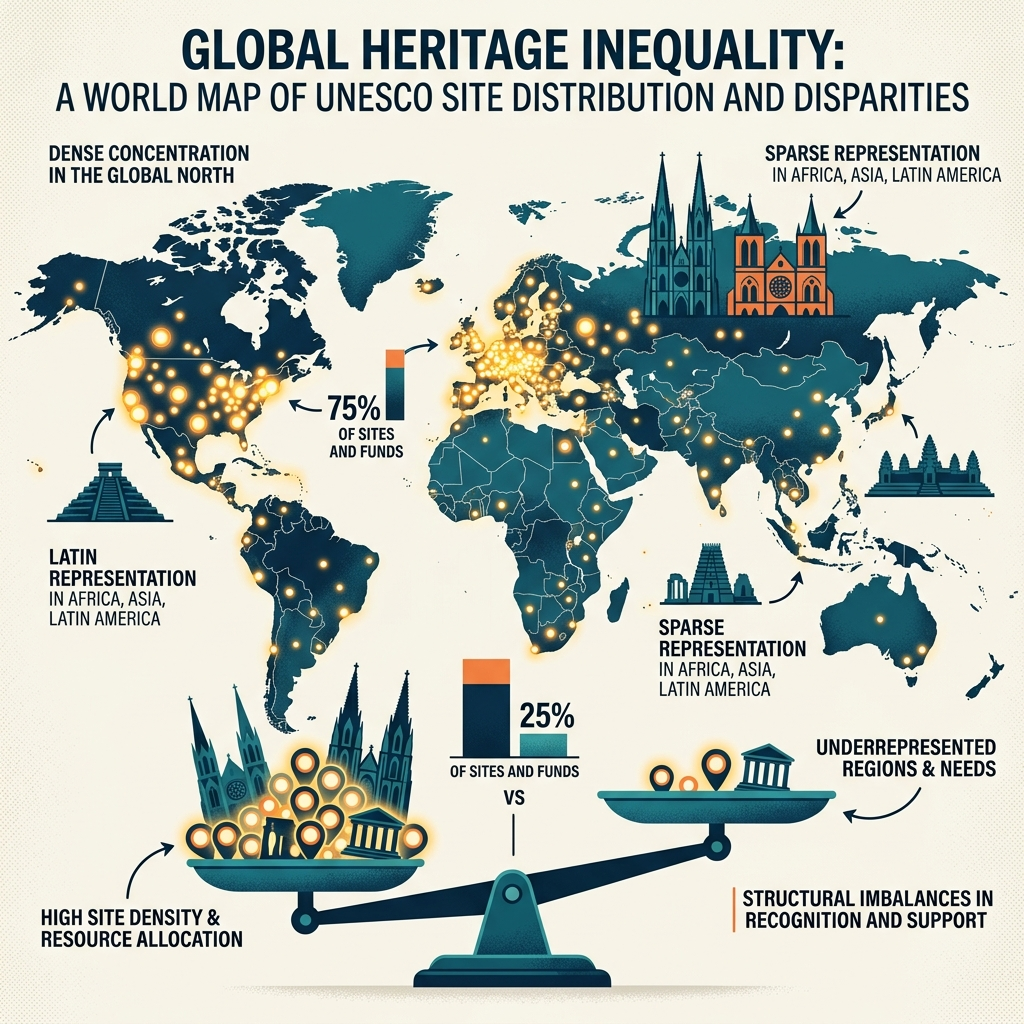
The UNESCO World Heritage List's defining benchmark — "Outstanding Universal Value," or OUV — was engineered in 1972 by Western powers at a moment when most of Africa had been independent for less than a decade, and the resulting disparity speaks for itself: Europe holds 473 inscribed cultural sites while Africa holds just 63, a 7.5-to-1 ratio that 50 years of declared reforms have not meaningfully closed. The OUV standard was not designed to be universal — it was designed by the architects of European civilization to evaluate everything else against the template of European cathedrals, Renaissance city centers, and Baroque palace complexes, and describing the output as mere "bias" dramatically understates what is actually structural by design. What makes this debate genuinely compelling rather than just depressing is the central paradox at its core: the countries that most loudly denounce UNESCO's Eurocentrism are simultaneously filing the most nomination dossiers — not because they're hypocrites, but because half a century of this system has so thoroughly colonized global cultural consciousness that even its sharpest critics have internalized its terms of legitimacy. With the 48th session of the World Heritage Committee opening its Youth Forum in Busan, South Korea on July 13, 2026, and the full plenary running July 19-29, the real question is whether this gathering will produce anything beyond a chairmanship reshuffle and a few carefully worded declarations. The World Heritage Fund's per-site allocation collapsing 67% from $6,900 in 1996 to $2,008 in 2018 — while the number of inscribed sites kept exploding — is probably the most honest single indicator of how seriously the international community takes its stated commitment to preserving humanity's shared heritage.
Key Points
The OUV Standard Was Engineered for European Aesthetics From the Start
The UNESCO World Heritage system's central benchmark — Outstanding Universal Value — was authored in 1972 when the World Heritage Convention was being drafted by the United States, France, Italy, and other Western powers at a moment when most of sub-Saharan Africa had been independent for less than a decade and had minimal institutional presence at the negotiating table. What emerged was a measurement framework calibrated to the European aesthetic tradition: monumental fixed architecture, clearly bounded historical zones, and heritage forms that can be physically inspected by a committee delegation on site visit. UNESCO World Heritage adviser Henry Cleere, who operated inside the system, acknowledged directly that the selection process is "inherently Western-oriented" and functions through "aesthetic and historical perspectives rooted in European culture." A Taylor & Francis study confirmed this institutionally, concluding that African, Latin American, and Asia-Pacific nations systematically perceived UNESCO's normative activities as directed toward a Eurocentric, monument-centric model that ignores indigenous and living cultural practices. The Cultural Landscapes category introduced later as a corrective measure failed to displace these biases — European dominance persisted within that category too, because adding a new label doesn't change the evaluators' conceptual framework. The six OUV criteria for cultural heritage speak of "masterpieces of human creative genius" and "exceptional architectural ensembles" — language that was written by people visualizing Chartres Cathedral and the Colosseum, not Lalibela's rock-hewn churches or the living oral traditions of the Sahel. African oral traditions, indigenous spiritual landscapes, and non-monumental living cultural systems cannot be evaluated by this framework on their own terms — they have to be translated into European institutional categories first, which is not a neutral translation at all.
The 7.5-to-1 Disparity Has Not Closed in Thirty Years of Reform Attempts
UNESCO adopted its Global Strategy for a Representative, Balanced, and Credible World Heritage List in 1994 — and thirty years later, the institution's own 2020 analysis admits candidly that "the proportional representation of underrepresented regions has not improved." Africa's absolute inscription count grew from 93 in 2018 to 112 in 2025, which sounds like progress until you note that Europe continued adding inscriptions at a comparable pace over the same period, leaving the proportional gap essentially unchanged. Europe and North America together account for approximately 47% of all UNESCO World Heritage Sites and 52% of cultural sites specifically; Africa accounts for 9% of a continent that represents 20% of Earth's land area and 17% of global population. Statista's 2025 data confirms the persistence of this distribution despite multiple reform initiatives. The most damning single data point in thirty years of effort: eleven African countries still hold zero World Heritage Sites, meaning the continent with the world's oldest documented human cultural history has more than a tenth of its member states entirely absent from the list. In 1999 alone, 48 sites were inscribed; 2000 produced a record 61 inscriptions — and neither record year reversed the European dominance trend. The Global Strategy explicitly identified "over-representation of Europe, Christianity, and monumental architecture" as the problem it was designed to solve, and the subsequent three decades of inscription data make it unmistakably clear that the strategy's mechanisms were insufficient to overcome the structural inertia they were designed to address.
The Paradox of Critics Who Apply Most Vigorously Reveals How Deep the Internalization Goes
The most revealing dynamic in the UNESCO World Heritage debate is not the bias itself — it's the paradox it produces: the countries most vocally critical of the system's Eurocentrism are simultaneously the most prolific filers of new nomination dossiers. This is not hypocrisy and calling it that fundamentally misreads the mechanism. It is internalization — the structural absorption of a powerful system's logic by the people that system disadvantages. George Okello Abungu, who served as vice-chair of the World Heritage Committee from 2004 to 2008 while simultaneously describing the process as "too Eurocentric," embodies this tension personally. China, with 60 inscribed sites and tied for the global top position, has systematically used World Heritage inscription to pursue Belt and Road legitimacy, nationalist narrative construction, and diplomatic positioning — according to SOAS's 2025 China Institute analysis — while the system itself makes no effort to acknowledge this strategic use. Latin American governments have learned empirically that colonial-era architecture produced by Spanish and Italian colonizers has a significantly better track record in OUV review than precolonial indigenous heritage, and they nominate accordingly — The Conversation's analysis found roughly half of Latin America's 77 cultural sites are colonial-era artifacts. São Tomé e Príncipe's first-ever nomination at this Busan session is a colonial plantation site, not indigenous heritage. The calculation behind that choice — "what do we need to nominate to actually get inscribed?" — is the system's logic having been fully internalized by a government that presumably has a full portfolio of precolonial African heritage it could have nominated instead.
The Financial Architecture Structurally Advantages Wealthy Nations at Every Stage
The cost of preparing and submitting a UNESCO World Heritage nomination runs between $540,000 and $730,000 — a figure that exceeds the entire annual tourism budget of many African states. This is not a minor administrative hurdle; it is a structural exclusion mechanism that operates before the first page of a nomination dossier has been reviewed. The US Okefenokee Swamp nomination mobilized over $500,000 in private philanthropy over three years to cover submission costs; Kenya's Arabuko Sokoke Forest ecosystem — which has genuine claims to Outstanding Universal Value under ecological and cultural criteria — cannot raise the $100,000-$300,000 required to file. The World Heritage Fund's per-site support allocation dropped 67% from $6,900 in 1996 to $2,008 in 2018 as the number of inscribed sites increased dramatically without proportional funding growth — meaning each site receives less real support even as UNESCO's nominal commitments expand. ICOMOS evaluation costs $22,000 per standard nomination and $44,000 for transboundary or serial nominations, and wealthy member states that draw on the World Heritage Fund to cover these costs are directly reducing the resources available for developing-country Upstream Process support. The Globalist's reform analysis calculates that if high-income and middle-income countries absorbed their own evaluation costs directly, approximately $638,000 annually could be freed for developing-country nomination assistance — a straightforward structural fix that has never been implemented. The US withdrawal from UNESCO in 2026, eliminating roughly 8% of total UNESCO budget, will most directly impact exactly these Upstream Process programs that represent the system's primary tool for addressing underrepresentation.
Political Override of Expert Recommendations Concentrates Bias at the Decision Layer
A Springer quantitative analysis found something counterintuitive but important: ICOMOS expert evaluators do not demonstrate statistically significant bias between colonial and indigenous heritage sites in their technical assessments. The professionals reviewing nominations are actually reasonably impartial. The problem is what happens to those assessments afterward: the World Heritage Committee overrode ICOMOS and IUCN expert recommendations in approximately 90% of cases during the 2017 session, and in 83.7% of cases at the 2019 Baku session. This means the bias is not primarily located in the technical evaluation layer where critics often assume it must reside — it is concentrated in the political decision-making layer above it, where member-state diplomats vote on nominations through the lens of bilateral relationships, regional blocs, and national self-interest. When government representatives override specialist expert judgment at a rate approaching 90%, you no longer have a heritage institution governed by technical criteria. You have a diplomatic forum that uses heritage inscription as currency in political negotiations, with the OUV criteria serving as post-hoc rationalization rather than genuine evaluation framework. The Globalist's reform proposal — having high-income countries pay their own evaluation costs — would also create financial accountability that might reduce the political override tendency, but this too remains unimplemented. The result is that committee composition changes, however genuine, cannot by themselves produce criteria-level reform as long as the political override culture remains entrenched.
Positive & Negative Analysis
Positive Aspects
- Official Institutional Acknowledgment and Structural Reform Investment Have Begun
UNESCO's adoption of the 1994 Global Strategy, followed by the 2022 Africa World Heritage Strategy covering 2022-2029, represents the institution formally placing structural underrepresentation on its standing agenda rather than treating it as a peripheral criticism. The 2025 Nairobi Outcome Document, produced by a 54-country conference of 400+ participants, provided the most substantive reform mandate in the system's history by declaring that authenticity must be "plural and dynamic" and explicitly recognizing oral traditions, spiritual associations, and social values as legitimate forms of heritage equivalent to physical monuments. UNESCO reports investing more than $34 million in African heritage since 2020, and the Upstream Process provides developing countries with technical and financial support in the early nomination stages — a direct intervention at the financial barrier that most structurally excludes low-income nations. The 2023 ICOMOS resolution recognizing indigenous peoples' values and cultural-nature interconnections represents an internal professional body formally acknowledging the system's own structural failures, a kind of institutional self-awareness that is a necessary precondition for genuine reform. These developments don't add up to structural transformation yet, but they represent a cumulative building of reform infrastructure — acknowledgment, declaration, financial commitment, and professional consensus — that gives the Busan session more substantive foundation to work from than any prior session has had.
- Africa's First-Nomination Pipeline Is Expanding Across New Member States
The 2026 Busan session includes first-ever nominations from Comoros and São Tomé e Príncipe; 2025 saw first nominations from Guinea-Bissau and Sierra Leone; and an estimated seven African countries are expected to file their first nominations before 2027. This expanding pipeline of participating nations signals that African states are moving from outside observers of a biased system to active participants asserting their cultural heritage claims within it — a structural change in engagement patterns that creates the institutional presence necessary for long-term advocacy. Sub-Saharan Africa crossed the 100-site milestone in 2023, a benchmark that demonstrates absolute growth even as proportional gaps persist. While eleven African countries still hold zero inscriptions, the first-nomination trend indicates that number is set to decline as more nations complete the technical and financial groundwork for participation. Even where first nominations receive "defer" decisions — the committee's standard diplomatic approach for sites requiring additional documentation — the participation itself builds national capacity, institutional knowledge, and diplomatic engagement within UNESCO processes that are prerequisites for eventual inscription success and for meaningful advocacy on criteria reform from inside the committee system.
- The 48th Committee Features the Most Geographically Diverse Composition in Recent History
The Busan committee configuration — 16 non-European member states versus 5 European — represents one of the most geographically diverse compositions the World Heritage Committee has had, with Africa represented by Kenya, Senegal, Togo, and Tanzania, and Asia represented by Korea (as chair), Bangladesh, Kazakhstan, and Mongolia among others. The vice-chair positions are held by Jamaica, Lebanon, Senegal, Türkiye, and Ukraine, shifting the formal leadership structure away from the Western European concentration that has historically characterized the committee's direction. This composition means that the voices of underrepresented regions have a numerical majority at the decision table — a necessary though not sufficient condition for substantive criteria reform. While committee composition does not automatically determine decision outcomes, particularly given the 83-90% historical override rate on expert recommendations, a non-European supermajority creates the formal arithmetic for reform votes that could not have been achieved under prior committee configurations. If the political will exists, the numerical foundation for change is present in a way it rarely has been in the committee's 48-year history.
- The Nairobi Outcome Document Provides a Concrete and Specific Reform Blueprint
The May 2025 Nairobi Outcome Document — produced by 54 countries at an international heritage conference explicitly convened to address OUV criteria reform — is qualitatively different from prior reform declarations in its specificity and its institutional backing. Prior calls for reform criticized the system in general terms; the Nairobi document provides explicit operational language: "authenticity must be plural and dynamic rather than singular," with oral traditions, spiritual associations, functional uses, and social values explicitly named as equivalent forms of authenticity to physical heritage integrity. It formally calls on UNESCO and the World Heritage Committee to incorporate these principles into the Operational Guidelines — transforming what has been an academic critique into a concrete policy demand backed by 54-country signatures. The conference's scale — more than 400 participants from across the Global South — demonstrates that this reform agenda represents broad international consensus rather than a minority position. If the Nairobi principles achieve even partial incorporation into the Guidelines at the 2028 or 2030 session, living cultural heritage, oral traditions, and non-monumental heritage forms would gain formal procedural standing within the OUV evaluation framework for the first time in the system's history, substantially expanding what kinds of heritage can realistically achieve inscription.
Concerns
- OUV Criteria Reform Faces Near-Insurmountable Procedural Barriers
Amending the Operational Guidelines that govern Outstanding Universal Value criteria requires a three-quarters supermajority of the full World Heritage Committee — meaning 16 of 21 member-state votes. At Busan, the committee's 5 European members would all have to support reform, or the 16 non-European members would need to vote as a unified bloc, a degree of political coordination that hasn't been achieved on any substantive issue in the committee's history. The European nations with the most to lose from criteria changes are also the most deeply embedded in UNESCO's institutional culture: Italy with 60 sites, Germany with 54, France with 53, and Spain with 52 have enormous structural incentives to preserve criteria that have consistently validated their heritage at the highest levels. Beyond the formal voting threshold, the Nairobi Outcome Document's path to Guidelines incorporation requires multiple committee sessions, each providing additional opportunities for dilution, deferral, and procedural delay. Even if initial reform language achieves adoption, the implementation challenge of retrofitting a complex bureaucratic evaluation system to recognize plural and dynamic authenticity — while maintaining intercomparability across 1,248 existing inscriptions — creates substantial practical obstacles that could take years to navigate. Reform advocates have consistently underestimated how effectively entrenched institutional interests can translate structural advantages into procedural persistence.
- The Financial Foundation Supporting Developing-Country Participation Is Actively Deteriorating
The World Heritage Fund's per-site allocation dropped 67% from $6,900 in 1996 to $2,008 in 2018, and the US withdrawal from UNESCO announced in 2025 — taking effect at the end of 2026 — will eliminate approximately 8% of total UNESCO budget at a moment when that budget is already stretched well beyond its effective coverage capacity. The programs positioned to absorb these cuts first are exactly the Upstream Process initiatives that provide technical and financial support to developing countries in early nomination stages — the primary mechanism available for addressing the financial barriers that most structurally exclude low-income African and Pacific Island nations. The annual World Heritage Fund budget of $2.5-4 million to support 1,248 inscribed sites globally, plus new nominations, plus capacity building programs, is already inadequate to the scope of the mandate; a further 8% reduction transforms inadequate into critically insufficient. Wealthy nations drawing on the Fund for their own ICOMOS evaluation costs — $22,000 per standard nomination, $44,000 for complex submissions — continue to cannibalize resources meant for developing-country support without formal acknowledgment that this cross-subsidy is occurring. The financing model is not merely underfunded; it is structurally perverse in ways that directly reinforce the geographic imbalances the fund was ostensibly created to correct.
- Political Decision-Making Continues to Override Expert Assessment at Disqualifying Rates
The World Heritage Committee's systematic override of ICOMOS and IUCN expert recommendations — at rates of 90% in 2017 and 83.7% in 2019 at Baku — represents a fundamental structural pathology that committee composition changes alone cannot correct. When political representatives override technical expert judgment nearly nine times out of ten, the formal OUV criteria become largely decorative; the actual determinants of inscription outcomes are bilateral diplomatic relationships, regional bloc solidarity, and national interest calculations that have nothing to do with cultural or natural heritage value. This dynamic produces two simultaneous harmful effects: sites recommended for inscription by experts get rejected for political reasons, denying recognition to legitimate heritage; and sites the experts would not recommend get inscribed through political pressure, degrading the list's credibility. For underrepresented nations, this political contamination of the process is particularly damaging — they are most likely to lack the diplomatic weight to convert expert recommendation into committee votes in their favor, while politically influential member states can reliably convert diplomatic capital into inscription outcomes regardless of expert assessment. Until there is meaningful accountability for the override pattern — perhaps through mandatory documentation of why expert recommendations are rejected — changing who sits on the committee will not change how the committee actually decides.
- Climate Change and Ongoing Conflicts Disproportionately Threaten the Sites of Underrepresented Regions
UNESCO estimates that 60% of World Heritage Sites globally face climate-related threats, but the geographic distribution of both threats and response capacity is profoundly unequal. African and Pacific Island heritage sites face sea level rise, intensifying drought, and desertification with conservation budgets that are fractions of what European counterparts receive, creating a compounding vulnerability where the most financially stressed heritage programs confront the most severe physical threats. Armed conflicts in Sudan, the Democratic Republic of Congo, and Mali are simultaneously destroying cultural heritage and making systematic conservation impossible, while the international community's monitoring mechanisms — the Danger List — cannot prevent physical deterioration without on-the-ground intervention capacity that doesn't exist in active conflict zones. Survival International's research adds another dimension: at least one-third of natural World Heritage Sites overlap with indigenous peoples' traditional territories, and documented cases show inscription being used to justify forced evictions rather than to protect communities alongside their heritage landscapes. The Maasai displacement from Ngorongoro and the Batwa displacement from Kahuzi-Biega — both associated with World Heritage conservation enforcement — demonstrate that "preservation" as currently practiced can mean indigenous communities losing their homes and livelihoods. A system whose conservation model generates forced evictions of the very people who maintained those landscapes for generations has a legitimacy problem that no amount of criteria reform language can resolve on its own.
- Three Decades of Reform Declarations Have Not Produced Proportional Structural Change
The history of reform efforts within the UNESCO World Heritage system is, at its core, a history of ambitious declarations followed by marginal structural change. The 1994 Global Strategy explicitly identified the over-representation of Europe and the under-representation of Africa, the Pacific, and living cultural traditions as the central problems to be corrected — and thirty years later, UNESCO's own 2020 analysis concludes that proportional representation has not improved. The 2022 Africa World Heritage Strategy, the 2023 ICOMOS resolution on indigenous rights, and the 2025 Nairobi Outcome Document represent the latest generation of this reform tradition, and there is no structural reason to expect them to produce different results from their predecessors unless the underlying power relationships change in ways they have consistently failed to change. Eleven African countries still hold zero World Heritage Sites after three decades of strategies specifically designed to address the imbalance — that is the most precise available measure of what "reform" has actually accomplished. The mechanism that consistently defeats these reform efforts is straightforward: the countries most invested in maintaining the current criteria are also the countries with the most institutional capacity, diplomatic leverage, and bureaucratic presence within UNESCO to slow, dilute, and eventually neutralize reform proposals. This is not a conspiracy — it is the normal behavior of institutional self-preservation. Understanding it accurately means adjusting expectations for what the Busan session, or any single session, can realistically achieve.
Outlook
No matter how the Busan plenary plays out over the next two weeks, the structural bias embedded in the UNESCO World Heritage system will not unwind on a short timeline. Let me lay out how I think this evolves — through the immediate Busan outcome, the medium-term window of 2027-28, and the long horizon toward 2030 — across three scenarios. I'll be transparent upfront about where I place my bets: the base case gets the highest probability. Structural change in international institutions moves slower than declarations, and entrenched beneficiaries do not voluntarily surrender institutional advantages. History is clear on this pattern.
Short-term, the 2026 Busan session is the most immediately legible test of whether anything is actually changing. Thirty new sites are up for inscription, including first-ever nominations from Comoros (the historic medina of the Indian Ocean sultanate), São Tomé e Príncipe (colonial plantation heritage), and South Sudan (the Boma-Badingilo migration landscape, filed as an emergency nomination). The fact that African countries are making first nominations is genuinely positive and should be acknowledged as such. But the specifics undercut easy optimism: São Tomé's nomination is a colonial plantation site, not indigenous precolonial heritage. The government calculated, correctly based on historical outcomes, that colonial-era architecture has a better track record in OUV review. This is the system's internalization playing out in a single nomination dossier, visible in real time.
The biggest near-term structural variable is the US withdrawal from UNESCO, announced in 2025 and taking effect at the end of 2026. This eliminates approximately 8% of UNESCO's total budget. The programs positioned to absorb the first cuts are precisely those designed to correct the structural imbalance — the Upstream Process that provides technical and financial assistance to developing countries in the early stages of nomination preparation. The most perverse possible outcome would be for the financial instrument specifically built to address structural inequity to be defunded by the fiscal consequences of great-power politics. But that is where the math currently points. Countries preparing first nominations for 2027 and 2028 sessions could face reduced technical support exactly when they need it most, compounding barriers that already price out the most underrepresented nations.
On committee composition at Busan: the 21-member body features a 16-to-5 non-European majority, with vice-chairs drawn from Jamaica, Lebanon, Senegal, Türkiye, and Ukraine — a genuinely diverse leadership configuration compared to prior sessions. But committee composition and the quality of political will are different things. The historical ICOMOS override rate of 83-90% means that numerical non-European dominance is necessary but not sufficient for reform. The decisive variable is whether Korea, as chair, can convert that numerical majority into coherent institutional pressure for OUV criteria reform — a political organizing challenge that has defeated every prior chairmanship that attempted it with less structural backing than Korea currently has. Diplomatic traditions inside UNESCO still favor consensus-building over direct confrontation, which historically benefits those defending the status quo.
Medium-term, between 2027 and 2028, the central question is whether the Nairobi Outcome Document — "authenticity must be plural and dynamic rather than singular" — gets translated into actual amendments to the Operational Guidelines governing OUV. The optimistic trajectory is that 2027 produces an initial draft for committee consideration and 2028 yields ratification in time for the 50th session. The realistic trajectory is that it takes at least three full committee cycles to move from a conference declaration to binding Guideline text, and that the European bloc — which has the most to lose from criteria reform that would reduce the primacy of fixed monumental heritage — will exercise maximum procedural delay. Italy holds 60 sites. Germany 54. France 53. Spain 52. These countries have no obvious strategic incentive to support criteria changes that dilute the comparative distinction of their existing inscriptions. The opposition does not need to be explicit. Procedural friction alone is enough.
The other mid-term axis worth tracking is Africa's own strategic positioning independent of UNESCO's internal politics. UNESCO's Africa World Heritage Strategy (2022-2029) targets increased African inscriptions, reduced Danger List presence of African sites, and expanded technical capacity building. UNESCO reports investing more than $34 million in African heritage since 2020. Against that: eleven African countries still have zero inscriptions. Seven are expected to file first nominations by 2027, but each nomination faces ICOMOS evaluation, committee review, and the political filtering layer where expert recommendations historically get overridden at 83-90% rates. Many will receive "defer" or "refer" decisions — the committee's diplomatic vocabulary for "not yet" — and actual inscriptions could trail expectations by multiple years. The 2029 strategy deadline and the reality of this pipeline don't align well.
Looking toward 2030, three distinct trajectories become visible. The bull scenario — which I estimate at roughly 15% probability — requires the Nairobi Outcome Document's core principles to be formally incorporated into the Operational Guidelines, with "authenticity" redefined to include oral traditions, spiritual associations, and living cultural practices on explicit equal footing with physical monuments. In this scenario, African inscriptions grow from 112 today toward 130 or more by 2030, and Europe's share of cultural inscriptions declines from approximately 52% toward the high 40s as the rate of new European nominations naturally slows and Africa accelerates. The World Heritage Fund's budget stabilizes through alternative funding mechanisms, the US returns to UNESCO under a different administration, and the committee's ICOMOS override rate drops below 70% as political accountability mechanisms improve. The system's legitimacy recovers substantially, and "Outstanding Universal Value" begins to approach what those words actually mean. I want to be direct about why I think this scenario is unlikely: there is no historical precedent for a major international institution's most powerful member states voluntarily ceding the structural advantages that have accrued to them over decades. The UN Security Council reform discussion has run for thirty years without meaningful resolution. IMF voting weight reform has proceeded at near-imperceptible pace across multiple decades. Cultural institutions are not immune to these patterns; if anything, cultural prestige is more jealously defended than economic influence precisely because it is harder to quantify and therefore harder to negotiate away.
The base scenario — which I put at roughly 55-60% probability — is incremental and largely cosmetic change. The Nairobi principles get partially incorporated into the Guidelines but don't replace the foundational European-authenticity framework; they get added alongside it, creating a two-track system where the old standard remains dominant in practice. The seven African first nominations filed by 2027 yield perhaps three actual inscriptions by 2030, with the others deferred indefinitely. The World Heritage Fund absorbs the 8% hit from the US withdrawal, and Upstream Process funding for developing countries is quietly reduced without formal acknowledgment of the policy change. The committee's ICOMOS override rate remains above 80%, meaning that expert assessment continues to be subordinated to political dealmaking on a structural basis. African inscriptions reach 118-125 by 2030, growing at roughly 1-2 per year; the European share of cultural inscriptions hovers around 40%; and the structural gap is effectively institutionalized for another generation.
This is the most probable outcome because it is the pattern that every prior reform initiative in this space has produced. The 1994 Global Strategy, the 2022 Africa Strategy, the 2023 ICOMOS resolution, the 2025 Nairobi Outcome — the declarations have been progressively more ambitious, and the structural changes have remained marginal. UNESCO is institutionally excellent at generating consensus language. The question has never been whether UNESCO can say the right things. The question is whether it can reorganize the power relationships that produce the wrong outcomes.
The bear scenario — which I put at 25-30% probability — involves reform failure accompanied by an accelerating legitimacy crisis. The US withdrawal triggers additional budget pressures; other major contributors quietly reduce their proportional contributions in a contagion effect. Ongoing armed conflicts in Sudan, the Democratic Republic of Congo, and Mali accelerate physical destruction of sub-Saharan African sites, while climate change — sea level rise, desertification, intensifying cyclone activity — degrades sites across coastal and arid Africa disproportionately relative to better-funded European sites. The Operational Guidelines amendment for OUV reform fails to achieve the required three-quarters supermajority, partly because non-European nations disagree profoundly among themselves about priorities: China wants to protect the status of its 60 existing inscriptions, India wants criteria reform favoring its own ancient heritage tradition, Kenya wants Africa-specific carve-outs that Latin America doesn't support, and the coalition for genuine structural reform never achieves sufficient coherence to force a vote. African inscriptions stagnate at 112-118, the European share of cultural inscriptions drifts back toward 42%, and by 2029-2030, Global South governments begin formally questioning whether UNESCO membership costs are justified by the institutional outputs — a credibility crisis that transitions from background diplomatic grumbling into a headline-level challenge to the institution's legitimacy.
One factor I want to flag that could shift all three scenarios significantly: China's strategic calculus toward African heritage. If China decides — for Belt and Road infrastructure narrative reasons, for diplomatic positioning in the African Union context, or simply for the soft-power returns it has already demonstrated in Southeast Asian heritage sites — to substantially fund African Heritage nominations the way it has funded African infrastructure projects, the composition of new inscriptions changes materially. China has already deployed conservation resources at Angkor Wat and elsewhere as cultural diplomacy instruments. A large-scale replication of that model across sub-Saharan Africa could add multiple African inscriptions per session cycle and alter proportional representation meaningfully by 2030. The obvious caveat: this would not replace European hegemony with something more equitable. It would replace European hegemony with Chinese hegemony. The measuring tape would change hands, not its design philosophy. The Cold War parallel is historically instructive — during the 1970s and 1980s, both the United States and the Soviet Union effectively used UNESCO as a venue for legitimizing their respective cultural narratives, with each bloc pushing inscriptions that served ideological interests. A Sino-European competition for World Heritage influence would be structurally similar, and potentially equally distorting to the system's stated universality.
My practical suggestion for anyone tracking this: watch the Busan plenary closely from July 19 onward. Track specifically the inscription decisions for Comoros, São Tomé e Príncipe, and South Sudan — three African countries filing first nominations at this session. Then track the rate at which the committee accepts versus overrides ICOMOS recommendations. If that override rate drops meaningfully below 83%, something has genuinely shifted in the committee's political culture. If it stays above 80%, you know that the shift in committee composition has not produced a corresponding shift in decision-making logic. The 2026 Busan session has the structural ingredients to be a genuine turning point for the most consequential cultural governance institution in the world. It also has every ingredient needed to be another beautifully worded disappointment that changes nothing structural. "Universal value" becoming actually universal requires that the people who define it stop being a subset of the people whose civilization it was built to reflect — and by any honest measure, that is one of the most difficult kinds of institutional transformation there is.
Sources / References
- UNESCO World Heritage List Statistics — UNESCO
- World Heritage site selection is Eurocentric — The Conversation
- Soft-power and pro-European bias in the UNESCO World Heritage List — Springer Public Choice
- UNESCO World Heritage Committee Reform — The Globalist
- 48th Session of the World Heritage Committee — UNESCO
- Whose World Heritage? The Problem — Equal Times
- The Nairobi Outcome on Heritage and Authenticity — Come Make We Go Africa
- UNESCO World Heritage Inscriptions — RICS Modus
- DecolonizeUNESCO Campaign — Survival International