
His Grave Got a Chariot and a Helmet. Hers Got "Jewelry." That's Not a 2,600-Year-Old Fact — It's a 2026 Sentence
Summary
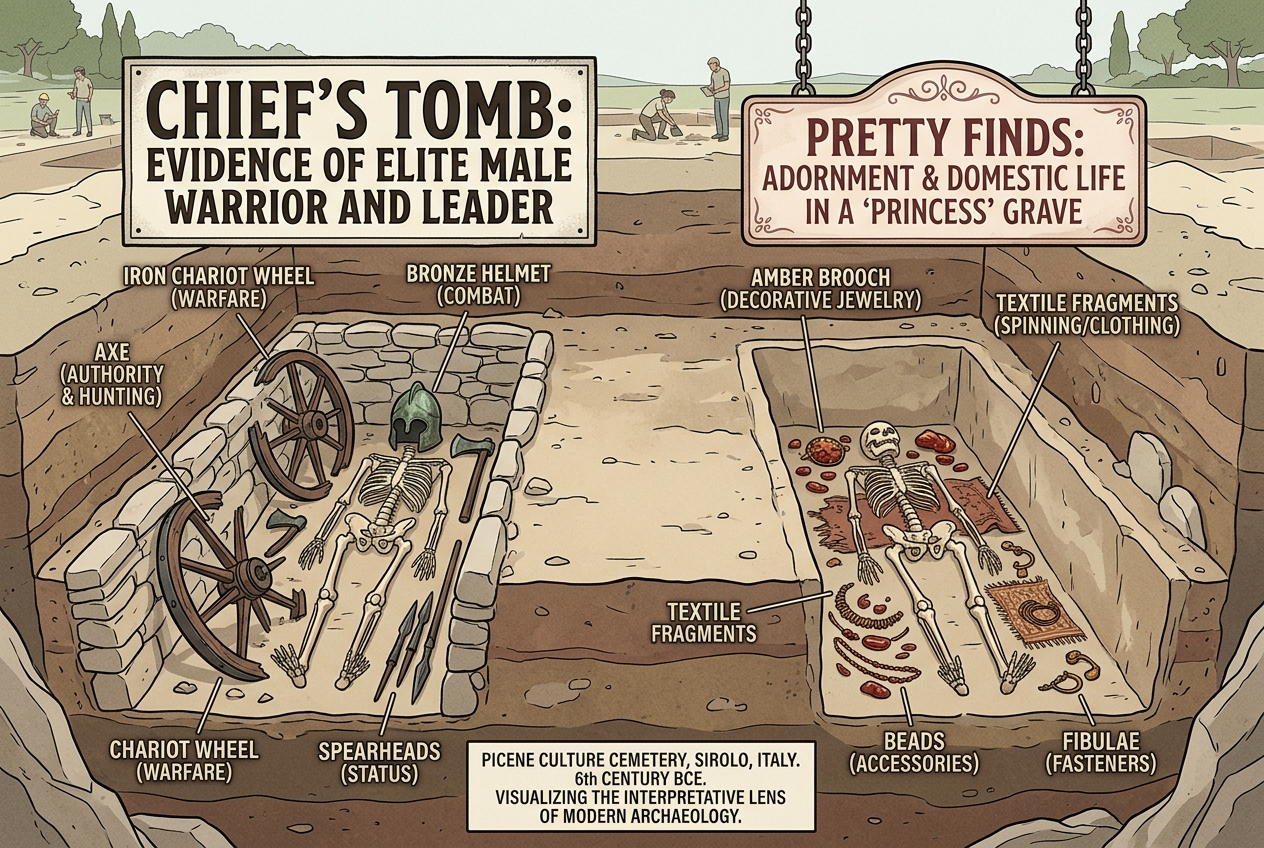
A roughly 2,600-year-old double burial excavated at the Sirolo necropolis in Italy's Marche region illustrates how naming conventions, not artifacts, ultimately determine perceived status in the archaeological record. Within a circular palisaded enclosure, a male skeleton buried with a chariot, a helmet, and an axe was labeled a "prince" or "lord" from the earliest hours of excavation, while a female skeleton found a few steps away, accompanied by an amber fibula, textiles, and leather shoes, received only the decorative title of "noblewoman." This binary — weapons read as evidence of power, ornaments read as evidence of adornment rather than status — does not originate from any individual researcher's malice but from a structural limitation in the discipline: osteological analysis alone can determine biological sex in barely half of skeletal samples, and no internationally agreed protocol for sex estimation currently exists. Yet once a definitive label is locked into a press release before skeletal analysis is even complete, a provisional hypothesis acquires the status of settled fact, and any later correction carries a far steeper cost. The 1953 Vix burial in France, the so-called "warrior prince" of Tarquinia in 2013, and Sweden's Birka BJ581 — whose genomic analysis confirmed female sex 139 years after its 1878 excavation — stand as three precedents in which hasty sex-based naming was repeatedly overturned. What this tomb ultimately proves is not Picene hierarchy but rather what excavators 2,600 years later have been trained to recognize as power.
Key Points
"Prince" and "Noblewoman" Aren't Words From the Same Grammar
The male skeleton found at the center of Sirolo's circular palisaded burial ground was called a prince or lord from the earliest hours of excavation, simply because he was buried with a chariot, a helmet, and an axe. Just a few steps away, the female skeleton found with an amber-decorated fibula, textiles, and leather shoes was given the name noblewoman. Prince is a status noun implying succession and rule, while noblewoman is a relational noun implying belonging to someone else — meaning two people who received the same burial care in the same tomb complex were handed words from entirely different grammatical categories. What makes this even more ironic is that even the outlets covering this excavation described the woman's tomb as rare evidence of how elite women displayed wealth, prestige, and social standing. All three words — wealth, prestige, social standing — were used, and the title still stopped at noblewoman. I don't think this was a summary of the findings; I think it was the output of a sentence that had already been prepared before the dig even began. Securing a single amber fibula required access to a long-distance trade network stretching from the Baltic to the Adriatic, and that is unambiguously a marker of status, not decoration.
Grave-Good-Based Sex Estimation Is a Methodological Limit, Not Bias
It's rarer than you'd think for a 2,600-year-old skeleton to be preserved well enough for morphological sex determination from the pelvis and skull. A 2020 comparative study in Scientific Reports found that among 55 skeletal samples, osteological analysis alone could determine sex in only 28 cases — just 51 percent. In the same study, osteological and genomic estimates disagreed in 18 to 20 percent of cases. The alternative, ancient DNA analysis, requires destructive sampling of teeth or the temporal bone's petrous portion, and running genomic analysis on every single skeleton at a rescue excavation funded by a regional heritage budget is simply not realistic. Add to that a 2024 PLOS ONE practitioner survey confirming zero internationally agreed standard osteological protocols, and the picture becomes clear. So assigning a provisional sex based on grave-good combinations in the field is a reasonable compromise when the only alternative is silence, and I disagree with any moral condemnation that ignores this reality. What's decisive, though, is that this limitation explains why a provisional estimate was made — it does nothing to explain why it was published as a definitive label.
A Question Mark Costs Nothing
Poor skeletal preservation isn't the excavation team's fault. Genomic analysis requiring destructive sampling isn't their fault either. Neither is the absence of an international standard protocol. But writing Tomb of the Prince in a press release costs exactly the same as writing adult individual buried with a chariot and weapons — which is to say, nothing. Choosing the definitive option when both options cost the same isn't a constraint of methodology; it's a habit of narration, and habits can be challenged and corrected. I think this is the crux of the entire debate: the moment we defend linguistic certainty by citing methodological limits, we're agreeing to circulate unverified guesses in the exact same sentence format as verified knowledge. In fact, the 2019 Antiquity reassessment paper stated that BJ581's biological sex was entirely secure while explicitly leaving the social role interpretation open — and I want to ask why that same caution was never once applied to a male skeleton.
Vix, Tarquinia, Birka — Already Overturned Three Times
The extraordinarily lavish Celtic tomb excavated at Vix in Burgundy, France, in 1953 contained a four-wheeled wagon, a bronze krater over 1.64 meters tall and weighing more than 200 kilograms, and a gold torque, and osteological analysis the following year determined the remains belonged to a woman aged 25 to 35. Even so, some officials clung for years to a cross-dressed priest hypothesis, unable to imagine a woman receiving such honors. In 2013 in Tarquinia, Italy, a spear-bearing skeleton was immediately called a warrior prince — but bone analysis revealed a woman aged 35 to 40 within about a month, no DNA required. The most dramatic case is Sweden's Birka BJ581, a grave containing a sword, axe, spear, shield, and two horses, classified as a male warrior from its 1878 excavation until 2014 osteological reassessment and 2017 genomic analysis confirmed two X chromosomes and no Y chromosome — 139 years from excavation to confirmation. What stands out is what happened afterward: for 139 years, while called male, nobody demanded evidence, but the instant she became female, the burden of proof appeared — and that asymmetry is the heart of the problem.
Definitive Labels Harden in a Day; Reversing Them Takes a Generation
The two words printed in a press release become a Wikipedia page title, a museum exhibit caption, a textbook footnote, and eventually training data for a language model. In Birka's case, even after the 2017 genomic paper was published, it took several more years for the Viking male warrior description to be pushed down in public search results, and the old description still surfaces alongside the new one today. Vix, too, was sexed as female back in 1954, yet the popular title princess has survived in public language for more than 70 years since. There's a structural asymmetry here: a provisional hypothesis gains the status of fact within 24 hours, but reversing it takes a full generation. What's more, museum storerooms worldwide hold tens of thousands of skeletons whose sex was determined from grave goods alone and never reassessed. Multiply the 18-to-20-percent osteological-genomic disagreement rate across that scale, and this stops being a single tomb's problem — it becomes a data-quality problem for the entire archaeological record.
Archaeology Doesn't Just Excavate the Past
Sirolo's two skeletons said nothing for 2,600 years. It was the excavators, journalists, and readers of 2026 who did the talking, and the two words we casually chose ended up recording our own society's hierarchy far more precisely than they recorded Picene society's. Reading a weapon as evidence of a power holder and jewelry as evidence of someone merely decorated isn't something the artifact told us — it's something we told the artifact to say. The excavation director said this discovery lets us observe, for the first time, not an isolated tomb but a complete aristocratic nucleus, and I think that statement is only half right. What we observed is simultaneously the Picene aristocratic core and the fact that 21st-century assumptions get excavated right alongside 2,600-year-old soil. The correction periods — 70 years at Vix, 139 years at Birka, a single month at Tarquinia — never happened because the bones changed; they happened because we changed. The bones were saying the same thing all along; there simply wasn't anyone ready to listen. So my proposal to put a single question mark before the word prince in the next press release isn't modesty — it's the bare minimum. In the end, the real discovery of this excavation isn't the chariot. It's us.
Positive & Negative Analysis
Positive Aspects
- Public Narrative Keeps Sites Alive
Almost nobody would click on an article titled Adult Individual 1, Buried with a Chariot and Weapons. A headline like Tomb of the Prince generates traffic, and traffic translates directly into real numbers at the budget negotiation table for a regional heritage authority. In southern European archaeology, it's statistically common for organic artifacts to decay or excavation reports to go unpublished simply because post-excavation conservation funding never materializes. Materials like Sirolo's textiles and leather shoes, which survived in an anaerobic environment, begin degrading rapidly the moment they're exposed to air, so immediate funding and staffing can be the difference between an artifact surviving and being lost. In fact, this tomb complex also yielded organic residue and animal bone preserved inside a ceramic-sealed bronze vessel, and for samples like that, the speed of conservation directly determines how much data survives. So I genuinely acknowledge the value that provisional naming creates in generating public interest, and I don't think dismissing it as mere sensationalism is a fair approach.
- Provisional Field Judgments Beat Silence
Very few excavation projects worldwide can afford to run genomic analysis on every single skeleton in the field. As the 2020 Scientific Reports study showed, osteological analysis alone could determine sex in only 28 of 55 samples — 51 percent — meaning morphological determination simply isn't possible for the rest to begin with. Ancient DNA analysis requires destructive sampling of teeth or the temporal bone, and when skeletal preservation is poor, you can absorb that cost and damage and still come away empty-handed. Under these conditions, assigning a provisional sex and status based on grave-good combinations also serves a practical need: organizing material into a form that can be handed off to future researchers, since a skeleton with no name attached doesn't even get properly indexed in storage. I don't think the excavation team reached this practice out of laziness — I think they arrived at it while doing their best within real constraints.
- The Debate Itself Advances Methodology
After Vix, Tarquinia, and Birka were overturned one after another, a growing number of European archaeology journals began requiring authors to state the basis for grave-good-based sex determinations. Proposals to distinguish morphological sex, genetic sex, and social gender in how findings are labeled have also been submitted repeatedly. The 2019 Antiquity reassessment of Birka, which stated that biological sex was entirely secure while leaving social-role interpretation open, is exactly the kind of linguistic precision that debate produces. If Birka's 130-year reversal hadn't happened, this very piece questioning Sirolo's labels wouldn't exist either. In other words, hasty naming is bad, but the experience of having it publicly overturned becomes an asset for the whole field, and I hold a cautious optimism because I think this correction mechanism is actually working.
- Organic Preservation Lowers the Bar for Verification
The fact that organic materials like textiles and leather shoes survived at Sirolo means more than mere novelty. Organic survival implies an unusually anaerobic burial environment, which in turn suggests the skeletal collagen and DNA may also be relatively well preserved. Recent methodological advances compound this advantage. High-throughput ancient DNA extraction cuts costs by about 39 percent compared to single-column methods while processing 96 samples in four hours, and sediment DNA pooling techniques cut costs by up to 70 percent. Strontium isotope analysis for tracing geographic origin, and carbon and nitrogen isotope analysis for reconstructing diet, have also become standard procedures that regional university labs can now perform. Thanks to this combination, I put the probability that Sirolo's remains receive a morphological sex reassessment and radiocarbon dating before 2028 at over 70 percent.
- This Tomb Points at the Whole Dataset, Not Just One Case
Sirolo's real significance doesn't hinge on whether this one tomb gets overturned. Museum storerooms worldwide hold tens of thousands of skeletons whose sex was determined solely from grave-good combinations and never reassessed. Apply the measured 18-to-20-percent disagreement rate between osteological and genomic estimates across that scale, and a substantial portion of what we believe we know about Iron Age social structure turns out to be resting on statistical error. Every time an individual case gets overturned, the confidence coefficient of that entire massive dataset gets recalibrated, and that recalibration changes the input values for every model we use to reconstruct past societies. In other words, the Sirolo debate isn't a dispute over how to interpret one tomb — it's a data-quality-control problem for the archaeological record itself, and I think it will be the most boring yet most important task in archaeology over the next decade.
Concerns
- Definitive Labels Are Effectively Irreversible
A word printed in a press release locks into top search results within 24 hours, becomes a Wikipedia page title, a museum exhibit caption, a textbook footnote, and ultimately, training data for a language model. In Birka BJ581's case, even after the 2017 genomic paper was published, it took several more years for the Viking male warrior description to be pushed down in public search results, and the old description still surfaces alongside the new one today. Vix, too, was determined female by osteological analysis back in 1954, yet the popular title princess has survived for more than 70 years. This asymmetry — a provisional hypothesis gaining the status of fact within a day, while reversing it takes a generation — is structural. At Sirolo, there's a quiet stretch coming up after the excavation season ends, during conservation work, when almost no new information will surface — and that's exactly when the label hardens. I think this six months of silence will determine how this site gets described for decades to come.
- The Burden of Proof Is Distributed Unevenly by Sex
When Birka BJ581 was called a male warrior for 139 years, nobody demanded evidence. But the moment 2017 genomic analysis confirmed two X chromosomes and no Y chromosome, counterarguments poured in — maybe the bones got mixed up, maybe she simply inherited weapons she never used in battle. The same thing happened at Vix: it was apparently easier for scholars to doubt the sex of a woman buried with a four-wheeled wagon and a 200-kilogram bronze krater than to imagine her as a ruler. Power is granted to men by default and has to be proven as an exception for women — and this asymmetry looks less like an individual researcher's attitude and more like the field's baseline setting. The contrast at Sirolo captures it perfectly: a man got the title prince from a single chariot, while a woman with a sword, axe, shield, and two horses at Birka still had warrior withheld.
- Follow-Up Resources Already Skew Toward the "Interesting" Individual
Precise analysis requires budget, staff, and destructive-sampling approval, and all three are finite. Statistically, those resources flow toward whichever individual has already been assigned narrative importance — meaning whoever has already been named prince. The male individual's helmet, axe, and chariot are likely to be meticulously typed and turned into multiple papers, while the female individual's amber fibula and textiles risk being reduced to a single line about exceptional organic preservation. In other words, the initial naming determines where future research resources flow, and that research then turns around and justifies the initial naming, closing a self-reinforcing loop. I put the odds of both individuals receiving full genomic analysis and kinship determination at under fifty percent, and I think this circularity is the most concerning aspect of the entire Sirolo case.
- Academic Norms and Public Language Stay Split in Two
The trend of European archaeology journals requiring disclosure of the basis for sex determinations is clearly progress. But the starting point is harsh: as a 2024 PLOS ONE survey confirmed, zero internationally agreed standard osteological protocols currently exist, and most practitioners said they still prefer traditional morphological methods. What's more, submission guidelines govern papers, not press releases. An individual labeled Individual 1 in an academic paper is likely to keep being called the prince in that same institution's PR channels and regional tourism materials for quite some time, and the public overwhelmingly encounters the latter, not the former. For a shift in norms to become a shift in perception, it's press release templates and exhibit caption policies that need to change, not just journal editorial guidelines — and I expect meaningful progress on the former by 2028 but almost none on the latter.
- The Most Realistic Worst Case Is Conservation and Budget Failure
The Marche region sits in an earthquake-prone zone, and regional heritage budgets are chronically underfunded. Emergency conservation of the organic artifacts could fail, budget cuts could leave the remains uncatalogued in storage, or the excavation report itself could simply never get published — outcomes that are statistically common, not hypothetical, in southern European archaeology. Materials like textiles and leather, which barely survived in an anaerobic environment, begin collapsing the moment they're exposed to air, so a conservation failure means a permanent loss of data. In that scenario, the only information humanity permanently retains about Sirolo is a handful of lines from a July 2026 press release, and the words in those lines are prince and noblewoman. I put this scenario's probability around 20 percent — and what's scarier than the probability itself is the consequence: we may have already written, before any verification took place, the sentence that ends up being the final record.
Outlook
The next six months — meaning the rest of 2026 — will likely follow a fairly predictable path for the Sirolo excavation. Once the digging season wraps up, the artifacts get moved to a restoration lab under the Marche region's cultural heritage authority, and emergency conservation of the organic artifacts becomes the top priority. The fact that textiles and leather shoes survived at all tells us the burial environment was unusually anaerobic, and materials like this begin to degrade rapidly the moment they're exposed to air. Reports that a bronze vessel sealed with a ceramic lid preserved organic residue and animal bone inside it suggest this tomb complex ranks among the best-preserved Iron Age sites in southern Europe. Media coverage will likely taper off during this phase. And it's exactly in that quiet stretch that the labels harden. During the first six months, while almost no new information comes out, the two words already in circulation — "prince" and "noblewoman" — will climb search rankings and settle into the archive.
Over the same period, the scholarly community's response is also fairly predictable. I expect the preliminary report to appear first in Italian domestic journals or regional heritage authority bulletins, with an international journal paper following at least 12 to 24 months later. This is where an important time lag emerges. What gets etched into public memory is the press release from excavation day — not the peer-reviewed paper published two years later. In fact, even after Birka BJ581's genomic paper was published in 2017, it still took several more years for the "male warrior" description to be pushed down in public search results. Sirolo will likely face the same delay. In the short term, the best-case outcome I'm hoping for is that the excavation team flags the provisional nature of the labels in a follow-up briefing. The worst case is that "Tomb of the Prince" gets enshrined as a proper noun in regional tourism materials.
The real inflection point comes in the mid-term — 2027 to 2028. What gets decided in this window is whether precise analysis of the two skeletons actually gets carried out. The deciding factors are budget and approval for destructive sampling. But conditions are genuinely improving. New high-throughput ancient DNA extraction methods cut costs by about 39 percent compared to traditional single-column approaches and can process 96 samples in four hours, while sediment DNA pooling techniques cut costs by up to 70 percent and reduce lab time to a fifth of what it used to take. Add to that strontium and oxygen isotope analysis for tracing geographic origin, and nitrogen and carbon isotope analysis for reconstructing diet — both of which are now standard procedures that regional university labs can already perform. I put the probability that Sirolo's remains get at least a morphological sex reassessment and radiocarbon dating published before 2028 at over 70 percent.
But what worries me most in that same mid-term window isn't whether the analysis is possible — it's how the analysis gets allocated. Precision analysis requires budget, staff, and approval, and all three are finite. Statistically, resources flow toward whichever individual has already been assigned narrative importance — meaning whoever has already been named "prince." The male individual's helmet, axe, and chariot are likely to be meticulously typed and turned into multiple papers, while the female individual's amber fibula and textiles risk being reduced to a single line about exceptional organic preservation. The initial naming determines where future research resources flow, and that research then turns around and justifies the initial naming — a self-reinforcing loop closes right here. I'd put the odds of both individuals receiving full genomic analysis and kinship determination at under fifty percent.
During the same period, the field's own descriptive norms will shift too. A growing number of European archaeology journals now require authors to state the basis for any sex determination made from grave goods, and repeated proposals have called for distinguishing morphological sex, genetic sex, and social gender in how findings are labeled. But the starting point is harsh. As of 2024, zero internationally agreed standard osteological protocols existed, most practitioners said they still preferred traditional morphological methods, and only a minority reported feeling confident in their sex determinations. Norms take time to settle in a field with no standard to begin with. I expect a handful of major European journals to add source-of-determination disclosure to their submission guidelines by 2028, but I wouldn't expect much beyond that.
And here's the decisive limitation. Journal submission guidelines govern papers, not press releases. An individual labeled "Individual 1" in an academic paper from a given institution will likely keep being called "the prince" in that same institution's PR channels and regional tourism materials for quite some time, and the public overwhelmingly encounters the latter, not the former. For a shift in norms to actually become a shift in public perception, it's not journal editorial guidelines that need to change — it's press release templates and museum caption policies. I expect meaningful progress on the former by 2028 and almost none on the latter. The real inertia in this whole problem is the gap between how fast academia corrects itself and how fast that correction reaches everyday language.
Looking further out, to 2029 through 2031, I see three branching scenarios. In the optimistic scenario, precise analysis of the Sirolo remains gets published in an international journal, the female individual's amber fibula gets reevaluated not as mere decoration but as a status marker signaling access to long-distance trade networks stretching from the Baltic to the Adriatic, and the relationship between the two individuals turns out to be siblings or two unrelated elites rather than a married couple. The catalyst here is clear: the Tarquinia case proved that osteological reassessment alone, without expensive DNA work, corrected a mislabel in about a month, and combined with analysis costs now down 39 to 70 percent, early verification is genuinely realistic. In this case, Sirolo joins Vix and Birka as a textbook example, and the phrase "prince and noblewoman" itself starts getting cited in methodology courses as a cautionary tale. I'd put this scenario's probability around 25 percent.
The baseline scenario is far more mundane. Analysis gets only partially carried out, sex reassessment either doesn't happen or, when it does, simply confirms the existing assumption. Academic papers use careful language — "Individual 1," "Individual 2" — while the regional museum's permanent exhibit caption keeps printing the two words assigned on excavation day. This is exactly the path Vix walked. Excavated in 1953 and sexed as female by 1954, it still took decades for scholarly reinterpretation to accumulate, and the "Princess of Vix" label remains alive in popular language today. Nobody lied, but a state of "nothing verified" became permanent. I'd put this baseline scenario's probability around 55 percent — the most likely outcome, the least interesting one, and for that exact reason, the most dangerous.
A pessimistic scenario deserves consideration too, in fairness. The Marche region sits in an earthquake-prone zone, and regional heritage budgets are chronically underfunded. Conservation of the organic artifacts could fail, budget cuts could leave the remains uncatalogued in storage, or the excavation report itself could simply never get published. This isn't a hypothetical fear — it's a statistically common outcome in southern European archaeology. In this scenario, the only information humanity permanently retains about Sirolo is a handful of lines from a July 2026 press release, and the words in those lines are "prince" and "noblewoman." I put this probability at 20 percent. And this scenario, more than any other, cruelly proves why naming matters in the first place — we may have already written, on day one of the dig, the sentence that ends up being the final record.
Let's push the ripple effect one step further. The first-order effect is how we interpret this one tomb. The second-order effect is the entire hierarchical model of Picene society. The excavation team itself said this find could reshape existing understanding of how the ruling family around Monte Conero exercised leadership in the 6th century. If the female individual is confirmed to have held independent status markers as an elite in her own right, the model that has long portrayed Adriatic Iron Age society as centered on male warrior aristocracy will require at least partial revision. The third-order effect is much broader. Museum storerooms worldwide hold tens of thousands of skeletons whose sex was determined solely from grave goods and never reassessed. Multiply that 18-to-20-percent disagreement rate between osteological and genomic estimates across tens of thousands of individuals, and a good portion of what we currently believe we know about Iron Age societies turns out to be standing on statistical error.
It's only honest to state the conditions under which my forecast could turn out wrong. If follow-up analysis reveals clear traumatic injury — combat wounds — on the male individual and none on the female individual, and if the two burials turn out to be separated by decades, revealing that one was a secondary burial made for the other, then "prince" and "noblewoman" could turn out to be an accurate summary rather than lazy bias. The osteological method itself is quite accurate under the right conditions: when both the skull and pelvis survive, accuracy reaches 97.7 percent; with the pelvis alone, 95.7 percent; with the skull alone, 88.4 percent. I don't rule that possibility out. But even in that case, my core argument doesn't collapse, because that conclusion only becomes justified after the analysis is done — not something you could have known on day one of the dig. A correct guess and a verified conclusion may look identical, but they don't carry the same status, and I believe only the latter counts as knowledge.
So let me close this forecast with some concrete recommendations. To excavation institutions: before using a definitive status noun in a press release, attach one line stating the basis for the sex determination — osteological, genomic, or grave-good inference. Even that single disclosure completely changes how a reader interprets the rest of the story. To journalists: I want to remind you that "believed to be a prince" and "a prince" read as entirely different sentences to your audience. To museum curators: a small caption label disclosing the basis for a determination has a bigger impact on visitors' scientific literacy than you might expect. And to you, reading this: next time you come across an archaeology headline, I'd suggest reading the label before you look at the photo of the artifact. That one word is often already telling you the whole conclusion. Every time we dig up the past, what we're also digging up, in the end, is a record of what we've been trained to call power.
Sources / References
- Elite chariot burial and noblewoman's tomb unearthed — HeritageDaily
- Princely Tomb Unearthed in Italy — Archaeology Magazine (Archaeological Institute of America)
- Princely chariot tomb near Monte Conero — Archaeology News Online Magazine
- Monumental tomb with chariot found in Italy — GreekReporter
- 2,600-Year-Old Picene Prince's Tomb with Chariot Found in Italy — Ancient Origins
- The Vix Princess Redux: a retrospective on European Iron Age gender and mortuary studies — Bettina Arnold
- A female Viking warrior confirmed by genomics — Hedenstierna-Jonson et al
- Viking warrior women? Reassessing Birka chamber grave Bj.581 — Price et al
- Bone Analysis Reveals Etruscan Warrior Princess — Archaeology Magazine (2013)
- A comparison of proteomic, genomic, and osteological methods of archaeological sex estimation — Buonasera et al
- Evaluating macroscopic sex estimation methods using genetically sexed archaeological material — Inskip et al
- Practitioner preferences in the analysis of cremation deposits — Hlad et al
- High-throughput ancient DNA extraction methods — Research on high-throughput ancient DNA extraction