
Perfect Technology Kills Civilizations — Angkor's Royal Water System Delivers an 800-Year Warning
Summary
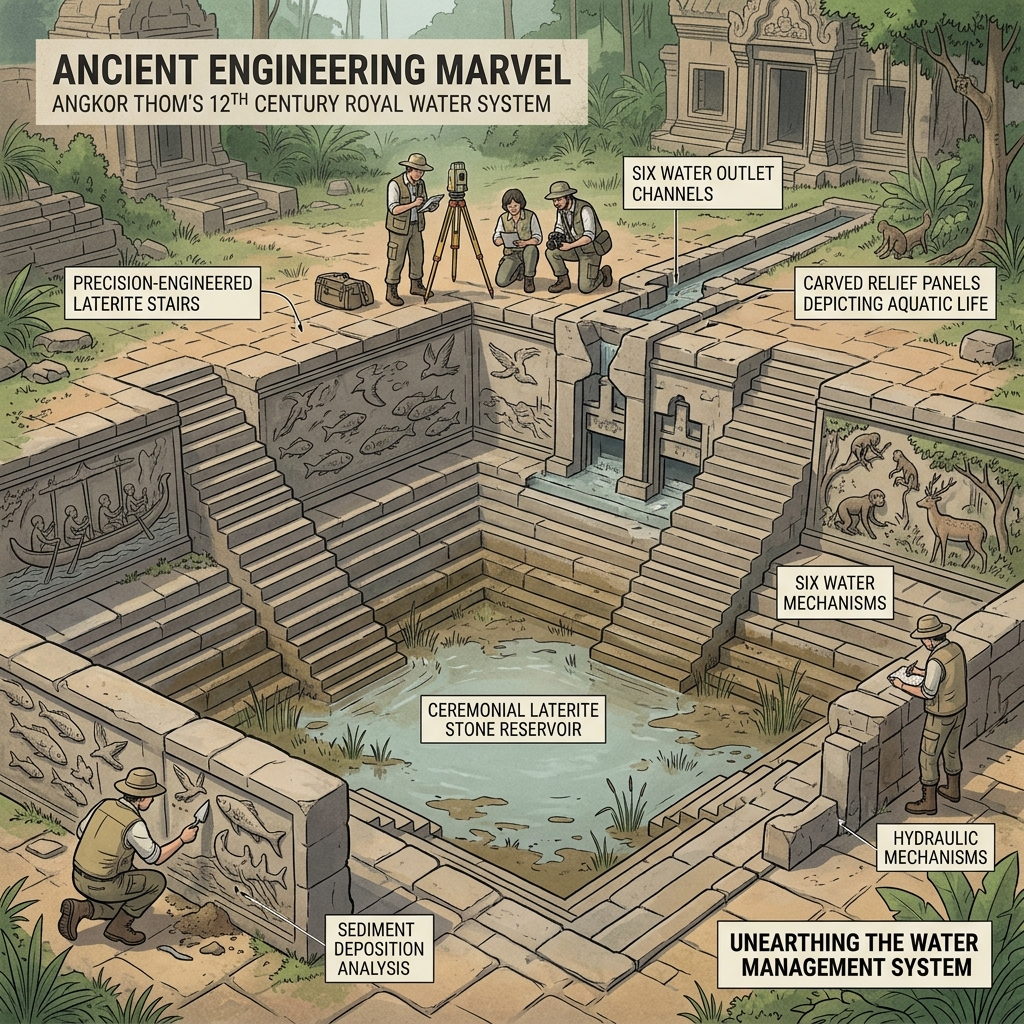
Cambodia's APSARA national authority has excavated a large-scale 12th-century Khmer hydraulic infrastructure beneath the royal palace complex of Angkor Thom, revealing a 65-meter reservoir with nine to eleven laterite-step tiers and six canal outlets that once served as a core operational node in the ancient water management network. This discovery adds crucial physical evidence to our understanding of how Angkor sustained up to one million residents across a thousand square kilometers — making it the largest pre-modern city in the medieval world — through an engineering system that achieved sub-centimeter elevation tolerances across dozens of kilometers of canals without modern surveying equipment. The excavation confirms that the hydraulic infrastructure built during Jayavarman VII's reign was not a simple utility but an integrated complex combining royal ceremonial function, urban water supply, agricultural irrigation, and flood regulation within a single, exquisitely calibrated network. Yet this same engineering brilliance that enabled three annual rice harvests became the civilization's fatal vulnerability when extreme climate variability in the 14th and 15th centuries overwhelmed the precision design and triggered cascading infrastructure failures that ultimately emptied the city into jungle. The finding is far more than an archaeological milestone: it is an 800-year-old structural warning about the civilizational risk of total dependence on a single technological system — a warning that resonates with particular urgency for our own era of hyper-centralized AI infrastructure, semiconductor supply chains, and globally interconnected digital networks.
Key Points
The Astonishing Precision of 12th-Century Khmer Hydraulic Engineering
Pool No. 11, excavated beneath the Angkor Thom royal palace complex, measures 65 by 30 by 3.5 meters and features nine to eleven tiers of precisely cut laterite steps, six canal outlets, and walls carved with detailed reliefs depicting boats, fish, birds, and reptiles in a level of artistic detail that makes clear this was not purely functional infrastructure. Khmer engineers achieved sub-centimeter elevation tolerances across tens of kilometers of canal networks without the benefit of modern surveying equipment, representing a standard of hydraulic precision that was not matched in Western engineering practice for several centuries after Angkor's peak. The structure almost certainly served multiple simultaneous functions — royal ceremonial use, urban water supply distribution, agricultural irrigation management, and monsoon flood control — making it an integrated system where engineering and aesthetics were inseparable design elements rather than competing priorities. This discovery adds critical physical evidence to earlier findings from comprehensive lidar and ground-penetrating radar surveys, which first revealed the full 1,000-square-kilometer extent of Angkor's urban footprint in the PNAS study led by Roland Fletcher and colleagues at the University of Sydney. The level of sophistication demonstrated by Pool No. 11 — infrastructure serving a city of up to one million people while simultaneously functioning as a site of artistic expression — demands a fundamental revision of how we understand the technological capabilities of pre-modern Southeast Asian civilizations, and reinforces that the technological frontier of human history has moved around the globe more often than Western-centric historiography has typically acknowledged.
The Dependency Paradox — How Perfect Technology Creates Systemic Vulnerability
Angkor's hydraulic system succeeded so completely that the city's entire food production, water supply, and flood management became fully dependent on a single tightly integrated network, with no meaningful independent alternatives maintained anywhere in the system. The more perfectly the system performed, the stronger the rational incentive to expand it further and the weaker the incentive to maintain redundant local alternatives — creating a feedback loop in which success systematically eliminated the slack that resilience requires. This pattern is what modern systems theorists call tight coupling: when every component depends on every other component performing exactly as designed, a failure in any part of the system can propagate rapidly into a failure of the whole, with no circuit breakers to absorb the cascade. In Angkor's case, when 14th-century climate variability began stressing the network beyond its design parameters, there was no independent water source, no backup food production system, and no logistical infrastructure capable of importing supplies at the scale required to sustain one million people through an extended crisis. The precise structural analog in 2026 is impossible to miss: 73% of global AI computing capacity concentrated in three cloud providers, 90% of advanced semiconductor production flowing from a single manufacturer, and 97% of global internet traffic traversing a limited number of undersea cables that are physically vulnerable and slow to repair represent exactly the same pattern of concentration-as-vulnerability that the Khmer Empire built to its maximum expression and then suffered the consequences of in the most definitive possible way.
How Climate Variability Dismantled a Precision Design
The climate evidence from tree-ring analysis and sediment cores does not show a simple prolonged drought destroying Angkor's water system, but rather an oscillating pattern of extreme events — sustained droughts alternating with unusually intense monsoons — that attacked the precision engineering from both ends simultaneously and created a deterioration spiral that no amount of engineering skill could reverse once it reached sufficient scale. During extended drought periods, the canals silted up as reduced flow velocity caused suspended sediments to settle and accumulate in the precisely calibrated channels, reducing their carrying capacity and effectiveness. During the subsequent extreme monsoon events, the high-energy flooding eroded canal embankments that had not been designed to handle flows significantly above average monsoon levels, creating breaches that required repair before the next drought cycle arrived. Published research in ScienceDirect, combining hydrological evidence with the PNAS lidar survey data, documents that portions of the hydraulic network had already failed by the early 14th century, and that the cascade of subsequent failures over the next 50 to 100 years progressively rendered the entire system inoperable — the exact pattern predicted by tight-coupling theory for complex precision systems subjected to conditions outside their original design envelope. This mechanism has direct relevance today: the IPCC Sixth Assessment Report's warnings about increasing extreme weather frequency describe precisely the same kind of alternating stress regime that destroyed Angkor's infrastructure, applied now to water management systems, power grids, and supply chains that modern cities depend on at comparable civilizational scale.
The Quiet Revolution of Decolonial Archaeology — APSARA's Autonomous Excavation
When Henri Mouhot wrote about "rediscovering" Angkor for European audiences in 1860, he encoded into the historical record a form of erasure: Cambodian communities had been living in proximity to these structures continuously, and the temples had never been unknown to the people whose ancestors built them, yet the language of "discovery" constructed the site's significance as something European observers had bestowed. For most of the 150 years following that moment, Angkor's academic interpretation was dominated by European institutions — most prominently France's Ecole francaise d'Extreme-Orient, which led restoration and interpretation work throughout the 20th century — with Cambodian scholars frequently relegated to supporting roles in the study of their own nation's most significant historical site. The 2026 APSARA excavation marks a genuine institutional shift: Cambodia's national cultural authority is conducting primary archaeological work, making interpretive decisions, and retaining physical custody of discovery data at the site rather than channeling it to overseas institutions for analysis and publication. This transfer of interpretive authority from Northern institutions to local ones is consistent with the principles established in UNESCO's 2003 Convention on Intangible Cultural Heritage, which recognized the right of originating communities to define, interpret, and manage their cultural heritage rather than having those definitions imposed from outside. As archaeological methodologies and institutional capacity continue developing within APSARA and Cambodian universities, the historical record of Angkor's civilization will increasingly be written by the people most directly connected to it — a change that improves not just the justice of the process but the quality and completeness of the resulting knowledge.
A Direct Lesson for Modern Infrastructure Design — Decentralization and Redundancy
The most practically applicable lesson from Angkor's hydraulic collapse is not merely that dependencies are dangerous, but that the economic logic of optimization actively works against the maintenance of resilient alternatives through a specific and predictable mechanism: when a centralized system delivers demonstrably better performance than distributed alternatives, investment shifts entirely to the central system, the skills and infrastructure needed to operate alternatives atrophy from disuse, and eventually the alternative capacity disappears entirely before anyone registers that it is gone. Angkor's experience illustrates the complete arc: distributed local water management capabilities existed across the region before the empire's hydraulic system was built, but as the central system proved superior, local alternatives were abandoned, and by the time the central system failed there was nothing left to fall back on. Cambodia's Ministry of Agriculture, Forestry and Fisheries is currently studying the Angkor distributed reservoir model as a potential framework for small-scale rural irrigation development in areas where centralized dam projects are not feasible, and the Asian Development Bank's 2025 Mekong basin strategy explicitly recommends community-based small-scale water storage as the preferred resilience approach for the lower basin — a remarkable full-circle journey for an 800-year-old design philosophy. Applied to digital and AI infrastructure, the same logic points toward multicloud architecture as a functional standard rather than a premium option, geographic diversification of semiconductor manufacturing as a strategic imperative rather than a pure economic calculation, and investment in analog and distributed backup capabilities for critical systems as insurance rather than archaism. The 12th-century Khmer engineers built the best possible water management system within their constraints, and the fact that their extraordinary success created the very conditions for catastrophic failure is precisely why the dependency paradox they demonstrated remains one of the most important structural lessons any civilization choosing efficiency over resilience can absorb.
Positive & Negative Analysis
Positive Aspects
- Reconfirming the Peak of Pre-Modern Hydraulic Engineering
Pool No. 11 provides physical proof that Khmer hydraulic engineering in the 12th century operated at a standard not matched in Western practice for several centuries afterward, adding crucial evidence to the larger case for reassessing the global technological history that Western-centric scholarship has too often narrated incompletely. The structure's combination of functional precision — nine to eleven laterite tiers, six canal outlets, sub-centimeter elevation tolerances across the broader network — with the artistic ambition of carved reliefs depicting boats, fish, birds, and reptiles demonstrates an integration of engineering and aesthetic expression that has few contemporary parallels in the medieval world. This discovery adds critical physical artifacts to the lidar-derived macro picture of Angkor's urban scale, giving researchers actual structures to analyze at the component level rather than just remote-sensing signatures that show infrastructure existed without revealing how it actually worked. For the history of technology and the ongoing reassessment of non-Western civilizational achievements, the evidence accumulating at Angkor is reshaping the global narrative in ways that will take decades to fully work through and integrate into standard historical accounts. It is a concrete reminder that the technological frontier of human history has moved around the globe more than most textbooks still acknowledge, and that ignorance of that movement impoverishes our understanding of what human civilizations are capable of achieving.
- Historical Experimental Data for Climate Adaptation Research
Angkor's hydraulic system represents something genuinely rare in the climate science toolkit: a large-scale, long-running real-world experiment in water management that operated for approximately five centuries across varying climate conditions and ultimately reached its documented failure mode in a datable and physically recoverable record. Sediment samples from Pool No. 11 will yield radiocarbon dates, pollen profiles, and geochemical signatures that allow researchers to reconstruct climatic and agricultural conditions at Angkor at decade-level resolution, far finer than what existing tree-ring records alone provide. This kind of high-resolution historical data, cross-referenced with lidar-derived hydraulic maps of the broader network, is precisely what climate modelers need to validate projections about how water infrastructure performs under conditions of extreme variability rather than gradual change. For Southeast Asia — which faces intensifying monsoon variability, more frequent extreme drought-flood oscillations, and growing water conflict pressure in the Mekong basin — having a well-documented prior failure case that can be analyzed at high resolution is directly actionable in current infrastructure planning discussions, not merely an academic exercise. Cambodia's ongoing collaboration with the ADB on small-scale distributed water management demonstrates that this historical knowledge is already moving from research toward applied policy, which is the conversion that actually matters for the communities facing these challenges today.
- A New Engine for Cambodia's Cultural Tourism Industry
Archaeological discoveries have a documented economic multiplier effect on cultural tourism, and Pool No. 11's combination of spectacular scale, extraordinary preservation, and compelling narrative creates conditions for substantial tourism expansion at exactly the moment Siem Reap is adding airport capacity to handle 30% more annual visitors. The new discovery adds a hydraulic engineering narrative to what has previously been largely an architectural and religious tourism product, differentiating the Angkor experience in ways that appeal to broader visitor segments — particularly the growing international market for educational and heritage tourism that wants to understand how ancient civilizations actually functioned rather than just admire their monuments. Cambodia has explicitly positioned cultural tourism as a pillar of economic development strategy, and high-profile discoveries that generate sustained international media coverage are among the most cost-effective forms of destination marketing available to a country without large-scale tourism promotion budgets. The economic case for continued investment in archaeological work at Angkor is significantly strengthened by this result, creating a feedback loop in which successful excavations drive tourism revenue that funds further excavations and conservation work. For a country where cultural tourism represents approximately 15% of GDP, the potential to deepen and differentiate that contribution through continued discoveries is one of the most promising economic development avenues available.
- Establishing Archaeological Sovereignty and Decentralizing Knowledge Production
APSARA's autonomous conduct of this excavation represents a meaningful institutional milestone in the global archaeology of major heritage sites, moving the longstanding and often uncomfortable power asymmetry between originating communities and external scholars toward a more equitable distribution of interpretive authority. The physical custody of artifacts and data at the site, combined with Cambodian-led decision-making about excavation priorities, publication strategy, and interpretive frameworks, breaks a longstanding pattern in which the historical record of non-Western civilizations was written predominantly by Western institutions operating with Western conceptual tools and publishing for Western academic audiences. Over time, this shift matters enormously for the quality of historical knowledge produced: as Cambodian archaeologists and scholars publish findings in their own voice, informed by their own cultural and historical context, the picture of Angkor's civilization that enters the scholarly record will be qualitatively richer than what external scholars working from a distance could produce on their own. This model has clear potential applicability across Southeast Asia, where Myanmar, Laos, Vietnam, and Indonesia all have significant heritage sites whose interpretation remains substantially influenced by external institutions, and where APSARA's example could catalyze a broader regional shift toward locally led heritage management. The practical and symbolic dimensions of archaeological sovereignty reinforce each other: building local institutional capacity for heritage management is both the right thing to do and the thing most likely to result in the best historical knowledge being produced.
Concerns
- Preservation Risks at the Excavation Site — Racing Against the Monsoon
Angkor Thom's rainy season runs from May through October, bringing tropical downpours at rainfall intensities that are an order of magnitude higher than what temperate weather systems produce, and the newly excavated laterite structures are now exposed to precisely the kind of environmental cycling that the material handles worst. Laterite — the iron-rich sedimentary rock used throughout Angkor's construction — is structurally robust in stable dry conditions but chemically vulnerable to repeated saturation and drying cycles, because the iron compounds in the material react with moisture in ways that progressively weaken the rock's structural integrity over time. The carved reliefs on Pool No. 11's walls, depicting boats, fish, birds, and reptiles, have survived 800 years precisely because they were sealed underground in relatively stable conditions; that 800 years of protection is a measure of how good the underground environment was for preservation, not a guarantee of the structures' robustness once exposed to the surface. APSARA has announced plans to restore the hydraulic drainage system to protect the excavation, but the race against the seasonal clock is genuinely difficult to win if protective infrastructure installation is delayed for any reason — budget constraints, procurement timelines, logistical bottlenecks — and any shortfall in the protective measures before the rains arrive could result in irreversible damage to features that no conservation effort could restore. This is the most urgent near-term risk from the excavation, and it is particularly painful to contemplate because the discovery itself was a triumph that represents years of careful work.
- Accelerating Physical Damage Through Over-Tourism
Angkor already receives more than 2.5 million visitors annually, and several of the most popular structures within the complex show measurable physical degradation attributable to visitor traffic, soil compaction, moisture from respiration, and the environmental modifications that high visitor concentrations produce in enclosed spaces. A new high-profile archaeological discovery with sustained international media coverage will draw additional visitors to a site that is already at or near sustainable capacity for many of its most sensitive areas, without the benefit of the visitor management infrastructure — controlled access routes, protective surfacing, visitor flow restrictions, timed entry systems — that would be standard practice for a newly opened site in a country with stronger regulatory and financial capacity. UNESCO issued explicit warnings about sustainable visitor limits for Angkor in its 2019 management plan, but converting those warnings into binding restrictions on tourist access is politically difficult in a country where tourism represents a significant share of national income and where local communities depend on visitor spending for their livelihoods. The Siem Reap airport expansion projecting 30% growth in annual visitor numbers amplifies this concern: without a concrete access management plan for Pool No. 11 implemented before tourist volumes increase, the physical integrity of the newly excavated site is vulnerable to visitor-driven degradation at rates that could outpace conservation responses within a few years of the discovery.
- Financial Sustainability of Long-Term Preservation
Major archaeological site preservation is consistently and substantially more expensive than the excavation that produces it, and the financial arithmetic at Angkor is challenging under any realistic scenario that relies primarily on national budget resources. Structural consolidation, drainage restoration, relief preservation treatment, site monitoring infrastructure, and conservation staffing for Pool No. 11 alone could require several million dollars in initial investment and significant ongoing annual expenditure, and Cambodia's per capita GDP of approximately $1,800 does not provide a national budget scaled for that kind of expenditure across the dozens of structures that continued excavation will uncover over the coming decade. Dependence on international donor funding creates its own fragility: donor priorities shift with geopolitical conditions, international attention moves on to new crises, and the pandemic period demonstrated that international conservation budgets can be cut by 40% or more in a single crisis year — exactly when the site continues to need maintenance regardless of what is happening in donors' home countries. Building a self-sustaining financial model — ideally one in which tourism revenues are systematically and transparently reinvested into the conservation infrastructure that makes the tourism possible — is not yet fully achieved at Angkor, and the gap between what the site needs and what predictable funding sources can reliably deliver represents a structural vulnerability to the long-term preservation mission.
- Risk of Over-Simplification in Applying the Modern Infrastructure Analogy
The structural parallel between Angkor's 12th-century hydraulic network and 21st-century digital infrastructure is analytically compelling and genuinely instructive, but it is an analogy, and all analogies have limits that must be clearly acknowledged to avoid the analogy doing more argumentative work than it can legitimately support. Modern cloud and AI infrastructure has capabilities that Angkor categorically lacked: real-time system monitoring at millisecond resolution, automated failover mechanisms that can redirect traffic in seconds, distributed backup systems that maintain data integrity across geographic regions, and organizational capacity to respond to incipient failures before they cascade to catastrophic scale — capabilities that represent a qualitative difference from what the Khmer engineering corps could deploy. The gap between a modern infrastructure organization that can detect a failure signature and begin remediation before users are significantly impacted, and a 12th-century engineering corps that relied on physical inspection of canal sections spread across hundreds of kilometers, is not a difference of degree but of kind. Drawing too direct a line from Angkor's collapse to inevitable modern failure risks understating these genuine advances and could produce the very complacency about existing resilience measures that the analogy is meant to counteract. The core structural insight — that tight coupling between civilizational dependency and a single optimized system creates non-linear failure risk — remains valid and important regardless of these caveats, but the specific mechanisms and timescales of any modern failure scenario would differ substantially from the Angkor precedent in ways that matter for how we think about prevention and response.
Outlook
The APSARA excavation of Angkor Thom's royal hydraulic infrastructure is not simply an archaeological event — it is a discovery with multi-layered implications that will unfold across very different timescales. In the near term, it reshapes tourism and academic attention. In the medium term, it informs climate adaptation policy in Southeast Asia. In the long term, it will become one of the defining reference points in global debates about infrastructure resilience — debates that are already intensifying in AI and semiconductor policy circles. What hasn't happened yet is the ripple effect, and that's what demands careful analysis here. The physical discovery is complete. The intellectual reckoning it demands has barely begun.
In the next six months, I expect at least two to three additional hydraulic structures to be identified within the Angkor Thom royal palace complex. The current APSARA excavation is focused on Pool No. 11, but ground-penetrating radar surveys have already identified subsurface anomalies consistent with additional constructed features elsewhere in the complex. The palace compound covers approximately four square kilometers, and the currently excavated area represents less than 10% of the total footprint. Lidar and radar data are essentially mapping the excavation roadmap — the direction is clear, and the work is logistically constrained rather than directionally uncertain. As additional finds are announced, expect a wave of international media coverage that drives both tourist interest and research funding toward Angkor at a scale not seen since the major lidar revelations of the early 2010s. Cambodia's Siem Reap International Airport expansion is projected to complete in 2026, increasing capacity by roughly 30%, and the timing of a high-profile archaeological discovery at exactly that moment is about as favorable as it gets for destination marketing.
At the same time, the near-term conservation picture is genuinely concerning. Angkor's rainy season runs from roughly May through October, and it brings tropical downpours that deposit rainfall at rates an order of magnitude higher than what temperate regions experience in comparable events. Laterite — the iron-rich sedimentary rock used throughout Angkor's construction — is durable when dry but chemically vulnerable to the cycle of saturation and drying that accompanies tropical monsoons. The carved reliefs on Pool No. 11's walls, depicting boats, fish, birds, and reptiles, have survived 800 years precisely because they were sealed underground in relatively stable conditions. Eight hundred years of protection doesn't make them invincible; it makes them unprepared for the surface environment. If the drainage restoration that APSARA has announced is not completed before the rains begin in earnest, there is a real risk of irreversible damage to irreplaceable relief work within a single wet season. This is the most urgent and actionable near-term risk from the excavation, and it is not a small one.
Moving into the medium term — roughly six months to two years out — I see this discovery having its largest initial impact in the academic literature. The sediment samples extracted from Pool No. 11 will undergo radiocarbon dating, pollen analysis, and geochemical profiling. When that data is published — I expect the first wave of papers by mid-2027 — it will provide a high-resolution record of climatic and agricultural conditions at Angkor through the 12th and 13th centuries with much greater precision than anything currently available. Cross-referencing this data with existing tree-ring datasets will allow researchers to identify, at decade-level resolution, which specific climatic events triggered which infrastructure failures. That is the difference between "climate change contributed to Angkor's decline" and "a specific drought-flood oscillation sequence in the 1320s disabled these specific canal segments, reducing agricultural output by approximately X percent." The latter is directly useful to climate scientists and infrastructure planners in ways that a general attribution is not. If this data lands in Nature or Science, Angkor moves from tourist destination to core reference case for climate resilience research — permanently.
The medium-term impact on Southeast Asian climate adaptation policy may ultimately be more significant than the academic contribution. The Mekong basin is currently the site of an ongoing and intensifying conflict over water resources, with China's upstream dam construction repeatedly disrupting downstream agricultural and fisheries systems in Cambodia, Vietnam, and Thailand. Downstream nations are searching for approaches that reduce dependence on the Mekong's main channel flows, and Angkor's distributed reservoir model — which worked remarkably well for five centuries — is precisely the kind of alternative that regional planners need to consider seriously. The Asian Development Bank's 2025 Mekong Strategy explicitly recommended community-based, small-scale water storage as the preferred approach for climate resilience in the lower basin. I expect that by 2027, at least two to three provincial-level water management projects in Cambodia will explicitly reference the Angkor hydraulic model in their design documentation, and the broader principle — that distributed smaller-scale systems outperform centralized mega-infrastructure under conditions of high climate variability — will gain policy traction across the region.
Looking further out, into the two-to-five-year horizon, I see the Angkor case becoming a canonical example in infrastructure resilience scholarship. Roman aqueducts, Mayan irrigation systems, and Angkor's hydraulic network are already the three most commonly cited cases of pre-modern infrastructure collapse, but Angkor's case is uniquely well-documented both physically, through lidar and radar surveys, and climatologically, through tree-ring and sediment records. As new research from the Pool No. 11 excavation adds resolution to the causal story, the Angkor case will move from "interesting historical analogy" to "rigorously documented case study" in the engineering and policy literature. I expect academic papers published between 2028 and 2030 to explicitly apply Angkor's collapse patterns to modern infrastructure vulnerability modeling, particularly in AI and cloud computing. The structural similarities are too striking to ignore: a single critical network serving as the foundation for civilization-scale functions, optimized to peak efficiency, with alternatives allowed to atrophy, and then subjected to conditions outside the design envelope. The scenario writes itself.
The most important long-term implication, in my view, is the direct structural parallel between Angkor's collapse and the current concentration of AI and semiconductor infrastructure. As of 2026, 73% of global AI computing runs on three cloud providers, TSMC manufactures 90% of cutting-edge chips, and 97% of global internet traffic traverses undersea cables that are physically vulnerable and slow to repair. This concentration is not an accident — it is the natural result of economies of scale operating in the absence of resilience requirements. Just as Angkor's rulers had every rational incentive to expand the central hydraulic system rather than maintain costly redundant local alternatives, today's technology industry has every rational incentive to consolidate on the most efficient providers rather than maintain expensive geographic diversity. The incentive structure produces optimal efficiency until conditions exceed the design envelope — and then it produces catastrophic, cascading failure. I predict with reasonable confidence that at least one major cloud service disruption with civilizationally significant consequences will occur before 2030. When it does, Angkor will be cited — not as a novelty historical parallel, but as the clearest prior demonstration of what civilization-scale infrastructure failure actually looks like.
Here is how I see the scenarios playing out. In the optimistic scenario — roughly 25% probability — the Angkor excavation catalyzes genuine and sustained policy change. Southeast Asian governments accelerate distributed water management programs explicitly modeled on the Angkor hydraulic design, meaningfully reducing agricultural vulnerability to both drought and flooding within five years. The technology industry, driven by a combination of regulatory pressure and near-miss infrastructure events, adopts multicloud architectures as the functional standard, reducing single-provider dependencies by 40% relative to 2026 levels. Cambodia's cultural tourism sector expands from its current 15% of GDP contribution toward 20%, with the Angkor story anchoring a premium heritage tourism product that generates revenue without destroying the asset it sells. Archaeological sovereignty established by APSARA's work becomes a model for heritage management across Southeast Asia, transferring interpretive authority from Northern institutions to local ones in a durable and systematic way. I want this scenario to materialize, but the incentives for concentration are strong and the costs of redundancy are visible, which is why I put it at a quarter probability.
The base scenario — 50% probability — is characterized by progress that is real but consistently insufficient. Academic output from the Angkor excavation is significant: five to eight major papers appear between 2026 and 2030, the climate resilience research community genuinely integrates the Angkor case, and two to three regional water management projects in Cambodia implement distributed reservoir approaches. AI infrastructure concentration continues, but multicloud awareness grows and partial redundancy becomes more common in enterprise architecture. One major cloud outage occurs during this period, triggering intense concern and some regulatory attention, but stopping well short of the structural overhaul that would actually address the underlying concentration risk. Angkor's tourism revenues grow steadily, conservation budgets increase proportionally, and the balance between accessibility and preservation remains precarious but manageable. This is the scenario where the lessons are understood but not acted on at the scale required — which is, depressingly, the historically normal outcome for warnings that arrive before the catastrophe they predict.
The pessimistic scenario — 25% probability, though historical patterns make me fear it may be higher — is the one where we look back from 2035 and recognize we had all the information we needed and acted on none of it. The Angkor discovery becomes a successful media story and a popular addition to the Siem Reap tourism circuit, but its structural lessons dissolve into academic papers that policy makers don't read. Over-tourism accelerates damage to the newly excavated sites faster than conservation measures can respond, and some of the carved reliefs are irreversibly degraded by a combination of monsoon exposure and visitor traffic within a decade of discovery. AI infrastructure concentration deepens: by 2030, more than 85% of global AI computing is concentrated in four companies, each operating with efficiency-optimized thin redundancy margins. And then something goes wrong — a geopolitical event, a natural disaster, a cyberattack — and the cascade begins. In the aftermath, people pull out the Angkor analogy and nod gravely. But pulling out an analogy after the fact is not the same as learning from it before. Angkor sent this warning 800 years in advance. That is considerably more notice than most catastrophes give.
Let me be honest about where my analysis might be wrong, because intellectual honesty requires it. The comparison between Angkor's 12th-century hydraulic network and 21st-century digital infrastructure is analytically powerful but structurally approximate. Modern infrastructure systems have capabilities that Angkor categorically lacked: real-time monitoring, automated failover, distributed backup systems, and organizational capacity to respond to incipient failures before they cascade to catastrophic scale. The gap between an early-warning-capable modern infrastructure organization and the Khmer engineering corps working without telecommunications or real-time data is genuinely substantial. I may also be underweighting the pace of voluntary diversification already underway — distributed manufacturing capacity is growing, edge computing is adding geographic distribution, and multicloud architectures are becoming more common even without regulatory mandates. My reading of current AI and semiconductor concentration as a near-term existential risk may be too pessimistic about the adaptive capacity of modern institutions. Even with these caveats, however, the core structural insight stands: when a civilization places total dependency on a single optimized system and allows alternatives to atrophy, it has created the conditions for catastrophic non-linear failure. That insight is not time-bounded.
What should you actually do with this? At the individual level: maintain local backups, know what your alternatives are when primary systems fail, and don't assume that a system that has never failed cannot fail. At the organizational level: the cost of maintaining two independent technology infrastructures should be treated as insurance rather than waste — any organization that cannot function through a 72-hour outage of its primary cloud provider is one incident away from a crisis. At the policy level: semiconductor manufacturing geographic concentration is a strategic vulnerability that market forces alone will not resolve, and public investment in diversified manufacturing capacity is a legitimate security expenditure rather than industrial protectionism. Angkor's engineers were not given the chance to read an 800-year-old warning from a prior collapsed civilization. We are. The warning is right here: build in redundancy before you need it, because once the cascade begins, there is no recovery protocol. There is only the jungle, and time, and 800 years later, an excavation team asking what went wrong.
Sources / References
- Ancient Royal Water System Discovered Beneath Angkor Thom — HeritageDaily
- Comprehensive Archaeological Map of Angkor: Redefining Pre-Modern Urbanism — PNAS
- Scientific Evidence for the Collapse of Angkor's Hydraulic System — ScienceDirect
- How Climate Change Collapsed the Angkor Civilization — National Geographic
- APSARA Excavation Finds Ancient Angkor Water System and Sculptures — Khmer Times
- The Hydraulic System of Angkor Wat: Engineering Triumph and Civilizational Vulnerability — Ancient Origins