
Exclude Israel, Welcome Russia? — The 2026 Venice Biennale Exposes the Hypocrisy of 'Artistic Freedom'
Summary
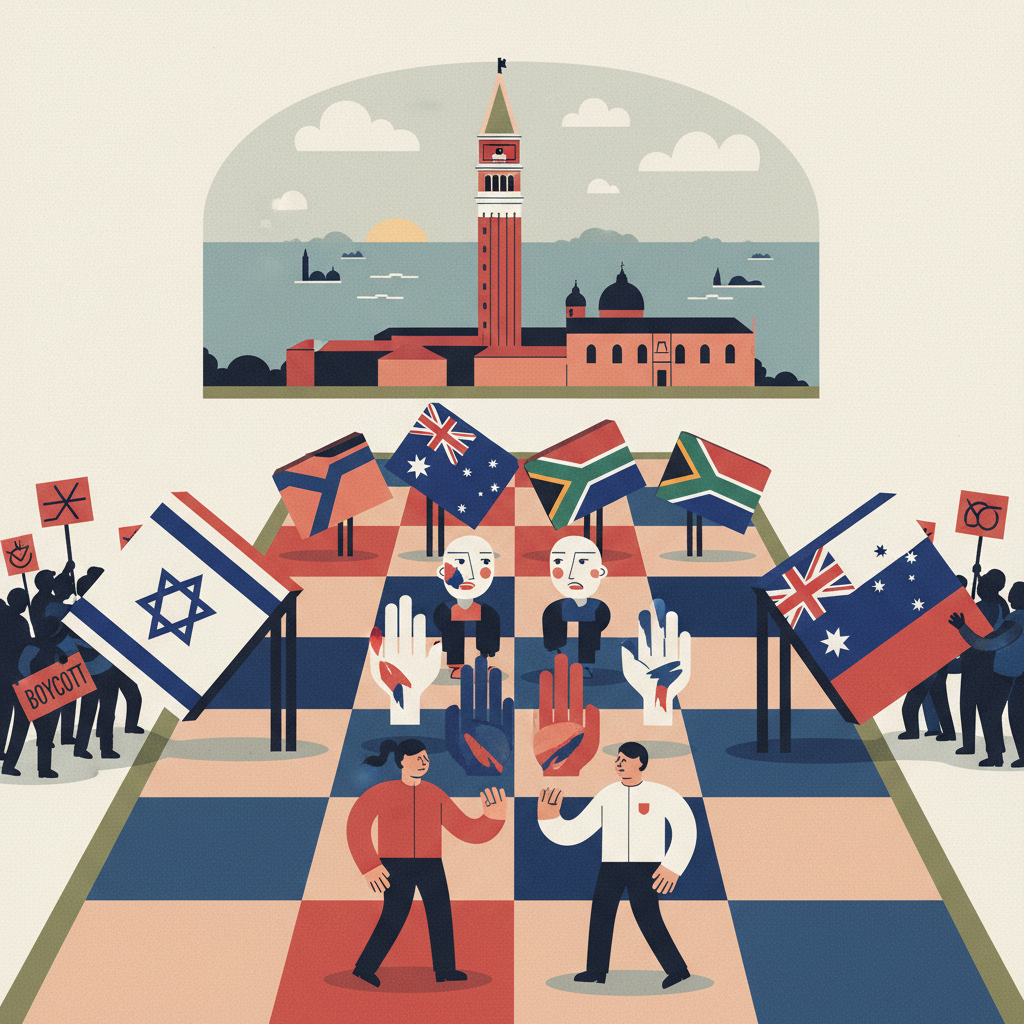
The Venice Biennale faces an unprecedented quadruple geopolitical storm: 183 participants demanding Israel's exclusion, Russia's controversial return after four years, Australia's artist selection fiasco, and South Africa's complete withdrawal. The 131-year-old national pavilion system itself stands accused of structurally undermining artistic freedom.
Key Points
183 Participants Sign Organized Demand to Exclude Israel — Curators Join Unprecedented Revolt
The Art Not Genocide Alliance (ANGA) published an open letter on March 17, 2026, signed by 183 participating artists and curators demanding Israel's exclusion. Two curators of the main exhibition In Minor Keys are among the signatories. Representatives from approximately 25 national pavilions signed, with some choosing anonymity.
Russia Returns After Four Years — EU Threatens Funding Cut, Venice Mayor Warns Against Propaganda
Russia returns with a folk music program called Tree rooted in the sky featuring 38 young musicians. The European Commission threatened to withdraw 2 million euros in funding. Italy's culture minister demanded the Biennale president's resignation, and the Venice mayor warned the pavilion will close if used for propaganda.
Australia's Creative Australia Suffers Comprehensive Institutional Failure
Creative Australia selected Lebanese-Australian artist Khaled Sabsabi then reversed the decision just six days later due to political backlash. An independent audit confirmed comprehensive institutional failure, leading to key resignations. Sabsabi was eventually reinstated.
South Africa's Empty Pavilion — Gaza Memorial Artwork Censored
When artist Gabrielle Goliath planned a work memorializing Gaza victims, Culture Minister Gayton McKenzie terminated the partnership eight days before deadline. Goliath's court challenge was dismissed. South Africa's pavilion will stand empty.
The 131-Year-Old National Pavilion System's Structural Contradiction
Since Belgium built the first pavilion in 1907, the 30 permanent pavilions have been shaped by fascism and Cold War geopolitics. When the state funds the pavilion, the artist's expression is structurally subordinate to state interests. This was simultaneously proven in four countries.
Positive & Negative Analysis
Positive Aspects
- A New Model of Artist Solidarity Is Born
The ANGA open letter with 183 organized signatories demonstrates that collective action among art workers is becoming professionalized. This can function as a check mechanism against cultural institutions.
- Institutional Accountability Becomes Real
The independent audit and resignations in the Sabsabi affair represent a rare instance where political interference in artistic decisions actually resulted in accountability.
- A Catalyst for National Pavilion Reform
Simultaneous controversies in four countries provide an unprecedented trigger for fundamental reexamination of the 131-year-old system.
- Koyo Kouoh's Legacy Endures
The vision of curator Koyo Kouoh, who passed away in May 2025, is being faithfully realized through In Minor Keys by the team she chose.
Concerns
- Selective Moralism Risks Becoming Entrenched
The asymmetry between the organized exclusion movement against Israel and the comparatively muted response to Russia's return exposes a dangerous pattern of selective moral outrage.
- State Censorship of Art Becomes Normalized
South Africa's censorship of its own artist's Gaza-related work demonstrates that even in the Biennale, state power can control artistic expression. The court's dismissal means legal safeguards failed.
- Artistic Discourse Gets Marginalized
With all coverage focused on geopolitical controversies, substantive discussion of the exhibition's artistic value has vanished.
- The Empty Pavilion Is a Double-Edged Sword
South Africa's empty pavilion may serve as a political statement, but artists pay the irreversible price of lost opportunity.
- Long-Term Erosion of the Biennale's Authority
If geopolitical controversies consume every edition, major artists may avoid participation and commercial art fairs could displace the Biennale.
Outlook
Here is the honest truth about the 2026 Venice Biennale: what we are witnessing is not a single year's controversy. It is a structural inflection point. Four fronts opening simultaneously is not coincidence.
In the short term, the Israel exclusion petition will likely grow to 300+ signatories before the May 9 opening, but actual exclusion is extremely unlikely. Large-scale protests are probable. Russia's pavilion will likely open but attract additional controversy.
In the medium term, between 2027 and 2028, reform discussions could begin in earnest: transnational pavilion pilots, rebalancing artist-centered exhibitions, and participation criteria based on human rights records.
Looking to 2030, in the bull case, the Biennale transitions to a hybrid model and evolves into an artistic Davos. In the base case, the current system persists with recurring controversies and incremental reform. In the bear case, geopolitical conflict swallows the Biennale and artistic discourse is completely marginalized. The base case is most realistic. It will take at least a decade for national pavilion abolitionism to become mainstream, but the direction has already been set.
Sources / References
- Nearly 200 Venice Biennale participants sign letter demanding cancellation of Israeli pavilion — The Art Newspaper
- Russia pavilion at Venice Biennale will be closed if it features propaganda — The Art Newspaper
- 178 Venice Biennale Participants Demand Israel Be Barred — Artnet News
- Russia returns to the Venice Biennale amid fierce criticism — Euronews
- Russia return to Venice Biennale triggers backlash and EU funding threat — Meduza
- Dozens of Venice Biennale Artists Demand Israel Exclusion — Hyperallergic
- Creative Australia backflip exposes deep governance failures — The Conversation
- South Africa Cancels Artist Over Artwork Referencing Gaza — Artnet News
- 60th Venice Biennale, National Pavilions — e-flux