
The AI Art War Inside Video Games — From Crimson Desert's Apology to Steam's Disclosure Battle and Tim Sweeney's Counterattack
Summary
From Crimson Desert's undisclosed AI art scandal to Steam's disclosure battle, Tim Sweeney's anti-label stance, Battlefield 6's non-disclosure, and Korea's AI Basic Act enforcement, the gaming industry's AI art war is erupting on every front simultaneously.
Key Points
The Crimson Desert AI Art Scandal — Structural Failure Behind the 'It Was an Accident' Defense
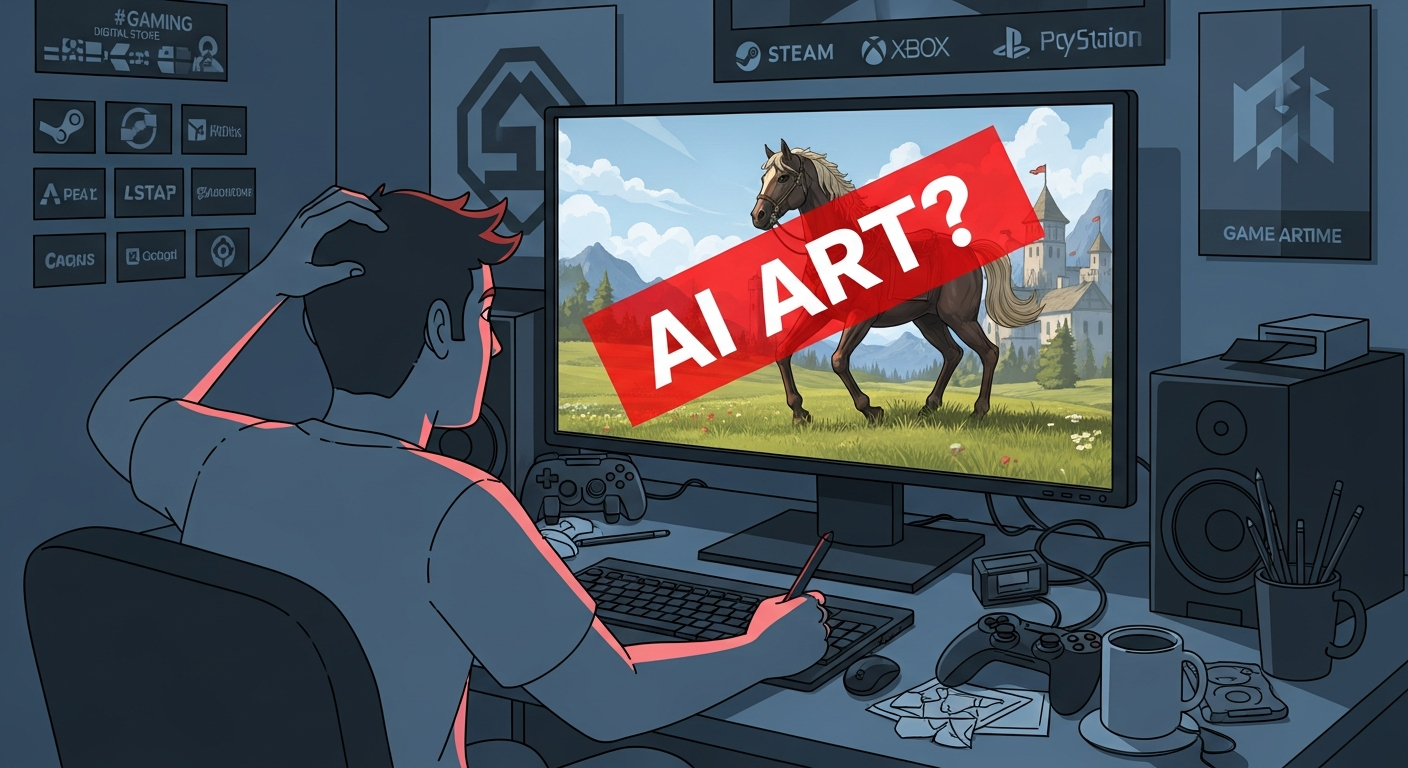
Pearl Abyss's Crimson Desert drew immediate backlash within 24 hours of its March 19, 2026 launch when players discovered AI-generated paintings with five- and six-legged horses, misshapen rider torsos fused into mounts, and shop signs with incorrect finger counts — telltale hallmarks of generative AI output. Pearl Abyss issued an apology stating that "experimental AI generation tools were used during early development to quickly explore tone and atmosphere" and that these assets were supposed to be replaced before launch. They acknowledged they "should have clearly disclosed AI usage." However, the GDC 2026 State of the Game Industry report paints a revealing picture: only 5% of developers use AI for player-facing features, meaning the vast majority of studios consciously avoid putting AI-generated content in front of players. The fact that a years-long AAA development process involving hundreds of team members failed to catch six-legged horses and anatomically broken figures points not to an individual oversight but to a systemic process failure — either nobody was checking, or nobody cared enough to flag it. The absence of any AI disclosure on Crimson Desert's Steam page also violated Valve's disclosure policy that has been in effect since 2024. Despite the controversy, Crimson Desert sold 3 million copies in its first week and is approaching 5 million, demonstrating that consumer backlash has so far failed to serve as a meaningful deterrent against AI concealment in commercial releases.
Steam's AI Disclosure Policy vs. Tim Sweeney's 'Labels Are Meaningless' Declaration
Valve has been at the forefront of AI transparency in the gaming industry, introducing AI disclosure requirements on Steam in 2024 and significantly overhauling the policy in January 2026. The revised rules distinguish between two categories: AI used to create game content (in-game assets, store pages, marketing materials) and AI that generates content during live gameplay (real-time image, audio, or text generation). For live-generated content, Valve requires developers to implement guardrails and player reporting systems, with non-compliant games subject to removal from the store. Roughly 8,000 titles disclosed AI usage in the first half of 2025 alone — an eightfold increase over the approximately 1,000 titles that disclosed across all of 2024. On the opposing side, Epic Games CEO Tim Sweeney has publicly argued that "AI tags make sense for art exhibitions or digital content marketplaces, but are meaningless in game stores" because "AI will be involved in nearly all future production." Valve artist Ayi Sanchez fired back directly, calling this argument equivalent to "saying food products shouldn't have their ingredients list" and noting that "the only people scared of this are those who know their product is low effort." Notably, the Epic Games Store currently has zero AI disclosure requirements — a policy gap that conveniently aligns with Sweeney's public stance against labeling.
Battlefield 6's Non-Disclosure — The Double Standard Favoring Major Publishers
EA's Battlefield 6 became another flashpoint when players identified AI-generated art defects in the paid Windchill cosmetic bundle: an M4A1 with two barrels, a missing index finger, and hand positions misaligned with the weapon scope — all characteristic anatomical errors produced by generative AI systems. Reports also surfaced that approximately 30% of in-game animated voicelines were produced using AI systems. Yet Battlefield 6's Steam page contains no AI disclosure whatsoever, and franchise lead Rebecka Coutaz told the BBC that the game does not use player-facing generative AI — a claim directly contradicted by the mounting evidence. This case exposes a glaring double standard in the industry. When indie developers include undisclosed AI art, communities punish them swiftly and severely through review bombing and social media backlash. But when a publisher like EA — generating over $7 billion in annual revenue — does the same thing, the controversy blows over without material consequences. EA quietly updated the Objective Ace and Winter Warning cosmetics roughly a month after the scandal to "align with Battlefield's visual identity" but offered no explanation of what was changed or why. Valve's disclosure policy exists on paper, but the absence of concrete enforcement mechanisms has created an accountability gap that structurally advantages large publishers over smaller studios.
The Survival Crisis for Game Artists — Voice Actors Are Protected, Visual Artists Are Not
SAG-AFTRA's 11-month video game performer strike culminated in the 2025 Interactive Media Agreement, ratified with an overwhelming 95.04% vote. The deal secured landmark AI protections for voice actors: consent requirements for AI digital replicas, mandatory usage reports from employers, the right to revoke consent during strikes, a 15.17% compensation increase, and annual 3% raises through 2027. But visual artists — concept artists, texture artists, environment designers, character modelers — have no comparable protection. The GDC 2026 report reveals devastating numbers: one-third of U.S. game industry workers experienced layoffs in the past two years, and two-thirds of AAA studios conducted layoffs within the last 12 months. Among visual and technical art professionals specifically, 64% said generative AI is having a negative impact on the industry — 12 percentage points above the overall average of 52%, and a sharp climb from 30% in 2025 and just 18% in 2024. Meanwhile, 74% of game students expressed concern about job prospects, citing the shrinking number of entry-level positions, competition from laid-off veterans, and the looming threat of AI replacement. The Animation Guild's 2024 deal with Hollywood studios secured written notification and consultation rights on AI use but failed to include the right to refuse AI usage or prevent one's work from being used to train AI models — shortcomings significant enough that three negotiating committee members publicly voted against ratification. For game industry visual artists, systematic protection remains a distant prospect.
Korea's AI Basic Act and Game Industry Act Amendment — The First Attempt at Legal Enforcement
South Korea positioned itself as a global regulatory pioneer by enacting the AI Basic Act on January 22, 2026 — the world's first comprehensive AI legislation covering both public and private sectors. The law requires disclosure of AI usage in any product that partially or fully incorporates AI, including creative content, with maximum penalties of 30 million won (roughly $20,000) and a one-year grace period. Building on this foundation, a proposed amendment to the Game Industry Promotion Act, sponsored by People Power Party lawmaker Kim Sung-won, would mandate disclosure of generative AI usage in game development specifically. The amendment proposes dramatically stronger penalties: up to 1 billion won in surcharges, imprisonment of up to two years, or fines of up to 20 million won for tampering with or falsifying disclosure information. The National Assembly's senior expert committee noted that these penalties are significantly heavier than the AI Basic Act's 30 million won cap and questioned whether sufficient justification exists for imposing disproportionately severe punishment on game companies alone. Meanwhile, the Korea Association of Game Industry (K-GAMES) formally opposed the amendment, arguing that the AI Basic Act already imposes relevant disclosure obligations and that sector-specific regulation is unnecessary — revealing a sharp internal divide between those prioritizing transparency and those prioritizing industry competitiveness. Internationally, the EU AI Act's transparency rules take full effect in August 2026, with the European Commission finalizing its Code of Practice on AI-generated content labeling by mid-2026, creating a parallel tightening of global regulatory frameworks.
Positive & Negative Analysis
Positive Aspects
- Steam's AI Disclosure Framework Exists and Continues to Evolve
Valve introduced the gaming industry's first AI disclosure system on Steam in 2024 and followed up with a significantly revised policy in January 2026 that distinguishes between pre-generated and live-generated AI content. The fact that approximately 8,000 titles disclosed AI usage in just the first half of 2025 — compared to roughly 1,000 across all of 2024 — demonstrates the system's tangible impact on developer behavior. Valve's decision to exempt development-assistance AI tools like code assistants and debuggers while requiring disclosure only for player-facing content represents a pragmatic balance between transparency and practicality. If this framework continues to mature, it has the potential to become the global benchmark for AI transparency in interactive entertainment.
- Pearl Abyss's Swift Apology and Corrective Action Sets a Response Precedent
Following the controversy, Pearl Abyss immediately issued a public apology, committed to a comprehensive audit of all in-game assets, and delivered a patch replacing AI-generated artwork with human-created art. Their acknowledgment that "we should have clearly disclosed AI usage" — while reactive rather than proactive — represents a meaningful admission from a major studio that AI disclosure is a legitimate obligation. The speed and transparency of their incident response provides a replicable model for other developers facing similar situations. If more studios adopt this corrective approach, reactive accountability could gradually evolve into proactive prevention.
- SAG-AFTRA's AI Protections Establish Precedent Across the Entertainment Industry
The 2025 Interactive Media Agreement, forged through 11 months of striking and ratified with 95.04% support, secured unprecedented AI protections including digital replica consent requirements, mandatory employer usage reports, strike-period consent revocation rights, a 15.17% compensation increase, and annual 3% raises through 2027, along with an increase in AFTRA Retirement Fund contributions from 16.5% to 17.5%. This precedent is already rippling through the game industry: United Videogame Workers-CWA, launched in March 2025, unveiled an AI protection "bill of rights" draft at GDC 2026, and Blizzard QA workers secured a collective bargaining agreement with Microsoft that includes guarantees that AI will be used to support — not replace or harm — workers.
- Korea's Game Industry Act Amendment Proposes Penalties with Real Teeth
The proposed surcharges of up to 1 billion won and potential imprisonment of up to two years represent penalties severe enough to serve as a genuine deterrent — a critical element missing from most existing AI disclosure frameworks worldwide. South Korea's position as the first country to implement a comprehensive AI law gives its sector-specific proposals outsized influence on global regulatory design. If the amendment passes, it would demonstrate that voluntary self-regulation alone is insufficient and that legislative enforcement can achieve transparency outcomes that market forces and industry goodwill cannot.
- Transparent AI Usage as a Development Tool Offers a Viable Path Forward
As Valve's policy framework recognizes, AI used to assist development processes — code generation, debugging, prototyping, rapid iteration — can meaningfully reduce development timelines and costs without raising the same consumer trust concerns as player-facing AI content. With average AAA development budgets ballooning from roughly $80 million in 2020 to $150-200 million by 2025, efficiency tools are not a luxury but a necessity. The key distinction is not whether AI is used but whether its use in final consumer-facing content is honestly disclosed.
Concerns
- Disclosure Policies Lack Enforcement Teeth, Especially for Major Publishers
Valve's Steam AI disclosure policy exists in writing, but its enforcement mechanisms remain frustratingly vague. Both Crimson Desert and Battlefield 6 shipped with undisclosed AI content, and neither faced concrete penalties from the platform. The asymmetry is stark: indie developers who fail to disclose face swift community justice through review bombing and social media campaigns, while major publishers can absorb the controversy and move on relatively unscathed. When rules exist but lack meaningful consequences for violation, the practical difference from having no rules at all becomes negligible.
- Visual Artists Face a Systematic Protection Gap with No Safety Net
While SAG-AFTRA's protections cover voice performers, game industry visual artists — concept artists, texture artists, environment designers, character modelers — lack any comparable organized protection. Tens of thousands of game industry workers have been laid off over the past three years, with AI adoption accelerating this trend. The GDC 2026 report shows 47% of artists experiencing shifts in their work dynamics, with the prevailing direction being a demotion from creator to editor of AI-generated output.
- The 'Everyone Will Use It Anyway' Argument Threatens to Neutralize Transparency Efforts
Tim Sweeney's argument that AI labeling is pointless because "AI will be involved in nearly all future production" carries a surface-level logic that makes it dangerously persuasive. If this reasoning becomes the industry's dominant narrative, it provides every publisher with a ready-made justification for skipping disclosure entirely. Universal adoption makes transparency more important, not less, precisely because consumers lose the ability to distinguish on their own.
- Industry Pushback Against Regulation and the Risk of Global Regulatory Asymmetry
K-GAMES' formal opposition to mandatory AI disclosure in game legislation signals that significant portions of the industry itself prioritize convenience over transparency. Even if South Korea successfully implements strict disclosure requirements, the absence of equivalent regulations globally could create a regulatory asymmetry that disadvantages Korean developers competing in an international market. The AI Basic Act's maximum penalty of 30 million won is unlikely to deter major publishers whose annual revenues run into the billions.
- AI-Generated Content Quality Issues Erode Consumer Trust in Game Products
Six-legged horses in Crimson Desert, double-barreled M4A1s in Battlefield 6 — these are not abstract policy concerns but concrete quality defects that directly degrade the player experience. When such flaws appear in paid content, consumers are justified in feeling they did not receive the quality they paid for. The pattern of uncritical AI art deployment, if it becomes normalized, threatens to erode baseline consumer trust in game content broadly. As Valve's Sanchez warned, the result is "slopification" — a systematic lowering of quality standards enabled by the speed and cheapness of AI generation.
Outlook
This war is only beginning, and the battle lines drawn in early 2026 will shape how the entire interactive entertainment industry handles AI transparency for years to come. In the immediate term — the next one to six months — the most direct aftershocks of the Crimson Desert incident will play out in full public view. Pearl Abyss committed to a comprehensive asset audit across the entire game, and when those results are published, any discovery of additional AI-generated assets could reignite the controversy with even greater intensity. The community-driven audit movement has already taken root on Reddit and Steam forums, where players have begun systematically scrutinizing other titles for undisclosed AI content. If this grassroots detective work expands — and every indication suggests it will — expect previously unnoticed AI assets to surface in games well beyond Crimson Desert.
Valve now faces a defining test of credibility. How the company responds to the Crimson Desert and Battlefield 6 non-disclosure cases will set the tone for the entire disclosure regime going forward. If Valve demands retroactive disclosure from Pearl Abyss and EA, or announces specific penalties for policy violations, that sends an unmistakable signal to every developer on the platform. If they quietly let both cases slide, the message is equally clear: the rules are decorative, and enforcement is optional. The gaming community is watching this closely, and Valve's decision will either strengthen or permanently undermine the disclosure framework they built.
Steam's AI disclosure policy itself is likely due for another revision. Having been introduced in 2024 and substantially rewritten in January 2026, a third iteration could emerge specifically addressing the enforcement gap that Crimson Desert exposed. The most probable addition would be explicit penalty provisions for non-disclosure — something conspicuously absent from the current policy. With approximately 1,500 new titles launching on Steam every month and the proportion containing AI content rising rapidly, automated monitoring systems for disclosure compliance may also enter the conversation. Valve has the technical infrastructure to implement image analysis tools that flag potential AI-generated content, and the Crimson Desert incident provides compelling justification for investing in such capability.
Tim Sweeney and the Epic Games Store represent a parallel storyline worth tracking closely. Having publicly declared AI labels meaningless, Sweeney has staked out a position that directly contradicts Valve's transparency push. How Epic Games Store handles its own AI policy — or conspicuous lack thereof — becomes a barometer for the industry's ideological divide. If Steam and Epic adopt opposing approaches, a troubling adverse selection dynamic could emerge: developers seeking to avoid AI disclosure might preferentially launch on the platform with fewer requirements. While this could give Epic a short-term catalog advantage, the long-term consumer trust implications are significant. Players who care about AI transparency would have reason to avoid the Epic Games Store entirely, creating a reputation risk that Sweeney's current stance does not appear to account for.
The enforcement of SAG-AFTRA's AI protections in real-world production environments will become visible during this period as well. The 2025 Interactive Media Agreement includes digital replica usage reporting obligations that create an oversight mechanism for employer compliance. If these provisions prove effective in practice, they could catalyze visual artist organizing efforts. The momentum is already building: United Videogame Workers-CWA has grown to 550 members and unveiled its AI protection bill of rights at GDC 2026, while Blizzard's Albany and Austin QA teams secured AI-specific protections in their Microsoft collective bargaining agreement. The joint events held by ZeniMax and Blizzard union members at GDC 2026 signal that organizing is spreading beyond individual studios toward an industry-wide movement.
Looking at the medium term — six months to two years out — three scenarios emerge with distinct implications. In the bull case, South Korea's Game Industry Promotion Act amendment passes, and the EU AI Act's transparency rules (taking full effect in August 2026) create complementary pressure from two major regulatory jurisdictions simultaneously. The European Commission's Code of Practice on AI-generated content labeling, expected to be finalized by mid-2026, would extend disclosure obligations across all synthetic media — a category that inescapably includes game assets. In the United States, more than 10 states including California and Illinois already have AI disclosure legislation in progress. If these regulatory threads converge, a de facto global AI disclosure standard for games could emerge by 2027-2028. Under this scenario, Valve implements concrete enforcement penalties, visual artists gain new labor protections through expanding unionization, and over 90% of major AAA titles transparently disclose AI usage by 2028. AI becomes a legitimate tool used openly, and both consumer trust and creator livelihoods are preserved.
The base case envisions disclosure existing but being enforced unevenly. Indie developers comply diligently — they have no choice, as community scrutiny targets them disproportionately — while major publishers exploit gray areas and definitional ambiguity to avoid meaningful disclosure. The GDC 2026 report already hints at this bifurcation: only 30% of game studio employees report using AI, compared to 58% of those at publishing and marketing companies. This usage gap will likely map directly onto a disclosure gap. Visual artist organizing begins in earnest but takes years to achieve the kind of protection SAG-AFTRA secured for performers. Korea's regulations are enforced domestically but remain a regional framework rather than a global standard. AI art quality improves significantly, making detection harder, and hybrid workflows — AI-generated drafts refined by human artists — become the industry standard. According to Mordor Intelligence estimates, AI adoption in game development is projected to rise from approximately 35% in 2025 to 65-70% by 2028, with more than half employing this hybrid approach.
The bear case is the scenario that should concern everyone most, and it is unfortunately not implausible given the current trajectory. In this world, Sweeney's "labels are meaningless" philosophy becomes the prevailing industry consensus, and disclosure frameworks wither through neglect and deliberate erosion. AI art quality advances so rapidly that consumers can no longer distinguish AI-generated content from human-created work, and the argument that "if you can't tell the difference, the distinction doesn't matter" gains dominant cultural acceptance. Visual artist layoffs accelerate catastrophically — of the estimated 150,000 visual art professionals currently working in the global game industry, up to 40%, approximately 60,000 individuals, could face forced career transitions within three years. Games in this scenario become technically impressive but artistically homogenized, as AI systems trained on existing art converge toward statistical averages rather than pushing creative boundaries. Perhaps most concerning in the bear case is the entrenchment of consumer indifference. Crimson Desert's Steam reviews settled at "Very Positive" despite the AI scandal, with 77% of English-language reviews rating the game favorably and a Metacritic PC score of 78. Pearl Abyss's stock price actually surged following sales announcements. If consumers consistently demonstrate through their purchasing behavior that AI concealment carries no financial cost, the economic incentive for disclosure evaporates entirely.
Over the long term — two to five years — the resolution of this conflict will establish governance models that extend far beyond gaming into every digital content industry. The stakes are not limited to disclosure labels on store pages; they encompass the fundamental question of how creative industries integrate AI while preserving both consumer trust and the economic viability of human artistry. Games represent the first creative medium where AI-generated content has been commercialized at massive scale, and the norms established here — the scope of disclosure obligations, penalties for violations, the level of creator protections, the boundaries of consumer rights — will transfer directly to film, music, publishing, design, and advertising. Hollywood's WGA already secured AI-related contract provisions through the 2023 strike, and the game industry's evolving standards will inform how visual art, music, and advertising handle their own AI transitions.
By approximately 2028, AI-generated game assets are expected to reach quality levels virtually indistinguishable from human-created work. At that inflection point, the purpose of disclosure shifts fundamentally: it will no longer be about flagging quality differences but about providing information on the ethics of the production process. The analogy is organic food certification — it does not guarantee superior taste, but it gives consumers agency over how their purchases are produced. Similarly, "AI-Free" or "Human-Crafted" labels could emerge as premium market designations, creating a new segment that assigns higher value to human artistry and provides economic incentives for studios that invest in human creative talent.
The economic forces driving this conflict are staggering in scale and unlikely to abate. Grand View Research projects the gaming AI market will grow from approximately $3.28 billion in 2024 to $51.26 billion by 2033, representing a compound annual growth rate of 36.1%. North America holds the largest market share at 34.98% as of 2024. Technavio projects the same market will expand by $34.1 billion between 2025 and 2030, while Precedence Research forecasts growth from $5.85 billion in 2024 to $37.89 billion by 2034. Despite variation across research firms, the directional consensus is unambiguous: explosive growth. Meanwhile, Newzoo has revised its 2025 global games market forecast upward to $197 billion, a 7.5% year-over-year increase. PC gaming leads growth at 10.4%, mobile gaming reaches $108 billion with 7.7% growth, and console gaming hits $45 billion at 4.2% growth, with the total market projected to reach $206.5 billion by 2028. With average AAA development costs having escalated from roughly $80 million in 2020 to $150-200 million by 2025, the economic pressure to cut costs through AI adoption will only intensify. This economic imperative colliding with demands for transparency is the fundamental tension at the heart of this entire conflict.
One additional dimension worth examining closely is the evolution of consumer behavior. To date, AI art controversies have had limited measurable impact on actual sales. Crimson Desert sold 2 million copies within 24 hours, 3 million in its first week, and is approaching 5 million — all despite the AI scandal. Its Steam reviews climbed from Mixed at launch to Mostly Positive, and Pearl Abyss's stock price surged on the sales figures. This raises the most uncomfortable question in this entire debate: do consumers actually vote with their wallets on AI disclosure? If players consistently buy games regardless of AI content, the business case for disclosure weakens dramatically. However, the opposite scenario is equally plausible: if review bombing campaigns or elevated refund rates become associated with undisclosed AI content, companies may come to view proactive disclosure as a risk management tool rather than a burden. The tipping point may come not from regulatory pressure alone but from a single high-profile case where undisclosed AI content triggers a consumer backlash severe enough to materially impact revenue. A class-action lawsuit over paid AI-generated cosmetics, a major refund wave on a AAA title, or a viral expose that reframes AI non-disclosure as consumer fraud — any of these could shift the economic calculus overnight.
The independent game development scene may also play a pivotal role in shaping the cultural norms around AI disclosure. Indie studios that proudly label their games as "100% human-crafted" could carve out a market niche that attracts players who value artistic authenticity, creating competitive pressure from below that complements regulatory pressure from above. Platforms like itch.io and smaller storefronts may become testing grounds for stricter disclosure norms before they are adopted by Steam or Epic. The interplay between grassroots cultural movements and top-down regulatory frameworks will determine whether AI transparency becomes a genuine industry value or merely a compliance checkbox.
Ultimately, this war comes down to a single question: is a game a work of art or a commercial product? If it is art, transparency about the creative process is intrinsic to how the work should be evaluated. If it is a product, ingredient labeling is a baseline consumer protection. Either way, the answer leads to the same conclusion: disclosure is necessary.
The fact that a painting with six-legged horses survived years of development to ship in a AAA title is itself a warning signal — not about the limitations of AI technology, but about the industry's attitude. The calculation that "nobody will look closely enough to notice," the rationalization that "everyone uses it anyway," and the empirical judgment that "rules exist but nothing happens if you break them" — when these three converge, the quality and honesty that consumers pay for quietly disappears. The six-legged horse has been patched out. Pearl Abyss replaced it. But what those six legs revealed about the industry's true face — that cannot be fixed with a patch.
Sources / References
- Pearl Abyss Addresses Crimson Desert AI Art Scandal — Insider Gaming
- Crimson Desert Team Apologizes After Players Find AI Art — PC Gamer
- Valve Artist Responds to Tim Sweeney — GamesRadar+
- Epic Boss Tim Sweeney Argues Steam Should Stop Labeling Games — PC Gamer
- Battlefield 6 Under Fire for AI Cosmetics — Dexerto
- Video Game Actors Contract Ratified — Variety
- Valve Rewrites Steam AI Disclosure Rules — VGC
- Korea Game Industry Association Opposes AI Disclosure — Inven Global
- Korea AI Basic Act Enters Enforcement — KoreaTechDesk
- GDC 2026 State of the Game Industry — GDC
- 2026 State of the Game Industry Report — BusinessWire
- Battlefield 6 Is Selling Gen AI Cosmetics — Kotaku
- Battlefield 6 Fixes Cosmetics After AI Allegations — Kotaku
- SAG-AFTRA Members Approve 2025 Video Game Agreement — SAG-AFTRA
- AI in Gaming Market Size Report 2033 — Grand View Research
- Global Games Market 2025 Forecast $197 Billion — Outlook Respawn / Newzoo
- Code of Practice on AI-Generated Content Labeling — European Commission
- Blizzard QA Workers Ratify Union Contract With Microsoft — Communications Workers of America
- Blizzard QA Workers Ratify Historic Union Contract — Esports Legal News
- Pearl Abyss Plans More Content for Crimson Desert — The FPS Review
- Crimson Desert Apologizes for Using AI Art — Game Informer
- The Animation Guild Ratifies Deal With Studios — Deadline