
Your Game Library Evaporates Every 30 Days — Sony's Quiet Redefinition of "Ownership"
Summary
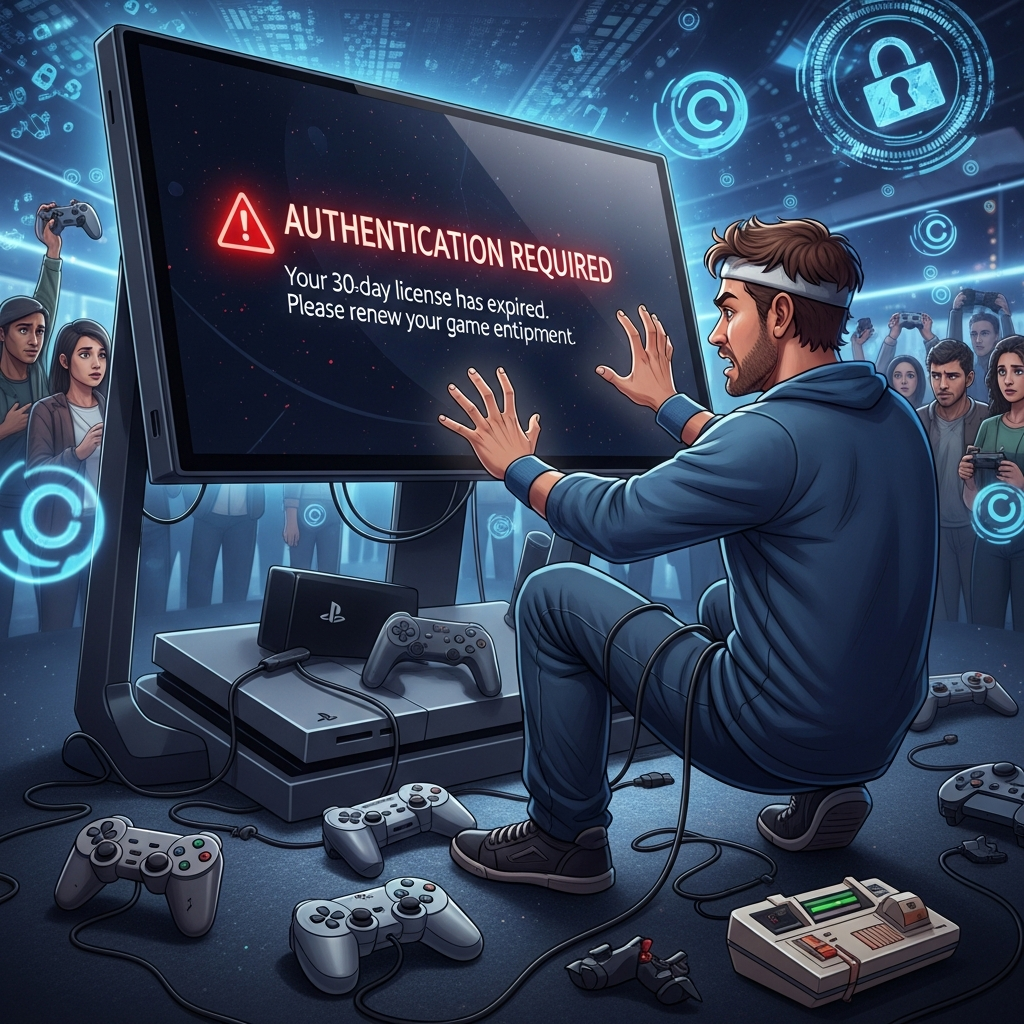
PlayStation's silent introduction of a mandatory 30-day online authentication requirement for digitally purchased games in March 2026 detonated a firestorm across the global gaming community and forced a long-overdue reckoning with how digital ownership actually functions in the modern economy. The incident revealed what has always been legally true but commercially obscured: clicking buy on a digital storefront transfers not ownership but a revocable license of indefinite duration, and the seller retains the ability to restrict or terminate access at any point thereafter. This structural flaw is not confined to gaming—it pervades every corner of the digital economy, from Amazon Kindle libraries to Adobe Creative Cloud subscriptions, and the same catastrophic access-loss scenario applies to all of them equally. On both sides of the Atlantic, legislative responses are accelerating: California AB 2426 took effect in January 2025 requiring transparent license disclosures, the EU Stop Killing Games initiative gathered 1.4 million signatures and earned a favorable parliamentary hearing in April 2026, and France's UFC-Que Choisir filed suit against Ubisoft over The Crew server shutdown. The PlayStation DRM episode stands as a potential inflection point—a moment when the hidden asymmetry of the access economy finally became visible enough to drive structural change, provided consumer attention can outlast the next major game release cycle.
Key Points
The Legal Reality of "Buying" Digital Games: You Own a License, Not a Game
When you click "Buy" on the PlayStation Store and pay $70, every commercial instinct built by centuries of retail experience tells you that ownership is being transferred. The "Buy" button, the price tag, the order confirmation email—all of it speaks the language of property transfer. Buried in the terms of service, however, is language granting you a "limited, non-exclusive, non-transferable license," which is the legal mechanism that transforms what feels like a purchase into something closer to an indefinite-term rental. This is not a Sony-specific quirk—every major digital game platform, including Steam, Epic Games Store, Nintendo eShop, and Microsoft Store, operates under the same license structure. California acknowledged the deceptive gap between commercial presentation and legal reality when it passed AB 2426 in 2024, effective January 1, 2025, prohibiting digital retailers from using "buy" or "purchase" language unless they transparently disclose that the consumer is acquiring a license. A law designed specifically to prevent a form of consumer deception is a legal admission that the deception was real and widespread. The global digital games market reached approximately $188.8 billion in 2025, meaning a market of that scale is built on a structural misrepresentation that most consumers have never had clearly explained to them, and that the industry has historically relied on them not investigating.
The Server Shutdown Time Bomb: Every Digital Library Has a Corporate Expiration Date
Sony's assurances of a "lifetime license" rest entirely on the assumption that PlayStation Network servers will operate indefinitely—an assumption that Sony's own track record directly contradicts. PS Vita and PSP digital stores had their purchasing functions terminated in 2021, and PS3's store survived only because a consumer backlash campaign intense enough to generate mainstream news coverage forced Sony's hand at the last moment. Google shut down Stadia in January 2023 and eliminated users' entire game libraries in the process, offering refunds but providing no mechanism for preserving the games themselves. Ubisoft terminated The Crew's servers in March 2024, making a fully paid-for game completely unplayable and triggering the UFC-Que Choisir lawsuit working through French courts. If the PS5 hardware lifecycle runs the typical 7 to 10 years, server infrastructure decisions will arrive around 2033 to 2036—at which point the digital libraries that millions of consumers have spent hundreds or thousands of dollars assembling will face exactly the same existential question. The DRM market is itself projected to grow from $6.66 billion in 2025 to $20.37 billion by 2034 at a CAGR of 12.78 percent, meaning the industry is investing more heavily in DRM at precisely the moment consumers are most aware of its implications. No amount of "lifetime license" language changes the structural reality that every digital library has a corporate-controlled expiration date.
DRM's Self-Defeating Logic: Pirates Get a Better Product Than Paying Customers
The DRM paradox has never been more starkly illustrated than by Sony's current policy. A consumer who paid full retail price for a digital game cannot access it offline under the authentication requirement, while someone who obtained a cracked version faces no technical restrictions whatsoever. This is not an edge case or a hypothetical—it is the defining failure mode of DRM as a technology, where restriction falls entirely on people who complied with the law and zero percent on those who did not. Independent testing has documented that Denuvo DRM—one of the gaming industry's most aggressive implementations—degrades frame rates by 5 to 15 percent in affected titles, meaning legal buyers receive a technically inferior version of the product compared to what pirates run. PlayStation's DRM controversy has injected new energy and mainstream credibility into the game preservation movement: organizations like the Video Game History Foundation, which have been documenting that 87 percent of classic games are commercially unavailable and arguing these points to small audiences for years, are now receiving increased donations and substantially more public attention. Sony's policy has inadvertently provided the preservation movement its most compelling mainstream argument to date. If legal purchases can be rendered inaccessible while preservation-oriented circumvention makes otherwise dead games playable, the moral alignment of the two positions deserves honest and open examination.
The Digital Economy's Hidden Power Asymmetry
The PlayStation DRM episode is most accurately understood not as a gaming scandal but as a high-visibility manifestation of a structural power imbalance built into the digital economy over the past two decades. When you purchase a physical product, the commercial relationship ends at the point of sale—your bookshelf exists independently of the bookseller's corporate decisions, and no subsequent business development can reach into your home and remove your books. Digital transactions create no such independence: the seller retains the ability to modify, restrict, or revoke access through policy changes, server shutdowns, bankruptcy proceedings, or platform discontinuation, and consumers accepted these terms through service agreements written to protect sellers rather than buyers. Adobe Creative Cloud gives you full creative access while your subscription is active and none when it lapses, even for files you created entirely yourself. Microsoft 365 reduces Office to read-only mode when subscription renewal fails. The gaming industry's version of this asymmetry is simply the most visible because the "buy" language is so explicit and the price points are high enough to produce real financial pain when the arrangement fails. The 2025 digital share of the global games market reached approximately 91 to 95 percent by multiple estimates, meaning the overwhelming majority of games sold worldwide exist under this structure. PlayStation DRM is the moment the asymmetry became impossible for a mainstream audience to overlook or rationalize away.
Regulatory Momentum: EU, California, and France Are All Moving
The regulatory response to the PlayStation DRM controversy is noteworthy because it represents genuine institutional momentum rather than political theater. California AB 2426, effective January 1, 2025, requires digital retailers to transparently disclose license terms when using "buy" or "purchase" language—a law that exists because the California legislature explicitly determined that "a reasonable consumer might interpret [buy/purchase] as conferring full ownership." The Stop Killing Games EU Citizens' Initiative, energized by the Ubisoft/The Crew shutdown, collected 1.4 million verified signatures—surpassing the threshold required for mandatory EU legislative consideration—and secured a European Parliament hearing on April 16, 2026, where every MEP in attendance responded positively. Committee Vice Chair Nils Ušakovs described the issue as "a concern for probably hundreds of millions of European citizens." The EU Commission is legally obligated to issue a formal legislative response by July 27, 2026. France's UFC-Que Choisir has already demonstrated its willingness to litigate these questions by suing Ubisoft over The Crew in March 2026, providing a live court test of the "limited access, not ownership" corporate defense. The EU's Digital Content Directive (2019/770), covering digital goods since January 2022, provides an existing legal framework that strengthened regulation can build on without requiring entirely new legislative architecture. The regulatory environment in 2026 is genuinely different from even three years ago, and the PlayStation DRM controversy has materially accelerated timelines that were already in motion.
Positive & Negative Analysis
Positive Aspects
- The Digital Ownership Debate Goes Mainstream at Last
For years, digital rights advocates, game preservation organizations, and legal scholars had been making the precise arguments now appearing in BBC headlines and Washington Post op-eds—to audiences measured in thousands rather than millions. The PlayStation DRM controversy achieved in a single news cycle what years of patient advocacy could not: it made digital ownership a mass-audience consumer rights story that general-interest outlets treated with the seriousness typically reserved for healthcare or housing debates. Reddit's r/PS5 community generated hundreds of thousands of comments on DRM threads, the #WeOwnNothing hashtag trended globally, and the Stop Killing Games initiative's 1.4 million European signatures reflect the same dynamic at the legislative scale. Mainstream awareness of this issue is a prerequisite for any meaningful regulatory or market-structure change, and PlayStation's miscalculation delivered that awareness faster and more comprehensively than years of methodical advocacy had achieved. The shift in public consciousness that has occurred is not easily reversed—once consumers genuinely understand that "buy" means "license," that knowledge persists beyond the next game release cycle and accumulates into a permanently altered baseline for how people think about their digital spending.
- Physical Media Gets Its Reputation Rehabilitated
One of the more unexpected positive outcomes of the DRM controversy is the genuine revaluation of physical media it has triggered. Secondary market prices for disc-based games have moved upward noticeably since the controversy broke. Limited Run Games and comparable specialty publishers—whose entire business model rests on producing physical editions of games that would otherwise exist only in license-dependent digital form—have reported sales increases directly correlated with the DRM news cycle. The vinyl record industry provides the most instructive parallel: physical music formats exceeded $1.2 billion in annual revenue in 2023, their best performance since 1988, despite the existence of effectively unlimited digital streaming at low monthly cost. The market demonstrates clearly that a meaningful consumer segment will consistently pay a premium for formats conferring genuine, unconditional ownership—formats that don't require server availability, don't depend on subscription maintenance, and don't evaporate when a corporation changes its priorities. This rehabilitation of physical media creates genuine consumer choice that has been eroding steadily for years, and it provides a market-driven counterweight to the gaming industry's consistent pressure toward digital-only hardware configurations at every price point.
- Legislative Pressure Finally Reaches Real Policy-Making Channels
Previous DRM controversies have generated community outrage without translating into binding regulatory response. The current episode is meaningfully different because it is occurring within a legislative environment that has already moved. California AB 2426 is existing law. The EU Stop Killing Games initiative has cleared the signature threshold and received a formally positive parliamentary hearing. France's UFC-Que Choisir has an active lawsuit against Ubisoft working through the courts. The EU Commission faces a July 2026 binding deadline for a formal legislative response. These are not petitions or open letters—they are legal and procedural commitments that create genuine institutional pressure on industry practices regardless of whether any individual outcome succeeds. The engagement of EU Parliament members describing digital game ownership as "a concern for probably hundreds of millions of European citizens" represents a political framing that makes legislative action substantially more viable than it was eighteen months ago. When the people with authority to write the laws describe a consumer protection gap in those terms, the probability of action is meaningfully higher than when gaming advocacy groups make the same argument to audiences that were already convinced.
- Game Preservation Gets the Mainstream Attention It Has Always Deserved
The game preservation movement has operated for years with genuine cultural urgency but limited mainstream recognition. The Video Game History Foundation has documented that 87 percent of classic games are commercially unavailable, making preservation a matter of cultural heritage rather than just enthusiast nostalgia—but that framing had not broken into general-audience awareness. The PlayStation DRM controversy connected the preservation argument to a lived experience of potential loss that mainstream consumers now understand directly and personally: if DRM can prevent you from accessing a game you paid for because of a server dependency, then DRM is actively destroying gaming history in real time, not just threatening abstract future access. Donations to preservation organizations have increased since the controversy broke. GOG's DRM-free model is receiving mainstream gaming coverage as a principled alternative rather than a niche product for specialists. The Library of Congress's DMCA exemption process for game preservation is attracting more public attention than it typically generates. Perhaps most importantly, the conversation has shifted from "why should anyone care about old games" to "why should anyone accept a system that makes games disappear"—a framing that connects preservation directly to contemporary consumer experience rather than requiring historical interest as a precondition.
Concerns
- Gamer Outrage Has a Short Half-Life—And Sony's PR Team Knows It
The most realistic concern is the one gaming history validates most consistently: consumer outrage burns intensely and fades quickly, and the companies targeted by that outrage have learned to manage it rather than substantively respond to it. The Xbox One's always-online DRM requirement in 2013 generated extraordinary backlash that forced Microsoft's hand before launch—but Microsoft's reversal was on their specific policy implementation, not on the underlying license model that governs all digital gaming, and DRM has continued evolving throughout the decade since. Star Wars Battlefront II's loot box controversy in 2017 prompted congressional inquiries and global coverage, and loot boxes remain standard industry practice nine years later. Sony has a clearly legible playbook here: issue a clarifying statement that reframes the specific practice causing maximum outrage—the "one-time check" clarification is already step one—make a minor concession on implementation details if pressure persists, and wait for a major game release to redirect community attention. The cycle has a predictable structure because platforms provide an endless supply of compelling content that competes with policy outrage for finite human attention, and compelling content consistently wins. I put the probability that the fundamental architecture of digital licensing is substantively unchanged two years from now at better than 50 percent despite the current level of engagement.
- The License Model Is the Architecture of the Entire Digital Economy
The deeper structural problem is that the license-based access model is not a gaming industry anomaly—it is the foundational business model of the digital economy across every sector. Netflix, Spotify, Amazon Kindle, Adobe Creative Cloud, Microsoft 365, Google Workspace: collectively these services represent trillions of dollars in annual revenue, and every one of them operates on the same "access, not ownership" principle that Sony's DRM policy made visible in gaming. Changing this model requires not just persuading one company or regulating one industry—it requires confronting the economic architecture that the entire tech sector has built its most profitable businesses around. The ESA alone invests approximately $5 million annually in lobbying, and the broader digital content industry's political influence dwarfs that figure when streaming services, software publishers, and platform operators are included. Regulatory bodies capable of taking on this coalition—primarily the EU—operate on timelines of years to decades, not months. The companies benefiting from the current structure have every financial incentive to fund delay and dilution of reform efforts, and they have demonstrated high effectiveness at deploying those incentives across multiple regulatory battles over the past decade.
- Cross-Border Digital Services Create a Regulatory Patchwork Problem
Even when jurisdictions enact meaningful digital consumer protection legislation, applying those laws effectively to globally operating services presents fundamental enforcement challenges that domestic legislation cannot fully resolve. PlayStation Network operates simultaneously in dozens of countries under different legal frameworks, and strong EU regulation does not automatically improve the situation for users in the United States, Japan, Australia, or the hundreds of millions of PlayStation users in jurisdictions with weaker consumer protection regimes. The GDPR experience is instructive here: Europe's strongest-in-class privacy regulation has produced some global compliance improvements, but it has also resulted in service degradation for European users in cases where platforms chose to restrict functionality rather than adapt their global data practices to meet European standards. Digital consumer protection legislation, however well-designed, risks producing a patchwork outcome where consumers in certain jurisdictions are meaningfully protected while consumers elsewhere remain minimally protected—and where global platforms optimize their service structures around the regulatory minimum applicable in each market rather than adopting a uniform high-standard approach. Genuine solutions require international coordination that the current state of digital trade governance is not equipped to deliver quickly.
- Blockchain Solutions Face a Consumer Trust Wall That May Be Insurmountable
The most technically coherent solution to the server-dependency problem—decentralized authentication that operates without corporate server infrastructure—runs directly into a consumer trust barrier that may be practically insurmountable in the near to medium term. The NFT gaming wave of 2022 to 2023 left the gaming community with an intensely negative association between blockchain technology and predatory monetization: the projects that received the most attention were primarily structured to extract money from participants rather than deliver gaming value, and the resulting backlash was severe enough to create reflexive rejection of blockchain terminology regardless of the specific application. Even if a technically sound decentralized license verification system were developed today—one that genuinely gave consumers verifiable ownership independent of any corporate server—naming it a "blockchain" or "NFT-based" solution would likely doom its adoption prospects in the gaming community. The technology problem may be solvable, but the branding and consumer trust rehabilitation problem is a separate and potentially harder challenge operating on a longer timeline. Publishers also face a fundamental incentive misalignment: adopting technology that enables genuine user ownership directly undermines the subscription and recurring-revenue models that currently drive their most profitable business lines, and no company voluntarily dismantles its most profitable revenue mechanism without being required to do so.
Outlook
Looking at the immediate horizon—the next six months—Sony's response to sustained community pressure is the most directly visible development to track. The company has issued its "one-time check" clarification, but community sentiment remains raw and PlayStation's brand equity has taken measurable damage heading into the PS5 Pro launch window in the second half of 2026. I put the probability of Sony making additional substantive concessions before the end of 2026 at above 60 percent. The most plausible scenarios are extending the authentication cycle to 90 or 180 days, introducing a "legacy mode" for unrestricted offline play, or issuing a formal policy statement that explicitly addresses the server-shutdown access question rather than sidestepping it. The most relevant historical precedent is Microsoft's 2013 reversal: Xbox One's always-online requirement was reversed within weeks of launch once pre-order data made the commercial damage visible, and Microsoft's retreat was complete rather than partial. Sony is aware of that playbook and calculating whether the current pressure warrants a similar response. The PS5 Pro sales timeline does not leave room for prolonged damage to PlayStation's brand reputation.
Meanwhile, the competitive dynamics are going to make this genuinely interesting to observe. Xbox has already been circulating implicit messaging about respecting game ownership on social media, and Nintendo—heading into the Switch 2 launch cycle—has clear market incentive to position itself as the consumer-friendly option on digital rights. I expect the second half of 2026 to see something the gaming industry has not meaningfully experienced before: companies competing on DRM policy as a marketing differentiator. That is a genuinely strange sentence to write, but it accurately reflects how thoroughly this issue has shifted from technical footnote to brand positioning element. Valve has been expanding its DRM-free badge system on Steam since 2024, and Epic Games CEO Tim Sweeney has voiced DRM skepticism publicly on multiple occasions. If Epic Games Store makes an aggressive move toward expanded DRM-free options, Steam faces competitive pressure to respond. When consumer-friendliness on digital ownership becomes a genuine selling point, the market mechanism starts doing the regulatory work that legislation has historically struggled to accomplish.
On the legal and regulatory front, the next twelve months will be substantively active. Class-action preparation is reportedly underway in the United States targeting Sony's DRM policy directly. France's UFC-Que Choisir filed its lawsuit against Ubisoft over The Crew server shutdown in March 2026, providing a live court test of the "limited access, not ownership" corporate defense that the entire industry relies on. EU consumer protection authorities have clear grounds to open formal investigations into Sony's policy under the existing Digital Content Directive. None of these proceedings will produce verdicts quickly, but they function as sustained institutional pressure that constrains corporate behavior even before any ruling is reached. The single most consequential near-term event on the regulatory calendar is the EU Commission's July 27, 2026 deadline for a formal response on legislative intentions regarding Stop Killing Games. If the Commission signals genuine legislative intent, it immediately changes how every major publisher calculates the risk profile of server shutdown and DRM policy decisions. I put the probability of at least one formal legal challenge against Sony over this specific policy at above 80 percent before end-2026.
Moving into the medium-term window of 2026 through 2028, I expect the regulatory environment to begin shifting in substantive ways. The EU's Digital Content Directive (Directive 2019/770), applicable to video games since January 2022, provides an existing legislative foundation that can be strengthened without requiring entirely new legal architecture. The central debates will focus on two specific questions: whether consumers have a legal right to resell digital goods, and whether publishers must provide offline-functional versions when server infrastructure is shut down. I put the probability of the EU enacting meaningful minimum protections for digital game purchasers before end-2027 at 55 to 65 percent. France is the most likely first mover at the national level—UFC-Que Choisir's active lawsuit creates domestic political pressure, and French precedent has historically shaped EU-wide adoption in digital consumer protection contexts. The DMA's second review cycle in early 2027 may add digital content ownership to its scope. In the United States, California AB 2426 is the first substantive legislation, and California consumer protection frameworks have historically propagated to other states and functioned as de facto national standards. The gaming industry's lobbying infrastructure—the ESA alone invests approximately $5 million annually—will fight hard to dilute any legislation, but when the affected constituency numbers in the tens of millions of voters, the political calculus shifts in ways that prior tech policy battles did not face.
The physical media renaissance deserves serious attention as a medium-term market development. Vinyl records generated over $1.2 billion in annual revenue in 2023—their strongest performance in 35 years—demonstrating that a meaningful consumer segment will consistently pay a premium for unconditional ownership even when digital alternatives are cheaper and more convenient. I expect premium DRM-free physical editions—combining guaranteed-offline discs with digital bonus content—to emerge as a standard retail SKU for major releases by 2027, with specialty publishers' model being adopted more broadly by AAA studios responding to ownership-conscious consumers. This market could reasonably reach $1.5 to $2.5 billion annually, small relative to the $188.8 billion global games market but carrying higher margins than standard digital distribution. Blockchain-based digital ownership solutions remain theoretically compelling but face a practically insurmountable consumer sentiment barrier in the near to medium term. The NFT gaming wave of 2022 to 2023 left such intensely toxic residue—primarily from projects structured to extract money rather than deliver gaming value—that even technically superior decentralized licensing solutions face reflexive rejection by association with blockchain terminology. The technology may eventually reach consumers under different branding, but that is a 2029-or-later story at the earliest.
Looking at the longer arc from 2028 through 2031, the bull case carries a probability of approximately 25 percent. In this scenario, effective regulation in both the EU and United States establishes genuine minimum consumer rights: guaranteed offline access to purchased content after server shutdowns, and legal recognition of digital goods resale rights. Decentralized authentication technology matures to the point where license verification operates without corporate server dependency. Roughly 15 to 20 percent of the global digital games market—approximately $28 to $38 billion at 2025 scale—transitions to true ownership models, and game preservation work by organizations like the Video Game History Foundation ceases to be an emergency operation conducted with insufficient resources. The 1.4 million European signatures on Stop Killing Games translate into binding legislation establishing a new international baseline. Companies moving early to adopt genuine ownership models gain first-mover competitive advantage, and the industry's transition toward authentic digital ownership becomes self-reinforcing once critical mass is reached. In this scenario, PlayStation DRM is remembered as the catalyst that started the shift rather than the cautionary example of what was never corrected.
The base case carries a probability of approximately 50 percent. Partial regulatory action achieves meaningful but incomplete progress: the EU mandates offline access preservation for a minimum of three to five years post-shutdown, but full resale rights do not materialize within the legislative window. US regulation remains fragmented at the state level, with California's framework failing to propagate to a federal standard before 2030. Publishers adopt more consumer-friendly DRM policies as competitive differentiation without structural change to the underlying license model. Physical media stabilizes as a niche at roughly 8 to 12 percent of the market, serving an ownership-conscious consumer segment but not returning to mainstream prominence. Consumer awareness improves dramatically—the "digital buy means permanent ownership" illusion is permanently shattered across the mainstream user base—but most consumers ultimately accept the convenience-for-rights trade-off and continue using license-based platforms because switching costs and sunk-cost library investments make migration too painful in practice. The access economy continues operating, but with greater transparency and modestly more protective contractual terms for consumers who know to ask for them.
The bear case carries a probability of approximately 25 percent, and I find it most concerning precisely because it is the most historically consistent with how these cycles have resolved. The controversy fades with the news cycle, regulatory action is effectively neutralized by sustained industry lobbying, and Sony's authentication model becomes the industry baseline rather than the cautionary example. Xbox and Nintendo adopt analogous verification systems over the following years. Physical media's market share falls below 5 percent by 2030 as digital-only hardware configurations become the price-competitive default for mainstream consumers. The access economy completes its colonization of digital goods, and "you own nothing" transitions from a consumer rights critique to a neutral description of standard commercial practice. This outcome is most troubling because it does not stop at gaming—it validates across the entire digital economy the principle that payment entitles consumers to access rather than ownership, and regulatory bodies failed to establish any meaningful counterweight during the window when consumer sentiment was most activated and most potentially effective.
One counterargument deserves direct engagement: most PlayStation users are always online, so 30-day authentication creates minimal practical friction. The data supports this premise—approximately 85 percent of PS5 users maintain consistent internet connectivity during gaming sessions, making the immediate technical inconvenience real but minor for the majority. But I think this argument mistakes current-conditions comfort for structural rights, and it is structurally identical to the argument Sony will employ when it eventually retires PS5 server infrastructure. The question is not whether the authentication requirement is inconvenient today—it is whether you will have access to your library in 2033 when Sony decides to prioritize the next console generation's infrastructure over backward compatibility. "It worked fine while the servers were up" will not be useful when a library representing hundreds or thousands of dollars in accumulated purchases ceases to exist. Present-tense convenience does not address future-tense loss, and every digital library has a corporate-controlled future that its current owner cannot influence or predict.
The cascade of consequences this story sets in motion extends well beyond gaming and well beyond the current news cycle. First-order effects are already visible: tens of millions of consumers are confronting the structural reality that digital "purchases" function as revocable licenses. Second-order effects will follow as the same question—"do I actually own what I paid for?"—surfaces in music, film, ebooks, professional software, and productivity tools with renewed urgency and a gaming precedent to reference. Third-order effects translate consumer activation into legislative pressure across multiple sectors simultaneously. Fourth-order effects reshape industry incentives as companies credibly positioned on genuine ownership rights gain competitive advantage, generating market pressure for structural change independent of regulatory action. The first domino has fallen. My practical recommendation is direct: choose physical media when the option exists, use DRM-free platforms like GOG actively and consciously, mentally classify every digital "purchase" as a long-term rental when making spending decisions, and engage with digital consumer protection legislation in your jurisdiction when it comes up for public comment or vote. Consumer pressure can meaningfully shape the terms of the access economy right now. The window for that influence will not remain open indefinitely, and what we decide—as consumers, as voters, as participants in digital culture—in this specific moment will define the rules for a very long time.
Sources / References
- PlayStation Fans Panic Over Sony's Ridiculous New 30-Day License Check — TechRadar
- "I Paid for It" — PlayStation's License Renewal Policy Controversy — Inven Global
- Sony PlayStation DRM Policy Explained — TechWiser
- PlayStation Users Report New Online License Checks for Digital Games — GameSpot
- Sony Responds to PlayStation Online License Check Controversy — CBR
- PlayStation's New DRM Policy Might Lock You Out of Your Games — 80 Level
- Sony Sets the Record Straight on PlayStation DRM: A One-Time Online Check Is Required — Kotaku
- Sony Rolls Out 30-Day Online DRM Check-In for PlayStation Digital Games — Tom's Hardware
- Stop Killing Games Gets Its EU Parliament Hearing — Techdirt
- California's New Digital Content Law AB 2426: What You Need to Know — Morrison Foerster