
When 15 Minutes of Silence Is the Loudest Protest You Can Make, Who Does Tennis Actually Belong To?
Summary
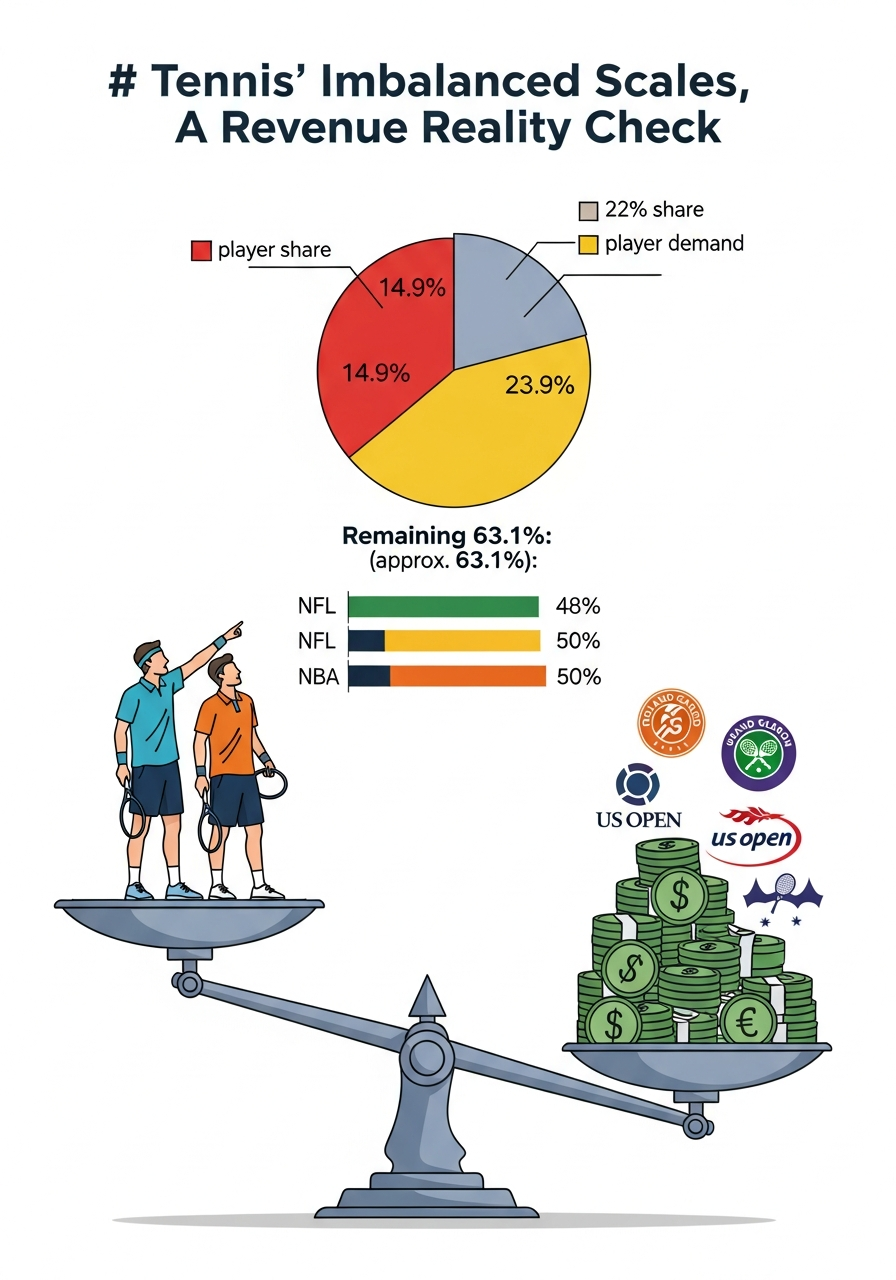
At Roland Garros 2026, three simultaneous events laid bare the structural power imbalances that have defined professional tennis for over half a century. World number one Jannik Sinner received a medical timeout for cramping — a condition the sport's own rulebook explicitly excludes from injury protections — triggering on-air criticism from former Grand Slam champion Jim Courier and reopening a debate about whether the sport applies its rules equally across all ranking levels. In parallel, top players coordinated a 15-minute media blackout to protest prize money that constitutes just 14.9% of Roland Garros's approximately 395 million euros in annual revenue, far below their demand of 22% and vastly below the 48% and 50% revenue shares that NFL and NBA players routinely receive. The Professional Tennis Players Association simultaneously pressed forward with an antitrust lawsuit targeting the ATP, WTA, ITF, and all four Grand Slam tournaments — the first time in tennis history that players have formally reached for a legal instrument to challenge the sport's fragmented, multi-body governance structure. Taken together, these three events are not isolated controversies but simultaneous fractures in a system where the athletes who generate the product hold the least decision-making power — and this analysis argues that resolving this imbalance requires structural reform far beyond any incremental prize money adjustment.
Key Points
Cramping Timeout and the Selective Application of Tennis Rules
The controversy at the heart of Sinner's five-set loss to Cerundolo wasn't the match result — it was that the world's top-ranked player received a medical timeout for cramping, a condition the sport's own rulebook explicitly excludes from injury classifications that qualify for timeout treatment. Former Grand Slam champion Jim Courier stated on live broadcast that the ruling was incorrect, representing not just a commentator's opinion but an on-air acknowledgment from someone deeply embedded in the sport that the call conflicted with written procedure. The structural implication is more troubling than any individual bad call: the real question isn't whether the chair umpire made a good-faith error, but whether the system governing these decisions carries an embedded bias toward protecting the sport's highest-profile performers at the expense of consistent rule application. If a player ranked 80th in the world had presented with identical symptoms in the same match situation, the probability of receiving the same timeout is substantially lower — not because the rules would be different, but because the informal signals and institutional incentives surrounding enforcement would be pointing in a different direction. That structural bias, operating beneath the level of any explicit policy, is precisely the kind of problem that's hardest to address because it isn't written anywhere and doesn't require anyone to consciously choose unfairness. Consistent rule enforcement regardless of ranking is a foundational condition for competitive integrity, and this incident raises serious questions about whether that condition is reliably being met at the sport's highest level.
Revenue Share at 14.9% and Professional Sports' Lowest Labor Distribution
The prize money figures at Roland Garros — 14.9% of approximately 395 million euros in annual revenue flowing to players — represent the lowest labor share in any major professional sport, and understanding why requires examining what's absent from tennis that exists everywhere else. The NFL distributes approximately 48% of league revenue to players, the NBA distributes roughly 50%, and Major League Baseball maintains a share well above 40%. According to the Michigan Journal of Economics analysis published in May 2026, the difference between tennis and these leagues is not primarily a function of market size or global reach — it's a direct function of the presence or absence of a genuine labor organization with collective bargaining authority and the legal ability to call a work stoppage. The players' demand of 22% — still less than half of what NFL players receive — is not a radical position by any comparative standard; it's a relatively modest request that would still leave tennis as the sport with the lowest player revenue share among major professional leagues. At Roland Garros's current revenue base, moving from 14.9% to 22% would increase the total prize pool from approximately 59 million euros to approximately 87 million euros, with the largest proportional benefit accruing to lower-ranked players — a first-round loser's check rising from roughly 70,000 euros to over 100,000 euros would meaningfully change the economic viability of a professional tennis career for hundreds of players currently operating near financial margin. The 14.9% isn't a market outcome. It's what happens when labor lacks genuine bargaining power.
The PTPA Antitrust Lawsuit: Historical Significance and Legal Stakes
The Professional Tennis Players Association's antitrust suit against the ATP, WTA, ITF, and all four Grand Slam tournaments is the first time in the sport's history that players have deployed formal legal mechanisms to challenge the governance structures controlling their economic conditions, and the scope of the filing reflects how comprehensive the structural critique has become. According to the Harvard Law School analysis, the core legal argument is that the four Grand Slam organizations operate as a collective market-controlling entity — independently run on paper but effectively coordinating to suppress player compensation and exclude meaningful player representation from governance decisions — in ways that constitute anticompetitive behavior under federal antitrust law. If the case advances to substantive proceedings and produces even a partial finding in the players' favor, the precedent would extend well beyond tennis, establishing a framework under which individual-sport athletes in other disciplines could challenge similar governance arrangements. The closest historical analogy is Curt Flood's 1970 antitrust challenge to Major League Baseball's reserve clause — a suit he personally lost, but which set in motion the legal and organizing developments that produced free agency in 1976, a six-year arc from one principled lawsuit to a structural transformation of an entire sport's labor relations. The time asymmetry of litigation is a real risk — the case will proceed on a timeline that may outlast the careers of the players who filed it — but the Miller Johnson sports law analysis suggests the structural claims are legally substantive enough that early dismissal is far from a foregone conclusion.
Structural Limits on Player Protest in an Individual Sport
The most clarifying fact about the current state of tennis labor relations is that the maximum collective action the sport's top players could organize at Roland Garros 2026 was a 15-minute media blackout — and understanding why reveals the full depth of the structural problem. In team sports with union structures, the credible threat of a work stoppage is the foundational source of player bargaining power; the threat doesn't have to be exercised to be effective, it just has to be real enough that institutional decision-makers factor it into their calculations. In tennis, no equivalent threat exists in any practical sense, because the individual sport structure means each player bears the complete personal cost of any tournament boycott — lost prize money, lost ranking points, lost competitive positioning — with no institutional mechanism to distribute that cost across a player coalition. This creates a classic prisoner's dilemma: the rational strategy for each individual is to participate in low-cost protests and to defect when personal costs rise, even if everyone would collectively benefit from sustained high-cost action. The 1973 Wimbledon boycott escaped this dilemma through exceptional circumstances — a specific unified target, leadership willing to absorb personal costs for structural outcomes, and a moment when institutional alternatives were sufficiently limited that players had less to lose than usual. Recreating those conditions in 2026, with current prize money levels and the ranking system creating much stronger individual incentives to keep competing, requires a degree of structural coordination that no existing player organization is currently positioned to guarantee.
Tennis Governance Fragmentation and Its Effect on Player Leverage
Tennis is operated through a governance architecture nearly unique in professional sports: four independently run Grand Slam tournaments — Roland Garros, Wimbledon, the US Open, and the Australian Open — each controlled by different national organizations in different countries, alongside a separate ATP men's tour, a separate WTA women's tour, and an ITF holding nominal overarching authority with limited practical enforcement power. This structure creates what is, from the players' perspective, a negotiation maze: achieving a collective agreement that binds all major tournament operators simultaneously requires reaching separate agreements with at least six distinct governance entities, each with strong incentives to preserve its own independence and each capable of undermining any deal struck with the others simply by declining to participate. In the NFL and NBA, one round of collective bargaining with a single league entity produces binding conditions across the entire system — it's one counterparty, one agreement, one set of rules that applies in every game. Tennis players effectively have to fight the same structural campaign four or five times over, in different jurisdictions, against different organizational cultures, with different amounts of leverage at each table. The PTPA's antitrust argument essentially contends that this structural fragmentation, while appearing to involve many independent actors, functions in practice as a coordinated suppression of player bargaining power — an arrangement that should be recognized as anticompetitive regardless of whether the tournament organizations explicitly coordinate with each other. Until that governance architecture is either consolidated or legally reformed, player leverage in tennis will remain structurally constrained in ways that social media campaigns and media blackouts alone cannot fully overcome.
Positive & Negative Analysis
Positive Aspects
- PTPA Antitrust Lawsuit Potential to Create Legal Precedent
The PTPA's decision to pursue antitrust litigation against tennis's major governing bodies represents the single most consequential strategic escalation in the history of player advocacy within the sport. Unlike protest actions, which depend on sustained collective will and dissipate when players return their attention to competing, a filed lawsuit advances on its own procedural timeline — court dates, discovery obligations, and legal briefings don't require ongoing player activism to keep the pressure alive. Harvard Law School's published analysis assesses the legal theory as substantive rather than frivolous, suggesting that courts examining the actual governance arrangements between the Grand Slams and the player tours could find anticompetitive elements that warrant legal remedy. If the case produces even a partial ruling in the players' favor, the precedent would extend to other individual sports with similarly fragmented governance structures, potentially opening antitrust challenges in golf, cycling, and other disciplines where athletes face comparable labor conditions. The strategic value of the lawsuit is present even if it ultimately fails — the cost, distraction, and reputational exposure it creates for tournament organizations constitutes a form of ongoing negotiating pressure that shapes private settlement discussions well before any court renders a final judgment.
- Historic Cross-Gender Player Solidarity at Roland Garros
One of the most significant developments at Roland Garros 2026, which has received less attention than it deserves, is that ATP and WTA players stood together in the media protest under a unified message about overall revenue share. Historically, prize money discussions in tennis have fractured along gender lines because the conversation typically gets organized around equal pay between men and women — a framing that puts the two player groups in potential conflict over the same pool of money rather than focusing on the total allocation going to all players combined. By reframing the issue as the overall player share being too low regardless of how it's internally divided, the 2026 protest effectively neutralized that traditional fracture point and created space for a coalition that both tours can sustain simultaneously. If that cross-gender solidarity evolves from a one-tournament moment into a durable strategic alliance — with ATP and WTA negotiators presenting coordinated demands to Grand Slam operators — the combined player weight would be qualitatively more powerful than either organization could exert independently. I think this is the most undervalued positive signal from the entire Roland Garros episode, because it addresses the coalition fragmentation problem from the player side in a way that individual-tour actions can never fully achieve.
- Social Media as a Direct-to-Fan Advocacy Channel
The asymmetry between player communication capacity in 1973 and 2026 is genuinely significant for assessing the prospects of the current movement. When 81 players boycotted Wimbledon in 1973, getting their message to a mass audience required convincing journalists to cover the story — a process dependent on editorial gatekeepers who could frame, ignore, or contextualize player grievances in ways that served existing power arrangements. Today, a single Instagram post from Djokovic reaches tens of millions of followers directly, bypassing every traditional media filter and creating immediate public framing that previously required weeks of press access and careful relationship management. ESPN's decision to publish a piece directly addressing whether a boycott was necessary — an unusually pointed framing for a sports media outlet with significant commercial relationships with tournament operators — reflects how social media-driven player narratives have changed the calculus of sports journalism itself. Used strategically and consistently rather than through occasional individual posts between matches, the social media communication channel available to top tennis players constitutes a genuine asymmetric advantage against institutions that have historically benefited from their ability to control how labor disputes get framed in public.
- Labor Rights Framing Expanding Public and Academic Awareness
One of the structural shifts that could prove most consequential over the long term is the reframing of tennis prize money disputes from "wealthy athletes complaining" to "sports labor rights" — a framing that attracts different allies, creates different political dynamics, and generates different kinds of institutional pressure. Once academic institutions begin treating a topic as a serious research question — as evidenced by the Michigan Journal of Economics analysis comparing tennis revenue distribution to NFL, NBA, and MLB labor structures — the legitimacy of the underlying argument gets a credentialing that protest actions alone cannot produce. The labor rights framing also connects tennis's specific disputes to broader conversations about athlete compensation, collegiate sports, and the economic structure of entertainment industries, drawing in advocacy communities and policy commentators who wouldn't otherwise have an entry point to tennis debates. Tennis prize money discussions framed as labor rights issues travel across different media ecosystems — from sports coverage into economics journalism, labor advocacy networks, and policy commentary — in ways that straightforward sports controversy simply cannot sustain over time. This expanded conversation creates ambient public pressure on Grand Slam operators that persists independent of what any individual player chooses to say or do at any particular tournament.
- Financial Transparency Becoming a Legitimate Public Issue
For the first time in the sport's history, the specific percentage of Grand Slam revenue flowing to players — 14.9% — has become a number that the general sports public knows and actively debates. Until recently, the financial structures of Grand Slam tournaments were largely opaque, with revenue figures rarely disclosed in meaningful detail and prize money presented in absolute terms rather than as a fraction of total income. Players' ability to cite a specific percentage and compare it directly to NFL and NBA standards transformed what had been a vague sense of unfairness into a concrete, empirically disputable claim — a crucial shift in any public advocacy campaign. The transparency that players are demanding and that some academic and journalistic sources are now providing creates an accountability standard that Grand Slam operators cannot easily walk back: once the 14.9% figure circulates widely, any future prize money announcement will be evaluated against the percentage, not just the nominal amount. This means even a nominally generous-seeming prize money increase will be assessed publicly for whether it actually improves players' structural share, creating persistent external monitoring pressure that simply didn't exist before 2026.
Concerns
- Individual Sport Structure's Fundamental Collective Action Problem
The deepest structural obstacle facing tennis player advocates is one that no organizing sophistication can fully dissolve: professional tennis is an individual sport, and that structural reality creates a prisoner's dilemma that makes sustained, high-cost collective action nearly impossible to maintain over time. In team sports, striking players receive implicit support from teammates, contracts protect them from being replaced during work stoppages, and the union absorbs legal and financial risks that would otherwise fall on individuals. Tennis players operate entirely alone — one player boycotting a Grand Slam tournament personally forfeits their own prize money, ranking points, competitive standing, and sponsor visibility, with zero compensation or collective support from any external structure. The rational individual calculation therefore points consistently toward participating in low-cost symbolic protests when coalition solidarity is high, and toward quietly competing when personal stakes rise, even if the player individually agrees that sustained collective action is the structurally correct strategy. This dynamic is not a failure of player character or commitment — it's a mathematically predictable outcome of the incentive structure, and it means any call for tournament boycotts faces structural headwinds that are essentially impossible to overcome through inspiration or moral appeal alone.
- Short Career Spans Creating Structural Disadvantage in Long-Term Fights
Professional tennis players operate under a time constraint that doesn't apply to the institutions they're challenging: the average elite competitive career spans roughly 10 to 15 years, with the highest-impact years for ranking and earnings often concentrated in a 5- to 8-year window. Antitrust litigation takes years to reach substantive proceedings. Governance reform requires sustained political pressure across multiple negotiating cycles. The structural changes player advocates are seeking almost certainly operate on a timeline that will outlast the competitive careers of the players currently driving the effort — Djokovic, the PTPA's most prominent champion, is already 39 years old. This creates a time asymmetry that systematically favors the institutional side: Grand Slam operators can adopt a waiting strategy, counting on player leadership to eventually age out of competition while the next generation hasn't yet built the organizing relationships or institutional knowledge to continue the fight at the same intensity. Structurally overcoming this asymmetry requires either unusually rapid legal outcomes or the creation of permanent player organizing institutions that survive individual career cycles — a far harder goal than any single protest or lawsuit can achieve on its own.
- Divergent Economic Interests Between Top-Ranked and Lower-Ranked Players
The player coalition faces an internal fracture line that becomes increasingly destabilizing as concrete concessions come onto the negotiating table: the economic interests of the world's top 20 to 30 players and the interests of players ranked 100 and beyond point in structurally different directions. Top-ranked players earn the majority of their income from sponsorships, exhibition events, and appearance fees rather than prize money — for Sinner or Alcaraz, a Grand Slam title is primarily about ranking, marketing value, and competitive legacy, not the prize check. For a player ranked 150th, a first-round Grand Slam exit represents a check that may cover a month or two of training, travel, and living expenses — prize money is effectively their primary professional income, and a 30% increase in first-round payments is a matter of career viability rather than a bonus. When real money starts appearing on the negotiating table, top players may find themselves more interested in governance participation and scheduling autonomy while lower-ranked players push for immediate prize money increases at the bottom of the draw, and an opposing institution skilled at divide-and-conquer can offer selective concessions that satisfy enough of either group to fracture the coalition beyond repair. Historical sports labor movement scholarship consistently identifies internal interest fragmentation as a more frequent cause of movement failure than direct institutional opposition.
- Four Independent Grand Slams Creating a Multi-Front Negotiation Battle
The governance fragmentation that makes collective bargaining difficult for players doesn't just complicate the math of negotiation — it creates a situation where even successful agreements provide incomplete protection. If players reach a favorable revenue-sharing arrangement with Roland Garros after sustained pressure, Wimbledon retains the legal right to maintain its existing allocation structure without any obligation to match Paris terms. If pressure then shifts to Wimbledon, the Australian Open and the US Open can each point to their own independent governance structures to delay or avoid equivalent agreements. This means players effectively have to fight four separate, sequential campaigns against four distinct institutional cultures in four different countries, each with its own legal jurisdiction — a logistical and coalition-sustaining challenge that is enormously more demanding than the single-counterparty negotiations characterizing team sport labor relations. Grand Slam operators can individually claim to be engaging constructively while collectively the four organizations maintain a low-wage equilibrium that none of them has to publicly defend as a coordinated policy. This is precisely the anticompetitive arrangement the PTPA lawsuit challenges, but proving and remedying it through litigation is a process entirely outside the players' control to accelerate.
- Risk of Losing Movement Momentum Through Extended Litigation
Antitrust litigation is inherently slow, and the timeline mismatch between legal process and athletic career creates specific risks for a player movement that has staked significant credibility on the lawsuit as a strategic centerpiece. If the case is dismissed at the pleading stage or produces no meaningful interim relief for multiple years, the public narrative around the PTPA's challenge risks shifting from "bold structural reform attempt" to "expensive distraction" — a framing that erodes coalition morale and makes it harder to recruit active support from players weighing the costs of association with a losing effort. The historical pattern in sports labor movements shows that momentum is fragile: the 1973 boycott succeeded partly because it produced visible, immediate institutional results within a tight time window. The PTPA lawsuit operates on a five-to-ten-year timeline with no guaranteed results at any intermediate point, and the players who need structural change most urgently — those at the lower end of the ranking operating near financial viability — are the least positioned to wait for a court ruling before their circumstances improve. If the lawsuit's eventual outcome arrives after current player leadership has retired and before a new generation of leadership has fully committed to continuing the fight, tennis may find itself exactly where it started, without the organizational infrastructure to mount another challenge of comparable scope.
Outlook
These three events could easily be framed as a Roland Garros news cycle — a rule call controversy, players unhappy about money, a lawsuit ticking in the background — and forgotten by Wimbledon fortnight. I think that's the less likely outcome, and here's why. For the first time in tennis history, the player movement has three separate mechanisms operating simultaneously: a legal instrument in the PTPA antitrust lawsuit that advances on its own procedural timeline independent of player unity, an organizational instrument in coordinated media protests that has now demonstrated it generates substantial press coverage, and a direct communication channel via social media that bypasses traditional media gatekeeping entirely. Previous player uprisings typically had one of these operating at a time. The 1973 boycott had organizational action but neither a legal instrument nor social media. The 2026 situation has all three running in parallel, and that combination is qualitatively different from anything that's come before in this sport's labor history.
In the short term, the first real indicator will be Wimbledon 2026. Roland Garros's media blackout successfully generated substantial international coverage and public sympathy, which means players have now proven to themselves that coordinated action produces at least visibility — a meaningful first step. The question is whether they escalate the form of protest. Wimbledon presents a specific challenge: the All England Club is historically the most conservative of the Grand Slams, its traditions carry cultural weight that makes protests there riskier in terms of public perception, and its commercial brand image is carefully managed in ways that make institutional confrontation costly for players as well as administrators. I put the probability of players escalating beyond a 15-minute media blackout at Wimbledon — moving toward something like longer organized media withdrawal, visible protest armbands, or delayed court entry — at roughly 40%. If that escalation happens, the story shifts from "players unhappy about money" to "tennis labor dispute," forcing a different kind of institutional response. If players hold at the Roland Garros level, Grand Slams will likely respond with sympathetic listening language while changing nothing of substance.
The period through the US Open represents what I'd call the first genuine inflection point. If both Wimbledon and the US Open see sustained, coordinated player action in succession, the narrative hardens from "temporary frustration" into "structural demand" — a crucial shift in how both media and institutional stakeholders frame what's happening. The PTPA lawsuit will also be in its early procedural stages by this point, generating court filings and legal analysis that keep the structural critique in circulation independent of what happens on court. I estimate the probability of Grand Slam leadership opening some form of official dialogue channel with player representatives by the end of 2026 at roughly 55%. Historically, institutions in sports labor disputes open dialogue channels as a defensive move to buy time and de-escalate public pressure — not as genuine signals of willingness to concede. But a formal dialogue channel is itself a player tactical victory, because it establishes the foundational premise that players have legitimate negotiating standing, and that premise, once established, is very hard to walk back. The most critical variable in this window is whether the top ten players maintain a unified public position throughout.
The medium term plays out differently depending on PTPA litigation progress. If the case advances to substantive proceedings in 2027, courts will begin examining whether tennis's multi-body governance structure constitutes an anticompetitive arrangement — a serious legal threshold that would impose meaningful liability risk on the tournament organizations. I estimate that one or two Grand Slams will make preemptive prize money concessions at this stage, raising player share to roughly 16 to 18 percent, with about 45% probability. These won't be structural reforms — they'll be liability management decisions designed to reduce legal exposure. But incremental improvements create momentum. The relevant historical parallel is Curt Flood's 1970 antitrust suit against Major League Baseball, which led to the creation of free agency in 1976 — a six-year arc. Tennis could follow a similar timeline, though the real-time public opinion environment of 2026 and the higher sports-labor-rights consciousness among younger fans could meaningfully accelerate the process compared to what was possible in the 1970s.
Between 2027 and 2028 lies the most consequential decision node in the entire arc. If the PTPA case produces even a partial ruling in favor of players — a judicial finding that tennis governance creates anticompetitive conditions — the Grand Slam organizations will face a legally binding obligation to engage in something resembling formal collective bargaining with player representatives. I put the probability of this outcome at roughly 35%. That's not a majority scenario, but it represents a genuine possibility rather than a longshot, and if it materializes it would constitute the single largest structural change in tennis since the ATP's creation in 1972. The simultaneous risk in this window is internal coalition fracture: the interests of top-30 players diverge structurally from those of players ranked 100 and beyond, since top players earn far more from sponsorships than prize money while lower-ranked players depend on prize money as their primary income. When real concessions appear on the table, opposing institutions will actively exploit these fault lines, and history shows that internal fragmentation ends labor movements more reliably than external institutional resistance.
Looking further ahead to 2028 and beyond, the most probable long-term outcome is a tennis prize money share that gradually reaches the 18 to 22 percent range. That remains well below NFL or NBA levels, but a jump from 14.9% to 30% in one step is structurally unrealistic given the institutional resistance and governance fragmentation. The realistic path is incremental, with the first meaningful benchmark landing around 18%. At Roland Garros's current revenue level of roughly 395 million euros, this translates to the total player prize pool growing from approximately 59 million euros today to somewhere between 71 million and 87 million euros. That difference is genuinely material for players ranked below the top 50 — a first-round loser's check increasing from approximately 70,000 euros to over 100,000 euros doesn't just change a number, it changes whether professional tennis is a viable career path for players ranked between 100 and 200. The sport's long-term depth and competitive diversity depends on that economic viability existing outside the top handful of global stars.
From 2029 to 2031, the most significant potential development isn't prize money percentages — it's governance architecture. Tennis is nearly unique among major professional sports in having four independently operated Grand Slams with no coordinating obligation. Every other sport that meaningfully improved player compensation did so through consolidation of the bargaining structure: one league, one union, one negotiation. The NBA's 1976 ABA merger created the unified framework that eventually produced stable collective bargaining and a more equitable revenue split. Tennis needs an equivalent structural moment to achieve similar results. I estimate the probability of all four Grand Slams agreeing to a common revenue-sharing framework within five years at roughly 30%. If it happens, the governance landscape transforms permanently and player leverage increases across all future negotiations. If it doesn't, player dissatisfaction becomes a chronic condition, and five years from now the same 15-minute media blackout will be happening at the same tournament with the same numbers being debated in the same press conferences.
Here is how I score the full scenario landscape. The bull case — PTPA wins partial antitrust relief, Grand Slam prize share reaches 20% or above by 2028, and formal player representation in governance gets institutionalized — carries roughly 25% probability. The base case — litigation extends while Grand Slams make incremental prize money concessions into the 16 to 18 percent range, with governance structure staying fundamentally intact — gets about 50%. The bear case — the lawsuit gets dismissed or the player coalition fractures internally, prize share remains at 15 to 16 percent, and movement momentum dissipates — carries roughly 25% probability. No realistic scenario has tennis reaching NFL or NBA revenue distribution levels within this decade, because the structural preconditions simply don't exist yet. The single variable I'd watch more than any other isn't the prize money percentage — it's whether a formal collective bargaining framework with legal standing gets established. Without that framework, every improvement is an institution's gift, revocable at will. With it, even a modest percentage improvement becomes a structural floor that compounds over time. My overall assessment: by 2031, tennis players will have crossed 18% revenue share, and some recognized form of collective player representation in governance will exist. When that happens, the 15 minutes of silence at Roland Garros 2026 will be recorded as the moment this particular clock started.
Sources / References
- Sinner upset by Cerundolo after controversial cramping timeout — Yahoo Sports
- Jim Courier on Sinner physical collapse at Roland Garros — Tennis365
- Top players united in disappointment over Roland Garros prize money — Tennis Majors
- French Open players plan media protest over prize money share — ESPN
- Boycott needed over prize share issue — ESPN
- Beyond the Baseline: The Economics of Tennis Revenue Sharing — Michigan Journal of Economics
- Is an antitrust suit against top tennis organizations a grand slam or an unforced error? — Harvard Law School
- Breaking down the players' media protest at Roland Garros — Sports Illustrated