
104 Matches, 48 Nations — and Haitian Fans Can't Even Get In: The World Cup's Two Faces
Summary
The 2026 FIFA World Cup, set to open on June 11 across the United States, Canada, and Mexico, marks the most expansive tournament in the event's 96-year history — 48 nations, 104 matches, and 16 host cities spread across a single continent. For the first time, nations including Curaçao, Cape Verde, Uzbekistan, and Jordan will take the world's biggest football stage, representing genuine geographic expansion after decades of European and South American dominance. Yet the same tournament faces mounting scrutiny over U.S. travel restrictions affecting 75 countries, which have left fans from Haiti, Iran, and several other qualified nations structurally unable to attend their teams' matches in person, placing FIFA's long-standing "Football for All" ethos under direct challenge. More than 174,000 people in the Netherlands alone have signed a boycott petition, though the historical record shows no World Cup participating nation has ever successfully withdrawn from the tournament. This article examines the three-way collision of format expansion, political exclusion, and a $10.9 billion revenue ambition that makes this the most contested World Cup in the modern era. **카테고리**: sports
Key Points
From 32 to 48 — The Match Count Jumps from 64 to 104, Nearly Doubling the Tournament
This is the most fundamental structural change in the 2026 World Cup, and it deserves careful analysis rather than simple celebration or reflexive criticism. The expansion from 32 to 48 participating nations means the total match count rises from the 64 games seen at Qatar 2022 to 104 games spread across 16 cities in three countries over approximately five weeks. That is a 63% increase in the number of matches, and every one of those additional matches generates proportional increases in broadcast rights fees, ticket revenues, and sponsorship exposure. FIFA is projecting overall revenues of roughly $10.9 billion from this tournament — a 56% jump from the previous cycle — and the architecture of that revenue growth runs directly through the expanded format. I believe the expansion was fundamentally a commercial decision that found an available inclusion narrative, not an inclusion decision that happened to generate commercial upside. The distinction matters because it shapes how we evaluate the trade-offs. When you frame it as commercial logic, the question of what gets sacrificed — competitive quality, fan access, player welfare — becomes easier to see clearly. The 48-team format was approved by FIFA in 2017, overriding concerns from coaches and players alike. It also has irreversible political momentum: the new qualifying spots granted to Africa, Asia, and smaller confederations mean those federations' member nations and their votes in FIFA's governance structure now depend on maintaining the expanded format. I view a return to 32 teams as essentially impossible regardless of how the 2026 experiment performs.
Curaçao, Cape Verde, Uzbekistan, Jordan — Four Nations Make Their World Cup Debuts
The four first-time qualifying nations represent the most genuinely compelling case for the 48-team expansion, and I want to engage with it honestly rather than dismissing it as a talking point. Curaçao is the smallest nation by both area and population ever to qualify for the men's World Cup — a Caribbean island of approximately 150,000 people with a football culture rooted in its Dutch colonial history and shaped by its proximity to Venezuela and the broader Caribbean diaspora. Uzbekistan has been a FIFA member since 1994, meaning the country waited 34 years through the post-Soviet era to see its national team compete at this level. Cape Verde qualified by finishing first in their African group, defeating Cameroon — a nation with five World Cup appearances — in the process. Jordan makes its debut as the highest-profile qualifier from the Western Asian region. The simple fact of these nations standing on the same competitive platform as Argentina, France, and Brazil creates stories that no amount of corporate promotion can manufacture, because they come from the actual histories of the people involved. I believe this is the strongest genuine argument for the expansion: it creates legitimacy pathways for football traditions that existed and developed entirely outside the global spotlight. The critical test is whether these nations can compete meaningfully rather than serve as exercises in scoreboard management. If even one of them advances from the group stage, the case for inclusion grows significantly stronger.
75-Country Travel Restrictions — Fans from Haiti and Iran Can't Get to the Games
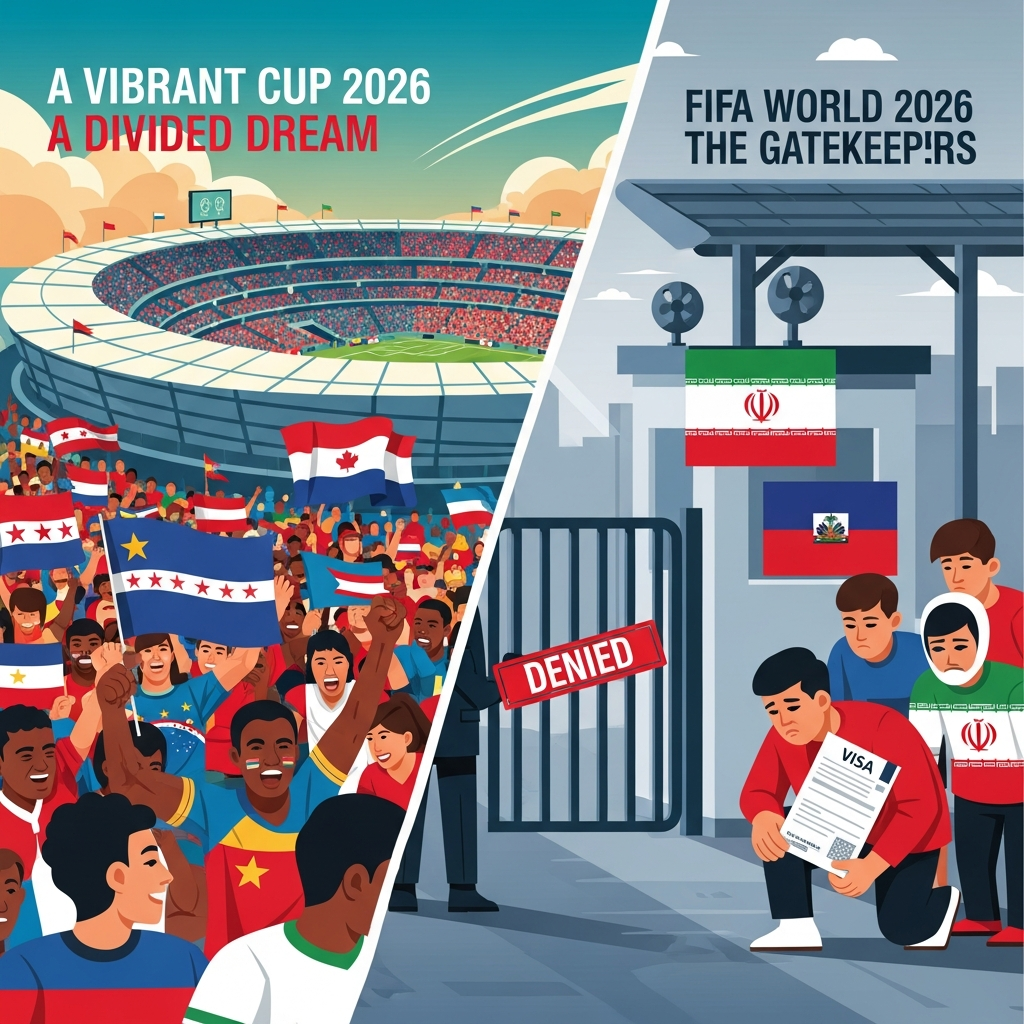
This is the issue I believe matters most in this tournament, and it is receiving significantly less attention than it deserves relative to its importance for the sport's foundational values. The United States government has imposed travel restrictions or visa processing suspensions affecting 75 countries, and has simultaneously escalated immigration enforcement operations with ICE making more than 167,000 arrests in the 11 U.S. host cities in the first two months of 2026. For fans from Haiti — a nation that qualified for its first World Cup since 2010 — and from Iran, attending matches in person is effectively impossible under these conditions. The American Immigration Council has documented that fans from Haiti and Iran face visa restrictions so narrow that ordinary supporters without pre-existing visas cannot obtain entry. Fans from some nations, including Algeria and certain African qualifying nations, faced requirements including $15,000 financial guarantees to enter the United States for match attendance. Human Rights Watch's characterization of "a climate of fear" surrounding the tournament in host cities is supported by documented evidence of ICE enforcement operations in the same geographic areas where matches are being held. My view is that FIFA carries meaningful accountability for this situation, not because it controls American immigration policy, but because it awarded hosting rights to this specific environment with full knowledge of the political context. The structural exclusion of qualified fans is not a peripheral concern — it directly undermines the legitimacy of the "Football for All" principle that FIFA uses to justify the expansion of the tournament in the first place.
174,000 Petition Signatures in the Netherlands — But No World Cup Boycott Has Ever Succeeded
The political pressure on this tournament is real and quantifiable in ways that previous cycles have not experienced at this scale. Over 174,000 people in the Netherlands signed a petition submitted to parliament calling for the Dutch national team to withdraw from the 2026 World Cup, citing the United States' immigration policies and the exclusion of fans as incompatible with the tournament's stated values. Similar conversations have emerged in Germany and the United Kingdom, where public figures and media commentators have raised the boycott question with more seriousness than in previous cycles. The Royal Netherlands Football Association (KNVB) responded by stating it had no immediate plans to reconsider participation, though it noted it was monitoring the geopolitical situation closely. This institutional response is almost certainly what will occur in every case where boycott pressure mounts: governing bodies acknowledge the concern and then proceed with participation, because the structural costs of withdrawal — lost qualifying investment, athlete opportunity costs, sponsor obligations — are simply too high for any national federation to absorb. Academic analysis from scholars at Utrecht University confirms that sporting boycotts have historically produced minimal policy change while imposing concentrated costs on athletes. The 1980 Moscow Olympics boycott, involving 65 nations, remains the most significant modern example, and it failed to alter Soviet policy in Afghanistan. What the Dutch petition's 174,000 signatures genuinely represent, however, is a useful signal: public tolerance for the contradiction between the tournament's stated values and its operating reality has reached a threshold that cannot be dismissed as marginal.
Spain and France Lead Experts' Title Forecasts — But the Real Drama Is Somewhere Else Entirely
According to widely reported experts' title forecasts, Spain enters the 2026 World Cup as the slight frontrunner in the title race, with France close behind them, and Argentina, England, and Brazil in the next competitive tier based on squad depth, coaching quality, and recent international form. Spain's combination of generational talent at multiple positions and a tactically coherent collective system makes them a genuine candidate for the title, while France's individual quality at the elite level gives them an equal claim. The defending champion Argentina adds the singular emotional dimension of Lionel Messi's possible final World Cup — a storyline that will command enormous global attention regardless of the team's eventual progress. From a purely competitive standpoint, the prospect of a Spain-France final, or either nation against a resurgent Argentina, represents the kind of high-quality football showcase the expanded format was meant to deliver at its apex. However, I want to be direct about where I think the real drama of this tournament lies, because I believe it is not primarily on the scoreboard. The question of whether 48 nations can coexist in a coherent and competitive tournament structure — being answered live, in real time, for the first time — matters more to the sport's long-term trajectory than which specific nation wins the final. The question of whether political exclusion becomes the defining image of the opening week matters more to FIFA's long-term credibility than any trophy presentation. I believe people will remember this World Cup not primarily for its winner, but for the structural questions it forced into the open and left unresolved.
Positive & Negative Analysis
Positive Aspects
- Football's Geographic Footprint Has Genuinely Expanded
The most plainly defensible advantage of the 48-team format is that it has opened the door for nations that previously had no realistic path to the World Cup stage. Curaçao, Cape Verde, Uzbekistan, and Jordan are all making their tournament debuts in 2026 — nations with genuine football cultures and histories that now receive global recognition and competitive exposure for the first time. For a country like Curaçao, with a population of around 150,000 and a football tradition rooted in its Caribbean and Dutch heritage, qualifying for the World Cup is not a symbolic achievement — it is a structural catalyst for youth investment, coaching development, and infrastructure improvement that will persist for years after the tournament. I believe the "first-time qualifying effect" is significantly underestimated in these conversations: the historical evidence from Asia and Africa suggests that competitive participation at the highest level accelerates football development across the qualifying region for roughly a decade following the first appearance. Africa gained four additional qualifying spots with the 2026 expansion, and Asia nearly doubled its allocation. That increase in realistic competitive aspiration across dozens of national programs represents a genuine long-term asset for the global game, even if it comes at some short-term cost to group-stage competitive density. The expansion creates a positive feedback loop: broader qualification creates more investment, more investment creates better football, and better football eventually produces more competitive World Cups.
- More Nations Now Have a Realistic Chance to Dream
When the qualification path feels genuinely achievable, national football programs invest differently. Under the old 32-team allocation, many nations in the lower tiers of African, Asian, and CONCACAF competition essentially built their programs around regional tournaments and Olympic cycles, knowing the World Cup was structurally out of reach. The 48-team format changes that calculus in meaningful ways. Oceania's first automatic qualifying berth, Africa's expanded allocation from five to nine spots, and Asia's increase from 4.5 to eight direct qualifying places represent concrete structural changes in what it means to be a lower- or mid-tier football nation. I think this shift in realistic aspiration is one of the most underrated benefits of the expansion, precisely because its effects compound over time rather than appearing immediately. A coaching program that previously trained players for regional cups now trains them with a World Cup target in sight. A federation that previously allocated budgets primarily to internal competition structures now invests in systems designed to produce qualification-level football. The aspirational effect cascades through youth development, sponsorship attractiveness, and public engagement in ways that a single generation of fans and players can begin to see. Ultimately, a larger, more competitive global football ecosystem makes the World Cup itself a better product in the long run, even if there are short-term quality trade-offs in the current cycle.
- Distributed Hosting Spreads Economic Benefits Across the Continent
The 2026 World Cup's multi-city, three-country hosting model represents a meaningful structural improvement over the concentrated hosting approach that characterized the Qatar 2022 cycle. Rather than funneling the economic effects of a global mega-event into a single metropolitan area or country, the 2026 model distributes tourism, employment, and infrastructure investment across 16 cities in the United States, Canada, and Mexico. Aviation, hospitality, food service, and entertainment industries in multiple cities benefit simultaneously from the global influx of visitors and media attention. I believe this distributed model also addresses one of the most persistent criticisms of mega-event economics: the "white elephant" problem of purpose-built facilities that become underused liabilities after the event concludes. North America's existing world-class stadium infrastructure means the marginal investment in new construction for 2026 is significantly lower than it was for Qatar, where essentially an entire hosting infrastructure had to be built from scratch at enormous financial and human cost. FIFA-WTO joint research projects a total GDP impact of $40.9 billion across the North American continent from this tournament — and while independent economists have noted that a portion of this represents displacement of existing tourism rather than net new economic activity, the core proposition of continental-scale distribution remains a genuine advantage over concentrated single-city models.
- More Matches Generate More Memorable Moments and Global Stories
The arithmetic of 104 matches compared to 64 means something for the quality of storytelling the tournament generates. More games create more opportunities for the unexpected results, individual performances, and competitive scenarios that become part of football's collective memory. The format also introduces groups where well-matched smaller nations face each other, creating genuine competitive encounters that would never occur under the old format. I believe the unpredictability factor of the expanded field is actually higher, not lower, than it was under 32 teams, because the introduction of genuinely competitive nations from underrepresented regions adds variables that traditional forecasting frameworks cannot easily account for. In the digital media environment where a single extraordinary moment can reach a billion people within hours of occurring, the tournament's increased match volume is commercially and culturally significant. Each memorable result generates its own story cycle, its own social media momentum, and its own contribution to the global expansion of football's fan base. The 2026 World Cup is also the first to be broadcast under the digital rights architecture that reflects streaming's dominance over traditional television, meaning the additional matches translate directly into additional subscriber and engagement value for rights holders. I think the content multiplication effect of 104 matches is genuinely and significantly underestimated by critics who focus only on the quality of individual group-stage encounters.
Concerns
- Mismatched Games Will Dilute Competitive Quality in the Group Stage
The most direct downside of the 48-team expansion is the one that is hardest to paper over with inclusion rhetoric: the group stage will contain more games where the competitive outcome is not genuinely in doubt. Expanding the field to accommodate smaller nations is structurally inseparable from accepting greater ability disparities in the early rounds. Two-thirds of all teams now advance to the knockout stage, which further reduces the competitive pressure in group play and creates the possibility of nations advancing without the kind of performances that historically defined World Cup standards. The 1982 expansion to 24 teams and the 1998 expansion to 32 teams both generated the same criticism, and football did adapt over time as the new participants raised their competitive levels. But this 16-team single-step expansion is larger than either of those transitions, and the immediate adaptation period carries more risk. Al Jazeera's analysis of the 2026 format noted that the ability range "is likely to be the broadest we've ever seen at a men's World Cup," with some matchups — like a heavily favored European power against the lowest-ranked qualifier — essentially presenting no competitive uncertainty whatsoever. I believe the "tournament dilution" narrative, if it gets anchored to specific viral moments of non-competitive group games, has the potential to damage the event's long-term brand value in ways that won't show up in this cycle's revenue figures but will be measurable in subsequent broadcast rights negotiations.
- Host Country Policy Has Structurally Excluded Fans Based on Nationality
This is, in my assessment, the most serious and least justifiable failure associated with the 2026 World Cup, and it deserves to be called precisely what it is. U.S. travel restrictions affecting 75 countries, combined with intensified interior immigration enforcement including more than 167,000 ICE arrests in host cities in the first two months of 2026, have created a situation where citizens of certain qualified nations cannot practically attend their teams' matches. Haitian and Iranian fans face visa conditions so restrictive that ordinary supporters without pre-existing U.S. visas are effectively excluded. Some fans from affected nations faced financial guarantee requirements of $15,000 for match attendance consideration. FIFA's slogan "Football for All" becomes operationally meaningless when the structural reality of the hosting environment contradicts it in this direct and documented manner. I believe FIFA's response — characterized primarily by silence and the deflection of responsibility to host government policy — represents a failure of the fiduciary obligation it claims toward its global fan constituency. The Council on Foreign Relations captured the core irony with stark precision: "The U.S. is co-hosting the FIFA World Cup. But much of the world can't attend." No amount of first-time qualifying nation storytelling can offset the moral weight of a fan who cannot watch their national team because of their passport.
- Player Overload and Schedule Congestion Have Reached Breaking Point
The competitive calendar for elite football players has been accumulating stress for years, and the 48-team World Cup is the most visible recent contributor to a problem that FIFPRO, the international players' union, has documented extensively. The union's 51-page "Overworked and Under-Protected" report found that Chelsea and Real Madrid players were left with only 20 days of summer recovery in 2024-25, compared to a medically recommended minimum of 28 days. PSG players had a pre-season rebuilding window of just 7 days against the same standard. The expanded Club World Cup, running concurrently with the increased World Cup match load, has pushed annual match totals for the most successful players to levels that their contracts never contemplated and that sports science guidelines explicitly warn against. FIFPRO is currently pursuing legal action against FIFA over the congested calendar, and European club executives have made their dissatisfaction increasingly public and formal. I view this as a structural debt that is temporarily hidden by the excitement of the opening ceremony but that will land as a real invoice within the next two years. If a marquee player at the peak of their career suffers a significant injury that is publicly and credibly linked to schedule overload, the narrative about expansion-driven player welfare failures will define the policy conversation about format decisions for the next cycle.
- Commercial Logic Is Overriding the Sport's Core Identity
I believe it is important to name the fundamental dynamic driving this tournament clearly: the 48-team expansion is primarily a commercial decision that uses inclusion as its public-facing narrative. Going from 64 to 104 matches generates proportional increases in broadcast revenues, ticket sales, and sponsorship exposure, and FIFA's projected $10.9 billion revenue target represents the clearest evidence of what is actually motivating the format. The FIFA-WTO joint projection of $40.9 billion in total GDP impact across North America provides additional institutional cover for a decision that was always primarily about maximizing financial returns in the largest remaining underpenetrated sports market in the world. I am not opposed to commercial success in professional football — the revenues that tournaments generate fund youth development, infrastructure, and participation programs globally. But when the commercial imperative consistently produces outcomes that contradict the stated values of the tournament — fan exclusion, player welfare compromise, competitive quality reduction — the credibility of the institutional narrative breaks down. The asymmetry between how loudly inclusion stories are promoted and how quietly exclusion stories are managed is not coincidental; it is a reflection of deliberate institutional choices about what kind of coverage serves the commercial interest. I believe that when the commercial logic and the sport's foundational identity come apart in visible and documented ways, it erodes the long-term fan trust that is ultimately the most valuable asset any sporting institution owns.
Outlook
Let me break down where I see this going — short-term, medium-term, and long-term, with a realistic look at the scenario range. Start with the immediate picture: the opening week through the conclusion of the group stage, roughly the next month. The moment that first ball rolls in Mexico City's Estadio Azteca on June 11, I expect most of the political noise to get absorbed by the gravitational field of the event itself. That is simply what the World Cup does to public attention — it draws everything back to the pitch. Even the Dutch boycott petition, for all its 174,000 signatures, will likely fade as a daily talking point the moment the Oranje play their first match. This isn't cynicism; it's a pattern that has repeated across every controversial hosting cycle in modern sporting history, and there is no compelling reason to expect 2026 to break it.
The single most consequential short-term variable, in my assessment, is how the four debut nations perform in the group stage. Curaçao, Cape Verde, Uzbekistan, and Jordan all enter their first World Cup with the eyes of their nations and a watching global audience looking for validation of the expansion experiment. If even one of these nations manages a meaningful result — a win, a draw against a traditional power, an unexpected advance to the round of 32 — the pro-expansion narrative gets exactly the proof of concept it needs. Cape Verde is the most likely candidate for a genuine surprise: the team has climbed steadily in FIFA's world rankings, qualified by topping their African group ahead of Cameroon, and with a favorable group draw they are not an impossible dark horse for the knockout rounds. A single shock result from a debutant nation can reframe an entire policy debate, and that moment would be amplified globally within minutes.
Meanwhile, the access and exclusion issue will not disappear during the tournament itself. Individual stories of visa denials, deportation proceedings near host cities, and the climate of enforcement in the match venues will continue surfacing in international coverage throughout the competition. According to Human Rights Watch, ICE made more than 167,000 arrests in the 11 U.S. host cities between January and March 2026 alone — that enforcement environment does not switch off when the stadiums fill up. What I expect to emerge is an uncomfortable visual split: sold-out arenas broadcasting scenes of global celebration, set against a backdrop of ongoing enforcement operations in the same neighborhoods. It is exactly the kind of image FIFA spent its entire promotional campaign trying to prevent becoming the dominant visual metaphor for this tournament, and it is the kind of image that proves surprisingly difficult to contain once it starts circulating.
Looking at the medium-term — the six months to roughly two years following the final — the central question is how FIFA conducts its institutional reckoning with this experiment. If the revenue target of approximately $10.9 billion is met or exceeded, which I consider the more likely scenario, the 48-team format effectively becomes permanent. In fact, reporting by Goal.com indicates FIFA is already exploring the possibility of expanding to 66 teams for the 2030 World Cup, which would be co-hosted across Spain, Portugal, Morocco, and three South American nations. I view the expansion trajectory as essentially irreversible at this point. Contracting the field would require FIFA to strip qualifying spots from African, Asian, and CONCACAF federations that gained significant representation — and those federations control decisive votes in FIFA presidential elections. The political math for a rollback simply does not work.
One medium-term storyline that deserves genuine optimism is the American soccer market. The United States has long represented the most significant untapped commercial frontier for football globally, and the evidence suggests the 2026 World Cup will function as a genuine inflection point. YouGov data shows that 56% of U.S. soccer fans cite this tournament as the primary reason their interest is growing, and roughly a third of the general American population expects the event to raise their long-term engagement with the sport. Combined with the Messi-Inter Miami effect that has already elevated MLS's profile, this is a compelling setup for a sustained shift in American sporting culture. Gabelli Research estimates that North American club valuations could rise 20-30% if the U.S. market fully embraces football at the level this World Cup might catalyze. I think that shift is genuinely coming — the question is whether it is built on a foundation that feels inclusive rather than exclusionary, which matters more for long-term fan loyalty than any single tournament result.
The medium-term crack that tends to get buried beneath the excitement of the opening ceremony is the player workload situation, and I want to be direct about it because I think it is being significantly underpriced. FIFPRO, the international players' union, released a detailed 51-page report documenting that elite players' competitive and training loads have already exceeded safe recovery thresholds by significant margins. Chelsea and Real Madrid players were left with just 20 days of summer recovery in 2024-25, against a recommended minimum of 28 days. PSG players had a pre-season rebuilding window of just 7 days against the same 28-day standard. FIFPRO is currently pursuing legal action against FIFA over the congested calendar, and European club executives have made their frustration increasingly public. A 48-team World Cup adds up to eight matches for the deepest-running teams onto an already overloaded annual schedule. I believe the invoice for this structural decision will arrive within two years, and it will be uncomfortable.
Now for the longer view — two to five years out — and the structural legacies this tournament will leave behind. My central conviction is that the 2026 World Cup will be remembered as the moment when the geopoliticization of mega-events became undeniable and irreversible as a feature of the landscape rather than an exception. Every future Olympic host and every future World Cup host will face the question that this tournament is forcing into the open: do your immigration and security policies align with the stated values of the event you are hosting? The 2028 Los Angeles Olympics lands on the exact same soil in the exact same political environment, and if the travel restriction regime is still in place, the questions will be harder to sidestep because the precedent will have been established. Researchers at the Baker Institute for Public Policy at Rice University have documented how modern states use major sporting events as instruments of statecraft and soft power projection — and the inverse is equally true: hosting a mega-event exposes domestic policy to unprecedented international scrutiny.
The optimistic scenario — where I place a probability of roughly 35% — is a tournament that overperforms across nearly every measurable dimension. Revenue clears $10.9 billion, at least one debut nation produces a genuinely memorable giant-killing result, and some combination of diplomatic negotiation and ad-hoc visa provisions reduces the worst access failures enough to take them off the front page. In this scenario, FIFA writes the post-tournament narrative as a comprehensive success: global democratization achieved, commercial records shattered, new fan markets activated across North America and beyond. The 48-team format gets locked in for 2030, and the stories of exclusion become historical footnotes rather than defining images. I think this outcome is possible but requires the political environment to shift in a cooperative direction over a compressed time window. Given the structural dynamics in place, I would not bet heavily on it.
The base case — where I place the highest probability, around 45% — is what I would describe as a fractured success. The commercial numbers get hit or come close to it. The knockout rounds generate genuine excitement and at least several memorable matches. FIFA executives deliver self-congratulatory press conferences emphasizing the record-breaking metrics. But the access and exclusion narrative never fully goes away, because the underlying policy environment never changes. Individual visa denial stories continue surfacing throughout the tournament. A handful of group-stage matches between heavily mismatched opponents disappoint expectations. The fan access critique becomes the dominant intellectual frame for historical evaluation of the tournament, even as the commercial win is secured. In this scenario, the structural problems simply get deferred to 2030 rather than resolved — arriving with a larger stage, a potentially expanded 66-team format, and two continents of complexity to navigate.
The bear case — which I place at approximately 20% probability — involves a tipping-point event that reframes the narrative so rapidly the commercial wins get overshadowed. A high-profile incident involving a fan's arrest or deportation covered in real time on social media. A string of group-stage mismatches that generate viral mockery and trigger mainstream quality-of-sport critiques. A marquee player injury in the latter rounds publicly attributed to schedule overload, with FIFPRO's legal action as immediate backdrop. Any one of these could shift the dominant media frame from celebration to systemic critique within a news cycle. I flag this not because I think it is likely, but because the consequences if it materializes are severe — and mega-events have a well-documented tendency to crystallize around a single symbolic moment that then defines collective memory of the entire experience.
Let me be clear about how I read the combined picture from these three scenarios. This World Cup will almost certainly set commercial records — the $10.9 billion revenue target is well-supported by the broadcast rights data and the demonstrated global appetite for the event. What it is considerably less certain to achieve is the qualitative validation of its own stated values: inclusion, access, and the idea that football truly belongs to everyone. The shift in how we evaluate mega-events — from measuring commercial success to interrogating values alignment — is already underway in public discourse, and this tournament will not resolve it but will sharpen it. The empty seat where a Haitian fan should have been sitting is not a footnote in the official record. It is the question this tournament carries into history, and I believe it will be asked again, louder, the next time the world's biggest sporting events come to American soil.
Sources / References
- List of 2026 FIFA World Cup Controversies — Comprehensive overview of format expansion, political controversies, and boycott discussions surrounding the 2026 tournament
- FIFA World Cup 2026: What to Expect from the 48-Team Format — Analysis of the 48-team format structure and its implications for competitive quality
- 2026 World Cup: Tournament Will Kick Off in Climate of Fear — Human Rights Watch warning about travel restrictions, ICE enforcement, and fan access concerns
- The U.S. Is Co-Hosting the FIFA World Cup. But Much of the World Can't Attend. — Analysis of 75-country travel restrictions and fan access barriers
- Calls for a Boycott of the 2026 FIFA World Cup Are Growing — But How Realistic Is One? — Expert analysis of boycott movement and historical precedent
- Too Much World Cup? How FIFA's Experiment May Have Made the Tournament Too Big — Coverage of tournament expansion, quality dilution debate
- First-Time Nations: 4 Teams Making Their FIFA World Cup Debut in 2026 — Profiles of Curaçao, Cape Verde, Uzbekistan, and Jordan's historic debuts
- 2026 World Cup: Spain Narrowly Favored Over France — Experts' analysis of title contenders and competitive landscape