
Everyone Swore Small Ball Would Kill the Big Man. Then Wembanyama Dropped 41-24 and Proved Them All Wrong.
Summary
Victor Wembanyama's 41-point, 24-rebound performance in Western Conference Finals Game 1 placed him among only seven players in NBA history to record a 40-20 game at the conference final level, and only the second — alongside Wilt Chamberlain in 1960 — to accomplish this in his debut at that stage of the playoffs. This historic stat line carries significance far beyond individual achievement; it constitutes structural evidence of a profound paradox built quietly across a decade of NBA history — the small-ball revolution engineered to render traditional centers obsolete instead generated the precise competitive conditions that produced the most complete big man the league has ever seen. Three-point attempts per game exploded from 2.8 in the 1979-80 season to 32 by 2018-19, and Dartmouth sports analytics research confirmed that elite center offensive win shares declined by 1.5 as a direct consequence, yet recent seasons have revealed an unmistakable counter-trend as surviving centers adapted by developing range shooting, passing, and multi-positional defensive versatility. Wembanyama now holds the unanimous Defensive Player of the Year award — the first player in league history to receive every single first-place vote — while simultaneously leading the league in blocks and pulling up for contested threes from midcourt range, a combination that redefines what the center position can mean in the modern era. With Game 3 scheduled tonight in San Antonio and the series deadlocked at one game apiece, this Western Conference Finals has become something larger than a playoff series — it is the moment when the NBA is forced to reckon with the irony that its own decade-long campaign to eliminate the dominant center has instead produced the most dominant center of the modern era.
Key Points
66 Years Apart, Same Stage: What Wembanyama's 40-20 Actually Means
The 41-point, 24-rebound performance Victor Wembanyama delivered in Western Conference Finals Game 1 is the first 40-20 game at the conference final level since Wilt Chamberlain accomplished the same in 1960, placing Wembanyama seventh on the all-time list alongside Chamberlain, Kareem Abdul-Jabbar, Elgin Baylor, Karl Malone, Charles Barkley, and Shaquille O'Neal. Only two players in NBA history have achieved this milestone in their conference final debut: Chamberlain and Wembanyama, separated by sixty-six years. What elevates this performance beyond historical comparison is the manner in which Wembanyama constructed it — pulling up from the midcourt logo to force double overtime, then scoring nine points himself in the final five minutes of that overtime to complete a game his team had no obvious business winning on paper. Wembanyama accomplished all of this at 22 years and 134 days old, making him the youngest player in history to post a 40-20 game at the conference final level. The record's deeper significance lies in what it communicates about the ceiling of what the center position can structurally be in the current era — it is not simply a statistical entry but an argument that the conversation about center position limits needs to be reopened entirely from the beginning.
The Three-Point Paradox: How Small Ball Summoned Its Own Worst Nightmare
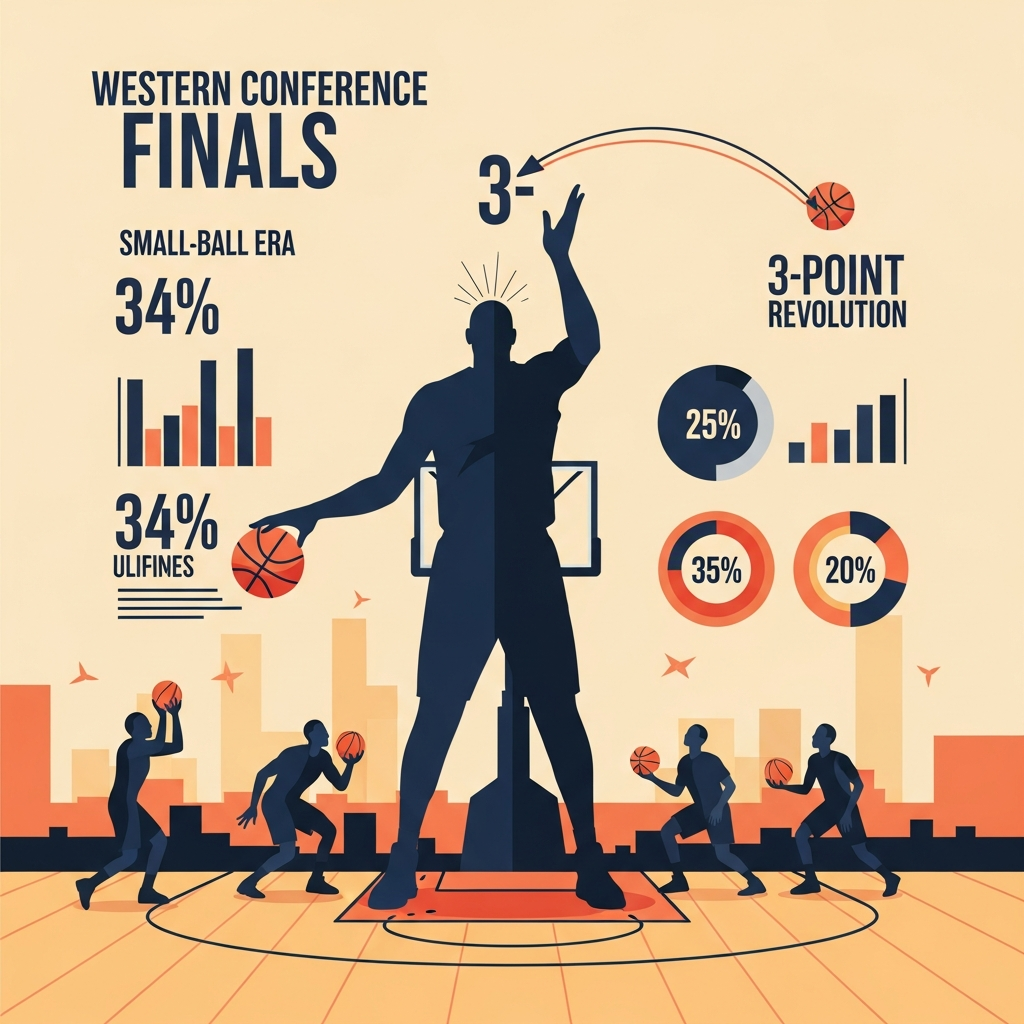
NBA three-point attempts per game increased from 2.8 in the 1979-80 season to 32.0 by the 2018-19 season, a trend accompanied by a corresponding drop in two-point attempts from 85.42 per game to 60.78, fundamentally reshaping what roster construction looked like across the entire league. Dartmouth College sports analytics research documented that elite center offensive win shares — the top 20 percent of the position — fell by 1.5 in the three-point era, with statistical significance at p = 1.13 × 10⁻¹², confirming this was a structural realignment rather than noise. But the same research identified something the dominant small-ball narrative almost entirely missed: center offensive value has been recovering toward pre-three-point-era levels in the most recent seasons, driven by centers who survived the selection pressure by adapting to its demands. Brook Lopez's transformation from 0.2 three-point attempts per game in 2015-16 to 5.2 the very next season — with accuracy climbing from 14.3 to 34.6 percent — represents the most visible single example of this adaptation in action. The two-big lineup usage rate that collapsed from 58.8 percent in 2011-12 to roughly half that by 2015-16 did not eliminate the center position; it applied evolutionary pressure that culled centers who refused to grow and left behind a position with a dramatically higher floor of required competencies, at the very top of which stands Wembanyama.
The MVP Math That Doesn't Add Up: 83 Votes Versus a Plus-16 Impact Differential
Shai Gilgeous-Alexander won the 2025-26 MVP award with 83 of 100 first-place votes on the strength of 31.1 points per game and 55.3 percent field goal shooting for a 64-win Oklahoma City Thunder — a performance and résumé that, in most competitive seasons, would represent an unambiguous choice for the league's most prestigious individual award. The problem is that this was not most competitive seasons. Wembanyama's on-court/off-court impact differential of plus-16.0 points per 100 possessions surpassed SGA at plus-12.6 and three-time MVP Nikola Jokić at plus-13.5, representing the single highest individual impact figure in the league by a meaningful margin. Wembanyama publicly stated that his combined offensive and defensive contribution makes him the most impactful player in the NBA — a claim that the data directly substantiates, which makes the gap between the claim and the voting outcome particularly striking. The deeper issue is structural: the MVP award has quietly drifted over the years toward rewarding the best player on the best team rather than the player whose presence most dramatically changes his team's fortunes, and a 64-win Thunder record creates an outsized gravitational pull on voters regardless of what the underlying numbers show. This isn't an argument against SGA's excellence; it is an argument that the definition of "most valuable" needs honest reexamination before the next voting cycle begins.
France's Basketball Industrial Complex: One Nation, One Pipeline, Two Consecutive Number-One Picks
Victor Wembanyama's emergence as the face of the NBA cannot be fully explained as individual genius operating in a vacuum — it is inseparable from the systematic French basketball development infrastructure that identified, trained, and refined his talent over years of intensive work. France currently has 19 players on NBA rosters — a national record — with 12 of them first-round draft selections and seven lottery picks drawn from just the last three drafts alone. Wembanyama in 2023 and Alexandre Sarr in 2024 became the first players from the same country to be selected first overall in consecutive NBA drafts in the league's entire history. The institution behind this sustained output is INSEP, the French national sports performance institute founded in 1975, which selects 36 young athletes annually and intensively develops 20 of them through a rigorous, long-term skill-building program that has produced 18 NBA draft picks over seven years — 11 of them direct INSEP products. France's 2019 FIBA World Cup victory over Team USA and its Olympic silver medal in Tokyo in 2021 were not isolated results but the measured outputs of a pipeline that has been compounding its advantages with each successive generation of players, and Wembanyama is both the current peak of that pipeline and the model against which every subsequent French prospect will inevitably be measured.
The Media Proof: Why Record Viewership Is More Than a Ratings Story
The Spurs-Thunder Western Conference Finals Game 1 set the all-time viewership record for a Game 1 at that stage of the playoffs, averaging 9.2 million viewers with a peak of 12 million during double overtime — representing a 71 percent increase over the prior year's equivalent game and the strongest opening engagement number the Western Conference Finals has ever produced. Social media generated 1.3 billion views of Game 1 content, also a conference finals all-time record, while Peacock and NBC streaming averaged 2.3 million minute viewers per minute of broadcast — the highest streaming figure for any NBA game in league history. These numbers are not simply popularity metrics; they are the direct economic justification for NBC's $7.7 billion broadcasting rights commitment, arriving in the first year of the deal at a moment that validates every assumption the league made when it negotiated those terms. I expect Wembanyama's personal sponsorship portfolio to expand by at least 30 to 40 percent by the conclusion of this playoff run, as brand managers who track cultural resonance recognize that a 22-year-old writing NBA history in front of global audiences represents exactly the kind of rare commercial opportunity that does not stay underpriced for long. The 1997 post-Jordan low point in NBA ratings demonstrated how much a single transcendent personality can move the market; what these Game 1 numbers suggest is that Wembanyama may represent the inverse — the entry point of a sustained upward trajectory rather than a momentary peak.
Positive & Negative Analysis
Positive Aspects
- The Big Man Renaissance Restores Tactical Diversity the NBA Had Been Slowly Losing
For a full decade, the relentless march of small-ball basketball produced a creeping uniformity across NBA competition — virtually every contending team deployed similar three-point-centric schemes, interchangeable positionless wings, and near-identical pick-and-roll defensive coverages, creating a product that even many devoted fans found increasingly difficult to distinguish from week to week. Wembanyama's emergence alongside Jokić and Joel Embiid as multi-dimensional elite centers fundamentally disrupts that uniformity in ways the small-ball formula never anticipated. When a center can shoot from range, set dynamic screens, pass out of pick-and-roll, and simultaneously erase opponents' attempts at the rim, opposing coaches face genuine strategic dilemmas that have no clean solution within conventional defensive frameworks. This tactical complexity gives coaches more creative options to work with, generates matchup problems that spill over into every possession in both directions, and delivers the kind of varied, intellectually engaging basketball that has historically attracted and retained the most discerning fans. The record viewership for this Spurs-Thunder series is not coincidental — it directly reflects the market's appreciation for a product that has become unpredictable and tactically rich in ways it had begun to lose during the peak small-ball years.
- The Global Market Explosion Wembanyama's International Profile Makes Possible
Seventy percent of the NBA's 2.1 billion social media followers are already located outside the United States, and the emergence of a French player as the defining figure of the league's next era creates a direct pathway to fan communities across Europe and francophone Africa that no American-born superstar could access with the same organic cultural resonance. The NBA market is already projected to grow from $12.94 billion in 2025 to $20.04 billion by 2031, but Wembanyama's French identity accelerates the critical mechanism behind that projection — the conversion of casual international observers into committed fans — in ways that are difficult to model precisely but impossible to dismiss. Dirk Nowitzki transformed Germany into a core NBA market across his career; Yao Ming did the same for China; Wembanyama is positioned to do the same for France and potentially the broader European basketball community at a moment when French clubs, academies, and sporting culture are investing heavily in basketball at every level of the development pipeline. As the league expands to 32 teams in 2026, adding Las Vegas and Seattle franchises that will require roster construction, international player representation will rise further — and the commercial infrastructure to convert that global talent into global fandom is now more developed than at any previous point in the league's history. Wembanyama's commercial reach extends beyond Europe to francophone Africa — Senegal, Côte d'Ivoire, Cameroon, and a dozen other countries where basketball has deep cultural roots but limited high-level visibility — and this audience of hundreds of millions represents a market the NBA has barely begun to systematically develop, one that a French-speaking player at the center of the league's cultural conversation will activate in ways that no previous international expansion investment has attempted.
- Youth Basketball Development Gets a Paradigm Shift That Will Compound Over Decades
For generations, the implicit message delivered to tall young basketball players was narrowly prescriptive: your size makes you a center, and centers operate in the post, protect the rim, and set screens for smaller players who handle the ball and make decisions. Wembanyama's success — and the INSEP methodology that helped produce him — delivers a direct and powerful counter-instruction to every youth coach, youth federation, and youth player in the world watching this playoff run. The new standard, already being implemented in programs across Europe and increasingly adopted by American AAU systems, is that height does not determine skill ceiling: every player, regardless of size, develops ball-handling, perimeter shooting, and playmaking abilities from the earliest stages of their training. INSEP's demonstrated output — 18 NBA draft picks over seven years from a program that selects only 36 athletes annually — quantifies the return on this all-around development philosophy in terms that youth development organizations across every basketball-playing nation can point to when arguing for expanded investment. The players being trained under these principles today will not enter the NBA until the mid-to-late 2030s, meaning the effects of this paradigm shift are genuinely long-term and will compound across multiple draft cycles before their full impact becomes visible in league-wide statistics.
- Live Sports Reconfirm Their Premium Status in an Era of Streaming Fragmentation
The media industry has spent years debating whether streaming fragmentation — audiences splitting across dozens of platforms and consuming content on-demand rather than live — would permanently erode the premium value that live sports had historically commanded for broadcast rights negotiations. Spurs-Thunder Game 1 provided the clearest single-game answer to that debate that the current era has produced. Peacock and NBC streaming averaged 2.3 million minute viewers per minute of broadcast — an all-time NBA streaming record — while the game simultaneously performed at 9.2 million average viewers across traditional television, confirming that premium live sports operate as a distinct content category that functions across distribution channels rather than competing against them. NBC's $7.7 billion rights investment, which arrived under pressure from critics questioning whether the price was defensible in a fractured media landscape, received its most compelling first-year justification in the form of a single double-overtime game that set multiple all-time records. Amazon, Netflix, and every other streaming platform currently bidding on future sports rights packages will cite these Game 1 numbers in their negotiations as evidence that live sports retain pricing power that no other content category can match — and those negotiations will directly shape what sports looks like on screens everywhere for the next decade.
Concerns
- Body Type Durability Risk: A 7-Foot-4 Frame Carries Real Long-Term Uncertainty
The most concrete and undeniable risk attached to any long-term projection about Wembanyama is the durability question posed by a 7-foot-4, 235-pound frame operating at the intensity level that playoff basketball demands. NBA history provides cautionary evidence at the extreme end of the size spectrum: Yao Ming stood 7-foot-6 and 310 pounds, won eight All-Star selections, and was forced into retirement at 30 by recurring stress fractures; Greg Oden stood 7 feet and 285 pounds and spent more of his prime career recovering from injuries than playing meaningful basketball. Wembanyama's body type sits at a different point on that spectrum — leaner and more mobile than either predecessor — but the fundamental physics of a very tall, very long frame absorbing the accumulated stress of an 82-game regular season plus deep playoff runs represents a genuine long-term concern that no training methodology or medical technology can entirely neutralize. The 49-minute double-overtime Game 1 performance was spectacular to watch, but playing 49 minutes in a playoff game as a 235-pound 7-footer creates tissue and joint loads that are genuinely difficult to sustain across a multi-year postseason run, and the Spurs medical and performance staff will face increasingly complex load management decisions as the series continues and the stakes compound with each game. The ideal scenario for San Antonio's medical staff would involve minutes closer to 36 to 38 per game rather than 49, but the competitive reality of a tied series playing on home floor makes disciplined load management extraordinarily difficult to enforce when one player changes possession outcomes more dramatically than anyone else in the league.
- Team Construction Dependency: One Transcendent Player Cannot Win Championships Alone
The history of NBA superstardom is lined with cautionary examples of players whose individual transcendence was never matched by the roster construction around them, and the lesson those examples teach is both harsh and consistent. Anthony Davis spent seven seasons in New Orleans, collected six All-Star selections, and produced two playoff appearances before the franchise acknowledged that surrounding talent acquisition had failed to match his individual ceiling. Kevin Durant won two scoring titles and multiple All-Star nods in Oklahoma City before concluding that the roster around him would never be sufficient to carry a championship run to completion. Game 2 of this series — where the Thunder won 122-113 despite Wembanyama posting 21 points, 17 rebounds, 6 assists, and 4 blocks — demonstrated concretely that SGA and Holmgren's collective team chemistry can neutralize even historically exceptional individual performance when the supporting cast advantage is sufficient. San Antonio is a small market with genuine structural disadvantages in the free agent competition for premium talent, and the front office's ability to construct a roster that meaningfully complements Wembanyama's unique skill profile over the next two to three years will ultimately matter more for his legacy than any individual performance he delivers, however historic that performance might be in isolation.
- The Generalization Problem: Wembanyama May Be the Exception the Rule Cannot Accommodate
The core argument underlying much of the center renaissance narrative — that small ball created the conditions for a new generation of elite big men — contains a logical vulnerability that honest analysis requires acknowledging directly. If Wembanyama's talent level is genuinely generational in the sixty-six-years-between-comparable-performers sense, then the argument from his existence to a broader structural trend risks being constructed on a sample size of one. The Dartmouth research confirms that across the full population of NBA centers, offensive win shares declined in the three-point era and have only partially recovered — the majority of centers in the league today are still less offensively impactful than centers of equivalent statistical profile twenty years ago, and most teams still prefer small lineup configurations when Wembanyama-type players are not available to them. Jokić, Embiid, and Wembanyama represent the upper tail of a distribution that still has a conventional center body at its median, and extrapolating renaissance from three exceptional outliers — however genuinely exceptional — may be drawing structural conclusions from individual talent exceptions. I believe the trend is real and structural, but intellectual honesty requires holding this objection alongside the bullish case rather than dismissing it as obviously wrong.
- Globalization Backlash: The Domestic Fan Base Tension Nobody Wants to Discuss Directly
The NBA's aggressive international expansion strategy has produced measurable commercial benefits — 2.1 billion social media followers, markets across Europe, Asia, and Africa that are genuinely engaged with the product — but it has also generated a quieter, less visible counter-reaction within the domestic American fan base that deserves honest acknowledgment. The percentage of NBA players born outside the United States has climbed past 28 percent, international players have claimed an increasing share of the major individual awards in recent seasons, and voices in certain domestic fan communities have expressed growing frustration with a trend they experience as the displacement of American-born talent from the center of the league's cultural narrative. The MVP voting outcome — SGA receiving 83 first-place votes against Wembanyama's 5, despite the impact differential data — may reflect technical basketball judgment, but it also almost certainly contains some component of cultural preference that operates independently of any statistical argument. If international players continue capturing a disproportionate share of lottery picks, All-Star selections, and individual awards, the NBA faces a long-term tension between cultivating its international commercial opportunities and maintaining the depth of connection with the American fan communities whose sustained engagement has historically provided the economic foundation on which the global expansion strategy itself depends. Whether this tension ultimately resolves in favor of continued globalization or some form of recalibration toward domestic-first storytelling will likely depend on whether the next generation of American-born superstars produces players compelling enough to share the narrative stage with the international talent the current draft system is increasingly delivering.
Outlook
Let's start with the immediate picture, because the playoff dynamics right now are genuinely compelling. The series sits at one game apiece heading into Game 3 tonight on San Antonio's home floor, and one regularly overlooked data point deserves more weight in the analysis: the Spurs went 4-1 against Oklahoma City during the regular season, a matchup record that tends to predict playoff outcomes more reliably than most analysts acknowledge before the games are played. I believe this series goes six or seven games. The key insight from Game 1 isn't only the 41-24 line — it's what that performance establishes as Wembanyama's floor in a high-stakes playoff environment. His second-round 12-block triple-double against Minnesota was not a fluke; it's the category of game this player produces when the competitive stakes get higher. The betting markets currently price the Spurs' Finals probability at 22 to 25 percent, and I believe that range meaningfully undervalues them. If San Antonio takes two of the next three home games, the series dynamics flip entirely — and we would be looking at the most improbable championship run since the 2011 Dallas Mavericks. The odds as currently set are wrong, and they will correct themselves as the series develops.
The short-term economic story unfolding around this series is already significant in ways that extend well beyond raw television ratings. Game 1's 9.2 million average viewers and 71 percent year-over-year increase arrived in the first year of NBC's $7.7 billion rights deal — timing that could not have been scripted more favorably for the league's negotiating position going forward. If this series extends to seven games, NBC will record one of the strongest first-year returns on a major sports broadcasting investment in recent history. The Peacock streaming record of 2.3 million average minute viewers per game confirms something the entire media industry has been debating as cord-cutting accelerates: premium live sports drive digital subscriber acquisition and retention in ways that no amount of scripted original content can replicate at comparable cost. I expect Wembanyama's personal sponsorship portfolio to expand by at least 30 to 40 percent before the Finals begin. A 22-year-old player writing NBA history in front of global audiences does not remain commercially undervalued for long — the brand partnership market will move quickly to close that gap.
The medium-term story — covering the next six months to two years — is where things get genuinely consequential for anyone who runs an NBA franchise. For a full decade, the operating assumption across the entire league was that the center position had become a luxury rather than a necessity. Every contending roster chased the Golden State blueprint: maximize three-point shooting volume, deploy versatile wings capable of switching everything, and keep your lineup small enough to generate the floor spacing that a traditional two-big setup could never create. Wembanyama demolished that assumption across a single playoff run. The problem he creates for opposing front offices is architectural, and there is no clean solution within the existing small-ball framework. Match him big, and you get traditional centers posting negative net ratings against him. Go small, and you concede 24 rebounds to one player per game. The only rational organizational response — and I believe this will define at least the next two or three NBA draft cycles — is to accelerate the search for multi-dimensional big men who can shoot from range, switch across positions, and protect the rim simultaneously. I expect at least five or six franchises to begin dismantling small-ball-centric roster constructions before the 2027 draft, redirecting trade capital and draft selections toward versatile big men in ways that would have seemed unnecessary as recently as two years ago.
The global basketball talent pipeline is the second medium-term development that deserves considerably more attention than it typically receives in domestic American coverage. France's 19 current NBA players represent a national record, and the institutional infrastructure behind them — INSEP's elite youth development program, selecting 36 young athletes annually and intensively developing 20 of them — has produced 18 NBA draft picks over seven years, with 11 of those passing through the INSEP system directly. Wembanyama and Alexandre Sarr's consecutive number-one selections in 2023 and 2024 were unprecedented in league history. I believe that within the next two years, basketball federations across Serbia, Greece, Australia, Canada, and West Africa will significantly expand funding for their own elite youth development programs, explicitly benchmarking against the INSEP model as the gold standard. France beat Team USA at the 2019 FIBA World Cup and won Olympic silver in Tokyo — these are the documented outputs of a pipeline that is only becoming more sophisticated and more productive with each passing cycle. The 2028 Los Angeles Olympics will serve as the next major stress test of global basketball infrastructure, and I place France's probability of defeating the United States in a gold medal game at above 30 percent — a figure that would have seemed absurd to anyone a decade ago but now reflects a genuine and honest assessment of where the talent and the systems genuinely stand.
Projecting two to five years out, the structural questions about the NBA as a business come into their sharpest possible focus. Mordor Intelligence projects league market size growing from $12.94 billion in 2025 to $20.04 billion by 2031 at a 7.56 percent compound annual growth rate, with international fan base expansion as the primary driver. Seventy percent of the NBA's 2.1 billion social media followers are already located outside the United States — the league has already crossed the threshold from American sport to global property, and Wembanyama accelerates every component of that international growth trajectory in ways a purely American-born superstar simply cannot replicate. He is the mechanism that transforms France into a core NBA market, in the same way Dirk Nowitzki transformed Germany and Yao Ming transformed China in their respective eras.
When the league expands to 32 teams with Las Vegas and Seattle franchises in 2026, international player representation will likely climb from 28 percent to above 35 percent of total roster spots. On the specific question of whether the center renaissance is a temporary blip or a permanent structural reorientation, I believe firmly that it is the latter. The evolutionary pressures small ball applied to the center position over ten years cannot be reversed — they permanently raised what the position must be able to do. The next generation of elite centers will use Wembanyama as their baseline, and any big man who cannot shoot, switch, and protect simultaneously will not survive the competitive demands of the modern game.
Three distinct scenarios shape how the next three to five years of NBA history unfold from here. The bull case sees Wembanyama reaching the Finals this season or winning his first championship by 2027, triggering an explosive acceleration of global NBA interest that pushes the league to the $20 billion market threshold two to three years ahead of current projections. In this scenario, Wembanyama's off-court earnings approach LeBron-tier territory at $70 to $80 million annually in endorsements, and French basketball infrastructure investment accelerates across the entire European continent as federations and sponsors respond to the sustained visibility. The base case involves Wembanyama reaching the Finals within two to three seasons while the Spurs establish themselves as consistent playoff contenders, NBA global growth proceeds along its projected trajectory without dramatic acceleration, and demand for versatile big men explodes across the 2027-28 draft cycle as front offices across the league reorient their team-building philosophies toward the multi-dimensional center model. The bear case centers on the injury risk inherent in a 7-foot-4, 235-pound frame — a body type that has historically produced durability concerns, as Yao Ming's career arc illustrated. I consider this probability genuinely low, partly because Wembanyama is deliberately building muscle mass incrementally to preserve his mobility, and partly because modern sports medicine has advanced substantially beyond what was available in the early 2000s. But the physical risk is real and deserves honest acknowledgment rather than dismissal in any complete analysis.
The question underneath all of this is the one that I keep returning to as the most fundamental: is Wembanyama a once-in-sixty-six-years individual talent, or is he a systematic output of the era that paradoxically tried to make him impossible? My honest answer is both, and I do not think that is a contradiction. His physical gifts are generationally rare — that much is simply undeniable. But those gifts would have produced a meaningfully different player in a different basketball era. Born in the 1990s, he would almost certainly have developed into a dominant post scorer in the tradition of Shaquille O'Neal or Hakeem Olajuwon — an extraordinary player, but one operating within the conventional boundaries of the center position as it existed at the time. The fact that he instead emerged as a three-point-shooting, floor-spacing, position-defying defensive force is the direct product of the decade of small-ball competitive pressure that forced every aspiring center to expand their skill set or disappear entirely from meaningful rotations. The NBA spent ten years constructing a game designed to make the big man irrelevant, and the cumulative result of that construction was the most relevant big man who has ever played the sport. Tonight's Game 3 is one more data point in an argument that the next decade will fully resolve. I expect the resolution to arrive on Wembanyama's terms, in ways that will surprise even the most enthusiastic supporters watching him right now.
Sources / References
- Wembanyama Game 1 41-point 24-rebound box score and detailed game recap, first 40-20 conference final performance since Chamberlain — NBA Official
- Three-point era impact on center offensive win shares, elite center decline of 1.5 win shares with p = 1.13 × 10⁻¹² — Dartmouth College Sports Analytics
- 40-season NBA shooting pattern analysis, three-point attempts rising from 3.45 to 23.05 per game, two-point attempts declining from 85.42 to 60.78 — PubMed Central Academic Study
- 2026 MVP finalist comparison of SGA, Jokić, and Wembanyama with on-court/off-court impact differential analysis — ESPN
- WCF Game 1 record 9.2 million average viewers, 71 percent year-over-year increase, peak viewership 12 million — Spectrum News
- France's 19 NBA players, INSEP development system, consecutive number-one draft picks Wembanyama and Sarr — NBA Official
- Wembanyama unanimous DPOY, youngest player and first in history to receive all 100 first-place votes — ESPN
- NBA market size forecast from $12.94 billion in 2025 to $20.04 billion by 2031, 7.56 percent CAGR — Mordor Intelligence
- NBA global expansion analysis, 2.1 billion social media followers with 70 percent international, Las Vegas and Seattle expansion franchises — Sportsepreneur