
They Built a "Doping Olympics" for $1.2 Billion — Then Clean Athletes Swept the Podium
Summary
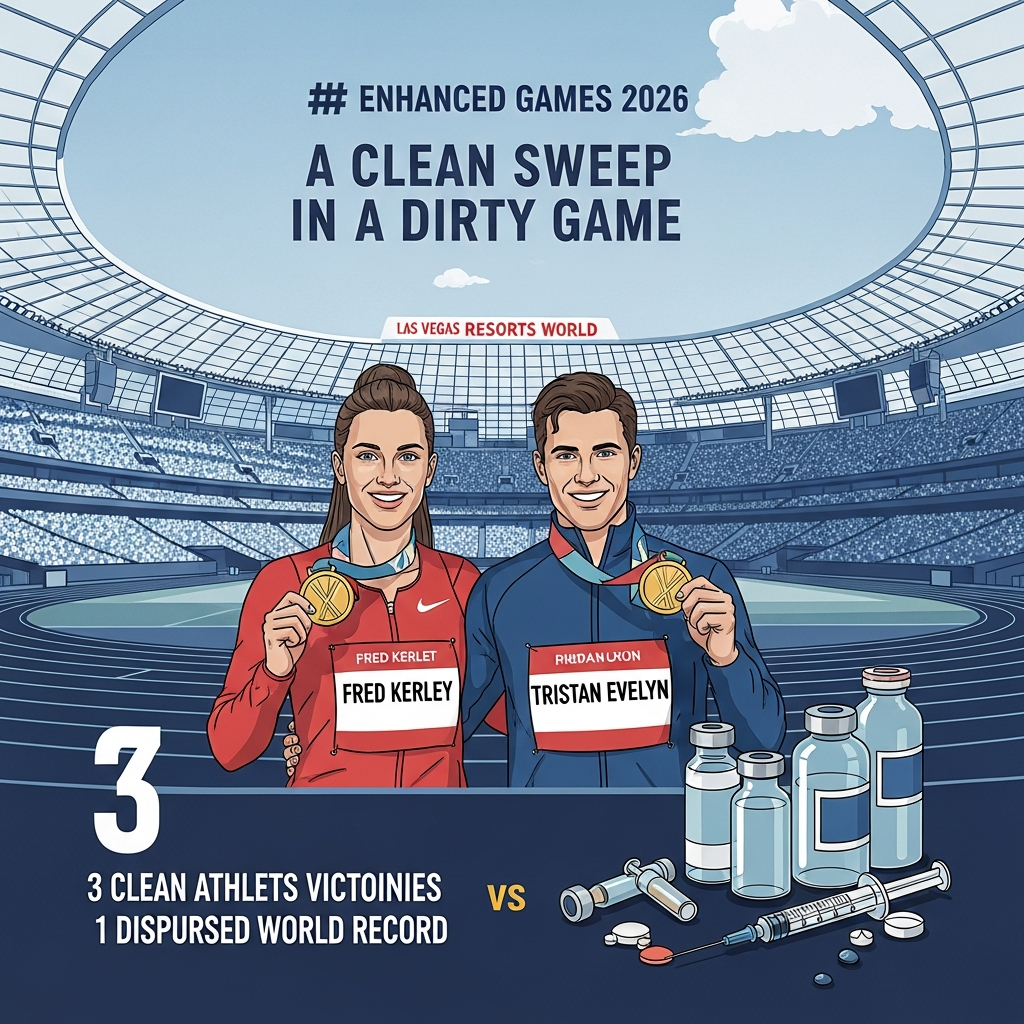
The Enhanced Games, staged on May 24, 2026, at Resorts World in Las Vegas, made history as the world's first large-scale sporting event to officially permit performance-enhancing drugs (PEDs) across all disciplines, attracting global scrutiny from athletes, medical experts, regulators, and investors. Forty-two competitors from 24 nations raced, swam, and lifted across three sports under a framework where 91% of athletes reported testosterone use and 79% reported human growth hormone (HGH) use, making PED consumption effectively the default participation standard rather than an exception. In a paradox that struck at the heart of the event's founding logic, drug-free clean athletes won three of the six contested events — including Fred Kerley's blistering 9.97-second 100m and Tristan Evelyn's women's sprint gold — directly contradicting the premise that PEDs deliver decisive competitive advantages. The sole world record claimed, Kristian Gkolomeev's 50m freestyle time of 20.81 seconds, was immediately contested due to a FINA-banned polyurethane suit and credible timing system irregularities, leaving the event with zero internationally recognized records. Enhanced Group, the SPAC-backed NYSE-listed company valued at $1.2 billion with backing from Peter Thiel and Donald Trump Jr., found its own showcase event inadvertently becoming the most compelling argument yet for the anti-doping movement it sought to displace.
Key Points
The Decisive Paradox: Clean Athletes Win in a Fully Doping-Legal Event
In the six competitive events at Enhanced Games 2026, clean athletes — those competing without performance-enhancing drugs — won exactly three, representing half of all contested disciplines. American sprinter Fred Kerley won the men's 100 meters in 9.97 seconds against a field where 91% of competitors had reported testosterone use and 79% had reported HGH use. Barbadian sprinter Tristan Evelyn claimed the women's 100m gold at 11.25 seconds while competing drug-free, in what became one of the competition's most symbolically resonant results. American swimmer Hunter Armstrong won the 50m backstroke without pharmaceutical enhancement, completing the trio of clean victories. This outcome directly contradicts Enhanced Games' foundational premise — that permitting PED use would produce demonstrably superior athletic performance — and provides empirical evidence that the performance gap between enhanced and non-enhanced athletes may be significantly smaller than conventional wisdom assumes. The result is the most powerful real-world counterargument to PED supremacy mythology that the anti-doping movement has ever received, delivered courtesy of the very event that sought to undermine it.
The World Record That Doesn't Count: Gkolomeev's Disputed 20.81 Seconds
The only world record claim to emerge from the Enhanced Games came from Greek swimmer Kristian Gkolomeev, who posted a 50m freestyle time of 20.81 seconds — compared to the existing non-enhanced world record of 20.88 seconds. That 0.07-second differential, achieved with the full suite of legally permitted PEDs, is a remarkably modest improvement that itself challenges the narrative of pharmaceutical transformation. The record carries multiple disqualifying complications: Gkolomeev wore a polyurethane suit that FINA banned in 2010 because it provided unfair performance advantages through enhanced buoyancy, and multiple event observers reported that the timing system displayed a finishing time before the swimmer made contact with the touchpad — a fundamental technical credibility problem. WADA and World Aquatics declined to recognize the mark, as did every other international sports regulatory body. The Enhanced Games organization entered Las Vegas claiming it would "change the world" of sport, and exited with zero internationally sanctioned records and a disputed measurement that raises more questions than it answers. This episode encapsulates the broader credibility challenge facing the entire enterprise.
The $1.2 Billion SPAC: Enhanced Group's Business Model and Its Contradictions
Enhanced Group, the company behind the Enhanced Games, achieved a $1.2 billion valuation through a SPAC merger and NYSE listing, with major backing from Peter Thiel, Donald Trump Jr.'s 1789 Capital, the Winklevoss twins, and German entrepreneur Christian Angermayer. The actual revenue model, however, is supplement and peptide sales — not event management or media rights. The sporting competition functions as a global marketing campaign for these products, which means every aspect of the event's design serves a commercial purpose: generating controversy, driving brand awareness, and positioning Enhanced Group's products in the $56 billion annual wellness market. The core problem is that "clean athletes beat doped competitors" is not a useful message for selling performance supplements, and the resulting brand credibility damage may be more significant than the organizers anticipated. SPAC-listed companies historically face steep post-merger stock price declines, and Enhanced Group now faces that statistical headwind while carrying a self-inflicted wound to its product's central marketing claim. Understanding this commercial framing reveals why the Enhanced Games made every decision it did — and why those decisions ultimately undermined the enterprise's own commercial logic.
WADA's Structural Credibility Problem and the Anti-Doping Paradox
WADA condemned the Enhanced Games as dangerous and irresponsible, and on medical grounds, that condemnation is warranted. The irony is that WADA is making this argument while carrying institutional baggage from the Russian state-doping scandal, numerous post-competition athlete disqualifications, and persistent credibility problems with its testing protocols' false positive and negative rates. Enhanced Games filed an $800 million antitrust lawsuit against WADA, World Aquatics, and USA Swimming in 2025 — dismissed in November of that year, but significant as a reflection of the structural resentment toward anti-doping institutions among athletes who have experienced the system's failures. The fundamental problem that Enhanced Games exposed is not that PED permission is preferable to prohibition — the competitive results demonstrated it isn't — but that the existing prohibition framework has its own serious legitimacy deficits that haven't been adequately addressed. WADA's moral authority to condemn Enhanced Games is real; it's just substantially diminished by its own institutional record, and Enhanced Games' failure doesn't automatically rehabilitate WADA's system as the uncontested alternative.
Athlete Exploitation: When Prize Money Becomes Structural Coercion
The Enhanced Games prize structure — $250,000 per event win, $1 million for world records — creates a fundamentally different incentive landscape for athletes from economically disadvantaged backgrounds than it does for well-supported competitors from wealthy nations. For an elite American or European athlete with national federation backing and commercial sponsorships, $250,000 is a meaningful but not transformative sum. For an athlete from a developing nation who funds their own training costs and has limited access to world-class coaching and medical support, that same prize money represents life-altering economic opportunity. Forty-two athletes from 24 countries participated, and it does not require cynicism to infer that economic pressure played a meaningful role in recruitment for a significant portion of that field. Medical research ethics protocols specifically prohibit exploiting economically vulnerable populations as clinical research subjects without stringent protections — protections the Enhanced Games applied to none of its participants. The structure effectively leverages financial desperation to recruit athletes into a PED-permissive environment with incompletely characterized long-term health risks, while the wealthy investors who designed and backed the event bear no physical risk whatsoever.
Positive & Negative Analysis
Positive Aspects
- Full Public Disclosure: Opening the Doping Conversation Medicine Has Avoided
Enhanced Games accomplished something that decades of clandestine PED use in mainstream sports never could: it forced a completely public, documented reckoning with what PED-assisted athletic performance actually looks like in competitive conditions. The data — 91% testosterone use, 79% HGH use, 62% stimulant use, 41% EPO use — is now part of the public record, creating a research baseline that sports medicine researchers can analyze and reference in ways that covert doping never permitted. Academic outlets including The Conversation published serious analyses of both athlete health risks and psychosocial effects on spectators, driven directly by Enhanced Games' existence as a case study. WADA, under institutional pressure from both the event's existence and its own critics, now faces stronger social momentum toward modernizing its testing infrastructure — AI biomarker analysis, blockchain testing records, and other technological improvements that had been moving slowly are likely to accelerate. The enhanced doping conversation isn't just symbolic: it creates documented pressure for the anti-doping system to justify its methods with greater scientific transparency, which benefits clean athletes who have been harmed by false positives for years.
- Real-World PED Data: The First Competitive Comparison Dataset
Enhanced Games generated what the sports science community has never previously had: a large-scale, publicly documented dataset of PED-using athletes competing directly against drug-free competitors in actual sporting events. The ethical barriers to randomized controlled trials involving performance-enhancing drugs are essentially insurmountable in traditional research environments — IRB approval for intentionally exposing human subjects to substances with known health risks is not obtainable for performance research. The Enhanced Games produced competitive outcomes that can now be analyzed and debated by researchers, providing directional evidence rather than theoretical modeling. The 0.07-second swimming differential between the enhanced world record attempt and the clean world record is a specific, quantified data point that will appear in future anti-doping literature. The divergent results across disciplines opens research questions about whether PED effectiveness differs systematically between strength-dependent and neuromuscular coordination-dependent sports. This is the Enhanced Games' accidental academic contribution, and it has genuine value regardless of the organization's commercial motivations.
- Athlete Compensation Visibility: Putting Real Numbers on the Table
The Enhanced Games prize structure — $250,000 per event, $1 million for world records — has placed explicit, controversial, attention-generating numbers into the public discussion about what athletes should actually earn from their competitive performance. The Olympic system has faced sustained criticism for decades over its failure to compensate athletes directly for the commercial value they generate, while the IOC, national federations, and broadcast rights holders capture enormous revenues from their labor. Enhanced Games' prize money didn't solve this structural problem, but it made the implicit contrast explicit and visible in a way that abstract advocacy couldn't match. The French Open 2026 near-boycott, in which top seeds including Sinner, Gauff, and Sabalenka threatened withdrawal to demand revenue sharing, is part of the same accelerating conversation. Enhanced Games' role in that conversation is problematic in its methods but meaningful in its effect: it raised the stakes of the compensation debate in ways that traditional advocacy couldn't match, and that pressure will continue reverberating through sports economics long after the Enhanced Games itself fades.
- Body Autonomy Philosophy: The First Large-Scale Real-World Test
Enhanced Games represents the first substantial real-world implementation of "body autonomy" as a guiding principle for sporting competition — the idea that adult athletes should have unrestricted rights to make their own pharmaceutical choices, including decisions that carry personal health risks. This philosophical position has credible intellectual foundations: the same reasoning underlies decriminalization arguments for recreational drug use, legal frameworks for voluntary extreme sports, and personal medical decision-making rights in general. Applying it to athletic competition produces a testable hypothesis: if we remove the prohibition, does competition become fairer, more spectacular, or more ethically coherent? The Enhanced Games provided an empirical answer to that question rather than leaving it in the realm of pure theory. The fact that the answer was largely negative — competition did not become more spectacular, clean athletes remained competitive, and the world record margin was trivial — is itself scientifically valuable information. Knowing that the libertarian sporting experiment produced underwhelming outcomes is more useful for the ongoing philosophical debate than having no data at all.
Concerns
- Long-Term Health Risks with Zero Institutional Accountability
The Enhanced Games' most serious flaw is the combination of documented, substantial health risks with a complete absence of institutional accountability for those risks. Testosterone excess is associated with cardiac hypertrophy, liver toxicity, hormonal dysregulation, and psychiatric symptoms. EPO misuse increases blood viscosity and has been directly linked to thrombosis-related deaths in professional cycling during the 1990s. Long-term HGH abuse raises acromegaly and diabetes risk. These are not theoretical future harms — they are documented outcomes from decades of PED use in professional wrestling, bodybuilding, and other sports where organizational oversight was weak or absent. Enhanced Group promoted "transparency" as a foundational value, publishing athletes' drug usage data publicly. But transparency is not accountability: disclosing that an athlete took EPO does not obligate Enhanced Group to monitor that athlete's hematocrit levels over the following five years, cover their medical costs if they develop thrombosis, or maintain any ongoing relationship with their health outcomes. There are no public reports of Enhanced Group committing to long-term medical follow-up, health insurance, or medical support for any of the 42 competitors. The combination of encouraged PED use and zero medical accountability creates a corporate structure that extracts athletic performance for commercial purposes while externalizing all resulting health costs onto the athletes themselves.
- Economic Coercion of Vulnerable Athletes
The prize money structure that Enhanced Games presents as evidence of athlete-friendly compensation functions, in practice, as a structural coercion mechanism targeting economically vulnerable competitors. A $250,000 event prize is financially meaningful to any athlete, but its coercive power scales inversely with the athlete's existing economic resources. An American athlete with national federation support, training stipends, and commercial sponsorships faces a genuinely free choice about Enhanced Games participation. An athlete from a nation with limited sports investment infrastructure, who self-funds training costs and has limited pathways to conventional prize money, faces something closer to an offer they can't practically refuse. Medical ethics treats this asymmetry seriously: institutional review boards require special protections for economically disadvantaged populations in clinical research precisely because financial incentives undermine the voluntariness of consent. Enhanced Games applied none of these protections to a competition explicitly designed around substances with known health risks and incompletely characterized long-term effects. The investor class — Peter Thiel, the Winklevoss twins, Donald Trump Jr.'s fund — bears zero personal health exposure from the event. The athletes bear all of it. This structural asymmetry between who profits from the risk and who absorbs the risk is, in the most literal sense, exploitative.
- SPAC Valuation Disconnected from Demonstrable Business Fundamentals
Enhanced Group's $1.2 billion SPAC valuation was predicated on a business narrative — "sports revolution drives supplement sales" — that its own flagship event substantially undermined. The $56 billion U.S. supplement market is already saturated with established brands possessing superior distribution networks, customer loyalty programs, and regulatory relationships. A new entrant needs either a compelling product differentiation story or a marketing narrative that genuinely moves consumers; "our doped athletes barely outperformed clean ones" provides neither. SPAC merger structures have a well-documented post-merger performance pattern: roughly 60% of de-SPAC companies see their share price decline more than 50% within two years of merger completion, typically as promotional hype collides with quarterly earnings reality. Early institutional investors in SPAC structures typically harvest gains during the transaction itself, leaving retail investors disproportionately exposed to the downside scenario. Investors attracted to Enhanced Group's narrative of disruptive sports transformation are holding equity in a supplement company whose flagship marketing event produced outcomes directly contrary to its marketing thesis, in a competitive market where that thesis was already the primary differentiator.
- Institutional Isolation Guarantees Long-Term Structural Decline
Enhanced Games has achieved complete institutional isolation from every major international sports body — WADA, World Aquatics, World Athletics, IOC, and major national federations — and this isolation creates a structural decline mechanism that compounds over time. No records set at Enhanced Games will ever appear in official sports history databases under the current framework. Athletes who participate risk losing eligibility for national team selection, as demonstrated by British Swimming's warning to Ben Proud. As more national federations implement similar sanctions, the talent pool available for future Enhanced Games events will progressively consist of athletes who have already burned their conventional competitive eligibility — a selection process that systematically removes the most credible and compelling competitors. The parallel with early UFC is instructive in failure mode rather than success mode: UFC resolved its institutional isolation by pursuing regulatory legitimacy and adapting its rules, while Enhanced Games seems constitutionally unable to pursue the legitimacy pathway required for sustainable growth. An entertainment property that can only recruit athletes with nothing left to lose in conventional sport is not a platform for elite athletic performance — it is a collection of footnotes looking for a page to inhabit.
Outlook
Honestly, forecasting Enhanced Games' near-term trajectory feels a lot like betting at one of Las Vegas's own blackjack tables — entertaining, somewhat predictable in broad strokes, and ultimately driven by forces you can't fully control. Over the next one to six months, Enhanced Group faces its most immediate challenge: how do you spin a narrative when your own event has dismantled your core thesis? Three clean athletes won. The single world record is disputed and internationally unrecognized. The "we changed the world" press release collided with headlines reading "clean athletes stole the show." In my estimation, we'll see a large-scale PR rebranding effort within the next quarter — something along the lines of positioning Enhanced Games as "the platform where athlete choice is respected" or "the event that transcends old-fashioned rules." Whether that spin holds up against investor scrutiny of actual supplement revenue numbers is the more consequential question, and quarterly earnings reports will answer it far more honestly than any press release.
The more significant short-term development to watch is the regulatory cascade from national sports federations. British Swimming's warning to Ben Proud — that Enhanced Games participation could cost him Olympic eligibility — is the opening shot in what I expect becomes a coordinated international response. I'll go on record: within six months, I expect at least five major national federations to issue formal sanctioning policies against Enhanced Games participation. The obvious candidates are Australia, Germany, France, and Japan — nations with deep Olympic cultures and institutional investment in clean sport frameworks. Once those dominoes start falling, the dynamic for elite athlete recruitment changes dramatically. Top-tier competitors will face a genuine binary: Enhanced Games prize money versus Olympic eligibility. For the vast majority of athletes ranked in the global top ten in their disciplines, this is not a close call. Olympic medals have monetary, historical, and social value that dwarfs any event prize structure, and the talent quality of future Enhanced Games events will likely decline as this regulatory net tightens.
Over the six-month to two-year horizon, the picture becomes considerably more complicated for Enhanced Group as a NYSE-listed business. Quarterly earnings pressure doesn't care about philosophical arguments about athletic freedom. Enhanced Group's actual revenue engine — supplements and peptides — operates in what is already a brutally competitive market. The U.S. supplement industry is worth approximately $56 billion annually, but it's dominated by established brands like GNC, Herbalife, and dozens of direct-to-consumer players with entrenched customer bases. A new entrant, even one with $1.2 billion in SPAC-derived capital, faces massive customer acquisition costs to build meaningful market share. The post-merger de-SPAC pattern is well documented: approximately 60% of SPAC-merged companies see their share price fall more than 50% within two years of the merger. The contradiction between "our product makes you perform better" and "the athletes who took our products lost to clean competitors" is not a minor brand challenge — it's a fundamental credibility problem that erodes conversion rates at every stage of the sales funnel. I put the probability of Enhanced Group achieving revenue growth sufficient to justify its current valuation at no better than 30%.
Looking at the broader industry impact over the same two-year window, the Enhanced Games may paradoxically accelerate the very reforms it was supposed to make irrelevant. WADA, stung by the implicit critique that a $1.2 billion enterprise just launched on the premise that its system is broken, will face intensified pressure to modernize its testing infrastructure. AI-based biomarker analysis and blockchain-verified testing records have been in development for several years — Enhanced Games' existence will likely accelerate pilot implementation timelines into 2027. The parallel development in athlete compensation is equally significant: the French Open 2026 near-boycott by top seeds demanding revenue sharing is part of the same accelerating conversation. Enhanced Games' $250,000 prize structure, however ethically problematic in the exploitation context, has put a number on the table that traditional sports organizations will struggle to ignore indefinitely. The IOC's athlete compensation model — which provides medals but limited direct financial rewards — will face mounting pressure from athletes who can now point to an explicit alternative market rate.
Looking three to five years out, I see three scenarios with meaningfully different probabilities. The optimistic case — call it 15% likely — is the UFC model: Enhanced Games survives its controversial inception, introduces structural elements that give it credibility and narrative coherence, and grows into a legitimate alternative sports entertainment genre. UFC started in the 1990s as "no rules combat," faced congressional pressure and state-level bans, then systematically built a rules framework and regulatory legitimacy that transformed it into a $10+ billion enterprise. The key to UFC's success was not that it eliminated rules — it was that it built better, more coherent rules than boxing had. Enhanced Games would need to do something analogous: find a differentiated structural identity that makes events consistently compelling to watch, not just controversial to discuss. The first event's results don't support the conditions for this scenario, but I acknowledge it as possible rather than impossible. At 15%, I'm recognizing the upside without betting on it.
The base case — which I put at 55% probability and consider most likely — sees Enhanced Games staging two or three more events before interest collapses and the organization pivots to treating competition as an annual marketing cost center rather than its core product. In this scenario, Enhanced Group shrinks its sporting ambition, reduces event frequency to once per year, and focuses organizational energy on growing supplement revenue through direct-to-consumer channels. The company's SPAC valuation erodes to somewhere between 30 and 40 cents on the dollar by 2028 — consistent with historical de-SPAC underperformance. Early institutional investors have already harvested returns through the SPAC transaction structure; the long-term holders in this scenario are retail investors who bought the "sports revolution" story and now face standard value destruction. This is historically what happens to controversy-dependent entertainment properties once novelty wears off: the XFL failed twice on the promise of "edgier football," boxing's superstar-fight model has progressively eroded its fan base over decades, and the Enhanced Games' shock value faces the same short shelf life in an attention economy where the next outrage is always one scroll away.
The bear case — 30% probability — centers on a health incident. Enhanced Games has created a competitive environment where athletes are openly using testosterone, HGH, EPO, stimulants, and other compounds with well-documented cardiovascular and hepatic risks. Professional wrestling's body count from the steroid era of the 1980s and 1990s was not a statistical anomaly — it was the predictable consequence of sustained, high-dose PED use across a broad population. The bodybuilding community continues to report PED-related cardiac deaths at rates that dwarf other athletic disciplines. If a current or former Enhanced Games competitor suffers a serious medical event — stroke, cardiac arrest, organ failure — that can be reasonably connected to their competition participation, the legal and regulatory consequences cascade rapidly. We're talking about potential criminal negligence proceedings, congressional hearings, securities class action lawsuits from investors who claim material risk factors were undisclosed, and state-level athletic commission intervention. I weight this at 30% not because I think it's likely in any single year, but because the probability compounds across the event series as a whole — and each additional competition increases the statistical exposure.
The historical comparison that frames all three scenarios is UFC, and it's worth being precise about why the comparison both applies and fails. UFC succeeded not because it removed rules but because it created better, more coherent rules than the sport it was challenging. It built a weight class system, prohibited certain strikes, mandated rounds and time limits, and pursued state athletic commission licensing with aggressive consistency. The result was a sport with a clear, defensible structural identity that could be regulated, televised, and ultimately mainstreamed. Enhanced Games has done the opposite: it built its entire identity around the removal of a specific rule (PED prohibition), and that negative identity — defined entirely by what it allows rather than what it is — leaves it structurally unable to evolve. To become a mainstream sport, it would need to impose new limitations, which would contradict its founding identity. To maintain its founding identity, it remains permanently outside mainstream sports infrastructure. This is what game theory would call a dominated strategy: there is no path from the current position to sustainable long-term viability without sacrificing the premise that got the enterprise funded in the first place.
I want to be honest about the conditions under which my forecast fails. The most plausible path to a bullish realization involves technological acceleration: if CRISPR-based gene editing, nanotechnology, or other next-generation human augmentation technologies become commercially accessible faster than expected — say by 2030 — the boundary between "natural" and "enhanced" athletes becomes genuinely incoherent, and the Enhanced Games' framework retroactively looks prescient. If traditional sports institutions experience a corruption collapse that resets public trust — another state-sponsored doping scandal of Sochi magnitude, or worse — the demand for a credible alternative framework could surge in ways I'm currently discounting. I'm also aware that the peptide market may contain specific product categories where Enhanced Group can build genuine first-mover advantage before regulatory tightening arrives. My base case is not certain. It is the outcome most consistent with the available evidence. The evidence could change, and if it does, so should the forecast.
Here's what I'd actually tell people engaging with this story beyond the spectacle. Whatever your position on PEDs, athletic freedom, or regulatory philosophy, the Enhanced Games has given us something genuinely useful: $1.2 billion worth of real-world data on PED effectiveness in competitive athletic settings. The belief that steroids make clean athletes uncompetitive, the fear that PEDs irreparably distort the fairness of competition, the faith that anti-doping systems protect the purity of sport — all three received empirical challenges from a single afternoon in Las Vegas. For anyone considering Enhanced Group as an investment, extreme caution is warranted: the de-SPAC pattern is historically brutal, and the company's core marketing thesis was not supported by its flagship event. For sports fans, the more useful lens is recognizing that the real debate here isn't about drugs — it's about capital, power, and who gets to define athletic legitimacy. We want to watch the fastest humans alive, not the most expensively medicated. That distinction still matters, and the Enhanced Games' most useful achievement may be reminding us exactly why.
Sources / References
- Inside the Enhanced Games: Everything That Happened on Sport's Most Controversial Night — Euronews
- Enhanced Games Claim 'We Changed the World' But Only One Record Broken and Three Clean Athletes Win — Irish Times
- Enhanced Games, Steroids, Olympics, Trump: Inside the 'Doping Olympics' and Its Political Backers — NPR
- Clean Athletes Stole the Show at the Enhanced Games — Front Office Sports
- The Enhanced Games, or Steroid Olympics, Are On — They Pose Risks for Athletes and Those Watching" — The Conversation
- Enhanced Games: Did the Controversial Las Vegas Debut Land or Underwhelm, and What Comes Next? — Sky Sports
- Clean Athletes Fred Kerley (9.97) and Tristan Evelyn (11.25) Win Doping Olympics at Enhanced Games — LetsRun.com
- Just 1 World Record at the Enhanced Games Shows the Integrity of the Competition — Reason