
The NBA Pocketed $77 Billion and Gave Fans a 2-Minute Blackout in Return
Summary
The NBA's landmark 11-year, $77 billion media rights deal with NBCUniversal, Disney, and Amazon — the largest in professional sports broadcasting history — has fundamentally restructured how fans access the game, forcing them to subscribe to three separate streaming platforms at a combined cost exceeding $50 per month just to watch every playoff game. On April 14, 2026, Amazon Prime Video's exclusive broadcast of the Hornets-Heat play-in game suffered a complete two-minute blackout during overtime at a 127-126 scoreline, exposing the structural vulnerabilities of streaming-based live sports delivery to millions of viewers at the worst possible moment. The crisis is compounded by a historic scoring collapse in the 2026 playoffs — down 8.8 points per game from the regular-season average of 115.6 to just 106.8 — representing the steepest single-season drop in modern NBA history and signaling a dual degradation in fan experience. This situation illustrates what I call the "Loyalty Tax": professional sports leagues exploit the psychological dependency of devoted fans, pricing them out while delivering a product that is simultaneously becoming harder to access, less reliable, and less exciting. The NBA's $77 billion deal is not just a league success story — it is a preview of where global sports media is heading, and a warning that unless fan advocacy intervenes before the 2035 contract renewal, the commodification of sports loyalty will only accelerate.
Key Points
The Structural Problems Inside the $77 Billion Deal
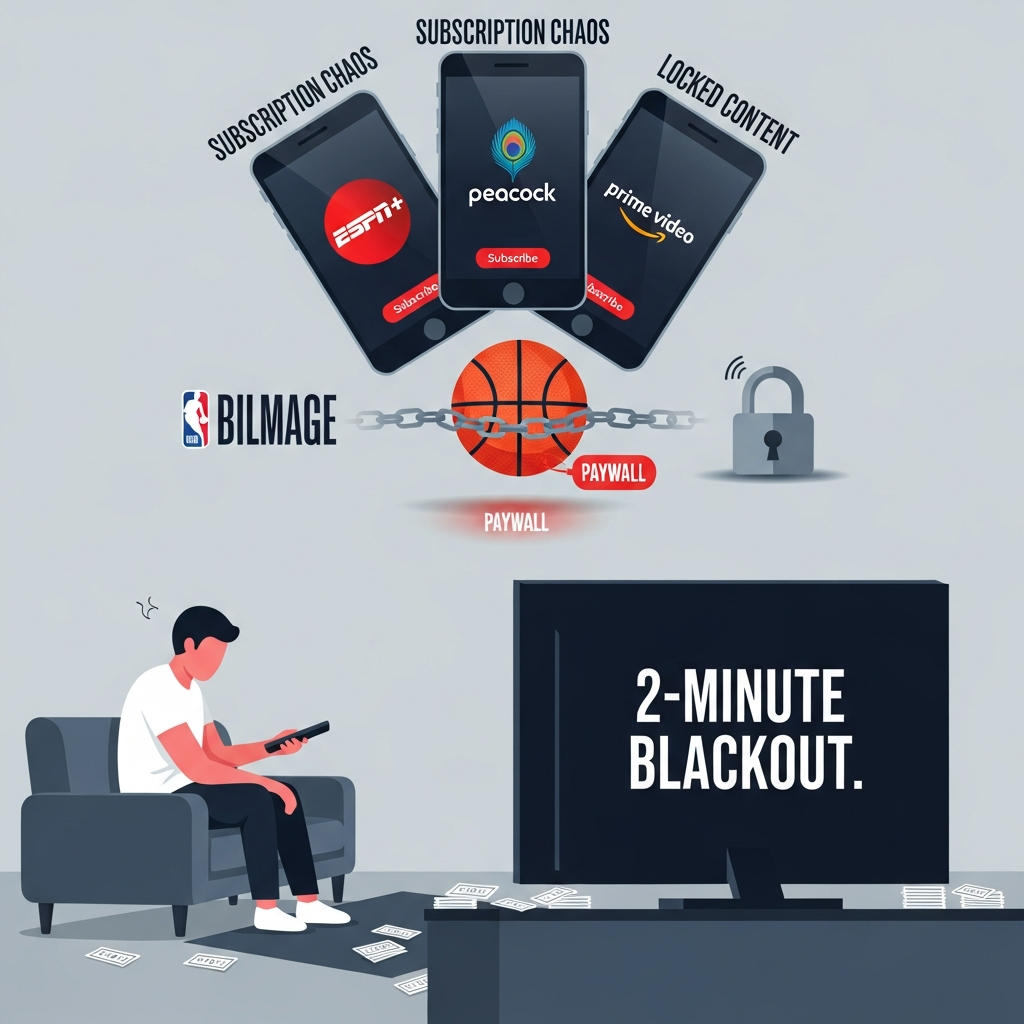
The NBA's 11-year, $77 billion contract with NBCUniversal, Disney's ESPN, and Amazon is the single largest media rights deal in professional sports history, generating approximately $7 billion per year — nearly three times the roughly $2.6 billion annual value of the preceding contract. The magnitude of this increase is historically unprecedented, but the financial architecture that makes it possible comes at a direct and concrete cost to fan accessibility. Amazon secured exclusive broadcast rights to the entire play-in tournament and a portion of playoff games for approximately $1.8 billion annually, meaning those games are simply unavailable anywhere else — not on ESPN, not on NBC, not through any competing service. Turner Broadcasting, which had partnered with the NBA for decades through TNT, was offered a matching opportunity but ultimately lost out when the league chose to prioritize Amazon's digital distribution reach over continuity with an established partner. The result is that complete playoff coverage now requires simultaneous active subscriptions to ESPN+ (approximately $11/month), Peacock (approximately $8/month), and Amazon Prime (approximately $15/month), adding up to more than $50 monthly — before accounting for the base internet and device infrastructure that streaming assumes. This isn't a marginal inconvenience; it represents a fundamental restructuring of the economic relationship between the league and its fans, converting what was once a cable-era commodity into a fragmented premium product that systematically excludes anyone unwilling or financially unable to pay the full multi-platform toll. The league has captured enormous value from this arrangement. The question of who bore the cost of creating that value has a clear and uncomfortable answer.
Amazon Prime Blackout — The Structural Breaking Point of Live Streaming
On April 14, 2026, during Amazon Prime Video's exclusive broadcast of the Hornets-Heat play-in game, the stream went completely dark for approximately two minutes — with the game tied at 127-126 in overtime, at what was arguably the single most consequential moment of that game's entire season arc. The failure isn't best understood as a simple server overload; technical analysts examining the incident have pointed to fundamental limitations in content delivery network architecture when subjected to the extreme simultaneous traffic that live sports generates at peak moments. A live playoff game on a major streaming platform produces concurrent viewership spikes that dwarf typical on-demand consumption patterns by orders of magnitude, creating infrastructure stress that no amount of standard capacity planning fully addresses. Amazon acknowledged it was conducting an internal investigation but has yet to release a formal explanation of the root cause or announce any compensation structure for the subscribers who paid their monthly fee and received a black screen at the decisive moment. Crucially, this is not the first incident of its kind: Amazon's own NFL Thursday Night Football broadcasts have experienced similar disruptions, and Apple TV+'s early MLB Friday broadcasts struggled with buffering that would have been unacceptable by cable standards. A pattern is emerging, and it is not an anomaly. The deepest irony is that the entity bearing the risk of these failures is not Amazon — it collected its broadcast fee regardless — and it is not the NBA, which received its rights payment in full. The entity bearing all the risk is the fan who paid a monthly subscription and got a black screen during overtime.
The Loyalty Tax — How Sports Leagues Monetize Fan Psychological Dependency
The concept I call the "Loyalty Tax" describes the mechanism by which professional sports leagues exploit the deep psychological dependency that decades of fandom create in order to extract increasing economic value without proportionate improvement in the product being delivered. An NBA fan who has followed the same franchise for 30 years has invested not just money but identity, memory, and social belonging into that team — and this investment cannot be rationally liquidated in response to pricing changes the way a consumer might switch streaming services over a television show. The league understands this dependency with precision and exploits it systematically. It has calculated where the mass-departure threshold sits, and it manages pricing and access restrictions to operate just below that line — extracting maximum value while preventing the kind of catastrophic fan revolt that could actually damage the brand's long-term commercial value. The structural parallel to how tobacco companies exploited nicotine dependency is uncomfortable but I believe analytically accurate: both involve an organization that has identified and deliberately monetized a form of psychological lock-in that customers cannot easily escape. The 2021 European Super League episode demonstrated powerfully that organized fan resistance can be overwhelmingly effective — twelve clubs abandoned the breakaway competition within 48 hours under coordinated fan backlash. However, American sports fan culture differs structurally from European football fandom in its history of organized collective action, making a directly comparable response less certain in the NBA context. The realistic leverage point is the 2035 contract renewal, and building a sustained advocacy movement around accessibility provisions before that date represents the most concrete path available to fans who want to change the current dynamic before it becomes permanently entrenched.
The Death of Regional Sports Broadcasting and the Erosion of Fan Identity
The effective elimination of the regional sports network — the RSN — is the least-reported but arguably the most culturally significant casualty of the NBA's media restructuring, and it is a change whose full human cost won't be felt for years. In the previous model, a Boston Celtics fan watched games through a Boston-based broadcast team whose voices, rhythms, and local references were deeply embedded in the community's shared experience of the sport across multiple generations. Local announcers were not simply commentators; they were emotional anchors for entire metropolitan fan communities, and their work built decades of place-specific sports culture that no national broadcast can meaningfully replicate. The shift to exclusively national broadcasts has replaced this with a uniform NBA brand voice, stripping the locally distinctive experience of fandom and substituting a product that is indistinguishable regardless of which team you support or where you live. The RSN collapse is not merely financial — it signals the conversion of sports from a community cultural institution into a standardized global media commodity. More than half of all U.S. regional sports networks are currently in serious financial distress or bankruptcy proceedings; Diamond Sports Group's Chapter 11 filing under the Bally Sports banner is the most prominent example of a trend with no reversal in sight. Once this infrastructure is dismantled and the institutional knowledge and community relationships behind local broadcasting disappear, rebuilding them becomes essentially impossible at any cost. The NBA is simultaneously claiming it has never cared more about growing the game while systematically eliminating the very local infrastructure that made fan communities feel like actual communities.
The 2026 Scoring Collapse and Its Connection to Media-Driven Schedule Overload
The 2026 NBA playoff scoring average has dropped from 115.6 points per game during the regular season to 106.8 — a decline of 8.8 points per game, representing the largest postseason scoring drop in modern NBA history by a substantial margin. Conventional basketball analysis would attribute some portion of this to the normal defensive intensification that characterizes playoff competition, but 8.8 points is categorically different in scale from typical postseason adjustments, and it demands a more structural explanation. Reporting from outlets including The Ringer has pointed toward fatigue caused by a more compressed and expanded schedule operating under the new media deal, with more games played across a denser calendar meaning players enter the playoff stretch with materially less recovery and diminished physical reserves compared to previous seasons. From a pure fan experience perspective, the scoring decline translates directly to less entertainment value: fewer explosive highlight plays, more grinding half-court sequences, diminished late-game drama from the high-variance offensive possessions that create the moments fans remember. This produces a compound fan experience failure — paying significantly more in subscription costs while receiving a product that delivers measurably less of what made the sport worth watching. The NBA has engineered a media architecture optimized for revenue extraction, and one of the observable downstream effects appears to be degradation of the on-court product that the revenue architecture was built to monetize. That is not a trade-off the league has been honest about with the fans funding the entire structure.
Positive & Negative Analysis
Positive Aspects
- Genuine and Measurable Expansion of Global Accessibility
Amazon Prime Video's distribution infrastructure spans more than 200 countries, and the NBA's international reach has genuinely expanded in ways the cable model could never have achieved at any price point. In the pre-streaming era, fans in Brazil, Indonesia, Nigeria, and dozens of other markets where basketball is rapidly growing had to rely on inconsistent country-by-country broadcast deals that frequently left playoff games unavailable, delayed, or accessible only through expensive satellite packages. Now a single Amazon Prime subscription provides direct playoff access regardless of geography, eliminating the entire country-specific licensing complexity that previously blocked international viewership. Estimates suggest the NBA's international viewership grew more than 25% in the 2025-26 season compared to the previous year, a concrete gain that is directly attributable to the global distribution leverage Amazon brings to the partnership. Over the long term, a genuinely global fan base is a structural asset that elevates the league's brand value and unlocks sponsorship and partnership revenue from markets that were previously peripheral, providing the financial foundation for the league's international ambitions in Africa, Asia, and Latin America. This is a real and meaningful benefit, and it deserves honest acknowledgment even in the context of serious domestic accessibility concerns.
- Higher Salary Cap Driving Player Compensation Across the Entire Ecosystem
The NBA's salary cap is structurally tied to league-wide revenues, and the explosion in broadcast income from the $77 billion deal has pushed the cap to historically unprecedented levels that directly benefit every player in the league. This improvement flows from franchise cornerstone max-contract players all the way down to developmental roster players fighting for guaranteed spots who would historically have been underpaid in their early career years. Enhanced G League and two-way contract compensation — both anchored to the broader salary structure — improves working conditions for players who haven't yet broken through at the top level, which strengthens the talent pipeline over time. Better compensation across the developmental ecosystem tends to correlate with stronger competitive motivation, reduced early-retirement pressure on stars managing injuries, and a more financially stable overall player environment. The counterargument that improved player compensation doesn't directly benefit fans watching games is technically accurate in the short run, but a league where players at every level are fairly compensated and professionally secure ultimately produces a more competitive, higher-quality product on the floor — which is what fans are paying to watch in the first place.
- Broadcast Technology Innovation Accelerated by Platform Competition
Competition among three well-resourced streaming platforms for viewer engagement and subscriber retention has produced a genuine wave of broadcast technology innovation that cable television's effectively monopolized delivery model would never have incentivized at the same pace. Amazon has introduced multi-angle camera selection, real-time statistical overlays, and player-specific tracking perspectives that allow engaged fans to follow the game at a granularity previously available only to coaching staffs and analytics departments. ESPN+ has deployed AI-driven automatic highlight generation and personalized alert systems that surface exactly the moments most relevant to each individual viewer. The competitive pressure to differentiate on the technical viewing experience is pushing all three platforms toward capabilities that are genuinely novel — social co-viewing features, interactive on-screen elements, and VR-adjacent immersive formats are reaching commercial viability through streaming-native experimentation that cable infrastructure could never structurally support. For fans who engage with basketball beyond passive viewing, this innovation pipeline represents a real and expanding improvement in the range and quality of available experiences, even if the baseline experience of simply watching the game has become more expensive and logistically complicated.
- International Revenue Diversification Building Long-Term League Financial Stability
The NBA's global expansion under the new media framework is constructing a revenue base that is substantially less dependent on any single domestic market or demographic, which has significant strategic value for the league's long-term financial resilience. International broadcasting rights, sponsorships from non-American brands seeking NBA's global platform, and merchandise revenue from new growth markets collectively represent a diversification that provides genuine protection against the kind of domestic audience erosion that the current fragmentation model risks accelerating over time. The league's investment in Basketball Africa League operations and its expanding presence in European, Southeast Asian, and South Asian markets are partly enabled by the visibility and distribution infrastructure that global streaming partnerships provide. In a scenario where domestic streaming revenue faces sustained pressure from subscriber fatigue, cord-cutting reversals, or regulatory intervention, a robust international revenue stream becomes a critical financial buffer that keeps the league commercially viable. This long-term strategic diversification has real structural value for the sustainability of the entire enterprise, even if its benefits are not immediately visible to the average domestic fan paying their monthly subscription bill.
Concerns
- The Structural Cost Explosion Hitting Every Fan's Wallet
The most direct and most broadly felt harm from the new media structure is the dramatic, structural increase in the financial cost of being a complete NBA fan. What once required a single cable subscription is now distributed across three separate streaming platforms, each with its own monthly fee and annual renewal, collectively demanding more than $50 per month for comprehensive playoff coverage. On an annualized basis, that translates to more than $600 per year in streaming costs attributable specifically to NBA access — an amount representing close to one percent of the median U.S. household income. The stratification this creates is not abstract or theoretical: fans from lower-income households, including the children of working-class families who might otherwise grow up watching basketball and developing the lifelong fandom the league commercially depends on, are the first to be economically excluded from the product. Beyond the immediate human cost, this exclusion is structurally self-defeating for the league's long-term health — the fans who become the most deeply emotionally attached, the season-ticket buyers and generational merchandise customers of the next twenty years, are being locked out during the developmental years when that attachment forms most powerfully. A league that prices out its own pipeline of future devoted fans is not growing sustainably; it is extracting present-day loyalty at the direct expense of the next generation's connection to the sport.
- Streaming Infrastructure Is Not Yet Structurally Reliable Enough for Live Sports
The Amazon Prime Video blackout during the Hornets-Heat overtime is not a random technical failure — it is a symptom of a fundamental structural mismatch between current streaming infrastructure capabilities and the extreme, uncompromising demands of live sports broadcasting at scale. Live playoff games on major streaming platforms generate simultaneous viewer spikes that create content delivery network stress of a qualitatively different order than on-demand viewing; the tolerance for latency, buffering, or complete interruption is effectively zero when you're watching a 127-126 overtime game that determines a team's season. Amazon has experienced comparable disruptions during NFL Thursday Night Football broadcasts, and Apple TV+ struggled with significant buffering problems during its early MLB Friday game broadcasts under similar conditions. Cable television infrastructure, whatever its other legitimate failures, essentially never produced a two-minute complete blackout during a playoff overtime in three decades of operation. Until streaming platforms can demonstrably prove end-to-end reliability under live sports peak-load conditions — not merely average-load or on-demand conditions — fans are being asked to pay premium subscription prices for a product that carries a non-trivial probability of failing at precisely the moments that matter most. That is not a reasonable value proposition, and it becomes less defensible with each documented recurrence.
- The Irreversible Loss of Local Sports Culture and Community Identity
The replacement of regional sports networks with nationally uniform exclusive broadcasts has eliminated an entire layer of sports culture that cannot be rebuilt once it has been dismantled, regardless of how much money anyone is willing to spend on reconstruction. Local announcers were not incidental to the fan experience — they were a foundational part of it, the familiar voices through which entire generations of fans experienced the full emotional spectrum of winning, losing, rebuilding, and contending alongside their city. The geographic specificity of local broadcast culture created a sense of community ownership over a team that purely national broadcasting simply cannot replicate, no matter how technically sophisticated the production quality becomes. With more than half of all U.S. regional sports networks currently in financial distress or bankruptcy proceedings, the infrastructure supporting genuinely local sports culture is collapsing in real time, and the institutional knowledge and community relationships embedded in those operations will not be reconstituted once they are gone. The NBA is transforming itself from a confederation of franchises with deep and distinctive local roots into a single homogenized global entertainment brand — and in doing so, it is eliminating the very thing that made fandom feel personally meaningful and culturally distinct. When every fan in every city watches the same broadcasters analyze the same league through the same national lens, the irreplaceable sense of your team as yours, and your city's relationship to basketball as something uniquely your own, quietly and permanently disappears.
- Illegal Streaming Surge as a Self-Defeating Threat to the Deal's Own Value
The profound irony of pricing loyal fans out of legitimate access is that it drives them directly toward the illegal streaming ecosystem — a dynamic that has already played out extensively in European soccer, where Premier League fragmentation across Sky Sports and TNT Sport produced a sustained illegal streaming surge that costs the league tens of millions of pounds annually in enforcement costs with demonstrably limited effectiveness at containing the behavior. The NBA is following an identical trajectory. Reddit's NBA community is already producing heavily upvoted threads where fans publicly announce their return to illegal streaming sites, and unofficial estimates suggest playoff-period illegal streaming traffic has risen more than 40% year over year. This is not simply an ethical or legal problem — it represents a direct and structural economic threat to the underlying value proposition of the $77 billion deal itself. The contract was built on projected advertising reach and subscriber growth projections; if a material fraction of the natural audience migrates to illegal streams instead, advertiser reach projections become inaccurate, advertising rates face sustained downward pressure, and the foundation of the entire rights valuation begins to erode from underneath. The league has built a structure that punishes its most loyal paying fans while inadvertently subsidizing a free alternative that grows more accessible and more capable the more the legitimate pricing pressure increases.
- Permanent Long-Term Damage to the Fan-League Emotional Compact
The most consequential harm — and the least quantifiable in near-term financial reporting — is the erosion of the foundational emotional compact between fans and the league that the entire commercial enterprise ultimately rests on. The NBA's existence as a multi-billion-dollar institution is entirely predicated on the willingness of millions of people to invest their emotional lives in its franchises: to watch the games through every medium available, buy the merchandise, purchase the tickets, argue the debates, and pass the devotion forward to the next generation. When the league converts that emotional investment from a relationship to be honored into a resource to be extracted — treating fan loyalty as a commercial input rather than a cultural bond — it damages the invisible infrastructure that the entire financial structure is built upon. The most telling response reported across fan communities in the aftermath of the Amazon blackout was not rage but resignation: a pervasive and spreading sense that the league fundamentally does not care about the people who love it. When the next generation of fans — currently in their teens and twenties — forms the conclusion that the NBA views them primarily as subscription revenue units rather than as community members with a legitimate stake in the sport's future, the emotional pipeline that feeds lifelong fandom begins to run dry in ways that won't show up in next quarter's earnings report but will absolutely appear in attendance figures, merchandise revenue, and cultural relevance measurements two decades from now.
Outlook
Let me start with the near-term picture — the next one to six months — because the immediate fallout from this blackout is still unfolding in real time. The 2026 Conference Finals and NBA Finals are right around the corner, with additional Amazon Prime exclusive broadcasts already scheduled. If a similar technical failure occurs even once during the Finals, this will transform instantly from a technology story into a full-blown political issue. The U.S. Federal Communications Commission could launch a formal investigation, and Congress could hold hearings specifically on streaming reliability standards for live sports. I place the probability of at least one Congressional hearing or official FCC statement before the end of 2026 at above 60%. Several Democratic legislators have already begun framing sports accessibility as a public interest issue, and in an election season, that framing finds a receptive audience among voters who feel priced out of watching their own teams.
Fan collective action is already beginning to crystallize into something more organized. The social media reaction immediately after the blackout was substantial, but it was still early-stage outrage. By the time the Conference Finals arrive, there is a real possibility that price reduction demands and calls for a bundled multi-platform subscription evolve into organized campaigns with genuine momentum behind them. Online petitions demanding a consolidated NBA playoff streaming package are already circulating, with signature counts climbing daily. What I find most telling is the signal coming from Reddit's NBA community: threads announcing a return to illegal streaming are receiving thousands of upvotes. This is precisely the signal the league should be most afraid of. Unofficial estimates suggest illegal streaming traffic during the playoffs has increased more than 40% year over year, and if this trend continues, the advertising revenue model that underpins the entire $77 billion deal starts to crack at its foundation.
In the medium term — six months to two years out — the most consequential variable is the domino effect this model has on other major sports leagues. The NFL already has an exclusive Amazon deal for Thursday Night Football and is reportedly exploring additional streaming-exclusive playoff games starting in 2027. MLB is in discussions to expand its Apple TV+ Friday games agreement, and Major League Soccer has already committed its entire schedule exclusively to Apple TV+. My assessment is this: if the NBA's streaming fragmentation model gets declared a financial success — judged by viewership aggregates and ad revenue rather than fan satisfaction scores — the probability that all four major U.S. professional sports leagues adopt a similar three-or-more-platform structure by 2027 or 2028 exceeds 70%. At that point, a comprehensive American sports fan could easily be paying more than $100 per month in combined subscriptions just to follow the major leagues. That's actually more expensive than the legacy cable packages everyone celebrated ditching a decade ago.
This fragmentation is also migrating globally at a rapid pace that most fans haven't fully registered yet. The English Premier League is already split in the UK between Sky Sports and TNT Sports, with international rights carved up country by country across entirely different platforms. UEFA Champions League coverage in the United States runs on CBS's Paramount+, while individual European markets each have their own dedicated broadcasters. The IPL — India's premier cricket competition — already set a precedent by separately selling digital rights to Jio and television rights to Star India in a bifurcated structure that the NBA's deal closely resembles. If the NBA's $77 billion framework becomes the global benchmark for sports rights negotiations, then when the Premier League's current deal expires in 2029, it is virtually certain that Amazon or Apple will arrive at the table with premium exclusive packages. I predict that by 2028, at least four of the world's top five sports leagues will be distributed across three or more streaming platforms simultaneously. The fragmentation that started with NBA basketball will consume football, cricket, baseball, and beyond — and each new fragmentation event will generate the same fan backlash cycle that's playing out right now.
Looking further out — two to five years — the most structurally ironic development I anticipate is what I'll describe as the rebirth of the bundle. Right now we're in peak fragmentation, but when consumer fatigue reaches a genuine tipping point, the market logic inevitably bends back toward aggregation. Netflix launched live WWE broadcasts in 2025. Apple owns MLS. Amazon holds both NBA and NFL rights. The pieces are already on the board. Between 2028 and 2030, I give a 55% probability to the emergence of a dedicated sports super-bundle: a single subscription — perhaps $40 to $50 per month — that packages NBA, NFL, MLB, and Premier League under one roof. The deep irony here is that this structure is essentially identical to what cable television was. The industry will have spent an entire decade dismantling cable, convincing everyone that fragmentation into individual apps was the future, only to reinvent cable under a streaming-native wrapper. We'll have gone full circle, except the new version will have better highlight generation and worse blackout record.
The most unsettling long-term transformation in this scenario isn't the pricing story — it's what happens to fan behavioral data. Streaming platforms can capture viewing behavior at a granularity that cable infrastructure never could approach. Which player's appearance on screen triggers a viewership spike? At what point in the third quarter do casual viewers start checking other apps? Does the ad break cause stream-switching or does it not? All of this is trackable in real time, at a per-viewer level. By 2030, I am confident that NBA fan behavioral data will be worth as much to these platforms as the broadcast rights themselves. The fan stops being an audience member and becomes a data point in a commercial intelligence system. That data will flow into advertising rate-setting, player marketing valuations, and — in a scenario I consider plausible but genuinely disturbing — into game scheduling decisions themselves. When primetime matchup selection gets driven by algorithmic audience prediction rather than competitive merit, the integrity of the sport sits on a foundation that is fundamentally compromised.
Let me be direct about the three scenarios I see playing out from here, because the range of outcomes is genuinely wide. In the optimistic bull scenario, Amazon responds to the blackout crisis by committing $200 to $300 million in dedicated sports CDN infrastructure investment, achieving near-uninterrupted live delivery by 2027. The three platforms cooperate to release a consolidated sports package priced below $30 per month — perhaps through a league-mandated bundling provision — international viewership doubles relative to current levels, and advertising revenue sufficiently offsets subscription dependency. A free-tier access program for lower-income households gets introduced, defusing the accessibility criticism before it reaches legislative momentum. I put this bull scenario at roughly 20% probability. The technical execution is achievable; the economic cooperation is not. Three competing commercial platforms have almost no financial incentive to collaborate on price reduction, and without regulatory pressure, that incentive structure doesn't change.
The base scenario is the most realistic, and that's precisely what makes it the most dispiriting. Amazon makes incremental technical improvements but doesn't fully solve the live-sports latency and reliability problem — expect one or two minor disruptions per season, not catastrophic Finals blackouts. Prices creep upward three to five percent annually in line with inflation. Fans complain loudly and continuously, post angry threads, sign petitions, and then maintain their subscriptions anyway because the emotional cost of quitting is simply higher than the financial cost of staying. Illegal streaming grows but remains manageable from the league's revenue perspective — irritating but not existentially threatening. I give this scenario 55% probability. It is the equilibrium state the NBA has deliberately engineered: bad enough to generate constant resentment, not quite bad enough to trigger mass departure. The league has calculated the fan breaking point with actuarial precision, and it will not cross that line. It will instead hover perpetually just beneath it, extracting the maximum that the traffic will bear.
The bear scenario involves a major, nationally-covered blackout during the 2026 Finals itself — and given the infrastructure vulnerabilities already demonstrated, this should not be treated as a tail risk. Such an incident would dominate national news cycles for days, crystallize the accessibility debate into concrete legislative momentum, and transform a sports story into a mainstream political issue in a mid-term election environment. The FCC opens a formal streaming reliability investigation. Congress drafts a sports access bill with bipartisan support from members in swing districts. Simultaneously, illegal streaming traffic surges by 50% or more year over year, and advertisers begin openly questioning the reach projections and reliability of NBA streaming as an advertising vehicle. The downstream consequence: when the 2035 rights contract comes up for renewal, the bidding environment is materially cooler than the current landscape, and rights fees could come in 20 to 30% below current levels. I assign 25% probability to this scenario, but its impact magnitude far exceeds the other two. If the NBA becomes the first major American sports league to experience a measurable decline in broadcast rights revenue at a renewal cycle, it will force every sports property on the planet to fundamentally reconsider its media architecture. That would be a genuine inflection point, not just for basketball, but for the entire global sports media economy.
One honest caveat before I close: I could be wrong in meaningful ways, and intellectual honesty demands I name those ways explicitly. If Amazon stabilizes its infrastructure faster than my analysis assumes and the league proactively introduces a credible low-income accessibility program, the current fan frustration may dissipate more quickly and more completely than I'm projecting. If AI-powered personalized broadcasting delivers genuinely revolutionary viewing experiences — multi-camera freedom, real-time tactical analysis, seamless social co-viewing — fans might embrace the premium pricing willingly, the way they embraced paying more for streaming over DVD rentals when the value proposition was self-evident. There is also a real structural difference between American sports fan culture and European football fandom when it comes to organized collective action; the coordinated mass resistance that killed the Super League in 48 hours reflects decades of European fan organizing tradition that simply doesn't have a direct American equivalent yet. These are legitimate variables that could cut meaningfully against my more pessimistic projections.
That said, I believe the structural pressures toward continued fragmentation and monetization are substantially stronger than the countervailing forces, and that belief is grounded in economic incentives rather than pessimism. For fans reading this with an eye toward practical action: ruthlessly audit your subscriptions and pay only for the platforms carrying games you actually watch. Refuse the psychological anxiety of feeling like you have to subscribe to all three simultaneously just to be a real fan. And if the accessibility provisions in the 2035 contract matter to you — and they absolutely should — the time to build the advocacy infrastructure for that fight is now, not two years from now when the negotiating framework is already locked and the leverage window has permanently closed.
Sources / References
- The Ringer: NBA Playoff Scoring Drop and Defensive Trends Analysis — The Ringer
- Techdirt: Amazon Prime Video Fails Completely During Several Minutes of NBA Playoff Game — Techdirt
- Yahoo Sports: NBA Playoffs TV Deal Brings Controversial Changes for Basketball Fans — Yahoo Sports
- Sportico: Amazon Prime Video Stream Glitch and Blackout Investigation — Heat vs. Hornets — Sportico
- The Southerner Online: NBA Viewership Regulations and Media Rights Deal Prioritizes Profit Over Fans — The Southerner Online
- Fox News: Amazon Prime Video Stream Cuts Out During Final Minute of NBA Play-In Tournament Game — Fox News
- Athlon Sports: NBA Playoffs TV Deal Brings Controversial Change for Basketball Fans — Athlon Sports