
The Night 54 Wins Died and Two Coaches Screamed at Halfcourt — Women's Basketball Is Changing Its Throne
Summary
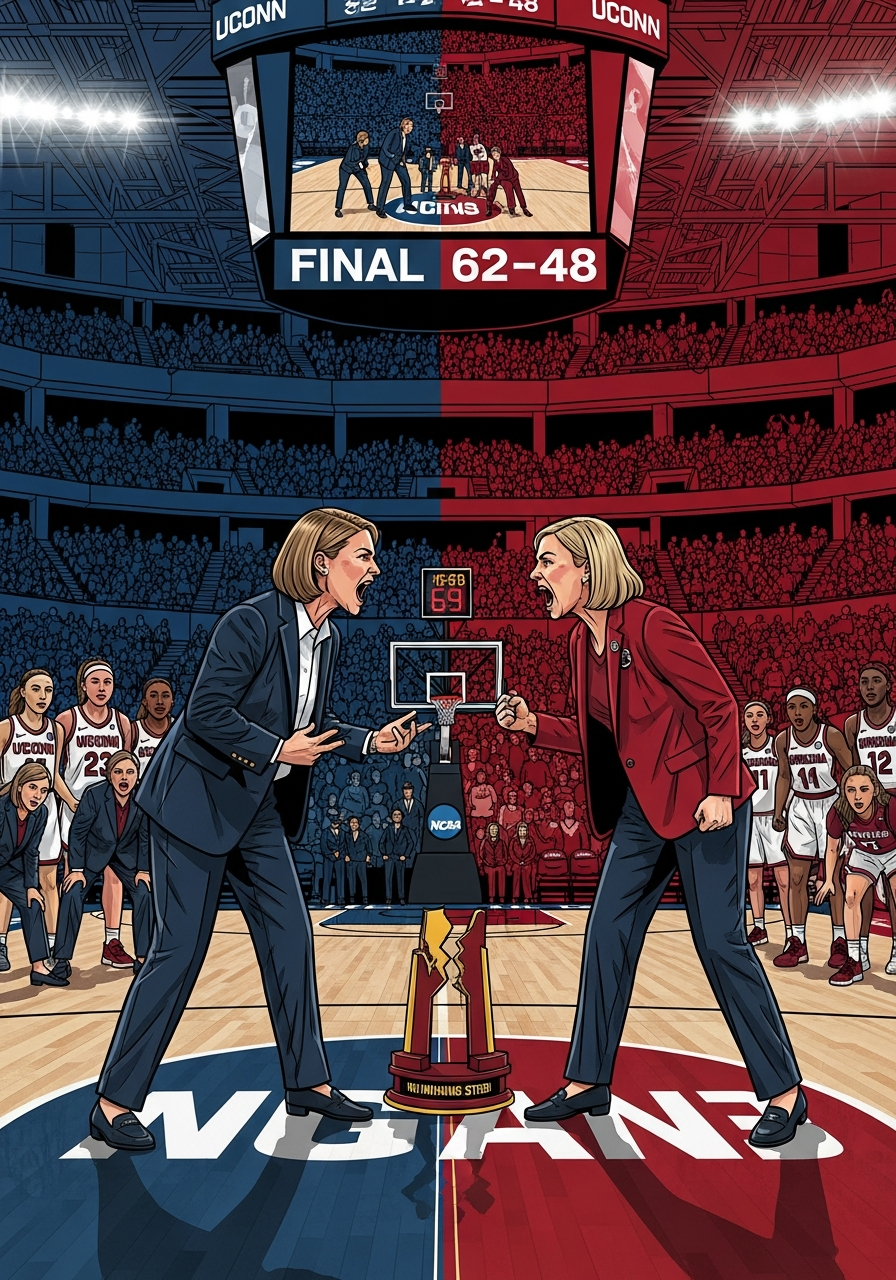
South Carolina shattered UConn's 54-game winning streak with a suffocating 62-48 victory, declaring a seismic power shift in women's basketball. The postgame halfcourt confrontation between Geno Auriemma and Dawn Staley — in which the 41-year coaching legend erupted at the woman who just dethroned him — has become the defining image of a dynasty in decline. Staley's methodical revenge, fueled by an 82-59 championship loss she turned into a year-long motivational weapon, crowned her as the sport's new standard-bearer while igniting a double-standard debate that transcends the court and elevates the broader narrative of women's sports.
Key Points
The Death of a 54-Game Streak and a Year-Long Revenge
UConn had been untouchable during their 54-game winning streak, winning by an average margin of 36.1 points. Dawn Staley kept the score 82-59 displayed on gym screens throughout summer workouts. South Carolina held UConn to 31% shooting, locked down Sarah Strong and Azzi Fudd to a combined 7-for-31, and dominated rebounding 47-32. Ta'Niya Latson delivered a 16-point, 11-rebound double-double going 10-for-10 from the free throw line.
The Halfcourt Clash: Emotional Outburst or Symbol of a Power Transfer
Moments after the final buzzer, Geno Auriemma approached Dawn Staley and erupted — pointing his finger at the floor and shouting aggressively. Assistant coaches and officials had to physically separate the two legends. Cameras caught Staley saying I will beat Geno's ass. Auriemma returned to the locker room without shaking hands. Broadcast footage showed Staley had hugged Auriemma before the game, contradicting his claims about a skipped handshake.
The Official Transfer of The Standard
In women's college basketball, The Standard has long been UConn's exclusive brand. Auriemma earned it through 12 national championships, a 111-game winning streak, and an all-time record of 1,250-165. Dawn Staley has built her own empire: three national championships (2017, 2022, 2024), six consecutive Final Four appearances (2021-2026), and a career record of 475-110 (.812). Yahoo Sports declared the standard has shifted from Auriemma/UConn to Staley/South Carolina.
The Double Standard Debate and Lisa Leslie's Rebuke
Auriemma accused Staley of ranting and raving on the sideline and said he wanted to make sure there's not a double standard. WNBA legend Lisa Leslie posted: It's a real shame that Geno took the low road. We have all had to lose with class. Geno needs to start with an apology. Andscape published an analysis noting Staley's restrained remarks reflect a restraint familiar to Black women.
Women's Basketball After Caitlin Clark: The Power of Narrative
The 2024 championship drew 18.9 million viewers surpassing the men's final. The 2026 tournament averaged 931,000 viewers (down 34% from 2024) but recorded the third-highest viewership in history. Women's basketball is transitioning from individual stardom to structural competition between programs — a more sustainable shift for the sport's future.
Positive & Negative Analysis
Positive Aspects
- Women's Basketball Gains Genuine Narrative Depth
The Staley-Auriemma rivalry has created a long-term narrative arc rarely seen in women's sports. The halfcourt confrontation clip was shared millions of times. ESPN, CBS Sports, Fox News, and every major outlet led with this story, validating that women's sports possess independent capacity to generate dramatic narratives.
- Dawn Staley's Leadership as a Masterclass
Staley's concise deflection followed by the pivot to concentrating on winning the national championship seized control of the narrative. As Andscape analyzed, this restraint reflects the self-control Black women leaders routinely practice in professional settings.
- Post-Clark Sustainable Growth Confirmed
The 2026 NCAA women's tournament recording the third-highest viewership in history demonstrates the sport's appeal endures without an individual superstar. The 2026 figure of 931,000 exceeds every pre-2022 year.
- Women's Sports Media Value Redefined
This incident proved women's sports can produce media content extending far beyond game results. A single game produced 4-5 days of continuous news coverage. Nielsen reported 46 billion minutes of women's sports consumption in 2025.
Concerns
- Risk of Unprofessional Framing for the Confrontation
In men's sports, similar incidents are romanticized as competitive fire. In women's sports, identical behavior risks being interpreted as lack of control. Some social media reactions criticized both coaches for tarnishing women's basketball's image.
- Structural Viewership Decline Remains a Concern
The 64% drop in Final Four viewership — from 10.8 million to 3.9 million — reveals structural challenges. Broadcast partners and sponsors make investment decisions based on peak-to-trough decline metrics.
- The Lingering Poison of the Double Standard Remark
Auriemma's double standard comment was interpreted as carrying racial implications. A 72-year-old white male coach telling a Black female coach that some people are allowed to talk to officials like that touched a deeply sensitive nerve.
- Questions Around South Carolina's Dynasty Sustainability
UConn maintained elite status for over 30 years while South Carolina's concentrated dominance spans less than a decade. The NIL era and transfer portal make long-term talent monopolization far more difficult.
Outlook
What does this incident truly mean, and where is women's basketball headed from here? I want to break down the outlook into short-term, mid-term, and long-term perspectives with concrete scenarios.
Starting with the short-term (1-6 months), the most immediate impact centers on the 2026 championship game and media environment. South Carolina faces UCLA today (April 5), and the halfcourt confrontation has elevated interest beyond initial projections. The semifinal drew 3.9 million viewers, but the additional media exposure could push championship viewership into the 5-7 million range on ABC.
If South Carolina prevails, it becomes their fourth title (2022, 2024, 2026) — an unmistakable dynasty. If UCLA wins, the program's first NCAA championship since 1978 with Lauren Betts ascending as a new star. Either result is a win for the sport.
Auriemma has already apologized publicly, but the NCAA could impose separate disciplinary action. Historically, the NCAA has been lenient with postgame coaching conduct. Across media, this incident will dominate conversation for 2-3 weeks, functioning as free marketing. On recruiting, South Carolina becomes the immediate beneficiary with the 'championship team whose handshake was refused' narrative.
For the mid-term (6 months to 2 years), three scenarios emerge. The Bull Case (30%): formal reconciliation reframed as 'an emotional moment in a great rivalry,' with 2027 regular season games attracting 5M+ viewers. The Base Case (55%): surface-level reconciliation with fierce internal competition, viewership stabilizing at 930K-1M average with Final Four audiences of 4-6M as the new normal. Competitive parity expands from 2-3 powers to 5-6. The Bear Case (15%): festering conflict, media fixating on coaching drama over play quality, tournament viewership dropping below 600K by 2028.
The WNBA pipeline is another critical variable. How effectively college interest converts to WNBA viewership determines the ecosystem's health. Ta'Niya Latson, Lauren Betts, and Sarah Strong must sustain the Clark-generated momentum after graduation.
Long-term (2-5 years): Auriemma's retirement timeline (age 72, 41 years at UConn, 1,250 wins) represents an era's end. Staley's legacy trajectory (age 55, potentially a decade remaining, 6-8 championships theoretically achievable) is the most consequential variable. The approaching women's sports media rights mega-cycle (2028-2030) with Nielsen's 46 billion minutes measurement signals standalone major contracts. The transition to multipolar competition is already underway — UCLA, LSU, Texas emerging alongside UConn and South Carolina. The 'double standard' discourse will reverberate through coaching hiring, media coverage, and officiating training.
The April 3, 2026 semifinal will be remembered as a watershed moment. The end of a 54-game streak, a halfcourt confrontation, and a double-standard debate — all compressed into one game. Women's basketball is evolving beyond on-court excellence into a sport consumed through narrative and cultural significance.
One final number: UConn's 111-game streak was broken in 2017 before 3 million viewers. This 54-game streak ended before 3.9 million. The streak was less than half the length, but viewership was 30% higher. That single data point captures how far women's basketball has traveled in a decade. The throne is shifting. And the process of that shift is precisely what is making women's basketball a great sport.
Sources / References
- South Carolina, Fueled by 2025 Loss, Upsets Undefeated UConn — ESPN
- Frustrated Auriemma Gets Into Heated Sideline Spat With Staley After Loss — ESPN
- No Excuse: Geno Auriemma Apologizes to South Carolina After Post-Game Confrontation — CNN
- WNBA Legend Lisa Leslie Demands Geno Auriemma Apologize for Dawn Staley Exchange — Newsweek
- Dawn Staley's Remarks on Rival's Outburst Reflect a Restraint Familiar to Black Women — Andscape
- As South Carolina Chases 3rd Championship in 5 Years, the Standard Shifted From Geno Auriemma and UConn to Dawn Staley — Yahoo Sports
- Women's Final Four Delivers Nearly 4M Viewers, Still 64% Drop — Front Office Sports
- NCAA Women's Tourney Trails Past Two Years, Still on Higher End Historically — Sports Media Watch
- South Carolina Smothers UConn 62-48 to Advance to NCAA Title Game — University of South Carolina Athletics
- Geno Auriemma, Dawn Staley Get Into Heated Exchange After UConn's Final Four Loss — CBS Sports
- South Carolina Smothers UConn 62-48, Snaps Huskies' 54-Game Win Streak — Washington Post
- Double Standard on Display When Geno Auriemma Came for Dawn Staley — Sports Illustrated
- Nielsen: 46 Billion Minutes of Women's Sports Were Consumed in 2025 — Nielsen
- Geno Auriemma Apologizes for Final Four Dustup With Dawn Staley — NBC News
- Women's Final Four Teams Reflect on the Transfer Portal's Impact — Fox Sports
- Ta'Niya Latson's Double-Double Leads South Carolina to Stunning Upset of UConn — On3
- HBCU Commissioner Condemns Disrespect of Black Women After Auriemma-Staley Clash — HBCU Sports