
Real Gone, Barca Gone — The UCL Semifinals Finally Set Football Free
Summary
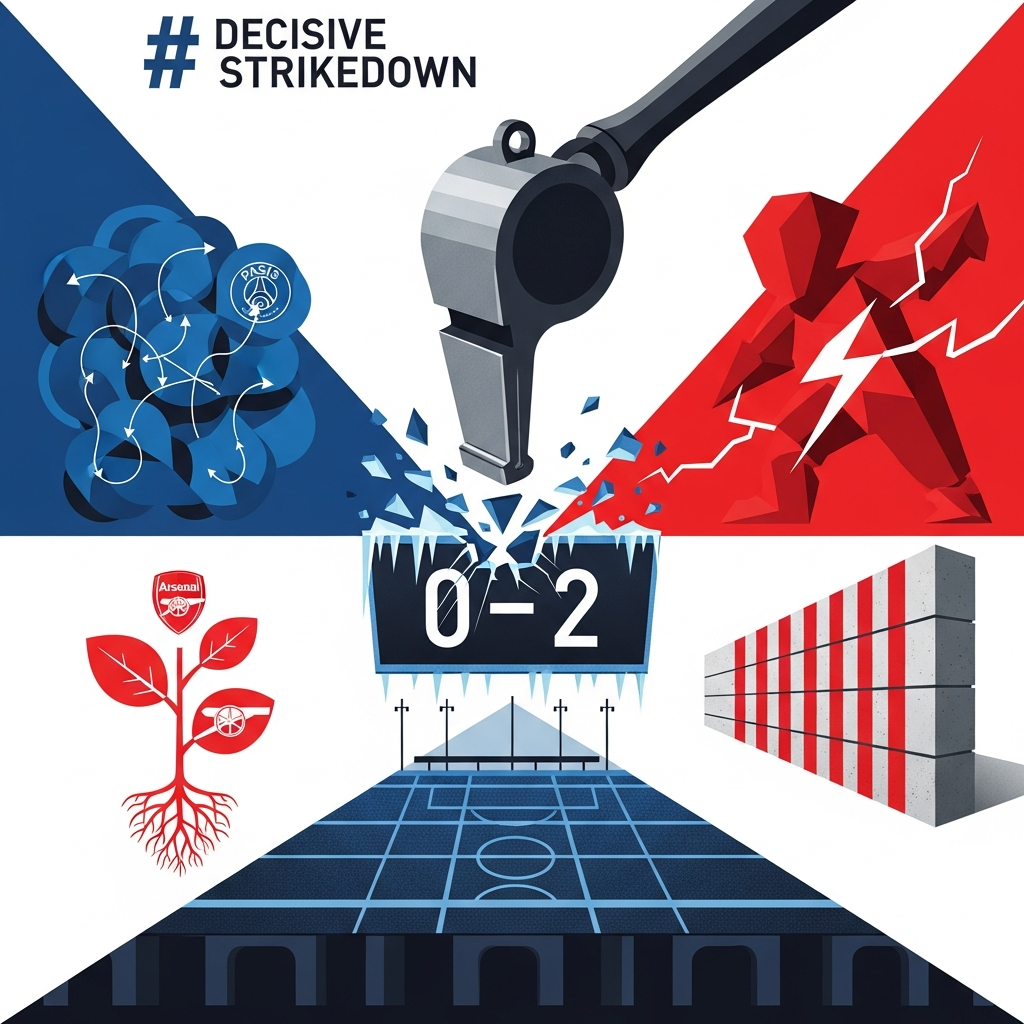
The 2025-26 UEFA Champions League quarterfinals produced one of the most historically significant results in the tournament's 70-year history: Real Madrid and FC Barcelona were eliminated simultaneously, stripping the competition of clubs that together hold twenty European titles and have defined the tournament's identity across generations. Barcelona fell 2-3 on aggregate to Atlético Madrid after a shockingly limp 0-2 home defeat at Camp Nou, prompting club president Joan Laporta to file multiple formal complaints with UEFA over refereeing decisions — complaints UEFA promptly dismissed as inadmissible. The resulting semifinal field of PSG, Bayern Munich, Arsenal, and Atlético Madrid embodies four entirely distinct philosophical approaches to modern football: collective high-press, dramatic resilience, patient long-term rebuilding, and uncompromising defensive organization. Beneath the sporting drama, however, lies a structural governance crisis: UEFA's practice of self-adjudicating complaints against its own referees constitutes a textbook conflict of interest that has drawn criticism from clubs across Europe for decades, and Barcelona's high-profile protest has reignited that debate with unprecedented intensity. This analysis argues that the absence of the traditional Big Two signals not a diminishment of the competition but a genuine liberation of football's tactical ecosystem, while simultaneously identifying the structural reforms that European football's governing body can no longer afford to delay.
Key Points
Barcelona's Refereeing Complaints and the Line Between Protest and Self-Deception
Barcelona exited the Champions League quarterfinals 2-3 on aggregate against Atlético Madrid, and president Joan Laporta responded by filing multiple formal complaints with UEFA. The specific objections included the claim that Cubarsí's red card should have been a yellow, that a handball by Marc Pubill went uncalled as a penalty, that Ferran Torres's goal was wrongly disallowed for offside, and that Atlético goalkeeper Musso faced no punishment after appearing to strike Fermín López. Laporta described the officiating as "a disgrace, intolerable" and took the extraordinary step of reaching out directly to UEFA president Čeferin — a move that goes well beyond standard appeals procedure and signals how intensely the club is committed to this fight. UEFA rejected the first complaint as inadmissible, and the second complaint is widely expected to meet exactly the same fate. However, the entire premise of Barcelona's grievance rests on a deeply uncomfortable fact: the team failed to score a single goal in the first leg at Camp Nou, their home ground, in front of 80,000 supporters. A team that cannot capitalize on home advantage in a knockout tie and then attributes its elimination primarily to officiating is engaging in a form of accountability avoidance that undermines the credibility of whatever legitimate points it might have about individual decisions. Even within Barcelona's own fan community, the reaction to Laporta's appeals has been divided — a significant portion of supporters have argued that the Camp Nou performance itself deserves scrutiny first, and that refereeing complaints risk becoming a distraction from addressing the tactical vulnerabilities Simeone's team so clinically exposed.
UEFA's Self-Adjudication Structure and the Governance Conflict of Interest
The current UEFA system for handling club complaints about referee decisions has a fundamental structural problem: UEFA's own internal bodies receive the complaint, evaluate the complaint, and dismiss the complaint, with no independent external review at any stage of that process. This is not a new criticism — it is a criticism that Manchester City, Chelsea, Juventus, Liverpool, and dozens of other clubs across multiple decades have articulated after their own controversial eliminations, and every time the answer has been the same internal dismissal. The conflict of interest is not subtle: UEFA is an organization funded in significant part by the contributions and broadcast revenue generated by the same clubs that are filing complaints against its officiating decisions. In any judicial or quasi-judicial context, this arrangement would be immediately recognizable as requiring independent oversight. Cricket's ICC addressed a directly analogous problem in 2008 with the Decision Review System, which moved final arbitration on disputed umpiring calls to a technology-based independent verification system rather than leaving it in the hands of the official whose decision was being challenged. Tennis has Hawk-Eye. Football has VAR, but VAR is operated and supervised by UEFA-appointed officials, and there is no independent post-match review mechanism for the decisions those officials make. The English Premier League maintains referee oversight through PGMOL, a body that operates with greater independence from club interests, but UEFA has nothing equivalent at the continental level. Until that structural gap is addressed, controversies like Barcelona's 2026 complaint will repeat themselves every season with different protagonists but the same structural dynamic driving the same institutional frustration.
The Historical Significance of Real Madrid and Barcelona's Simultaneous Quarterfinal Exit
In 70 years of Champions League history, the simultaneous quarterfinal elimination of Real Madrid — fifteen-time champions — and FC Barcelona — five-time champions — has happened only a handful of times, making this season's result genuinely historic. Together, these two clubs account for twenty of the competition's titles, representing nearly 29% of all Champions League trophies ever awarded, and their commercial presence consistently generates the competition's highest global broadcast figures. Real Madrid went out 3-4 on aggregate to Bayern Munich, with the second leg — a 4-3 Bayern win from a 3-1 deficit — producing what may be the single most dramatic match of the entire 2025-26 competition. Barcelona lost 2-3 on aggregate to Atlético, with the Camp Nou first leg's 0-2 result being the decisive moment of the tie. The simultaneity of these exits is not random noise: it reflects real structural changes in European football, including the growing financial competitiveness of the Premier League ecosystem, the tactical evolution of clubs outside Spain's traditional powers, and the new 36-team league format's tendency to front-load difficult fixtures in ways that tax even the deepest squads. The Galáctico model and the Barcelona possession model — the two dominant paradigms of Spanish football for fifteen years — have both demonstrably failed to produce Champions League success this season, and that dual failure invites serious structural reassessment rather than one-off explanations rooted in refereeing or misfortune.
The Four Football Philosophies Colliding in the Semifinals
What makes this semifinal genuinely compelling is not simply that Real and Barcelona are absent — it's that the four clubs who remain each represent a completely distinct and coherent vision of how to win at the highest level of club football. PSG under Luis Enrique have undergone one of the more dramatic institutional transformations in recent European football: from a Galáctico model built around Mbappé, Neymar, and Messi to a collective high-press system where no individual carries disproportionate tactical burden, backed by a 2025-26 Ligue 1 PPDA of 8.3 that places them among Europe's most aggressively pressing sides. Bayern Munich represent something fundamentally different: the culture of collective resilience and dramatic late-game comeback, encapsulated in the 4-3 second-leg win over Real Madrid where a trailing team recovered through organized collective pressure rather than individual brilliance. Arsenal embody the longest and most patient of these four stories — seventeen years absent from this stage, rebuilt through Arteta's five-year plan combining academy development with precision recruitment rather than financial shock treatment. Atlético Madrid, finally, represent the most contrarian philosophy in modern European football: the belief that defensive organization and tactical discipline defeat aesthetic possession football not in spite of its quality but because of the intelligence required to implement that discipline under sustained pressure. Simeone's system has now silenced Barcelona's possession machine in two separate competitive contexts, which is about as compelling a refutation of "beautiful football always wins" as you can produce in elite competition. Four clubs, four completely incompatible answers to the same fundamental question — and no obvious hierarchy between them heading into the semifinals.
What Arsenal's Return After 17 Years Proves About Modern Football
Arsenal's presence in the 2026 Champions League semifinals deserves particular attention as evidence that European football's power structure is more genuinely open than its financial concentration suggests. In 2020, Arteta inherited a club sitting eighth in the Premier League with a fragmented squad and no coherent tactical identity, and what followed was five years of precise, patient construction: Saka developed through the academy into one of Europe's most effective wide attackers, Saliba was signed for £27 million and loaned out three times over three years before emerging as a genuinely elite center-back, and Rice was identified and signed as an architecturally essential central midfielder whose presence reorganized the team's structural logic. None of this happened through financial shock treatment or the imposition of a pre-built squad. It happened through managerial conviction, ownership patience, and the willingness to absorb two Premier League runner-up finishes — each one painful in its own way — in service of a longer vision that required time to materialize. The Champions League semifinal appearance in back-to-back seasons is the return on that investment, and the squad's average age suggests the ceiling hasn't been reached. In a football economy dominated by narratives about sovereign wealth fund investment and nine-figure transfer fees, Arsenal's arc is a reminder that structural clarity and managerial time still produce results at the very highest level — and that remains genuinely important for every club that cannot spend its way to the top of European competition.
Positive & Negative Analysis
Positive Aspects
- The Healthy Revival of Tactical Diversity at the Top of European Football
For several years, the Champions League knockout rounds had begun to feel like an elaborate process designed to confirm that Real Madrid would eventually be in the final. Real reached six of the last ten finals before this season and won four of them, and the accumulated weight of that dominance had genuinely narrowed the competition's sense of open possibility. This semifinal erases that feeling entirely. The four clubs remaining — PSG with their collective press, Bayern with their resilience culture, Arsenal with their patient build-up, Atlético with their defensive discipline — don't just represent different clubs; they represent four genuinely incompatible answers to the question of how you win at the highest level. None of them is obviously correct over the others in the specific head-to-head matchups these semifinals will produce. When football is structured this way — when there's no single correct answer, no established hierarchy of approaches that renders the outcomes predictable — it becomes most fully itself as a sport. The conversation around each match is no longer "can anyone beat Real?" but "which philosophy wins when they directly collide?" That is a richer and more engaging conversation, and it draws in fans who are watching genuinely different teams pursuing genuinely different solutions to the same competitive problem. Tactical diversity at the top of European football is not a bug — it is the feature that makes the sport worth caring about.
- Proof That Patient Long-Term Project Building Can Compete at the Highest Level
Arsenal's semifinal appearance is the most important piece of evidence in recent Champions League history that patient long-term project building can compete with financial shock treatment as a route to European relevance. The dominant narratives in European football over the past decade have been built around petrodollar investment, hedge fund ownership, and the idea that rapid squad construction through elite transfer spending is the only reliable route to the top of the competition. Arsenal's five-year Arteta project directly challenges that story in measurable terms. Saka came from the academy. Saliba was developed through four years of carefully staged loan management before being integrated as a starter. Rice was an expensive but architecturally precise signing who reorganized how the team functions structurally rather than simply adding individual quality. The squad was built around a coherent tactical identity rather than assembled from individual star purchases and then asked to find a system that accommodates them all. Two Premier League near-misses were absorbed without managerial panic or ownership demanding a pivot to short-term thinking. The result is a club now consistently present at the final stages of European competition in consecutive seasons, with a squad whose development trajectory continues upward. For every mid-level club watching from the outside, Arsenal's arc represents a real and replicable model — and that matters for the health of the broader football ecosystem.
- Barcelona's Complaint Has Forced a Long-Overdue UEFA Governance Conversation
Whatever the specific merits of Barcelona's individual refereeing appeals, the wider effect of Laporta's very public, very sustained, and very political campaign against UEFA's officiating has been to force a structural question into mainstream football discourse that deserved serious attention long before this season. The question — who independently reviews decisions made by officials appointed by UEFA, when those decisions are disputed by clubs whose contributions fund UEFA? — has been raised quietly by multiple clubs over multiple decades, and each time it has been absorbed and dismissed through internal process. Barcelona's 2026 campaign has raised it loudly, publicly, and with enough political backing that it is generating regulatory attention beyond the football world itself. The UK established its Independent Football Regulator in 2024. The EU Parliament's interest in sports governance has been sharpening since 2025. Germany and France are watching the English model with genuine interest as a potential template. This is no longer simply a sporting governance issue — it is becoming a regulatory and political issue that UEFA's internal processes may not be sufficient to contain indefinitely. Barcelona's specific complaints will almost certainly be rejected, as will the second appeal. But the structural argument they've accidentally articulated has a lifespan that extends well beyond this season's exit, and UEFA's self-adjudication structure is a problem that genuinely needed a noisy, high-profile protagonist to push it into the open where it belongs.
- Fresh Storylines and Genuine Uncertainty About the Outcome
The Champions League's most commercially and emotionally valuable product is narrative — the story of who wins and why, constructed match by match and decision by decision through a knockout format that rewards coherence and resilience over a sustained period. This semifinal has more genuine, unmanufactured narrative than any Champions League knockout round in recent memory. Arsenal's seventeen-year absence makes their appearance feel both earned and long-awaited in a way that annual semifinalists simply cannot replicate. PSG are proving that a project built without superstar individuals can reach the final four of European football's premier competition. Simeone is getting another chance at a Champions League final after his last appearance a decade ago in 2016. Bayern's extraordinary late comeback against Real Madrid in the quarterfinals has given their semifinal run a dramatic momentum that's difficult to manufacture through any other means. None of this was scripted by a marketing department — it emerged from years of coaching decisions, player recruitment, tactical development, and competitive results unfolding in real time. The uncertainty about who actually wins the semifinal and lifts the trophy in Budapest is entirely genuine: a credible case can be constructed for any of the four clubs. That is not a situation that described the last several Champions League cycles, when Real Madrid entered the knockout rounds as heavy favorites who required serious eliminating. The result is a tournament that rewards watching carefully rather than assuming the outcome — which is, when you think about it, what sport is supposed to feel like.
Concerns
- The Commercial Risks of a Real and Barça-Free Final
The absence of Real Madrid and Barcelona carries real financial consequences that UEFA cannot simply dismiss with philosophical arguments about tactical diversity and competitive health. Broadcast data consistently shows that Real Madrid's participation in a Champions League final generates approximately 15-20% higher global viewership than a final without them — a gap that translates directly into tens of millions of euros in advertising premium for broadcasters and, through revenue distribution mechanisms, to the clubs participating in the competition. The Spanish television market, historically one of UCL's most commercially significant, faces projected viewership declines exceeding 30% for the remaining semifinal rounds given the absence of both major domestic clubs. UEFA's revenue structure is approximately 70% dependent on broadcasting rights, meaning sustained absence of marquee clubs from the late rounds creates genuine medium-term revenue pressure on the entire distribution system — pressure that eventually reaches even smaller clubs who depend on UEFA development payments for financial stability. This is the structural irony at the heart of this "liberated" semifinal: the tactical diversity worth celebrating may be undermining the economic foundation that allows that diversity to exist and be broadcast globally. If the commercial impact proves significant enough, institutional pressure to redesign the competition in ways that better guarantee marquee club participation in late rounds will intensify, potentially producing format changes that work against the very competitive equity this season has produced.
- Barcelona's Grievances Could Revive Super League Momentum
The pattern of Laporta's response to Barcelona's elimination — filing formal complaints, going directly to UEFA's president, constructing a sustained narrative of institutional injustice — is not simply about refereeing disputes in isolation. It is the construction of a political argument: that UEFA cannot be trusted to treat its biggest clubs fairly, and that an alternative structural arrangement is therefore not merely desirable but justified. In 2021, Barcelona was one of three clubs — alongside Real Madrid and Juventus — that refused to withdraw from the Super League project even after nine other founding clubs abandoned it under fan and regulatory pressure. The European Court of Justice's 2023 ruling gave the Super League's legal architecture partial validation, meaning the threat is not empty. Barcelona's current debt position — approximately €1.3 billion — means the club has structural financial incentives to find a competition format that generates larger revenues than UEFA currently distributes. A narrative that "we followed the rules, we appealed correctly, and UEFA still treated our concerns as irrelevant" is the single most politically effective tool available for building club owner support for a structural breakaway from UEFA's ecosystem. If Laporta successfully frames this season's exit as institutional bias rather than tactical failure, he creates momentum that could bring three of European football's most powerful clubs back into Super League discussions precisely when UEFA's governance is under external regulatory scrutiny. The long-term stability of European club football's unified structure depends on resolving this tension constructively, and Barcelona's current trajectory is moving in the wrong direction.
- Reforming UEFA's Governance Structure Is Genuinely Difficult
The structural argument for independent referee oversight in Champions League football is clear and compelling, but the institutional path to actually implementing it is considerably more complicated than the argument itself suggests. UEFA is a political organization representing 55 national associations, each of which has its own interest in protecting the jurisdiction and sovereignty of its national referee systems. Agreeing to route appeals about referee decisions through an independent external body means ceding a degree of national referee sovereignty to a supranational institution — which is, politically, a much more sensitive step than simply introducing technology like VAR as an additional tool within the existing system. The VAR implementation process itself is instructive: from FIFA's first serious discussions about video review in 2012 to full World Cup deployment in 2018 took six years, with extensive political negotiation at every stage and significant technical controversy persisting after implementation. An independent adjudication body for referee disputes would be politically more sensitive than VAR because it directly challenges UEFA's institutional authority rather than simply adding a technical tool to referees' existing decision-making process. UEFA president Čeferin has not shown meaningful appetite for voluntarily surrendering institutional power, and the 55-association assembly structure makes it extremely difficult to build the qualified majority needed for genuinely structural governance reform. The most realistic outcome is that any reform proceeds incrementally, cosmetically, and over a longer timeframe than advocates for change would consider adequate — which means the structural problem Barcelona has highlighted this season will persist long after the specific complaints of 2026 are forgotten.
- The Structural Inequality of European Football Remains Essentially Intact
A semifinal without Real Madrid and Barcelona might look like evidence that European football's power hierarchy has been democratized, but a clear-eyed structural analysis shows that the underlying inequalities remain essentially unchanged by this season's results. The four semifinalists are not scrappy underdogs — they are each among the top revenue-generating clubs in their respective leagues, backed by significant commercial infrastructure, and benefiting from UCL coefficient seedings that preferentially place them against weaker opponents in earlier rounds. The 2025-26 season's 36-team format seeding system was designed specifically to reward historical UCL performance, which means clubs with the longest traditions of deep runs receive structural draw advantages that smaller clubs never access. Real and Barça's absence this year is better understood as a one-season tactical underperformance by clubs whose financial foundations remain unchanged than as evidence that the competition's structural hierarchy has meaningfully shifted. The probability of both clubs returning to the semifinals within two seasons is substantial, given their revenue base, global recruitment reach, and institutional capacity to diagnose and correct tactical problems. The deeper story of European football's structural inequality — the widening gap between Premier League broadcast revenues and every other league's equivalent, the UEFA coefficient system's compounding effect on competitive access, the concentration of youth development resources in established powerhouses — remains entirely unaffected by this season's quarterfinal results. Celebrating this semifinal as democratization of European football risks significantly overstating what is likely to prove a temporary exception rather than a durable structural realignment.
Outlook
The immediate picture is clear: the semifinal first legs on April 28-29 are the first real test of everything this unusual quarterfinal stage has set up. PSG vs. Bayern Munich is the match I'm watching most closely, because it's effectively the shadow final — the winner of that tie becomes the heavy favorite in Budapest. Luis Enrique's pressing system has been constructed precisely for this kind of high-stakes environment, and the Parc des Princes is a brutal place to visit when PSG are executing their press at full intensity. I expect PSG to take a narrow first-leg lead of 1-0 or 2-1 at home, though Bayern have already demonstrated against Real Madrid that they can find answers under pressure when Musiala and Sané are operating at their ceiling. The key variable is whether PSG can maintain their pressing intensity for ninety minutes — when they have, they've been close to unplayable this season.
The Atlético–Arsenal fixture has a quieter surface energy but a tactical depth that rewards close attention. Both Simeone and Arteta are coaches who treat conceding goals as strategic failure rather than acceptable collateral damage, and that shared mindset tends to produce low-scoring, high-intensity encounters where marginal details — a set-piece sequence perfected in training, a goalkeeper reading the right cross at the right moment, a defensive line holding its shape for eighty-nine minutes — decide outcomes. I think this series produces 0-0 or 1-1 in the first leg, with the aggregate series potentially going to extra time; I put that probability at roughly 40%. The Metropolitano is one of the most hostile environments in European football for visiting sides, and Simeone's Champions League knockout record at home over twelve years of management is genuinely remarkable. Arteta will have studied it with extreme care.
Barcelona's second UEFA appeal will almost certainly be rejected before the end of May. Once UEFA dismisses a first complaint through its own internal process, reversing that decision would be tantamount to admitting the process itself was flawed — a politically impossible move for any institution with basic self-preservation instincts. A 90%-plus probability of rejection doesn't mean the story ends there, though. Laporta has been building a narrative, and the formal rejection is actually a useful component of it: "We appealed correctly, we followed every procedure, and UEFA still dismissed us" is a significantly stronger political argument than simply losing on the pitch. That narrative will shape Barcelona's summer transfer window positioning, giving Laporta cover for aggressive investment and redirecting fan frustration outward rather than at the club's own management decisions.
Looking six to twelve months ahead, I believe UEFA will face genuine institutional pressure to reform its referee oversight structure. Barcelona's campaign has done something years of quieter protests could not: it generated sustained mainstream media attention on the specific structural question of who independently reviews UEFA's officiating decisions. The UK's Independent Football Regulator, established in 2024, is being watched by continental football associations as a potential governance model. The EU Parliament has been deepening its regulatory interest in sports governance since 2025, and France's EU chairmanship in 2027 is likely to put sports governance higher on the European legislative agenda. I estimate roughly a 30% chance that UEFA proactively introduces some form of independent review panel — even a limited advisory one — before the 2027-28 season begins. The ICC took seven years from serious DRS discussion to full tournament implementation; UEFA's political structure, involving 55 national associations each with jurisdictional interests, is considerably messier, but the direction of travel is becoming visible.
The landscape of European football's power structure will also shift over the next twelve to eighteen months in ways that reflect this season's results. Barcelona's summer window will be shaped by Laporta's political survival calculus — his legacy at the club depends on returning Barcelona to European football's summit, quickly. Given Barcelona's current debt position, generating the €200-300 million needed for aggressive squad investment will require further asset leveraging, and the pressure to deliver results fast will be intense. Real Madrid, meanwhile, will not accept being out-maneuvered by Bayern Munich without a structural response. Ancelotti's future at the club looks increasingly uncertain, and the question of whether Real appoints a tactically progressive successor who can build a coherent system will define whether the club returns to the semifinal level within two seasons or takes longer. Both clubs have the financial foundations to rebuild rapidly — the issue is whether money alone can reconstruct the tactical coherence that Bayern and PSG have built through years of systematic work.
On a two-to-five-year horizon, the question that matters most is whether UEFA's governance paradigm actually shifts. I believe that by 2028, UEFA will find the current self-adjudication structure increasingly difficult to defend in public, given the combination of political pressure from EU institutions, the UK regulatory precedent, and the compounding effect of social media amplifying refereeing controversies every knockout round. An organization funded by the clubs it governs, judging complaints made by those clubs about its own officials, cannot function as a credible neutral arbiter indefinitely. My estimate is that external regulatory pressure will force some structural response before 2030, even if UEFA's internal politics resist the more substantive versions of reform. The Barcelona 2026 complaint may be remembered as the moment that pressure crossed a meaningful threshold.
The multipolarity of global football will also continue to develop as a long-term structural force. The Saudi Pro League has invested over $2 billion annually in player recruitment since 2023. MLS attendance figures climbed more than 25% following the Messi effect and have held. India's football infrastructure is expanding at a pace that surprises observers who haven't looked recently. The Champions League remains the peak of club football, but the equation that "European big club equals world football's best" will look considerably more contested by 2030. What this semifinal demonstrates — that the competition is genuinely compelling without Real and Barça, and may even be richer for their absence — is actually important evidence for UEFA's argument that the tournament's value doesn't depend on specific franchise brands. That's a counterintuitive dividend from this unusual semifinal: it may have weakened the commercial case for the Super League by proving entertainment value survives the absence of the biggest names.
Let me break down the scenarios explicitly. The optimistic case — call it the bull scenario — is that this semifinal's tactical diversity captures a new generation of global fans, the final delivers a classic match that generates record streaming numbers, and UEFA responds to sustained governance pressure by piloting an independent review panel in time for the 2027-28 season. I put this at 25% probability. The base scenario is that Barcelona's appeals are fully rejected, UEFA introduces cosmetic adjustments to its complaints process without structural reform, Real and Barça both return to the semifinals within two seasons, and this year is remembered as an interesting anomaly rather than a paradigm shift. That's the 50% scenario. The pessimistic case is that Barcelona accelerates its Super League positioning, finds common cause again with Real Madrid and Juventus, and the governance crisis simmering since 2021 escalates into a genuine structural rupture in European club football. I put that at 15%. The remaining 10% goes to variables nobody has modeled yet — because 2021 proved that the things nobody models are often exactly the ones that actually happen.
There are specific conditions that would invalidate my more optimistic outlook. If both semifinal matches produce low-quality football and global viewership drops more than 25% compared to last year's final, the "Big Two are necessary" argument will gain institutional momentum. If Gulf capital constructs a third super-club to sit alongside Real and Barça in commercial scale, the structural diversity I'm celebrating here could collapse back into a different kind of oligopoly within three to four seasons. And the most pragmatic counterargument deserves to be stated plainly: Real Madrid and Barcelona generate €700-800 million each in annual revenue. Clubs at that financial level don't miss multiple consecutive Champions League semifinals without correcting whatever went wrong — and historically, they've always corrected it. The odds favor their return within two seasons. I still think what we're living through in April 2026 represents something genuinely different, not just a one-season fluctuation. The evidence is in front of us: four clubs, four philosophies, one trophy, and no predetermined answer. Football is most itself when it surprises you. April 28-29, it gets to surprise us again.
Sources / References
- Barcelona plan more UEFA complaints over UCL officiating — Joan Laporta — ESPN
- Joan Laporta calls out disgraceful refereeing — Goal.com
- Bayern edge Real Madrid 4-3 in classic to reach Champions League semifinals — Al Jazeera
- Champions League 2026 Semifinals: Fixtures, Dates and Everything You Need to Know — beIN Sports
- Dates confirmed for Champions League semi-final — Arsenal.com
- Joan Laporta lets rip after Barcelona Champions League exit — Barca Blaugranes
- Champions League semifinal preview and predictions — ESPN