
Even the Scientist Who Discovered the SRY Gene Says This Is Wrong — So Why Is the IOC Pushing It?
Summary
The IOC's March 2026 announcement of an SRY gene-based female category policy resurrected the very test abandoned 30 years ago due to scientific errors. Gene discoverer Andrew Sinclair has publicly opposed its use, the UN Human Rights Council has classified it as a rights violation, and Olympic champion Caster Semenya has pledged a class-action lawsuit. Released immediately after a Trump executive order targeting transgender athletes, the policy cannot escape accusations of political pressure. The tension between protecting women's sports and the test's scientific inaccuracy and human rights implications has put the Olympic ideal on trial.
Key Points
The Scientific Limitations of SRY Gene Testing — Publicly Opposed by the Gene's Own Discoverer
Professor Andrew Sinclair, who discovered the SRY gene in 1990, has pointed out that this test only reveals whether the gene is present — it tells you nothing about whether the gene is actually functional, whether testes have formed, whether testosterone is being produced, or whether the body can even utilize those hormones. He is also the very person who personally persuaded the IOC to abandon SRY testing before the 2000 Sydney Olympics. Sinclair has criticized defining biological sex by a single chromosome as an "oversimplified" approach that ignores the roles of hormones, reproductive organs, and secondary sex characteristics.
The historical data backs him up. At the 1996 Atlanta Olympics, 8 out of 3,387 female athletes tested positive, yet every single one of them was allowed to compete because they had androgen insensitivity syndrome — their bodies could not respond to male hormones, meaning they had zero competitive advantage. Even something as mundane as skin cells from a male technician contaminating a sample can produce a false positive, raising fundamental questions about the test's reliability.
Intersex Women Are the Real Targets — And History Proves It
The IOC justifies this policy by claiming it will catch "men disguised as women" — but in the entire history of Olympic sex testing, not a single such case has ever been found. Every athlete who has been flagged was an intersex woman. Of the 8 positive results at the 1996 Atlanta Games, 7 had androgen insensitivity syndrome. Analysis published in The Conversation confirms that the SRY gene test is far more likely to exclude intersex women than transgender women.
What this means in practice is that people who were assigned female at birth, who have lived their entire lives as women, are suddenly being told they are "not real women." The cases of Caster Semenya and Dutee Chand illustrate this painfully — and they also reveal a pattern where the victims of these tests are disproportionately women from developing nations, adding layers of racial and regional inequality to an already problematic policy.
The Gap Between Trump Administration Pressure and the IOC's Claim of 'Independent Decision-Making'
President Trump issued an executive order directing Secretary of State Rubio to take "all appropriate and available measures" to ensure the IOC determines eligibility based on "biological sex, not gender identity." Within hours of the IOC's announcement, the White House claimed credit for the decision. IOC President Kirsty Coventry pushed back, insisting this had been "a priority for me way before President Trump came into his second term," but the fact that the United States is the host nation for LA 2028 makes it difficult to believe political considerations played no role.
Semenya herself has directly criticized the policy as having been "born from political pressure." The New Republic reported that the White House openly celebrated having pressured the Olympics into banning transgender women athletes. This timeline of events raises serious questions about the IOC's claims of scientific independence.
Sex Testing Returns After 30 Years — Progress or Regression?
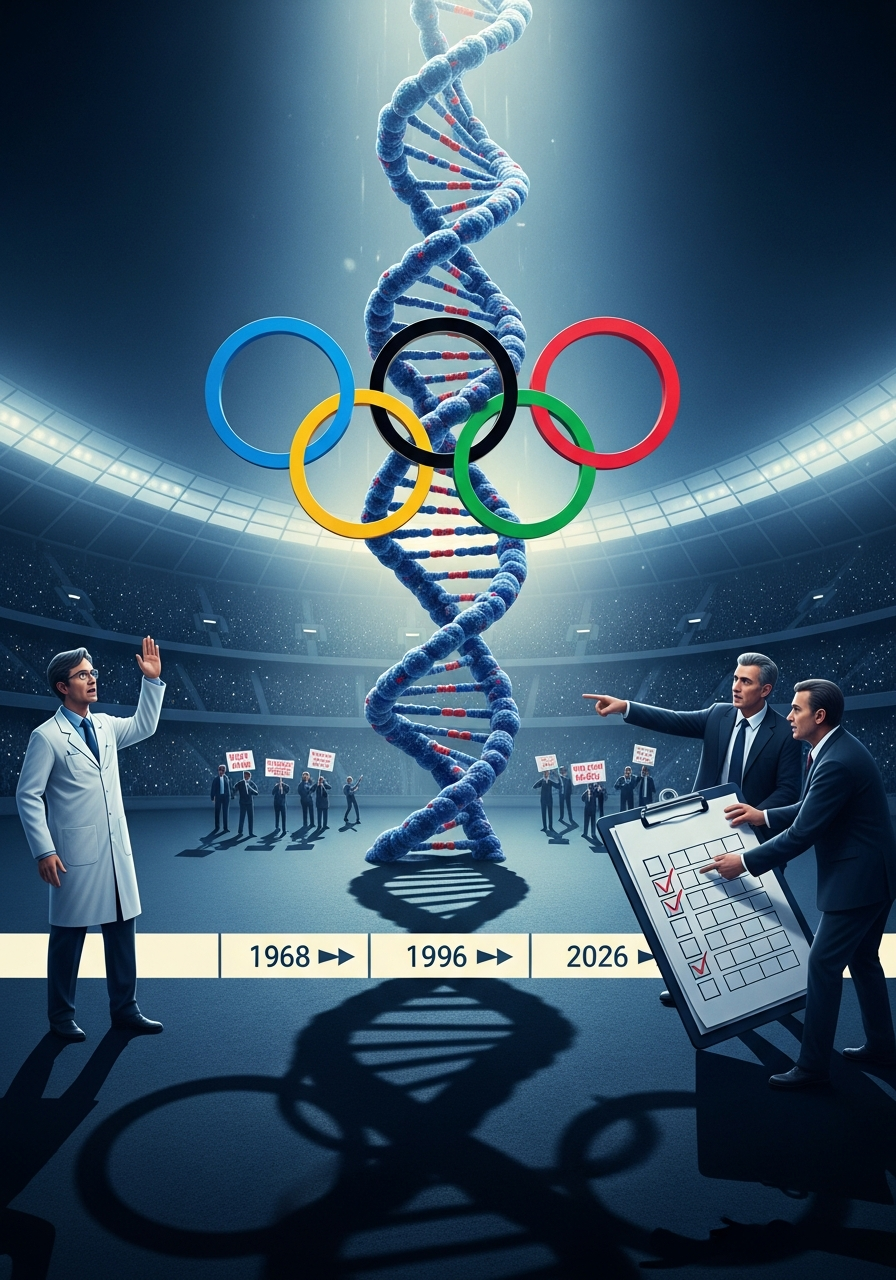
Olympic sex testing was introduced at the 1968 Mexico City Games, subjecting female athletes to humiliating physical examinations. It transitioned to genetic testing in 1996 but was abandoned after Sydney 2000 due to overwhelming scientific criticism and human rights concerns. Now, in 2026, the IOC has reintroduced the same SRY gene test after a 26-year hiatus.
This decision was made under the leadership of Kirsty Coventry, the first female president in the IOC's 132-year history, and it carries the symbolism of "a woman protecting the women's category." But an academic paper published on idrottsforum.org has labeled this move a "regression, not progress." When the scientific limitations of a tool have already been thoroughly demonstrated, reintroducing it suggests the decision was driven not by new evidence but by political motivation.
Semenya's Class-Action Lawsuit and the Dawn of an International Legal War
Two-time Olympic 800m champion Caster Semenya has declared the IOC's new policy "a stigma, not science" and has formally announced a class-action lawsuit. She has called on fellow Olympians to "come together as one," and India's Dutee Chand has publicly pushed back as well, saying that "my fight from a decade ago now feels wasted." Semenya also revealed that the IOC only notified athletes on the very day the policy was published: "They sent us a letter the day they were going to publish [the policy]."
The legal landscape is already tilting against the IOC. The European Court of Human Rights (ECHR) ruled in the 2023 Semenya v. Switzerland case that Switzerland had violated human rights, setting a precedent. The UN Human Rights Council's February 2026 declaration that forced genetic testing constitutes a human rights violation could serve as a powerful weapon in court. The outcome of this legal battle will send shockwaves far beyond the IOC, creating a domino effect across FIFA, FIBA, and every international sports governing body's gender policy.
Positive & Negative Analysis
Positive Aspects
- Elevating Women's Sports Fairness to the Global Agenda
The IOC's decision, controversial as its methodology may be, has propelled the issue of protecting competitive fairness in women's sports to the forefront of the global sports agenda. For too long, the question of a level playing field for female athletes was not taken seriously enough, often sidelined in favor of more commercially prominent debates. Now, it commands worldwide attention — media outlets on every continent have dedicated sustained coverage to the question of what fairness in women's sport actually means. This could serve as the driving force behind developing more sophisticated and scientifically rigorous eligibility criteria in the future. International sports bodies from FIFA to FIBA have been prompted to re-examine their own gender policies in response, and increased investment in sports science research targeting this specific question can be expected.
- Procedural Improvement Through a One-Time, Non-Invasive Test
Compared to earlier sex testing regimes that were repeated at every competition and inflicted severe humiliation on athletes, the IOC has adopted a once-in-a-lifetime saliva or oral swab method. This is procedurally less invasive and eliminates the repeated psychological trauma that athletes like Maria Jose Martinez-Patino endured when forced to undergo testing at every major event. The policy is also not retroactive — it takes effect starting with LA 2028, which provides currently active athletes with a transition period to understand its implications. Additionally, a limited medical exemption pathway exists for positive-testing athletes to present evidence of conditions like complete androgen insensitivity. While the test itself remains deeply problematic, the procedural framework represents a meaningful step forward from the degrading physical examinations that characterized the 1968-1996 era.
- Potential Catalyst for Sports Science Research Investment
Scientific data on the athletic performance of transgender and intersex athletes is critically lacking at present — the number of rigorous, peer-reviewed studies can be counted on one hand. The controversy sparked by the IOC's decision has the tangible effect of drawing both academic interest and research funding to this neglected field. Within a few years, this could lead to the development of far more sophisticated multi-biomarker assessment systems that surpass the crude binary of an SRY gene test. The European Society of Human Genetics (ESHG) has already called for clinical geneticists to be included in policy-making working groups, which could help bridge the gap between sports governance and actual science. Ultimately, the debate, while painful for those caught in its crossfire, may accelerate the very research needed to resolve these questions properly.
- Symbolic Leadership from the First Female IOC President
The fact that Kirsty Coventry — the first female president in the IOC's 132-year history — has made women's category protection her top priority carries significant symbolic weight. As a former Olympic swimmer who competed at four Games and won seven medals, her perspective is grounded in firsthand understanding of what female athletes experience. This represents a genuine shift that would have been difficult to expect under previous male-led administrations, where women's sports issues were often afterthoughts. Regardless of whether one agrees with the specific policy, the elevation of women's sports protection to a core IOC priority — championed by a woman who lived it — deserves recognition as a meaningful institutional development.
Concerns
- A Severe Lack of Scientific Foundation
Andrew Sinclair, the very scientist who discovered the SRY gene, has publicly stated that using this test for sex determination is wrong — a remarkably damning verdict from the person who knows this gene better than anyone alive. The 1996 Atlanta Olympics already demonstrated its flaws when all 8 positive results turned out to be misidentifications. The gene's presence alone cannot determine whether it functions, whether testosterone is produced, or how the body responds to hormones — and this reflects a broad scientific consensus that the IOC has chosen to ignore. The European Society of Human Genetics has officially called SRY testing "a proxy and not definitive." As Sinclair has warned, defining biological sex by a single chromosome is a dangerous oversimplification that discards everything we know about hormones, reproductive anatomy, and secondary sex characteristics.
- De Facto Discrimination Against Intersex Women
In the entire history of Olympic sex testing, not a single "man disguised as a woman" has ever been discovered — the very premise the IOC uses to justify the policy has zero historical evidence behind it. Every athlete ever flagged was an intersex woman. Athletes with androgen insensitivity syndrome carry a Y chromosome but are completely unresponsive to male hormones, meaning they have zero competitive advantage, yet they would be excluded under this policy. Women from developing nations are particularly vulnerable to the social stigma and discrimination that follow genetic test results — as Polish sprinter Ewa Klobukowska learned in 1967 when her medals were stripped, despite having typical female anatomy and later giving birth. Semenya's decade-long ordeal illustrates this reality in vivid, personal terms, showing how the test functions as a mechanism of harm against the very women it claims to protect.
- Legal Risk and Potential Damage to the Olympic Brand
Semenya has announced a class-action lawsuit, and the ECHR has already recognized human rights violations in a similar case in 2023. The UN Human Rights Council declared forced genetic testing a human rights violation in February 2026. If the IOC loses at CAS or the ECHR, European Olympic committees could find themselves legally unable to enforce the test on their own athletes, fracturing universal application. Once the policy cannot be applied consistently, its legitimacy collapses entirely, and the IOC's authority and the Olympics' status as a globally unified institution suffer serious damage.
- Compromised Political Independence and a Betrayal of the Olympic Spirit
The timing — a Trump executive order directing Secretary Rubio to pressure the IOC, followed by the IOC's policy announcement, followed by White House spokesperson Karoline Leavitt claiming credit on social media — raises profound questions about the IOC's political independence. The Olympic Charter explicitly mandates political neutrality in sport, yet the appearance of capitulating to pressure from the government of the LA 2028 host nation undermines a core Olympic value. Semenya has directly called the policy "born from political pressure," and the circumstantial evidence supports her assessment. Worse, it sets a dangerous precedent suggesting that future host-nation governments can similarly exert political influence over IOC eligibility rules.
- Sponsorship Conflicts and Financial Risk from Brand Misalignment
Global Olympic sponsors like Nike and Coca-Cola have built their marketing identities around diversity and inclusion over the past decade, investing billions in campaigns that celebrate exactly the kind of athlete this policy targets. The IOC's new policy creates a direct and visible conflict with these carefully cultivated brand values, placing corporate communications teams in an impossible position. Friction is anticipated as sponsorship renegotiations begin in the second half of 2026, with some sponsors likely seeking contractual language that distances them from the policy. Calls for Olympic boycotts from LGBTQ+ organizations could create dual pressure on sponsor companies from both sides of the debate, escalating what began as a sports policy dispute into a multi-billion-dollar business risk that threatens the financial foundation of the Games themselves.
Outlook
Let me start with what is likely to happen in the next few months. Caster Semenya's class-action lawsuit will almost certainly be officially filed within the second half of 2026. She has already publicly called on athletes to "come together as one," and influential figures like Dutee Chand have signaled their willingness to join. The Court of Arbitration for Sport (CAS) will serve as the first battleground, and Semenya brings extensive experience from that arena. Although she lost the 2019 case against World Athletics, one of the three arbitrators explicitly stated in a dissenting opinion that "this regulation is discriminatory." This time around, the UN Human Rights Council's February 2026 statement could prove to be a game-changing legal weapon. When a human rights body has clearly declared that "forced genetic testing violates human rights," there is real room for CAS to reach a different conclusion than it did before.
Significant friction is also expected throughout the LA 2028 preparation process. LGBTQ+ organizations in the United States are already pushing back forcefully against the IOC policy, and Olympic sponsors face the excruciating task of not alienating either side of this debate. Global sponsors like Nike and Coca-Cola have championed diversity and inclusion as core brand values for years, and they will now have to grapple with the contradiction between the IOC's new policy and their own carefully cultivated brand identities. As sponsorship renegotiations kick off in the second half of 2026, this issue has the potential to escalate from a sports policy dispute into a multi-billion-dollar business concern that reverberates through boardrooms worldwide.
Looking at the medium-term window of one to two years, the outcomes of legal battles will be the decisive factor in determining the direction of sports policy globally. The European Court of Human Rights (ECHR) already recognized a human rights violation by the Swiss government in its 2023 Chamber ruling on a Semenya-related case, voting 4-3 that Articles 14 and 8 had been violated. The 2025 Grand Chamber final ruling then found a 15-2 violation of Article 6 (the right to a fair trial), though it declined jurisdiction on Articles 8 and 14. Critically, four dissenting judges issued a powerful opinion — Judge Simackova pointed out that Semenya faces intersectional discrimination as "a woman, Black, and from the Global South." If the current SRY gene testing policy reaches the ECHR, European Olympic committees could find themselves legally unable to enforce the test on their athletes. That would create a head-on collision between IOC policy and European human rights law, trapping the IOC in a dilemma: either modify the policy or carve out exemptions for European athletes. And once universal application breaks down, the policy's legitimacy crumbles with it.
The trajectory of World Athletics also deserves close attention. Even before the IOC's announcement, World Athletics had already introduced mandatory SRY gene testing, drawing fierce pushback from the scientific community. An academic paper published on idrottsforum.org branded the decision a "regression, not progress," and Professor Sinclair from the Murdoch Children's Research Institute issued an open letter in opposition. As these scientific criticisms continue to pile up, there is a realistic possibility that the IOC will modify the policy within 18 to 24 months, framing the revision as a "scientific advisory committee review." The most likely outcome would not be a complete abandonment of SRY testing, but rather the introduction of supplementary evaluation procedures following a positive result — testosterone level assessments, androgen sensitivity testing, and individualized medical review panels.
The International Commission of Jurists (ICJ) published a joint statement in March 2026 arguing that genetic sex testing in sport conflicts with (1) the IOC's own existing guidelines, (2) domestic and international human rights law, and (3) regulations governing genetic testing and the use of genetic information. The European Society of Human Genetics (ESHG) issued an official statement calling the SRY test "a proxy and not definitive," recommending that exceptions should be considered for both XY individuals with more feminine phenotypes and XX individuals with more masculine phenotypes. These institutional voices carry enormous weight in legal proceedings and regulatory discussions, and they are uniformly skeptical of the IOC's approach.
In the long term — three to five years out — the gender binary in sports itself will face fundamental challenges. The current Olympic framework divides competitions into male and female categories, but the scientific consensus that biological sex is not strictly binary continues to strengthen. Intersex conditions occur in approximately 1.7 percent of the population, which is about the same prevalence as red hair. By the 2030s, alternative frameworks — such as "hormone-profile-based categories" or "physical-advantage-based classifications" analogous to weight classes in boxing or wrestling — will be seriously discussed at least within academic and policy circles. Actual implementation would take considerably longer, but the IOC controversy will serve as the catalyst that launches these conversations into the mainstream.
Let me walk through three scenarios. The most optimistic case — call it the bull case — involves Semenya winning at CAS or the ECHR, which forces the IOC to abandon standalone SRY testing before 2028 and transition to a more sophisticated multi-biomarker system. In this scenario, LA 2028 gets remembered as a "triumph of sports science" — the Games where evidence defeated ideology. I put the probability of this scenario at roughly 25 percent.
The base case — and the most likely path — involves the IOC maintaining SRY testing while legal proceedings grind forward, but announcing a modified policy sometime in 2027 that bolsters the post-positive-result evaluation process. Think of it as the IOC trying to have it both ways: keeping the test in name while softening its impact enough to survive legal challenges. Additional medical evaluation for athletes who test positive, including testosterone level assessments, androgen sensitivity panels, and individualized review by an expert medical committee, would be added. This is precisely what the ESHG has recommended — that unexpected results should trigger supportive medical and psychological pathways rather than automatic disqualification. The probability here sits at approximately 50 percent.
The bear case — the most pessimistic scenario — involves sustained pressure from the Trump administration, with the IOC prioritizing its relationship with the US government as the LA 2028 host nation and the billions in hosting revenue at stake. Under this scenario, the policy is rigidly enforced, multiple intersex athletes from developing nations are disqualified in the months leading up to the Games, and a coalition of nations declares an Olympic boycott in solidarity. Athletes like Semenya become symbols of institutional injustice in a way that transcends sport. If the bear case materializes, LA 2028 would become the most controversial Games in Olympic history, potentially rivaling the political boycotts of Moscow 1980 and Los Angeles 1984. The probability is roughly 25 percent, but the consequences would be devastating and long-lasting.
There is one additional cascading effect that cannot be ignored. The IOC's decision creates a domino effect across every other international sports governing body. If FIFA, FIBA, the ITF, and others follow the IOC's lead and adopt similar policies, women's sports worldwide will regress to an era of genetic testing — a return to practices that were abandoned precisely because they did not work. Conversely, if the IOC reverses course after a legal defeat, every organization that copied the policy will have to retreat as well. The IOC is not just one sports body among many; it sits at the apex of global sports governance. That means this policy's ripple effects extend far beyond the Olympic arena. Whether this policy survives in some form by the time the LA 2028 opening ceremony takes place, or whether it has already been consigned to the dustbin of history, depends entirely on the legal and political battles of the next two years.
The secondary and tertiary effects on related industries are also substantial. The genetic testing industry has gained a new market in sports, but the very public debate about the test's limitations could simultaneously raise trust issues for genetic testing across all its applications — from healthcare to ancestry to forensics. Sports broadcasters will need to develop new editorial guidelines for handling controversies about athletes' genetic eligibility during live competition coverage, a situation for which there is no modern precedent. And perhaps most consequentially, this controversy will shape sports-related legislation in countries around the world. Multiple US states have already passed laws targeting transgender athletes, and the IOC's decision effectively provides international legitimacy to that domestic legislation. If the IOC policy is later invalidated by courts, the legal foundation supporting those state-level laws weakens in turn.
There is also a deeply personal dimension to this story that policy discussions tend to flatten into abstraction. Maria Jose Martinez-Patino, the Spanish hurdler who was flagged in 1985, described the experience in her own words: "I lost my friends, my fiance, my hopes." Ewa Klobukowska, the Polish sprinter stripped of her medals in 1967, had her medals taken despite having typical female reproductive anatomy — she later gave birth, proving conclusively that the test that destroyed her career was wrong. These are not hypothetical harms. They are documented, lived realities of what happens when blunt genetic instruments are applied to the infinitely complex reality of human biology. The athletes who will be caught by the revived SRY test will overwhelmingly be women from countries with fewer resources to challenge the results — women from Africa, South Asia, and South America who lack the legal and financial infrastructure to fight back the way Semenya has.
The IOC conducted an 18-month policy review from September 2024 to March 2026, convening a working group of experts from five continents spanning sports science, endocrinology, transgender medicine, ethics, and law. This is not nothing — it represents a genuine institutional effort to ground the policy in expertise. But the question is whether the working group's conclusions were genuinely independent or whether the political endpoint was predetermined. Coventry's insistence that this was her priority "way before President Trump came into his second term" may be true, but it does not address the more uncomfortable question of whether the IOC's definition of "science-based" was shaped by the political environment in which the review took place.
The numbers tell a stark story. At the 1996 Atlanta Olympics, 8 out of 3,387 athletes tested positive — and all 8 were intersex women with no competitive advantage. At the 1992 Barcelona Olympics, 12 tested positive: 1 false positive, 6 cases of incorrect gene identification, and 5 with DSD conditions. In 126 years of Olympic history, exactly one transgender woman — Laurel Hubbard — has ever competed, and she did not medal. Transgender athletes represent fewer than 10 out of 510,000 NCAA athletes, a rate of 0.002 percent. These are the numbers that supposedly justify reviving a test that has already been tried, found wanting, and discarded.
The International Commission of Jurists (ICJ) and multiple legal scholars have pointed out that this policy may violate the Council of Europe's Convention on Human Rights and Biomedicine, which restricts genetic testing to health-related purposes with informed consent. The Bioethics Convention explicitly states that genetic tests should not be performed for non-health purposes, and sport eligibility screening falls squarely outside that boundary. If this legal argument gains traction in European courts, the entire enforcement architecture of the IOC policy could be invalidated for athletes under European jurisdiction — which includes a substantial portion of Olympic competitors.
The question every sports fan, policymaker, and athlete should be asking is deceptively simple: if this test failed in the 1990s with these exact results, what has changed that would make it succeed now? The science has not changed — if anything, our understanding of sex biology has grown more nuanced, not less, making a binary test even more inappropriate than it was 30 years ago. The athletic landscape has not changed — the supposed epidemic of men infiltrating women's sports remains a phantom with zero documented cases. What has changed is the political climate, and that may be the most damning indictment of all. A policy that cannot justify itself on scientific or practical grounds but aligns perfectly with the political demands of the moment is not science — it is politics wearing a lab coat.
Sources / References
- The Olympic committee bans trans athletes from women's events, raising many questions — NPR
- Sex test used in IOC's new transgender ban more likely to exclude intersex women — The Conversation
- World Athletics' mandatory genetic test for women athletes is misguided — I discovered the relevant gene in 1990 — The Conversation (Andrew Sinclair)
- Caster Semenya pledges to fight against Olympic gender-testing policy — Al Jazeera
- White House applauds ban on transgender women in women's Olympic events — Washington Post
- My fight a decade ago now feels wasted: Dutee Chand — The Bridge
- IOC announces new Policy on the Protection of the Female (Women's) Category in Olympic Sport — IOC Official
- UN Experts Rebut Olympics Sex Testing Plan — Human Rights Watch
- Joint Statement from Legal Experts on Genetic Sex Testing in Sport — International Commission of Jurists
- The Olympics' transgender athlete ban is a legal and moral minefield — The Conversation
- White House Celebrates Pressuring Olympics Into Banning Trans Women — The New Republic
- Regression, Not Progress: A Response to World Athletics' Return to Sex Testing — idrottsforum.org
- Semenya v. Switzerland: Grand Chamber of the European Court of Human Rights Judgment — OII Europe
- ECtHR Grand Chamber Ruling in Semenya v. Switzerland: Joint Statement of Third-Party Interveners — International Commission of Jurists
- Transgender women athletes banned from Olympics by new IOC policy on female eligibility — CNN